

On June 25, 2026, Front Office Sports published a Microsoft-presented explainer showing how the Premier League uses Azure, Microsoft Foundry, Copilot, live match telemetry, and decades of historical records to turn match data into real-time fan, club, and broadcast intelligence. The pitch is not simply that football has become more quantified. It is that the league’s next competitive frontier is the infrastructure between the event and the audience. Microsoft is using the Premier League to make a broader argument: modern AI is most persuasive when it disappears into the experience.
The old cliché says football is a game of two halves. The modern Premier League is also a distributed computing problem with stoppage-time latency requirements, global traffic spikes, rights-holder dependencies, mobile-app expectations, and a fan base that does not politely wait for a data warehouse to refresh.
That is the real significance of the Front Office Sports segment. The video frames a match as a river of events: player tracking, possession changes, sprint speeds, substitutions, tactical sequences, fan interactions, and contextual records accumulated over decades. On their own, those signals are just exhaust. The business question is whether a league can convert them into something useful while the fan is still watching.
That is where Microsoft wants Azure to sit: not as an invisible utility in the basement, but as the operating layer for live sport. The Premier League is being presented as both showcase and proof point, because few sporting products create the same combination of global concurrency, emotional intensity, and data appetite. A mid-table match can still draw worldwide attention, and a single controversial moment can create a demand spike faster than most enterprise systems ever see.
For WindowsForum readers, the interesting part is not that a cloud platform can scale. That is table stakes. The interesting part is how Microsoft is positioning real-time reasoning as the next layer above real-time data.
The Premier League Companion described in the Microsoft-presented explainer suggests a different model. Instead of forcing fans to interpret tables or navigate structured menus, the system is framed as a conversational layer that can answer natural-language questions by combining live match context with historical data. That turns the interface from a dashboard into something closer to an analyst at your elbow.
This is the subtle but important distinction between retrieval and reasoning. Retrieval gives you the answer to “Who has the most goals?” Reasoning tries to handle “Has this team changed its attacking pattern since the substitution?” or “When was the last time this fixture produced a comeback from this scoreline?” The user is not asking for a database row; the user is asking the system to understand intent, context, and relevance.
That is why Microsoft’s references to Copilot and Foundry matter. The marketing language can be slippery, but the architectural ambition is clear enough: assemble data sources, models, governance, prompts, and application logic into a production-grade AI system. The Premier League becomes a consumer-friendly example of what Microsoft would like every business buyer to imagine for their own operations.
But the more difficult problem is trust. Live sport is full of ambiguity, and football in particular resists the clean certainties of a spreadsheet. A player may appear to be out of position because of a tactical instruction, a broken press, a transition moment, or a camera angle. A data system can count a sprint; it cannot automatically know whether that sprint mattered.
This is where AI sports products face the same problem as enterprise copilots. They must be fast enough to feel magical, but constrained enough not to fabricate confidence. A wrong answer in a consumer app is embarrassing. A wrong answer amplified by broadcasters, clubs, sponsors, or betting-adjacent ecosystems can become reputationally expensive.
Microsoft’s language around trust and accuracy, especially at the scale of a fan base claimed at 1.9 billion, is therefore not decorative. It is the central challenge. The bigger the audience, the less tolerance there is for a system that confuses similar players, mishandles historical records, or invents context during a live match.
For years, that history has been useful mainly to commentators, producers, statisticians, and obsessive fans. AI changes the access pattern. If a system can safely connect live telemetry to historical context, a supporter no longer needs to know the right database field, season, player spelling, or stat provider taxonomy. The question can be messy because the system is supposed to clean it up.
That is the promise behind the Premier League Companion. It is not merely a search box wearing a conversational mask. Its value depends on whether it can infer what the fan is really asking and then ground the answer in current and historical information. The difference between a gimmick and a product will be whether the answer feels like insight rather than autocomplete.
There is also a commercial logic here. The Premier League already sells a global media product. If AI can personalize the narrative around a match, the league can make the same 90 minutes feel different to a fantasy player, a casual viewer, a local supporter, a tactical obsessive, and a broadcaster preparing a halftime package.
A stoppage-time winner, a red card, a VAR controversy, or a title-deciding result can turn ordinary fan interest into a global surge. Infrastructure has to absorb that without turning the experience into a queue. It also has to do so while ingesting live feeds, serving apps, supporting broadcast workflows, and potentially running AI inference against a changing state of play.
That is a familiar pattern to any sysadmin who has watched a planned event become an unplanned incident. The Premier League version is glossier, but the underlying concerns are the same: ingestion pipelines, caching, identity, API durability, observability, model latency, cost controls, failover design, and graceful degradation.
The point Microsoft is making is that the architecture built for a sports league is not fundamentally exotic. Retailers have launch-day spikes. Banks have market shocks. Logistics firms have weather events. Media companies have viral traffic. The Premier League is simply a more glamorous way to explain why the same cloud-and-AI stack has to work when everyone shows up at once.
That is strategically important. If Copilot remains synonymous with drafting emails and summarizing meetings, it is useful but bounded. If Copilot becomes the way organizations build natural-language experiences over proprietary data, it becomes more like middleware for the AI era.
This is why the Premier League Companion matters beyond football. It is a template: take a domain with complex data, encode business rules and context, expose it through natural language, and present the result as a branded experience. The end user sees the Premier League. The enterprise buyer sees a pattern that could apply to customer service, field operations, finance, healthcare administration, or retail.
The risk is that “Copilot” becomes too elastic a brand. Microsoft now uses the term across products that behave differently, rely on different data sources, and carry different operational responsibilities. For technical audiences, the question is always what sits underneath: which models, which data stores, which permissions, which safeguards, which logs, and which human controls.
Foundry, in Microsoft’s telling, is part of the answer to a problem enterprises keep discovering: a chatbot demo is easy; a governed, domain-specific, monitored, cost-aware AI application is not. The Premier League is a useful example because the data is specialized, the audience is massive, and the tolerance for hallucination is low.
The implied stack is familiar to modern Azure shops. Data must be ingested, normalized, secured, indexed, and made available to applications. Models need grounding and evaluation. Prompts and orchestration need versioning. Outputs need guardrails. Latency and cost need monitoring. The hard part is not asking an AI model a question; it is building the machinery that lets the answer survive contact with production.
That is why the football example is sharper than another generic “AI transforms business” slogan. In sport, the gap between a plausible answer and a correct answer is visible to millions of people. If the system misreads the score, the substitution, or the relevant historical comparison, fans will notice immediately. That makes it a more demanding benchmark than a sanitized conference demo.
But fan engagement is also the Trojan horse for a much larger transformation. Once a league can process and reason over live data at scale, the same infrastructure can support club analysts, commentators, editors, sponsors, fantasy products, accessibility features, and multilingual experiences. The fan app is the visible tip of a broader data platform.
There is a line to walk here. The best sports technology deepens attention; the worst turns the match into a casino of micro-events and push notifications. If every action is immediately converted into a stat, probability, prediction, or monetizable prompt, the sport risks becoming subordinate to its instrumentation.
The Premier League has an advantage because its global audience already consumes the game through layers of commentary, fantasy football, highlights, clips, and social discussion. AI does not create that second screen; it accelerates it. The strategic question is whether the league can use AI to enrich the game rather than fragment it.
A commentator can use a well-timed historical comparison to make a moment feel larger. A halftime producer can turn a tactical pattern into a segment. A social team can clip and contextualize a stat while the conversation is still hot. If AI can surface those angles quickly and reliably, it becomes a newsroom assistant for live sport.
That has implications for staffing and skill. The value of human experts will not disappear; if anything, the best analysts become more important because they can judge which machine-generated insight is worth airing. But production teams that learn to work with AI systems will move faster than those that treat data as a post-match artifact.
The danger is homogenization. If every broadcaster, app, and social feed draws from the same AI-assisted insight engine, coverage can start to sound algorithmically flattened. The best use of the technology will be as a starting point for editorial judgment, not a replacement for it.
AI systems also introduce a new kind of error. Traditional stat feeds can be wrong, but their failure modes are usually bounded. A generative system can produce a sentence that sounds authoritative while blending correct and incorrect context. That is much harder for users to detect in real time.
The sensible approach is layered. Live numerical facts should come from authoritative feeds. Historical claims should be grounded in verified records. Interpretive answers should be hedged when the evidence is incomplete. The system should know when not to answer, and it should be designed so that uncertainty is visible rather than hidden behind fluent prose.
For Microsoft, this is the enterprise lesson hiding inside the sports story. Businesses do not need AI that is charming in demos and reckless in production. They need systems that can separate known facts, calculated metrics, model inference, and speculation. Football just makes that distinction easier to see.
The Premier League and Microsoft can reasonably argue that aggregated match telemetry and historical records are core to the product. Still, the more personalized the experience becomes, the more important it is to define what data is collected, how long it is retained, who can access it, and whether it is used for advertising, recommendations, betting-adjacent products, or profiling.
This is not a reason to reject the technology. It is a reason to treat governance as part of the product rather than paperwork after launch. Fans may enjoy personalized insight, but they should not have to wonder whether every question they ask the Companion becomes another durable behavioral signal.
Enterprise IT will recognize the pattern. The excitement around AI often begins with capability and only later catches up with data boundaries. The organizations that avoid trouble will be the ones that make those boundaries boring, explicit, and enforceable from the beginning.
That combination is powerful because it turns abstract enterprise architecture into a consumer story. Nobody outside IT wants to hear about ingestion pipelines, semantic indexes, orchestration, inference latency, or observability. Many people understand the desire to ask, during a live match, whether a player’s performance is unusual or whether a comeback has historical precedent.
The danger for technical readers is to dismiss the whole thing as sports marketing. It is marketing, certainly. But good marketing often reveals product strategy before product documentation does. Microsoft wants every organization to believe it has Premier League-like data trapped inside its systems, waiting for an AI interface to make it useful.
That does not mean every business needs a Copilot-shaped experience. Some need better data hygiene first. Some need simpler analytics. Some need to fix identity, permissions, or cost controls before adding generative AI. The Premier League example is aspirational, not automatically transferable.
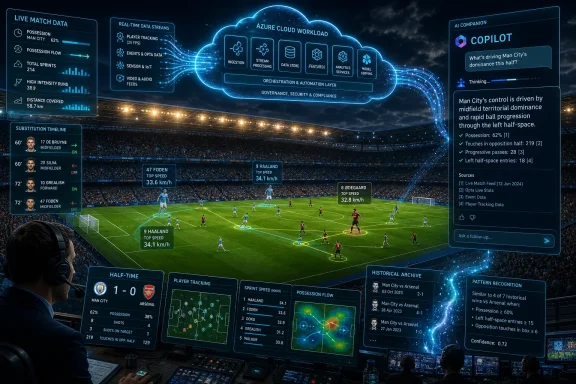 The Match Is Now a Cloud Workload
The old cliché says football is a game of two halves. The modern Premier League is also a distributed computing problem with stoppage-time latency requirements, global traffic spikes, rights-holder dependencies, mobile-app expectations, and a fan base that does not politely wait for a data warehouse to refresh.That is the real significance of the Front Office Sports segment. The video frames a match as a river of events: player tracking, possession changes, sprint speeds, substitutions, tactical sequences, fan interactions, and contextual records accumulated over decades. On their own, those signals are just exhaust. The business question is whether a league can convert them into something useful while the fan is still watching.
That is where Microsoft wants Azure to sit: not as an invisible utility in the basement, but as the operating layer for live sport. The Premier League is being presented as both showcase and proof point, because few sporting products create the same combination of global concurrency, emotional intensity, and data appetite. A mid-table match can still draw worldwide attention, and a single controversial moment can create a demand spike faster than most enterprise systems ever see.
For WindowsForum readers, the interesting part is not that a cloud platform can scale. That is table stakes. The interesting part is how Microsoft is positioning real-time reasoning as the next layer above real-time data.
Microsoft’s Sports Pitch Has Moved Beyond Dashboards
For years, sports analytics lived in a split-screen world. Clubs used data to scout, train, and optimize performance, while broadcasters used graphics to make viewers feel better informed. Fans got heat maps, pass networks, xG models, and player speeds, usually as packaged visuals after the fact.The Premier League Companion described in the Microsoft-presented explainer suggests a different model. Instead of forcing fans to interpret tables or navigate structured menus, the system is framed as a conversational layer that can answer natural-language questions by combining live match context with historical data. That turns the interface from a dashboard into something closer to an analyst at your elbow.
This is the subtle but important distinction between retrieval and reasoning. Retrieval gives you the answer to “Who has the most goals?” Reasoning tries to handle “Has this team changed its attacking pattern since the substitution?” or “When was the last time this fixture produced a comeback from this scoreline?” The user is not asking for a database row; the user is asking the system to understand intent, context, and relevance.
That is why Microsoft’s references to Copilot and Foundry matter. The marketing language can be slippery, but the architectural ambition is clear enough: assemble data sources, models, governance, prompts, and application logic into a production-grade AI system. The Premier League becomes a consumer-friendly example of what Microsoft would like every business buyer to imagine for their own operations.
The Real-Time Problem Is Not Just Speed
Speed is the easy part to sell. Everyone understands why a live match cannot wait. If a fan asks a question during a counterattack, the answer that arrives after the final whistle is not insight; it is trivia.But the more difficult problem is trust. Live sport is full of ambiguity, and football in particular resists the clean certainties of a spreadsheet. A player may appear to be out of position because of a tactical instruction, a broken press, a transition moment, or a camera angle. A data system can count a sprint; it cannot automatically know whether that sprint mattered.
This is where AI sports products face the same problem as enterprise copilots. They must be fast enough to feel magical, but constrained enough not to fabricate confidence. A wrong answer in a consumer app is embarrassing. A wrong answer amplified by broadcasters, clubs, sponsors, or betting-adjacent ecosystems can become reputationally expensive.
Microsoft’s language around trust and accuracy, especially at the scale of a fan base claimed at 1.9 billion, is therefore not decorative. It is the central challenge. The bigger the audience, the less tolerance there is for a system that confuses similar players, mishandles historical records, or invents context during a live match.
Decades of History Become Useful Only When They Are Queryable
The Premier League’s archive is a valuable asset because football is a memory sport. Fans do not watch only the present; they watch the present in conversation with everything that came before. A derby goal means more because of the last derby. A title-race collapse means more because of old collapses. A young player’s breakout invites comparison with every teenager who came before him.For years, that history has been useful mainly to commentators, producers, statisticians, and obsessive fans. AI changes the access pattern. If a system can safely connect live telemetry to historical context, a supporter no longer needs to know the right database field, season, player spelling, or stat provider taxonomy. The question can be messy because the system is supposed to clean it up.
That is the promise behind the Premier League Companion. It is not merely a search box wearing a conversational mask. Its value depends on whether it can infer what the fan is really asking and then ground the answer in current and historical information. The difference between a gimmick and a product will be whether the answer feels like insight rather than autocomplete.
There is also a commercial logic here. The Premier League already sells a global media product. If AI can personalize the narrative around a match, the league can make the same 90 minutes feel different to a fantasy player, a casual viewer, a local supporter, a tactical obsessive, and a broadcaster preparing a halftime package.
Azure Gets the Matchday Spike Microsoft Loves to Talk About
Cloud vendors love spike stories because they dramatize elasticity. A matchday spike is especially useful because it is predictable and unpredictable at the same time. The fixture list tells you when traffic may arrive, but the match tells you whether traffic will explode.A stoppage-time winner, a red card, a VAR controversy, or a title-deciding result can turn ordinary fan interest into a global surge. Infrastructure has to absorb that without turning the experience into a queue. It also has to do so while ingesting live feeds, serving apps, supporting broadcast workflows, and potentially running AI inference against a changing state of play.
That is a familiar pattern to any sysadmin who has watched a planned event become an unplanned incident. The Premier League version is glossier, but the underlying concerns are the same: ingestion pipelines, caching, identity, API durability, observability, model latency, cost controls, failover design, and graceful degradation.
The point Microsoft is making is that the architecture built for a sports league is not fundamentally exotic. Retailers have launch-day spikes. Banks have market shocks. Logistics firms have weather events. Media companies have viral traffic. The Premier League is simply a more glamorous way to explain why the same cloud-and-AI stack has to work when everyone shows up at once.
Copilot Is Becoming an Experience Layer, Not Just an Office Feature
Microsoft has spent the last several years pushing Copilot across Windows, Microsoft 365, GitHub, security, business apps, and Azure. The Premier League example widens the frame. Copilot is not being positioned only as a productivity assistant; it is being positioned as a reasoning layer that can sit inside another brand’s product.That is strategically important. If Copilot remains synonymous with drafting emails and summarizing meetings, it is useful but bounded. If Copilot becomes the way organizations build natural-language experiences over proprietary data, it becomes more like middleware for the AI era.
This is why the Premier League Companion matters beyond football. It is a template: take a domain with complex data, encode business rules and context, expose it through natural language, and present the result as a branded experience. The end user sees the Premier League. The enterprise buyer sees a pattern that could apply to customer service, field operations, finance, healthcare administration, or retail.
The risk is that “Copilot” becomes too elastic a brand. Microsoft now uses the term across products that behave differently, rely on different data sources, and carry different operational responsibilities. For technical audiences, the question is always what sits underneath: which models, which data stores, which permissions, which safeguards, which logs, and which human controls.
Microsoft Foundry Is the Quiet Enterprise Message
The FOS description references Microsoft Foundry processing live match data and historical records in real time. That wording matters because Microsoft’s AI strategy is not just about selling finished copilots. It is also about selling the factory floor where organizations build their own.Foundry, in Microsoft’s telling, is part of the answer to a problem enterprises keep discovering: a chatbot demo is easy; a governed, domain-specific, monitored, cost-aware AI application is not. The Premier League is a useful example because the data is specialized, the audience is massive, and the tolerance for hallucination is low.
The implied stack is familiar to modern Azure shops. Data must be ingested, normalized, secured, indexed, and made available to applications. Models need grounding and evaluation. Prompts and orchestration need versioning. Outputs need guardrails. Latency and cost need monitoring. The hard part is not asking an AI model a question; it is building the machinery that lets the answer survive contact with production.
That is why the football example is sharper than another generic “AI transforms business” slogan. In sport, the gap between a plausible answer and a correct answer is visible to millions of people. If the system misreads the score, the substitution, or the relevant historical comparison, fans will notice immediately. That makes it a more demanding benchmark than a sanitized conference demo.
The Fan Experience Is the Trojan Horse
The Premier League’s public-facing AI story is about fans. That is sensible because fans are the emotional center of the product and the least abstract audience for the technology. “Ask the match a question” is easier to understand than “operationalize retrieval-augmented generation across streaming telemetry and long-term historical stores.”But fan engagement is also the Trojan horse for a much larger transformation. Once a league can process and reason over live data at scale, the same infrastructure can support club analysts, commentators, editors, sponsors, fantasy products, accessibility features, and multilingual experiences. The fan app is the visible tip of a broader data platform.
There is a line to walk here. The best sports technology deepens attention; the worst turns the match into a casino of micro-events and push notifications. If every action is immediately converted into a stat, probability, prediction, or monetizable prompt, the sport risks becoming subordinate to its instrumentation.
The Premier League has an advantage because its global audience already consumes the game through layers of commentary, fantasy football, highlights, clips, and social discussion. AI does not create that second screen; it accelerates it. The strategic question is whether the league can use AI to enrich the game rather than fragment it.
Broadcasters Will Feel This Before Clubs Do
Clubs already live in a data-rich world. Their analysts, scouts, coaches, and performance teams have access to specialized tools that go far beyond what fans see. The more immediate disruption may come in broadcast production, where speed and storytelling matter almost as much as the underlying number.A commentator can use a well-timed historical comparison to make a moment feel larger. A halftime producer can turn a tactical pattern into a segment. A social team can clip and contextualize a stat while the conversation is still hot. If AI can surface those angles quickly and reliably, it becomes a newsroom assistant for live sport.
That has implications for staffing and skill. The value of human experts will not disappear; if anything, the best analysts become more important because they can judge which machine-generated insight is worth airing. But production teams that learn to work with AI systems will move faster than those that treat data as a post-match artifact.
The danger is homogenization. If every broadcaster, app, and social feed draws from the same AI-assisted insight engine, coverage can start to sound algorithmically flattened. The best use of the technology will be as a starting point for editorial judgment, not a replacement for it.
Accuracy Is a Product Feature, Not a Compliance Checkbox
Microsoft’s trust message is not optional in this context. Sports data may not seem as consequential as medical or financial records, but live public errors have their own blast radius. Fans are unforgiving, clubs are protective, and broadcasters depend on credibility.AI systems also introduce a new kind of error. Traditional stat feeds can be wrong, but their failure modes are usually bounded. A generative system can produce a sentence that sounds authoritative while blending correct and incorrect context. That is much harder for users to detect in real time.
The sensible approach is layered. Live numerical facts should come from authoritative feeds. Historical claims should be grounded in verified records. Interpretive answers should be hedged when the evidence is incomplete. The system should know when not to answer, and it should be designed so that uncertainty is visible rather than hidden behind fluent prose.
For Microsoft, this is the enterprise lesson hiding inside the sports story. Businesses do not need AI that is charming in demos and reckless in production. They need systems that can separate known facts, calculated metrics, model inference, and speculation. Football just makes that distinction easier to see.
The Privacy Story Is Bigger Than the Pitch
The FOS explainer emphasizes match data and fan engagement, but any real system at this scale inevitably raises privacy and governance questions. Player tracking data is not the same as ordinary customer telemetry, and fan engagement data can quickly become sensitive when tied to accounts, location, viewing behavior, purchases, or personalization.The Premier League and Microsoft can reasonably argue that aggregated match telemetry and historical records are core to the product. Still, the more personalized the experience becomes, the more important it is to define what data is collected, how long it is retained, who can access it, and whether it is used for advertising, recommendations, betting-adjacent products, or profiling.
This is not a reason to reject the technology. It is a reason to treat governance as part of the product rather than paperwork after launch. Fans may enjoy personalized insight, but they should not have to wonder whether every question they ask the Companion becomes another durable behavioral signal.
Enterprise IT will recognize the pattern. The excitement around AI often begins with capability and only later catches up with data boundaries. The organizations that avoid trouble will be the ones that make those boundaries boring, explicit, and enforceable from the beginning.
WindowsForum Readers Should See the Stack, Not Just the Sizzle
For Microsoft watchers, the Premier League story is another chapter in the company’s larger cloud-and-AI convergence. Azure provides the infrastructure, Foundry provides the AI application-building layer, Copilot provides the interface metaphor, and the Premier League supplies a globally recognizable use case.That combination is powerful because it turns abstract enterprise architecture into a consumer story. Nobody outside IT wants to hear about ingestion pipelines, semantic indexes, orchestration, inference latency, or observability. Many people understand the desire to ask, during a live match, whether a player’s performance is unusual or whether a comeback has historical precedent.
The danger for technical readers is to dismiss the whole thing as sports marketing. It is marketing, certainly. But good marketing often reveals product strategy before product documentation does. Microsoft wants every organization to believe it has Premier League-like data trapped inside its systems, waiting for an AI interface to make it useful.
That does not mean every business needs a Copilot-shaped experience. Some need better data hygiene first. Some need simpler analytics. Some need to fix identity, permissions, or cost controls before adding generative AI. The Premier League example is aspirational, not automatically transferable.
The Premier League Example Shrinks the Distance Between Data and Narrative
The most concrete lesson from Microsoft’s Premier League showcase is that the value of data increases as the distance between signal and story shrinks. The fan does not care that a cloud service processed a million events. The fan cares that the match suddenly makes more sense.- A modern Premier League match is being framed as a real-time data platform, not merely a televised sporting event.
- Microsoft is using Azure, Foundry, and Copilot to argue that AI becomes useful when it can reason over live and historical data in context.
- The Premier League Companion represents a shift from static dashboards toward natural-language sports intelligence.
- Accuracy, grounding, and transparency will determine whether fans trust AI-generated match insights.
- The same architecture Microsoft is showcasing for football is being pitched as reusable for enterprises facing their own data spikes and decision bottlenecks.
- The strongest use cases will assist human analysts, broadcasters, and fans rather than replace editorial or sporting judgment.
References
- Primary source: Front Office Sports
Published: 2026-06-25T13:53:08.680520
How the Premier League Turns Data Into Decisions in Real Time
Derryl Barnes breaks down how Microsoft Azure powers the Premier League's real-time data infrastructure.frontofficesports.com
