
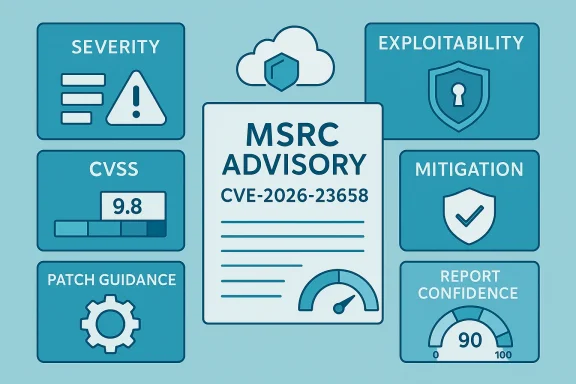
Microsoft’s report-confidence field on the MSRC page for CVE-2026-23658 is best read as a measure of how certain Microsoft is that the vulnerability really exists and how credible the technical details are. In practical terms, it is not saying “how severe” the bug is; it is saying how much trust defenders should place in the advisory’s underlying evidence. That distinction matters because a high-confidence finding usually means Microsoft has stronger validation, while a lower-confidence one suggests the issue may be real but not yet fully corroborated. The current public tracking for this issue indicates an Azure DevOps / msazure elevation-of-privilege problem, so the metric should be interpreted in the context of a likely privilege-escalation path rather than as a standalone risk score. l context
Microsoft’s Security Update Guide uses vulnerability entries to communicate several different things at once: the product affected, the vulnerability class, the remediation status, and in some cases a confidence-style signal about the quality of the reporting. The excerpt you supplied is not a description of the bug itself; it is Microsoft explaining the meaning of that confidence field. In other words, the page is telling readers how to interpret the metadata around the CVE, not giving a full exploit narrative. For defenders, that means the field is a signal about certainty and evidentiary strength, not a substitute for the rest of the advisory.
That is consistent increasingly framed cloud and service CVEs. In several recent advisories, Microsoft has used concise public descriptions while leaving out detailed root-cause information, especially when the service is cloud-hosted or when disclosure is still being staged. MSRC’s recent cloud-service disclosures emphasize transparency but also show that public CVE text may remain deliberately limited even after Microsoft has confirmed and fixed the issue. (msrc.microsoft.com)
For CVE-2026-23658, the available public snippet places the issue in the Azure DevOps family and classifies it as Elevation of Privilege (EoP). That classification already tells you the likely security consequence: an attacker who can trigger the bug may be able to gain permissions above their intended level, potentially moving from a constrained account or context into one with broader access. The confidence field, however, tells you something different: whether Microsoft hastand behind that claim with high certainty.
This is especially important in cloud and DevOps environments, where the difference between “possible” and “confirmed” can affect triage priority, patch urgency, and detection engineering. A privilege-escalation vulnerability in a build, release, or orchestration plane is often more operationally meaningful than the title alone suggests because those systems frequently sit close to source code, secrets, pipelines, and deployment permissions. Microsoft’s recent MSRC disclosures about cloud-service flaws repeatedly show that even when the public write-up is brief, the underlying impact can still be highly material. (msrc.microsoft.com)
What the MSRC confidence language means
The wording you quoted is almost a textbook description of a confidence metric. It says the field measures the degree of confidence in the existence of the vulnerability and the credibility of the known technical details. That means Microsoft is rating two related things:- whether the vulnerability is believed to exist at all;
- whether the public or internal technical details are strong enough to be trusted.
How to read it operationally
If you are a defender, the useful interpretation is straightforward:- High confidence: treat the issue as real and actionable.
- Medium confidence: treat it as likely real, but expect possible revision.
- Low confidence: maintain awareness, but verify exposure before overcommitting resources.
What it is not
It is easy to confuse confidence with severity, exploitability, or urgency. Those are different things.- Severity answers: how bad is the impact?
- Exploitability answers: how feasible is it to weaponize?
- Confidence answers: how sure is Microsoft that the issue is real and technically understood?
Why Microsoft uses this kind of field
Microsoft has been moving toward greater transparency in its CVE handling, especially for cloud services. MSRC’s broader disclosure work shows a pattern: concise public advisories, clear product mapping, and metadata that helps defenders judge how seriously to take a report even when the detailed exploit mechanics are withheld. That approach balances the need for public awareness with the reality that not every vulnerability can be fully explained immediately without increasing risk. (msrc.microsoft.com)The defender’s perspective
From a security operations point of view, confidence metadata is valuable because it helps answer questions like:- Should this be prioritized today or merely tracked?
- Is the advisory based on a confirmed flaw or a plausible theory?
- Do we need compensating controls immediately, or can we wait for patch validation?
- How likely is it that the advisory details re update?
The attacker’s perspective
Microsoft’s description also hints at the attacker-usefulness of the information. If technical details are well understood, a motivated adversary may need less reverse engineering to get to a working exploit. In that sense, theindirectly a rough proxy for how much of the attack chain is already visible. That does not guarantee exploit development, but it does change the risk posture.How to apply this to CVE-2026-23658
Because the public material available here is sparse, the safest interpretation is conservative: treat the issue as a vendor-recognized Azure DevOps privilege-escalation concern and use the confidence field to gauge how strongly Microsoft is standing behind the report. If the field is high, you should assume the issue is credible and plan remediation accordingly. If it is lower, you should still monimay want to wait for corroboration from Microsoft’s later updates or from a patched release note before escalating every adjacent control.Practical triage questions
When MSRC leaves technical detail thin, defenders should ask:- Is the affected Azure DevOps deployment internet-facing?
- Which identities can reach the vulnerable feature?
- Does the issue require authentication, specific roles, or tenant-level access?
- Could the flaw expose tokens, pipeline permissions, or project-level administration?
- Are there compensating controls already limiting privilege movement?
- Has Microsoft since updated the advisory with more detail or mitigation steps?ter more than the label alone because EoP in DevOps often becomes a stepping stone rather than a final objective.
What the field suggests about maturity of the report
The wording in your excerpt describes a progression:- the vulnerability may only be recognized as undesirable;
- research may suggest where it lies;
- the issue may later be corroborated;
- finally, the vendor may confirm it.
How this fits Azure DevOps risk
Azure DevOps is not just a ticketing or code-hosting product; it is often a control plane for software delivery. That means an elevation-of-privilege weakness can affect much more than the local user experience. It can interact with:- repository access;
- pipeline configuration;
- service connections;
- variable groups;
- release approvals;
- artifact publishing;
- project-scoped permissions.
Why EoP matters more in cloud control planes
An EoP flaw in a desktop app and an EoP flaw in a control plane are not equivalent. In a DevOps service, privilege escalation can:- reveal source code;
- expose signing or deployment secrets;
- alter build definitions;
- inject malicious artifacts;
- enable lateral movement into connectedaken software supply chain integrity.
The danger of underreacting to sparse advisories
Sparse technical detail does not mean trivial impact. Microsoft has repeatedly shown that cloud-service advisories may be brief precisely because the vulnerability sits inside a managed platform or because the company wants to avoid overexposing exploit paths. Microsoft’s cloud-service disclosures on SSRF and similar issues demonstrate that the absence of a long public narrative does not mean the issue lacked operational significance. (msrc.microsoft.com)Interpreting confidence levels in plain English
If you want a working mental model, use this:- Confidence is about truthfulness of the bug claim.
- Severity is about the size of the damage.
- Exploitability is about how hard it is to use.
- Exposure is about whether your environment is reachable.
A simple decision rule
A practical rule for enterprise teams:- If confidence is high, prioritize as confirmed.
- If confi as likely and verify exposure.
- If confidence is low, track closely but seek corroboration.
Suggested defender response
Even without full exploit details, there are a few disciplined steps teams should take when a cloud EoP advisory appears.- Inventory all Azure DevOps tenants and projects.
- Identify privileged roles and service accounts.
- Review recent changes to pipeline permissions.
- Check for unusual approvals, token use, or project-level access changes.
- Apply vendor patches or mitigations as soon as available.
- Validate audit logging for escalation attempts.
- Watch he advisory page.
- Correlate with threat intelligence for exploitation patterns.
What not to do
Avoid these mistakes:- assuming a sparse advisory is a low-risk advisory;
- conflating confidence with CVSS;
- waiting for proof of reparing remediation;
- ignoring identity and token hygiene because the bug is “just” EoP;
- treating Azure DevOps as a low-value target.
Why the wording matters to vulnerability managers
The exact language in the MSRC definition is especially useful to vulnerability managers because it captures uncertainty in a way that can be operationalized. Instead of forcing teams to decide whether a vulnerability is “real” or “fake,” Microsoft gives them a gradient. That gradient can be mapped into ticket priority, validation effort, and escalation workflow.A reporting framework you can use
You can translate the field into internal labels like this:- Confirmed: Microsoft has strong evidence and technical confidence.
- Likely confirmed: Microsoft believes the isss may still evolve.
- Uncertain: the report is plausible, but validation is incomplete.
Why this helps in board-level reporting
Executives do not need the technical minutiae, but they do need to know whether a vulnerability is:- acknowledged by the vendor;
- likely to be real;
- likely systems;
- likely to influence software delivery or business continuity.
Strengths and Opportunities
The strongest thing about Microsoft’s confidence field is that it reduces ambiguity. It gives defenders a better way to distinguish between a fully corroborated issue and one that is still under validation. That is particularly valuable in cloud security, where public disclosures can be intentionally terse. (msrc.microsoft.com)Other advantages include:
- better triage prioritization;
- clearer communication with management;
- more precise risk ratings;
- less overreaction to unconfirmed claims;
- more informed compensating-control decisions.
Risks and Concerns
The main risk is misreading confidence as a substitute for severity or exposure. A highly confident bug can sta particular environment, while a lower-confidence report can still represent a serious threat if it turns out to be real. Another concern is that sparse public detail can lead teams to underinvest in remediation preparation.Additional concerns include:
- false reassurance from minimal prose;
- overreliance on third-party aggregators;
- delay while waiting for more technical detail;
- confusion between advisory certainty and exploit activity;
- assumption that cloud-managed services are inherently safe.
What to Watch Next
The most important thing to watch is whether Microsoft updates the CVE page with additional technical detail, remediation guidance, or a revised confidence signal. MSRC advisories sometimes evolve as more evidence arrives, so the first publication should be treated as a starting point rather than the final word. (msrc.microsoft.com)Watch for these signals
- changes to the advisory wording;
- newly added mitigation instructions;
- revised product scope;
- updated CVSS or attack-vector data;
- confirmation of patch availabilityg post expanding on the issue;
- corroboration from other trusted security researchers.
The practical lesson for defenders is simple: in MSRC land, the confidence field is part of the security signal, not decorative metadata. For CVE-2026-23658, it tells you how much trust to place in the advisory’s technical foundation while reminding you that Azure DevOps privilege escalation can have meaningful consequences even before every detail is public. The right response is to treat the issue as credible, map it to your environment, and stay alert for Microsoft’s next update.
Source: msrc.microsoft.com Security Update Guide - Microsoft Security Response Center
Last edited:
