

In a short, revealing post on his long-running Old New Thing blog, Microsoft veteran Raymond Chen pulled back the curtain on one of Windows 95’s smaller — but unexpectedly knotty — triumphs: how Microsoft managed to include Weezer’s “Buddy Holly” music video on the Windows 95 CD-ROM. What looks, today, like a charming piece of 1990s product theatre — a tech company stuffing a memorable music video onto an installer disc — was actually the product of layered licensing negotiations, old‑school legwork tracking down TV actors, and a set of rights distinctions that remain instructive for anyone who works with music and video today. Chen’s account shows why something that seems trivial — copying a clip to a CD — required lawyers, phone calls, and a healthy dose of persistence.
Windows 95 was as much a media statement as a platform release. Beyond the Start menu and long file paths, the retail CD-ROM contained a handful of multimedia extras — cartoons by Bill Plympton, the Edie Brickell “Good Times” clip, demo files and trailers — intended both to entertain and to demonstrate Windows 95’s multimedia capabilities. That catalogue of extras read like a time capsule of mid‑1990s multimedia: clever, eclectic, and technically demonstrative. Raymond Chen recalls the mix of whimsy and marketing intent behind those inclusions.
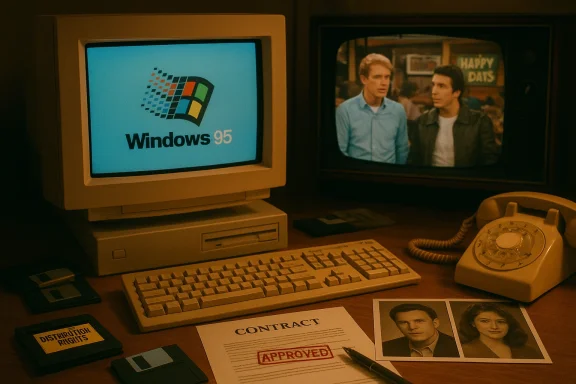
Among the extras, the Weezer music video for “Buddy Holly” became the most culturally consequential: its appearance on millions of Windows 95 CDs helped the band reach audiences who otherwise would not have encountered them, accelerating mainstream recognition. But getting that file onto the disc involved more than a simple “ask the label” — Microsoft’s lawyers first had to secure music rights from Geffen Records, and then tackle a separate set of permissions because the video itself intertwined newly shot footage with archival clips from the TV sitcom Happy Days. Those creative editorial choices created additional legal hooks that had to be cleared.
(For context, the Weezer single “Buddy Holly” was released in 1994 and Windows 95 shipped in 1995 — the video was therefore fresh and culturally relevant when Microsoft decided to include it as a demo asset on the OS disc.)
That legal split is exactly what Microsoft’s team encountered: they secured the music rights through Geffen for redistribution of the audio/video file, but the video’s inclusion of Happy Days clips meant that redistributing the finished video required permissions that extended beyond the label and producers into actor agreements and potentially the original show’s rights holders. Raymond Chen highlights the unusual — and entertainingly human — detail that the Microsoft lawyer had to track down actors (or their representatives), including locating Henry Winkler/the Fonz, to get sign‑offs.
That outcome demonstrates a split effect: labels and rights holders could act quickly to exploit assets, while the artists themselves sometimes learned later — a pattern that has evolved but still exists in niches where masters and publishing are controlled by third parties.
That meant Microsoft’s lawyers could not treat the video as a single self‑contained asset; they needed to parse the visual components and secure permissions from the parties who owned those images or who were prominently visible. Raymond Chen’s anecdote about the lawyer “thoroughly enjoying the assignment” — and the practical challenge of finding agents or telephone numbers for high‑profile actors — underscores how licensing becomes a detective exercise as much as a legal negotiation.
Additionally, archived discussion threads and forum snapshots in the files we hold echo the same recollections about Windows 95’s CD extras and Chen’s retelling — a useful cross‑check for readers interested in the community conversation around these artifacts. Those uploaded archives reflect reader recollections and commentary on Chen’s posts and Windows 95 extras.
A cautionary note: some retrospective accounts fold in anecdote and institutional memory, which can conflate the exact sequence of negotiations. Where possible I prioritized first‑person writing (Chen) and contemporaneous industry reporting. When a detail could not be independently verified (for example, the precise phrasing of internal label communications), I flagged the recollection as an reported account rather than established documentary fact.
Source: Windows Central Microsoft’s legal hurdles adding the Buddy Holly video to Windows 95
 Background and overview
Windows 95 was as much a media statement as a platform release. Beyond the Start menu and long file paths, the retail CD-ROM contained a handful of multimedia extras — cartoons by Bill Plympton, the Edie Brickell “Good Times” clip, demo files and trailers — intended both to entertain and to demonstrate Windows 95’s multimedia capabilities. That catalogue of extras read like a time capsule of mid‑1990s multimedia: clever, eclectic, and technically demonstrative. Raymond Chen recalls the mix of whimsy and marketing intent behind those inclusions.Among the extras, the Weezer music video for “Buddy Holly” became the most culturally consequential: its appearance on millions of Windows 95 CDs helped the band reach audiences who otherwise would not have encountered them, accelerating mainstream recognition. But getting that file onto the disc involved more than a simple “ask the label” — Microsoft’s lawyers first had to secure music rights from Geffen Records, and then tackle a separate set of permissions because the video itself intertwined newly shot footage with archival clips from the TV sitcom Happy Days. Those creative editorial choices created additional legal hooks that had to be cleared.
(For context, the Weezer single “Buddy Holly” was released in 1994 and Windows 95 shipped in 1995 — the video was therefore fresh and culturally relevant when Microsoft decided to include it as a demo asset on the OS disc.)
Why this mattered: multimedia as product signal
Microsoft’s inclusion of multimedia content on the Windows 95 CD served two clear goals:- To showcase that Windows 95 could handle audio and video playback on consumer PCs, a meaningful technical sales point in an era when multimedia accelerators and codecs were still nascent.
- To humanize the operating system: shipping demos, cartoons, and music signaled a consumer-friendly identity that differentiated the product in retail boxes and on demo kiosks.
The legal anatomy: audio rights vs. video rights
The Weezer story is a useful case study in the layered nature of licensing when music and images intersect.- A music placement typically requires at least two separate permissions:
- A synchronization (sync) license or permission from the music publisher/songwriter for the composition (the melody and lyrics).
- A master or sound recording license from the record label or master owner for the specific recorded performance that will be used.
- A music video adds another set of layers. When a video includes third‑party footage (for example, clips from a TV show), the distributor needs permission to use that footage and — crucially — may also have to secure releases from the individual actors whose likenesses appear in the clip.
That legal split is exactly what Microsoft’s team encountered: they secured the music rights through Geffen for redistribution of the audio/video file, but the video’s inclusion of Happy Days clips meant that redistributing the finished video required permissions that extended beyond the label and producers into actor agreements and potentially the original show’s rights holders. Raymond Chen highlights the unusual — and entertainingly human — detail that the Microsoft lawyer had to track down actors (or their representatives), including locating Henry Winkler/the Fonz, to get sign‑offs.
The behind‑the‑scenes chronology
- Microsoft identifies candidate multimedia clips to include on the Windows 95 CD as demonstrative assets.
- For the Weezer “Buddy Holly” video, Microsoft’s legal team negotiates with the label/publisher (Geffen) to secure rights to redistribute the content on the Windows 95 installation CD. This negotiation covered the audio/video package that would be distributed with millions of retail discs. Raymond Chen confirms the label‑side negotiations were the primary audio clearance route.
- Lawyers review the video itself to check for third‑party content. The “Buddy Holly” video intercuts new footage of the band performing in a Happy Days–style set with genuine Happy Days clips to create the illusion that the band is performing alongside the TV characters.
- Because actors appear in the spliced Happy Days footage, Microsoft had to obtain releases or permissions from the actors or their representatives for redistribution. Chen notes that locating and contacting some cast members — and, in one colorful anecdote, Henry Winkler — made for an unusual licensing assignment.
How this affected Weezer (and why the band was surprised)
The band members reportedly learned about the inclusion after the deal was already struck by the label, which was not unusual in the 1990s. Many label agreements grant the record company broad rights to exploit the master recording and related media; bands — particularly early in their careers — sometimes lacked direct control or real‑time visibility into licensing decisions. Weezer band members, some of whom did not own computers at the time, were initially blindsided but ultimately recognized the exposure value: the Windows 95 distribution put millions of users in front of the clip at a time when discoverability was far more gate‑kept than today’s always‑connected platforms. Pat Wilson’s retrospective quip — “one of the greatest things that could have happened to us. Can you imagine that happening today? It’s like, there’s one video on YouTube, and it’s your video.” — captures how different distribution dynamics were then.That outcome demonstrates a split effect: labels and rights holders could act quickly to exploit assets, while the artists themselves sometimes learned later — a pattern that has evolved but still exists in niches where masters and publishing are controlled by third parties.
The Happy Days complication: actor releases and personality rights
Why did Microsoft need to call Henry Winkler, Al Molinaro, or other Happy Days actors? Because the video used actual clips of the TV show intercut with the band’s performance. Even when a video creates the “illusion” of interaction — as Spike Jonze’s direction achieved in “Buddy Holly” — the visible appearances of actors, even in archival footage, can trigger separate personality/publicity rights and contractual permissions that extend beyond the standard music clearances.That meant Microsoft’s lawyers could not treat the video as a single self‑contained asset; they needed to parse the visual components and secure permissions from the parties who owned those images or who were prominently visible. Raymond Chen’s anecdote about the lawyer “thoroughly enjoying the assignment” — and the practical challenge of finding agents or telephone numbers for high‑profile actors — underscores how licensing becomes a detective exercise as much as a legal negotiation.
Cultural impact: how a CD-ROM amplified a music video
The “Buddy Holly” inclusion is a useful case study in pre‑streaming virality. By putting the file on millions of installation discs, Microsoft guaranteed repeated exposure for users who tested demo PCs, installed the OS in stores, or explored CD contents at home. The effect was measurable:- The music video enjoyed heavy rotation on MTV and later recognition at the MTV Video Music Awards (it won several categories in 1995).
- The Windows 95 placement contributed to the clip’s ubiquity and, by extension, Weezer’s breakout profile in the mid‑1990s mainstream.
What the Weezer/Windows 95 case teaches modern product teams
- Rights are layered; plan for them. If you want to ship audio + visuals, map out the composition, master, sync, and any third‑party image/personality rights before you finalize creative editorial decisions. Negotiation time can blow out if you only discover embedded third‑party footage late in the process. Sync and master rights are typically negotiated separately and can carry different pricing and restrictions.
- Chain of title matters. The label may control the master; the publisher controls the composition; the studio or TV rights holder may control archived clips; actors or unions may hold publicity/collective rights. A single creative artifact can therefore require conversations with multiple rights owners.
- Distribution channel changes the calculus. Microsoft’s use case — delivering a file on a physical retail disc — required a different set of contractual promises (e.g., perpetual distribution on physical media) than a time‑limited streaming license would have. Modern negotiators must tailor terms to format, geography, device class, and the permanence of distribution.
- Old workflows left artists surprised; modern workflows emphasize visibility. Labels historically made many distribution decisions on artists’ behalf; today, artists and their management often demand transparency and approval rights in contracts. However, the underlying rights architecture still creates edge cases that require careful legal work.
Strengths, risks, and counterfactuals
- Notable strengths
- Microsoft’s curiosity and willingness to package multimedia made Windows 95 more approachable to mainstream users; bundling fun content accelerated emotional adoption and showcased platform capabilities.
- The inclusion delivered disproportionate promotional value to Weezer, demonstrating how platform curators can stimulate cultural momentum for creators.
- Potential risks
- Rights risk: failing to clear a single embedded clip or actor appearance could have led to lawsuits, takedowns, or costly retroactive licensing fees.
- Reputation risk: including content without artists’ knowledge, while legal in some label agreements, can cause artist backlash or negative PR if perceived as exploitative.
- Technical risk: bundling large media files on a retail OS disc consumed limited CD-ROM space and required careful packaging to avoid interfering with the installer or retail presentation.
A note on sources and corroboration
The narrative above rests on multiple independent sources. Raymond Chen’s first‑hand account on Microsoft’s Old New Thing blog provides the central, inside perspective on the legal process and the product rationale. Independent reporting, including technology press coverage, and historical music‑industry summaries corroborate the broad claims — that Geffen handled label negotiations, that the band was initially unaware of the distribution decision, and that Happy Days footage created the actor‑clearance requirement. For the technical/legal taxonomy of sync and master rights I relied on industry treatises and plain‑language licensing explainers that describe the separation between composition and sound‑recording rights and how synchronization licensing operates in practice.Additionally, archived discussion threads and forum snapshots in the files we hold echo the same recollections about Windows 95’s CD extras and Chen’s retelling — a useful cross‑check for readers interested in the community conversation around these artifacts. Those uploaded archives reflect reader recollections and commentary on Chen’s posts and Windows 95 extras.
A cautionary note: some retrospective accounts fold in anecdote and institutional memory, which can conflate the exact sequence of negotiations. Where possible I prioritized first‑person writing (Chen) and contemporaneous industry reporting. When a detail could not be independently verified (for example, the precise phrasing of internal label communications), I flagged the recollection as an reported account rather than established documentary fact.
Practical takeaways for engineers, product managers, and content licensors
- Map rights early. If your product will ship media (audio or video), include licensing counsel in the product plan and allocate time for sync/master negotiation and any image/personality clearances.
- Treat archival footage as a separate risk vector. Even brief, incidental TV clips can trigger actor releases or studio permissions.
- Consider the distribution permanence. Physical distribution or “perpetual” digital bundles demand different commercial terms than limited streaming windows.
- When possible, secure artist buy‑in. Surprising creators has short‑term upside but can create long‑term friction; transparent communications reduce reputation risk.
- Use this story as a historical example: platform placement can create outsized exposure, and platform owners should treat curated content as both a legal and cultural responsibility.
Conclusion
The Weezer “Buddy Holly” clip on the Windows 95 CD is more than a nostalgic footnote; it’s a compact lesson in how creative editing choices, rights silos, and platform distribution strategies intersect. What looks like a lighthearted inclusion — a memorable music video tucked onto an OS disc — was a small legal expedition requiring label negotiations, actor clearances, and some old‑fashioned detective work to find agents and actors. Raymond Chen’s recollection reminds us that every media file shipped at scale carries hidden costs and responsibilities, and that the technical feat of demonstrating multimedia capability is inseparable from the legal and human processes that make distribution possible. For product teams today, the lesson is simple and enduring: the creative choice to include media is also a decision to do the paperwork — and those who do that paperwork well turn legal complexity into cultural opportunity.Source: Windows Central Microsoft’s legal hurdles adding the Buddy Holly video to Windows 95
