

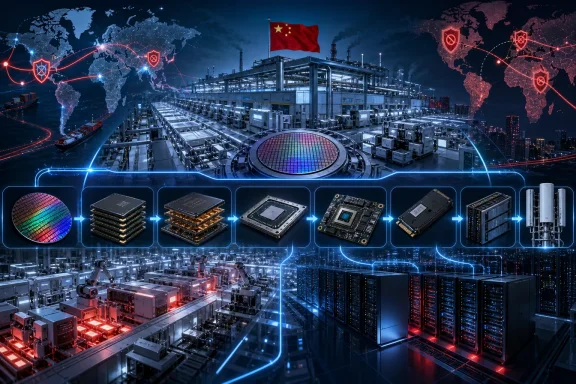
Huawei may be preparing its most ambitious semiconductor move yet: extending its increasingly self-contained chip ecosystem into DRAM manufacturing through reported links with Shenzhen memory producer SwaySure. If the claims are accurate, Huawei would gain influence over the processors, AI accelerators, storage controllers, solid-state drives, and memory feeding its products, creating a vertically integrated technology operation that resembles Samsung more than Apple, Intel, or Nvidia. That would not put Huawei “ahead” of those companies in semiconductor technology, but it could make Huawei unusually difficult to isolate through conventional supply-chain sanctions.
Huawei entered the semiconductor business primarily as a chip designer rather than a manufacturer. Its HiSilicon division developed Kirin mobile processors, Kunpeng server CPUs, networking silicon, modem technology, and the Ascend family of AI accelerators, while external foundries handled the physically demanding task of fabricating those designs.
That arrangement worked while Huawei could access leading international suppliers. Taiwan Semiconductor Manufacturing Company manufactured some of Huawei’s most advanced chips, while global memory companies supplied DRAM, NAND flash, and high-bandwidth memory components for phones, servers, telecom equipment, and computing systems.
Those measures sharply reduced Huawei’s access to leading-edge foundry capacity. They also complicated the company’s ability to buy advanced components from suppliers whose production depended on American intellectual property or machinery.
Huawei’s semiconductor strategy changed accordingly. Instead of optimizing purely for performance, cost, and time to market, it increasingly had to optimize for availability under sanctions.
Subsequent investigations linked Huawei to a broader network of semiconductor facilities, equipment companies, investment vehicles, and nominally independent manufacturers. Huawei has denied operating a covert fabrication network, but satellite imagery, corporate relationships, government restrictions, and industry reporting have continued to fuel the allegations.
The reported connection with SwaySure matters because it suggests that Huawei’s manufacturing strategy is spreading beyond logic chips. Memory is becoming as strategically important as processing power, particularly in AI infrastructure.
Neither the number of facilities nor Huawei’s effective control over them has been conclusively established in public. Some sites may manufacture logic chips, memory, analog devices, power semiconductors, image sensors, or supporting components rather than forming one standardized production network.
A plant does not need to carry Huawei’s name to serve Huawei’s priorities. Huawei could shape production through guaranteed purchases, engineering support, equipment development, intellectual property agreements, personnel transfers, or financing without directly owning the operating company.
Conversely, proximity and commercial cooperation do not automatically prove control. Reports describing every Huawei-linked project as a “Huawei fab” may therefore overstate what can be demonstrated.
Industry commentary has suggested that early SwaySure production may involve relatively mature DRAM technology rather than cutting-edge HBM. A mature-node starting point would not be surprising. New memory producers must first stabilize processes, improve yields, qualify products, and prove reliability before attempting the most complex stacked memory packages.
The strategically important point is not whether the first wafers rival Samsung or SK hynix. It is whether Huawei can establish a controlled path from basic DRAM to advanced memory optimized for its own systems.
Huawei is moving toward a similarly broad footprint, but the comparison can easily become misleading. Controlling a supply chain is not the same as possessing global leadership in every part of it.
The semiconductor industry separates several distinct functions:
Huawei’s reported model appears more captive. Its priority is likely to secure components for its own AI platforms, telecom systems, enterprise hardware, smartphones, vehicles, and cloud infrastructure rather than immediately becoming a global merchant memory supplier.
That distinction matters. Samsung’s scale comes partly from serving an enormous external market, while Huawei could initially accept lower output and higher cost if the resulting memory secures strategically essential domestic supply.
Artificial intelligence has altered that calculation. The most valuable accelerators now depend on advanced memory systems capable of moving enormous quantities of data at exceptionally high speed.
High-bandwidth memory addresses this bottleneck by stacking multiple DRAM dies and connecting them through dense vertical pathways. The resulting package sits close to the accelerator and provides substantially more bandwidth than conventional memory modules.
Huawei’s Ascend roadmap therefore depends on more than producing a competitive compute die. It requires access to a complete system that includes:
For Huawei, an imported component is not merely a procurement risk. It can become unavailable after a regulatory change, a license denial, or pressure applied to a supplier in another jurisdiction.
Captive DRAM production would not instantly solve the HBM problem, but it would create a development base Huawei could protect and direct. Even older memory could support telecommunications equipment, industrial systems, storage products, lower-end accelerators, and consumer devices while more advanced processes mature.
This is where claims that Huawei could leave Apple, Intel, and Nvidia “in the dust” require the most skepticism. Huawei may become more vertically integrated, but the leading memory companies possess decades of production experience and enormous portfolios of manufacturing knowledge.
HBM magnifies the yield challenge because multiple dies are combined in one stack. A defective die, interconnect, or bonding step can reduce the value of the entire package. As stack heights increase, the number of opportunities for failure rises.
Leading memory manufacturers have refined these processes over multiple product generations. Their advantages include:
A successful HBM product requires through-silicon vias, wafer thinning, die stacking, bonding, testing, heat control, and integration with a processor package. The base die may use logic technology different from the stacked DRAM dies, creating dependencies across several manufacturing disciplines.
Huawei’s advantage is its ability to coordinate systems engineering. It can design Ascend accelerators, interconnects, servers, racks, cooling, and software around whatever memory its domestic supply chain can reliably manufacture.
That approach may compensate for weaker individual components. Instead of matching Nvidia chip for chip, Huawei can pursue acceptable performance at the cluster or supernode level by using more accelerators, more networking hardware, and system-level optimization.
Its challenge is no longer demonstrating that Chinese-designed processors can function. The harder task is producing enough competitive chips at acceptable cost, power consumption, and reliability.
SMIC’s advanced production is generally considered behind the newest nodes available from TSMC, Samsung Foundry, and Intel Foundry. Without access to extreme ultraviolet lithography equipment, Chinese manufacturers must rely more heavily on complex multi-patterning techniques for advanced layers.
That can increase process steps, cycle time, mask costs, defect opportunities, and power inefficiency. A chip may work and ship commercially while still costing more per usable die than a comparable product from a leading international foundry.
Huawei’s CloudMatrix and SuperPoD strategies illustrate a systems-level response to limits in individual chip performance. By connecting large numbers of Ascend processors through high-bandwidth networking, Huawei can target workloads that would otherwise run on Nvidia-based clusters.
That architecture creates enormous internal demand for accelerators, CPUs, optical components, networking chips, storage, and memory. A captive DRAM operation would have a guaranteed customer before it sold a single chip on the open market.
A modern enterprise SSD contains NAND flash packages, a controller, firmware, DRAM or alternative cache, power-loss protection, security features, and error-correction technology. Huawei can design or specify many of these elements without fabricating the underlying NAND itself.
This creates a more mature foundation for Huawei’s storage ambitions than the country currently possesses in leading-edge HBM. Huawei can combine domestic NAND, internally developed controllers, firmware, and system management with its servers and cloud platforms.
For customers operating entirely inside Huawei’s ecosystem, ownership of every factory matters less than dependable domestic availability. A Huawei-qualified SSD assembled from Chinese components can reduce exposure to international restrictions even if several affiliated suppliers participate.
Enterprise SSD optimization therefore gives Huawei another way to improve system-level performance without winning every processor benchmark. Firmware can be tuned for Huawei’s servers, operating systems, data-center networks, and AI frameworks.
The result could be a tightly integrated platform comparable in concept to hyperscale systems designed by major cloud providers. It may be less flexible than an industry-standard configuration, but it can be optimized as one unit.
WindowsForum readers should distinguish between chips used inside China and products likely to reach international retail markets. Regulatory and political barriers may keep Huawei-controlled components out of many Western supply chains even if the hardware becomes technically competitive.
The effects would probably emerge in stages:
Memory or SSDs connected to Huawei’s ecosystem may face additional scrutiny in government, defense, telecommunications, financial, and critical-infrastructure environments. Even technically sound components can become impractical if procurement teams cannot guarantee future support or regulatory compliance.
Inside China, the calculation is reversed. Government-backed buyers may prefer domestic components specifically because Western products carry a greater risk of export interruption.
Each has chosen a different point of control in the semiconductor value chain.
This fabless model gives Apple access to leading manufacturing without requiring it to fund every generation of production equipment. The trade-off is exposure to supplier concentration, geopolitical risk, and memory-market volatility.
Huawei’s reported strategy sacrifices some of that efficiency for resilience. It may accept less advanced components or higher manufacturing costs to reduce the chance that an external government can halt production.
That does not make Huawei’s model inherently superior. It reflects a different threat environment.
Intel could source memory from several global suppliers while concentrating capital on logic manufacturing. Huawei may not have that freedom, especially for HBM destined for advanced AI processors.
The comparison highlights how sanctions can reverse conventional business logic. Vertical integration that might appear inefficient in an open market can become rational when supply access is uncertain.
That specialization has created one of the industry’s most powerful computing platforms. Huawei cannot surpass it merely by owning more factories.
Huawei’s opportunity is regional substitution. If Chinese customers cannot freely purchase Nvidia’s most capable products, Huawei does not need to defeat Nvidia everywhere. It needs to deliver a sufficiently capable, supportable, and available alternative inside China.
The United States has repeatedly added Chinese semiconductor manufacturers, equipment companies, and Huawei affiliates to the Entity List. These additions indicate that regulators view indirect access and diversion as central enforcement concerns.
Regulators have responded with broader end-use controls, affiliate restrictions, foreign direct product rules, and due-diligence requirements. Each expansion, however, increases compliance costs for legitimate trade and encourages further localization in China.
This produces an unintended feedback loop:
They cannot guarantee technological stagnation. Companies can redesign products, reuse older equipment, develop substitutes, acquire tools before restrictions take effect, or optimize systems around less advanced processes.
The realistic question is not whether Huawei can manufacture semiconductors at all. It is whether it can do so at the scale, yield, performance, and efficiency required to satisfy China’s growing computing demand.
Several milestones will indicate whether the reported strategy is advancing.
Commodity DDR, LPDDR, or specialty memory would establish manufacturing capability but not HBM leadership. Evidence of through-silicon-via production, stacked dies, advanced base dies, or accelerator qualification would be far more consequential.
Yield and volume will remain harder to measure. A demonstration device may prove technical feasibility without establishing mass-production economics.
Huawei has already presented a roadmap extending its Ascend and SuperPoD platforms through 2026 and beyond. If future systems scale rapidly despite restrictions on imported HBM, that would suggest meaningful progress somewhere in the domestic memory chain.
Conversely, unusually large clusters, higher power consumption, limited availability, or delayed launches could indicate persistent component constraints.
Regulators will also have to decide how broadly to define affiliates. Overly narrow rules may permit circumvention, while overly broad restrictions risk capturing companies with only incidental commercial relationships.
The premium memory market will be more difficult to penetrate. Server buyers, hyperscalers, and accelerator designers require long qualification periods and consistent high-volume output.
Watch the gap between announced capacity and shipped products. Semiconductor history is filled with ambitious fab projects that never achieved competitive yields.
That effort could reshape competition even if Huawei never matches Samsung, SK hynix, TSMC, or Nvidia at their strongest individual technologies.
The resulting stack may initially be more expensive, less efficient, and less advanced than the best internationally sourced alternative. Its strategic value comes from being deployable under restrictions.
Once a parallel stack reaches adequate performance, market dynamics change. Chinese buyers may choose it not only because foreign technology is unavailable, but because domestic integration, support, financing, or policy makes it preferable.
Huawei’s experience exposed the vulnerability of that model when governments use supply-chain access as leverage. The company’s response is to recreate as much of the chain as possible within a politically protected sphere.
Other technology companies are unlikely to copy Huawei completely because they do not face the same restrictions. Nevertheless, more businesses are investing in custom processors, long-term capacity agreements, domestic manufacturing, and diversified suppliers.
The era of choosing components solely on price and performance is ending. Geographic location, regulatory jurisdiction, political alignment, and manufacturing control now influence architectural decisions.
Huawei is not yet leaving Apple, Intel, Nvidia, or Samsung “in the dust.” Apple retains world-leading device integration, Intel possesses deep logic-manufacturing expertise, Nvidia dominates the global AI computing platform, and Samsung remains vastly more accomplished in memory and semiconductor fabrication. What Huawei may be building is different: a sufficiently complete, domestically anchored technology stack designed to survive exclusion from the Western semiconductor economy. If the reported SwaySure relationship develops into large-scale DRAM and eventually HBM production, the result will not merely be another memory supplier. It will mark a decisive step toward two increasingly separate computing ecosystems, each with its own processors, memory, storage, software, standards, and supply chains.
 Background
Huawei entered the semiconductor business primarily as a chip designer rather than a manufacturer. Its HiSilicon division developed Kirin mobile processors, Kunpeng server CPUs, networking silicon, modem technology, and the Ascend family of AI accelerators, while external foundries handled the physically demanding task of fabricating those designs.That arrangement worked while Huawei could access leading international suppliers. Taiwan Semiconductor Manufacturing Company manufactured some of Huawei’s most advanced chips, while global memory companies supplied DRAM, NAND flash, and high-bandwidth memory components for phones, servers, telecom equipment, and computing systems.
The 2019 turning point
The United States placed Huawei and numerous affiliates on the Commerce Department’s Entity List in May 2019. Restrictions subsequently expanded, including rules targeting foreign-made products created with certain American technology, equipment, or software.Those measures sharply reduced Huawei’s access to leading-edge foundry capacity. They also complicated the company’s ability to buy advanced components from suppliers whose production depended on American intellectual property or machinery.
Huawei’s semiconductor strategy changed accordingly. Instead of optimizing purely for performance, cost, and time to market, it increasingly had to optimize for availability under sanctions.
From fabless designer to industrial network
Huawei initially appeared to remain dependent on Chinese foundry SMIC for the production of advanced logic devices. The unexpected arrival of the Kirin 9000S in the Mate 60 Pro in 2023, however, demonstrated that Huawei and its domestic manufacturing partners could produce commercially usable advanced chips despite export controls.Subsequent investigations linked Huawei to a broader network of semiconductor facilities, equipment companies, investment vehicles, and nominally independent manufacturers. Huawei has denied operating a covert fabrication network, but satellite imagery, corporate relationships, government restrictions, and industry reporting have continued to fuel the allegations.
The reported connection with SwaySure matters because it suggests that Huawei’s manufacturing strategy is spreading beyond logic chips. Memory is becoming as strategically important as processing power, particularly in AI infrastructure.
What Huawei Is Reportedly Building
The central claim is that Huawei is building or operating DRAM fabrication capacity through a joint venture or closely aligned relationship with SwaySure. Semiconductor analysts have also associated Huawei with as many as 11 fabrication facilities or projects operating through different corporate entities across China.Neither the number of facilities nor Huawei’s effective control over them has been conclusively established in public. Some sites may manufacture logic chips, memory, analog devices, power semiconductors, image sensors, or supporting components rather than forming one standardized production network.
Why the ownership structure is difficult to verify
Chinese semiconductor projects often combine municipal financing, provincial investment funds, state-owned companies, private operators, research institutes, and strategic customers. That structure can make the difference between an investor, customer, technology partner, and operational controller difficult to establish from public records.A plant does not need to carry Huawei’s name to serve Huawei’s priorities. Huawei could shape production through guaranteed purchases, engineering support, equipment development, intellectual property agreements, personnel transfers, or financing without directly owning the operating company.
Conversely, proximity and commercial cooperation do not automatically prove control. Reports describing every Huawei-linked project as a “Huawei fab” may therefore overstate what can be demonstrated.
SwaySure’s potential role
SwaySure has emerged as a potentially important domestic memory manufacturer, reportedly recruiting experienced engineers and developing DRAM production capabilities in Shenzhen. Its location and relationships place it near the center of Huawei’s wider semiconductor ecosystem.Industry commentary has suggested that early SwaySure production may involve relatively mature DRAM technology rather than cutting-edge HBM. A mature-node starting point would not be surprising. New memory producers must first stabilize processes, improve yields, qualify products, and prove reliability before attempting the most complex stacked memory packages.
The strategically important point is not whether the first wafers rival Samsung or SK hynix. It is whether Huawei can establish a controlled path from basic DRAM to advanced memory optimized for its own systems.
The Samsung Comparison Needs Qualification
Samsung is one of the world’s most vertically integrated technology companies. It designs mobile processors, operates advanced logic foundries, manufactures DRAM and NAND flash, builds SSDs, produces displays, assembles consumer electronics, and sells finished systems under its own brand.Huawei is moving toward a similarly broad footprint, but the comparison can easily become misleading. Controlling a supply chain is not the same as possessing global leadership in every part of it.
Design, fabrication, and product branding are different
Huawei designs CPUs and AI accelerators through HiSilicon, but much of its advanced logic fabrication has been attributed to SMIC rather than a Huawei-owned leading-edge foundry. Huawei-branded or Huawei-developed SSD products similarly do not mean that Huawei manufactures every NAND cell, controller, package, and firmware component internally.The semiconductor industry separates several distinct functions:
- Chip architecture determines what a processor or controller is designed to do.
- Physical design converts that architecture into layouts suitable for manufacturing.
- Wafer fabrication creates the transistors and interconnects on silicon.
- Packaging connects dies, substrates, interposers, and external interfaces.
- Product integration combines chips, firmware, cooling, power delivery, and software into usable systems.
Samsung remains the more complete model
Samsung controls advanced DRAM, NAND, logic manufacturing, display production, mobile devices, servers, appliances, and numerous component businesses. It can also sell memory and foundry services to external customers, including companies that compete with its finished-product divisions.Huawei’s reported model appears more captive. Its priority is likely to secure components for its own AI platforms, telecom systems, enterprise hardware, smartphones, vehicles, and cloud infrastructure rather than immediately becoming a global merchant memory supplier.
That distinction matters. Samsung’s scale comes partly from serving an enormous external market, while Huawei could initially accept lower output and higher cost if the resulting memory secures strategically essential domestic supply.
Why DRAM Has Become a Strategic Priority
DRAM was once treated as a comparatively interchangeable component. Buyers selected among compatible products based on capacity, speed, reliability, price, and availability, while a small group of major manufacturers competed through manufacturing efficiency.Artificial intelligence has altered that calculation. The most valuable accelerators now depend on advanced memory systems capable of moving enormous quantities of data at exceptionally high speed.
AI performance is increasingly memory-bound
An AI accelerator can contain vast numbers of arithmetic units, but those units produce little value while waiting for model weights or intermediate data. Memory bandwidth, memory capacity, interconnect performance, and software scheduling consequently determine how much of a chip’s theoretical computing power can be used.High-bandwidth memory addresses this bottleneck by stacking multiple DRAM dies and connecting them through dense vertical pathways. The resulting package sits close to the accelerator and provides substantially more bandwidth than conventional memory modules.
Huawei’s Ascend roadmap therefore depends on more than producing a competitive compute die. It requires access to a complete system that includes:
- Sufficient quantities of advanced DRAM dies.
- High-yield die stacking and packaging.
- Suitable base dies and memory controllers.
- Advanced substrates and interposers.
- High-speed interconnect technology.
- Software capable of efficiently managing memory across large clusters.
Export controls changed the business case
In December 2024, the United States announced additional restrictions targeting certain high-bandwidth memory and semiconductor manufacturing technologies destined for China. The measures increased pressure on Chinese companies to develop domestic alternatives to memory supplied by Samsung, SK hynix, and Micron.For Huawei, an imported component is not merely a procurement risk. It can become unavailable after a regulatory change, a license denial, or pressure applied to a supplier in another jurisdiction.
Captive DRAM production would not instantly solve the HBM problem, but it would create a development base Huawei could protect and direct. Even older memory could support telecommunications equipment, industrial systems, storage products, lower-end accelerators, and consumer devices while more advanced processes mature.
The Long Road From DRAM to HBM
Manufacturing commodity DRAM is difficult. Manufacturing commercially competitive HBM at scale is considerably harder because the producer must combine advanced memory fabrication with precision packaging and rigorous thermal management.This is where claims that Huawei could leave Apple, Intel, and Nvidia “in the dust” require the most skepticism. Huawei may become more vertically integrated, but the leading memory companies possess decades of production experience and enormous portfolios of manufacturing knowledge.
Yield is the hidden contest
A technically functional memory die is not automatically economical. Manufacturers must produce large numbers of dies with consistent electrical characteristics and very low defect rates.HBM magnifies the yield challenge because multiple dies are combined in one stack. A defective die, interconnect, or bonding step can reduce the value of the entire package. As stack heights increase, the number of opportunities for failure rises.
Leading memory manufacturers have refined these processes over multiple product generations. Their advantages include:
- Mature process recipes and defect-control systems.
- Extensive intellectual property portfolios.
- Established supplies of specialized chemicals and materials.
- Proven thermal and packaging techniques.
- Strong relationships with accelerator designers.
- Experience qualifying products for hyperscale data centers.
Packaging may matter as much as lithography
Discussion of semiconductor competition often focuses on process nodes. HBM demonstrates why that view is incomplete.A successful HBM product requires through-silicon vias, wafer thinning, die stacking, bonding, testing, heat control, and integration with a processor package. The base die may use logic technology different from the stacked DRAM dies, creating dependencies across several manufacturing disciplines.
Huawei’s advantage is its ability to coordinate systems engineering. It can design Ascend accelerators, interconnects, servers, racks, cooling, and software around whatever memory its domestic supply chain can reliably manufacture.
That approach may compensate for weaker individual components. Instead of matching Nvidia chip for chip, Huawei can pursue acceptable performance at the cluster or supernode level by using more accelerators, more networking hardware, and system-level optimization.
Huawei’s CPU and AI Chip Position
Huawei already owns one of the broadest processor portfolios among equipment manufacturers. HiSilicon’s designs span mobile systems-on-chip, server CPUs, AI accelerators, networking processors, security devices, and connectivity silicon.Its challenge is no longer demonstrating that Chinese-designed processors can function. The harder task is producing enough competitive chips at acceptable cost, power consumption, and reliability.
Kirin proved resilience, not process leadership
The return of advanced Kirin processors showed that Huawei could reestablish a domestic smartphone processor supply after sanctions had severely disrupted its premium handset business. It did not prove that Chinese manufacturing had reached parity with TSMC’s leading processes.SMIC’s advanced production is generally considered behind the newest nodes available from TSMC, Samsung Foundry, and Intel Foundry. Without access to extreme ultraviolet lithography equipment, Chinese manufacturers must rely more heavily on complex multi-patterning techniques for advanced layers.
That can increase process steps, cycle time, mask costs, defect opportunities, and power inefficiency. A chip may work and ship commercially while still costing more per usable die than a comparable product from a leading international foundry.
Ascend changes the scale of demand
Smartphone processors ship in high volume, but each device uses a limited amount of memory and power. AI infrastructure introduces a different problem: every accelerator requires substantial memory capacity, while clusters may contain hundreds or thousands of accelerators.Huawei’s CloudMatrix and SuperPoD strategies illustrate a systems-level response to limits in individual chip performance. By connecting large numbers of Ascend processors through high-bandwidth networking, Huawei can target workloads that would otherwise run on Nvidia-based clusters.
That architecture creates enormous internal demand for accelerators, CPUs, optical components, networking chips, storage, and memory. A captive DRAM operation would have a guaranteed customer before it sold a single chip on the open market.
SSDs and NAND Complete the Data-Center Stack
The claim that Huawei could produce its own CPUs, SSDs, and DRAM combines several layers of the technology stack. SSD production is especially nuanced because an SSD is a system rather than a single semiconductor.A modern enterprise SSD contains NAND flash packages, a controller, firmware, DRAM or alternative cache, power-loss protection, security features, and error-correction technology. Huawei can design or specify many of these elements without fabricating the underlying NAND itself.
China is stronger in NAND than HBM
China’s NAND ecosystem has advanced quickly, led by YMTC and its distinctive flash architectures. Chinese NAND has become increasingly credible in consumer storage, embedded devices, and some enterprise applications, although sanctions and equipment restrictions remain significant constraints.This creates a more mature foundation for Huawei’s storage ambitions than the country currently possesses in leading-edge HBM. Huawei can combine domestic NAND, internally developed controllers, firmware, and system management with its servers and cloud platforms.
For customers operating entirely inside Huawei’s ecosystem, ownership of every factory matters less than dependable domestic availability. A Huawei-qualified SSD assembled from Chinese components can reduce exposure to international restrictions even if several affiliated suppliers participate.
Storage matters to AI beyond capacity
AI systems require storage capable of feeding training data, checkpoints, vector databases, and model artifacts to compute clusters. Faster accelerators can sit idle if the storage layer cannot deliver data efficiently.Enterprise SSD optimization therefore gives Huawei another way to improve system-level performance without winning every processor benchmark. Firmware can be tuned for Huawei’s servers, operating systems, data-center networks, and AI frameworks.
The result could be a tightly integrated platform comparable in concept to hyperscale systems designed by major cloud providers. It may be less flexible than an industry-standard configuration, but it can be optimized as one unit.
Implications for Windows PCs and Enterprise IT
Huawei’s immediate memory ambitions are unlikely to change the configuration of a typical Windows desktop in the United States or Europe. Over time, however, expanded Chinese DRAM and NAND capacity could reshape component pricing, product availability, and technology standards.WindowsForum readers should distinguish between chips used inside China and products likely to reach international retail markets. Regulatory and political barriers may keep Huawei-controlled components out of many Western supply chains even if the hardware becomes technically competitive.
Consumer PC effects
Additional DRAM production could eventually place downward pressure on commodity memory prices. Chinese manufacturers already have incentives to supply domestic PC builders, module brands, laptop producers, and device makers with alternatives to Samsung, SK hynix, and Micron.The effects would probably emerge in stages:
- Domestic Chinese systems would adopt the components first. Manufacturers could validate reliability and expand production without depending on Western OEM approvals.
- Regional and value-focused brands could follow. Price-sensitive vendors may accept lesser-known memory if it passes qualification testing.
- Retail modules and SSDs could reach broader markets. Distributors would assess warranty support, firmware quality, compatibility, and legal exposure.
- Major Western OEM adoption would require extensive review. Security policy, export controls, government procurement rules, and political pressure could outweigh component pricing.
- Global incumbents would respond through product mix and pricing. They might emphasize premium DDR, HBM, enterprise products, and long-term support rather than fighting exclusively on commodity cost.
Enterprise qualification will be slower
Enterprises evaluate more than benchmark performance. They need predictable error rates, long support cycles, firmware update policies, failure analysis, traceability, and replacement availability.Memory or SSDs connected to Huawei’s ecosystem may face additional scrutiny in government, defense, telecommunications, financial, and critical-infrastructure environments. Even technically sound components can become impractical if procurement teams cannot guarantee future support or regulatory compliance.
Inside China, the calculation is reversed. Government-backed buyers may prefer domestic components specifically because Western products carry a greater risk of export interruption.
Competitive Consequences for Apple, Intel, and Nvidia
Huawei competes with Apple in smartphones and consumer ecosystems, with Intel in servers and computing platforms, and with Nvidia in AI infrastructure. Yet the comparison does not mean all four companies pursue the same business model.Each has chosen a different point of control in the semiconductor value chain.
Apple remains integration-focused
Apple designs highly customized processors and integrates them with operating systems, devices, and services. It relies on external foundries and memory manufacturers because those suppliers can spread fabrication costs across many customers.This fabless model gives Apple access to leading manufacturing without requiring it to fund every generation of production equipment. The trade-off is exposure to supplier concentration, geopolitical risk, and memory-market volatility.
Huawei’s reported strategy sacrifices some of that efficiency for resilience. It may accept less advanced components or higher manufacturing costs to reduce the chance that an external government can halt production.
That does not make Huawei’s model inherently superior. It reflects a different threat environment.
Intel has factories but not a captive memory empire
Intel historically combined processor design and manufacturing, although it exited major commodity memory businesses decades ago and later sold its NAND and SSD operations. Its present strategy centers on x86 processors, accelerators, advanced packaging, and foundry services.Intel could source memory from several global suppliers while concentrating capital on logic manufacturing. Huawei may not have that freedom, especially for HBM destined for advanced AI processors.
The comparison highlights how sanctions can reverse conventional business logic. Vertical integration that might appear inefficient in an open market can become rational when supply access is uncertain.
Nvidia’s strength remains its platform
Nvidia does not manufacture its own GPUs or HBM. Foundry and memory partners produce the physical components, while Nvidia controls processor architecture, systems, networking, and the CUDA software ecosystem.That specialization has created one of the industry’s most powerful computing platforms. Huawei cannot surpass it merely by owning more factories.
Huawei’s opportunity is regional substitution. If Chinese customers cannot freely purchase Nvidia’s most capable products, Huawei does not need to defeat Nvidia everywhere. It needs to deliver a sufficiently capable, supportable, and available alternative inside China.
Export Controls and the Shadow-Network Problem
The reported network of Huawei-linked fabs presents a difficult enforcement challenge. Export controls generally identify restricted technologies, destinations, entities, and end users, but complex corporate structures can obscure who ultimately benefits from a transaction.The United States has repeatedly added Chinese semiconductor manufacturers, equipment companies, and Huawei affiliates to the Entity List. These additions indicate that regulators view indirect access and diversion as central enforcement concerns.
Why lists alone may not be enough
A supplier can screen a customer’s legal name, but the buyer may be part of a larger network with shared staff, financing, facilities, or end users. Equipment may also move between sites after delivery.Regulators have responded with broader end-use controls, affiliate restrictions, foreign direct product rules, and due-diligence requirements. Each expansion, however, increases compliance costs for legitimate trade and encourages further localization in China.
This produces an unintended feedback loop:
- Restrictions reduce Chinese access to foreign technology.
- China increases subsidies and guaranteed demand for domestic alternatives.
- Domestic suppliers improve through scale and repeated production.
- Regulators broaden controls to cover the expanding network.
- Chinese companies become even more determined to eliminate sanctionable dependencies.
Controls can delay without permanently preventing
Export restrictions can increase costs, slow development, constrain production volumes, and deny access to the best tools. Those effects are strategically significant, especially when leading competitors improve at the same time.They cannot guarantee technological stagnation. Companies can redesign products, reuse older equipment, develop substitutes, acquire tools before restrictions take effect, or optimize systems around less advanced processes.
The realistic question is not whether Huawei can manufacture semiconductors at all. It is whether it can do so at the scale, yield, performance, and efficiency required to satisfy China’s growing computing demand.
Strengths and Opportunities
Huawei’s reported expansion into DRAM gives it several strategic advantages even if its technology initially trails the market leaders.- Captive demand reduces market-entry risk. Huawei can consume memory across smartphones, telecom equipment, servers, storage systems, vehicles, and AI clusters without first winning external customers.
- System-level control enables co-design. Engineers can optimize processors, controllers, memory, networking, cooling, firmware, and software together.
- Domestic production improves supply resilience. Components manufactured within a protected Chinese ecosystem are less vulnerable to foreign licensing decisions.
- State-backed financing supports long development cycles. Memory fabrication requires sustained investment before yields and profitability reach competitive levels.
- China offers enormous deployment scale. Government agencies, state-owned enterprises, cloud providers, telecom carriers, and consumer manufacturers can provide early customers.
- Mature memory can generate useful experience. Commodity DRAM and lower-end products can help refine process control before more demanding HBM programs mature.
- Integration could improve total platform economics. Huawei may offset weaker individual chips through optimized clusters, networking, storage, and software.
- Domestic standards could reinforce adoption. A large installed base can encourage developers and suppliers to optimize products around Huawei interfaces and platforms.
Risks and Concerns
Vertical integration also introduces financial, technical, and geopolitical vulnerabilities. Huawei could gain strategic autonomy while inheriting some of the semiconductor industry’s most difficult operating problems.- Manufacturing yields may remain uneconomical. A process can produce working chips yet consume too much wafer capacity to compete sustainably.
- HBM packaging presents a separate bottleneck. DRAM fabrication alone does not provide the stacking, bonding, testing, and thermal expertise needed for advanced products.
- Restricted equipment may cap progress. Limited access to leading lithography, deposition, etching, metrology, and inspection systems can slow yield improvements.
- State support can mask inefficient investment. Guaranteed financing and customers may preserve projects that would fail under normal commercial discipline.
- Overlapping fabs could duplicate resources. Fragmented ownership may produce coordination problems, inconsistent standards, and redundant capacity.
- Technology isolation can reduce interoperability. Proprietary interfaces and domestic-only standards may make Huawei systems harder to integrate with global hardware and software.
- Further sanctions are likely. Any publicly identified facility supporting Huawei’s advanced chips could become a target for additional restrictions.
- Cybersecurity and procurement concerns will limit exports. Western governments may treat Huawei-linked memory or storage components as supply-chain risks regardless of technical merit.
- Commodity overcapacity could destabilize prices. Heavily subsidized production may pressure established manufacturers and increase trade disputes.
- Talent and intellectual-property disputes may intensify. Rapid expansion requires experienced engineers, creating competition over recruitment and proprietary manufacturing knowledge.
What to Watch Next
Public confirmation of Huawei-controlled DRAM production may remain elusive, so evidence will probably emerge indirectly. Product analysis, recruitment, equipment purchases, patents, construction activity, regulatory action, and supplier disclosures will collectively reveal more than corporate announcements.Several milestones will indicate whether the reported strategy is advancing.
Production and product evidence
The first major signal would be independently verified DRAM from SwaySure or another Huawei-linked facility appearing in commercial hardware. Analysts will examine die markings, process characteristics, density, performance, packaging, and controller behavior.Commodity DDR, LPDDR, or specialty memory would establish manufacturing capability but not HBM leadership. Evidence of through-silicon-via production, stacked dies, advanced base dies, or accelerator qualification would be far more consequential.
Yield and volume will remain harder to measure. A demonstration device may prove technical feasibility without establishing mass-production economics.
Ascend memory configurations
Huawei’s future Ascend products will provide another indicator. Changes in memory capacity, bandwidth, package construction, or supplier identity could show whether domestic HBM is entering production.Huawei has already presented a roadmap extending its Ascend and SuperPoD platforms through 2026 and beyond. If future systems scale rapidly despite restrictions on imported HBM, that would suggest meaningful progress somewhere in the domestic memory chain.
Conversely, unusually large clusters, higher power consumption, limited availability, or delayed launches could indicate persistent component constraints.
Regulatory action
New Entity List designations may reveal which facilities American investigators believe belong to Huawei’s effective network. Restrictions targeting particular equipment companies, packaging houses, or memory producers could provide indirect confirmation of government assessments.Regulators will also have to decide how broadly to define affiliates. Overly narrow rules may permit circumvention, while overly broad restrictions risk capturing companies with only incidental commercial relationships.
Pricing and market behavior
A rapid increase in Chinese DRAM output could first appear through aggressive domestic pricing. Module manufacturers and PC vendors may begin substituting Chinese dies for products from established suppliers, especially in mainstream systems.The premium memory market will be more difficult to penetrate. Server buyers, hyperscalers, and accelerator designers require long qualification periods and consistent high-volume output.
Watch the gap between announced capacity and shipped products. Semiconductor history is filled with ambitious fab projects that never achieved competitive yields.
Looking Ahead
Huawei’s reported DRAM strategy should be viewed as part of a much larger transformation. The company is not simply adding another component business; it is attempting to convert itself from a global technology buyer into the organizing center of an increasingly domestic semiconductor ecosystem.That effort could reshape competition even if Huawei never matches Samsung, SK hynix, TSMC, or Nvidia at their strongest individual technologies.
A parallel technology stack is emerging
China’s semiconductor drive increasingly spans design software, manufacturing equipment, wafer fabrication, memory, packaging, servers, operating systems, AI frameworks, cloud platforms, and finished devices. Huawei participates in nearly every layer.The resulting stack may initially be more expensive, less efficient, and less advanced than the best internationally sourced alternative. Its strategic value comes from being deployable under restrictions.
Once a parallel stack reaches adequate performance, market dynamics change. Chinese buyers may choose it not only because foreign technology is unavailable, but because domestic integration, support, financing, or policy makes it preferable.
Vertical integration is becoming geopolitical insurance
For decades, semiconductor specialization produced extraordinary efficiency. One company designed a chip, another fabricated it, others supplied memory and packaging, and global manufacturers assembled the finished system.Huawei’s experience exposed the vulnerability of that model when governments use supply-chain access as leverage. The company’s response is to recreate as much of the chain as possible within a politically protected sphere.
Other technology companies are unlikely to copy Huawei completely because they do not face the same restrictions. Nevertheless, more businesses are investing in custom processors, long-term capacity agreements, domestic manufacturing, and diversified suppliers.
The era of choosing components solely on price and performance is ending. Geographic location, regulatory jurisdiction, political alignment, and manufacturing control now influence architectural decisions.
Huawei is not yet leaving Apple, Intel, Nvidia, or Samsung “in the dust.” Apple retains world-leading device integration, Intel possesses deep logic-manufacturing expertise, Nvidia dominates the global AI computing platform, and Samsung remains vastly more accomplished in memory and semiconductor fabrication. What Huawei may be building is different: a sufficiently complete, domestically anchored technology stack designed to survive exclusion from the Western semiconductor economy. If the reported SwaySure relationship develops into large-scale DRAM and eventually HBM production, the result will not merely be another memory supplier. It will mark a decisive step toward two increasingly separate computing ecosystems, each with its own processors, memory, storage, software, standards, and supply chains.
References
- Primary source: TechRadar
Published: 2026-07-21T22:30:00+00:00
Leaving Apple, Intel, and Nvidia in the dust? Huawei could join Samsung as the only tech firms producing its own CPUs, SSDs, and DRAM | TechRadar
A full-service state-backed semiconductor play in the making?www.techradar.com - Related coverage: blocksandfiles.com
Huawei could become a DRAM fabber
Evidence is mounting that Huawei is building its own DRAM fabrication plants.It comes from various m ...www.blocksandfiles.com - Related coverage: networkworld.com
Huawei eying possible DRAM market entry | Network World
www.networkworld.com
- Related coverage: tomshardware.com
China mulls $70 billion domestic chip fabrication injection, would be largest of any government semiconductor investment — Huawei and Cambricon among candidates in push to compete with Nvidia, other U.S. firms | Tom's Hardware
Huawei and Cambricon are seen as likely candidates for investment.www.tomshardware.com - Related coverage: trendforce.com
[News] Apple Reportedly Eyes Chinese Memory as Leverage Against Samsung, SK hynix Amid Rising Costs
Apple is reportedly exploring Chinese memory suppliers as prices continue to climb. According to Commercial Times, citing Wccftech, sources say Apple ...www.trendforce.com