

Huddly AS disclosed on 22 June 2026 in Oslo that newly elected board member Svenn Tore Larsen, a primary insider, was granted 40,000 share options at an exercise price of NOK 25.00 under the company’s amended 2025 Share Incentive Plan. The transaction is small in headline size, but it says something larger about where Huddly wants investors to look. A company selling AI-powered meeting-room cameras is tying board compensation to a future share-price recovery, not to the comfort of current cash. That is both a governance signal and a reminder that collaboration hardware remains a tougher business than the phrase “AI camera” makes it sound.
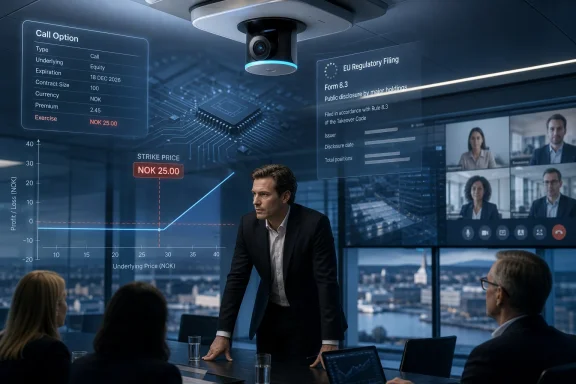
The mechanics are straightforward. Larsen receives no shares today, no cash payment, and no guaranteed payday. He receives the right to buy 40,000 Huddly shares later at NOK 25 per share, if the terms of the company’s 2025 Share Incentive Plan are met and if the market price eventually makes exercise worthwhile.
That distinction matters. Options are not the same as a share purchase, and they are not the same as a bonus. They are an upside instrument: valuable only if the company’s equity story improves enough to put the option holder in the money.
For investors, the practical message is that Huddly is continuing to use equity-based incentives to align insiders with shareholders. For skeptics, the same transaction can be read less romantically: options are also a low-cash way to compensate leadership while preserving capital.
Both readings can be true. In a hardware-and-software company still trying to prove durable scale, cash discipline and equity alignment are often two sides of the same boardroom coin.
That is the point of options, of course. They do not reward mere survival. They reward market appreciation.
But a fixed strike price can also harden expectations. Huddly is not simply saying that a new director has joined the board; it is saying that the incentive structure approved by shareholders points toward a materially higher equity outcome than the market has often been willing to underwrite for small listed technology hardware names.
This is why insider option grants deserve more attention than they usually receive. They rarely change the business overnight, but they reveal the compensation architecture around the people expected to help change it.
Huddly sits at the intersection of optics, embedded systems, AI processing, firmware, cloud-connected device management, and enterprise purchasing cycles. That is not a simple consumer-electronics story. It is closer to the world of specialized hardware platforms that must win through ecosystem fit, supply-chain discipline, software longevity, and repeatable channel execution.
A director with semiconductor-sector experience is therefore not decorative. Huddly’s cameras may be sold into meeting rooms, but the business depends on decisions that look very familiar to anyone who has spent time around components, reference designs, distribution partners, and enterprise product roadmaps.
The grant also follows the resignation of Jostein Devold, who had served on Huddly’s board across multiple periods and previously chaired it. Board changes are normal, but they can be revealing when they happen alongside incentive-plan adjustments. Huddly is not merely filling a seat; it is refreshing the expertise around a company that needs to convert product credibility into predictable financial performance.
The problem is that the category is crowded. Microsoft Teams Rooms, Zoom Rooms, Google Meet hardware ecosystems, integrated displays, bars, webcams, and room kits all compete for the same enterprise budget. The camera may be intelligent, but procurement still asks ordinary questions: how many rooms, how much per room, how long will the device be supported, and does it work cleanly with the collaboration stack already deployed?
This is where Huddly’s AI language must meet buyer reality. AI-powered framing and meeting-room intelligence are useful, but they are no longer exotic. Large platform vendors and peripheral makers alike have moved aggressively into similar territory.
That does not make Huddly irrelevant. It makes execution more important. The winner in this market is not necessarily the company with the cleverest demo; it is the company whose devices become easy for IT departments to standardize, update, secure, support, and justify across hundreds or thousands of rooms.
That gives certified or well-integrated meeting-room hardware a route into organizations that already manage identity, endpoints, calendars, compliance, and device policy through Microsoft infrastructure. A camera is not just a camera in that setting. It becomes part of a managed collaboration endpoint.
The opportunity is substantial, but so is the burden. Enterprise IT teams do not want novelty if it creates operational drag. They want devices that behave predictably after firmware updates, work across room sizes, remain manageable over time, and do not turn every conference room into a bespoke support ticket.
That is why Huddly’s promise of upgradable software and durable hardware matters. It is also why investors should treat the promise as a test, not an achievement. The market will reward Huddly only if those qualities translate into deployments, renewals, and measurable account expansion.
Yet the dullness is part of the point. These filings give outside shareholders a standardized window into how insiders are being paid, how much exposure they are taking, and whether leadership’s economic incentives move with the equity.
In this case, Larsen’s grant is explicitly disclosed under EU Market Abuse Regulation article 19 and Norwegian securities rules. That does not imply misconduct or controversy. It means the company is making the transaction visible because a primary insider has received a financial instrument linked to the shares.
The more interesting issue is dilution. If options are eventually exercised, new or existing shares must satisfy them, depending on plan mechanics. A single 40,000-option grant is not transformative by itself, but incentive plans accumulate. Shareholders should watch the total pool, not just the latest notification.
The great criticism is that options can encourage asymmetry. They provide upside without the same downside exposure as buying shares with personal cash. A director who receives options without consideration is not making the same economic statement as a director purchasing shares in the market.
That does not make the grant inappropriate. Board compensation often mixes cash, shares, and options precisely because boards need to attract experienced people without overburdening operating budgets. But investors should resist the lazy interpretation that every insider option grant is equivalent to insider buying.
It is better understood as a conditional incentive. Larsen is being handed exposure to a recovery case. He is not, at least through this transaction, committing personal capital to it.
That is a harder environment for a specialist vendor. The easy demand is gone. The remaining demand is more professional, more centralized, and more comparative.
Huddly’s product pitch fits the moment in theory. AI can make remote participants feel less like spectators. Better room framing can reduce meeting fatigue. Software-upgradable hardware can extend useful life and lower replacement pressure.
But theory is not revenue. The company has to show that its differentiation survives procurement scrutiny and competitive bundling. The phrase “future-proof” is powerful in marketing copy; in IT purchasing, it becomes a claim that must be renewed with every update cycle.
Huddly sells into a world where channel partners, platform certifications, integrators, resellers, and enterprise standards all matter. A strong product can still struggle if it is hard to procure, hard to compare, or absent from the preferred buying paths of large customers.
That is one reason board composition matters. Directors do not write firmware, but they influence strategy, capital allocation, partnerships, executive hiring, and market focus. A board with relevant technology and scaling experience can help a company avoid mistaking technical elegance for commercial momentum.
The Larsen appointment therefore deserves to be read together with the option grant. The company is bringing in a technology executive and tying part of his upside to the share price. It is a compact version of the larger Huddly story: expertise now, reward later, if execution follows.
What it does tell us is that Huddly’s shareholders have approved a compensation framework in which board-level incentives are attached to a NOK 25 strike. It tells us that the company is continuing to use options as part of its governance toolkit. It tells us that a newly elected director is being economically linked to the same recovery narrative management needs the market to believe.
That is enough to matter, but not enough to settle the argument. Investors should not confuse a grant with validation. The filing is a clue, not a conclusion.
The next evidence will come from operating results, product adoption, gross margins, cash runway, and the company’s ability to turn AI-enabled collaboration hardware into a repeatable enterprise business. Compensation can align incentives; it cannot manufacture demand.
That does not mean Larsen receives NOK 1 million. It means he would need the shares to be worth more than NOK 25 each for exercise to make economic sense. The value lies in the spread between the exercise price and the future market price.
This is why option announcements should be read with discipline. The notional number can sound large, but the real value depends on vesting terms, expiration, future share price, liquidity, tax treatment, and the holder’s ability or willingness to exercise.
For ordinary shareholders, the key question is not whether the director has been awarded a potentially lucrative package. It is whether the package pushes the board toward decisions that create durable per-share value rather than merely chasing a temporary stock bounce.
That shift creates opportunity for Huddly. Software can improve a device after purchase, differentiate features across room types, and support enterprise fleet management. It can also create a longer relationship with customers than a one-off hardware sale.
But the same shift raises expectations. If a vendor sells software-upgradable hardware, customers expect ongoing updates. If a vendor sells AI-powered experiences, customers expect the intelligence to improve rather than stagnate. If a vendor sells into Teams, Zoom, and Meet environments, customers expect compatibility not just at launch but through platform changes.
That lifecycle burden costs money. It requires engineering capacity, quality assurance, support infrastructure, and a roadmap that does not strand installed customers. The investment case for Huddly depends on whether the company can support that burden while building a profitable installed base.
A specialized camera vendor can be attractive if it reduces friction. Better framing and audio-visual intelligence can improve meetings without asking users to learn new behavior. But any device added to the room estate also adds another lifecycle to manage.
That is the practical lens through which IT pros should read Huddly’s positioning. AI is useful when it disappears into a better meeting. It is a nuisance when it becomes another opaque subsystem that breaks after an update.
Huddly’s opportunity is to be the former. Its risk is becoming the latter in a market where large platform vendors are steadily absorbing more of the room experience into their own ecosystems.
Still, the timing and recipient give the notice weight. Huddly has added a director with deep technology-company experience and attached his upside to the same share-price threshold embedded in the amended incentive plan. That is a governance action with a message.
The message is not “trust us.” Public markets are not obliged to trust. The message is closer to “judge us by whether the equity becomes worth exercising.”
That is a cleaner proposition, and a harsher one. If Huddly executes, the option grant will look like smart alignment. If it does not, the options may become another artifact of ambition outrunning results.
 Huddly Turns a Board Appointment Into a Market Signal
The mechanics are straightforward. Larsen receives no shares today, no cash payment, and no guaranteed payday. He receives the right to buy 40,000 Huddly shares later at NOK 25 per share, if the terms of the company’s 2025 Share Incentive Plan are met and if the market price eventually makes exercise worthwhile.That distinction matters. Options are not the same as a share purchase, and they are not the same as a bonus. They are an upside instrument: valuable only if the company’s equity story improves enough to put the option holder in the money.
For investors, the practical message is that Huddly is continuing to use equity-based incentives to align insiders with shareholders. For skeptics, the same transaction can be read less romantically: options are also a low-cash way to compensate leadership while preserving capital.
Both readings can be true. In a hardware-and-software company still trying to prove durable scale, cash discipline and equity alignment are often two sides of the same boardroom coin.
The Strike Price Is the Detail That Carries the Story
The NOK 25.00 exercise price is the number to watch because it converts a governance filing into a bet on valuation. If Huddly’s share price remains below that level, the options are effectively theoretical. If the company’s market value climbs above it, Larsen’s grant becomes a levered expression of confidence in the company’s future.That is the point of options, of course. They do not reward mere survival. They reward market appreciation.
But a fixed strike price can also harden expectations. Huddly is not simply saying that a new director has joined the board; it is saying that the incentive structure approved by shareholders points toward a materially higher equity outcome than the market has often been willing to underwrite for small listed technology hardware names.
This is why insider option grants deserve more attention than they usually receive. They rarely change the business overnight, but they reveal the compensation architecture around the people expected to help change it.
A Veteran Semiconductor Executive Joins a Camera Company at a Telling Moment
Larsen is not an anonymous appointee. He is best known as a former chief executive of Nordic Semiconductor, one of Norway’s more globally recognizable technology companies. That background gives the appointment a different texture from a routine board replacement.Huddly sits at the intersection of optics, embedded systems, AI processing, firmware, cloud-connected device management, and enterprise purchasing cycles. That is not a simple consumer-electronics story. It is closer to the world of specialized hardware platforms that must win through ecosystem fit, supply-chain discipline, software longevity, and repeatable channel execution.
A director with semiconductor-sector experience is therefore not decorative. Huddly’s cameras may be sold into meeting rooms, but the business depends on decisions that look very familiar to anyone who has spent time around components, reference designs, distribution partners, and enterprise product roadmaps.
The grant also follows the resignation of Jostein Devold, who had served on Huddly’s board across multiple periods and previously chaired it. Board changes are normal, but they can be revealing when they happen alongside incentive-plan adjustments. Huddly is not merely filling a seat; it is refreshing the expertise around a company that needs to convert product credibility into predictable financial performance.
Collaboration Hardware Has Become an AI Story, but Buyers Still Count the Rooms
Huddly describes itself as a maker of intelligent camera systems for inclusive and productive teamwork. That positioning is sensible. Meeting rooms are now expected to support hybrid work by default, and vendors that can improve framing, speaker awareness, image quality, and platform integration have a natural opening.The problem is that the category is crowded. Microsoft Teams Rooms, Zoom Rooms, Google Meet hardware ecosystems, integrated displays, bars, webcams, and room kits all compete for the same enterprise budget. The camera may be intelligent, but procurement still asks ordinary questions: how many rooms, how much per room, how long will the device be supported, and does it work cleanly with the collaboration stack already deployed?
This is where Huddly’s AI language must meet buyer reality. AI-powered framing and meeting-room intelligence are useful, but they are no longer exotic. Large platform vendors and peripheral makers alike have moved aggressively into similar territory.
That does not make Huddly irrelevant. It makes execution more important. The winner in this market is not necessarily the company with the cleverest demo; it is the company whose devices become easy for IT departments to standardize, update, secure, support, and justify across hundreds or thousands of rooms.
The Microsoft Teams Angle Is Strategic, Not Cosmetic
For WindowsForum readers, the obvious hook is Microsoft Teams. Huddly’s cameras are marketed for major platforms including Teams, Zoom, and Google Meet, but Teams occupies a particular place in enterprise IT because it is bundled into the broader Microsoft 365 operating environment.That gives certified or well-integrated meeting-room hardware a route into organizations that already manage identity, endpoints, calendars, compliance, and device policy through Microsoft infrastructure. A camera is not just a camera in that setting. It becomes part of a managed collaboration endpoint.
The opportunity is substantial, but so is the burden. Enterprise IT teams do not want novelty if it creates operational drag. They want devices that behave predictably after firmware updates, work across room sizes, remain manageable over time, and do not turn every conference room into a bespoke support ticket.
That is why Huddly’s promise of upgradable software and durable hardware matters. It is also why investors should treat the promise as a test, not an achievement. The market will reward Huddly only if those qualities translate into deployments, renewals, and measurable account expansion.
Insider Filings Are Boring Until They Reveal the Compensation Philosophy
Mandatory notifications of primary-insider trades are usually among the least glamorous market announcements. They exist because regulators require transparency when directors, executives, or their closely associated parties transact in company securities.Yet the dullness is part of the point. These filings give outside shareholders a standardized window into how insiders are being paid, how much exposure they are taking, and whether leadership’s economic incentives move with the equity.
In this case, Larsen’s grant is explicitly disclosed under EU Market Abuse Regulation article 19 and Norwegian securities rules. That does not imply misconduct or controversy. It means the company is making the transaction visible because a primary insider has received a financial instrument linked to the shares.
The more interesting issue is dilution. If options are eventually exercised, new or existing shares must satisfy them, depending on plan mechanics. A single 40,000-option grant is not transformative by itself, but incentive plans accumulate. Shareholders should watch the total pool, not just the latest notification.
Options Align Insiders, but They Also Move Risk Around
The great defense of options is alignment. If the share price rises, insiders benefit alongside shareholders. If the share price does not rise, the options may expire worthless or remain unexercised.The great criticism is that options can encourage asymmetry. They provide upside without the same downside exposure as buying shares with personal cash. A director who receives options without consideration is not making the same economic statement as a director purchasing shares in the market.
That does not make the grant inappropriate. Board compensation often mixes cash, shares, and options precisely because boards need to attract experienced people without overburdening operating budgets. But investors should resist the lazy interpretation that every insider option grant is equivalent to insider buying.
It is better understood as a conditional incentive. Larsen is being handed exposure to a recovery case. He is not, at least through this transaction, committing personal capital to it.
Huddly’s Real Test Is Whether AI Features Become a Repeatable Business
The collaboration market has been through several waves since the pandemic normalized hybrid meetings. First came the emergency purchase cycle, when companies bought what they could get. Then came standardization, as IT teams rationalized their rooms and platforms. Now the category is in a more demanding phase: upgrades must be justified by experience, manageability, security, and lifecycle economics.That is a harder environment for a specialist vendor. The easy demand is gone. The remaining demand is more professional, more centralized, and more comparative.
Huddly’s product pitch fits the moment in theory. AI can make remote participants feel less like spectators. Better room framing can reduce meeting fatigue. Software-upgradable hardware can extend useful life and lower replacement pressure.
But theory is not revenue. The company has to show that its differentiation survives procurement scrutiny and competitive bundling. The phrase “future-proof” is powerful in marketing copy; in IT purchasing, it becomes a claim that must be renewed with every update cycle.
The Boardroom Bet Is About Distribution as Much as Technology
Small technology companies often overestimate the value of invention and underestimate the value of distribution. In enterprise hardware, both are necessary, but distribution usually decides the pace of adoption.Huddly sells into a world where channel partners, platform certifications, integrators, resellers, and enterprise standards all matter. A strong product can still struggle if it is hard to procure, hard to compare, or absent from the preferred buying paths of large customers.
That is one reason board composition matters. Directors do not write firmware, but they influence strategy, capital allocation, partnerships, executive hiring, and market focus. A board with relevant technology and scaling experience can help a company avoid mistaking technical elegance for commercial momentum.
The Larsen appointment therefore deserves to be read together with the option grant. The company is bringing in a technology executive and tying part of his upside to the share price. It is a compact version of the larger Huddly story: expertise now, reward later, if execution follows.
The Filing Says Less Than Investors Want, and More Than It Seems
The announcement does not tell us whether Huddly is about to win a major customer. It does not tell us whether margins are improving, whether channel momentum is accelerating, or whether the company’s AI features are converting skeptics. It does not even tell us whether Larsen’s options will ever have economic value.What it does tell us is that Huddly’s shareholders have approved a compensation framework in which board-level incentives are attached to a NOK 25 strike. It tells us that the company is continuing to use options as part of its governance toolkit. It tells us that a newly elected director is being economically linked to the same recovery narrative management needs the market to believe.
That is enough to matter, but not enough to settle the argument. Investors should not confuse a grant with validation. The filing is a clue, not a conclusion.
The next evidence will come from operating results, product adoption, gross margins, cash runway, and the company’s ability to turn AI-enabled collaboration hardware into a repeatable enterprise business. Compensation can align incentives; it cannot manufacture demand.
The Small Print Points to the Bigger Questions
The most concrete part of the announcement is also the easiest to overlook: each option gives Larsen the right to acquire one share. That one-for-one structure makes the arithmetic plain. The grant represents potential exposure to 40,000 shares, with a total exercise cost of NOK 1 million if fully exercised at NOK 25.That does not mean Larsen receives NOK 1 million. It means he would need the shares to be worth more than NOK 25 each for exercise to make economic sense. The value lies in the spread between the exercise price and the future market price.
This is why option announcements should be read with discipline. The notional number can sound large, but the real value depends on vesting terms, expiration, future share price, liquidity, tax treatment, and the holder’s ability or willingness to exercise.
For ordinary shareholders, the key question is not whether the director has been awarded a potentially lucrative package. It is whether the package pushes the board toward decisions that create durable per-share value rather than merely chasing a temporary stock bounce.
The Camera Business Is Now a Software-Lifecycle Business
Huddly’s own description emphasizes AI, software, hardware, and user experience. That combination is not incidental. The modern meeting-room camera is becoming less like a peripheral and more like a managed computing endpoint with optics attached.That shift creates opportunity for Huddly. Software can improve a device after purchase, differentiate features across room types, and support enterprise fleet management. It can also create a longer relationship with customers than a one-off hardware sale.
But the same shift raises expectations. If a vendor sells software-upgradable hardware, customers expect ongoing updates. If a vendor sells AI-powered experiences, customers expect the intelligence to improve rather than stagnate. If a vendor sells into Teams, Zoom, and Meet environments, customers expect compatibility not just at launch but through platform changes.
That lifecycle burden costs money. It requires engineering capacity, quality assurance, support infrastructure, and a roadmap that does not strand installed customers. The investment case for Huddly depends on whether the company can support that burden while building a profitable installed base.
Why This Matters to Windows-Centric IT Shops
Windows administrators have learned the hard way that conference rooms are endpoints too. They have firmware, drivers, network requirements, security settings, identity-adjacent workflows, and support expectations from executives who do not care why a meeting failed.A specialized camera vendor can be attractive if it reduces friction. Better framing and audio-visual intelligence can improve meetings without asking users to learn new behavior. But any device added to the room estate also adds another lifecycle to manage.
That is the practical lens through which IT pros should read Huddly’s positioning. AI is useful when it disappears into a better meeting. It is a nuisance when it becomes another opaque subsystem that breaks after an update.
Huddly’s opportunity is to be the former. Its risk is becoming the latter in a market where large platform vendors are steadily absorbing more of the room experience into their own ecosystems.
A Modest Grant With an Immodest Set of Implications
There is a temptation to overstate every insider filing because market announcements arrive with legal seriousness. This one should not be inflated into a sweeping verdict on Huddly’s future. A 40,000-option grant to a new board member is not, by itself, a strategic reset.Still, the timing and recipient give the notice weight. Huddly has added a director with deep technology-company experience and attached his upside to the same share-price threshold embedded in the amended incentive plan. That is a governance action with a message.
The message is not “trust us.” Public markets are not obliged to trust. The message is closer to “judge us by whether the equity becomes worth exercising.”
That is a cleaner proposition, and a harsher one. If Huddly executes, the option grant will look like smart alignment. If it does not, the options may become another artifact of ambition outrunning results.
The NOK 25 Bet Gives Shareholders a Simple Scorecard
This announcement is narrow, but it leaves investors with a useful checklist. The grant should be understood neither as a red flag nor as a victory lap, but as a marker for how Huddly wants to align leadership around future value creation.- Larsen has been granted 40,000 options, each carrying the right to acquire one Huddly share at NOK 25.00.
- The options were granted without consideration under Huddly’s amended 2025 Share Incentive Plan.
- The notification was required because Larsen is a primary insider following his election to the board.
- The economic value of the grant depends on Huddly’s future share price exceeding the exercise price and on the plan’s detailed terms.
- The appointment brings semiconductor-sector leadership experience into a company trying to scale AI-enabled collaboration hardware.
- The filing is best read as an incentive-alignment signal, not as proof that the company’s commercial trajectory has changed.
References
- Primary source: Finansavisen
Published: 2026-06-22T20:42:08.291778
Huddly AS - Mandatory notification of trade by primary insider | Finansavisen
 www.finansavisen.no
- Related coverage: huddly.com
- Related coverage: inderes.se
Huddly AS - Mandatory notification of trade - Inderes
Oslo, 26 March 2026: Reference is made to the stock exchange announcement published by Huddly AS ("Huddly" or the "Company", ticker: HDLY) earlier today regarding the final results in a subsequent...www.inderes.se - Related coverage: marketscreener.com
- Related coverage: financialreports.eu
Huddly AS | Investor Relations / Filings / Financial statement
Investor Relations – Filings and financial statements from Huddly AS. Check out the latest publications, news and insider trades.financialreports.eu - Related coverage: live.euronext.com
- Related coverage: storage.mfn.se
