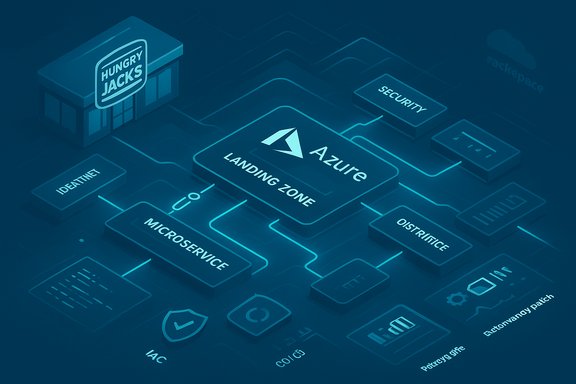
Hungry Jack’s has taken a decisive step toward modernising its digital business by partnering with Rackspace Technology to migrate core systems onto Microsoft Azure, building an automated, secure Azure landing zone that promises faster feature delivery, improved reliability for its mobile and loyalty channels, and a more cost‑efficient operating model for the brand’s nationwide digital estate.
Hungry Jack’s, the Australian master franchisee for Burger King, operates hundreds of restaurants across the country and has been under pressure to scale digital services as mobile ordering, loyalty and promos increasingly drive in‑store traffic and margin. The company’s prior digital platform began showing its limits as app usage accelerated, creating a strategic imperative to move away from brittle, manually managed infrastructure toward a cloud foundation that supports continuous delivery, robust security and elastic scale. This migration is part of a wider trend among quick‑service restaurant (QSR) chains to treat digital channels as core revenue engines rather than marketing extras. Lean, resilient cloud architectures enable rapid experimentation with offers, faster incident resolution during peak times and simplified integrations with payment, delivery and analytics partners.
Key technical shifts include:
Benefits delivered:
Expected customer‑facing improvements:
If Hungry Jack’s continues to enforce governance, invest in FinOps and maintain a strong partnership with Rackspace through a well‑defined Day‑2 operations model, it should be well positioned to leverage the platform for faster innovation, improved customer engagement and more efficient operations. The new cloud foundation is not an end in itself but a platform for product teams to experiment faster, reduce failure blast radius and deliver customer value more predictably.
Hungry Jack’s migration to Azure, executed with Rackspace Technology, is a textbook example of how a consumer‑facing brand can convert infrastructure investment into commercial agility: shorter release cycles, better reliability during promotional peaks, and a platform that supports both cost‑management and faster customer innovation. The critical next steps will be to sustain operational discipline, measure outcomes against clear KPIs and keep governance tight while product teams take advantage of the new capabilities to deliver more relevant, timely and reliable digital experiences.
Source: DataCenterNews Asia Pacific Hungry Jack’s boosts digital agility with Azure cloud upgrade
 Background
Hungry Jack’s, the Australian master franchisee for Burger King, operates hundreds of restaurants across the country and has been under pressure to scale digital services as mobile ordering, loyalty and promos increasingly drive in‑store traffic and margin. The company’s prior digital platform began showing its limits as app usage accelerated, creating a strategic imperative to move away from brittle, manually managed infrastructure toward a cloud foundation that supports continuous delivery, robust security and elastic scale. This migration is part of a wider trend among quick‑service restaurant (QSR) chains to treat digital channels as core revenue engines rather than marketing extras. Lean, resilient cloud architectures enable rapid experimentation with offers, faster incident resolution during peak times and simplified integrations with payment, delivery and analytics partners.Overview of the Rackspace–Hungry Jack’s project
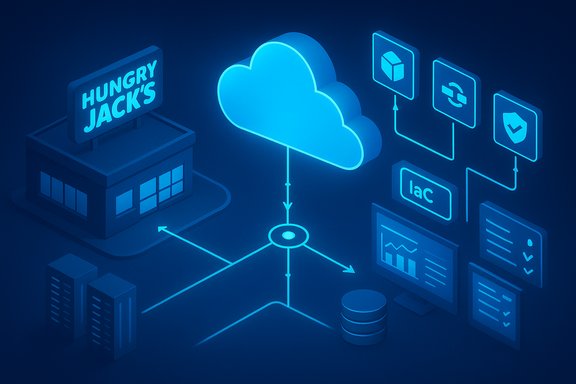
- What happened: Rackspace Technology designed and deployed an enterprise‑grade Azure landing zone for Hungry Jack’s, automating environment provisioning, security patching and resource management through Infrastructure as Code (IaC).
- Why it matters: The new environment is intended to reduce manual toil, shrink release cycles via CI/CD pipelines, embed security earlier in the development lifecycle (DevSecOps), and allow the business to scale compute and services on a pay‑as‑you‑go basis.
- Who said what: Hungry Jack’s Digital Technology Lead, Chad Capiz, praised the ability to “spin up environments as needed — fast, repeatable, and reliable,” while Rackspace APJ Managing Director Adhil Badat described the engagement as a model of collaborative modernisation.
Platform modernisation: what changed and why it matters
From fragile to repeatable
Hungry Jack’s legacy platform experienced capacity and agility constraints as usage spiked. The migration replaces ad hoc, manually configured infrastructure with repeatable, auditable constructs — Azure landing zones defined and deployed with IaC.Key technical shifts include:
- Adoption of an enterprise Azure landing zone to centralise networking, identity, and security baselines.
- Use of IaC (Terraform/ARM/Bicep or equivalent) to automate environment creation and maintain consistency across dev, test and production.
- Standardised pipelines for CI/CD to move code from commit to production faster and with less human error.
DevSecOps baked in
A standout element of the programme is embedding security checks inside build and release pipelines — the core of DevSecOps practice. Automated security scans at build time, policy enforcement in IaC, and continuous compliance checks reduce the chance that vulnerabilities or misconfigurations reach production. This shift turns security from a gating function into a continuous quality attribute of releases.Operational agility and engineering practices
Rackspace supplied Elastic Engineering resources to implement CI/CD and automation patterns that enable faster iteration cycles for Hungry Jack’s development teams.Benefits delivered:
- Faster time to market: automated pipelines reduce friction between development and production.
- Safer rollouts: feature gating, canary deployments and automated rollback strategies lower production risk.
- Better observability: centralised telemetry and logging provide quicker root cause analysis during incidents.
- Knowledge uplift: structured handovers and training for internal and offshore teams increase self‑sufficiency.
Cost, efficiency and financial implications
One of the principal promises of cloud migration is more efficient resource consumption. Hungry Jack’s reports improved cost optimisation through Azure’s consumption billing model, reducing the need to over‑provision for peak loads and allowing more granular control over spend. Rackspace’s automation contributes by turning idle, long‑running infrastructure into ephemeral, policy‑managed resources. Concrete financial levers available to Hungry Jack’s:- Scale compute instances up/down automatically during promotions and peak hours.
- Use reserved instances or savings plans where predictable baseline workloads exist.
- Implement cost‑guardrails and tagging for improved chargeback and optimisation.
- Reduce operational expense (OpEx) by automating routine maintenance tasks such as patching.
Security, compliance and resilience
Security was a core requirement for the Azure foundation. The Rackspace landing zone approach combines Azure native controls (identity, network segmentation, policy enforcement) with automation for patching and compliance verification. This results in:- Faster security patch rollouts through orchestration.
- Reduced attack surface via consistent network and identity baselines.
- Continuous compliance checks to meet regulatory and corporate policies.
Customer engagement: why the move is customer‑centric
Hungry Jack’s explicitly framed the migration as a way to deliver better customer experiences — faster app updates, more reliable loyalty program access, and more personalised digital offers.Expected customer‑facing improvements:
- Reduced downtime for mobile ordering and loyalty services during peak promotions.
- Faster rollout of experiments and personalised offers using real‑time or near‑real‑time telemetry.
- Consistent multi‑channel behaviour as backend services standardise on the Azure platform.
Technical deep dive: Azure landing zone, IaC and CI/CD
What is an Azure landing zone in practice?
An Azure landing zone is a prescriptive, enterprise‑grade baseline that sets up identity (Azure AD), subscription design, networking (VNets, subnets), security controls (policies, role‑based access), logging and monitoring. For Hungry Jack’s, Rackspace implemented this with IaC so that environments are declarative, repeatable and auditable. Key components typically included:- Identity and access management via Azure AD with least privilege controls.
- Networking: hub‑and‑spoke VNet topology and secure egress patterns.
- Security: Azure Policy, Blueprints, and baseline guardrails enforced as code.
- Observability: centralized logs, Application Insights, and metrics for SLAs.
- Automation: pipelines for deployment, patching, and configuration drift detection.
Infrastructure as Code (IaC)
IaC makes it possible to version control infrastructure alongside application code, enabling peer review, automated testing, and consistent deployments across environments. By treating environment configuration as code, Hungry Jack’s gains:- Faster provisioning of sandbox and staging environments for development.
- Lower risk of configuration drift between environments.
- Audit trails for changes to critical security and network settings.
CI/CD and DevSecOps
Rackspace’s Elastic Engineering established CI/CD pipelines that integrate automated tests, security scanning and quality gates. Typical patterns implemented include:- Automated builds and unit tests.
- Static Application Security Testing (SAST) and dependency scanning.
- Container image scanning and runtime controls for containerised workloads.
- Automated deployments with canary and blue/green strategies to minimise blast radius.
Change management and skills transfer
A critical non‑technical outcome highlighted in the engagement is knowledge transfer. Rackspace worked not only as a delivery partner but as a coach, transferring operational know‑how to Hungry Jack’s in‑house and offshore teams. This approach is essential to avoid long‑term dependence on external partners and to build internal capability for:- Operational runbooks and incident playbooks.
- Pipeline maintenance and IaC governance.
- Cost governance and cloud financial operations (FinOps).
- Establish a measured handover plan with defined milestones.
- Run joint operations for a period (shadowing) to build confidence.
- Create a centre of excellence to capture learnings and maintain standards.
Business impact and measurable KPIs
The Rackspace–Hungry Jack’s engagement delivers outcomes that can be tracked with clear KPIs:- Deployment frequency: number of production deployments per week/month (expected to rise).
- Lead time for changes: time from commit to production (expected to fall).
- Mean time to recovery (MTTR): time to restore service after an incident (expected to fall).
- Cost per transaction: infrastructure cost allocated to mobile/loyalty transactions (expected to fall through better scaling).
- Availability and uptime of customer‑facing services (expected to improve).
The Australian cloud landscape and strategic timing
Hungry Jack’s move comes as hyperscalers expand local capacity in Australia — improving network locality, latency and regulatory compliance options. For businesses operating across Australia, proximity to Azure regions and edge zones matters for both performance and sovereignty. Rackspace’s partnership leverages these hyperscaler investments to offer platform modernisation tailored to the market. Timing matters: as digital channels become the revenue backbone for QSRs, the ability to execute rapid, low‑risk changes becomes a competitive advantage.Risks, blind spots and governance considerations
The cloud promises are real, but several risks must be managed actively:- Vendor lock‑in: heavy use of platform‑specific services (PaaS) may increase switching costs. Design patterns should favour portability for critical services where appropriate.
- Cost drift: without robust FinOps, consumption models can lead to unexpected spend. Implementing tagging, budget alerts and rightsizing is essential.
- Security misconfiguration: IaC reduces human error, but poorly written IaC can codify insecure defaults. Code reviews and automated policy checks are mandatory.
- Data residency and regulatory concerns: while Azure has local presence, data flows and backups must adhere to any applicable local laws and contractual obligations.
- Operational maturity: automation reduces toil but requires internal teams capable of operating and evolving the platform — the success of the project hinges on effective skills transfer.
- Define a cloud operating model and ownership boundaries.
- Run policy as code and automate enforcement.
- Invest in FinOps and a security centre of excellence.
- Maintain an architecture review board for new services.
How Hungry Jack’s compares with peers
Several global QSR brands have undertaken similar cloud modernisations, often with comparable goals: scale for peak demand, faster product experimentation and improved resilience during promotions. The value chain — mobile ordering, loyalty, delivery integrations — is the same; the differentiator is execution speed and operational discipline. Rackspace’s role as a managed platform and engineering partner is consistent with patterns where retailers choose a specialist services provider to accelerate adoption and absorb early program risk.Recommendations for organisations planning a similar migration
- Start with a well‑scoped landing zone that enforces security and networking guardrails from day one.
- Automate everything possible — provisioning, patching and deployments — to reduce manual errors.
- Build a phased knowledge transfer plan to make the customer self‑sufficient.
- Combine FinOps, security and developer enablement to balance speed, cost and risk.
- Measure impact with clearly defined KPIs (deploy frequency, MTTR, cost per transaction).
Final assessment: strengths, trade‑offs and the road ahead
The Rackspace‑led Azure modernisation addresses the principal pain points Hungry Jack’s faced: scalability limits, long release cycles and manual operations. The project’s strengths include:- Tangible engineering practices (IaC, CI/CD, DevSecOps) that convert strategy into daily operational improvements.
- Automated cost and security controls that can materially reduce risk and unreliable spend patterns.
- Knowledge transfer and operational uplift to ensure the platform can be sustained in‑house.
If Hungry Jack’s continues to enforce governance, invest in FinOps and maintain a strong partnership with Rackspace through a well‑defined Day‑2 operations model, it should be well positioned to leverage the platform for faster innovation, improved customer engagement and more efficient operations. The new cloud foundation is not an end in itself but a platform for product teams to experiment faster, reduce failure blast radius and deliver customer value more predictably.
Hungry Jack’s migration to Azure, executed with Rackspace Technology, is a textbook example of how a consumer‑facing brand can convert infrastructure investment into commercial agility: shorter release cycles, better reliability during promotional peaks, and a platform that supports both cost‑management and faster customer innovation. The critical next steps will be to sustain operational discipline, measure outcomes against clear KPIs and keep governance tight while product teams take advantage of the new capabilities to deliver more relevant, timely and reliable digital experiences.
Source: DataCenterNews Asia Pacific Hungry Jack’s boosts digital agility with Azure cloud upgrade