

The oil and gas sector has lived the digital paradox: an early, optimistic embrace of data-driven tools that often produced flashy pilots but limited long-term operational impact. After a quarter-century of "digital oilfield" experiments, the path to meaningful AI-driven production gains is no longer about choosing between machine learning or engineering math — it is about combining them. Practical, scalable wins come when models are grounded in the physical laws that govern wells and equipment, continuously updated with live telemetry, and deployed in ways that respect field workflows and human ownership.
The phrase “digital oilfield” is not new; the industry began layering instrumentation, remote monitoring and integrated workflows decades ago as computing and communications matured. That long pedigree explains why oil and gas has produced many sophisticated digital pilots, but it also explains the industry’s deep skepticism: pilots that ignored operational realities or produced inscrutable recommendations quickly lost support. The historical arc—from 3D seismic and remote wells to today’s agentic AI platforms—shows steady technical progress but mixed operational adoption. Today’s opportunity is distinct: teams can combine modern machine learning, large-model components, and edge computing with robust mechanistic models and operational practice to create systems that are both intelligent and credible in the field. Recent academic and industrial reviews of digital twins and physics-informed machine learning show that hybrid architectures — physics backbones with ML surrogates and state estimation layers — are maturing into production-ready patterns across energy sectors. These hybrid twins address the principal weaknesses of both extremes: pure physics models that cannot adapt in real time, and pure data models that can make physically impossible recommendations.
Leaders who will win will do three things well:
Source: American Oil & Gas Reporter Balancing Intelligent Automation, Real-World Operational Physics Key to AI-Based Optimization | Cover Story | Magazine
 Background: why the “digital oilfield” promise still matters
The phrase “digital oilfield” is not new; the industry began layering instrumentation, remote monitoring and integrated workflows decades ago as computing and communications matured. That long pedigree explains why oil and gas has produced many sophisticated digital pilots, but it also explains the industry’s deep skepticism: pilots that ignored operational realities or produced inscrutable recommendations quickly lost support. The historical arc—from 3D seismic and remote wells to today’s agentic AI platforms—shows steady technical progress but mixed operational adoption. Today’s opportunity is distinct: teams can combine modern machine learning, large-model components, and edge computing with robust mechanistic models and operational practice to create systems that are both intelligent and credible in the field. Recent academic and industrial reviews of digital twins and physics-informed machine learning show that hybrid architectures — physics backbones with ML surrogates and state estimation layers — are maturing into production-ready patterns across energy sectors. These hybrid twins address the principal weaknesses of both extremes: pure physics models that cannot adapt in real time, and pure data models that can make physically impossible recommendations. Why hybrid — not “AI-only” or “physics-only” — is the operational sweet spot
The limits of single-minded approaches
- AI-only systems (pattern recognition, correlation-driven forecasts) can be powerful at identifying statistically consistent precursors to failures or suboptimal setpoints, but they frequently produce recommendations that clash with engineering intuition and test conditions. When operators see a suggestion that violates familiar physical constraints, they tend to ignore it — and that kills adoption faster than any technical flaw.
- Physics-only systems rely on mechanistic models and design assumptions that are essential for extrapolation and safety, but they often lack the agility to account for real-world variability: sensor degradation, changing fluid compositions, transient multiphase flows, and operational noise.
How the hybrid stack looks in practice
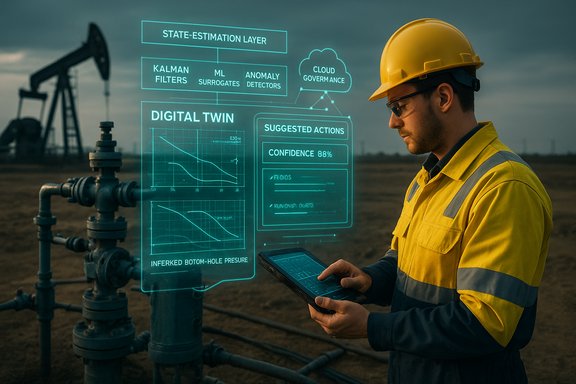
A practical production architecture typically layers:- a physics backbone (mass/energy balances, pump performance maps, choke curves, ESP electrical–hydraulic relationships) that enforces conservation laws and operational constraints;
- state estimation and virtual sensing (Kalman/particle filters, model-based observers) to infer hard-to-measure quantities like bottom-hole pressure or gas fraction;
- ML surrogates and anomaly detectors that learn residual behavior, detect signatures of impending failure, and accelerate computationally expensive simulations;
- an orchestration and governance layer that provides explainability, deterministic safety gates, versioning and rollback, and human-in-the-loop controls.
Operational targets that actually move the needle
For field teams, value is concrete: fewer truck rolls, longer run life for artificial lift equipment, cleaner runtime data, and sustained uptime. AI succeeds only when it measurably improves those metrics.1) Reduce truck rolls and non-productive time (NPT)
Automating chemical dosing, backpressure control, and alarm triage reduces unnecessary site visits and saves hours otherwise spent on low-value tasks. Practical deployments have shown immediate operational savings by shifting routine monitoring tasks to automated systems that surface only high-confidence, actionable alerts for human attention. Over time, service routes can be consolidated and expensive on-site trips reduced, lowering operating expense and incident exposure.2) Extend pump and equipment life
One of the clearest, most quantifiable wins comes from optimizing electrical submersible pump (ESP) operations. When a hybrid AI+physics approach controls pump speed, stabilizes tubing pressure, and prevents damaging operating modes (e.g., gas lock or sand ingestion transients), operators have documented extended run life. Public case studies from major service providers show large improvements: engineered ESP systems plus lifecycle monitoring have delivered run-life increases ranging from tens of percent to several-fold in harsh wells. These are company-verified outcomes reported in commercial case studies and conference presentations. They are not universal guarantees — results depend heavily on instrumentation fidelity, failure modes, and local geology — but they demonstrate the real potential when technology and operations align.3) Cleaner run-time data and faster decision cycles
Reliable signals and unified data views make setpoint decisions faster and easier. A single source of truth reduces friction between operator anecdotes, supervisor oversight, and engineering forecasts. Confidence in data leads to higher trust in automation — and that is a crucial adoption multiplier.4) Better KPIs and aligned incentives
When automations translate directly into improved uptime and reduced interventions, that performance ties into supervisor and engineer incentives. That alignment creates grassroots momentum for adoption because field personnel see personal and team-level wins, not just corporate dashboards.How to deploy: a phased adoption framework that earns trust
Adoption is a people problem as much as a technology one. The most successful rollouts follow a simple three-level progression that mirrors how operators learn and accept change:- Visibility and suggestions — instrumentation, centralized dashboards, and non-binding recommendations that let teams compare AI suggestions to their own judgment.
- Semi-automated decisions — the system implements lower-risk actions with supervisor oversight and defined hand-off rules.
- Full autonomy — deterministic control in constrained loops (e.g., pump speed control or chemical dosing) after acceptance tests and governance checks are satisfied.
Proof points: real-world results and how to read them
Concrete numbers make buy-in possible — but they must be treated with context.- Major service firms publish case studies showing ESP run-life improvements from intelligent monitoring and engineered hardware. For example, an engineered ESP system and lifecycle management service documented a run-life increase from ~50 days to more than 200 days in a harsh Siberian well — a >300% improvement that combined more robust hardware with production lifecycle monitoring and optimization. Another vendor reported collaborative environments and data science tools that improved runlife by roughly 51% while reducing premature failures by 30% in specific deployments. These vendor-validated results show the scale of potential gains but are site-specific and should be replicated with local pilots.
- Enterprise AI platforms highlight reductions in false alarms and earlier failure predictions (often reported as predictions 20–40 days before a failure), which directly translate into fewer unplanned interventions and higher recovery of production. Again, platform claims should be validated by independent pilot metrics and contractual SLAs.
- Academic and applied research on physics-informed neural networks (PINNs) and hybrid surrogates confirms the technical feasibility of learning pump dynamics, inferring bottom-hole pressures, and integrating conservation laws into ML models. Those techniques reduce the risk of physically inconsistent recommendations and improve generalization across fields.
Scaling up: technology, usability, and organizational ownership
Technology and product design
Scalable systems use modular, reusable components: an edge layer for deterministic loops, a cloud layer for heavy inference and fleet learning, and a governance plane for model versioning and traceability. The best deployments prioritize:- Edge determinism for safety-critical control (local fail-closed behavior).
- Model grounding and retrieval to minimize hallucinations by linking recommendations to specific telemetry and engineering evidence.
- Human-centered UI that presents concise operator actions, confidence intervals, and the physical rationale behind recommendations.
Usability and workflow alignment
A redesigned UI built around operator workflows beats a feature-packed dashboard that engineers ignore. Simplicity, transparency, and the ability to drill down into the physics or sensor traces when necessary are essential. Systems that validate operator instincts instead of asking them to abandon experience win far more quickly.Business ownership and governance
Too often, IT is expected to deliver an operations solution end-to-end. That rarely works. For durable adoption, the business (operations, engineering, and field leadership) must take ownership of the project lifecycle: requirements, acceptance criteria, staffing for ModelOps and AgentOps, and maintenance budgets. Leadership resolve matters: projects that survive the skeptical first six months typically have a sponsor willing to sustain investment until benefits become obvious.Risks, governance, and the hard edges
No technology is risk-free. The principal risks to manage are:- Hallucination and unsafe recommendations — mitigated by physics constraints, retrieval-augmented grounding, and fail-closed controls for safety-critical actions.
- Data quality and sensor drift — resolved through virtual sensing, frequent calibration, and conservative human-in-the-loop thresholds.
- Ownership and sustainment gaps — addressed by clear handovers from IT to operations and funding for ongoing ModelOps.
- Cyber and compliance exposure — controlled with network segmentation, private links, key management and audit trails, particularly where edge nodes command real-world equipment.
A practical roadmap for oil and gas operators
- Select a focused, high-value pilot (e.g., chemical dosing automation on a multiwell pad, or ESP optimization on a set of similarly instrumented wells).
- Instrument and baseline — ensure telemetry fidelity, create a single trusted view of runtime data, and record pre-deployment KPIs.
- Deploy hybrid models with constrained autonomy — start with suggestions, move to supervised actions, then to autonomy in low-risk loops.
- Measure rigorously and demand transparency — require reproducible benchmarks, define acceptance criteria, and insist on audit-ready outputs.
- Build ModelOps and AgentOps — plan for ongoing training, drift detection, and an operational team responsible for model performance.
- Scale modularly — port the validated module to similar wells and workflows; avoid one-off, monolithic integrations.
What success looks like — and who needs to lead
Success is not more dashboards; it is fewer midnight phone calls, fewer truck rolls, longer equipment run life, and more consistent production. Technically, it looks like a deployed hybrid model that reduces false alarms, predicts failures with useful lead time, and automatically keeps equipment operating in optimal windows under supervision. Organizationally, it looks like operations teams that own the tools, an executive who enforces acceptance tests, and a governance system that keeps models honest.Leaders who will win will do three things well:
- Hold the line on disciplined pilots and acceptance criteria.
- Assign business ownership to operations and engineering (not just IT).
- Invest in the sustainment organization — ModelOps, AgentOps, and retraining budgets — required to make AI a durable capability.
Conclusion
The industry’s digital future depends less on a new algorithm than on a new operating model: hybrid systems that embed physical laws, learn from live data, fit the way operators work, and are owned by the business functions that will use them every day. When physics and intelligent automation work together — not as competitors but as complementary layers — AI becomes a tool that validates operator judgment, extends equipment life, reduces truck rolls, and meaningfully improves production. The models are ready. The technical patterns are proven. The remaining barrier is leadership resolve: the companies that commit to disciplined pilots, embed governance, and give operations ownership will be the ones who convert pilots into permanent advantage.Source: American Oil & Gas Reporter Balancing Intelligent Automation, Real-World Operational Physics Key to AI-Based Optimization | Cover Story | Magazine
