

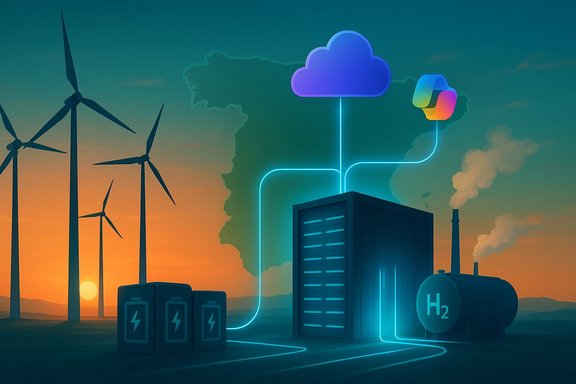
Iberdrola Group and Microsoft have deepened a strategic alliance that pairs two long‑term wind power purchase agreements (PPAs) in Spain totaling 150 MW with an expanded technology pact to increase Iberdrola’s use of Microsoft Azure, deploy Microsoft Copilot, and explore industrial applications such as data‑centre waste‑heat reuse, hydrogen, battery storage and other grid‑integration solutions.
Iberdrola is one of Europe’s largest renewable developers and an active corporate PPA seller; Microsoft is one of the hyperscalers that has aggressively paired cloud and AI expansion with long‑term renewable procurement. The December announcement frames the latest agreements as the first direct Iberdrola–Microsoft PPAs in Europe, complementing prior offtake deals Microsoft has with Iberdrola’s U.S. arm (Avangrid). Together, the companies say their U.S. and European contracted capacity with Iberdrola/Avangrid approaches the mid‑hundreds of megawatts.
This collaboration explicitly combines two commercial vectors that are increasingly fused across the energy sector: (1) asset‑backed renewable procurement by hyperscalers to meet corporate decarbonisation commitments, and (2) cloud + AI partnerships that give utilities new capabilities to optimise operations and open revenue streams beyond selling electrons. The Iberdrola–Microsoft package is therefore both an energy‑supply transaction and an industrial digital‑services alliance.
At the same time, the announcement highlights perennial PPA caveats: press headlines rarely reveal contract mechanics, and the difference between annual renewable MWh and hourly zero‑carbon matching remains a central technical and commercial challenge. For stakeholders — operators, regulators and community groups — the crucial test will be turning signed agreements into time‑synchronised, resilient systems that deliver measurable climate and socioeconomic benefits without transferring undue operational or governance risk to utility systems.
Watch the next disclosures closely: CODs, physical vs virtual structure, certificate allocation, and any pilot results for storage, hydrogen or heat reuse will determine whether this partnership is an incremental win or a substantive blueprint for energy‑to‑AI integration across Europe.
Source: energy-pedia.com Spain: Iberdrola Group and Microsoft strengthen their partnership with two PPAs in Spain for 150 MW and the use of new AI solutions
 Background and overview
Iberdrola is one of Europe’s largest renewable developers and an active corporate PPA seller; Microsoft is one of the hyperscalers that has aggressively paired cloud and AI expansion with long‑term renewable procurement. The December announcement frames the latest agreements as the first direct Iberdrola–Microsoft PPAs in Europe, complementing prior offtake deals Microsoft has with Iberdrola’s U.S. arm (Avangrid). Together, the companies say their U.S. and European contracted capacity with Iberdrola/Avangrid approaches the mid‑hundreds of megawatts.This collaboration explicitly combines two commercial vectors that are increasingly fused across the energy sector: (1) asset‑backed renewable procurement by hyperscalers to meet corporate decarbonisation commitments, and (2) cloud + AI partnerships that give utilities new capabilities to optimise operations and open revenue streams beyond selling electrons. The Iberdrola–Microsoft package is therefore both an energy‑supply transaction and an industrial digital‑services alliance.
What the deal contains — the PPAs and the tech scope
- Energy offtake: two long‑term PPAs in Spain covering output linked to the Iglesias wind farm (province of Burgos) and the El Escudo wind farm (Cantabria), with a combined contracted capacity publicised as 150 MW.
- Cloud and AI: expanded use of Microsoft Azure for Iberdrola’s migrated systems, broader deployment of Microsoft Copilot, and the adoption of Microsoft security and regulatory‑compliance tooling across business units.
- Joint innovation areas: exploratory work on waste‑heat reuse from data centres (a Zaragoza data‑centre use case is cited), battery storage, green hydrogen pilots, carbon credits, and grid‑integrating solutions that could firm intermittent renewable supply.
Verifying the headline numbers: what 150 MW means in practice
A 150 MW PPA headline is useful for signalling scale but requires context to translate into real energy (MWh) and operational value.- Nameplate vs contracted offtake: company and trade reporting show variation in the nameplate figures reported for each windpark. Public statements indicate the PPA contracted offtake is 150 MW in aggregate, but that may not equal the combined nameplate capacity of both farms — developers commonly sell partial output or size PPAs differently from installed capacity. This nuance is explicitly flagged in the public materials.
- Capacity factor and annual generation: onshore wind in northern Spain typically delivers capacity factors in the mid‑20s to mid‑30s percent range. Using a mid‑case 30% capacity factor, the math is:
150 MW × 8,760 hours/year × 0.30 ≈ 394,000 MWh/year (≈394 GWh/year).
A 25% capacity factor yields ≈329 GWh/year; 35% yields ≈459 GWh/year. Those numbers show the order‑of‑magnitude of energy Microsoft could reasonably attribute to the contracts, depending on site quality and turbine selection. - Temporal matching: even with hundreds of GWh/year delivered, intermittent generation does not guarantee power at a specific hour. Microsoft’s public ambition to match electricity consumption with zero‑carbon supply “100% of the time” (often summarised as 100/100/0) requires hourly or near‑hourly matching solutions — which typically need storage, dispatchable zero‑carbon resources, or market‑level time‑matching mechanisms. The Iberdrola PPAs form part of that regional supply strategy but are not, on their own, a time‑synchronous guarantee.
Project details and verification gaps (what is confirmed and what is not)
The announcement and industry reporting confirm the PPA counterparties, target projects (Iglesias and El Escudo) and the aggregate contracted capacity (150 MW). However, several contract‑level and technical specifics remain undisclosed publicly:- Tenor (contract length), strike price or pricing formula: not disclosed. These elements materially affect project bankability and the value to the offtaker/seller and therefore are central to commercial impact but remain private.
- Physical vs virtual PPA: the public statements do not clarify whether Microsoft is taking physical delivery on the local grid or using virtual (financial) PPAs that settle against market prices while Microsoft retains renewable attributes. This distinction affects system impact, accounting, and compliance.
- Guarantees of Origin (GOs) and certificates: allocation rules for renewable attributes are not published, yet they determine how and where Microsoft can claim the associated renewable energy.
- Commercial Operation Dates (COD) and commissioning timelines: several reports indicate the projects are advanced or under construction, and industry snippets reference expected commissioning windows; however, definitive CODs and permitting/grant status should be tracked through developer filings. Treat any publicly quoted commissioning dates as provisional until confirmed in regulatory filings or company updates.
The technology layer: Azure, Copilot and operational AI
The announcement explicitly ties the PPAs to an expanded Azure footprint inside Iberdrola and to deployment plans for Microsoft Copilot and security/compliance solutions. That is significant for both operational outcomes and market signalling:- Short‑term operational use cases:
- Predictive maintenance: Azure Data + AI models can analyse SCADA, vibration and performance telemetry from turbines to reduce downtime and O&M costs.
- Grid forecasting & dispatch optimisation: AI models can improve wind‑power forecasts, optimise storage dispatch, and coordinate plant output with local demand and market windows.
- Regulatory and compliance automation: Copilot and Microsoft compliance tooling could speed reporting workflows, document generation and audit trails required under energy sector regulation.
- Cybersecurity posture: deploying Microsoft security stacks across critical systems can harden digital assets but also concentrates dependencies on a single vendor’s ecosystem.
- Strategic Rationale:
- For Iberdrola, access to Azure and Copilot can accelerate AI adoption across generation, networks and retail businesses, creating efficiency gains and new service lines.
- For Microsoft, embedding its cloud and AI tools within a major generator increases stickiness of the relationship, offers a real‑world laboratory for energy‑to‑AI integration, and supports its renewable procurement narrative.
- Practical limits and governance:
- AI tools like Copilot can increase productivity but also introduce operational risks: model hallucinations, data‑leakage concerns, and the need for clear governance on training data, model explainability and human‑in‑the‑loop controls. Organisations adopting such tools must plan for validation, access controls, and incident response. This is especially critical in regulated energy systems.
Strategic rationale: why Microsoft signed and why Iberdrola agreed
Why Microsoft:- Regional renewable coverage to support its 100/100/0 ambition and to diversify procurement across grids and geographies.
- Operational synergies: potential to utilise Iberdrola’s assets and local knowledge for heat‑reuse pilots and other grid services useful to data centres.
- Industrial integration: securing a cloud footprint inside a generator creates cross‑selling and integration advantages beyond pure electricity procurement.
- Anchored demand: a major hyperscaler customer improves project bankability and revenue predictability for new wind builds.
- Digital acceleration: deeper Azure and Copilot use can speed internal AI initiatives and reduce O&M costs.
- Joint innovation channels: co‑developing heat‑reuse, hydrogen and storage projects creates new monetisable services and diversifies Iberdrola’s business model.
Key risks and operational challenges
- Temporal mismatch and the limits of annual contracts
- Annual MWh accounting does not resolve hourly matching challenges; achieving 100% time‑synchronous zero‑carbon supply requires additional firming or market mechanisms. The PPA adds supply to the portfolio but is not, by itself, a time‑synchronous guarantee.
- Grid constraints and permitting
- New wind projects, grid interconnection and local permitting can be delayed; COD slippage reduces near‑term value to buyers that need green electrons for imminent data‑centre sites. Local community consent and grid upgrades are practical gating items.
- Disclosure and contract‑structure opacity
- Unknown tenor, price mechanisms, and certificate allocation complicate financial accounting and the buyer’s ability to report renewable procurement credibly. Transparency over whether the PPA is physical or virtual is essential for accurate emissions claims.
- Vendor lock‑in and data governance
- Iberdrola’s deeper reliance on Azure and Copilot concentrates operational dependency on Microsoft technologies. That increases efficiency but introduces strategic risk should vendor pricing, product strategy, or geopolitical constraints shift. Contracts must include clear portability, data‑sovereignty, and exit provisions.
- AI governance and operational safety
- Copilot and other AI tools can mislead or produce incorrect outputs; in critical grid operations, such failures could have material safety or compliance consequences. Robust human oversight, model‑validation routines, and explainability are non‑negotiable.
- Market and regulatory reaction
- Hyperscaler PPAs can attract regulatory scrutiny over market impacts (price signals, capacity adequacy). Authorities and local stakeholders will expect transparent environmental assessments and benefit‑sharing strategies.
What to watch next (practical milestones)
- Commercial Operation Dates (CODs) and permitting milestones for Iglesias and El Escudo — these determine when Microsoft can credibly count the contracted energy for regional targets.
- Contract mechanics: tenor, strike price, physical vs virtual PPA, and the handling of Guarantees of Origin (GOs) or other certificates. These determine accounting, risk allocation and the effectiveness of the procurement.
- Integration pilots: announcements or demonstrators around waste‑heat reuse in Zaragoza, battery storage co‑location, or hydrogen pilots — these will show whether the partnership moves from contractual signalling to operational systems design.
- Further European offtakes: whether Microsoft pursues additional Iberdrola PPAs in Spain or other European markets, and whether other hyperscalers replicate the model of bundling cloud services with PPAs.
- Regulatory and community responses: local grid upgrade plans, environmental assessments and community engagement outcomes that can influence timeline and social licence to operate.
Practical takeaways for data‑centre operators and utilities
For data‑centre and cloud operators:- Treat PPAs as part of a broader time‑matching strategy — combine PPAs with storage, demand flexibility, or regional portfolios to improve hourly alignment.
- Insist on clarity in contract terms: whether the PPA is physical or virtual, who retains renewable attributes, and how curtailment and imbalance risk are allocated.
- Build multi‑vendor portability into AI+cloud integrations to reduce strategic vendor concentration risk.
- Use hyperscaler PPAs to secure bankable revenue but pair them with clear community benefit plans and transparent permitting timelines.
- Design pilot projects for heat reuse, storage and hydrogen with measurable KPIs and open data to attract regulatory goodwill.
- Treat enterprise AI deployments as infrastructure projects requiring governance, audit trails and compliance with sectoral regulation.
Critical assessment — strengths and potential blind spots
Strengths:- The deal is a pragmatic example of cross‑sector industrial collaboration: it couples long‑term renewable procurement with Azure‑based digitalisation, providing both financial certainty for projects and an immediate pathway for Iberdrola to scale AI‑driven operational gains.
- For Microsoft, the PPA deepens regional renewables coverage while giving it a platform to trial waste‑heat reuse and other energy‑to‑AI synergies that will matter as AI compute scales.
- Headline MWs can be misleading without contract and delivery details. The announced 150 MW should be read as the contracted offtake figure — not necessarily the farms’ combined nameplate capacity — and the real‑world value depends on capacity factors, scheduling rules and storage/firming arrangements. This nuance is emphasised by industry reporting.
- The digital‑technology element introduces governance demands that many utilities have not fully matured for: model validation, cybersecurity at scale, and strict traceability for regulatory compliance. Overlooking these could turn an operational uplift into operational risk.
- The announcement leaves commercial terms undisclosed; without tenor, price or certificate allocation detail, the market cannot fully assess financial implications for either party. This opacity is common but material.
Conclusion
The Iberdrola–Microsoft pact in Spain is emblematic of a broader re‑engineering of corporate energy procurement: hyperscalers are not merely buyers of renewable megawatts — they are partners in designing energy systems that meet the temporal, flexibility and data‑integration demands of modern AI‑intensive computing. The two Spanish PPAs (150 MW) and the associated Azure/Copilot roadmap show how a utility and a cloud giant can align decarbonisation, digital transformation and industrial innovation.At the same time, the announcement highlights perennial PPA caveats: press headlines rarely reveal contract mechanics, and the difference between annual renewable MWh and hourly zero‑carbon matching remains a central technical and commercial challenge. For stakeholders — operators, regulators and community groups — the crucial test will be turning signed agreements into time‑synchronised, resilient systems that deliver measurable climate and socioeconomic benefits without transferring undue operational or governance risk to utility systems.
Watch the next disclosures closely: CODs, physical vs virtual structure, certificate allocation, and any pilot results for storage, hydrogen or heat reuse will determine whether this partnership is an incremental win or a substantive blueprint for energy‑to‑AI integration across Europe.
Source: energy-pedia.com Spain: Iberdrola Group and Microsoft strengthen their partnership with two PPAs in Spain for 150 MW and the use of new AI solutions
