IBM Enterprise Advantage: Platform First for Multi Cloud AI at Scale

  • Thread Author
IBM’s new Enterprise Advantage service is a clear bid to turn the consulting playbook that IBM used internally into a packaged, multi‑cloud offering for enterprise customers trying to move from pilots to scaled AI — a platform‑first, agent‑centric approach that promises speed, governance and reusability while explicitly avoiding a single‑vendor trap.

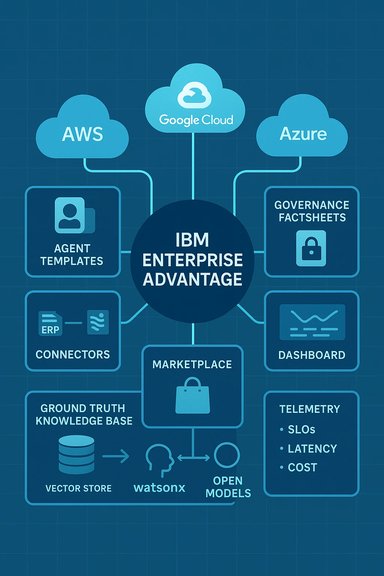
IBM Enterprise Advantage links AWS, Google Cloud, and Azure with Marketplace, Dashboard, Open Models.Background​

Enterprise Advantage launches as an asset‑based consulting service that packages IBM Consulting’s internal delivery platform, IBM Consulting Advantage, and the company’s watsonx technologies into a repeatable offering for customers. IBM positions the service as a way for organizations to “build, govern and operate their own tailored internal AI platform at scale,” while continuing to use existing cloud providers, models and infrastructure. The public announcement on January 19, 2026 frames the product around multi‑cloud support (AWS, Google Cloud, Microsoft Azure), IBM watsonx, and both open‑ and closed‑source models. IBM’s own historical context matters here: IBM introduced IBM Consulting Advantage in 2024 as an AI services platform and library of role‑based assistants that improved internal consultant productivity in pilot scenarios. That internal platform — now repackaged as the technology backbone for Enterprise Advantage — is designed to provide reusable assistants, playbooks and governance guards that IBM says accelerated delivery for its consultant teams. The Consulting Advantage story is a foundational piece of the new service’s credibility claim.

What IBM Enterprise Advantage actually offers​

A platform‑first, vendor‑agnostic consulting service​

At its core, Enterprise Advantage is a consulting engagement model plus a prebuilt set of assets and engineering patterns to stand up an enterprise AI platform. Key features IBM highlights include:
  • Platform design and implementation tailored to existing cloud footprints (AWS, GCP, Azure) or hybrid on‑prem deployments.
  • Model‑agnostic orchestration, able to route work to IBM watsonx or third‑party open and closed models to meet accuracy, cost and compliance requirements.
  • Agentic application support, enabling multi‑step, persistent agents that connect to enterprise systems and workflows rather than single‑turn chat assistants.
  • Prebuilt industry agents and a marketplace of reusable assets to shorten time to value and standardize known business processes.
IBM frames Enterprise Advantage as an approach that combines technical productization (connectors, agent templates, governance) with consulting change management — playbooks, leadership alignment and adoption work that convert prototypes into productionized services. That is consistent with the Consulting Advantage playbook IBM has iterated on since 2024.

Multi‑cloud and model neutrality​

A frequently repeated line in IBM’s announcement is the ability to scale agentic AI “without requiring changes to their cloud providers, AI models, or core infrastructure.” Practically, this means the solution emphasizes:
  • Connectors and adapters for common cloud services and identity stacks.
  • Model routing and selection layers so teams can use watsonx, hyperscaler models, or open models depending on requirements.
  • Hybrid deployment patterns using Red Hat OpenShift and other orchestration layers IBM has long promoted for enterprise hybrid cloud.
That multi‑cloud posture is both strategic and tactical: it lets IBM pitch value to customers who already have invested heavily in a hyperscaler, while preserving IBM’s own watsonx and hybrid governance story as preferred options for regulated workloads.

Real customer examples and the sales narrative​

IBM’s announcement includes two customer vignettes that illustrate the type of outcomes it is targeting.
  • Pearson (education & learning): building a custom AI platform that blends human expertise with agentic assistants to manage routine decision‑making and work orchestration. IBM positions this as a productivity uplift and workflow modernization story.
  • A manufacturing client (unnamed): followed a platform‑first strategy — identifying high‑value use cases, testing prototypes, aligning leaders — and began rolling out AI assistants across technologies in a secured, governed environment. This is the classic “pilot → platform → scale” narrative IBM presents to enterprise buyers.
These examples are illustrative and align closely with the typical consulting engagement lifecycle IBM and other large integrators sell: strategy and use‑case identification, prototyping and productionization. The customer names and outcomes are company‑reported and should be validated in a procurement process with production references where outcomes are critical.

How Enterprise Advantage ties back to IBM Consulting Advantage​

IBM is explicit that Enterprise Advantage is built from IBM Consulting Advantage — the company’s own internal delivery platform. Consulting Advantage was presented publicly in 2024 with claims of productivity improvements when used internally by IBM consultants. The new service essentially gives customers access to IBM’s IP (assistants, templates, governance frameworks) plus consulting expertise to assemble a customer‑owned platform. Independent community and practitioner discussions have highlighted two practical consequences of productizing consulting IP into a platform:
  • It reduces repeated engineering effort across similar projects by turning playbooks into callable agents and templates.
  • It surfaces integration and governance work earlier in the lifecycle, which can materially reduce the operational risk of agentic deployments — but requires rigor in telemetry, auditability and model provenance.
Those practitioner notes align with IBM’s stated emphasis on governance and auditor-friendly deployments.

The technical and governance building blocks to watch​

Building agentic systems at enterprise scale requires more than conversational wrappers. IBM’s messaging — and the industry trend — points to several specific technical components that Enterprise Advantage will need to operate well:
  • Context & retrieval infrastructure (RAG): ground agents in curated company knowledge stores and factsheets to reduce hallucination risk. This typically means vector stores, index management, and drift monitoring. IBM’s watsonx and Consulting Advantage already surface retrieval and grounding features in product literature.
  • Model routing & cost controls: the ability to route queries to different models depending on cost, latency, and accuracy requirements (e.g., small tasks to cheaper open models, sensitive tasks to private watsonx instances). That model‑selection fabric is central to multi‑model strategies.
  • Agent orchestration & tool access: connectors to ERP, CRM, ticketing and identity systems; action approval and rollback controls when agents execute actions on behalf of humans. Enterprise Advantage’s agent playbooks are designed to handle these use cases.
  • Auditability, bias checks, and policy enforcement: factsheets, PII detectors, and audit trails are required for regulated industries; IBM has built governance features into watsonx and Consulting Advantage and emphasizes them in Enterprise Advantage. These are necessary for compliance conversations.
  • Observability and SLOs for AI: telemetry to measure agent actions, error rates, hallucination incidents, cost per transaction and human override frequency. Without these signals, agentic applications are unsafe to scale.
These are not unique to IBM, but they are the minimal checklist any enterprise should require before moving agents into production.

Strengths: why this matters for enterprise IT​

  • Speed to a repeatable platform: By delivering prebuilt assistants, agent templates and governance patterns, Enterprise Advantage shortens the path from prototype to production compared to bespoke engineering projects. That’s the core sales proposition.
  • Multi‑cloud & model neutrality: Supporting AWS, Google Cloud, Azure and watsonx reduces the procurement friction for customers already invested in other clouds. It also aligns with enterprise preferences for hybrid architectures.
  • Proven internal IP: IBM’s claim that Consulting Advantage supported 150+ engagements and produced productivity gains in internal pilots gives Enterprise Advantage a credible origin story. Treat IBM’s numbers as vendor‑reported, but historically the company has built consulting playbooks that scale across verticals.
  • Governance focus: IBM’s longstanding emphasis on governance, factsheets and hybrid deployment options is a credential for regulated industries where auditability and data residency matter. IBM’s watsonx governance tooling and FedRAMP efforts reinforce that narrative.
  • Consulting + product model: The combination of consulting services and an extensible asset library helps transfer knowledge to customers while enabling IBM to monetize implementation and recurring ops engagements.

Risks and open questions​

No announcement changes the fundamental technical and organizational challenges of scaling AI. Enterprise Advantage addresses many structural problems but does not eliminate the following risks:
  • Vendor‑reported claims need validation. IBM’s figures — “150+ engagements” and “up to 50% productivity improvement” — are company statements. They are plausible at scale but must be validated with production references, measurement methodologies and contractually defined KPIs during procurement. Treat these numbers as directional until independently verified.
  • Hallucination and decision liability. Agents that take actions can produce plausible but wrong outputs. For operational or financial actions, organizations must define approval gates, provenance tracking and rollback mechanisms. This is still an immature area for many buyers and will require thorough validation in POCs.
  • Hidden cost of scale. Model inference, vector searches and data egress across clouds create ongoing operational costs that often exceed pilot budgets. Multi‑model routing helps manage cost, but procurement must bake in sustained inference, observability and vector index costs.
  • Integration debt and technical debt. Wrapping agents around legacy ERPs, mainframes and bespoke stacks can reintroduce brittle integrations. The platform approach helps standardize connectors, but the enterprise still needs disciplined SRE and MLOps practices.
  • Data protection and sovereignty. Hybrid deployments reduce some concerns, but data residency, training consent and third‑party model usage remain legal traps for regulated sectors. IBM’s Sovereign Core and watsonx FedRAMP moves are signals that the company is addressing these, but customers must verify regional compliance specifics.

A buyer’s checklist: evaluating Enterprise Advantage engagements​

  • Request production references and measurable KPIs tied to the claimed productivity improvements; insist on seeing the measurement methodology.
  • Define the platform ownership model: who owns connectors, vector stores, and model artifacts after deployment? Include exportability and vendor exit provisions.
  • Validate governance artifacts: ask for sample factsheets, audit trails, PII detection workflows, and escalation/rollback controls.
  • Run a realistic POC that exercises cross‑model routing, RAG/grounding under real data, and lifecycle operations (model upgrades, index refresh, drift alerts).
  • Require a transparent cost model that includes inference, vector indexing, storage and cross‑cloud egress assumptions over a 12–36 month horizon.
  • Confirm compliance posture: FedRAMP/AICPA/HIPAA/data residency requirements relevant to your industry and region.
  • Insist on an SLO and runbook for agent actions that can execute real operations (e.g., payments, inventory adjustments), including human override timelines.
This checklist maps directly to the components Enterprise Advantage sells; the difference is contractual rigor and proof in a controlled pilot.

Competitive and market context​

IBM is not inventing the concept of an “AI platform plus consulting” — many large systems integrators and hyperscalers offer variant platform plays — but its pitch is differentiated by a hybrid governance story, Red Hat OpenShift integration, and watsonx as an enterprise model/governance layer. Market coverage in 2024–2026 has shown that enterprise buyers increasingly prioritize platforms that combine governance, observability and multi‑model routing rather than raw model quality alone. Reuters and financial press on IBM’s broader AI strategy have highlighted how the company’s consulting arm and software revenue growth are central to its 2025–2026 narrative — Enterprise Advantage fits into that broader repositioning. Forum and practitioner discussions emphasize the need for strong observability, model context protocols, and careful management of agent lifecycles — areas that Enterprise Advantage claims to address but where operational rigor will determine outcomes.

Practical recommendations for enterprise architects and CIOs​

  • Start with a platform hypothesis: If multiple teams intend to deploy agentic workflows, require a platform‑first approach rather than treating projects as isolated pilots. Map common data sources, compliance constraints, and action types (read vs. write).
  • Measure before you buy: Insist on baseline measurements and success metrics for any claimed productivity gains. Convert qualitative benefits into measurable KPIs that can be included in statements of work.
  • Design for portability: Even with multi‑cloud support, insist that vector stores, embeddings, and key artifacts are exportable and that model routing logic can be re‑implemented or migrated if needed.
  • Invest in AI observability: Put logging, provenance, and human‑in‑the‑loop controls as non‑negotiable parts of the implementation. Agents that act without clear audit trails are a liability.
  • Budget for sustained operations: Account for inference cost, index refresh cycles, retraining and remediation for model drift across the product lifecycle.

Verdict: pragmatic move, but execution will decide outcomes​

IBM Enterprise Advantage is a pragmatic, credible productization of a consulting playbook that IBM has been using internally for more than a year. Its strengths are clear: platformization, governance emphasis, hybrid cloud posture and prebuilt industry agents that shorten the runway to production. That combination is attractive for regulated, large‑enterprise buyers that need repeatability and auditability.
However, the important caveat is that claims are still vendor‑reported and the hard work remains operational: grounding agents reliably, preventing hallucinations, controlling long‑term inference costs, and embedding observability and human oversight. Organizations evaluating Enterprise Advantage should demand production references, concrete KPIs and contractual guarantees around portability, data handling and costs.
In short: IBM’s offering maps closely to what enterprise buyers now say they need — a governed, multi‑cloud AI platform that delivers production outcomes, not just pilots. The real question for IT leaders is whether IBM (and its partners) can operationalize those promises consistently across verticals and legacy stacks. The early signals are promising, but measured proofs, disciplined procurement and strong operational controls will determine whether Enterprise Advantage becomes a reliable route to enterprise‑scale AI or another well‑packaged pilot framework.
Conclusion
Enterprise Advantage is a practical, platform‑focused response to the central enterprise problem of 2026: how to scale agentic AI safely, predictably and across hybrid clouds. It packages IBM’s internal IP and consulting muscle into a productized pathway that should shorten time to production for many organizations — provided customers insist on rigorous validation, measurable outcomes and contractual protections against hidden operational cost and integration risk.
Source: Techzine Global IBM launches Enterprise Advantage for scaling AI
 

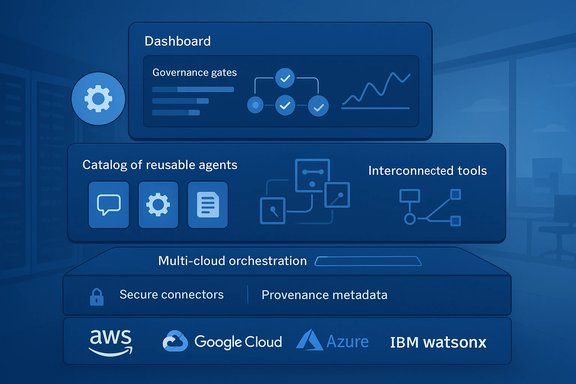
IBM’s new Enterprise Advantage consulting service marks a deliberate push to turn the promise of agentic AI into a repeatable, governed delivery model for large organizations, offering a packaged playbook, reusable agent libraries, and a platform approach that claims to work across major clouds and model providers.

Blue dashboard infographic showing multi-cloud orchestration with reusable agents and cloud providers.Background​

IBM announced Enterprise Advantage on January 19, 2026 as an asset‑based consulting service that combines IBM Consulting expertise with technology derived from IBM’s internal delivery platform, IBM Consulting Advantage. The launch positions Enterprise Advantage as a turnkey way for enterprises to design workflows, connect AI to existing systems, and scale agentic applications without forcing changes to cloud providers, models, or core infrastructure — explicitly naming AWS, Google Cloud, Microsoft Azure and IBM watsonx, and supporting both open‑ and closed‑source models. The core sales narrative is straightforward: IBM packages consulting playbooks, prebuilt agents, and deployment patterns used inside IBM to accelerate client adoption of AI while managing governance, security, and lifecycle concerns. The press materials highlight customer examples such as Pearson and a manufacturing client, and claim prior successes inside IBM — including more than 150 Consulting Advantage engagements and productivity uplifts of up to 50% for IBM consultants when using those internal assets. Enterprise Advantage is being offered as a service available now.

What IBM is selling: features and positioning​

The productized playbook​

Enterprise Advantage is marketed as a combination of three elements:
  • A secured platform and reference architecture for hosting agentic AI and internal assistant catalogs.
  • Shared standards and governance patterns (policy templates, human‑in‑the‑loop gates, telemetry).
  • Reusable AI assets — industry‑specific agents and templates drawn from IBM Consulting Advantage.
IBM’s messaging emphasizes that customers can adopt the approach without replatforming their existing cloud or model choices — a practical selling point for enterprises with multi‑cloud footprints or regulatory constraints. That hybrid orientation reflects IBM’s long strategy of positioning Red Hat OpenShift and watsonx as integration layers rather than exclusive stacks.

Agent marketplace and multi‑vendor interoperability​

A visible theme is the move from point chat assistants to agentic multi‑tool architectures: curated agents that can call tools, run multi‑step flows, and be groundable to tenant data sources. IBM points to a growing marketplace of industry agents and to technology patterns that let agents interoperate with third‑party models and clouds. That interoperability claim is central: it allows organizations to build on existing investments and route workloads to the most appropriate model or cloud host.

Consulting‑led deployment​

Enterprise Advantage is structured as a consulting engagement: IBM Consulting brings the playbooks and practitioner experience, then configures and operationalizes a customer’s own internal AI platform using reusable assets and governance controls. IBM frames this as transferring the same playbook they used internally to outside clients, with the goal of reducing time‑to‑value and avoiding common pilot‑to‑production failures.

Technical context: how Enterprise Advantage fits into the agentic AI stack​

Agent orchestration and grounding​

Agentic AI — agents that can reason, orchestrate tools, and act on behalf of users — typically depends on three capabilities: robust agent orchestration, reliable grounding to enterprise data, and auditability/observability. IBM’s materials place Enterprise Advantage in this middle layer: it’s not a new model, but a platform and set of assets that connect models (open or closed) to enterprise systems and governed knowledge indices. This is consistent with the broader industry adoption of patterns such as retrieval‑augmented generation (RAG) and registry/discovery layers that let agents find the right tools and knowledge sources.

Multi‑cloud and model gateway approach​

IBM explicitly states that Enterprise Advantage can operate across AWS, Google Cloud, Microsoft Azure, IBM watsonx and various open/closed models — allowing customers to retain existing providers and route workloads where compliance, latency, or cost justify it. This gateway‑style approach is consistent with IBM’s prior hybrid messaging and with other IBM offerings that emphasize tenant control and portability. Enterprises that need on‑prem or sovereign deployments will find this framing attractive.

Integration with governance primitives​

The service highlights embedded governance: publish/approval gates, telemetry, and human‑in‑the‑loop controls intended to make agents auditable and production‑ready. These capabilities mirror features being promoted across the market (agent lifecycle, versioning, observability), but their effectiveness depends heavily on implementation detail and organizational discipline.

Why this matters to enterprise IT and procurement​

Enterprise Advantage is IBM’s attempt to productize a common consulting pattern: turn repeatable consulting artifacts into deployable software assets. There are several practical implications:
  • Lower friction to pilot and scale: Packaging playbooks and agents reduces the upfront engineering lift for pilot workloads and can shorten time‑to‑value for repeatable tasks (research, briefing, document assembly).
  • Standardization and reuse: Instituting a catalog of validated agents and templates helps preserve institutional knowledge and avoid one‑off rework across divisions.
  • Governance by design: Integrating governance primitives into the deployment playbook is now table stakes for regulated industries and mission‑critical lexibility**: Claiming compatibility with multiple cloud and model vendors lowers an important blocker for CIOs who cannot or will not centralize on a single hyperscaler.
Those are clear benefits — but realizing them requires strong execution across data engineering, security, change management, and cost governance.

Critical analysis: strengths, execution risks, and vendor claims​

Strengths​

  • Practical, consulting‑first approach: IBM’s pitch is less about selling raw models and more about operationalizing AI in enterprise contexts where governance, compliance, and integration matter. That focus aligns well with buyers in regulated industries.
  • Hybrid and multi‑model flexibility: By supporting multiple clouds and both open and closed models, IBM reduces migration friction for large organizations with existing investments.r enterprises that must meet regulatory or latency constraints.
  • Reusable assotential: Packaging domain agents and templates into a catalogue accelerates pilots and makes knowledge portable across projects — a classic software‑product approach to consulting.

Vendor claims that need scrutiny​

IBM’s pnternal metrics — for example, that IBM Consulting Advantage supported more than 150 client engagements and boosted consultants' productivity by up to 50% when used inside IBM. Those are company‑reported figures and shoul statements until independent audits or customer case studies disclose methodology. Prospective buyers should demand the measurement methodology behind any productivity or ROI claim. Separate IBM messaging linked to other deployments also referenced aggregated outcomes (foly savings claims in related Copilot integrations). Those larger, aggregated figures are directional and plausible at scale, but they are still vendor‑reported and require verification in customer pilots with well‑defined baselines.

Operational and security risks​

  • Agent sprawl and cost unpredictability: Low‑friction agent creation can lead to dozens of bespoke agents, each consuming ence costs. Without consumption governance this can rapidly inflate expenses.
  • Grounding and hallucinations: Agents that synthesize across multiple sourcele but incorrect outputs. Strong RAG patterns, vetted indices, and provenance metadata are essential to limit hallucination risks.
  • Data leakage and IP exposure: Granting agents access to SharePoint, email, and proprietary systems creates new exfiltration pathways. DLP policies, least‑privilege connectors and agent identities must be part of the design.
  • Vendor lock and portability: Deeply embedding vendor‑authored assistants into core workflows can make eventual migration or exit expensive. Contractual protections for exportability, IP rights, and runbooks are crucial.

Practical, step‑by‑step guidance for CIOs and IT leaders​

  • Run a focused pilot on 1–2 highly repeatable tasks (e.g., RFP research, slide deck assembly). Capture baseline cycle times, error rates, and rework. Require measurable outcomes.
  • Insist on measurement transparency. Request the methodology behind any vendor ROI claims and demand telemetry that ties agent invocations to outcomes.
  • Enforce governance before scale. Publish/approval gates, versioning, telemetry, DLP and human‑in‑the‑loop for high‑risk outputs are non‑negotiable.
  • Model the total cost of ownership. Forecast consumption costs (Copilot Credits or model inference credits), training, change management, and monitoring. Apply monthly business units.
  • Treat agents as production software. Assign owners, SLAs, test suites, and deprecation plans. Maintain runbooks and exportable artifacts for portability.
Theserisk and convert vendor promises into verifiable value.

Commercial and competitive context​

The Enterprise Advantage launch comes as systems integrators and consulting firms race to productissets. Competitors — including major consultancies and cloud vendors — are packaging templates, accelerators and agent catalogs into delivery plays of their own. IBM’s differentiators areitage, watsonx/Red Hat positioning, and long relationships in regulated sectors. However, hyperscalers and other GSIs are advancing quickly, and the true moat will be execution quality: the depth and utility of agent libraries, the maturity of governance automation, and the ability to make assets portable across environments. Third‑party coverage of the launch echoed IBM’s central claims while noting the customary caveats around vendor‑reported metrics and the need for measurement transparency. Independent outlets largely republished the IBM release and accompanying customer vignettes, while market commentary framed the service as a credible response to the pilot‑to‑production challenge many enterprises still face.

Developerklist​

  • Confirm connector designs use least privilege scopes for data sources like SharePoint, Dataverse and mail systems. Validate token lifecycles and revocation processes.e telemetry: log agent invocations, model routing, prompt templates used, and output confidence/citation metadata. This supports auditability and troubleshooting.
  • Validate grounding indices: ensure SLAs for index freshness, rebuild windows, and search latency for mission‑critical datasets. Poorly maintained indices are the fastest route to hallucination.
  • Require test suites and approval gates for agents that perform write‑backs or produce client deliverables. Treat agents that affect financial, legal or safety outcomes as high risk.

Governance, compliance and ethics​

Enterprise Advantage’s promise depends on integrating governance and ethics into the platform and delivery process. For regulated industries, this means:
  • Documented provenance for any output used in decision‑making.
  • Explainability and confidence metadata attached to agent responses when used in regulated processes.
  • Retention, del policies that protect customer data and client examples used in agent training or responses.
  • Clear contractual language on IP ownership for artifacts created by or stored in vendor assets.
Without these guardrails, thentic assistants can be outweighed by compliance risk and eroded trust.

Where Enterprise Advantage is likely to deliver fastest value​

  • Knowledge worker accelerations: research retrieval, briefing and slide generation are repeatable tasks with clear baselines and measurable time savings. Agents can compound per‑user hourly savings across large teams.
  • Operational playbooks: standardized processes (claims triage, procuremg) that already follow clear rules are high‑value targets for agentization.
  • Governance and compliance augmentation: when agents are tightly integrated with existing governance stacks (e.g., OpenPages, tenant‑hosted indices), they can speed audits and compliance checks. IBM has showcased such patterns in other recent collaborations.

Red flags and limitations​

  • Headline ROI should be validated in your environment. IBM’s internal numbers — productivity boosts and engagement counts — are useful signals but require independent validation. Ask for runbooks, telemetry samples, and baseline definitions.
  • Operational lift is real. Building and sustaining grounded knowledge indices, identity for agents, and cost governance requires engineering and product discipline. Don’t treat Enterprise Advantage as a drop‑in replacement for an internal platform team; it’s a partner‑led acceleration that still needs internal commitment.
  • Portability matters. If business continuity or exit flexibility is important, insist on contractual guarantees for artifact export and migration paths. Deep embedding without an exit plan increases long‑term risk.

How to evaluate IBM’s pitch in procurement​

  • Require clarity on what is delivered vs. what is advisory (software artifacts, templates, managed services).
  • Insist on a measurable pilot with agreed KPIs and transparent telemetry.
  • Demand contract language covering IP, exportability, SLAs, audit rights and security controls.
  • Map expected agent usage to model consumption costs and require monthly caps or consumption alerts.

Conclusion​

IBM’s Enterprise Advantage is a logical, well‑timed productization of a consulting play: package proven internal delivery assets, wrap them with governance and production practices, and offer customers a faster route from pilot to scale for agentic AI. The offering’s strengths are practical orientation, hybrid model and cloud flexibility, and a consulting delivery model that many enterprise buyers will recognize.
However, the real test is implementation: third‑party validation of touted productivity gains, disciplined governance to prevent agent sprawl and data leakage, and contractual protections for portability. Prospective customers should treat vendor metrics as starting points, not certainties — run narrow, measurable pilots; insist on telemetry and methodology; and treat agents as production software with owners, SLAs and lifecycle plans. With those guardrails, Enterprise Advantage can be a productive step toward operational agentic AI. Without them, the familiar pilot‑to‑production gap risks returning under a new name.
Source: morningstar.com https://www.morningstar.com/news/pr...-service-to-help-businesses-scale-agentic-ai/
 

IBM’s new Enterprise Advantage consulting service, announced on January 19, 2026, promises to give enterprises an “asset-based” playbook for building, governing, and operating internal AI platforms at scale — a platform-first approach that claims to be cloud- and model-agnostic while leaning on IBM’s own consulting IP and delivery tooling to accelerate adoption of agentic AI and AI assistants across large organizations.

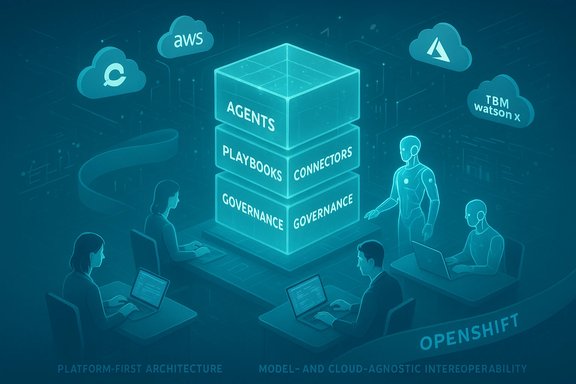
Glowing stack labeled AGENTS, PLAYBOOKS, CONNECTORS and GOVERNANCE, with people coding around.Background​

IBM positions Enterprise Advantage as a packaged consulting engagement that combines the firm’s consulting expertise with technology and reusable assets drawn from IBM Consulting Advantage, the company’s internal AI-powered delivery platform. The pitch is familiar to enterprise buyers: accelerate deployment, reduce integration risk, and inherit a governance and operations framework that lets companies reuse vetted agents and applications rather than rebuild from scratch.
The offering is explicitly designed to work with existing customer investments: Amazon Web Services (AWS), Google Cloud, Microsoft Azure, IBM watsonx, and both open- and closed-source models. IBM says Enterprise Advantage helps organizations redesign workflows, connect AI to existing systems, deploy agentic applications, and scale with governance and security controls in place.
Several early examples were highlighted at launch. A learning-services giant is building a bespoke AI-powered platform to pair human expertise with agentic assistants, and a global manufacturer used the service to identify use cases, build prototypes, and align leaders on a platform-first generative AI strategy. IBM also points to a separate collaboration deploying enterprise-grade agentic AI into governance and compliance systems with a large regional operator, illustrating the company-wide utility of the approach.

What IBM Enterprise Advantage actually is​

Asset-based consulting, explained​

At its core, Enterprise Advantage is an asset-based consulting engagement. That means clients don’t just receive strategy and professional services; they receive reusable components, connectors, governance templates, and prebuilt agents that can be combined into a tailored, internal AI platform.
Key elements IBM highlights as part of the offering:
  • Prebuilt, industry-specific AI agents and applications drawn from a marketplace of assets.
  • Integration patterns and connectors to major cloud providers and on-premises systems.
  • Governance frameworks, compliance controls, and operational playbooks to manage models and agentic workflows.
  • Technical delivery led by IBM consultants using the firm’s internal delivery tooling — the same stack IBM used to scale AI across its own operations.
This is distinct from a one-off PoC or a vendor lock-in product: IBM frames it as a platform program whose outputs (agents, playbooks, pipelines) become enduring, owned assets inside the customer environment.

Model- and cloud-agnostic by design​

A central selling point is the service’s claimed interoperability. IBM states the platform supports:
  • Multiple cloud platforms (AWS, Google Cloud, Azure, and IBM Cloud).
  • Multiple model runtimes, including IBM watsonx and both open- and closed-source models.
  • Customer-managed infrastructure and hybrid deployments, often underpinned by Red Hat OpenShift in IBM’s hybrid-cloud narrative.
For enterprises with heterogeneous stacks — legacy systems, multiple clouds, and a mix of vendor models — that interoperability is essential. IBM’s approach is to act as an integrator and platform architect, rather than forcing a single cloud or model choice.

Agentic AI and AI assistants​

Enterprise Advantage is targeted at a specific wave of adoption: agentic AI — systems that can reason over tasks, orchestrate actions across services, and support decision workflows rather than only answer questions. The offering emphasizes:
  • Design of agent workflows that combine human expertise with “digital workers.”
  • Scaled deployment of AI assistants across business functions.
  • Governance-by-design mechanisms to keep agents accountable, auditable, and explainable.
The aim: shift from isolated generative AI pilots to an enterprise-wide ecosystem of governed agents that augment knowledge workers and automate routine decisions.

Why this matters: strengths and differentiators​

1. A platform-first, repeatable approach​

IBM is selling a structured, repeatable route from experimentation to scale. For organizations that have many pilots but lack the roadmap or reusable assets to scale, this is a tempting proposition. The key differentiator is deliverables-as-assets — playbooks, templates, and prebuilt agents that can be re-used beyond the initial engagement.

2. Multi-cloud and model neutrality​

Enterprises are increasingly wary of single-vendor lock-in. A model- and cloud-agnostic approach aligns with corporate procurement realities: organizations want to keep architectural flexibility, run models where they make sense (latency, cost, data residency), and adopt a best-of-breed model strategy.

3. Governance and security as a core pillar​

One of the biggest blockers to enterprise AI deployment is governance: policies, provenance, explainability, and audit trails. IBM’s narrative emphasizes governance-by-design, model and data controls, and operational tooling to manage agents across environments. For regulated industries, that is a strong selling point.

4. Proven delivery methodology​

IBM points to its internal experience and prior engagements — an existing delivery platform and a history of enterprise transformation projects — as evidence that its playbook is battle-tested. For boards and CIOs, that matters. The promise of measurable productivity gains and standardized outcomes is compelling when evaluating vendor partners.

Risks, limits, and unanswered questions​

Company claims vs. independent verification​

Several of the headline metrics (for example, statements about boosting consultants’ productivity “up to 50%” and supporting “more than 150 client engagements”) are presented as company figures. These metrics are useful indicators but should be treated as vendor-reported until independently validated. Enterprises should request case study data, KPIs, and references to validate claimed productivity and ROI.

Vendor influence and potential lock-in​

While IBM advertises cloud- and model-agnosticism, the engagement still mobilizes IBM’s consulting practice and tooling. That raises questions about:
  • To what extent assets remain fully portable and free of vendor dependencies.
  • Whether long-term operational support binds customers into maintenance contracts.
  • How future model upgrades and agent changes will be managed without escalating costs.
Enterprises should insist on contractual protections that guarantee portability of code, agents, and governance artifacts.

Governance complexity in practice​

Governance-by-design is the correct aspiration, but implementing consistent, enterprise-wide model governance is hard. Real-world challenges include:
  • Harmonizing policy across business units with divergent risk appetites.
  • Ensuring explainability for agentic actions that may combine multiple models and external APIs.
  • Managing human-in-the-loop interventions in a way that preserves auditability and reduces bias.
Companies should be prepared to invest in organizational change and ongoing governance resources — not just an initial design sprint.

Security, data residency, and privacy​

Agentic AI systems will routinely touch sensitive systems and data. Key risks include:
  • Data exfiltration through model APIs or third-party tools used by agents.
  • Inadvertent data leakage into model training pipelines or partner systems.
  • Jurisdictional concerns when agents process cross-border data.
Safeguards must include end-to-end data controls, model gateways, and clear separation between production data and model telemetry.

Operationalizing agentic workflows​

Agentic systems don't just require models; they require robust orchestration, observability, and SRE practices. Many organizations underestimate the runbook and reliability engineering overhead. Failure modes to anticipate:
  • Drift in model performance as business data changes.
  • Automation errors causing cascading actions across systems.
  • Monitoring fatigue from an explosion of agent versions and telemetry streams.
Operational maturity is as important as architectural design.

Practical implementation considerations​

Start with a platform-first pilot​

Enterprise Advantage advocates a platform-first strategy and the initial proof points reflect that: identify a domain, build an agent marketplace around it, and reuse assets across similar functions. A recommended adoption path:
  • Sponsor selection and executive alignment.
  • Scoped pilot using high-value, low-risk workflows.
  • Instrumentation of KPIs (time saved, error reduction, compliance metrics).
  • Expand into other units with reusable agents and connectors.

Build a model and data governance foundation​

Before deploying agents into production:
  • Define model ownership, versioning, and rollback procedures.
  • Record model provenance and training datasets for auditability.
  • Implement watertight data access controls and encryption at rest and in transit.
These measures mitigate regulatory risk and simplify audits.

Choose the right deployment topology​

The deployment topology should be governed by latency, residency, and cost:
  • On-premises or customer-managed infrastructure for sensitive workloads.
  • Hybrid deployments using Red Hat OpenShift or similar for portability.
  • Cloud-hosted runtimes for less-sensitive, high-scale inference.
A clear hybrid-cloud strategy reduces friction as the platform expands.

Observability and SRE for agents​

Operationalizing agents requires:
  • Centralized telemetry for agent actions, decision paths, and system integrations.
  • Alerting thresholds that combine model confidence scores with business metrics.
  • Runbooks and human escalation pathways when agents hit ambiguous states.
Without these, even well-designed agents will create operational risk.

Contracts, SLAs, and IP​

When contracting for Enterprise Advantage engagements, IT leaders should demand clarity on:
  • Who owns the agents and IP produced during the engagement.
  • Portability clauses for code, templates, and connectors.
  • Service-level agreements for ongoing maintenance, model updates, and security patches.
These contractual levers prevent surprises during the scale phase.

Regulatory and compliance environment​

Enterprises must navigate an increasingly complex regulatory landscape as they deploy agentic AI:
  • Data privacy laws and sector-specific regulations impose obligations on data handling, retention, and consent.
  • Emerging AI-specific rules (in many jurisdictions) require traceability and risk assessments for high-impact systems.
  • Sector regulators (finance, healthcare, telecoms) expect clear governance and explainability for decision-support systems.
A governance-by-design approach helps, but legal and compliance teams must be engaged from day one to interpret obligations across jurisdictions.

Market context: How Enterprise Advantage fits the enterprise AI ecosystem​

The market is moving from experimentation to industrialization. Big consulting firms and integrators are all packaging platform plays that bundle IP, governance, and delivery practices. IBM’s Enterprise Advantage sits squarely in that competitive set, differentiating through:
  • Deep hybrid-cloud heritage and Red Hat/OpenShift expertise.
  • watsonx portfolio integration and an emphasis on agentic AI orchestration.
  • A market-facing marketplace of prebuilt agents and domain templates.
For buyers, the question is not whether to work with a major integrator but which partner provides genuinely reusable assets, minimal vendor friction, and a credible path to internal ownership.

What IT leaders should ask IBM (and any integrator) before signing​

  • What specifically will we own after the engagement? Request sample artifacts showing code, templates, and agent definitions.
  • How portable are the assets? Ask for a technical demonstration of moving an agent from one cloud to another.
  • Can you provide references and measurable KPIs from comparable deployments?
  • What are the ongoing costs for operations, governance, and model updates?
  • How do you prevent data leakage and ensure model training data never leaves controlled environments?
  • What SLAs are offered for model performance degradation and availability of orchestration services?
These questions turn vendor claims into contractual obligations.

Vendor claims to treat as vendor-reported until validated​

Several headline metrics presented at launch are useful but should be validated in procurement:
  • Productivity gains reported by IBM (for example, “up to 50%” productivity improvements for consultants) are vendor-provided and should be backed by case studies and customer references.
  • Counts of “more than 150 client engagements” and marketplace asset totals are helpful directional signals but not substitutes for client-specific performance metrics and ROI proof points.
Procurement teams should request independent references and measurable outcomes that directly map to the buyer’s business context.

Short-term outlook and likely adoption patterns​

In the near term, adoption of Enterprise Advantage-like programs will follow a predictable pattern:
  • Large enterprises with complex IT estates and regulatory constraints will be the earliest adopters, seeking governance and hybrid-cloud interoperability.
  • Organizations in regulated industries (financial services, healthcare, telecoms) will prioritize governance, explainability, and data residency features.
  • Mid-market companies may delay adoption until simpler, packaged offerings with lower start-up costs become widely available.
A strong partnership model — where the integrator helps build internal skills and hands ownership to the customer — will accelerate adoption at scale.

Conclusion​

IBM’s Enterprise Advantage is a strategic attempt to codify a repeatable playbook for scaling agentic AI inside large organizations. Its strengths are clear: a platform-first focus, multi-cloud and model flexibility, and a governance-centric approach that appeals to risk-conscious buyers. The service addresses two of the most persistent enterprise problems — the gap between pilots and production, and the lack of reusable assets across programs.
However, buyers should treat headline metrics and efficiency claims as vendor-reported until validated through references and measured outcomes. Critical implementation risks remain: model governance complexity, vendor influence over long-term operations, security and data residency concerns, and the operational burden of running agentic systems at scale.
The pragmatic path for IT and business leaders is to approach Enterprise Advantage (or equivalent integrator offers) as a means to accelerate ownership: insist on portability, demand measurable KPIs, secure explicit IP and portability terms, and commit to the organizational change, governance capacity, and SRE maturity required to keep agentic AI safe and productive. When those pieces are in place, a platform-first, asset-based strategy can convert experiments into sustained enterprise value — but only with rigorous governance, clear contractual protections, and ongoing investment in operations and people.

Source: AI Insider IBM Launches Enterprise Advantage Service to Help Businesses Scale Agentic AI
 

IBM’s Enterprise Advantage packages IBM Consulting’s internal deliveryivery platform and playbooks into an asset‑based consulting service designed to help large organizations build, govern and operate internal AI platforms at scale, while explicitly supporting multi‑cloud environments and both open‑ and closed‑source models.

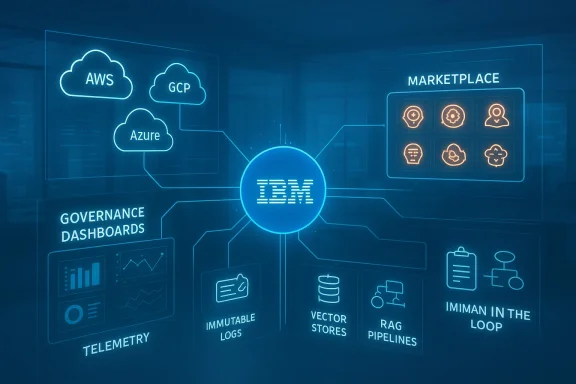
IBM central hub connects AWS, GCP, and Azure to a marketplace with governance dashboards and telemetry.Background​

IBM has repackaged elements of its internal AI tooling and delivery methodology—originally branded as IBM Consulting Advantage—into a commercial offering called Enterprise Advantage. The service is positioned as a platform‑first, asset‑based consulting engagement that delivers reusable agents, templates, governance playbooks and technical connectors so customers can move from pilots to productionized, enterprise‑grade AI faster. The public launch was presented as a way to build tailored internal AI platforms without forcing customers to abandon existing cloud providers, AI models, or core infrastructure.
This announcement follows a clear industry pattern: large integrators are turning consulting IP into productized platforms that package repeatable assets (catalogues of agents, connector libraries, governance patterns) alongside professional services. IBM’s unique selling point is its hybrid‑cloud heritage, watsonx integration, and the origin story that these assets were battle‑tested inside IBM Consulting before being externalized. IBM has framed Enterprise Advantage as “available now” and illustrated the offering with early customer vignettes including a learning‑services company (named in press materials as Pearson) and an unnamed manufacturer.

What Enterprise Advantage is and what it promises​

Asset‑based consulting, not just strategy​

Enterprise Advantage is explicitly an asset‑based consulting service: customers receive working components and artifacts—not just slide decks and roadmaps. That includes:
  • Prebuilt, industry‑specific AI agents and application templates.
  • Connectors and adapters for major cloud providers and enterprise systems.
  • Governance frameworks, policy templates, and telemetry patterns.
  • Deployment patterns for hybrid and on‑premises topologies.
IBM positions these deliverables as customer‑owned assets that accelerate rollout and improve repeatability across business units. The offering is intended to reduce duplicated engineering effort and standardize operational practices for agentic AI.

Platform‑first and vendor‑neutral posture​

A core part of IBM’s pitch is multi‑cloud and model neutrality. Enterprise Advantage is described as able to operate across Amazon Web Services, Google Cloud, Microsoft Azure, IBM watsonx, and both open‑ and closed‑source models. The technical architecture centers on an orchestration and routing layer that can direct requests to different model runtimes depending on cost, latency, accuracy, and regulatory needs—so enterprises can keep their existing cloud investments while adding an internal AI platform.

Agentic AI and marketplace‑style reuse​

IBM emphasizes agentic AI—agents that perform multi‑step tasks, orchestrate calls across services, and take actions on behalf of users rather than single‑turn chat interactions. Enterprise Advantage includes a marketplace concept (a catalog of reusable agents and role‑based assistants) that aims to shorten time‑to‑value and provide repeatable patterns for common business functions. IBM’s internal Consulting Advantage is cited as the origin of many of these assets.

How Enterprise Advantage likely works (technical anatomy)​

1. Model gateway and routing fabric​

At a technical level, Enterprise Advantage functions as a gateway between enterprise systems and multiple model runtimes. The routing fabric performs functions such as:
  • Selecting the appropriate model (watsonx, hyperscaler model, open model) based on policy.
  • Applying cost and latency controls so low‑risk tasks can use cheaper inference while sensitive workloads use private or on‑premise runtimes.
  • Managing authentication, keys, and telemetry for model invocations.
This multi‑model routing approach is central to IBM’s insistence that customers need not change their cloud or model choices to adopt the platform.

2. Retrieval, grounding and RAG​

Agentic systems depend on robust grounding to tenant data to reduce hallucinations. Expect Enterprise Advantage implementations to include:
  • Vector stores and embedding pipelines for retrieval‑augmented generation (RAG).
  • Index management and refresh workflows aligned with data retention and compliance rules.
  • Provenance and metadata attached to retrieval results so agent outputs can be traced back to sources.
These patterns are standard across enterprise agent architectures and are specifically called out as necessary building blocks in IBM’s materials.

3. Agent orchestration and connector layers​

Agents in an enterprise setting must interact with ERP, CRM, ticketing, identity providers, and other systems. The Enterprise Advantage asset set includes connectors, tool templates, and action approval workflows so agents can:
  • Read information from enterprise systems.
  • Compose multi‑step workflows.
  • Request human approval (human‑in‑the‑loop) before making write‑back changes.
Connector provenance, least‑privilege access, and audit logs are treated as governance primitives.

4. Governance, observability and SRE​

Scaling agents safely requires SRE and observability disciplines. Core observability features IBM emphasizes include:
  • Telemetry for agent invocations, model confidence, error rates and cost per transaction.
  • Immutable logging of prompts, sources used, and outputs for auditability.
  • Publish/approval gates, versioning, and rollback procedures for agents and models.
IBM frames governance as “by design,” but successful delivery depends on integrating legal, compliance, and operational teams throughout the lifecycle.

Early customer examples and business outcomes​

IBM provided vignettes at launch to demonstrate the kinds of outcomes Enterprise Advantage targets:
  • Pearson (learning & education): Building a custom AI platform that combines human subject‑matter expertise with agentic assistants to manage everyday workflows and routine decisions. The aim is productivity uplift and better orchestration across knowledge workers.
  • A manufacturing customer: Followed a platform‑first approach—identifying high‑value use cases, running targeted prototypes and aligning leadership around a scalable strategy. That client is reportedly deploying AI assistants across multiple technologies within secured, governed environments.
IBM has also cited internal metrics (now being offered outward): more than 150 Consulting Advantage engagements and internal productivity gains of up to 50% for consultants when using IBM’s delivery assets. These numbers are vendor‑reported and should be validated by procurement teams during reference checks.

Strengths: why Enterprise Advantage matters to enterprise IT​

  • Repeatability at scale. Packaging playbooks and reusable agents reduces one‑off engineering and helps organizations move from isolated pilots to an enterprise platform. This addresses the common “pilot trap.”
  • Multi‑cloud and model flexibility. Supporting AWS, GCP, Azure and watsonx, plus both open and closed models, lowers migration friction and fits procurement realities in large enterprises.
  • Governance‑first posture. IBM’s emphasis on telemetry, audit trails, and human‑in‑the‑loop mechanisms is a competitive differentiator for regulated industries. Buyers in finance, healthcare, and telecoms will prioritize this.
  • Proven internal IP. The product’s lineage—IBM Consulting Advantage—gives IBM a credible origin story and real‑world testbed for the assets being sold. That institutional experience makes the offering more than purely theoretical.
  • Consulting + product mix. Combining technical delivery tools with change management playbooks helps convert prototypes into production, addressing people and process issues in addition to technology.

Risks, limits and critical caveats​

Vendor‑reported claims require verification​

Several headline metrics—such as the claim of “more than 150 Consulting Advantage engagements” and productivity improvements “up to 50%”—are provided by IBM and should be treated as vendor‑reported until independently verified. Procurement teams should request methodology, baseline metrics, and referenceable clients before accepting these figures as proof of ROI.

Portability vs. practical lock‑in​

IBM emphasizes model‑ and cloud‑agnosticism, but the engagement mobilizes IBM consultants and tooling. Customers must insist contractually on the portability of code, agent definitions, connectors and operational runbooks. Practical vendor lock can arise from proprietary connectors, undocumented integrations, or ongoing maintenance agreements that make migration costly.

Governance in practice is hard​

“Governance‑by‑design” is an aspiration; implementing consistent governance across business units with varying risk appetites is complex. Real challenges include harmonizing policies, explaining agent decisions that combine multiple models, and maintaining human‑in‑the‑loop controls at scale. These are organizational problems as much as technical ones.

Security, data residency and exposure​

Agentic systems interact with sensitive systems and data. Risks include data exfiltration through third‑party APIs or incorrect connector permissions. Enterprises must require least‑privilege connectors, DLP controls, and segregation of production data from training/telemetry streams. Jurisdictional issues (cross‑border data flow) must be addressed at design time.

Operational overhead and cost unpredictability​

Low‑friction creation of agents can lead to agent sprawl and unpredictable inference costs. Without strong consumption governance, organizations risk escalating monthly bills. Observability, cost controls and metering are therefore fundamental to long‑term viability.

What IT leaders should demand from IBM (and any integrator)​

Enterprises evaluating Enterprise Advantage should convert promises into contractual and technical safeguards:
  • Request sample artifacts and runbooks that will be delivered and verify ownership/ports.
  • Insist on explicit portability clauses for agents, connectors, vector indices and code. Demonstrations of migration between clouds are prudent.
  • Require measurable KPIs and a baseline methodology for ROI claims (e.g., how “50% productivity lift” was measured).
  • Define SLAs for agent availability, model performance degradation and incident response.
  • Contractually mandate security controls: encryption, DLP, least privilege connectors and regular third‑party audits.
  • Require an observability and telemetry plan that exposes prompts, retrieval sources, model choices and human approvals in immutable logs.
These provisions turn high‑level claims into enforceable outcomes and reduce the risk that an attractive pilot becomes a costly, bureaucratic long‑term dependency.

Operational playbook: a practical adoption path​

The pragmatic route to adopt an Enterprise Advantage‑style program is a platform‑first pilot that follows disciplined steps.

Phase 1 — Sponsor, scope and measure​

  • Secure a senior executive sponsor.
  • Select 1–2 repeatable, high‑value use cases (e.g., RFP summarization, compliance checks).
  • Capture baseline metrics (cycle time, error rates, manual steps) so outcomes are measurable.

Phase 2 — Build a governed pilot​

  • Deploy a scoped agent connected to controlled datasets and with clear human approval gates.
  • Instrument telemetry from day one: model choices, invocation frequency, cost per inference, override rates.

Phase 3 — Validate and harden​

  • Run an adversarial review to identify hallucination and security failure modes.
  • Test portability: export the embedding indices and agent definitions; validate migration to another cloud or runtime.

Phase 4 — Scale with guardrails​

  • Publish an internal marketplace of validated agents with versioning and approval workflows.
  • Institute cost controls, consumption budgets and SRE runbooks for agent incidents.
This staged approach preserves agility while ensuring governance is baked into expansion.

Market context and competition​

Enterprise Advantage joins a crowded market where major integrators and cloud hyperscalers are packaging platform plays that combine governance, reusable assets and delivery practices. IBM’s differentiators include its hybrid‑cloud pedigree (Red Hat/OpenShift orientation), watsonx integration and a marketplace model for agents. Buyers must therefore evaluate not only feature sets but the true openness of connectors, the transparency of model routing, and the contractual promise of portability.

Final analysis: pragmatic play, but execution will decide outcomes​

IBM Enterprise Advantage is a credible, pragmatic response to the persistent enterprise problem of 2026: turning promising generative AI pilots into governed, productionized platforms. The offering’s strengths—assetization of consulting IP, multi‑cloud model neutrality, and governance emphasis—match what large, regulated enterprises now ask for when adopting agentic AI.
That said, many of the headline claims are vendor‑reported and the heavy lifting remains operational. Success will hinge on:
  • Rigor in grounding and RAG engineering to avoid hallucinations.
  • Transparent contracts that protect portability and ownership.
  • Strong observability, SRE practices and cost governance.
  • Organizational change to make governance and human‑in‑the‑loop processes sustainable.
Enterprises should treat Enterprise Advantage as a credible option in a shortlist of integrator platforms—but only after insisting on measurable KPIs, migration proofs and contractual protections that convert vendor claims into verifiable, repeatable outcomes.

Conclusion​

IBM’s Enterprise Advantage is an explicit attempt to productize a consulting playbook into a reusable platform for scaling agentic AI across large organizations. Its multi‑cloud, model‑agnostic architecture and governance‑first messaging align with current enterprise priorities, and the product’s pedigree inside IBM Consulting lends credibility to IBM’s claims. However, the real test for CIOs and procurement teams will be in the details: who owns the IP, how portable are the artifacts, how transparent are the ROI calculations, and whether governance and observability are operationalized rather than merely promised. When evaluated with rigorous KPIs, contractual safeguards and a staged pilot approach, Enterprise Advantage can shorten time‑to‑value—but success will depend on disciplined execution, not marketing rhetoric.

Source: The Fast Mode IBM Launches Enterprise Advantage to Help Organizations Build AI Platforms at Scale
 

Back
Top