

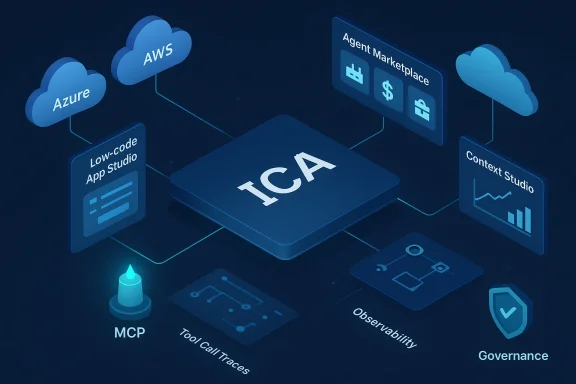
IBM’s new Enterprise Advantage repositions consulting as productized platform: a packaged stack of the company’s internal delivery assets, an agent marketplace, and a managed engagement model that promises to get enterprise organizations from pilots to production-grade, governed agentic AI without forcing them to re‑engineer their cloud or LLM choices.
Background
Enterprise AI has moved fast from “proof of concept” chat demos to demands for production‑grade automation that can act, orchestrate, and interoperate across enterprise systems. Large organizations now face an operational problem set that goes beyond model selection: how to supply high‑quality context, connect agents to the right tools, enforce governance and auditability, and run fleets of agents as first‑class, identity‑aware services. IBM’s Enterprise Advantage is explicitly designed to answer that operational checklist by commercializing the delivery platform IBM used internally and surfacing it as a consulting service and deployable platform for customers.Microsoft’s product roadmap over the last year—Copilot Studio, Foundry, Work IQ, and the Agent 365 control plane—has framed the market expectation that agents must be governable and observable at scale. IBM’s announcement positions Enterprise Advantage as a complementary accelerator that can be run on Azure and interoperate with Microsoft’s agent governance and data services. Independent trade coverage treats the move as a pragmatic industry response to the execution gap—the difference between executive ambition for AI and the reality of enterprise readiness.
What Enterprise Advantage actually is
Enterprise Advantage is an asset‑based consulting service plus an extensible platform. At its core the offering packages three things:- A productionized platform derived from IBM Consulting Advantage (ICA) — the internal delivery toolkit IBM used to scale its own consulting across thousands of consultants.
- A marketplace of pre‑built, industry‑specific agents and agentic applications that companies can adapt rather than build from scratch.
- Consulting services for strategy, integration, and operations to help customers turn pilots into repeatable, governed programs.
Key platform capabilities (as described by IBM)
- App Studio — a low‑code/no‑code and pro‑code surface for defining agents and process orchestration.
- Context Studio and Context Management — components for schema design, knowledge graphing and the data context that agents need for accurate decisions.
- A2A (Agent‑to‑Agent) connectivity — native plumbing to let agents call and coordinate with each other.
- MCP gateway — a gateway for the Model Context Protocol (MCP) that unifies tool access and centralizes security for agent toolcalls.
- Observability and traceability — end‑to‑end telemetry and auditing for agent actions and decisions.
How Enterprise Advantage maps to Microsoft’s agent stack
IBM frames Enterprise Advantage as a Microsoft‑friendly accelerator: ICA can run natively on Azure and complement Microsoft’s agent and data services rather than replace them. That’s a deliberate strategic choice—one that recognizes Microsoft’s Copilot as the primary interface for knowledge workers while treating IBM’s platform as the enterprise‑grade backend for agent orchestration and governance.- Microsoft’s Agent 365 offers a control plane for registering, governing, and observing agents as enterprise identities. IBM positions its observability and lifecycle tooling to feed and extend that governance fabric rather than compete with it.
- Copilot Studio and Microsoft Foundry are agent creation and publishing surfaces; IBM’s App Studio and agent marketplace promise pre‑trained domain agents and orchestration patterns that teams can publish into Copilot experiences.
- Azure data and AI services (including Fabric and semantic search) provide the data plane for context; IBM’s Context Studio is presented as a way to unify schema, knowledge graphs, and source routing at enterprise scale—feeding those Microsoft data services with high‑quality, curated context.
Why the MCP gateway matters
The Model Context Protocol (MCP) has become the lingua franca for agent‑to‑tool and agent‑to‑context interactions. IBM’s work—both open source and productized—around MCP gateways and registries is a practical response to the chaos of bespoke integrations. IBM’s ContextForge / MCP Gateway is explicitly designed to:- Translate REST and gRPC tool surfaces into MCP‑compliant endpoints,
- Offer a registry and admin UI to manage tool discovery and policy,
- Provide federation, caching, and OpenTelemetry observability for tool calls,
- Enable A2A connections so agents can securely call each other or third‑party services.
Real‑world examples and IBM’s productivity claim — take with context
IBM’s launch materials highlight customers such as Pearson and a large manufacturer that have used the platform to accelerate agentic workflows for learning personalization and process automation. IBM also points to internal results: the Consulting Advantage platform, when surfaced through Microsoft Copilot, is credited with saving IBM consultants roughly 250,000 hours per year—a number widely reported in industry coverage and company commentaries. Those savings are framed as redeployable consulting capacity and tens of millions of dollars in value.Important caveat: the productivity numbers are company reported and sourced to IBM internal metrics and case studies. Independent, third‑party audits of those uplift figures are not public; readers should treat the numbers as directional evidence of efficiency gains rather than audited proof. Nonetheless, the concrete examples show the practical value of surfacing domain knowledge and agent templates directly inside productivity tools like Word and Teams, which reduces context switching and accelerates standard consulting tasks.
Deep technical analysis — strengths and architectural implications
- Platform‑first, assetized consulting
IBM’s packaging of experience into deployable assets (agents, templates, context schemas) is not new to consulting, but it’s notable here because it changes the cost profile of adoption. Instead of bespoke development for each client, IBM can reuse and adapt proven agents, reducing time‑to‑value. That model scales consulting delivery but depends on high‑quality reuse libraries and strict versioning to avoid drift. - Context as a first‑class citizen
IBM’s emphasis on Context Studio and knowledge graphs acknowledges a persistent truth: LLMs without structured, authoritative context are unpredictable. Schemas, canonical sources, and a knowledge‑graph approach make factual grounding easier and improve agent trustworthiness. This approach complements Microsoft’s Work IQ / Foundry efforts that focus on routing the correct work context into Copilot experiences. - Interoperability via MCP and gateways
The MCP gateway approach is pragmatic: many enterprises have heterogeneous tools and legacy APIs. Wrapping those endpoints into an MCP registry and enforcing OAuth flows and rate limits simplifies integration and creates an auditable path for toolcalls. IBM’s open work on ContextForge shows a community‑oriented approach that can accelerate adoption. - Observability and traceability
Agentic systems require distributed tracing across model calls, tool invocations, and operator interventions. IBM’s explicit inclusion of observability and telemetry—combined with Agent 365’s registry and Microsoft’s Defender/Purview integrations—means teams can build compliance and forensics into agent lifecycles from day one. This is a decisive operational advantage for regulated industries. - No‑code to pro‑code balance
App Studio promises to lower the bar for citizen builders while preserving pro‑code extensibility for complex integrations. That balance is essential: too many low‑code abstractions prematurely lock away complex behaviors, while pure code solutions slow adoption. IBM’s inclusion of both modes acknowledges real enterprise needs.
Risks, governance challenges, and the question of lock‑in
The headline benefits are real, but the launch raises practical questions and trade‑offs every IT leader should consider.- Orchestration‑layer lock‑in. IBM markets Enterprise Advantage as multi‑cloud and model‑agnostic, yet packaging reusable agents, governance templates, and orchestration logic into a platform can create a different sort of lock‑in: once agents, processes, and governance policies are expressed in IBM’s platform, migrating them away could be costly. Industry analysts have warned that vendor lock‑in risk can shift from infrastructure to orchestration. Decision makers should insist on exportability, open connectors, and documented migration paths.
- Claims vs. independent verification. Productivity metrics (the 250k hours number) are meaningful but company‑reported. Procurement and audit teams should ask for measurable, contractual KPIs and sample evidence when negotiating engagements. Third‑party validation or pilot‑scoped SLAs help turn marketing claims into commercial guarantees.
- Agent sprawl and shadow agents. The proliferation of agents is an operational hazard. Microsoft’s Agent 365 is explicitly targeted at discovering and governing “shadow” agents; IBM’s MCP gateway and registries address similar concerns. However, organizations must still invest in lifecycle policy, role‑based access for agents, and continuous red‑teaming to detect drift and jailbreaks.
- Data residency and sensitive data handling. Enterprises in regulated industries must understand where context is stored, how knowledge graphs are populated, and whether tool calls expose sensitive records to third‑party models. Enterprises should require encryption, tenant isolation, and clear data flow diagrams before production rollout. IBM’s messaging emphasizes enterprise security considerations, but the details will matter in procurement.
- Operational cost complexity. Running fleets of agents, telemetry pipelines, and MCP gateways will introduce new cost centers (compute for model calls, storage for context, telemetry ingest, Entra/identity costs). IT finance teams need visibility into the ongoing TCO and must model scale scenarios.
Practical checklist for CIOs and platform teams
If you’re evaluating Enterprise Advantage (or any packaged platform of this type), here are practical questions to take into procurement and pilots:- Data & Context
- Where will context live and how is access gated?
- Can we export schemas, knowledge graphs, and context dumps in open formats?
- Identity & Access
- How do agents obtain identities (Entra Agent IDs, etc.) and how are permissions enforced?
- Can we integrate Agent 365 or an equivalent into our identity governance workflows?
- Observability & Audit
- What telemetry is captured for tool calls, and how long is it retained?
- Are traces readable by our SIEM and observability stack (OpenTelemetry, Jaeger, etc.)?
- Tooling & Interoperability
- Does the MCP gateway map to the APIs we already use, and can it virtualize legacy APIs?
- What is the process to add a new third‑party tool into the registry?
- Vendor & Contractual Safeguards
- Are productivity claims auditable? Can they be tied to pilot KPIs and SLA credits?
- Is migration and data export covered contractually to avoid orchestration lock‑in?
- Security & Compliance
- How are secrets, tokens, and credentials stored and rotated?
- Does the solution integrate with Defender, Purview, or equivalent DLP and compliance tooling?
The competitive and strategic angle
IBM’s offering is both pragmatic and strategic. Pragmatically, it packages usable IP and operational patterns organizations have demanded. Strategically, it deepens IBM’s Microsoft practice and creates an upsell path for consulting, managed services, and ongoing governance. For Microsoft, having major consultancies like IBM wrap their IP around Azure and Copilot helps grow enterprise adoption and reduces friction for regulated customers that want the safety of a trusted partner.Analysts will watch closely whether the market rewards packaged, assetized consulting versus pure product or platform plays. The practical question for customers is whether they prefer an integrated consulting‑platform bundle that reduces risk and time to value, or a best‑of‑breed assembly of cloud services assembled by internal teams. Each path has different operational trade‑offs in terms of speed, total cost, and strategic vendor dependency.
Conclusion
Enterprise Advantage is a credible, well‑engineered answer to a simple enterprise problem: how to move agentic AI out of experimental notebooks and into governed, auditable workflows that actually do work for the business. IBM’s decision to productize Consulting Advantage, add an agent marketplace, and align explicitly with Microsoft’s Copilot and Agent 365 ecosystem recognizes the real split in enterprise needs: human‑facing Copilots as UI, and purpose‑built agent platforms for orchestration, governance and traceability.That said, success depends on execution: measurable pilot KPIs, transparent data‑flow guarantees, and contractual exit paths to address orchestration lock‑in. For IT leaders building the next generation of enterprise automation, Enterprise Advantage is worth evaluating as an accelerator—provided due diligence, pilot verification, and a clear migration and governance plan are in place.
In short: IBM’s Enterprise Advantage may not reinvent agentic AI, but it packages the operational plumbing many firms urgently need—context engineering, tool governance, observability, and reusable agents—into a pragmatic path for enterprises that want to scale AI while keeping compliance, auditability, and control front and center.
Source: IBM How IBM Consulting’s Enterprise Advantage unlocks a new era of Agentic AI powered by Microsoft partnership
