

IBM’s new Enterprise Advantage service promises to turn the scattershot promise of “agentic AI” pilots into repeatable, governed production at enterprise scale — and it does so in public partnership with Microsoft, explicitly positioning Azure, Microsoft 365, and Microsoft’s agent governance tooling as core deployment surfaces for the offering.
Agentic AI — systems that coordinate multiple steps, call tools, access corporate systems, and act on behalf of users — moved from research curiosity to enterprise planning topic in 2024–2025. Large cloud vendors and platform companies raced to add agent runtimes, observability, and governance to their stacks, while systems integrators quietly rebuilt delivery frameworks to manage orchestration, data context, and lifecycle controls. IBM’s Enterprise Advantage (announced January 19, 2026) is a response to that market reality: a consulting-led, asset-based service that bundles IBM’s internal AI delivery platform with an industry marketplace of prebuilt agents and an explicit run-anywhere posture that includes Microsoft Azure as a primary hosting and governance target. IBM positions the service as a way to preserve customers’ existing cloud and productivity investments while introducing a consistent architecture for agentic automation.
This isn’t the first time IBM has leaned into Microsoft as a strategic partner. IBM established a formal Microsoft Practice in 2025 and has integrated its Consulting Advantage tools with Microsoft 365 workflows for more than a year. The Enterprise Advantage announcement builds on that track record, emphasizing joint deployment patterns and governance compatibility with Microsoft’s emerging agent control plane and Azure security stack.
Given that many enterprises already run core workloads on Azure and Microsoft 365, IBM’s Azure-friendly posture could be a pragmatic bridge — but enterprises should remain aware that the strategic lock-in question shifts to where the agent catalog, orchestration logic, and observability live.
But the offering is not a silver bullet. Expect integration complexity, new operational responsibilities, and the possibility of orchestration-layer lock-in. Vendor metrics — productivity gains, time-to-value assertions, and scale-up timelines — should be validated in your own environment before you commit to sweeping rollouts. And critically, organizations must treat agentic AI as a cross-functional program involving security, legal, HR, and business operations — not solely as a developer or cloud initiative.
If your organization is serious about agentic automation and already has significant Azure and Microsoft 365 investments, Enterprise Advantage represents a pragmatic accelerant. Use it to get structure, governance, and reusable assets into place — but enter with a procurement and architecture plan that protects portability, validates vendor claims, and establishes clear business metrics. The next 18–24 months will decide which enterprises convert early experimentation into durable, measurable advantage.
Conclusion
Agentic AI will reshape how routine decisions and multi-step processes are executed, but it will not be frictionless: the difference between pilots and enterprise-scale value is governance, context, and repeatability. IBM Enterprise Advantage is a credible, methodical attempt to provide that repeatability — particularly for Azure-aligned customers — yet success will depend on disciplined procurement, careful integration, and realistic timelines. CIOs who balance pragmatic pilots with rigorous governance and portability practices will be best positioned to convert the promise of agentic AI into sustained business outcomes.
Source: Redmond Channel Partner IBM Launches Enterprise Advantage to Advance Agentic AI With Microsoft -- Redmond Channel Partner
 Background
Agentic AI — systems that coordinate multiple steps, call tools, access corporate systems, and act on behalf of users — moved from research curiosity to enterprise planning topic in 2024–2025. Large cloud vendors and platform companies raced to add agent runtimes, observability, and governance to their stacks, while systems integrators quietly rebuilt delivery frameworks to manage orchestration, data context, and lifecycle controls. IBM’s Enterprise Advantage (announced January 19, 2026) is a response to that market reality: a consulting-led, asset-based service that bundles IBM’s internal AI delivery platform with an industry marketplace of prebuilt agents and an explicit run-anywhere posture that includes Microsoft Azure as a primary hosting and governance target. IBM positions the service as a way to preserve customers’ existing cloud and productivity investments while introducing a consistent architecture for agentic automation.This isn’t the first time IBM has leaned into Microsoft as a strategic partner. IBM established a formal Microsoft Practice in 2025 and has integrated its Consulting Advantage tools with Microsoft 365 workflows for more than a year. The Enterprise Advantage announcement builds on that track record, emphasizing joint deployment patterns and governance compatibility with Microsoft’s emerging agent control plane and Azure security stack.
What IBM Enterprise Advantage actually is
A service, not a single product
Enterprise Advantage is framed as a service and methodology rather than a single piece of software. At its core it combines three components:- The IBM Consulting Advantage (ICA) platform — IBM’s internal AI-powered delivery platform and marketplace of reusable agent assets.
- Consulting and industry services to map use cases, integrate agents into workflows, and manage change.
- A deployment and governance model that may run on multiple clouds (including Azure) and integrate with vendor governance tooling.
Key platform capabilities IBM highlights
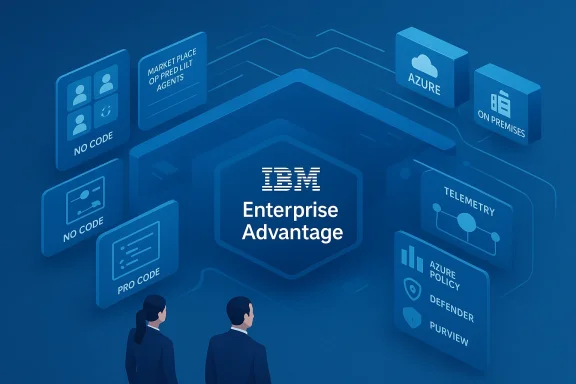
IBM’s public materials and follow-up briefings highlight a set of platform building blocks that are repackaged for clients as part of Enterprise Advantage:- App Studio / Agent design environments with no-code and pro-code options for building agents and orchestrations.
- Context Studio and a Context Management layer — schema, knowledge graphs, and connectors that give agents enterprise context.
- An MCP (Model Context Protocol) gateway pattern that controls tool access and data flow between agents and enterprise systems.
- Observability, traceability, and governance capabilities intended to align with enterprise security and compliance controls.
- A growing marketplace of industry-trained agents and templates for vertical workflows.
Why Microsoft matters to this offering
Azure and Microsoft 365 are the practical execution plane
IBM frames Azure as the natural execution surface for Enterprise Advantage where customers already have data, identities, and business systems. The IBM announcement and follow-up posts highlight integration points with Microsoft’s agent governance tools — notably Agent 365, Azure Policy, Defender for Cloud, and Purview — and position Enterprise Advantage as a way for Azure-centric enterprises to gain agentic capabilities while preserving existing investments. That alignment matters because agentic AI changes the surface area for security, identity, and data access in ways that are tightly coupled to cloud and productivity platform controls.Microsoft’s agent governance stack is real and relevant
Microsoft’s agent platform and governance stack — including Agent 365 and the Foundry/Agent Service — provides identity, observability, lifecycle controls, and the ability to apply Azure Policy and Defender protections to agent workloads. Documentation and product pages show that Microsoft expects enterprises to use Entra identities for agents, OpenTelemetry-based observability for tracing agent actions, and policy/monitoring integrations with Defender and Purview for compliance. IBM’s public description of Enterprise Advantage explicitly references these Microsoft primitives as complementary guardrails. That technical alignment reduces friction for customers already committed to Azure and Microsoft 365.Where Enterprise Advantage can help CIOs and transformation leaders
Unifying fragmented pilots
Many enterprise AI programs are fragmented: dozens of pilots, different models, inconsistent observability, and no firm orchestration layer. Enterprise Advantage promises to consolidate those experiments under a single architectural model and governance surface, enabling reuse of agent templates and a marketplace of industry agents so pilots are composable rather than one-off. IBM positions the service as the organizational bridge from experimentation to outcomes at scale.Practical benefits IBM claims
- Faster time-to-value by reusing proven agent assets developed inside IBM.
- Reduced risk through enterprise-grade governance and observability integration with established security tooling.
- Multi-cloud flexibility to preserve existing investments.
- Industry-specific agents that reduce bespoke development time.
Technical verification: what IBM says versus what Microsoft supports
To evaluate the technical fidelity of IBM’s claims, it’s worth lining them up against Microsoft’s documented agent stack capabilities:- Identity and lifecycle: Microsoft’s Entra-based Agent 365 identity model provides agent lifecycle and conditional access capabilities; IBM says Enterprise Advantage can plug into those identities for lifecycle governance. This is a direct compatibility point rather than a theoretical one.
- Observability and traceability: Microsoft doc pages show OpenTelemetry-based observability for agents and guidance for feeding audit and trace data into Defender and Purview. IBM’s platform emphasizes an observability layer and auditability that complements those capabilities. That alignment is technically consistent.
- Policy and security enforcement: Azure Policy and Defender for Cloud provide guardrails that can be applied to agent projects through the Foundry control plane. IBM states that Enterprise Advantage complements those controls rather than replacing them, which is consistent with Microsoft’s approach to partner-integrated governance.
Strengths: what IBM brings to the table
- Consulting scale and domain depth. IBM’s advantage is its consulting organization and industry domain teams. They have the people and process experience to map complex enterprise processes into agentic workflows and to run the organizational change programs that accompany automation at scale.
- Asset-based acceleration. Productizing IBM’s internal toolset and agent marketplace into a repeatable engagement model reduces the “blank-page” risk many organizations face when building orchestration layers or agent repositories from scratch.
- Multi-vendor posture. IBM’s public messaging stresses model and cloud choice, which is attractive to enterprises trying to avoid single-vendor technical lock-in. That flexibility is also useful for regulated customers that must meet data residency or sovereign requirements.
- Microsoft alignment where it matters. By designing the offering to integrate with Agent 365, Azure Policy, Defender, and Purview, IBM reduces friction for customers who have already invested in Microsoft’s cloud and productivity layers. That’s a pragmatic move: enterprises rarely want to re-platform their entire stack just to pilot an agent idea.
Risks, limits, and the fine print CIOs should read carefully
1) New lock-in at the orchestration layer
IBM’s multi-cloud posture is valuable, but history suggests that when organizations adopt an orchestration layer — whether a commercial platform or a bespoke control plane — they create a new locus of dependency. Migration away from a deeply embedded orchestration platform can be as costly as moving clouds. Analysts have cautioned that the lock-in risk shifts rather than disappears. Procurement teams should define exit criteria, data export mechanisms, and portability guarantees up front.2) Proven outcomes versus vendor claims
IBM cites productivity improvements and internal pilot success metrics (for example, claims of consultant productivity gains), but those numbers are vendor-provided and not independently audited in public. Treat such figures as directional rather than definitive: they can inform expectations but should not replace proof-of-value metrics defined in client engagements. Flag vendor metrics for third-party validation during pilots.3) Integration complexity with legacy systems
Agentic systems depend on deep context: HR records, CRM data, ERP transactions, contracts, and compliance workflows. Integrating agents safely with systems of record is non-trivial and often requires bespoke connectors, data transformations, and careful access control. Enterprises with highly customized or on-prem legacy systems should expect longer integration timelines and budget for engineering and security workstreams.4) Governance, compliance, and legal exposure
Agentic AI introduces new compliance vectors: automated decision trails, tool/endpoint access by agents, and auditability of chain-of-actions. Even with Azure Policy and Defender, organizations must define business-level policies (what an agent is allowed to change), escalation paths for exceptions, and retention and logging strategies that meet their regulators’ expectations. Don’t consider cloud vendor guardrails as a complete compliance solution; combine them with legal, risk, and internal audit oversight.5) Operational maturity and the 18–24 month reality
Enterprise benefit from agentic AI is not instantaneous. Executives at IBM and commentators in the trade press have projected that realizing meaningful business impact can take 18–24 months in many organizations due to culture, integration, and governance work. That timeline should factor into budget cycles, expectations, and metrics. Pilots can deliver quick wins, but scaling across an enterprise is an operational program as much as a technical one.A pragmatic adoption playbook for CIOs
If your organization is evaluating IBM Enterprise Advantage (or similar integrator-backed offerings), here’s a practical six-step roadmap to minimize risk and accelerate outcomes.- Map high-value workflows first.
- Identify three to five processes where agentic automation can reduce cycle time or error rates materially.
- Prioritize use cases with clear business KPIs (revenue, cost, compliance).
- Define governance and success metrics.
- Establish who owns agent approvals, tooling access, and the escalation path for agent actions.
- Set measurable success metrics up front (time saved, error reduction, cases handled).
- Run a bounded pilot on Azure (if you’re Azure-first).
- Prove the integration of identity (Entra/Agent 365), telemetry (OpenTelemetry), and policy enforcement (Azure Policy/Defender).
- Validate observability and audit trails meet internal and regulator requirements.
- Validate vendor claims independently.
- Demand third-party or customer references and run red-team testing on agent behaviors.
- Review IBM’s performance claims and ask for proof (logs, telemetry, before/after KPIs).
- Architect for portability.
- Require explicit data export, agent definitions in standard formats, and documented APIs for orchestration.
- Negotiate contract clauses for termination assistance and portability.
- Scale with a center of excellence.
- Create an internal team that owns agent cataloging, governance, and lifecycle management.
- Include legal, security, HR, and business process owners in the CoE charter.
Contract, procurement, and negotiation checklist
When engaging with IBM or any integrator around agentic AI, procurement and legal teams should ask for these explicit items in proposals:- Detailed scope of the agent marketplace items (what’s configurable vs. black-box).
- SLAs for uptime, response times, and support levels for agent runtimes and IAM integrations.
- Data handling and export rights, including schema and context management exports.
- Security testing commitments (penetration testing, red team results) and remediation timelines.
- Portability and termination assistance clauses that include agent and orchestration export in an interoperable format.
- Pricing model transparency: charges for agent actions, orchestration runtime, telemetry ingestion, and consulting services.
Competitive landscape: where Enterprise Advantage sits
The market for enterprise agent orchestration is now crowded. Hyperscalers provide building blocks (agent runtimes, identity, telemetry, policy); start-ups offer focused orchestration or domain-specific agents; and integrators bundle these into outcome-based services. IBM’s differentiator is its consulting scale and packaged internal assets; Microsoft’s differentiator is platform reach and native productivity integration. The choice between DIY, hyperscaler-led, or integrator-led paths depends on organizational risk appetite, internal skills, and the urgency of achieving outcomes.Given that many enterprises already run core workloads on Azure and Microsoft 365, IBM’s Azure-friendly posture could be a pragmatic bridge — but enterprises should remain aware that the strategic lock-in question shifts to where the agent catalog, orchestration logic, and observability live.
Final assessment: measured optimism with guarded discipline
IBM Enterprise Advantage is a sensible, pragmatic offering for enterprises that want help converting agentic AI experiments into governed, repeatable workflows. Its strengths are real: consulting scale, asset reuse, and explicit Microsoft alignment make it attractive for Azure-centric organizations that lack the internal resources to build an orchestration and governance layer from scratch. The technical claims IBM makes around identity, observability, and policy alignment line up with documented capabilities in Microsoft’s Agent 365 and Foundry stacks, which reduces integration uncertainty for clients choosing that path.But the offering is not a silver bullet. Expect integration complexity, new operational responsibilities, and the possibility of orchestration-layer lock-in. Vendor metrics — productivity gains, time-to-value assertions, and scale-up timelines — should be validated in your own environment before you commit to sweeping rollouts. And critically, organizations must treat agentic AI as a cross-functional program involving security, legal, HR, and business operations — not solely as a developer or cloud initiative.
If your organization is serious about agentic automation and already has significant Azure and Microsoft 365 investments, Enterprise Advantage represents a pragmatic accelerant. Use it to get structure, governance, and reusable assets into place — but enter with a procurement and architecture plan that protects portability, validates vendor claims, and establishes clear business metrics. The next 18–24 months will decide which enterprises convert early experimentation into durable, measurable advantage.
Conclusion
Agentic AI will reshape how routine decisions and multi-step processes are executed, but it will not be frictionless: the difference between pilots and enterprise-scale value is governance, context, and repeatability. IBM Enterprise Advantage is a credible, methodical attempt to provide that repeatability — particularly for Azure-aligned customers — yet success will depend on disciplined procurement, careful integration, and realistic timelines. CIOs who balance pragmatic pilots with rigorous governance and portability practices will be best positioned to convert the promise of agentic AI into sustained business outcomes.
Source: Redmond Channel Partner IBM Launches Enterprise Advantage to Advance Agentic AI With Microsoft -- Redmond Channel Partner
