

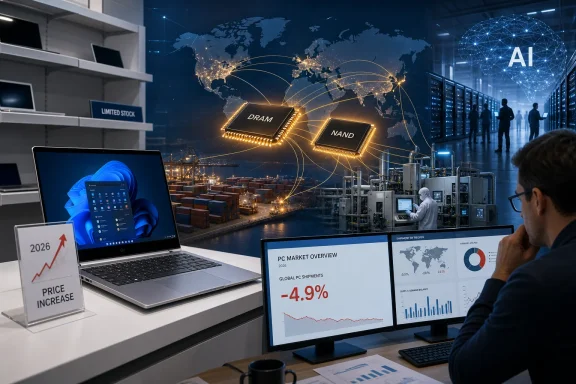
IDC says worldwide PC shipments fell 4.9% year over year in the second quarter of 2026, the industry’s first annual decline in two years, as an enduring memory-chip shortage raised hardware costs, stopped manufacturers from stocking ahead, and pushed the expected supply recovery into early 2028. This is not a conventional PC downturn in which weak demand simply leaves warehouses full and discounts follow. It is a supply-constrained contraction in which fewer machines can be sold even as buyers pay more for them—and HP’s decision to raise Windows-laptop prices shows how quickly that contradiction is reaching the checkout page. For Windows users and IT departments, the old assumption that waiting guarantees a cheaper PC is breaking down.
PC downturns normally have an understandable rhythm. Consumer demand softens, corporate refresh projects slip, manufacturers accumulate inventory, and retailers eventually discount machines to clear the channel.
The second quarter of 2026 does not fit that model. According to IDC data cited by GuruFocus, shipments declined 4.9% from the same quarter a year earlier, marking the first year-over-year contraction in two years. Yet manufacturers had not, at the time of the report, suffered corresponding revenue declines.
That disconnect is the most important part of the story. Unit volume is falling, but higher prices are cushioning the financial impact for vendors. ITPro and PC Gamer, in their coverage of IDC’s findings, both emphasized that manufacturers are passing rising component costs through to customers faster than demand is deteriorating.
The result is a market in which weakness no longer automatically produces bargains. A buyer can encounter fewer attractive configurations, higher prices, or both, even while the industry’s headline shipment number points downward.
IDC had already warned that rising memory costs would force manufacturers to choose between more expensive products and lower specifications. That choice is particularly uncomfortable in Windows laptops, where memory and storage are not optional luxuries but central to the usable life of the machine.
A laptop with less RAM may technically meet an operating system’s minimum requirements while becoming far less useful under real workloads. A smaller SSD can preserve an advertised entry price, but it pushes storage management, application deployment, and user support costs downstream.
This is why the 4.9% decline should not be read as a simple verdict that people no longer want PCs. It is evidence that the industry’s pricing structure is colliding with what customers are willing or able to pay.
PC manufacturers do not need exactly the same packaged components as an AI server, but they exist within the same capital-intensive memory ecosystem. Suppliers decide where to direct production, investment, packaging resources, and contractual commitments according to expected returns.
When premium infrastructure demand absorbs attention and capacity, consumer PCs become more expensive to build. Large manufacturers can use scale and long-standing supplier relationships to secure components, but purchasing power does not make the chips cheap. It merely makes the supply more predictable.
Smaller vendors face a harsher version of the same equation. They may lack the volume commitments and negotiating leverage needed to obtain memory at manageable prices, which can narrow their product ranges or force them out of price-sensitive categories.
This pressure can therefore consolidate the market without increasing total demand. The largest manufacturers may take share because they can continue shipping, not because the overall PC business is healthy.
GuruFocus named HP, Dell, Microsoft, and Apple in framing the companies affected, though its company-specific financial analysis centered overwhelmingly on HP. Dell and Apple are exposed through their hardware businesses, while Microsoft’s vulnerability is broader and more indirect: Windows depends on a large OEM ecosystem that must keep producing machines at prices businesses and consumers will accept.
Microsoft does not have to lose a Windows license on every delayed purchase for the shortage to become strategically awkward. A slower replacement cycle can impede adoption of newer hardware features, postpone fleet migrations, and weaken the pitch for premium Windows experiences designed around more capable systems.
That matters especially as the PC industry tries to persuade customers that new machines should include more local computing capacity, not less. Memory scarcity pushes in the opposite direction, encouraging manufacturers to reduce base configurations precisely when software ambitions are expanding.
The shortage is therefore not merely a component-market story. It is becoming a platform problem: Windows, OEM hardware, application requirements, local AI workloads, security tooling, and enterprise manageability all expect a baseline of resources that is getting more expensive to deliver.
GuruFocus reports that manufacturers have now halted this preemptive stocking. Once that pull-forward behavior ends, the market loses the temporary support created by orders that would otherwise have occurred later.
This helps explain why the second half of 2026 is expected to bring markedly slower industry growth. The market is not merely entering another quarter with expensive components; it is doing so after vendors and buyers have already used part of their ability to act early.
Pull-forward demand always creates a deceptively strong first act. Manufacturers secure available inventory, distributors bring in machines before anticipated price changes, and businesses accelerate purchases that were already planned.
But those actions do not represent additional long-term demand. They move transactions across the calendar. When the pipeline stops filling early, subsequent quarters reveal the underlying shortage and affordability pressure more clearly.
IDC’s outlook, as summarized by GuruFocus, is particularly severe because meaningful easing is not expected until early 2028. That timeline turns the shortage from a temporary purchasing inconvenience into a multi-budget-cycle planning problem.
A company that delays a laptop refresh for one quarter can often manage the consequences. A company that assumes prices and availability will normalize quickly, only to find the disruption continuing through 2027, may end up making emergency purchases under worse conditions.
July 10, 2026 — GuruFocus publishes its analysis of the shipment contraction and examines HP’s exposure, valuation, financial profile, and insider activity.
Second half of 2026 — Industry growth is expected to slow markedly as preemptive stocking stops and macroeconomic conditions weaken.
Early 2028 — The memory-chip shortage is expected to begin easing, leaving manufacturers and buyers to navigate elevated pressure through the intervening period.
The length of that timeline changes procurement logic. An organization should not treat every purchase as an emergency, but neither should it base a critical refresh on the hope that normal component pricing will return in a few months.
HP operates across consumer and commercial PCs as well as printing, and only one-third of its sales come from the United States. That global mix provides geographic diversification, but it also means the company must manage a worldwide supply problem across markets with sharply different levels of purchasing power.
A price increase that a large U.S. enterprise can absorb may shut a family, student, or small business out of a purchase elsewhere. Even within developed markets, higher entry prices can lengthen replacement cycles for organizations that manage hundreds or thousands of endpoints.
HP’s approximately $22.53 billion market capitalization gives it substantial scale, but scale does not eliminate the conflict between protecting margins and protecting volume. The company can absorb some cost pressure, alter its configuration mix, negotiate with suppliers, or pass more of the increase to customers. None of those choices is painless.
Absorbing costs damages profitability. Raising prices damages demand. Reducing memory or storage can weaken product appeal and shorten the useful life of the machine from the customer’s perspective.
The danger is greatest at the lower end of the Windows market, where margins are already thin. Budget laptops cannot accommodate large component-cost increases without either moving into a higher price band or arriving with specifications that make the machine a questionable long-term purchase.
That creates a particularly damaging form of inflation. Customers do not merely pay more for the same experience; they may pay more while compromising on RAM, storage, display quality, serviceability, or other components that manufacturers use to hold the line elsewhere.
For enterprise buyers, the published price is only the beginning. A cheaper configuration that creates slower application performance, greater help-desk demand, or an earlier replacement date can be more expensive over its lifetime than a properly specified system purchased at a higher initial price.
HP’s decision is therefore a signal to procurement teams, not just consumers browsing online stores. If a manufacturer with HP’s scale is already lifting Windows-laptop prices, buyers should assume that contract renewals, standard device catalogs, and negotiated configurations may also face pressure.
Dell shares HP’s direct exposure to Windows PC manufacturing and enterprise purchasing. Its large commercial customer base may provide more predictable demand, but business customers are also highly sensitive to lifecycle economics and can delay broad deployments when budgets tighten.
Microsoft sits one step removed from the component bill. It does not need to manufacture every Windows PC to suffer when OEM shipments decline, because the health of the platform depends on an active replacement market.
Fewer new PCs can mean fewer opportunities to move users onto current hardware, modern security baselines, and newer Windows capabilities. It can also increase the number of aging endpoints that administrators must continue supporting beyond their preferred lifecycle.
Microsoft’s strategic challenge is that its software ambitions increasingly assume better hardware. Local inference, richer collaboration features, virtualization-based protections, endpoint security agents, and complex browser workloads all compete for memory on ordinary PCs.
A market that responds to scarcity by reducing RAM in entry configurations could widen the gap between what Windows can theoretically do and what a typical machine can do comfortably. That would make premium features harder to demonstrate and could reinforce customer skepticism toward expensive upgrades.
Apple faces the same memory market but controls its hardware and operating-system stack more tightly. That integration may give it more freedom to manage configurations and pricing, although it does not exempt the company from the cost of scarce components.
The key competitive variable is no longer simply which company can design the best laptop. It is which company can obtain components, preserve a credible entry configuration, control costs, and convince buyers that the final price is justified.
The shortage may consequently produce uneven outcomes even within a declining market. A vendor can gain share while selling into an industry that is shrinking, especially if smaller competitors cannot secure supply or maintain viable products.
That is not evidence that the crisis has passed. It is evidence that scarcity redistributes power.
That headline discount looks substantial, but it needs to be interpreted alongside the operating conditions producing it. A low share price may represent excessive pessimism, but it can also reflect a market that expects weak growth, tighter margins, or an extended period of uncertainty.
HP’s trailing price-to-earnings ratio is 9.09 times, only slightly below its five-year median of 9.31 times. That comparison is less dramatic than the GF Value gap.
In other words, HP looks inexpensive according to the GuruFocus valuation model, but its earnings multiple is not radically detached from its own recent history. The market has long valued HP as a mature company rather than a high-growth technology business.
The distinction between cheap and undervalued is critical. A company can remain on a low multiple for years if its addressable market is stagnant, its revenue is cyclical, or investors believe cash flows face structural pressure.
GuruFocus gives HPQ a GF Score of 74 out of 100, a result it characterizes as solid overall performance. The system evaluates five components and is associated with a backtest covering 2006 through 2021, but that historical relationship does not remove the company-specific risks created by the current shortage.
The table exposes the central tension in the investment case. HP scores well on profitability, valuation, and momentum, but its growth rating is only 3 out of 10.
That low growth score is not an incidental blemish when the PC industry is entering a shipment contraction. It goes directly to the question of whether HP can expand sales while component costs rise, customers defer purchases, and manufacturers protect revenue through pricing rather than volume.
The 5-out-of-10 financial-strength rating also deserves attention. It is neither a distress signal nor an endorsement of exceptional balance-sheet protection. In a shortage expected to last until early 2028, middling financial strength means investors must consider endurance as well as headline valuation.
The bullish interpretation is that HP remains profitable, has already begun adjusting prices, and is being valued as though a large portion of the difficulty is permanent. If component conditions eventually normalize and replacement demand returns, the current discount could look excessive.
The bearish interpretation is that the PC market’s affordability problem will make revenue quality harder to sustain. Price increases can offset falling shipments for a period, but that strategy has limits: every increase tests demand, encourages delayed replacements, and raises the appeal of used or refurbished machines.
A valuation model can identify a discount; it cannot guarantee the catalyst that closes it.
Executives sell shares for many reasons, including scheduled transactions, diversification, taxes, and personal liquidity. The lack of reported purchases does not prove that insiders expect the stock to decline.
Even so, insider behavior can matter when a valuation argument rests on the idea that the market is overly pessimistic. Open-market buying would provide a stronger signal that people closest to the company viewed the price as unusually attractive.
Instead, the reported activity is one-sided, albeit modest relative to a company with an approximately $22.53 billion market capitalization. It adds a note of caution rather than overturning the investment case.
The responsible conclusion is not that insiders have invalidated GuruFocus’s valuation. It is that the 24.4% stated undervaluation should be weighed against low growth, only moderate financial strength, and no reported insider buying during the stated period.
Investors should also separate HP the company from HPQ the security. HP can execute competently through the shortage while its shares remain range-bound, just as the stock can rise before the underlying PC market improves if expectations become less negative.
The shipment decline is therefore useful context, not a standalone trading signal. It explains why the stock may appear inexpensive, but it does not determine whether that price is wrong.
For customers, however, the same outcome means the burden is being transferred. Manufacturers preserve dollars by collecting more revenue per unit, which can happen through direct price increases, a richer product mix, reduced discounting, or fewer low-cost configurations.
ITPro characterized this as consumers and businesses picking up the bill. PC Gamer similarly highlighted the widening separation between declining shipments and resilient vendor revenue.
The dynamic cannot continue indefinitely. Price increases work only while enough customers still need machines, have budget available, or perceive the offered products as good value.
Some purchases are unavoidable. Failed devices must be replaced, new employees need endpoints, security requirements can force retirements, and business expansion creates additional demand.
Other purchases are discretionary in timing. A three-year refresh can become a four-year refresh, a premium laptop can be replaced with a mainstream model, and an organization can redeploy existing hardware rather than order new systems.
As more customers make those compromises, pricing power begins to undermine volume. The 4.9% shipment decline may therefore represent the opening stage of the affordability response rather than the final adjustment.
That distinction is important for HP and its peers. Revenue resilience in one quarter does not guarantee stable revenue across a shortage expected to persist into early 2028.
It also matters for Windows support teams. Longer refresh cycles leave more old batteries, worn keyboards, low-capacity drives, and underpowered systems in active service. The savings recorded by procurement can reappear as support incidents and lost productivity.
The industry’s balance sheets may initially look healthier than the user experience. That is precisely why the unit-versus-revenue divide deserves more attention than either number in isolation.
The first step is understanding actual fleet condition. Organizations need to know which machines are merely old, which are nearing operational failure, and which cannot meet future software or security requirements.
That inventory should be connected to business criticality. A customer-service laptop, an engineering workstation, and a lightly used shared terminal do not carry the same risk if a replacement is delayed.
Standard configurations should also be reconsidered carefully. Reducing RAM or storage can lower the acquisition price, but it may conflict with expected application growth, security tooling, browser use, virtualization, or local AI workloads.
Where devices are not realistically upgradeable after purchase, an underspecified configuration locks the organization into that compromise. A modest saving at procurement can become a multi-year productivity tax.
Admins should also examine the diversity of approved models. Too little standardization increases support complexity, but relying on a single exact configuration can become dangerous when a particular memory or storage combination disappears from the channel.
The goal is not to buy everything immediately. It is to distinguish predictable demand from speculative stockpiling and to secure the machines that the organization genuinely expects to need.
A machine may contain dedicated processing hardware and still deliver a constrained experience if the rest of the system lacks sufficient RAM and storage. Component scarcity risks producing PCs whose marketing ambitions exceed their practical configuration.
IDC has warned that manufacturers may respond to high memory costs by reducing the baseline capacity of some devices. That preserves price points on paper but makes the comparison between generations less straightforward.
A new laptop is not necessarily a better value merely because it uses a newer processor. If it ships with less usable memory, a smaller drive, or fewer upgrade options, its long-term advantage may be limited.
This is especially relevant for organizations evaluating AI-oriented Windows fleets. They must judge systems according to deployable workloads, software maturity, privacy requirements, manageability, and memory consumption—not the presence of an AI label.
Microsoft has an incentive to keep the Windows hardware ecosystem moving toward higher specifications. OEMs under cost pressure have an incentive to protect margins and maintain attainable price points.
Those goals can conflict. If the shortage continues as expected, Microsoft may need to make its software more efficient while vendors become more selective about which premium capabilities they include in mainstream devices.
The market could consequently split. Better-funded enterprises and high-end consumers may continue purchasing well-equipped systems, while entry-level buyers receive smaller improvements or remain on older hardware for longer.
Such a split would be more consequential than one weak shipment quarter. It would reshape who receives the benefits of the next generation of Windows computing and how quickly developers can assume that modern capabilities are broadly available.
But the surrounding evidence makes this decline harder to dismiss. It is the first year-over-year drop in two years, it arrives amid a supply shortage expected to extend until early 2028, and it follows a period in which manufacturers attempted to get ahead of higher costs through preemptive stocking.
It also comes with an unusual revenue pattern. Vendors are not yet experiencing the full financial decline that the shipment number might imply because pricing is doing more of the work.
That gives manufacturers time, but it may also delay the moment when their financial statements fully reveal weakening affordability. Customers feel the price increase before vendor revenue necessarily shows the volume damage.
The expected marked slowdown in the second half of 2026 will test whether price increases can continue offsetting the loss of unit sales. If they can, the industry may preserve revenue while becoming smaller and more expensive.
If they cannot, manufacturers will face a harder trade-off between margins and market share. Discounts could eventually return, but they would arrive in a market where replacement cycles have lengthened and some buyers have already adjusted to doing without new equipment.
For HP, that uncertainty explains both sides of the valuation debate. The stock’s low price and strong valuation rating suggest pessimism, while its weak growth score reflects why that pessimism exists.
For Windows users, the conclusion is less abstract. The next PC may cost more, offer a less generous base configuration, or require more careful timing than the machine it replaces.
 The PC Market Is Shrinking Without Getting Cheaper
PC downturns normally have an understandable rhythm. Consumer demand softens, corporate refresh projects slip, manufacturers accumulate inventory, and retailers eventually discount machines to clear the channel.The second quarter of 2026 does not fit that model. According to IDC data cited by GuruFocus, shipments declined 4.9% from the same quarter a year earlier, marking the first year-over-year contraction in two years. Yet manufacturers had not, at the time of the report, suffered corresponding revenue declines.
That disconnect is the most important part of the story. Unit volume is falling, but higher prices are cushioning the financial impact for vendors. ITPro and PC Gamer, in their coverage of IDC’s findings, both emphasized that manufacturers are passing rising component costs through to customers faster than demand is deteriorating.
The result is a market in which weakness no longer automatically produces bargains. A buyer can encounter fewer attractive configurations, higher prices, or both, even while the industry’s headline shipment number points downward.
IDC had already warned that rising memory costs would force manufacturers to choose between more expensive products and lower specifications. That choice is particularly uncomfortable in Windows laptops, where memory and storage are not optional luxuries but central to the usable life of the machine.
A laptop with less RAM may technically meet an operating system’s minimum requirements while becoming far less useful under real workloads. A smaller SSD can preserve an advertised entry price, but it pushes storage management, application deployment, and user support costs downstream.
This is why the 4.9% decline should not be read as a simple verdict that people no longer want PCs. It is evidence that the industry’s pricing structure is colliding with what customers are willing or able to pay.
A Shortage Manufactured Upstream Lands on the Windows Price Tag
The immediate problem is a shortage of memory chips, but the deeper issue is how semiconductor capacity is being allocated. IDC has separately described a market in which consumer-device manufacturers are competing with infrastructure customers for DRAM and NAND supply, with AI-oriented data-center demand helping to pull production toward more lucrative products.PC manufacturers do not need exactly the same packaged components as an AI server, but they exist within the same capital-intensive memory ecosystem. Suppliers decide where to direct production, investment, packaging resources, and contractual commitments according to expected returns.
When premium infrastructure demand absorbs attention and capacity, consumer PCs become more expensive to build. Large manufacturers can use scale and long-standing supplier relationships to secure components, but purchasing power does not make the chips cheap. It merely makes the supply more predictable.
Smaller vendors face a harsher version of the same equation. They may lack the volume commitments and negotiating leverage needed to obtain memory at manageable prices, which can narrow their product ranges or force them out of price-sensitive categories.
This pressure can therefore consolidate the market without increasing total demand. The largest manufacturers may take share because they can continue shipping, not because the overall PC business is healthy.
GuruFocus named HP, Dell, Microsoft, and Apple in framing the companies affected, though its company-specific financial analysis centered overwhelmingly on HP. Dell and Apple are exposed through their hardware businesses, while Microsoft’s vulnerability is broader and more indirect: Windows depends on a large OEM ecosystem that must keep producing machines at prices businesses and consumers will accept.
Microsoft does not have to lose a Windows license on every delayed purchase for the shortage to become strategically awkward. A slower replacement cycle can impede adoption of newer hardware features, postpone fleet migrations, and weaken the pitch for premium Windows experiences designed around more capable systems.
That matters especially as the PC industry tries to persuade customers that new machines should include more local computing capacity, not less. Memory scarcity pushes in the opposite direction, encouraging manufacturers to reduce base configurations precisely when software ambitions are expanding.
The shortage is therefore not merely a component-market story. It is becoming a platform problem: Windows, OEM hardware, application requirements, local AI workloads, security tooling, and enterprise manageability all expect a baseline of resources that is getting more expensive to deliver.
Manufacturers Borrowed Sales From the Future
The industry initially responded to the worsening supply outlook by stocking components and shipping systems before the full effect of higher costs arrived. That strategy could soften the first impact, but it could not create new memory supply.GuruFocus reports that manufacturers have now halted this preemptive stocking. Once that pull-forward behavior ends, the market loses the temporary support created by orders that would otherwise have occurred later.
This helps explain why the second half of 2026 is expected to bring markedly slower industry growth. The market is not merely entering another quarter with expensive components; it is doing so after vendors and buyers have already used part of their ability to act early.
Pull-forward demand always creates a deceptively strong first act. Manufacturers secure available inventory, distributors bring in machines before anticipated price changes, and businesses accelerate purchases that were already planned.
But those actions do not represent additional long-term demand. They move transactions across the calendar. When the pipeline stops filling early, subsequent quarters reveal the underlying shortage and affordability pressure more clearly.
IDC’s outlook, as summarized by GuruFocus, is particularly severe because meaningful easing is not expected until early 2028. That timeline turns the shortage from a temporary purchasing inconvenience into a multi-budget-cycle planning problem.
A company that delays a laptop refresh for one quarter can often manage the consequences. A company that assumes prices and availability will normalize quickly, only to find the disruption continuing through 2027, may end up making emergency purchases under worse conditions.
Timeline
Second quarter of 2026 — Worldwide PC shipments decline 4.9% year over year, according to IDC, producing the industry’s first annual drop in two years.July 10, 2026 — GuruFocus publishes its analysis of the shipment contraction and examines HP’s exposure, valuation, financial profile, and insider activity.
Second half of 2026 — Industry growth is expected to slow markedly as preemptive stocking stops and macroeconomic conditions weaken.
Early 2028 — The memory-chip shortage is expected to begin easing, leaving manufacturers and buyers to navigate elevated pressure through the intervening period.
The length of that timeline changes procurement logic. An organization should not treat every purchase as an emergency, but neither should it base a critical refresh on the hope that normal component pricing will return in a few months.
HP’s Price Increases Turn an Industry Warning Into a Retail Reality
HP is the clearest case in the GuruFocus report because the company has already raised prices for its Windows laptops in response to higher costs. This moves the shortage from analyst forecasts into an observable commercial response.HP operates across consumer and commercial PCs as well as printing, and only one-third of its sales come from the United States. That global mix provides geographic diversification, but it also means the company must manage a worldwide supply problem across markets with sharply different levels of purchasing power.
A price increase that a large U.S. enterprise can absorb may shut a family, student, or small business out of a purchase elsewhere. Even within developed markets, higher entry prices can lengthen replacement cycles for organizations that manage hundreds or thousands of endpoints.
HP’s approximately $22.53 billion market capitalization gives it substantial scale, but scale does not eliminate the conflict between protecting margins and protecting volume. The company can absorb some cost pressure, alter its configuration mix, negotiate with suppliers, or pass more of the increase to customers. None of those choices is painless.
Absorbing costs damages profitability. Raising prices damages demand. Reducing memory or storage can weaken product appeal and shorten the useful life of the machine from the customer’s perspective.
The danger is greatest at the lower end of the Windows market, where margins are already thin. Budget laptops cannot accommodate large component-cost increases without either moving into a higher price band or arriving with specifications that make the machine a questionable long-term purchase.
That creates a particularly damaging form of inflation. Customers do not merely pay more for the same experience; they may pay more while compromising on RAM, storage, display quality, serviceability, or other components that manufacturers use to hold the line elsewhere.
For enterprise buyers, the published price is only the beginning. A cheaper configuration that creates slower application performance, greater help-desk demand, or an earlier replacement date can be more expensive over its lifetime than a properly specified system purchased at a higher initial price.
HP’s decision is therefore a signal to procurement teams, not just consumers browsing online stores. If a manufacturer with HP’s scale is already lifting Windows-laptop prices, buyers should assume that contract renewals, standard device catalogs, and negotiated configurations may also face pressure.
Dell, Microsoft, and Apple Face Different Versions of the Same Constraint
GuruFocus’s headline places Dell, Microsoft, and Apple beside HP, but the underlying article does not provide the same detailed financial treatment for those companies. That distinction matters: they are all exposed to the PC market, but not in identical ways, and the available evidence does not support pretending otherwise.Dell shares HP’s direct exposure to Windows PC manufacturing and enterprise purchasing. Its large commercial customer base may provide more predictable demand, but business customers are also highly sensitive to lifecycle economics and can delay broad deployments when budgets tighten.
Microsoft sits one step removed from the component bill. It does not need to manufacture every Windows PC to suffer when OEM shipments decline, because the health of the platform depends on an active replacement market.
Fewer new PCs can mean fewer opportunities to move users onto current hardware, modern security baselines, and newer Windows capabilities. It can also increase the number of aging endpoints that administrators must continue supporting beyond their preferred lifecycle.
Microsoft’s strategic challenge is that its software ambitions increasingly assume better hardware. Local inference, richer collaboration features, virtualization-based protections, endpoint security agents, and complex browser workloads all compete for memory on ordinary PCs.
A market that responds to scarcity by reducing RAM in entry configurations could widen the gap between what Windows can theoretically do and what a typical machine can do comfortably. That would make premium features harder to demonstrate and could reinforce customer skepticism toward expensive upgrades.
Apple faces the same memory market but controls its hardware and operating-system stack more tightly. That integration may give it more freedom to manage configurations and pricing, although it does not exempt the company from the cost of scarce components.
The key competitive variable is no longer simply which company can design the best laptop. It is which company can obtain components, preserve a credible entry configuration, control costs, and convince buyers that the final price is justified.
The shortage may consequently produce uneven outcomes even within a declining market. A vendor can gain share while selling into an industry that is shrinking, especially if smaller competitors cannot secure supply or maintain viable products.
That is not evidence that the crisis has passed. It is evidence that scarcity redistributes power.
The HP Stock Discount Reflects Risk, Not a Free Lunch
GuruFocus’s article shifts from the PC market to a valuation argument about HP. Its GF Value estimate places HPQ at $32.60 compared with a current price of $24.64, implying that the shares are 24.4% undervalued by that model.That headline discount looks substantial, but it needs to be interpreted alongside the operating conditions producing it. A low share price may represent excessive pessimism, but it can also reflect a market that expects weak growth, tighter margins, or an extended period of uncertainty.
HP’s trailing price-to-earnings ratio is 9.09 times, only slightly below its five-year median of 9.31 times. That comparison is less dramatic than the GF Value gap.
In other words, HP looks inexpensive according to the GuruFocus valuation model, but its earnings multiple is not radically detached from its own recent history. The market has long valued HP as a mature company rather than a high-growth technology business.
The distinction between cheap and undervalued is critical. A company can remain on a low multiple for years if its addressable market is stagnant, its revenue is cyclical, or investors believe cash flows face structural pressure.
GuruFocus gives HPQ a GF Score of 74 out of 100, a result it characterizes as solid overall performance. The system evaluates five components and is associated with a backtest covering 2006 through 2021, but that historical relationship does not remove the company-specific risks created by the current shortage.
| GF Score component | HPQ rating | What it suggests in the present market |
|---|---|---|
| Financial Strength | 5/10 | Adequate rather than exceptional resilience against a prolonged disruption |
| Profitability | 7/10 | An established ability to earn money despite a mature market |
| Growth | 3/10 | The clearest weakness as shipment volumes and affordability come under pressure |
| Valuation | 8/10 | Shares appear inexpensive according to GuruFocus’s framework |
| Momentum | 8/10 | Market performance is stronger than the growth rating alone might imply |
That low growth score is not an incidental blemish when the PC industry is entering a shipment contraction. It goes directly to the question of whether HP can expand sales while component costs rise, customers defer purchases, and manufacturers protect revenue through pricing rather than volume.
The 5-out-of-10 financial-strength rating also deserves attention. It is neither a distress signal nor an endorsement of exceptional balance-sheet protection. In a shortage expected to last until early 2028, middling financial strength means investors must consider endurance as well as headline valuation.
The bullish interpretation is that HP remains profitable, has already begun adjusting prices, and is being valued as though a large portion of the difficulty is permanent. If component conditions eventually normalize and replacement demand returns, the current discount could look excessive.
The bearish interpretation is that the PC market’s affordability problem will make revenue quality harder to sustain. Price increases can offset falling shipments for a period, but that strategy has limits: every increase tests demand, encourages delayed replacements, and raises the appeal of used or refurbished machines.
A valuation model can identify a discount; it cannot guarantee the catalyst that closes it.
Insider Selling Adds Caution but Not a Verdict
GuruFocus reports that HP insiders sold $0.3 million in shares during the past three months, with no reported insider purchases. That pattern is worth noting, but it should not be turned into a claim the evidence cannot support.Executives sell shares for many reasons, including scheduled transactions, diversification, taxes, and personal liquidity. The lack of reported purchases does not prove that insiders expect the stock to decline.
Even so, insider behavior can matter when a valuation argument rests on the idea that the market is overly pessimistic. Open-market buying would provide a stronger signal that people closest to the company viewed the price as unusually attractive.
Instead, the reported activity is one-sided, albeit modest relative to a company with an approximately $22.53 billion market capitalization. It adds a note of caution rather than overturning the investment case.
The responsible conclusion is not that insiders have invalidated GuruFocus’s valuation. It is that the 24.4% stated undervaluation should be weighed against low growth, only moderate financial strength, and no reported insider buying during the stated period.
Investors should also separate HP the company from HPQ the security. HP can execute competently through the shortage while its shares remain range-bound, just as the stock can rise before the underlying PC market improves if expectations become less negative.
The shipment decline is therefore useful context, not a standalone trading signal. It explains why the stock may appear inexpensive, but it does not determine whether that price is wrong.
Revenue Resilience Can Hide Customer Pain
The absence of immediate revenue declines could easily be mistaken for evidence that PC manufacturers are coping well. From a corporate perspective, maintaining revenue while shipping fewer machines is preferable to suffering declines in both measures.For customers, however, the same outcome means the burden is being transferred. Manufacturers preserve dollars by collecting more revenue per unit, which can happen through direct price increases, a richer product mix, reduced discounting, or fewer low-cost configurations.
ITPro characterized this as consumers and businesses picking up the bill. PC Gamer similarly highlighted the widening separation between declining shipments and resilient vendor revenue.
The dynamic cannot continue indefinitely. Price increases work only while enough customers still need machines, have budget available, or perceive the offered products as good value.
Some purchases are unavoidable. Failed devices must be replaced, new employees need endpoints, security requirements can force retirements, and business expansion creates additional demand.
Other purchases are discretionary in timing. A three-year refresh can become a four-year refresh, a premium laptop can be replaced with a mainstream model, and an organization can redeploy existing hardware rather than order new systems.
As more customers make those compromises, pricing power begins to undermine volume. The 4.9% shipment decline may therefore represent the opening stage of the affordability response rather than the final adjustment.
That distinction is important for HP and its peers. Revenue resilience in one quarter does not guarantee stable revenue across a shortage expected to persist into early 2028.
It also matters for Windows support teams. Longer refresh cycles leave more old batteries, worn keyboards, low-capacity drives, and underpowered systems in active service. The savings recorded by procurement can reappear as support incidents and lost productivity.
The industry’s balance sheets may initially look healthier than the user experience. That is precisely why the unit-versus-revenue divide deserves more attention than either number in isolation.
IT Departments Must Stop Treating Hardware as a Spot Purchase
For administrators, the practical lesson is to replace reactive buying with scenario planning. A procurement strategy based entirely on the current lowest quote is fragile when prices, configurations, and availability can all change before an order is approved.The first step is understanding actual fleet condition. Organizations need to know which machines are merely old, which are nearing operational failure, and which cannot meet future software or security requirements.
That inventory should be connected to business criticality. A customer-service laptop, an engineering workstation, and a lightly used shared terminal do not carry the same risk if a replacement is delayed.
Standard configurations should also be reconsidered carefully. Reducing RAM or storage can lower the acquisition price, but it may conflict with expected application growth, security tooling, browser use, virtualization, or local AI workloads.
Where devices are not realistically upgradeable after purchase, an underspecified configuration locks the organization into that compromise. A modest saving at procurement can become a multi-year productivity tax.
Admins should also examine the diversity of approved models. Too little standardization increases support complexity, but relying on a single exact configuration can become dangerous when a particular memory or storage combination disappears from the channel.
The goal is not to buy everything immediately. It is to distinguish predictable demand from speculative stockpiling and to secure the machines that the organization genuinely expects to need.
Action checklist for admins
- Audit the fleet by device age, warranty status, hardware condition, upgradeability, and business criticality.
- Identify replacements that cannot safely be delayed through the second half of 2026.
- Revalidate standard RAM and storage specifications against actual workloads rather than accepting cheaper base configurations automatically.
- Ask suppliers to document configuration substitutions, quote-validity periods, delivery expectations, and price-adjustment terms.
- Maintain approved alternatives for critical device classes instead of depending on one exact model.
- Compare extending device life with the full costs of warranty coverage, repairs, support labor, security requirements, and user downtime.
- Build 2027 hardware budgets around multiple pricing and availability scenarios rather than assuming rapid normalization.
The Shortage Complicates the AI PC Sales Pitch
The timing could hardly be worse for the industry’s push toward more capable PCs. Manufacturers and platform vendors want customers to see local AI processing as a reason to upgrade, but local AI does not thrive on minimal memory.A machine may contain dedicated processing hardware and still deliver a constrained experience if the rest of the system lacks sufficient RAM and storage. Component scarcity risks producing PCs whose marketing ambitions exceed their practical configuration.
IDC has warned that manufacturers may respond to high memory costs by reducing the baseline capacity of some devices. That preserves price points on paper but makes the comparison between generations less straightforward.
A new laptop is not necessarily a better value merely because it uses a newer processor. If it ships with less usable memory, a smaller drive, or fewer upgrade options, its long-term advantage may be limited.
This is especially relevant for organizations evaluating AI-oriented Windows fleets. They must judge systems according to deployable workloads, software maturity, privacy requirements, manageability, and memory consumption—not the presence of an AI label.
Microsoft has an incentive to keep the Windows hardware ecosystem moving toward higher specifications. OEMs under cost pressure have an incentive to protect margins and maintain attainable price points.
Those goals can conflict. If the shortage continues as expected, Microsoft may need to make its software more efficient while vendors become more selective about which premium capabilities they include in mainstream devices.
The market could consequently split. Better-funded enterprises and high-end consumers may continue purchasing well-equipped systems, while entry-level buyers receive smaller improvements or remain on older hardware for longer.
Such a split would be more consequential than one weak shipment quarter. It would reshape who receives the benefits of the next generation of Windows computing and how quickly developers can assume that modern capabilities are broadly available.
What the 4.9% Drop Actually Tells Us
The second-quarter decline is not large enough by itself to establish an irreversible collapse. PC markets are cyclical, and a single quarter can reflect inventory timing, product launches, macroeconomic pressure, or comparisons with an unusually strong prior period.But the surrounding evidence makes this decline harder to dismiss. It is the first year-over-year drop in two years, it arrives amid a supply shortage expected to extend until early 2028, and it follows a period in which manufacturers attempted to get ahead of higher costs through preemptive stocking.
It also comes with an unusual revenue pattern. Vendors are not yet experiencing the full financial decline that the shipment number might imply because pricing is doing more of the work.
That gives manufacturers time, but it may also delay the moment when their financial statements fully reveal weakening affordability. Customers feel the price increase before vendor revenue necessarily shows the volume damage.
The expected marked slowdown in the second half of 2026 will test whether price increases can continue offsetting the loss of unit sales. If they can, the industry may preserve revenue while becoming smaller and more expensive.
If they cannot, manufacturers will face a harder trade-off between margins and market share. Discounts could eventually return, but they would arrive in a market where replacement cycles have lengthened and some buyers have already adjusted to doing without new equipment.
For HP, that uncertainty explains both sides of the valuation debate. The stock’s low price and strong valuation rating suggest pessimism, while its weak growth score reflects why that pessimism exists.
For Windows users, the conclusion is less abstract. The next PC may cost more, offer a less generous base configuration, or require more careful timing than the machine it replaces.
The Decisions That Matter Before the Market Tightens Further
The signal from IDC, GuruFocus, and the broader industry coverage is not that every buyer should rush to purchase a PC. It is that buyers should stop assuming a falling shipment market will automatically reward patience with lower prices.- IDC reports a 4.9% year-over-year shipment decline in the second quarter, the first such drop in two years.
- The memory shortage is not expected to ease until early 2028.
- Growth is expected to slow markedly in the second half of 2026 after manufacturers stop stocking ahead.
- HP has already raised prices on Windows laptops as costs increase.
- HPQ appears 24.4% undervalued under GuruFocus’s model, but its 3-out-of-10 growth rating captures a central risk.
- IT buyers should protect critical refreshes while resisting underspecified systems that merely preserve an attractive sticker price.
References
- Primary source: GuruFocus
Published: 2026-07-10T22:10:13.199049
Loading…
www.gurufocus.com - Related coverage: techradar.com
Loading…
www.techradar.com - Related coverage: pcgamer.com
Loading…
www.pcgamer.com - Related coverage: itpro.com
Loading…
www.itpro.com - Related coverage: telecompaper.com
Loading…
www.telecompaper.com - Related coverage: gartner.com
Loading…
www.gartner.com