

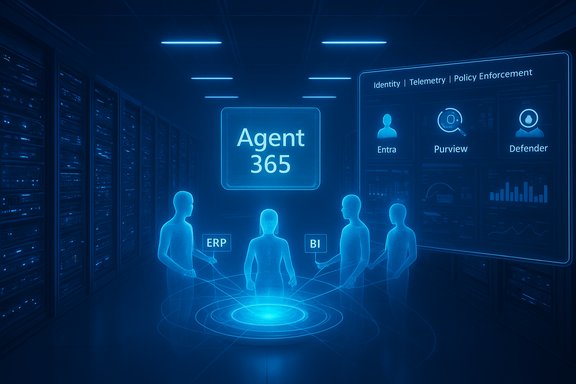
Microsoft’s Ignite this week doubled down on one thing: agents. The company used the Moscone stage to stitch together a sweeping product narrative — new infrastructure, multi‑vendor model choice, a governance control plane called Agent 365, and an expanding partner ecosystem that promises to make agentic AI a production reality for enterprises. The headlines were loud (multi‑billion compute deals, new GPU classes, and dozens of partner integrations) and the message was clear: Microsoft is pushing to make Azure the default fabric for large‑scale, governed AI — from model selection and data grounding to identity, observability, and lifecycle controls.
Background / Overview
Microsoft Ignite has long been the company’s venue for aligning product roadmaps with enterprise priorities — cloud scale, productivity, and security. This year’s edition reframed those priorities under an “agentic” architecture: specialized AI agents that can plan, act, and be audited inside enterprise systems. That narrative binds together multiple product threads introduced or emphasized at the show: Microsoft 365 Copilot and Copilot Studio as authoring and in‑app experiences; Azure AI Foundry and Foundry runtimes to host production models; Microsoft Agent 365 as the registry and governance plane; and infrastructure investments (Fairwater data centers, NVIDIA Blackwell GPUs, Spectrum‑X networking) to provide the scale. At the partner level, vendors announced an avalanche of integrations designed to make agents useful across real enterprise workflows — everything from data connectors that let agents read and write to ERP and BI systems to purpose‑built agent platforms and observability integrations. Those partner stories are not decorative: Microsoft’s go‑to‑market depends on an ecosystem that can package agent tenets into repeatable, SLA‑backed offerings for customers.What happened at Ignite — the concrete announcements
1) Agent 365 and the governance fabric
Microsoft unveiled Agent 365, its control plane for an “agent fleet”: a registry, identity binding, access control, discoverability, telemetry and integrated security controls tied to Entra, Purview, and Defender. Agent 365’s thesis is simple — treat agents like production services (with identities, lifecycle, and observability) rather than ephemeral assistants. Microsoft’s documentation and blog posts present Agent 365 as the glue that prevents “agent sprawl” and provides IT teams the controls they need to approve, monitor and retire agents. Why this matters: agents that can act introduce new enterprise risk vectors (unauthorized data writes, misconfigured connectors, and stealthy exfiltration). Bringing agents into existing identity and compliance tooling is a pragmatic move to make automation auditable and manageable.2) Infrastructure — Fairwater, Blackwell GPUs, Spectrum‑X and the AI “superfactory”
Microsoft and NVIDIA amplified a deep infrastructure partnership at Ignite. Microsoft described its Fairwater datacenter program (notably an Atlanta installation linked to the existing Wisconsin Fairwater site) as a purpose‑built “AI superfactory” optimized for rack‑scale GPU domains. NVIDIA confirmed expanded integration — including the use of NVIDIA Blackwell GPUs across the superfactory, new Spectrum‑X Ethernet switching, and public previews of Nvidia‑powered VM classes (e.g., NC/ND series updates and RTX PRO 6000 Blackwell Server Edition VMs on Azure). NVIDIA’s blog and Microsoft’s infrastructure disclosures explicitly reference large‑scale GPU deployments measured in the tens to hundreds of thousands of GPUs for training and inference, and the use of rack‑scale NVL72 systems for inference and high‑utilization workloads. Caveat: vendors routinely frame future hardware buildouts with aspirational scale numbers. The “hundreds of thousands” phrasing appears in public vendor narratives, but the exact operational counts and timelines are an enterprise‑grade procurement detail that should be confirmed through direct vendor disclosures or contractual statements for any capacity‑sensitive decision.3) Multi‑model Foundry, Anthropic and model diversification
Microsoft expanded the model catalog available through Azure AI Foundry and Copilot Studio, including Anthropic’s Claude families and other third‑party models. This is more than marketing: Microsoft’s aim is to let enterprises choose the “best‑for‑purpose” model (safety‑tilted, long‑context, coding‑focused, etc. while preserving unified governance, billing, and routing inside Azure and Foundry. The injected model diversity reflects Microsoft’s strategic move to reduce single‑vendor concentration and offer enterprises model choice for different workloads.4) Partner and product ecosystem headlines (representative samples)
- NVIDIA: deep full‑stack cooperation to power the Microsoft AI Superfactory and public preview of RTX PRO 6000 Blackwell Server Edition VMs.
- Avanade: launched an Agentic Platform built on Microsoft technologies and discoverable via Copilot Studio and Agent 365.
- Atos: released an Autonomous Data and AI Engineer agentic solution for Azure Databricks and Snowflake on Azure, grounded in Microsoft Responsible AI principles (available for those data platforms).
- C3 AI: expanded integrations across Microsoft Copilot, Microsoft Fabric, and Azure AI Foundry to unify reasoning, data, and models in a single enterprise AI system.
- CData: announced Model Context Protocol (MCP) connectivity into Copilot Studio/Agent 365 to let agents read/write from 350+ systems.
- ClickHouse: added an integration with Microsoft OneLake (Fabric’s unified data lake) enabling Iceberg Table API access for real‑time analytics.
- dbt Labs: added native integration for dbt in Fabric Data Factory with a roadmap to include dbt Fusion engine.
- Red Hat: OpenShift Virtualization is available as a self‑managed operator in Azure Red Hat OpenShift (ARO), bringing VMs onto the same Kubernetes management plane.
- SAP: announced SAP Business Data Cloud Connect for Microsoft Fabric to enable zero‑copy sharing between SAP data products and OneLake.
Technical reality check — verifying the load‑bearing claims
This section cross‑checks the announcements against independent reporting and vendor documentation to separate strategic messaging from verifiable claims.- Infrastructure scale and Blackwell adoption: NVIDIA’s blog and Microsoft materials describe the Fairwater sites and the use of Blackwell‑class GPUs in rack‑scale NVL72 installations; they reference large aggregate GPU counts and purpose‑built networking (Spectrum‑X) to support multi‑site distributed training. These are vendor statements corroborated by press reporting; they are credible as strategic design intent and supplier roadmaps but remain subject to procurement timelines and regional export regulations.
- RTX PRO 6000 Blackwell Server Edition on Azure: Microsoft’s Azure update feeds and third‑party coverage reference NC/ND/NCv6 / NVv6 VM families refreshed with Blackwell‑derived GPUs and the public preview of variants like RTX PRO 6000 BSE for workstation and inference acceleration use cases. Independent previews and vendor blogs show these VM families in public preview at Ignite. Enterprises should validate exact SKU names and pricing in Azure’s official update feed and their Azure subscription’s region availability.
- Agent 365 mechanics and partner integrations: Microsoft’s own Agent 365 product post and Microsoft 365 blogs describe registry, Entra Agent ID binding, Purview integration, and Defender telemetry — all verifiable in the announced docs and Microsoft posts. Partner press releases (Kasisto, Avanade, Kore.ai, Glean) confirm many third‑party integrations were publicly announced at Ignite, supporting Microsoft’s claim of a fast‑growing Agent 365 ecosystem.
- Data ecosystem integrations (OneLake, ClickHouse, dbt): ClickHouse and dbt issued press releases and technical posts confirming OneLake Table API support and dbt integration with Fabric Data Factory, respectively — these are tangible product releases with documentation and public preview availability.
Strengths — what Microsoft (and partners) got right
- Governance‑first narrative matches buyer priorities. The shift from “shiny assistant features” to an identity, telemetry and policy‑centric platform (Agent 365 + Entra + Purview + Defender) aligns with what CIOs and CISOs are demanding: safe, auditable automation that integrates with existing controls. The technical tie‑ins (Entra Agent ID, telemetry pipelines, Purview policy enforcement) are pragmatic and measurable advances.
- Model choice without siloed stacks. Supporting multiple model vendors (OpenAI, Anthropic, Cohere and others) inside Foundry gives enterprises flexibility to match model behavior to use cases, and reduces single‑vendor dependency. That approach increases buyer leverage and reduces the “one model fits all” risk.
- End‑to‑end partner ecosystem. The breadth of partner announcements (connectors, agent platforms, observability and storage innovations) reduces the integration burden for customers. When partners provide vetted templates, industry agents, and managed MCP connectors, the time from PoC to production shortens.
- Infrastructure prepared for scale. The Fairwater design and vendor collaboration with NVIDIA to deliver rack‑scale Blackwell accelerators and Spectrum‑X switching recognize the realities of multi‑site training and high utilization that frontier models demand. For large model builders this is a necessary evolution of datacenter design.
Risks and open questions — where the industry must be cautious
- Agent sprawl and human oversight: registering agents is one thing; preventing silent or over‑privileged agents from performing risky actions is another. Agent 365 provides a registry and ID binding, but organizational processes (access reviews, least privilege, emergency kill switches, human‑in‑the‑loop controls) will still be decisive in preventing accidents. Overreliance on automated governance without granular operational playbooks risks chaotic agent estates.
- Data grounding and semantic correctness: agents acting on business decisions require reliably grounded knowledge. Foundry IQ and Fabric IQ attempt to provide semantic layers, but garbage-in/garbage-out still applies. Enterprises must invest in data quality, lineage, and test harnesses for agent outputs; vendor promises about “trustworthy grounding” need end‑to‑end verification in each deployment.
- Cost and supply chain exposure: building petascale training and inference farms is capital‑intensive. The industry’s reliance on specific GPU families (Blackwell) concentrates supply risk; vendor statements about “hundreds of thousands” of GPUs are directional but highlight the capital intensity and the potential for bottlenecks or pricing pressure. IT procurement should model both compute and networking costs explicitly and negotiate capacity commitments or reserved pricing where possible.
- Security and MCP (Model Context Protocol) risks: MCP and similar connector patterns let agents read and write across many systems. That power must be harnessed with strict consent flows, token lifetimes, and strict least‑privilege connectors. Misconfigured MCP servers or poorly scoped connectors can enable unintended writebacks or data leakage. The pattern is powerful but raises a new class of operational security controls to manage.
- Vendor lock‑in vs. federation. Microsoft’s design aims to make Foundry and Agent 365 a neutral control plane for multi‑vendor models, but deep integration with Purview, Entra, and OneLake also increases the migration cost to other clouds. Organizations should weigh the benefits of consolidated controls against the long‑term flexibility costs.
Practical guidance for IT leaders — a tactical roadmap
- Start with a one‑year pilot plan:
- Identify 3 business processes with clear ROI and bounded risk (e.g., HR triage, sales prospect enrichment, or IT runbook automation).
- Require human review for any agent‑initiated change in production for at least the first two release cycles.
- Enforce identity and least‑privilege:
- Adopt Entra Agent ID patterns for every agent.
- Use conditional access policies, short token lifetimes, and connector‑scoped service principals.
- Architect data grounding and testing:
- Treat grounding data as a first‑class product: catalog, label, and version it in OneLake or your data mesh.
- Build automated evaluation harnesses for agent outputs (synthetic and real‑world tests) before broad rollouts.
- Instrument observability and audit trails:
- Forward agent telemetry to SIEM/SRE stacks and enable traceability to input datasets and model versions.
- Define SLOs for agents (latency, accuracy, failure modes) and monitor continuously.
- Control costs and capacity:
- Model compute consumption per agent and use metered pilots.
- Negotiate reserved capacity or committed use discounts for predictable workloads; consider hybrid approaches for bursty training.
- Treat MCP/connectors as high‑risk assets:
- Require connector approval playbooks, code reviews, and red‑team style prompt‑injection tests.
- Disallow writeback permissions until strict approval workflows and staging validations exist.
- Vendor evaluation checklist:
- SLAs for model availability and inference latency.
- Partner encryption, data residency guarantees, and liability terms.
- Support for standard formats (Iceberg/Delta) and OneLake interoperability.
What to watch next — short and medium term signals
- Early customer case studies and SLAs. The first customer references that include measurable outcomes (cost per automation, error rates, time‑to‑value) will be decisive in separating marketing from production reality.
- Capacity and supply updates. How Microsoft and NVIDIA operationalize the Fairwater sites and GB300/GB200 rack deployments (timelines and regional availability) will materially affect procurement decisions for large model training.
- Security incidents and red‑team reports. Expect adversarial testing and independent audits to surface gaps in agent governance; these will influence early regulatory guidance and enterprise adoption cadence.
- Open standards and interoperability uptake. The Model Context Protocol (MCP), Agent2Agent patterns, and OneLake Table APIs (Iceberg) should be watched for standardization and third‑party tool compatibility. Broad adoption will reduce integration friction across vendors.
Conclusion — measured optimism, disciplined adoption
Microsoft Ignite laid out an ambitious, coherent architecture for agentic enterprise AI: compute at scale, model choice, data grounding, developer surfaces, and a governance control plane. The announcements show a product strategy designed to make agents manageable at enterprise scale — and an ecosystem of partners ready to productize connectors, observability, and industry templates that enterprises need.That optimism should be disciplined. Agentic automation brings real upside — faster operations, lower manual toil, and new productivity models — but only when paired with rigorous governance, identity‑first controls, robust data grounding, and cost discipline. The immediate IT challenge is not if agents will matter (they will); it is how to adopt them safely and measurably. The steps are familiar to seasoned IT teams: pilot deliberately, instrument comprehensively, and require human approval until the metrics prove agents can be trusted.
Enterprises that treat Ignite’s promises as a well‑organized product roadmap — not a plug‑and‑play miracle — will gain the largest, most sustainable benefits. The next 12–24 months will separate platforms that deliver controlled, accountable automation from those that remain interesting demos.
Source: RT Insights Microsoft Ignite Takes Aim at AI - RTInsights
