

Microsoft’s Ignite 2025 set a clear, high‑stakes direction for enterprise AI: move beyond conversational copilots to agentic software that acts under identity, governance, and observable controls — and do so at scale by tying models, silicon and cloud capacity together in unprecedented commercial deals. The week’s marquee headlines included a three‑way strategic pact tying Anthropic, NVIDIA and Microsoft into a multibillion‑dollar fabric of compute, investment and distribution; the launch of Agent 365, the control plane for managing fleets of AI agents; a set of context services (Work IQ, Fabric IQ, Foundry IQ) and an Agent Factory program to accelerate adoption; and a major security recalibration that embeds Security Copilot and new hardening features into Microsoft’s core enterprise licensing and management stack. These announcements together form a coherent product and go‑to‑market play: enable rapid agent development, make agents discoverable and governable, and neutralize security objections by making defenses broadly accessible.
Microsoft framed Ignite 2025 around the idea of the “Frontier Firm” — organizations that rearchitect work to be AI‑native, centering customer outcomes, redesigning workflows, and embedding agents as first‑class workforce participants rather than tacking AI onto legacy processes. That narrative was reinforced across Microsoft’s product stack: Office and Teams expand with task‑specific agents; Windows gains agent runtime and Model Context Protocol (MCP) support; Azure extends Foundry and agent orchestration tooling; and security products are retooled to observe, govern and remediate agent activities. The message was consistent: the transformation is architectural, not cosmetic. At the same time, Microsoft used Ignite to reduce an important barrier to adoption — the economics and complexity of securing AI — by including Security Copilot access in Microsoft 365 E5 and introducing platform defaults meant to raise the baseline hygiene for AI-first deployments. Those moves aim to make a governance‑first pitch compelling for CIOs and CISOs who otherwise might slow agent rollout.
Key capabilities:
Source: The Futurum Group Microsoft Ignite 2025: AI, Agent 365, Anthropic on Azure & Security Advances
 Background / Overview
Microsoft framed Ignite 2025 around the idea of the “Frontier Firm” — organizations that rearchitect work to be AI‑native, centering customer outcomes, redesigning workflows, and embedding agents as first‑class workforce participants rather than tacking AI onto legacy processes. That narrative was reinforced across Microsoft’s product stack: Office and Teams expand with task‑specific agents; Windows gains agent runtime and Model Context Protocol (MCP) support; Azure extends Foundry and agent orchestration tooling; and security products are retooled to observe, govern and remediate agent activities. The message was consistent: the transformation is architectural, not cosmetic. At the same time, Microsoft used Ignite to reduce an important barrier to adoption — the economics and complexity of securing AI — by including Security Copilot access in Microsoft 365 E5 and introducing platform defaults meant to raise the baseline hygiene for AI-first deployments. Those moves aim to make a governance‑first pitch compelling for CIOs and CISOs who otherwise might slow agent rollout. The Anthropic–NVIDIA–Microsoft Alliance: What was announced
Headline terms, plainly stated
- Anthropic committed to purchase roughly $30 billion in Microsoft Azure compute capacity over time, and the arrangement includes an option to scale into up to one gigawatt of NVIDIA‑powered compute.
- NVIDIA announced it will invest up to $10 billion in Anthropic and enter deep co‑engineering with the model provider.
- Microsoft pledged up to $5 billion of investment in Anthropic and agreed to bring selected Claude family models into Azure AI Foundry and Microsoft Copilot surfaces.
Why the deal matters technically
The “one gigawatt” phrasing is an electrical capacity metric — not a direct GPU count — and signals data‑center scale. Achieving and operating gigawatt‑class AI capacity implies multiple AI‑dense halls, high‑capacity substations, advanced cooling and networking, and months to years of buildout and systems integration. For Anthropic, this means predictable scale for Claude training and inference; for NVIDIA, it’s a large co‑design customer to validate next‑gen architectures (Grace Blackwell, Vera Rubin); for Microsoft, it locks a significant model supplier and large committed spend into Azure’s revenue and product ecosystem. The arrangement also increases multi‑model choice inside Copilot and Foundry, letting enterprises pick models by cost, latency and safety profile.Strategic and market implications
- Model diversity and commercial hedging: Microsoft reduces concentration risk from a single dominant partner and shows enterprises multiple first‑class model options inside the same cloud and productivity surfaces.
- Verticalization of the AI stack: Cloud, silicon and models are now being financed and engineered in tighter alignment — which accelerates performance and lowers per‑token cost but also concentrates strategic power among a few hyperscalers and chip vendors.
- Circular investment dynamics: The deal illustrates a modern pattern where infrastructure providers take equity or investment exposure in model developers who in turn commit their buying power to those providers — efficient, but susceptible to regulatory and financial scrutiny if incentives misalign.
Agentic AI at Ignite: Product launches that matter
Agent 365 — the control plane for agents
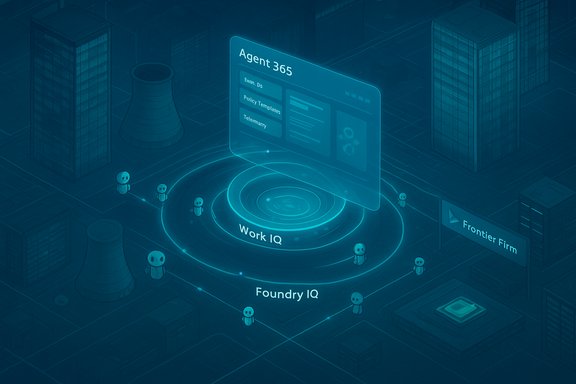
Agent 365 is Microsoft’s tenant‑level governance and operations plane for AI agents. It provides a registry and lifecycle controls, Entra‑bound Agent IDs, policy templates, telemetry and quarantine capabilities so administrators can discover, approve, observe and, if necessary, kill or sandbox agents. The aim is to treat non‑human agents with the same lifecycle rigor as employees and services — a critical architectural shift for enterprise governance.Key capabilities:
- Registry and cataloging: centralized inventory, owner and cost‑center binding, and approval workflows.
- Identity & least‑privilege: agents receive Entra Agent IDs and can be governed with conditional access and just‑in‑time permissions.
- Observability: traces of tool calls, retrieval events and decision logs that enable forensic reconstruction.
The IQ stack — Work IQ, Fabric IQ, Foundry IQ
Microsoft introduced three context services, each solving a facet of the context problem that limits agent reasoning:- Work IQ — personal and organizational memory: understands user behavior, work patterns and organizational “work charts” to personalize agent recommendations and model selection. It’s the glue that tells agents who does what, when, and how.
- Fabric IQ — business data semantics: converts operational telemetry, time‑series and location data into a semantic model aligned with business concepts (a response to the need for agents to reason over operational meaning).
- Foundry IQ — retrieval and grounding: a managed knowledge system that indexes public and private data sources, building retrieval pipelines and a single API for agents to query and act. Built on Azure AI Search and Foundry tooling, it automates RAG pipelines and connector management.
Agent Factory and publishing flow
Agent Factory is a go‑to‑market and support program that bundles metered access to Foundry and Copilot Studio, hands‑on FDE (forward‑deployed engineer) support, and training to help organizations build agent fleets without prohibitive upfront licensing. One‑click publishing from Foundry to Microsoft 365 and Agent 365 is intended to shorten the handoff between Dev and IT, automating Entra Agent ID provisioning and policy enforcement.Windows, MCP and endpoint controls
Microsoft previewed native MCP support in Windows so applications can surface capabilities to agents via a trusted MCP proxy that enforces authentication, authorization and auditing. Windows will also host Agent Workspace concepts (isolated runtimes) and a taskbar presence for Ask Copilot, increasing discoverability while attempting to constrain risk from local data access. These moves position Windows as both a discovery surface and a policy enforcement point for agent runtimes.Developer ecosystem and GitHub integration
The shift toward agentic architectures creates new DevOps needs. Microsoft and GitHub announced deeper integration for Copilot planning and workflow features, aligning code, policy, and runtime signals. Native Defender ↔ GitHub Advanced Security integrations aim to move vulnerability detection and remediation earlier into the lifecycle — surfacing runtime context to developers and enabling automated fixes tied to CI/CD pipelines. These capabilities are vital if agents are to be treated as production services rather than ad‑hoc automations.Adobe partnership and the productivity play
Microsoft and Adobe expanded collaboration to embed Adobe AI agents (for Marketing and Express) into the Agent 365 framework and Microsoft 365 apps. Adobe Marketing Agent for Microsoft 365 Copilot promises in‑app campaign insights and creative tooling inside Word, PowerPoint and Teams; Adobe Express Agent will enable rapid visual asset generation in context. This pattern reinforces Microsoft’s broader push: bring partner capabilities into the flow where users already work, increasing stickiness while letting partner ecosystems innovate on top of Microsoft’s agent governance.Security — a major shift in positioning and packaging
Security Copilot in Microsoft 365 E5
One of the most consequential commercial shifts is that Security Copilot access is now included for Microsoft 365 E5 customers, with a baseline allocation of Security Compute Units (SCUs) provisioned per user block and additional capacity available as overage. Microsoft’s documentation and multiple independent reports confirm that Security Copilot experiences (agents) are being embedded across Defender, Entra, Intune and Purview, and that Microsoft intends to make these AI defenses broadly available to E5 customers. This effectively removes a prior cost barrier that may have slowed SOC adoption of Copilot‑driven defenses.New defensive capabilities
Microsoft introduced several security innovations aimed at the agent era:- Predictive Shielding — an endpoint capability that uses graph signals to preemptively block attack paths on neighboring devices, reducing lateral movement risk.
- Baseline Security Mode — a “secure by default” guided posture that applies Microsoft‑recommended settings (for example: mandatory MFA, modern authentication defaults) and simulates impact before broad rollout.
- Quick Machine Recovery — Intune capability allowing remote recovery of unbootable machines, improving operational resilience for endpoint fleets.
- Vibe‑hacking detection with NVIDIA — a partnership claiming wire‑speed detection to catch AI‑driven social engineering and manipulation attempts that circumvent conventional filters; details remain preliminary.
Strengths, opportunities and immediate upsides
- Lowered adoption friction: Agent Factory, metered plans and inclusion of Security Copilot in E5 materially reduce up‑front procurement and security objections, accelerating pilots and early production adoption.
- Operational governance: Treating agents as directory objects with Entra Agent IDs and lifecycle controls is a pragmatic and necessary step toward auditable, enterprise‑grade agent operations.
- Model choice and resilience: Adding Anthropic models to Microsoft’s ecosystem expands enterprise options for model routing and safety profiling, and gives customers more knobs for cost/latency tradeoffs.
- Partner leverage: Embedding partners like Adobe into Agent 365 and Copilot surfaces meets customers where they already work, increasing real‑world value capture and making Microsoft’s platform more defensible.
Risks, caveats and critical concerns
- Concentration and circularity: The Anthropic–NVIDIA–Microsoft arrangement accelerates a concentration of compute, models and investment power. While efficient, it creates systemic dependencies where chipmakers, cloud providers and model labs are deeply intertwined — a structural risk for competition, pricing transparency and long‑term agility. The “up to” language in multi‑billion commitments means the timing, scope and contractual conditions matter; vendors’ framing should be interpreted carefully.
- Shadow AI and agent sprawl: Microsoft’s tooling helps, but the scale and ease of agent creation make operational discipline essential. Without rigorous AgentOps practices — owner binding, cost controls, frequent access reviews — organizations risk ungoverned agents that accidentally exfiltrate data or trigger compliance incidents.
- Opaque economics at scale: Metered plans, SCUs and metering thresholds are complex. Organizations should model costs conservatively for high‑volume agent workloads and test for divergence between test and production model performance as vendors tune stacks and hardware.
- Privacy and telemetry tradeoffs: Embedding Security Copilot and deep telemetry into Copilot experiences raises legitimate questions about what data is processed, stored and shared across tenant boundaries. Enterprises will need to validate retention, access and in‑tenant processing assurances before broad adoption.
Practical playbook — how to pilot agentic features safely
- Inventory current automations: catalog bots, scripts and scheduled tasks that could be reclassified as agents.
- Define Agent Governance Policy: owner, purpose, scope, data access, retention and human‑in‑the‑loop gating.
- Start monitor‑only: register a small set of read‑only agents in Agent 365 and evaluate telemetry, DLP, prompts and retrieval lineage.
- Enforce least privilege: require Entra Agent ID enrollment, short‑lived tokens and conditional access for any agent reaching sensitive scopes.
- Integrate security early: connect Defender, Purview and Sentinel to agent telemetry and run red‑team prompt‑injection tests.
- Validate TCO: benchmark latency, throughput and per‑token costs for candidate models (Anthropic vs OpenAI vs internal) on the anticipated runtime hardware, and plan for scaling margins.
What to watch next
- Ecosystem winners and laggards: watch which partners and ISVs adapt to Agent 365 and which struggle with governance requirements — early adopters will define best practices.
- Contractual specifics of the Anthropic commitments: regulators, filings or tranche disclosures will clarify how and when the $30B/$10B/$5B figures materialize, and whether conditional language constrains execution.
- Real‑world security outcomes: will embedding Security Copilot in E5 measurably improve MTTD/MTTR without creating new privacy or exposure vectors? Empirical case studies will matter.
- Open standards and interoperability: developments around the Model Context Protocol (MCP) and Agent‑to‑Agent interfaces will determine how portable agent workloads and connectors become across clouds and vendors.
Conclusion
Microsoft Ignite 2025 was a turning point in the maturation of enterprise AI: the company articulated a full stack for agentic computing — from identity and context to developer workflows and platform governance — while simultaneously addressing a major adoption obstacle by folding Security Copilot into core licensing. The Anthropic–NVIDIA–Microsoft deal anchors a new compute and model topology that promises greater model choice and operational scale, but it also underscores the industry’s move toward concentrated capital and engineering alliances. For IT leaders, the technical opportunity is large — faster automation, richer context, and built‑in security — but the organizational challenge is equally substantial: governance, lifecycle discipline and cost control must evolve in lockstep with the technology. The future the vendors described at Ignite is potent and plausible; realizing it responsibly requires deliberate AgentOps, skeptical cost modeling, and a commitment to auditing what agents do as meticulously as what humans do.Source: The Futurum Group Microsoft Ignite 2025: AI, Agent 365, Anthropic on Azure & Security Advances
