

Cybercriminals are increasingly bypassing technical perimeter defenses not by hacking in, but by being hired in—posing as legitimate remote employees, slipping through HR and onboarding, and then using hardware and identity tricks to gain persistent, trusted access to corporate systems.
The traditional model of “protect the perimeter, trust the employee” is collapsing under a new wave of identity-first attacks. Microsoft’s latest Cyberattack Series case study—Imposter for hire—details one real-world intrusion where a small number of compromised user accounts were found connected to PiKVM hardware, enabling out‑of‑band control of employer‑issued workstations and direct data exfiltration. Microsoft’s Detection and Response Team (DART) and Threat Intelligence traced the activity to a North Korean remote‑worker operation tracked as Jasper Sleet. At the same time, industry research is sounding the alarm about fake candidate profiles: Gartner’s surveys and analysis forecast that by 2028 one in four candidate profiles worldwide could be fake, increasing the risk that organizations will onboard threat actors disguised as legitimate hires. This article summarizes the incident, explains the tactics used, validates Microsoft’s findings with independent reporting, and lays out practical, technical, and HR controls organizations should adopt now to reduce the risk of “imposters for hire.”
Imposter‑style intrusions are a reminder that modern security must treat people, identity, and physical device posture as integral parts of the attack surface—not afterthoughts. Acting now to combine technical telemetry with stronger hiring checks and asset controls will blunt a threat that is already proving both low cost for attackers and high impact for victims.
Source: Microsoft Imposter for hire: How fake people can gain very real access | Microsoft Security Blog
 Background
The traditional model of “protect the perimeter, trust the employee” is collapsing under a new wave of identity-first attacks. Microsoft’s latest Cyberattack Series case study—Imposter for hire—details one real-world intrusion where a small number of compromised user accounts were found connected to PiKVM hardware, enabling out‑of‑band control of employer‑issued workstations and direct data exfiltration. Microsoft’s Detection and Response Team (DART) and Threat Intelligence traced the activity to a North Korean remote‑worker operation tracked as Jasper Sleet. At the same time, industry research is sounding the alarm about fake candidate profiles: Gartner’s surveys and analysis forecast that by 2028 one in four candidate profiles worldwide could be fake, increasing the risk that organizations will onboard threat actors disguised as legitimate hires. This article summarizes the incident, explains the tactics used, validates Microsoft’s findings with independent reporting, and lays out practical, technical, and HR controls organizations should adopt now to reduce the risk of “imposters for hire.”What happened: brief chronology and key discoveries
- A routine onboarding resulted in four compromised user accounts being observed with unusual external connections. Microsoft investigators discovered those accounts were connected to PiKVM devices attached to corporate workstations.
- PiKVM and similar KVM‑over‑IP devices were used as egress channels—they behave as hardware-level remote consoles that can operate outside the host OS visibility and may bypass Endpoint Detection and Response (EDR) controls. This allowed attackers to control systems as if physically present, capture screen output, and extract files.
- Telemetry and investigative work by Microsoft linked the activity to Jasper Sleet, the label Microsoft uses for a North Korean remote‑IT workforce operation that applies for remote roles, builds fake digital footprints, and channels revenue to sanctioned programs. Microsoft DART moved from hunting to full investigation, using tools such as Cosmic, Arctic, and Fennec, while leveraging Entra (Azure AD) and Microsoft Defender telemetry to trace and contain the intrusion.
- As part of broader mitigation, Microsoft suspended thousands of accounts tied to this campaign; public reporting has quantified some suspensions at roughly 3,000 Outlook/Hotmail accounts. Legal action and seizures (including laptop farm takedowns) aligned with intelligence on these operations.
Why this is a different class of threat
Hardware-level access changes the detection model
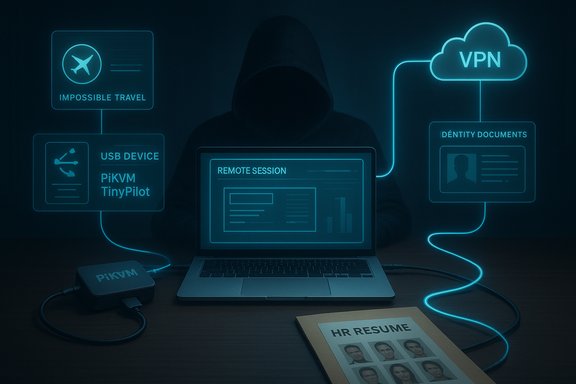
PiKVM, TinyPilot and other KVM‑over‑IP devices sit between the keyboard/video/mouse signals and the host. They can:- Capture display output and USB events directly from the hardware bus.
- Inject keyboard/mouse events and BIOS‑level inputs.
- Operate outside the host OS and therefore avoid many EDR heuristics that monitor only OS‑level processes and network flows.
Social + identity engineering at scale
These campaigns combine social engineering that targets HR/recruiting workflows with operational tradecraft:- Fake LinkedIn/GitHub portfolios, AI‑enhanced photos, and plausible work histories.
- Facilitators and laptop farms that forward corporate devices or present U.S.‑based logistical footprints.
- RMM tools, VPNs, and streaming utilities used to maintain persistence while masking operator location.
Corroboration and context from independent sources
Microsoft’s DART analysis aligns with multiple independent security providers and reporting:- Palo Alto Networks Unit 42 and DTEX both reported KVM‑over‑IP (TinyPilot/PiKVM) as a confirmed indicator in DPRK remote‑worker incidents and recommended forensic hunting for USB device insert events and device descriptors.
- Mainstream outlets (Fortune, Axios, CNBC) documented Microsoft’s suspensions and DOJ actions against facilitators and laptop farms tied to these schemes, echoing Microsoft’s attribution of revenue generation for DPRK programs and the use of identity fraud.
- Gartner’s research and other trade reporting confirm rising concern in HR and recruiting circles that AI and deepfakes will increase candidate fraud, reinforcing Microsoft’s warning that personnel vetting is now a security control.
Technical anatomy: how PiKVM and similar devices are used in breaches
Typical attack chain (condensed)
- Target role posted; attacker crafts a convincing persona and portfolio.
- Candidate passes HR screening (sometimes via fake referees or rented identities).
- Employer ships a laptop or grants access to company systems.
- Attacker installs remote management tools and attaches a KVM‑over‑IP device (or uses forwarded “laptop farm” devices).
- Operator connects via PiKVM/TinyPilot using an external management endpoint, controlling the workstation from outside OS‑level controls.
- Data exfiltration done by copying files, capturing screens, or using the host as a pivot to other internal resources.
- Attacker obfuscates signals with VPNs, VPS, or rotation through facilitators.
Why endpoint agents often miss this
EDR/endpoint agents hook into the operating system. When control is exercised at the hardware layer—keyboard/mouse injection or HDMI capture—those agents don’t see the remote operator’s keystrokes or screen scraping. Attackers also combine these devices with standard RMM or remote desktop tools to create layered persistence that looks, superficially, like legitimate administrative activity.How Microsoft responded (summary and validation)
Microsoft’s DART response included:- Immediate disabling of compromised accounts and restoration of affected devices from clean images.
- Forensic analysis of Unified Audit Logs, Entra ID (Azure AD) telemetry, Microsoft Defender for Endpoint, and Microsoft Defender for Identity to trace lateral movement and credential misuse.
- Deployment of advanced hunting and forensic tools (named internally as Cosmic, Arctic, Fennec) to map the intrusion and remediate at scale.
- Suspension of thousands of consumer email accounts tied to Jasper Sleet to disrupt the campaign’s infrastructure.
Practical detection and hunting guidance
The following actions are drawn from Microsoft’s recommendations and independent DFIR best practices. Organizations should tailor them to their environment and test each control in staging before wide deployment.Visibility and logging (what to enable)
- Unified Audit Log integration: ingest and actively hunt sign‑ins, app consent events, and unusual mailbox or SharePoint downloads. Microsoft used these logs to map attacker movements.
- EDR USB/Device telemetry: log USB insert/removal events, Device Manufacturer/Product strings, and serial numbers. KVM devices often present USB composite descriptors (e.g., “PiKVM”, “TinyPilot”, or serials like CAFEBABE). Hunt for unexpected composite devices.
- Conditional Access / Identity protection: configure impossible travel, geolocation anomalies, and risky sign‑in detection. Integrate VPN telemetry to detect known public VPN endpoints like Astrill flagged in these campaigns.
- Network and egress monitoring: watch for long, persistent outbound sessions to IPs or domains associated with KVM device management endpoints or known VPS providers used by facilitators.
Hunting queries and artifacts to surface
- USB device connect events where Manufacturer/Product contains “PiKVM”, “TinyPilot”, or matches known vendor IDs.
- Systems showing RMM installs (TeamViewer, JumpConnect, RustDesk, AnyDesk) concurrent with VPN usage and long idle screen lock overrides.
- Accounts that never appear on camera or show weak collaboration footprints but have high privileged access—particularly hires from staffing agencies or contractors.
- Alerts for OAuth consent grants to unverified apps with names visually similar to Microsoft or internal apps (device‑code and AiTM consent phishing remain active threats).
Governance and HR: closing the human attack surface
Technical controls are necessary but not sufficient. These operations exploit gaps in hiring, vetting, and IT asset governance. Recommended measures:- Enforce rigorous pre‑employment checks for remote hires in sensitive roles: verify identity documents, correlate IP/geolocation histories, validate digital footprints across GitHub/LinkedIn, and require in‑person or video‑verified interviews for higher‑risk positions. Microsoft and Gartner both advise stronger vetting.
- Adopt COBO (Corporate Owned, Business Only) device policies: require corporate devices for sensitive roles; lock down provisioning channels and maintain strict asset tracking.
- Implement least privilege from day one: avoid granting broad administrative rights during onboarding; use just‑in‑time (JIT) and time‑bound elevation where possible.
- Treat staffing vendors and contractors as high‑risk third parties: require secure shipping chains for hardware, maintain quarantine imaging processes, and log all device issuance.
Specific mitigation steps — a prioritized checklist
- Harden identity:
- Enforce phishing‑resistant MFA (hardware FIDO keys) for all privileged accounts.
- Enable Conditional Access with impossible‑travel detection and MFA prompts for high‑risk sign‑ins.
- Improve endpoint hygiene:
- Deploy policies to block unknown USB and composite devices (Windows Defender Application Control, AppLocker).
- Capture and retain detailed USB device logs centrally for hunting.
- Monitor for KVM signatures:
- Create hunts for DeviceManufacturer/Product strings and known OUIs associated with PiKVM/TinyPilot.
- Alert on systems with HDMI/USB attach events that correlate with privileged account activity.
- Strengthen HR and supply chain:
- Verify digital identities, require video verification, and conduct random post‑hire audits for remote hires in sensitive roles.
- Track shipment addresses and flag unusual use of forwarding services.
- Response planning:
- Prepare an insider‑risk playbook that includes account disablement, forensic imaging, and legal notification steps.
- Regularly rehearse tabletop exercises including HR, legal, IT, and executive leadership.
Risks, limitations, and caveats
- Attribution and scale: multiple reports tie activity to North Korea’s remote‑worker programs, but exact scope and revenue figures vary by source. Some widely quoted totals are estimates and may aggregate different campaigns; therefore treat single‑figure claims with caution unless supported by indictments or detailed telemetry. Microsoft’s DART findings are robust for the investigated incidents; broader operational scale claims require continued validation.
- Evolving tooling: adversaries quickly adapt. KVM‑over‑IP device fingerprints and vendor identifiers can be obfuscated. Detection strategies must therefore pair device spotting with behavioral analytics (impossible travel, unusual access patterns), which are harder to spoof at scale.
- False positives: USB and device hunts can generate noise, especially in organizations that permit docking stations, multi‑display setups, or legitimate KVMs. Tune detection thresholds and combine telemetry with contextual HR data to reduce investigation overhead.
Conclusion — shifting from perimeter to people‑centric risk management
The “imposter for hire” pattern blends social engineering, HR process gaps, and hardware‑level persistence to create an unusually hard‑to‑detect insider threat. The case Microsoft documented demonstrates a clear shift: attackers are achieving access by taking advantage of trust and legitimate employment channels, then using low‑cost hardware like PiKVM to operate beneath the OS‑level radar. Defenders must respond in kind with a combined program that treats hiring and device governance as first‑class security controls. That program should include:- Identity‑first defenses (phishing‑resistant MFA, conditional access),
- Enhanced telemetry and hunting for device and identity anomalies,
- Tighter HR vetting, COBO device policies, and third‑party controls,
- Playbooks that integrate legal, HR, and incident response for rapid containment.
Imposter‑style intrusions are a reminder that modern security must treat people, identity, and physical device posture as integral parts of the attack surface—not afterthoughts. Acting now to combine technical telemetry with stronger hiring checks and asset controls will blunt a threat that is already proving both low cost for attackers and high impact for victims.
Source: Microsoft Imposter for hire: How fake people can gain very real access | Microsoft Security Blog
