

The Indian Ministry of Labour & Employment’s recent memorandum of understanding with Microsoft marks a major public‑private step to scale AI‑driven skilling, modernize national job platforms and open tighter links between India’s workforce and global employers—anchoring cloud and AI technologies into the National Career Service (NCS), e‑Shram and the DigiSaksham skilling agenda while tying the announcement to Microsoft’s large capital pledge for AI capability development in India.
India has pursued an ambitious push to digitize labour markets and widen social protection for informal workers through platforms such as e‑Shram (a national registry for unorganised workers) and the National Career Service (NCS) portal. These platforms are positioned as digital public infrastructure (DPI) for labour-market matching and benefits delivery, and the new MoU places Microsoft at the center of efforts to add cloud‑scale AI, analytics and employer outreach to those public systems.
At the same time, Microsoft has framed a large investment program for India—part infrastructure, part skilling and part cloud capacity—that it says will underpin an “AI‑first” future for the country. Public messaging around that investment has varied in media accounts, and the company has presented multi‑year training targets that seek to turn short‑term skilling pilots into nation‑scale programs.
This article examines the substance of the MoU as reported, the technology and policy implications, the potential benefits for jobseekers and employers, and the realistic risks and governance challenges that will determine whether the promise becomes durable impact.
However, the scale of the technical and social challenge is enormous: success depends less on raw cloud capacity than on design choices, local delivery mechanisms, transparent measurement and durable legal frameworks. The danger is that headline training numbers and vendor‑led architectures become ends in themselves rather than means to sustained employment and worker empowerment. Without explicit safeguards—over data, portability and equitable access—the initiative risks concentrating technical dependency and amplifying inequalities even as it promises inclusion.
The earliest tests of credibility will be operational: whether AI assists actually raise placement rates, whether certifications translate into paid jobs at scale, and whether the platforms preserve worker agency and data rights as they scale. Those are evaluation questions, and the MoU should be judged by the outcomes it produces over the next 12–36 months rather than the size of its publicity.
In short, the partnership offers genuine potential to modernize labour services and broaden AI literacy—but the public interest will be served only if implementation prioritizes transparency, measurement and the protections that turn technological promise into real, lasting improvements in people’s livelihoods.
Source: DD News https://ddnews.gov.in/en/labour-min...bs-ai-training-and-global-workforce-mobility/
 Background / Overview
India has pursued an ambitious push to digitize labour markets and widen social protection for informal workers through platforms such as e‑Shram (a national registry for unorganised workers) and the National Career Service (NCS) portal. These platforms are positioned as digital public infrastructure (DPI) for labour-market matching and benefits delivery, and the new MoU places Microsoft at the center of efforts to add cloud‑scale AI, analytics and employer outreach to those public systems.At the same time, Microsoft has framed a large investment program for India—part infrastructure, part skilling and part cloud capacity—that it says will underpin an “AI‑first” future for the country. Public messaging around that investment has varied in media accounts, and the company has presented multi‑year training targets that seek to turn short‑term skilling pilots into nation‑scale programs.
This article examines the substance of the MoU as reported, the technology and policy implications, the potential benefits for jobseekers and employers, and the realistic risks and governance challenges that will determine whether the promise becomes durable impact.
What the MoU says (and what it practically means)
High‑level commitments
According to announcement summaries, the agreement focuses on three pillars:- Expanding employer access and global employer outreach for the NCS portal, including onboarding corporate partners and Microsoft’s ecosystem to widen formal job postings and international opportunities.
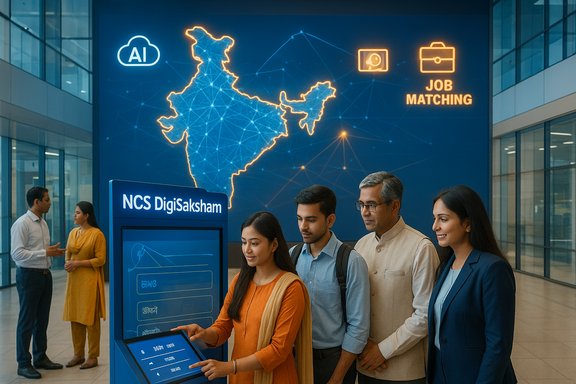
- Scaling AI‑enabled skilling through the government’s DigiSaksham initiative, bringing cloud, AI, cybersecurity and digital productivity training to millions of learners.
- Modernizing government employment services via Azure and Microsoft AI tooling — strengthening analytics on e‑Shram, improving job‑matching, and driving labour market intelligence for policy use.
Employer outreach and NCS
The MoU reportedly invites Microsoft’s global partner network to join NCS and promote job listings, which—if executed at scale—could increase visibility of formal and overseas roles to Indian candidates. The ambition is to link employer demand signals directly into the NCS job‑matching ecosystem and use AI to reduce friction in candidate discovery and shortlisting. Microsoft’s partner‑led model could accelerate employer engagement but also raises questions about integration pathways, data flows and standards for quality control on job posts.AI‑driven skilling and DigiSaksham
DigiSaksham—India’s digital skilling effort—will be a focal point for delivering Microsoft‑aligned training in AI, cloud and cybersecurity. Microsoft’s past programs pledge large numbers of learners trained (with targets in the millions across multiple initiatives), and the company plans to supply curricula, certification pathways and technical infrastructure to scale learning at national level. Public accounts emphasize pathways from low‑literacy onboarding through to Azure‑related credentials and Copilot literacy for productivity tasks.Technology stack and practical implementation
Azure + Azure OpenAI Service as the technical backbone
The technical vision in public briefings positions Azure as the cloud foundation and Azure OpenAI Service as the AI layer powering:- multilingual conversational assistants for portal access,
- AI‑assisted job matching and résumé generation,
- predictive labour‑market analytics to guide skilling investments,
- automated case handling for benefits and enrolment workflows.
Multilingual and accessibility features
Microsoft and government officials have emphasized multilingual access (including integration with national language initiatives) and low‑barrier user experiences for low‑literacy cohorts. Achieving genuine inclusivity at scale requires careful UX design, voice interfaces, offline/low‑bandwidth support and mediation channels (community centres, digital facilitators). Microsoft’s toolkit can support these features, but operational success depends more on design, localization and on‑the‑ground support than on raw AI capability alone.Interoperability and DPI reuse
Officials have talked about Employment DPI and the potential to make modular building blocks reusable as public goods. That approach—exposing APIs, standardizing data schemas and enabling third‑party innovation—could create an ecosystem of training providers, employers and platforms that reuse government infrastructure. The feasibility of this requires clear API governance, portability standards and an open‑by‑default posture for data exchange.Benefits on offer — realistic and measurable
- Faster job matching and reduced search friction. AI‑assisted matching and proactive outreach may reduce the time jobseekers spend hunting for roles and help NCS deliver targeted opportunities based on up‑to‑date demand signals.
- Large‑scale AI literacy and certifications. If DigiSaksham scales as described, millions of Indians will gain exposure to cloud and AI fundamentals linked to global credentials—this improves employability and creates a visible talent pipeline.
- Data‑driven skilling and policy design. Labour market analytics can improve the targeting of skilling investments, helping government and training partners prioritize fast‑growing sectors and reduce wasted training allocations.
- Potential for global mobility. Onboarding more employers onto NCS and integrating international partner networks could create clearer overseas pathways for qualified Indian professionals and young workers. This is a strategic aim of the partnership as publicized.
Real risks, caveats and governance questions
No technology partnership of this scale is risk‑free. Several practical and policy concerns must be acknowledged and actively managed.1. Data protection, sovereignty and consent
Government labour platforms hold sensitive personal data, sometimes including identity, employment history and benefits entitlements. Routing analytics and AI workloads through commercial cloud providers raises questions about:- where personal data will be stored and processed,
- whether appropriate consent and data minimization principles are applied,
- how long data is retained and who can access it for research or adjudication.
2. Vendor lock‑in and architectural concentration
Choosing a single large cloud vendor for DPI, AI services and certification pathways concentrates operational dependency. That may speed rollout but can raise long‑term switching costs, reduce bargaining power for the state and impede multi‑vendor innovation if not mitigated through open APIs, exportable data formats and contractual exit clauses. Governments must insist on portability and multi‑cloud readiness where possible.3. Equity, access and the digital divide
Training targets measured in millions are laudable, but numbers alone don’t equal access. Challenges include uneven internet coverage, device access, language barriers and opportunity costs for low‑income learners who cannot afford unpaid training time. Without stipends, local learning centres and community mediation, large skilling programs risk reinforcing existing inequalities. Program design must combine online modules with in‑person supports and financial scaffolding.4. Measuring real employment outcomes
Skilling programs have often measured outputs (course completions, certifications) rather than durable employment metrics (placement rates, wage uplift, job retention). To justify public investment and ensure social returns, the partnership should commit to transparent outcome metrics, independent evaluation and long‑term tracking of graduates. Otherwise, certification churn will not automatically translate into better livelihoods.5. Labour displacement and role transformation
AI augments productivity but also shifts task requirements. Many mid‑tier roles susceptible to automation may decline while demand for AI supervision, model‑ops and orchestration roles grows. Public policy must weigh transitions and put in place reskilling plus social safety nets for displaced workers rather than relying on market forces alone.6. Conflicting public narratives and headline figures
Different public statements have presented varying headline investment figures and training targets. For example, regional reporting has mentioned investment commitments in different magnitudes (multi‑billion‑dollar figures appear in media summaries). These discrepancies should be treated cautiously until specific, binding investment terms and timelines are published. Independent verification of headline numbers and contractual terms remains essential.Implementation checklist: what good delivery should include
For this MoU to deliver durable public value, these operational items should be explicit and measurable:- Published data governance framework that defines data ownership, retention, processing location, consent flows and audit mechanisms.
- Open API specifications and portability requirements so NCS and e‑Shram data can interoperate with multiple vendors, startups and civil‑society tools.
- A resilience plan that includes offline modalities, community learning centres, and device availability for disadvantaged cohorts.
- Independent, pre‑registered evaluation metrics focused on employment outcomes (placement, wages, retention at 6/12/24 months).
- Clear contractual commitments on sovereign control, exit paths, liability and compliance with national data protection law.
- A transparent employer quality‑assurance process for NCS listings to avoid spam, fraudulent postings or predatory hiring practices.
- Worker representation in governance boards or oversight committees to ensure skilling and job‑matching priorities reflect the lived reality of target cohorts.
Recommendations for stakeholders
For the government
- Insist on explicit data sovereignty clauses and publish a privacy impact assessment for the project.
- Require measurable employment outcome targets and fund independent evaluations.
- Build multichannel access (IVR, community kiosks, assisted registration) into the rollout plan.
For Microsoft and partners
- Commit to open standards, interoperable APIs and exportable datasets for portability.
- Offer contextualized curricula, low‑bandwidth learning modes and accredited certification for informal learners.
- Provide co‑funded stipends or placement guarantees for vulnerable cohorts to improve completion and placement rates.
For employers and training providers
- Adopt transparent hiring and assessment rubrics that recognize micro‑credentials and practical project work.
- Partner with local incubation centres to offer internships and apprenticeships tied to certification completion.
For civil society and researchers
- Demand public dashboards showing placement statistics, model performance metrics and anonymized aggregate outcomes.
- Participate in pilot evaluations to surface accessibility gaps and unintended harms.
Closing analysis — balancing promise and prudence
The MoU between India’s Labour Ministry and Microsoft is a high‑ambition attempt to convert digital public infrastructure into an AI‑enabled employment and skilling ecosystem. If implemented with robust governance, explicit outcome metrics and a commitment to interoperability and data protection, the partnership could lower matching friction, widen employer access and accelerate skill transitions for millions of workers.However, the scale of the technical and social challenge is enormous: success depends less on raw cloud capacity than on design choices, local delivery mechanisms, transparent measurement and durable legal frameworks. The danger is that headline training numbers and vendor‑led architectures become ends in themselves rather than means to sustained employment and worker empowerment. Without explicit safeguards—over data, portability and equitable access—the initiative risks concentrating technical dependency and amplifying inequalities even as it promises inclusion.
The earliest tests of credibility will be operational: whether AI assists actually raise placement rates, whether certifications translate into paid jobs at scale, and whether the platforms preserve worker agency and data rights as they scale. Those are evaluation questions, and the MoU should be judged by the outcomes it produces over the next 12–36 months rather than the size of its publicity.
In short, the partnership offers genuine potential to modernize labour services and broaden AI literacy—but the public interest will be served only if implementation prioritizes transparency, measurement and the protections that turn technological promise into real, lasting improvements in people’s livelihoods.
Source: DD News https://ddnews.gov.in/en/labour-min...bs-ai-training-and-global-workforce-mobility/
