

India’s IT and electronics minister Ashwini Vaishnaw has urged the country’s software industry to move into semiconductor design and related engineering, citing what he described as a global shortage of roughly one million qualified professionals.
Speaking at an industry town hall in Hyderabad on Saturday, July 11, Vaishnaw said India’s IT firms have an opening to apply their existing software and electronics expertise to chip design, validation, packaging, testing and manufacturing support. The push is part of a broader government effort to build a domestic semiconductor ecosystem rather than rely entirely on imported components.
Per the Ministry of Electronics and IT’s Press Information Bureau, the government has made advanced semiconductor design tools available to 315 universities. Vaishnaw positioned those institutions as a pipeline for engineers who can work across chip design and production, an area where EDA software, firmware, validation tools and systems integration all overlap.
That matters to the wider PC and Windows ecosystem even if it does not change anything for end users today. Semiconductor capacity is not only about cutting-edge processors. It also covers power-management chips, networking controllers, storage components, embedded controllers and the packaging and test operations that turn dies into shippable parts. Those components remain central to laptops, desktops, servers and the rapidly growing AI-PC category.
The practical opportunity for Indian software companies is therefore broader than creating silicon itself. It includes design automation, hardware verification, device drivers, firmware, manufacturing test systems, supply-chain software and AI-assisted engineering tools.
The minister also called on India’s traditional IT services sector to pivot from software-as-a-service toward “AI as a Service.” That is a familiar policy message, but it has a direct connection to the chip push: AI workloads need accelerators, servers, data-center networking, power infrastructure and a much larger pool of engineers who can work across software and hardware.
For Windows administrators and enterprise buyers, the immediate effect is limited. There is no announced change to Windows hardware availability, device pricing or support policy. But a larger regional base for chip design, assembly and electronics manufacturing could eventually broaden sourcing options for the OEMs and component suppliers that build Windows PCs and servers.
For now, the government’s next test is whether university access to design tools turns into deployable engineering talent and sustained commercial chip production.
Speaking at an industry town hall in Hyderabad on Saturday, July 11, Vaishnaw said India’s IT firms have an opening to apply their existing software and electronics expertise to chip design, validation, packaging, testing and manufacturing support. The push is part of a broader government effort to build a domestic semiconductor ecosystem rather than rely entirely on imported components.
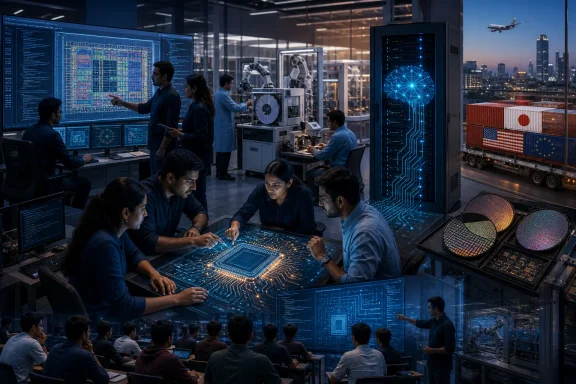 A talent-pipeline play
Per the Ministry of Electronics and IT’s Press Information Bureau, the government has made advanced semiconductor design tools available to 315 universities. Vaishnaw positioned those institutions as a pipeline for engineers who can work across chip design and production, an area where EDA software, firmware, validation tools and systems integration all overlap.That matters to the wider PC and Windows ecosystem even if it does not change anything for end users today. Semiconductor capacity is not only about cutting-edge processors. It also covers power-management chips, networking controllers, storage components, embedded controllers and the packaging and test operations that turn dies into shippable parts. Those components remain central to laptops, desktops, servers and the rapidly growing AI-PC category.
The practical opportunity for Indian software companies is therefore broader than creating silicon itself. It includes design automation, hardware verification, device drivers, firmware, manufacturing test systems, supply-chain software and AI-assisted engineering tools.
12 plants, three producing chips
Vaishnaw said 12 semiconductor facilities are at various stages of development, with three already manufacturing chips. He also said chips are being exported to Japan, the United States and Europe. The public statements did not provide a detailed breakdown of the chips, production volumes, process nodes or which customer products use them, so the scale and commercial impact of those operations remain unclear.The minister also called on India’s traditional IT services sector to pivot from software-as-a-service toward “AI as a Service.” That is a familiar policy message, but it has a direct connection to the chip push: AI workloads need accelerators, servers, data-center networking, power infrastructure and a much larger pool of engineers who can work across software and hardware.
For Windows administrators and enterprise buyers, the immediate effect is limited. There is no announced change to Windows hardware availability, device pricing or support policy. But a larger regional base for chip design, assembly and electronics manufacturing could eventually broaden sourcing options for the OEMs and component suppliers that build Windows PCs and servers.
For now, the government’s next test is whether university access to design tools turns into deployable engineering talent and sustained commercial chip production.
References
- Primary source: The Morning Voice
Published: 2026-07-12T18:30:00+00:00
Loading…
tmv.in - Independent coverage: Telangana Today
Published: 2026-07-11T10:34:38+00:00
Loading…
telanganatoday.com - Related coverage: moneycontrol.com
Loading…
www.moneycontrol.com - Related coverage: theprint.in
Loading…
theprint.in - Related coverage: nagalandpost.com
Loading…
nagalandpost.com - Related coverage: newsonair.gov.in
Loading…
newsonair.gov.in