

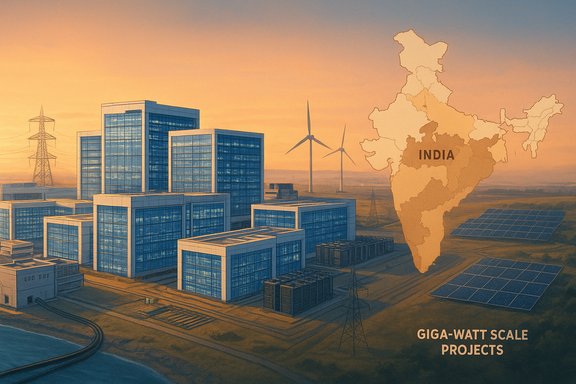
India’s data‑centre landscape has shifted from nascent to monumental over the past two years: global hyperscalers and domestic champions are committing tens of billions of dollars to build AI‑ready, gigawatt‑scale campuses, and that capital is already reshaping power, fibre and skills planning across multiple Indian states. New headline projects from AWS, Microsoft, Google, Meta (with Reliance), NTT, Yotta and CtrlS underscore a clear trend — India is now a primary battleground for the next wave of cloud and AI infrastructure — but the scale of the buildout brings acute execution, environmental and supply‑chain risks that must be managed if the promises are to become operational reality.
India’s policy and market fundamentals have aligned to accelerate hyperscale investment. Central and state governments have rolled out land, fiscal and single‑window incentives while digital‑sovereignty and data localisation debates have encouraged onshore capacity. Industry forecasts and state anchor projects suggest a multi‑gigawatt expansion over the remainder of the decade, with capacity targets and anchor commitments being used to catalyse supply‑chain and utility investments. The coordination mechanisms for these projects—state data‑centre councils, single‑window approvals and long‑term power procurement discussions—are now a material part of the story rather than background noise. The most significant effect of this phase is scale: individual projects now routinely reference hundreds of megawatts to multiple gigawatts of IT load, capital outlays in the billions of dollars, and multi‑year timelines to reach steady‑state operations. That scale changes the equation for developers, utilities, renewable energy providers and local governments alike. The remainder of this feature summarises the major hyperscaler commitments (as of the latest public announcements), evaluates their likely impact, and highlights the technical and policy risks that could slow or reshape deployment.
Yet the same scale that creates opportunity also introduces fragility. Gigawatt projects amplify every execution shortfall: delayed transformers, constrained GPU shipments, slow PPAs, or local environmental pushback can postpone capacity and leave expensive, unutilised real‑estate idle. The next 24–36 months will be a test of governance, contract discipline and the ability of private and public actors to synchronize power, fibre and finance on a colossal scale.
For enterprise IT planners and Windows‑platform professionals, the important takeaways are straightforward:
Conclusion
The hyperscaler era in India has moved from pilot projects and proof‑of‑concepts to industrial‑scale investments and national ambition. AWS, Microsoft, Google and large domestic groups are committing capital and shaping a new infrastructure topology that includes subsea gateways, gigawatt campuses and GPU farms. Those changes will be transformative for enterprises, developers and governments — but they will also require meticulous, cross‑sector execution to avoid bottlenecks that can delay or distort the benefits. Stakeholders who align energy, land, network and skills now will capture the upside; those who treat announcements as guarantees risk being surprised by the hard realities of grid‑scale engineering, supply chains and local approvals.
Source: Trade Brains List of Major Hyperscalers Investing in Data Centers in India (2025)
 Background / Overview
India’s policy and market fundamentals have aligned to accelerate hyperscale investment. Central and state governments have rolled out land, fiscal and single‑window incentives while digital‑sovereignty and data localisation debates have encouraged onshore capacity. Industry forecasts and state anchor projects suggest a multi‑gigawatt expansion over the remainder of the decade, with capacity targets and anchor commitments being used to catalyse supply‑chain and utility investments. The coordination mechanisms for these projects—state data‑centre councils, single‑window approvals and long‑term power procurement discussions—are now a material part of the story rather than background noise. The most significant effect of this phase is scale: individual projects now routinely reference hundreds of megawatts to multiple gigawatts of IT load, capital outlays in the billions of dollars, and multi‑year timelines to reach steady‑state operations. That scale changes the equation for developers, utilities, renewable energy providers and local governments alike. The remainder of this feature summarises the major hyperscaler commitments (as of the latest public announcements), evaluates their likely impact, and highlights the technical and policy risks that could slow or reshape deployment.The hyperscalers and large domestic players: who’s committing what
The following section presents the major announced commitments and the core claims behind them. Where company announcements or widely reported press coverage exist, those are used to verify figures. Any materially divergent or unverified claims are flagged.1) Amazon Web Services (AWS)
- What’s been announced: AWS publicly committed to invest INR 1,05,600 crore (about US$12.7 billion) into Indian cloud infrastructure through 2030, bringing a longer‑term total to roughly INR 1,36,500 crore (≈US$16.4 billion) when combined with prior investments. AWS framed this as funding for additional region capacity, availability zones, training and renewable projects.
- State‑level spin‑offs: Separate state announcements have followed: for example, an earlier AWS pledge to invest several billion dollars in a particular state/region (reported as roughly US$8.2B in the case of Maharashtra) is a distinct, more localised commitment that complements the national figure. The numbers cited in different reports (US$8.2B vs. US$8.3B vs. headline national totals) sometimes reflect separate programs and should not be conflated.
- Strengths: AWS’s global scale, existing Mumbai and Hyderabad regions, and established enterprise base in India make these investments immediately actionable. The company also ties capital to local skills training and renewable projects.
- Caveats: National aggregate figures (e.g., US$12.7B) are corporate projections across a multi‑year horizon; the actual pace and geographic allocation will depend on power and land availability, PPAs and permitting.
2) Microsoft Azure
- What’s been announced: Microsoft confirmed a US$3 billion investment in India focused on cloud and AI infrastructure and skilling over two years, plus programmes to train up to 10 million people in AI skills by 2030. The company also signalled expanded AI‑capable campuses and regional capacity to support Azure AI services.
- Strengths: Microsoft’s strategy combines physical infrastructure with product integration (Copilot/Azure AI) and an enterprise distribution channel, making the company’s India investments synergistic with its software and enterprise sales.
- Caveats: Microsoft’s capital buys time and capacity but does not eliminate the need for long‑lead items such as GPU supply, grid upgrades, and local compliance certifications.
3) Google (Alphabet)
- What’s been announced: Google announced a landmark commitment of approximately US$15 billion to establish an “AI hub” and gigawatt‑scale data‑centre campus in Visakhapatnam, with large energy and subsea connectivity components. That project is structured with local partners and aims to add both compute and a new international subsea gateway to India’s east coast.
- Strengths: The Visakhapatnam plan is notable for its integrated connectivity and energy components (subsea landings, large‑scale renewables), which address two of the sector’s most common bottlenecks.
- Caveats: Gigawatt‑scale sites require synchronous build‑outs of transmission, substation upgrades and often bespoke renewable generation or storage arrangements; timelines of 18–36 months per major phase are realistic and must be planned.
4) Meta & Reliance (joint ventures and anchor infrastructure)
- What’s been announced: Reliance Industries and Meta have deepened AI cooperation. A new joint venture—with Reliance holding a majority stake—was announced with an initial capital plan in the range of ₹855 crore (≈US$100 million) for an enterprise AI JV that combines Meta’s Llama models with Reliance’s distribution and infrastructure capabilities. Separately, Reliance has been reported to plan a massive 3‑GW data‑centre complex in Jamnagar, Gujarat, with estimates of capital expenditure that analysts place between US$20–30 billion for the full buildout.
- Strengths: Reliance brings land, grid adjacency (industrial complexes), and domestic market reach; Meta provides model IP and product capabilities. The partnership model aims to localise AI platforms for Indian enterprises.
- Caveats: The large Jamnagar project carries complex power‑and‑grid engineering and PPA risk; headline capex ranges vary widely across reports and remain estimates until formal project‑level financials are disclosed.
5) NTT Global Data Centers
- What’s been announced: NTT has signaled a significant India expansion and leadership hires; multiple reports and company materials indicate an India‑specific capital allocation aimed at materially increasing local capacity (published figures indicate an India programme in the region of US$1.5 billion to grow installed IT power toward 700 MW by 2027 from a lower base). NTT’s global documents and company reporting confirm a multi‑billion development programme that includes India as a priority market.
- Strengths: NTT’s global scale, technical capability (including advanced liquid cooling deployments) and experience with institutional PPAs make it a credible large‑scale operator in India.
- Caveats: The timing and geographic allocation of the $1.5B India programme are project‑specific; some public reports aggregate global capital rather than issuing India‑only binding commitments.
6) Yotta Infrastructure (Hiranandani Group)
- What’s been announced: Yotta has been an early mover in GPU procurement and “sovereign AI” positioning. Company statements and press coverage document large GPU orders (multiple thousands of H100/L40S class GPUs), prior public pledges in the range of multiple thousands of crores (for example, a historical Rs16,000 crore program) and more recent reporting about a potential additional US$1.5 billion GPU investment or procurement rounds. Yotta’s Shakti Cloud and related AI offerings are explicitly focused on GPU‑heavy AI workloads.
- Strengths: Yotta has operational Tier‑IV facilities, an existing GPU pipeline and an India‑focused product stack targeted at sovereign AI workloads.
- Caveats: Numbers vary by outlet and press release; earlier claims of 16,384 GPUs and plans to reach 32,768 GPUs are ambitious and were reported over a rolling timeline. Some later reports revise quantities and dollar equivalents — readers should treat evolving GPU counts and dollar figures as project‑level estimates that change with procurement cycles.
7) CtrlS
- What’s been announced: CtrlS has publicly launched a Rs 4,000 crore (~US$480M) Chennai hyperscale campus with 72 MW IT load and described a multi‑year expansion plan in the US$1.5–2 billion range (company commentary ties a USD two‑billion programmed spend over a multi‑year horizon to new parks and hyperscale campuses). The firm has also announced separate greenfield investments, including a Rs 500 crore project in Bhopal and expansion plans in Kolkata and Telangana.
- Strengths: CtrlS is an experienced domestic operator with multiple hyperscale campuses and the ability to move quickly on land and permitting in regional states.
- Caveats: The company’s aggregate target figures (e.g., a US$2B programme) represent company growth plans rather than binding, site‑level project finance commitments.
Why this wave matters: economic and technical implications
- Scale economies for AI: Gigawatt‑class sites are specifically engineered to host tens of thousands of GPUs with liquid cooling, high‑density networking and large contiguous power. These sites change the unit economics for training and inference at scale, and they allow both hyperscalers and large domestic buyers to amortise GPU investments more cost‑efficiently.
- Renewables and 24x7 power: The hyperscale model imposes continuous power demand. Developers are increasingly pairing data‑centre projects with dedicated renewable procurement, grid upgrades and energy storage to deliver the “24x7 clean power” regimes enterprise buyers now expect. This is more than marketing: many enterprise buyers will require contractual guarantees on firmed renewable supply.
- Connectivity and subsea networks: Large east‑coast projects (e.g., Visakhapatnam) include explicit subsea gateway elements. Those subsea builds are strategic because they add route diversity, reduce latency to key markets and anchor terrestrial backhaul investments that benefit entire regions.
- Jobs and supply chains: Announced projects reference thousands of direct construction and operations jobs and tens of thousands of indirect roles in the supply chain (engineering, cooling, transmission equipment). But skilled operators for GPU‑scale AI clusters are still a constrained resource; large skilling programmes are necessary to operationalise these campuses.
Major risks and execution challenges
The headline numbers are impressive; the delivery is not automatic. The following risks deserve urgent attention.1) Power and grid integration
Hyperscale AI sites are essentially industrial power consumers. Securing long‑term, firmed power (PPAs or dedicated generation) is a prerequisite. State grids may need major transmission upgrades, and the allocation of capacity to a single anchor can crowd out other industrial users without careful planning. If utilities or regulators cannot provide credible long‑term PPAs, projects will either be delayed or carry higher operating costs for firming and backup.2) Water and environment constraints
Cooling at AI densities traditionally used large water volumes. New cooling approaches (liquid immersion, closed‑loop systems, air‑side economisers) reduce water reliance, but environmental clearances and community impacts remain material. Projects that underestimate local environmental constraints risk long approval timelines or operational restrictions.3) GPU and hardware supply
High‑end GPUs (H100/GB200 class and successors) remain capacity‑constrained. Long lead contracts, pre‑payments and vendor financing have become normal. Companies that cannot secure timely GPU deliveries risk having idle power and building capacity. The industry has already seen multi‑billion dollar procurement commitments for GPUs and vendor‑backed occupancy guarantees because the hardware is the scarcest near‑term resource.4) Financing magnitude and concentration risk
Projects measured in single‑digit to multiple tens of billions of dollars require complex capital structures (developer equity, strategic partner equity, vendor financing, long‑dated debt). This scale concentrates political and execution risk: a delayed anchor tenant can cascade through land, transmission, and local supplier investments. Governments and developers must align incentives to manage contingent liabilities.5) Regulatory, data‑sovereignty and security demands
Data‑sovereignty rules and enterprise customers’ compliance requirements force local hosting and may create segmentation between international cloud customers and domestic regulated workloads. Meeting security certifications and establishing reliable incident response and audit trails is non‑trivial at scale.6) Local planning and political risk
Large land allotments and utility prioritisation require inter‑agency coordination. States that streamline approvals and commit to predictable PPA and land policies enjoy a first‑mover advantage; those that create uncertainty risk losing projects. Project timelines can stretch if permitting, social impact mitigation, or local opposition is not anticipated.What works: mitigation and operational best practice
The projects that convert headlines into sustainable capacity tend to combine a few predictable elements:- Pre‑allocated PPA and transmission commitments (or on‑site generation) that are commercially credible.
- Integrated renewable + storage programmes (so buyers can claim 24x7 low‑carbon supply rather than unbundled RECs).
- Plug‑and‑play data‑centre parks with pre‑permitted land parcels, utility corridors and standardised technical envelopes to compress build time.
- Workforce skilling and academic partnerships to generate operations and site engineering talent locally.
- Multi‑vendor hardware strategies to lower single‑supplier GPU risk and to provide contractual backstops for delivery cadence.
Short‑term outlook (next 12–36 months)
- Commissioning cadence: Expect many projects to show staged commissioning (partial availability for enterprise cloud and inference workloads, followed by later infill for full training clusters). Early phases will prioritise connectivity, resilience and incremental GPU racks.
- Supply‑chain pinch points: GPU deliveries and specialist electrical equipment (transformers, GIS switchyards) will remain the most frequent schedule risk factors.
- State competition: States with transparent data‑centre policies, available industrial land and PPA clarity (and access to coastal subsea landings) will attract anchor investments faster.
- Market consolidation: Expect a mix of global hyperscalers (AWS, Microsoft, Google) to anchor the largest campuses, while domestic players (Reliance, Adani partners, Yotta, CtrlS, NTT) fill a hybrid market of sovereign and co‑location demand.
Quick reference: what is verifiable today — and where to be cautious
- Verifiable commitments:
- AWS announced a national commitment of US$12.7B for India cloud infrastructure through 2030.
- Microsoft publicly announced a US$3B India investment with skilling targets to reach 10 million people for AI skills through 2030.
- Google publicly announced a US$15B plan for an AI hub in Visakhapatnam, including gigawatt compute and subsea connectivity.
- Reliance and Meta have formed a JV with an initial INR 855 crore capitalization for enterprise AI services (Reliance majority stake), and Reliance has publicly discussed a 3 GW Jamnagar project in multiple reports.
- CtrlS, Yotta and NTT’s India programmes are well documented in company releases and local press, including site‑level commitments such as CtrlS’s Chennai Rs 4,000 crore, 72 MW campus.
- Where caution is warranted:
- Aggregated investment totals and projected GDP/job multipliers are corporate estimates and often combine announced commitments, planned future investments and modelling assumptions. Treat those as indicative rather than binding project‑level financing.
- Projected GW capacity and capex ranges for single projects (e.g., Reliance’s Jamnagar 3 GW costs) are widely reported but fluctuate in public coverage; headline dollar ranges are often analyst estimates until definitive project finance disclosures are filed.
- GPU counts and exact procurement dollar values for businesses like Yotta have been reported in successive tranches and are subject to vendor delivery windows and financing terms; treat specific GPU‑count claims as time‑sliced commitments rather than immutable totals.
Final analysis: opportunity versus fragility
India’s moment as a data‑centre and AI infrastructure destination is real and accelerating. The convergence of policy incentives, domestic demand, hyperscaler strategic shifts (bring compute closer to data and users) and global GPU procurement economics make India an attractive place to build. The potential benefits are large: employment, exportable cloud services, sovereign AI options, and a more resilient South‑Asia connectivity node.Yet the same scale that creates opportunity also introduces fragility. Gigawatt projects amplify every execution shortfall: delayed transformers, constrained GPU shipments, slow PPAs, or local environmental pushback can postpone capacity and leave expensive, unutilised real‑estate idle. The next 24–36 months will be a test of governance, contract discipline and the ability of private and public actors to synchronize power, fibre and finance on a colossal scale.
For enterprise IT planners and Windows‑platform professionals, the important takeaways are straightforward:
- Expect more local AI‑capable cloud options and lower latency for AI services as these campuses come online.
- Prepare for potentially new procurement models (GPU‑as‑a‑service, onshore LLM hosting, and hybrid cloud offerings tailored to Indian regulatory needs).
- Monitor PPA and sustainability claims closely — 24x7 clean power is becoming a commercial differentiator, not a marketing line.
Conclusion
The hyperscaler era in India has moved from pilot projects and proof‑of‑concepts to industrial‑scale investments and national ambition. AWS, Microsoft, Google and large domestic groups are committing capital and shaping a new infrastructure topology that includes subsea gateways, gigawatt campuses and GPU farms. Those changes will be transformative for enterprises, developers and governments — but they will also require meticulous, cross‑sector execution to avoid bottlenecks that can delay or distort the benefits. Stakeholders who align energy, land, network and skills now will capture the upside; those who treat announcements as guarantees risk being surprised by the hard realities of grid‑scale engineering, supply chains and local approvals.
Source: Trade Brains List of Major Hyperscalers Investing in Data Centers in India (2025)
