

Infosys’ announcement that it has developed an AI Agent for energy‑sector operations marks a clear attempt to convert agentic generative AI from marketing demos into repeatable production patterns for drilling, well operations, pipelines and power‑generation workflows, promising conversational multimodal analysis, automated reporting and predictive early‑warnings designed to reduce non‑productive time (NPT) and improve safety and reliability.
The energy sector generates vast volumes of heterogeneous data — time‑series telemetry, downhole well logs, inspection images, lab reports and regulatory documents — and faces steep costs when operations stall or safety incidents occur. Infosys has positioned its new offering as a verticalized, production‑ready assistant that ingests those multimodal inputs, grounds responses in evidence, automates routine paperwork and surfaces prioritized predictive alerts so field crews and control‑room staff can act faster and with more context. Technically, the announcement bundles three principal building blocks:
The practical path forward is incremental: begin with high‑value, low‑risk pilots; require comprehensive provenance and audit logs; validate the agent’s outputs against human subject matter expertise; and harden OT boundaries with deterministic edge controls. Done right, agentic AI can become a force multiplier for energy operations — but it will succeed only with disciplined measurement, security hygiene and clear contractual accountability.
Source: Analytics Insight Infosys Develops AI Agent to Enhance Operations in the Energy Sector
Source: digitalmore.co Infosys Develops AI Agent to Enhance… | Digital More
 Background / Overview
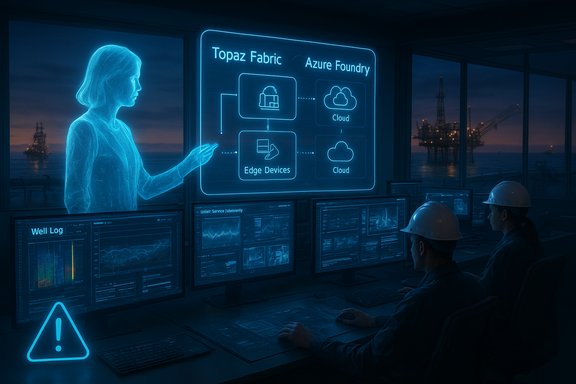
The energy sector generates vast volumes of heterogeneous data — time‑series telemetry, downhole well logs, inspection images, lab reports and regulatory documents — and faces steep costs when operations stall or safety incidents occur. Infosys has positioned its new offering as a verticalized, production‑ready assistant that ingests those multimodal inputs, grounds responses in evidence, automates routine paperwork and surfaces prioritized predictive alerts so field crews and control‑room staff can act faster and with more context. Technically, the announcement bundles three principal building blocks:- Infosys Topaz Fabric — described as an AI‑first agent fabric and orchestration layer for models, prompts, agents and lifecycle controls.
- Infosys Cobalt — the company’s cloud accelerators and compliance blueprints that supply hardened deployment patterns, identity and governance.
- Microsoft’s agent and model stack — notably Copilot Studio for low‑code agent creation and orchestration, and Azure AI Foundry / Azure OpenAI for multimodal model hosting and model routing.
What the solution promises
Core capabilities (vendor description)
Infosys frames the Agent with a concise set of measurable capabilities aimed at operational teams:- Multimodal ingestion and grounding — ingest and reason over well logs, streaming telemetry (SCADA/time‑series), downhole and inspection images, lab PDFs, plots and spreadsheets.
- Conversational access — Copilot‑style chat (and voice) that returns context‑aware summaries, evidence citations and recommended next steps to field crews and control‑room operators.
- Automated reporting — auto‑generate shift reports, regulatory summaries and structured extraction of key parameters from semi‑structured documents.
- Predictive insights & early warnings — anomaly detection and ranked alerts designed to surface conditions that historically lead to NPT or safety incidents.
- Hybrid cloud + edge operation — heavy inference and orchestration in Azure Foundry with deterministic safety loops and low‑latency checks at the edge.
Why this vertical fits agentic AI now
Energy operations combine long technical documents, high‑frequency telemetry and images — an optimal set of inputs for retrieval‑augmented, multimodal assistants. Well‑engineered agents can reduce cognitive load, accelerate decision cycles and preserve institutional knowledge by converting fragmented evidence into clear, auditable guidance. Yet energy is also safety‑critical and regulated; production readiness therefore requires governance, audit trails, and deterministic controls that prevent an assistant from inadvertently driving unsafe actions.Technical architecture — how the pieces fit
Data and ingestion layer
A governed lakehouse or knowledge graph is the starting point: telemetry, logs, historical incidents and documents must be stored with data contracts, lineage and access controls. This foundation is essential to avoid hallucination and provide provenance for any agent recommendation. The vendor narrative highlights vector retrieval and grounding layers to tie model outputs to specific documents and sensor streams.Agent fabric and orchestration (Infosys Topaz)
Infosys describes Topaz Fabric as the runtime and lifecycle layer that manages agent orchestration, prompt templates, tool integrations, observability and human‑in‑the‑loop gates. The aim is to convert one‑off LLM demos into reproducible agent patterns with governance and audit capabilities. This approach mirrors industry best practice for production agentic deployments.Cloud foundation and compliance (Infosys Cobalt)
Cobalt supplies the cloud landing zones, identity, security posture and prebuilt connectors (SCADA, CMMS, PI/OSIsoft, SAP, etc. that energy operators require. For regulated sectors, documented identity passthroughs, regional hosting and role‑based controls are non‑negotiable. Infosys positions Cobalt as the hardened scaffolding around Topaz and the Microsoft runtime.Model runtime, routing and multimodality (Azure AI Foundry + Copilot Studio)
Microsoft’s Copilot Studio provides a low‑code/no‑code authoring and management surface for agents, including triggers, autonomous workflows and a catalog of installable agents. Copilot Studio allows makers to publish agents into Microsoft 365 and field‑app channels and provides analytics and admin controls for governance. Azure AI Foundry supplies the model catalog, hosted multimodal models and a model router that can pick an appropriate model at runtime to trade off latency, cost and capability (smaller cheaper models for routine queries; larger multimodal models for complex synthesis). Foundry’s serverless model catalog already lists text, vision and document‑AI models tailored for enterprise workloads. Those features map directly to the agent runtime that Infosys cites.Verification: what is confirmed and what remains vendor‑reported
Key claims in the announcement fall into two categories — stack composition and operational outcomes — and the verification status differs:- Stack composition: It is independently verifiable that Infosys publicly launched Topaz Fabric (Nov 3, 2025) and that Infosys released a press statement on Nov 6, 2025 describing an energy Agent built using Topaz, Cobalt, Copilot Studio and Azure OpenAI (Foundry). Microsoft documentation confirms Copilot Studio capabilities (agents, triggers, analytics) and Azure AI Foundry confirms model routing and a multimodal model catalog. These technical building blocks and the stated partnership alignment are corroborated by vendor documentation and Microsoft platform docs.
- Operational outcomes and numeric claims: Infosys’ press release and syndications state the Agent aims to reduce NPT and improve safety, wellbore quality and operational efficiency. However, the announcement does not publish independent benchmarks (for example, % reduction in NPT or validated accuracy rates for multimodal interpretation). These outcome figures are vendor‑reported and should be treated as directional until validated by transparent customer case studies or third‑party audits.
Strengths — why this matters to energy operators
- Practical architecture: The stack announced — governed data layer, retrieval + grounding, agent fabric, model runtime and optional edge nodes — aligns with production best practices for safety‑critical agentic systems. Packaging these pieces reduces engineering lift for energy operators.
- Partner ecosystem leverage: Pairing Infosys’ systems‑integration and cloud blueprints with Microsoft’s agent tooling and model catalog offers a familiar procurement path for organizations already invested in Azure and Microsoft 365. This eases integration with enterprise identity, document stores and collaboration channels.
- Hybrid cloud + edge design: A hybrid approach keeps deterministic, safety‑critical loops local while the cloud handles heavier reasoning and automated documentation — a sensible trade when latency and reliability matter.
- Operational focus: The product explicitly targets high‑value, low‑risk starting points — report automation, evidence retrieval, and ranked alerts — which are pragmatic pilots before expanding into advisory or prescriptive controls.
Risks, limitations and governance considerations
Hallucination and evidence grounding
LLMs remain prone to plausible‑sounding but incorrect outputs. In energy workflows, an ungrounded recommendation can cause costly errors. Production agents must therefore:- Always return evidence anchors (document IDs, timestamps, telemetry snippets).
- Surface uncertainty and recommend human confirmation for safety‑critical decisions.
- Log provenance, model version, and the retrieved sources for every output.
Operational technology (OT) security and network segmentation
Energy sites commonly use OT networks (SCADA, PLCs) that are intentionally air‑gapped or segmented. Any architecture that sends telemetry or control recommendations to the cloud must preserve segmentation and implement robust identity passthrough (on‑behalf‑of authentication), least privilege and deterministic fallback modes for edge interlocks. Azure Foundry’s SharePoint and identity features provide patterns for secure access, but operators must validate them against site‑specific OT constraints.Regulatory, liability and certification hurdles
If an agent’s output actively influences operational decisions, regulators and insurers will demand:- Transparent validation data,
- Traceable model‑training data provenance,
- Human‑in‑the‑loop gating for hazardous operations,
- Clear contractual liability for erroneous guidance.
Supply and runtime cost
Multimodal inference at scale — especially with large context windows and image/document AI — can be expensive. Azure Foundry’s model router can reduce costs by routing simple queries to smaller models, but procurement must include consumption forecasts and cost‑control guardrails. Ask vendors for modeled TCO scenarios across pilot and scale phases.Security of agent ecosystems
Copilot Studio simplifies agent creation but also introduces new attack surfaces (malicious agents, OAuth token exfiltration via crafted agents). Recent security research shows adversaries exploiting agent flows to steal credentials; control of agent catalogs and admin‑level vetting is critical. Administrative controls, strict consent policies and token‑monitoring are immediate mitigations.Practical procurement and pilot checklist
Organizations that evaluate the Infosys energy Agent (or similar vendor offerings) should follow a staged, evidence‑driven approach:- Convene a cross‑functional sponsor team (operations, IT/OT, security, legal, procurement).
- Define a narrow pilot with measurable KPIs: mean time to detect (MTTD), mean time to repair (MTTR), hours saved per shift, false positive rate of alerts, and % reduction in NPT.
- Establish data contracts and mapping: identify telemetry streams, document repositories and image feeds; classify data sensitivity and residency requirements.
- Demand traceability: every agent output must record the model used, model version, retrieved evidence and confidence indicators.
- Run an independent validation: parallel the agent’s recommendations against human SME conclusions for a defined period and capture divergence rates and root‑cause analyses.
- Validate edge fallback: test deterministic edge interlocks and ensure the agent cannot override safety loops without explicit human authorization.
- Insist on exportable logs and audit packages for regulatory review and insurer validation.
- Negotiate consumption and support SLAs: include cost‑controls for model usage spikes and a roadmap for model‑update testing windows.
Implementation patterns and recommended pilot use cases
Start with conservative, high‑value scenarios that provide measurable ROI with minimal risk exposure:- Automated shift and well‑report drafting: ingest telemetry + operator notes, produce a pre‑filled report for human review; measure hours recovered per shift.
- Document and image extraction: automate extraction of perforation depths, casing set points and lab results from PDFs and downhole images to populate operational dashboards.
- Priority‑ranked advisory alerts: detect pressure anomalies and surface a ranked list of countermeasures with evidence citations for review by the duty engineer. Log both the recommendation and the human action taken.
- Knowledge continuity: use the agent to provide instant answers to field crews about past incidents, permission‑to‑work history and equipment manuals, reducing time lost waiting for SMEs.
Business case and commercial considerations
Infosys highlights three executive priorities — safety, operational reliability and efficiency — and positions the Agent as a lever to deliver measurable business value against those metrics. The commercial case rests on two pillars:- Reduced NPT and faster decision cycles translate directly to cost savings in drilling and asset uptime scenarios.
- Automated paperwork and faster report delivery reduce administrative margins and speed compliance cycles.
Conclusion
Infosys’ energy‑sector AI Agent is a credible, infrastructure‑forward effort to industrialize agentic AI for safety‑critical operations by packaging a repeatable architecture — Topaz Fabric, Cobalt cloud accelerators and Microsoft’s Copilot/Azure AI Foundry — into a vertical product offering. The technical choices are sensible and corroborated by vendor documentation from both Infosys and Microsoft, and the solution maps to real pain points in energy operations: fragmented evidence, high NPT costs and a need for rapid, auditable decisions. At the same time, the most important immediate caveat is that operational outcome claims remain vendor‑reported. Independent, transparent customer case studies and third‑party audits will be required before organizations can treat promised percentage improvements in NPT and safety as procurement facts. Energy operators that pilot this technology successfully will be those that pair technical pilots with rigorous governance, human‑in‑the‑loop validation and contractual protections covering model behavior, auditability and cost.The practical path forward is incremental: begin with high‑value, low‑risk pilots; require comprehensive provenance and audit logs; validate the agent’s outputs against human subject matter expertise; and harden OT boundaries with deterministic edge controls. Done right, agentic AI can become a force multiplier for energy operations — but it will succeed only with disciplined measurement, security hygiene and clear contractual accountability.
Source: Analytics Insight Infosys Develops AI Agent to Enhance Operations in the Energy Sector
Source: digitalmore.co Infosys Develops AI Agent to Enhance… | Digital More
