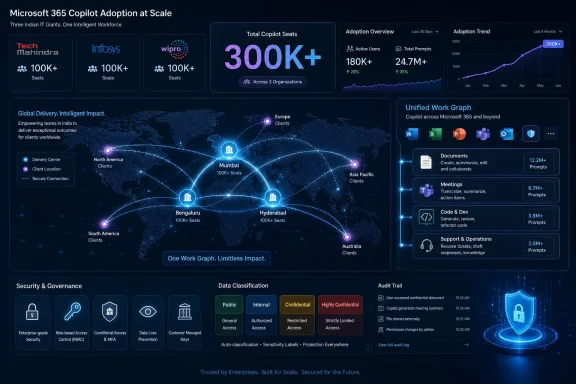
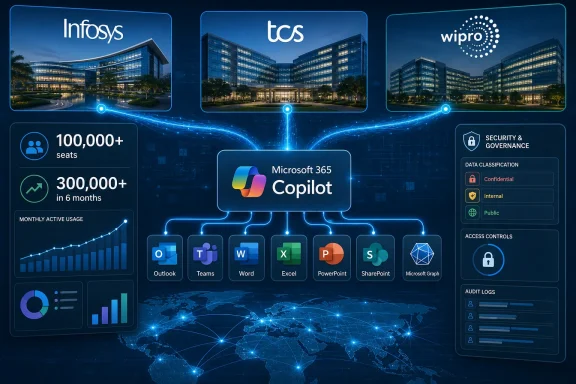
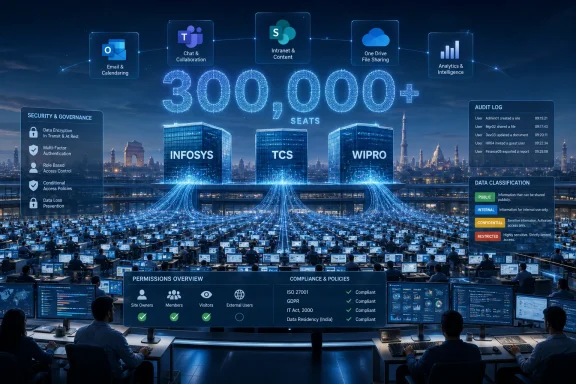
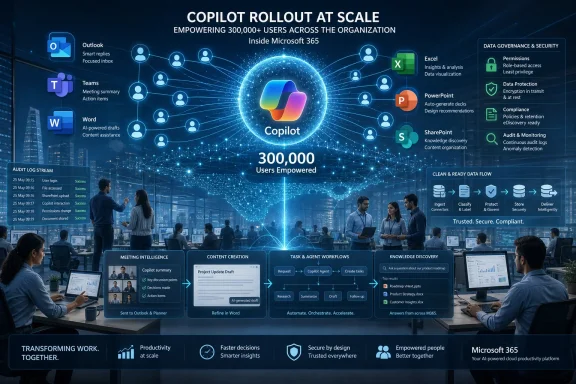
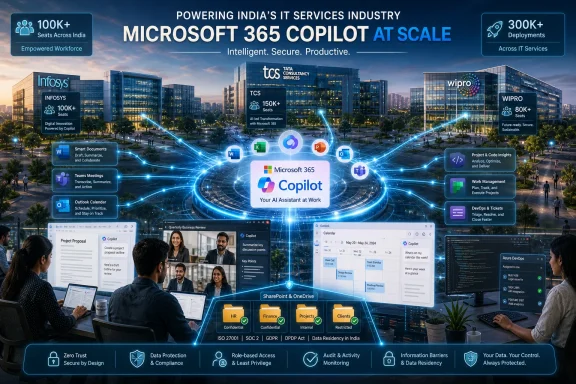
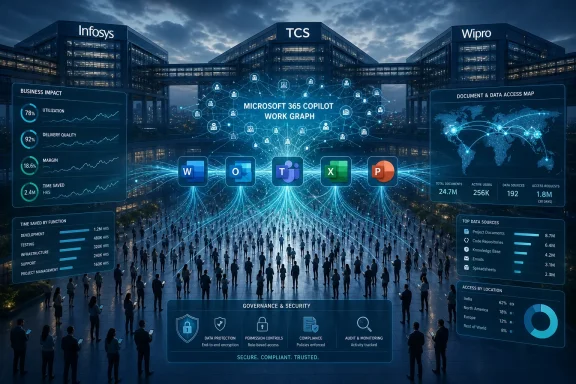
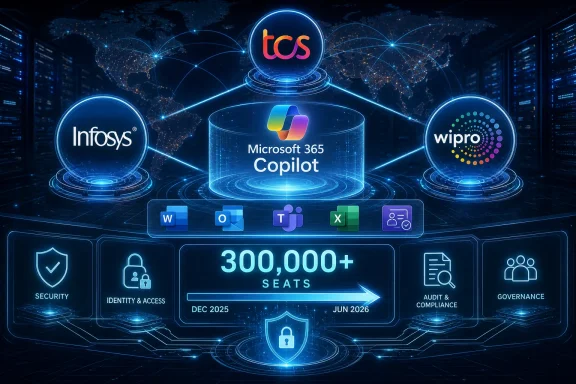
India’s TCS, Infosys, and Wipro have each expanded Microsoft 365 Copilot deployments beyond 100,000 employees as of June 3, 2026, taking their combined rollout past 300,000 users in less than six months. That makes the Indian IT services sector one of Microsoft’s most important proving grounds for enterprise AI at scale. It also turns Copilot from a boardroom promise into a daily operational experiment inside companies whose job is to modernize everyone else. The real story is not that three outsourcing giants bought a lot of seats; it is that Microsoft’s AI strategy is being stress-tested by the very firms that will sell, implement, customize, and defend it for the rest of the enterprise market.
Microsoft has spent the past several years insisting that Copilot is not merely a chatbot bolted onto Office, but the new interface for work. That claim has always needed something more persuasive than launch demos and earnings-call optimism. With TCS, Infosys, and Wipro now crossing 100,000 Microsoft 365 Copilot users each, the company finally has a scale story that sounds less like a pilot and more like infrastructure.
The timing matters. In December 2025, Microsoft announced that major IT services firms including TCS, Infosys, Wipro, and Cognizant were each committing to deployments of more than 50,000 Copilot licenses. Six months later, three of those Indian firms have doubled that footprint. In enterprise software, where deployments often crawl through procurement, compliance, training, and internal politics, that is a remarkably fast escalation.
But the venue matters even more. These are not ordinary corporate customers trying to shave minutes off meeting notes. TCS, Infosys, and Wipro are among the global system integrators that enterprises already trust to run migrations, rewrite business processes, maintain legacy systems, and staff transformation programs. When they standardize on Copilot internally, they are also building the playbook they can take to banks, insurers, retailers, manufacturers, and government-adjacent clients.
That is why Microsoft’s India announcement is both a customer win and a channel strategy. Copilot adoption inside these firms creates a workforce of consultants, engineers, delivery managers, and support staff who can speak from lived experience when pitching AI-assisted work to clients. Microsoft is not just selling Copilot into India’s IT majors; it is training the sales force for the next wave of Copilot deals.
That is why the activity numbers in this rollout deserve attention. Microsoft says Infosys has monthly active usage above 91 percent, TCS reports around 86 percent active usage among enabled associates, and Wipro is claiming more than 95 percent monthly active usage. Wipro also says employees are generating roughly 7.5 million prompts per month.
Those figures, if sustained, are far more meaningful than the initial license commitments. A high monthly active rate suggests Copilot is becoming part of daily rhythm rather than remaining a novelty. For a tool embedded in Outlook, Teams, Word, Excel, PowerPoint, and the Microsoft 365 graph, that rhythm is precisely the point.
Still, usage is not the same thing as value. A prompt can summarize a thread, draft a memo, rewrite a proposal, or produce a confidently wrong answer that someone must then correct. The enterprise challenge is not getting people to type into an AI assistant; it is making sure those interactions reduce friction without introducing new forms of review debt.
That is where the Indian IT firms become unusually useful case studies. Their employees do knowledge work at industrial scale, but much of that work is measurable: proposal generation, requirements gathering, ticket triage, documentation, research, code review, test planning, status reporting, and client communications. If Copilot has real leverage, these firms should be among the first to find it.
They also need to be read carefully. Productivity in research and content production is not the same as productivity across an entire delivery organization. A 25 percent improvement in drafting a client brief does not mean a 25 percent reduction in project cost, headcount, or delivery time. The most common trap in AI economics is converting task-level acceleration into company-level transformation without proving the intermediate steps.
Yet dismissing the numbers would be equally lazy. IT services companies are built around labor leverage. If Copilot reduces the time spent on low-margin internal work, improves reuse of prior knowledge, or accelerates the first draft of deliverables, the impact can compound. A few minutes saved across hundreds of thousands of employees becomes real operational capacity.
The accounting question is where that capacity goes. It could become higher margins, faster delivery, better documentation, more client-facing work, or simply more output demanded from the same employees. In services businesses, productivity tools often arrive wrapped in empowerment language and later reappear as utilization targets. Copilot will not escape that tension.
That shift is visible in the way Microsoft and its partners talk about the next phase. The language is moving from “help employees write and summarize” toward “embed AI into delivery, engineering, business operations, and enterprise workflows.” That is a different kind of deployment. It touches governance, identity, data classification, document permissions, automation, and client-specific operating models.
For TCS, Infosys, and Wipro, this is where Copilot becomes strategically interesting. Their commercial value depends on integrating tools into messy customer environments. If they can use Copilot internally to accelerate service delivery, they can package that experience into client offerings around Microsoft 365, Azure AI, Copilot Studio, GitHub Copilot, security, and data readiness.
This is also where Microsoft gains an advantage that pure AI model companies cannot easily replicate. Copilot sits inside the productivity estate where corporate knowledge already lives. It can draw on email, calendar data, Teams conversations, SharePoint documents, OneDrive files, and permissions inherited from Microsoft Entra ID. That makes it powerful, but it also makes it risky in ways that generic chatbots are not.
A consumer chatbot can hallucinate in public. An enterprise Copilot can surface a forgotten salary spreadsheet, summarize a sensitive acquisition memo, or expose a misconfigured SharePoint site that no one has audited in years. The value of Copilot depends on the quality of the tenant it inhabits. The bigger the deployment, the less room there is for wishful thinking about data hygiene.
That makes India more than a growth market. It is a force multiplier. If 300,000 employees at TCS, Infosys, and Wipro become fluent in Copilot, they become both users and translators. They learn the failure modes, build internal governance patterns, identify useful workflows, and discover which productivity claims survive contact with real delivery pressure.
This is especially important because many enterprises do not buy AI directly from product marketing. They buy it through migration programs, managed services agreements, modernization projects, and consulting roadmaps. The people writing those roadmaps often work at firms like the ones in this announcement.
The rollout also sharpens the competitive picture. Google, Salesforce, ServiceNow, AWS, OpenAI, Anthropic, and a long list of vertical AI vendors are all fighting for the enterprise automation layer. Microsoft’s advantage is not necessarily that Copilot is always the best AI assistant in isolation. Its advantage is that Microsoft 365 is already where many employees spend their day, and its partner ecosystem can convert adoption into repeatable implementation patterns.
India’s IT majors are therefore not just evidence that Copilot can scale. They are part of the machinery by which Microsoft hopes Copilot will scale elsewhere.
Copilot in the enterprise is less about one app and more about the authenticated workspace. A Windows PC becomes the endpoint through which employees access a graph of corporate data, cloud services, local files, browser sessions, Teams meetings, and managed applications. If Copilot becomes the interaction layer across that workspace, Windows remains part of the delivery surface even when the value is actually in Microsoft 365 and Azure.
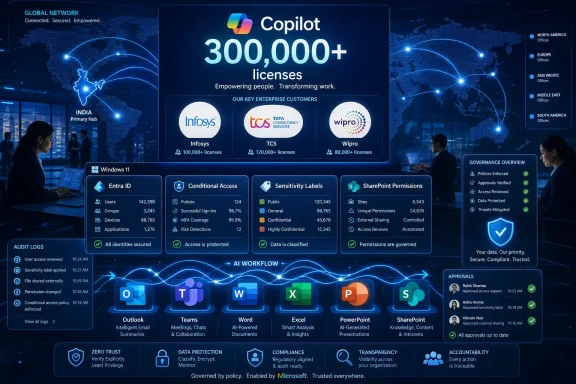
That matters for IT administrators. A large Copilot rollout is not just a licensing event; it is a governance event. Admins need to understand data access, retention, sensitivity labels, conditional access, endpoint compliance, audit logging, and user training. The AI assistant is only as safe as the permissions model underneath it.
For WindowsForum readers who manage fleets, the lesson is blunt: Copilot adoption will drag endpoint strategy along with it. Devices that were once judged on manageability, patch posture, and app compatibility will increasingly be judged on whether they can participate safely in AI-assisted workflows. That includes identity integration, browser controls, data loss prevention, and the ability to monitor what sensitive information can be retrieved, summarized, or reused.
The glamorous part is the prompt. The operational part is the permission boundary. Enterprise IT will spend far more time on the latter.
Copilot does not magically break permissions. That is the reassuring line. The uncomfortable follow-up is that it can make existing permissions newly visible and newly consequential.
Before AI, an employee might technically have had access to a folder but never known it existed. With Copilot, poorly governed information can become searchable, summarizable, and operationally useful. That changes the risk profile even if the access control model has not changed on paper.
This is why the Indian rollouts are interesting beyond their size. Companies like TCS, Infosys, and Wipro understand enterprise governance because they sell and operate it. If they can sustain high Copilot usage while managing internal risk, their methods will be studied. If they encounter friction, those lessons will be just as valuable.
For administrators elsewhere, the sequence is becoming clear. Copilot readiness is not achieved by buying licenses and sending a launch email. It requires tenant cleanup, data classification, access reviews, sensitivity labeling, user education, and a clear policy on what kinds of work should and should not be delegated to AI.
But the services industry cannot avoid the labor question. TCS, Infosys, and Wipro employ hundreds of thousands of people in businesses where billable effort, automation, margins, and headcount are permanently intertwined. If AI saves meaningful time, clients will eventually ask why contracts, staffing models, and rates should not change.
That does not mean mass displacement follows automatically. Enterprise work is full of exceptions, client-specific context, compliance requirements, integration complexity, and human coordination. The spreadsheet version of automation usually understates the messiness of delivery.
Still, AI adoption at this scale will alter expectations. Junior staff may be expected to produce stronger first drafts. Senior staff may spend more time reviewing AI-assisted output. Delivery teams may be asked to absorb more work without proportional hiring. Managers may use AI-driven summaries and dashboards to tighten oversight.
The result could be better work, more stressful work, or both. The technology does not decide that outcome by itself; organizational incentives do. That is why these deployments should be watched not only for productivity metrics, but for how companies redesign roles around them.
The TCS-Infosys-Wipro milestone strengthens Microsoft’s argument that Copilot can become a paid enterprise layer rather than a free feature users dabble with. It also gives Microsoft an answer to skeptics who see AI spending racing ahead of monetization. Three firms crossing 100,000 seats each is not a rounding error, even for Microsoft.
But the pressure is not gone. Customers will eventually demand hard returns. The first year of AI deployment can be funded by strategic urgency, competitive fear, and executive enthusiasm. Renewals are less sentimental. If Copilot becomes another expensive add-on with uneven value, procurement teams will notice.
That is why Microsoft’s most important Copilot metric may not be initial adoption, but expansion and renewal. The Indian IT majors have now expanded fast. The next test is whether usage remains high after the easy workflows are exhausted and whether the tool becomes embedded enough that removing it would feel disruptive.
In enterprise software, indispensability is the real moat. Microsoft is trying to make Copilot feel like part of work itself.
The danger is that the language runs ahead of operational maturity. A summary assistant is one thing. An agent that initiates actions inside enterprise systems is another. The second requires trust, auditability, rollback, permissions, exception handling, and a clear answer to who is responsible when automation goes wrong.
TCS, Infosys, and Wipro are well positioned to explore that frontier because they understand process engineering. They can identify where AI agents might safely handle routine work and where human review remains non-negotiable. They can also build client-specific integrations that turn Copilot from a general assistant into part of a managed workflow.
But “agentic” should not become a spell vendors cast over ordinary automation. The useful question is not whether a workflow contains AI, but whether the system reliably improves outcomes under real constraints. Enterprises will need to separate impressive demos from durable process change.
The most promising near-term use cases are likely to be bounded. Drafting, summarization, knowledge retrieval, document transformation, ticket classification, meeting follow-up, and structured research are natural fits. Autonomous decision-making in regulated or financially significant workflows will move more slowly, and rightly so.
Training matters here, but not in the simplistic “teach employees prompt engineering” sense. Workers need to understand when Copilot is useful, when it is dangerous, how to verify outputs, how to protect confidential information, and how to avoid treating fluent text as proof of accuracy. The best AI users are not the ones who type the fanciest prompts; they are the ones who know where the tool fits in the work.
Management training may be even more important. Leaders who see Copilot only as a cost-cutting lever will encourage shallow automation and demoralize teams. Leaders who treat it as a capability amplifier may get better results, but only if they invest in process redesign rather than simply telling employees to “use AI more.”
There is also a measurement problem. Counting prompts is easy. Measuring better decisions is hard. Counting hours saved is tempting. Determining whether those hours became higher-quality client work, reduced burnout, or merely more meetings is harder.
The companies that win with Copilot will not be the ones with the highest usage dashboard. They will be the ones that connect usage to measurable business outcomes without pretending every AI interaction is inherently productive.
For WindowsForum’s administrator-heavy audience, the practical lessons are already visible:
TCS, Infosys, and Wipro crossing 300,000 combined Microsoft 365 Copilot users is a milestone, but it is not the destination Microsoft wants investors, customers, or partners to imagine. The destination is a workplace where AI is embedded deeply enough into documents, meetings, service delivery, engineering, and operations that removing it feels like unplugging email. That future is not guaranteed, and it will be constrained by cost, trust, governance, and labor politics. But with India’s largest IT services firms now using Copilot at a scale few enterprises can match, Microsoft has moved its AI argument out of the demo hall and into the machinery of global enterprise work.
 Microsoft Finds Its Copilot Laboratory in India’s Services Giants
Microsoft has spent the past several years insisting that Copilot is not merely a chatbot bolted onto Office, but the new interface for work. That claim has always needed something more persuasive than launch demos and earnings-call optimism. With TCS, Infosys, and Wipro now crossing 100,000 Microsoft 365 Copilot users each, the company finally has a scale story that sounds less like a pilot and more like infrastructure.The timing matters. In December 2025, Microsoft announced that major IT services firms including TCS, Infosys, Wipro, and Cognizant were each committing to deployments of more than 50,000 Copilot licenses. Six months later, three of those Indian firms have doubled that footprint. In enterprise software, where deployments often crawl through procurement, compliance, training, and internal politics, that is a remarkably fast escalation.
But the venue matters even more. These are not ordinary corporate customers trying to shave minutes off meeting notes. TCS, Infosys, and Wipro are among the global system integrators that enterprises already trust to run migrations, rewrite business processes, maintain legacy systems, and staff transformation programs. When they standardize on Copilot internally, they are also building the playbook they can take to banks, insurers, retailers, manufacturers, and government-adjacent clients.
That is why Microsoft’s India announcement is both a customer win and a channel strategy. Copilot adoption inside these firms creates a workforce of consultants, engineers, delivery managers, and support staff who can speak from lived experience when pitching AI-assisted work to clients. Microsoft is not just selling Copilot into India’s IT majors; it is training the sales force for the next wave of Copilot deals.
The Seat Count Is Big, but the Usage Claims Are Bigger
Enterprise software vendors love seat counts because they sound concrete. Usage is the harder test. A company can buy 100,000 licenses and still have a product that employees avoid, misunderstand, or use only when managers ask for a quarterly adoption slide.That is why the activity numbers in this rollout deserve attention. Microsoft says Infosys has monthly active usage above 91 percent, TCS reports around 86 percent active usage among enabled associates, and Wipro is claiming more than 95 percent monthly active usage. Wipro also says employees are generating roughly 7.5 million prompts per month.
Those figures, if sustained, are far more meaningful than the initial license commitments. A high monthly active rate suggests Copilot is becoming part of daily rhythm rather than remaining a novelty. For a tool embedded in Outlook, Teams, Word, Excel, PowerPoint, and the Microsoft 365 graph, that rhythm is precisely the point.
Still, usage is not the same thing as value. A prompt can summarize a thread, draft a memo, rewrite a proposal, or produce a confidently wrong answer that someone must then correct. The enterprise challenge is not getting people to type into an AI assistant; it is making sure those interactions reduce friction without introducing new forms of review debt.
That is where the Indian IT firms become unusually useful case studies. Their employees do knowledge work at industrial scale, but much of that work is measurable: proposal generation, requirements gathering, ticket triage, documentation, research, code review, test planning, status reporting, and client communications. If Copilot has real leverage, these firms should be among the first to find it.
Productivity Claims Now Move From Theater to Accounting
TCS says teams have reported productivity improvements of 20 to 25 percent in research and content production, along with faster insight generation. Wipro says AI-led automation has translated into more than 250,000 full-time-equivalent days saved every quarter. Those are the kinds of figures that make executives lean forward and finance teams reach for spreadsheets.They also need to be read carefully. Productivity in research and content production is not the same as productivity across an entire delivery organization. A 25 percent improvement in drafting a client brief does not mean a 25 percent reduction in project cost, headcount, or delivery time. The most common trap in AI economics is converting task-level acceleration into company-level transformation without proving the intermediate steps.
Yet dismissing the numbers would be equally lazy. IT services companies are built around labor leverage. If Copilot reduces the time spent on low-margin internal work, improves reuse of prior knowledge, or accelerates the first draft of deliverables, the impact can compound. A few minutes saved across hundreds of thousands of employees becomes real operational capacity.
The accounting question is where that capacity goes. It could become higher margins, faster delivery, better documentation, more client-facing work, or simply more output demanded from the same employees. In services businesses, productivity tools often arrive wrapped in empowerment language and later reappear as utilization targets. Copilot will not escape that tension.
Copilot Is Becoming a Delivery Platform, Not Just a Personal Assistant
The phrase Microsoft 365 Copilot can make the rollout sound like a productivity-suite story. That undersells Microsoft’s ambition. The company increasingly frames Copilot as the front end for agents, workflows, internal knowledge, and business processes.That shift is visible in the way Microsoft and its partners talk about the next phase. The language is moving from “help employees write and summarize” toward “embed AI into delivery, engineering, business operations, and enterprise workflows.” That is a different kind of deployment. It touches governance, identity, data classification, document permissions, automation, and client-specific operating models.
For TCS, Infosys, and Wipro, this is where Copilot becomes strategically interesting. Their commercial value depends on integrating tools into messy customer environments. If they can use Copilot internally to accelerate service delivery, they can package that experience into client offerings around Microsoft 365, Azure AI, Copilot Studio, GitHub Copilot, security, and data readiness.
This is also where Microsoft gains an advantage that pure AI model companies cannot easily replicate. Copilot sits inside the productivity estate where corporate knowledge already lives. It can draw on email, calendar data, Teams conversations, SharePoint documents, OneDrive files, and permissions inherited from Microsoft Entra ID. That makes it powerful, but it also makes it risky in ways that generic chatbots are not.
A consumer chatbot can hallucinate in public. An enterprise Copilot can surface a forgotten salary spreadsheet, summarize a sensitive acquisition memo, or expose a misconfigured SharePoint site that no one has audited in years. The value of Copilot depends on the quality of the tenant it inhabits. The bigger the deployment, the less room there is for wishful thinking about data hygiene.
India’s AI Scale Story Is Also a Microsoft Distribution Story
Microsoft’s announcement lands within a broader push to make India central to its AI infrastructure, talent, and enterprise adoption strategy. The country offers an unusual combination: massive digital workforces, deep Microsoft penetration, global delivery centers, and a services industry whose business model depends on exporting technical implementation capacity.That makes India more than a growth market. It is a force multiplier. If 300,000 employees at TCS, Infosys, and Wipro become fluent in Copilot, they become both users and translators. They learn the failure modes, build internal governance patterns, identify useful workflows, and discover which productivity claims survive contact with real delivery pressure.
This is especially important because many enterprises do not buy AI directly from product marketing. They buy it through migration programs, managed services agreements, modernization projects, and consulting roadmaps. The people writing those roadmaps often work at firms like the ones in this announcement.
The rollout also sharpens the competitive picture. Google, Salesforce, ServiceNow, AWS, OpenAI, Anthropic, and a long list of vertical AI vendors are all fighting for the enterprise automation layer. Microsoft’s advantage is not necessarily that Copilot is always the best AI assistant in isolation. Its advantage is that Microsoft 365 is already where many employees spend their day, and its partner ecosystem can convert adoption into repeatable implementation patterns.
India’s IT majors are therefore not just evidence that Copilot can scale. They are part of the machinery by which Microsoft hopes Copilot will scale elsewhere.
The Windows Angle Is the Boring One Until It Is Not
For Windows enthusiasts, the immediate story may look like a Microsoft 365 and enterprise cloud announcement rather than a Windows story. That distinction is technically true and strategically incomplete. Microsoft’s AI agenda increasingly blurs the old lines between Windows, Office, Teams, Azure, identity, endpoint management, and security.Copilot in the enterprise is less about one app and more about the authenticated workspace. A Windows PC becomes the endpoint through which employees access a graph of corporate data, cloud services, local files, browser sessions, Teams meetings, and managed applications. If Copilot becomes the interaction layer across that workspace, Windows remains part of the delivery surface even when the value is actually in Microsoft 365 and Azure.
That matters for IT administrators. A large Copilot rollout is not just a licensing event; it is a governance event. Admins need to understand data access, retention, sensitivity labels, conditional access, endpoint compliance, audit logging, and user training. The AI assistant is only as safe as the permissions model underneath it.
For WindowsForum readers who manage fleets, the lesson is blunt: Copilot adoption will drag endpoint strategy along with it. Devices that were once judged on manageability, patch posture, and app compatibility will increasingly be judged on whether they can participate safely in AI-assisted workflows. That includes identity integration, browser controls, data loss prevention, and the ability to monitor what sensitive information can be retrieved, summarized, or reused.
The glamorous part is the prompt. The operational part is the permission boundary. Enterprise IT will spend far more time on the latter.
The Governance Bill Arrives Before the Productivity Dividend
Every major Copilot deployment begins with excitement about time savings and quickly runs into the less photogenic question of who can see what. Microsoft 365 environments are often full of old Teams, inherited SharePoint permissions, abandoned OneDrive folders, broad “everyone” groups, stale guest accounts, and documents that were never classified because no one expected an AI assistant to make them so discoverable.Copilot does not magically break permissions. That is the reassuring line. The uncomfortable follow-up is that it can make existing permissions newly visible and newly consequential.
Before AI, an employee might technically have had access to a folder but never known it existed. With Copilot, poorly governed information can become searchable, summarizable, and operationally useful. That changes the risk profile even if the access control model has not changed on paper.
This is why the Indian rollouts are interesting beyond their size. Companies like TCS, Infosys, and Wipro understand enterprise governance because they sell and operate it. If they can sustain high Copilot usage while managing internal risk, their methods will be studied. If they encounter friction, those lessons will be just as valuable.
For administrators elsewhere, the sequence is becoming clear. Copilot readiness is not achieved by buying licenses and sending a launch email. It requires tenant cleanup, data classification, access reviews, sensitivity labeling, user education, and a clear policy on what kinds of work should and should not be delegated to AI.
The Labor Story Is the One Everyone Talks Around
Microsoft and its partners prefer to describe Copilot as augmentation rather than replacement. That framing is understandable, and in many workflows it is accurate. AI that drafts meeting notes, summarizes research, generates first-pass content, or helps navigate internal knowledge can make employees faster without eliminating the need for judgment.But the services industry cannot avoid the labor question. TCS, Infosys, and Wipro employ hundreds of thousands of people in businesses where billable effort, automation, margins, and headcount are permanently intertwined. If AI saves meaningful time, clients will eventually ask why contracts, staffing models, and rates should not change.
That does not mean mass displacement follows automatically. Enterprise work is full of exceptions, client-specific context, compliance requirements, integration complexity, and human coordination. The spreadsheet version of automation usually understates the messiness of delivery.
Still, AI adoption at this scale will alter expectations. Junior staff may be expected to produce stronger first drafts. Senior staff may spend more time reviewing AI-assisted output. Delivery teams may be asked to absorb more work without proportional hiring. Managers may use AI-driven summaries and dashboards to tighten oversight.
The result could be better work, more stressful work, or both. The technology does not decide that outcome by itself; organizational incentives do. That is why these deployments should be watched not only for productivity metrics, but for how companies redesign roles around them.
Microsoft’s Paid-Seat Problem Gets a Better Story
For all the hype around Copilot, Microsoft has faced a persistent market question: how many organizations will pay real money for premium AI inside Microsoft 365, and how deeply will employees use it once the novelty fades? Large seat commitments from globally recognized enterprises help answer the first part. High monthly active usage helps answer the second.The TCS-Infosys-Wipro milestone strengthens Microsoft’s argument that Copilot can become a paid enterprise layer rather than a free feature users dabble with. It also gives Microsoft an answer to skeptics who see AI spending racing ahead of monetization. Three firms crossing 100,000 seats each is not a rounding error, even for Microsoft.
But the pressure is not gone. Customers will eventually demand hard returns. The first year of AI deployment can be funded by strategic urgency, competitive fear, and executive enthusiasm. Renewals are less sentimental. If Copilot becomes another expensive add-on with uneven value, procurement teams will notice.
That is why Microsoft’s most important Copilot metric may not be initial adoption, but expansion and renewal. The Indian IT majors have now expanded fast. The next test is whether usage remains high after the easy workflows are exhausted and whether the tool becomes embedded enough that removing it would feel disruptive.
In enterprise software, indispensability is the real moat. Microsoft is trying to make Copilot feel like part of work itself.
The Agentic AI Pitch Is Still Ahead of the Evidence
Microsoft’s messaging increasingly leans on agentic AI, a term that promises software capable of taking action across workflows rather than merely answering questions. The phrase is useful marketing because it suggests a future in which AI systems do the tedious connective work between documents, systems, approvals, tickets, dashboards, and business processes.The danger is that the language runs ahead of operational maturity. A summary assistant is one thing. An agent that initiates actions inside enterprise systems is another. The second requires trust, auditability, rollback, permissions, exception handling, and a clear answer to who is responsible when automation goes wrong.
TCS, Infosys, and Wipro are well positioned to explore that frontier because they understand process engineering. They can identify where AI agents might safely handle routine work and where human review remains non-negotiable. They can also build client-specific integrations that turn Copilot from a general assistant into part of a managed workflow.
But “agentic” should not become a spell vendors cast over ordinary automation. The useful question is not whether a workflow contains AI, but whether the system reliably improves outcomes under real constraints. Enterprises will need to separate impressive demos from durable process change.
The most promising near-term use cases are likely to be bounded. Drafting, summarization, knowledge retrieval, document transformation, ticket classification, meeting follow-up, and structured research are natural fits. Autonomous decision-making in regulated or financially significant workflows will move more slowly, and rightly so.
The Real Deployment Starts After the Licenses Are Assigned
A 300,000-seat rollout sounds like a finish line. In practice, it is the start of the difficult phase. Once licenses are assigned and usage begins, organizations must decide which behaviors to encourage, which outputs to trust, and which work patterns to redesign.Training matters here, but not in the simplistic “teach employees prompt engineering” sense. Workers need to understand when Copilot is useful, when it is dangerous, how to verify outputs, how to protect confidential information, and how to avoid treating fluent text as proof of accuracy. The best AI users are not the ones who type the fanciest prompts; they are the ones who know where the tool fits in the work.
Management training may be even more important. Leaders who see Copilot only as a cost-cutting lever will encourage shallow automation and demoralize teams. Leaders who treat it as a capability amplifier may get better results, but only if they invest in process redesign rather than simply telling employees to “use AI more.”
There is also a measurement problem. Counting prompts is easy. Measuring better decisions is hard. Counting hours saved is tempting. Determining whether those hours became higher-quality client work, reduced burnout, or merely more meetings is harder.
The companies that win with Copilot will not be the ones with the highest usage dashboard. They will be the ones that connect usage to measurable business outcomes without pretending every AI interaction is inherently productive.
A 300,000-User Rollout Gives IT Leaders a Sharper Checklist
The TCS, Infosys, and Wipro expansion does not prove that every enterprise should immediately license Copilot for everyone. It does prove that the “wait and see” phase is ending for large organizations already committed to Microsoft 365. The question is becoming less whether AI assistants will enter the workplace and more whether IT will shape the rollout before business units do it informally.For WindowsForum’s administrator-heavy audience, the practical lessons are already visible:
- Enterprises should treat Copilot deployment as a data-governance project before they treat it as a productivity launch.
- High usage rates matter only when organizations can connect them to quality, cycle time, compliance, or measurable business outcomes.
- Microsoft’s strongest Copilot advantage is its integration with existing Microsoft 365 identity, permissions, documents, meetings, and workflows.
- The biggest risks come from old access decisions, weak classification practices, and employees over-trusting generated output.
- IT services firms adopting Copilot internally will likely become the main channel for spreading Copilot patterns into client environments.
- The next phase of enterprise AI will be judged less by seat counts and more by renewals, workflow redesign, and governance maturity.
TCS, Infosys, and Wipro crossing 300,000 combined Microsoft 365 Copilot users is a milestone, but it is not the destination Microsoft wants investors, customers, or partners to imagine. The destination is a workplace where AI is embedded deeply enough into documents, meetings, service delivery, engineering, and operations that removing it feels like unplugging email. That future is not guaranteed, and it will be constrained by cost, trust, governance, and labor politics. But with India’s largest IT services firms now using Copilot at a scale few enterprises can match, Microsoft has moved its AI argument out of the demo hall and into the machinery of global enterprise work.
References
- Primary source: IANS LIVE
Published: 2026-06-03T05:03:07.439633
TCS, Infosys, Wipro cross 3 lakh Microsoft's Copilot users in major AI push
New Delhi, June 3 (IANS) India’s three leading IT services providers -- Infosys, TCS and Wipro -- have collectively expanded deployment of '365 Copilot' to more than 3 lakh employees within six months, marking one of the world’s largest enterprise artificial intelligence (AI) rollouts, Microsoft... ianslive.in
- Official source: news.microsoft.com
- Related coverage: windowscentral.com
Only 3.3% of Microsoft 365 users pay for Copilot | Windows Central
A new report suggests that only a fraction of the Microsoft 365 and Office 365 users who interact with Copilot Chat actually pay for it.www.windowscentral.com - Related coverage: m.rediff.com
Microsoft Ties Up With IT Firms For Copilot Deployment
Microsoft announced it partnered with TCS, Infosys, Wipro and Cognizant to deploy over 50,000 Copilot licences, collectively surpassing 200,000, to redesign workflows aroundm.rediff.com
- Related coverage: computerweekly.com
Microsoft taps Indian IT giants for agentic AI rollout | Computer Weekly
The partnership with Cognizant, Infosys, TCS and Wipro follows a $17.5bn pledge by the tech giant to bolster India’s cloud and AI infrastructure.www.computerweekly.com
- Related coverage: business-standard.com
Microsoft announces AI deals with TCS, Infosys, Wipro and Cognizant | Industry News - Business Standard
Microsoft deepens its India AI push as Cognizant, Infosys, TCS and Wipro commit to deploying over 50,000 Copilot licences each, signalling a rapid scale-up of agentic AI adoption across enterpriseswww.business-standard.com

- Related coverage: gadgets360.com
Microsoft Partners With Cognizant, Infosys, TCS and Wipro Over Agentic AI Adoption in India | Technology News
Microsoft, on Thursday, announced partnerships with Cognizant, Infosys, Tata Consultancy Services (TCS), and Wipro to help these IT services firms adopt and scale Copilot-powered agentic artificial intelligence (AI) workflows.www.gadgets360.com - Official source: ukstories.microsoft.com
Barclays to roll out Microsoft 365 Copilot to 100,000 colleagues
Barclays Bank PLC (Barclays) and Microsoft Corp. today announced that Barclays is to roll out Microsoft 365 Copilot to 100,000 colleagues globally, transforming the employee experience through AI agents and giving them access to the information they need most. ukstories.microsoft.com
- Related coverage: ciotechoutlook.com
Microsoft Expands Copilot Use as IT Firms Deploy 200k Licences
Microsoft partners with Cognizant, Infosys, TCS and Wipro to deploy over 200,000 Copilot licences, accelerating large-scale enterprise adoption of agentic and generative AI.....www.ciotechoutlook.com
- Related coverage: techradar.com
Barclays signs major Microsoft Copilot deal - over 100,000 workers set for major AI boost | TechRadar
Agreement worth tens of millions per yearwww.techradar.com - Related coverage: deccanherald.com
Microsoft, TCS, Infosys, Wipro Partner for Massive AI Adoption
Tech News: Microsoft partners with TCS, Infosys, Cognizant, and Wipro to deploy over 2,00,000 Microsoft 365 Copilot licenses, driving enterprise AI adoption in India. www.deccanherald.com
- Related coverage: timesofindia.indiatimes.com
Cognizant, Infosys, TCS and Wipro to deploy over 200,000 Microsoft Copilot licenses - The Times of India
Tech News News: Cognizant, TCS, Infosys and Wipro have announced their plans to deploy more than 200,000 Microsoft Copilot licenses. Each of these companies will depl. timesofindia.indiatimes.com
- Official source: microsoft.com
</rdf:Alt> </dc:title> <dc:description> <rdf:Alt> <rdf:li xml:lang="x-default"/> </rdf:Alt> </dc:description> <dc:creator> <rdf:Seq> <rdf:li>Lukas V
</rdf:Alt> </dc:description> <dc:creator> <rdf:Seq> <rdf:li>Lukas Velushwww.microsoft.com
- Official source: info.microsoft.com