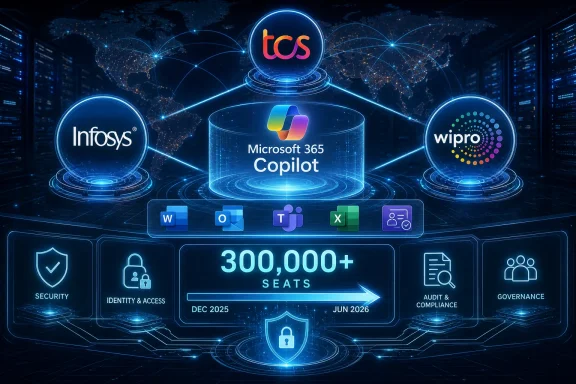
India’s TCS, Infosys, and Wipro have each expanded Microsoft 365 Copilot deployments beyond 100,000 employees as of June 3, 2026, taking their combined rollout past 300,000 users in less than six months. That makes the Indian IT services sector one of Microsoft’s most important proving grounds for enterprise AI at scale. It also turns Copilot from a boardroom promise into a daily operational experiment inside companies whose job is to modernize everyone else. The real story is not that three outsourcing giants bought a lot of seats; it is that Microsoft’s AI strategy is being stress-tested by the very firms that will sell, implement, customize, and defend it for the rest of the enterprise market.

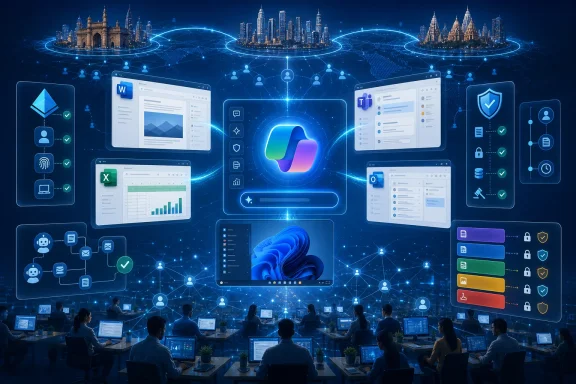
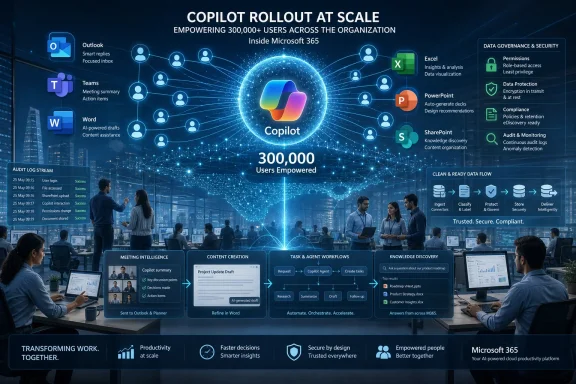
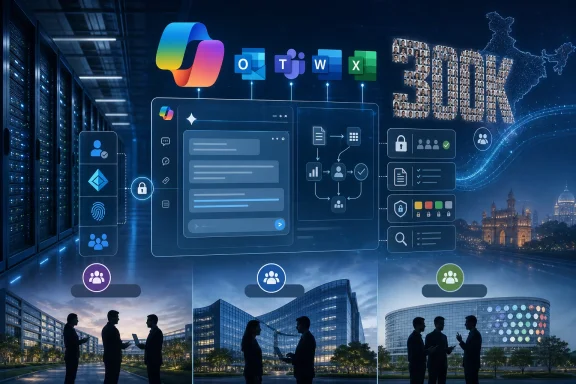
Glowing networked office scene showing Microsoft Office apps and secure data collaboration.Microsoft Finds Its Copilot Laboratory in India’s Services Giants​

Microsoft has spent the past several years insisting that Copilot is not merely a chatbot bolted onto Office, but the new interface for work. That claim has always needed something more persuasive than launch demos and earnings-call optimism. With TCS, Infosys, and Wipro now crossing 100,000 Microsoft 365 Copilot users each, the company finally has a scale story that sounds less like a pilot and more like infrastructure.
The timing matters. In December 2025, Microsoft announced that major IT services firms including TCS, Infosys, Wipro, and Cognizant were each committing to deployments of more than 50,000 Copilot licenses. Six months later, three of those Indian firms have doubled that footprint. In enterprise software, where deployments often crawl through procurement, compliance, training, and internal politics, that is a remarkably fast escalation.
But the venue matters even more. These are not ordinary corporate customers trying to shave minutes off meeting notes. TCS, Infosys, and Wipro are among the global system integrators that enterprises already trust to run migrations, rewrite business processes, maintain legacy systems, and staff transformation programs. When they standardize on Copilot internally, they are also building the playbook they can take to banks, insurers, retailers, manufacturers, and government-adjacent clients.
That is why Microsoft’s India announcement is both a customer win and a channel strategy. Copilot adoption inside these firms creates a workforce of consultants, engineers, delivery managers, and support staff who can speak from lived experience when pitching AI-assisted work to clients. Microsoft is not just selling Copilot into India’s IT majors; it is training the sales force for the next wave of Copilot deals.

The Seat Count Is Big, but the Usage Claims Are Bigger​

Enterprise software vendors love seat counts because they sound concrete. Usage is the harder test. A company can buy 100,000 licenses and still have a product that employees avoid, misunderstand, or use only when managers ask for a quarterly adoption slide.
That is why the activity numbers in this rollout deserve attention. Microsoft says Infosys has monthly active usage above 91 percent, TCS reports around 86 percent active usage among enabled associates, and Wipro is claiming more than 95 percent monthly active usage. Wipro also says employees are generating roughly 7.5 million prompts per month.
Those figures, if sustained, are far more meaningful than the initial license commitments. A high monthly active rate suggests Copilot is becoming part of daily rhythm rather than remaining a novelty. For a tool embedded in Outlook, Teams, Word, Excel, PowerPoint, and the Microsoft 365 graph, that rhythm is precisely the point.
Still, usage is not the same thing as value. A prompt can summarize a thread, draft a memo, rewrite a proposal, or produce a confidently wrong answer that someone must then correct. The enterprise challenge is not getting people to type into an AI assistant; it is making sure those interactions reduce friction without introducing new forms of review debt.
That is where the Indian IT firms become unusually useful case studies. Their employees do knowledge work at industrial scale, but much of that work is measurable: proposal generation, requirements gathering, ticket triage, documentation, research, code review, test planning, status reporting, and client communications. If Copilot has real leverage, these firms should be among the first to find it.

Productivity Claims Now Move From Theater to Accounting​

TCS says teams have reported productivity improvements of 20 to 25 percent in research and content production, along with faster insight generation. Wipro says AI-led automation has translated into more than 250,000 full-time-equivalent days saved every quarter. Those are the kinds of figures that make executives lean forward and finance teams reach for spreadsheets.
They also need to be read carefully. Productivity in research and content production is not the same as productivity across an entire delivery organization. A 25 percent improvement in drafting a client brief does not mean a 25 percent reduction in project cost, headcount, or delivery time. The most common trap in AI economics is converting task-level acceleration into company-level transformation without proving the intermediate steps.
Yet dismissing the numbers would be equally lazy. IT services companies are built around labor leverage. If Copilot reduces the time spent on low-margin internal work, improves reuse of prior knowledge, or accelerates the first draft of deliverables, the impact can compound. A few minutes saved across hundreds of thousands of employees becomes real operational capacity.
The accounting question is where that capacity goes. It could become higher margins, faster delivery, better documentation, more client-facing work, or simply more output demanded from the same employees. In services businesses, productivity tools often arrive wrapped in empowerment language and later reappear as utilization targets. Copilot will not escape that tension.

Copilot Is Becoming a Delivery Platform, Not Just a Personal Assistant​

The phrase Microsoft 365 Copilot can make the rollout sound like a productivity-suite story. That undersells Microsoft’s ambition. The company increasingly frames Copilot as the front end for agents, workflows, internal knowledge, and business processes.
That shift is visible in the way Microsoft and its partners talk about the next phase. The language is moving from “help employees write and summarize” toward “embed AI into delivery, engineering, business operations, and enterprise workflows.” That is a different kind of deployment. It touches governance, identity, data classification, document permissions, automation, and client-specific operating models.
For TCS, Infosys, and Wipro, this is where Copilot becomes strategically interesting. Their commercial value depends on integrating tools into messy customer environments. If they can use Copilot internally to accelerate service delivery, they can package that experience into client offerings around Microsoft 365, Azure AI, Copilot Studio, GitHub Copilot, security, and data readiness.
This is also where Microsoft gains an advantage that pure AI model companies cannot easily replicate. Copilot sits inside the productivity estate where corporate knowledge already lives. It can draw on email, calendar data, Teams conversations, SharePoint documents, OneDrive files, and permissions inherited from Microsoft Entra ID. That makes it powerful, but it also makes it risky in ways that generic chatbots are not.
A consumer chatbot can hallucinate in public. An enterprise Copilot can surface a forgotten salary spreadsheet, summarize a sensitive acquisition memo, or expose a misconfigured SharePoint site that no one has audited in years. The value of Copilot depends on the quality of the tenant it inhabits. The bigger the deployment, the less room there is for wishful thinking about data hygiene.

India’s AI Scale Story Is Also a Microsoft Distribution Story​

Microsoft’s announcement lands within a broader push to make India central to its AI infrastructure, talent, and enterprise adoption strategy. The country offers an unusual combination: massive digital workforces, deep Microsoft penetration, global delivery centers, and a services industry whose business model depends on exporting technical implementation capacity.
That makes India more than a growth market. It is a force multiplier. If 300,000 employees at TCS, Infosys, and Wipro become fluent in Copilot, they become both users and translators. They learn the failure modes, build internal governance patterns, identify useful workflows, and discover which productivity claims survive contact with real delivery pressure.
This is especially important because many enterprises do not buy AI directly from product marketing. They buy it through migration programs, managed services agreements, modernization projects, and consulting roadmaps. The people writing those roadmaps often work at firms like the ones in this announcement.
The rollout also sharpens the competitive picture. Google, Salesforce, ServiceNow, AWS, OpenAI, Anthropic, and a long list of vertical AI vendors are all fighting for the enterprise automation layer. Microsoft’s advantage is not necessarily that Copilot is always the best AI assistant in isolation. Its advantage is that Microsoft 365 is already where many employees spend their day, and its partner ecosystem can convert adoption into repeatable implementation patterns.
India’s IT majors are therefore not just evidence that Copilot can scale. They are part of the machinery by which Microsoft hopes Copilot will scale elsewhere.

The Windows Angle Is the Boring One Until It Is Not​

For Windows enthusiasts, the immediate story may look like a Microsoft 365 and enterprise cloud announcement rather than a Windows story. That distinction is technically true and strategically incomplete. Microsoft’s AI agenda increasingly blurs the old lines between Windows, Office, Teams, Azure, identity, endpoint management, and security.
Copilot in the enterprise is less about one app and more about the authenticated workspace. A Windows PC becomes the endpoint through which employees access a graph of corporate data, cloud services, local files, browser sessions, Teams meetings, and managed applications. If Copilot becomes the interaction layer across that workspace, Windows remains part of the delivery surface even when the value is actually in Microsoft 365 and Azure.
That matters for IT administrators. A large Copilot rollout is not just a licensing event; it is a governance event. Admins need to understand data access, retention, sensitivity labels, conditional access, endpoint compliance, audit logging, and user training. The AI assistant is only as safe as the permissions model underneath it.
For WindowsForum readers who manage fleets, the lesson is blunt: Copilot adoption will drag endpoint strategy along with it. Devices that were once judged on manageability, patch posture, and app compatibility will increasingly be judged on whether they can participate safely in AI-assisted workflows. That includes identity integration, browser controls, data loss prevention, and the ability to monitor what sensitive information can be retrieved, summarized, or reused.
The glamorous part is the prompt. The operational part is the permission boundary. Enterprise IT will spend far more time on the latter.

The Governance Bill Arrives Before the Productivity Dividend​

Every major Copilot deployment begins with excitement about time savings and quickly runs into the less photogenic question of who can see what. Microsoft 365 environments are often full of old Teams, inherited SharePoint permissions, abandoned OneDrive folders, broad “everyone” groups, stale guest accounts, and documents that were never classified because no one expected an AI assistant to make them so discoverable.
Copilot does not magically break permissions. That is the reassuring line. The uncomfortable follow-up is that it can make existing permissions newly visible and newly consequential.
Before AI, an employee might technically have had access to a folder but never known it existed. With Copilot, poorly governed information can become searchable, summarizable, and operationally useful. That changes the risk profile even if the access control model has not changed on paper.
This is why the Indian rollouts are interesting beyond their size. Companies like TCS, Infosys, and Wipro understand enterprise governance because they sell and operate it. If they can sustain high Copilot usage while managing internal risk, their methods will be studied. If they encounter friction, those lessons will be just as valuable.
For administrators elsewhere, the sequence is becoming clear. Copilot readiness is not achieved by buying licenses and sending a launch email. It requires tenant cleanup, data classification, access reviews, sensitivity labeling, user education, and a clear policy on what kinds of work should and should not be delegated to AI.

The Labor Story Is the One Everyone Talks Around​

Microsoft and its partners prefer to describe Copilot as augmentation rather than replacement. That framing is understandable, and in many workflows it is accurate. AI that drafts meeting notes, summarizes research, generates first-pass content, or helps navigate internal knowledge can make employees faster without eliminating the need for judgment.
But the services industry cannot avoid the labor question. TCS, Infosys, and Wipro employ hundreds of thousands of people in businesses where billable effort, automation, margins, and headcount are permanently intertwined. If AI saves meaningful time, clients will eventually ask why contracts, staffing models, and rates should not change.
That does not mean mass displacement follows automatically. Enterprise work is full of exceptions, client-specific context, compliance requirements, integration complexity, and human coordination. The spreadsheet version of automation usually understates the messiness of delivery.
Still, AI adoption at this scale will alter expectations. Junior staff may be expected to produce stronger first drafts. Senior staff may spend more time reviewing AI-assisted output. Delivery teams may be asked to absorb more work without proportional hiring. Managers may use AI-driven summaries and dashboards to tighten oversight.
The result could be better work, more stressful work, or both. The technology does not decide that outcome by itself; organizational incentives do. That is why these deployments should be watched not only for productivity metrics, but for how companies redesign roles around them.

Microsoft’s Paid-Seat Problem Gets a Better Story​

For all the hype around Copilot, Microsoft has faced a persistent market question: how many organizations will pay real money for premium AI inside Microsoft 365, and how deeply will employees use it once the novelty fades? Large seat commitments from globally recognized enterprises help answer the first part. High monthly active usage helps answer the second.
The TCS-Infosys-Wipro milestone strengthens Microsoft’s argument that Copilot can become a paid enterprise layer rather than a free feature users dabble with. It also gives Microsoft an answer to skeptics who see AI spending racing ahead of monetization. Three firms crossing 100,000 seats each is not a rounding error, even for Microsoft.
But the pressure is not gone. Customers will eventually demand hard returns. The first year of AI deployment can be funded by strategic urgency, competitive fear, and executive enthusiasm. Renewals are less sentimental. If Copilot becomes another expensive add-on with uneven value, procurement teams will notice.
That is why Microsoft’s most important Copilot metric may not be initial adoption, but expansion and renewal. The Indian IT majors have now expanded fast. The next test is whether usage remains high after the easy workflows are exhausted and whether the tool becomes embedded enough that removing it would feel disruptive.
In enterprise software, indispensability is the real moat. Microsoft is trying to make Copilot feel like part of work itself.

The Agentic AI Pitch Is Still Ahead of the Evidence​

Microsoft’s messaging increasingly leans on agentic AI, a term that promises software capable of taking action across workflows rather than merely answering questions. The phrase is useful marketing because it suggests a future in which AI systems do the tedious connective work between documents, systems, approvals, tickets, dashboards, and business processes.
The danger is that the language runs ahead of operational maturity. A summary assistant is one thing. An agent that initiates actions inside enterprise systems is another. The second requires trust, auditability, rollback, permissions, exception handling, and a clear answer to who is responsible when automation goes wrong.
TCS, Infosys, and Wipro are well positioned to explore that frontier because they understand process engineering. They can identify where AI agents might safely handle routine work and where human review remains non-negotiable. They can also build client-specific integrations that turn Copilot from a general assistant into part of a managed workflow.
But “agentic” should not become a spell vendors cast over ordinary automation. The useful question is not whether a workflow contains AI, but whether the system reliably improves outcomes under real constraints. Enterprises will need to separate impressive demos from durable process change.
The most promising near-term use cases are likely to be bounded. Drafting, summarization, knowledge retrieval, document transformation, ticket classification, meeting follow-up, and structured research are natural fits. Autonomous decision-making in regulated or financially significant workflows will move more slowly, and rightly so.

The Real Deployment Starts After the Licenses Are Assigned​

A 300,000-seat rollout sounds like a finish line. In practice, it is the start of the difficult phase. Once licenses are assigned and usage begins, organizations must decide which behaviors to encourage, which outputs to trust, and which work patterns to redesign.
Training matters here, but not in the simplistic “teach employees prompt engineering” sense. Workers need to understand when Copilot is useful, when it is dangerous, how to verify outputs, how to protect confidential information, and how to avoid treating fluent text as proof of accuracy. The best AI users are not the ones who type the fanciest prompts; they are the ones who know where the tool fits in the work.
Management training may be even more important. Leaders who see Copilot only as a cost-cutting lever will encourage shallow automation and demoralize teams. Leaders who treat it as a capability amplifier may get better results, but only if they invest in process redesign rather than simply telling employees to “use AI more.”
There is also a measurement problem. Counting prompts is easy. Measuring better decisions is hard. Counting hours saved is tempting. Determining whether those hours became higher-quality client work, reduced burnout, or merely more meetings is harder.
The companies that win with Copilot will not be the ones with the highest usage dashboard. They will be the ones that connect usage to measurable business outcomes without pretending every AI interaction is inherently productive.

A 300,000-User Rollout Gives IT Leaders a Sharper Checklist​

The TCS, Infosys, and Wipro expansion does not prove that every enterprise should immediately license Copilot for everyone. It does prove that the “wait and see” phase is ending for large organizations already committed to Microsoft 365. The question is becoming less whether AI assistants will enter the workplace and more whether IT will shape the rollout before business units do it informally.
For WindowsForum’s administrator-heavy audience, the practical lessons are already visible:
  • Enterprises should treat Copilot deployment as a data-governance project before they treat it as a productivity launch.
  • High usage rates matter only when organizations can connect them to quality, cycle time, compliance, or measurable business outcomes.
  • Microsoft’s strongest Copilot advantage is its integration with existing Microsoft 365 identity, permissions, documents, meetings, and workflows.
  • The biggest risks come from old access decisions, weak classification practices, and employees over-trusting generated output.
  • IT services firms adopting Copilot internally will likely become the main channel for spreading Copilot patterns into client environments.
  • The next phase of enterprise AI will be judged less by seat counts and more by renewals, workflow redesign, and governance maturity.
The companies that approach Copilot as a button to switch on will get inconsistent results. The companies that approach it as a new layer of enterprise architecture will at least be asking the right questions.
TCS, Infosys, and Wipro crossing 300,000 combined Microsoft 365 Copilot users is a milestone, but it is not the destination Microsoft wants investors, customers, or partners to imagine. The destination is a workplace where AI is embedded deeply enough into documents, meetings, service delivery, engineering, and operations that removing it feels like unplugging email. That future is not guaranteed, and it will be constrained by cost, trust, governance, and labor politics. But with India’s largest IT services firms now using Copilot at a scale few enterprises can match, Microsoft has moved its AI argument out of the demo hall and into the machinery of global enterprise work.
References​

  1. Primary source: IANS LIVE
    Published: 2026-06-03T05:03:07.439633
  2. Official source: news.microsoft.com
  3. Related coverage: windowscentral.com
  4. Related coverage: m.rediff.com
  5. Related coverage: computerweekly.com
  6. Related coverage: business-standard.com
  1. Related coverage: gadgets360.com
  2. Official source: ukstories.microsoft.com
  3. Related coverage: ciotechoutlook.com
  4. Related coverage: techradar.com
  5. Related coverage: deccanherald.com
  6. Related coverage: timesofindia.indiatimes.com
  7. Official source: microsoft.com
  8. Official source: info.microsoft.com
 

India’s TCS, Infosys, and Wipro have each expanded Microsoft 365 Copilot deployments beyond 100,000 employees as of June 3, 2026, putting more than 300,000 workers across the three IT services giants on Microsoft’s enterprise AI assistant within roughly six months. The milestone is not just another trophy number in the AI adoption race. It is a sign that the world’s largest outsourcing firms are moving Copilot from pilot-project novelty into the machinery of delivery, engineering, documentation, and client operations. For Microsoft, it is also a strategically convenient proof point: enterprise AI is no longer being sold only on demos, but on seat counts, usage rates, and repeatable workflows inside companies that make a living industrializing technology for everyone else.

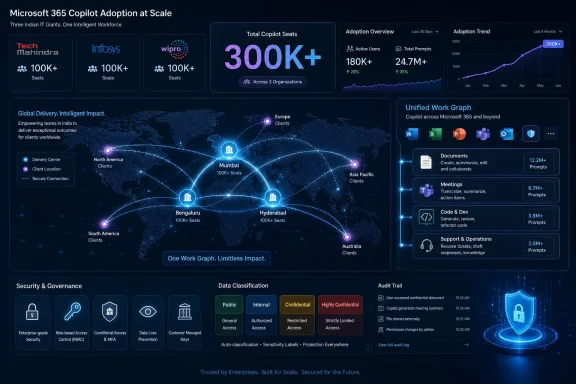
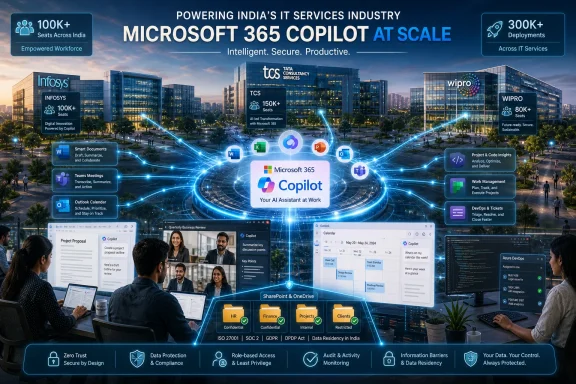
Infographic showing Microsoft 365 Copilot adoption across companies, regions, and security governance metrics.India’s IT Giants Just Turned Copilot Into a Delivery Platform​

The important detail is not that three large companies bought a lot of Microsoft licenses. Large enterprises buy a lot of software all the time, often with grand plans and uneven follow-through. The important detail is that TCS, Infosys, and Wipro are all claiming active internal usage at a scale that makes Copilot part of the operating model rather than a sandbox experiment.
Microsoft says the three firms crossed the 300,000-seat mark after starting from deployments of around 50,000 seats each in December 2025. That pace matters because six months is roughly the interval in which most enterprise software rollouts either find daily use or begin to fossilize into a line item nobody wants to defend at renewal time. Copilot appears to have cleared that first internal hurdle at India’s top-tier services firms.
These companies are not casual Office users. They are the layer between global enterprises and the systems those enterprises rely on: ERP migrations, cloud modernization, help desks, application maintenance, data platforms, cybersecurity operations, and custom software delivery. If Copilot changes how those firms document, summarize, search, code, and coordinate work, the effects will not remain inside their own inboxes.
That is why this rollout has broader meaning for WindowsForum readers than a standard enterprise licensing story. Microsoft 365 Copilot is not merely another assistant bolted onto Word, Excel, Outlook, and Teams. In a services environment, it becomes a template for how AI is packaged, governed, measured, and resold into client engagements.

The Pilot Phase Is Over, and the Productivity Claims Are Getting Specific​

Enterprise AI has suffered from a measurement problem. Executives say “productivity,” employees say “sometimes useful,” and finance teams ask whether any of it shows up in margins. The new figures from these Indian IT firms are notable because they move the discussion from aspiration to activity.
Infosys reports more than 100,000 employees using Copilot, with monthly active usage above 91 percent. TCS says more than 100,000 associates are enabled and around 86 percent are active users. Wipro claims more than 95 percent monthly active usage, with employees generating about 7.5 million prompts per month.
Those numbers do not prove transformational productivity by themselves. Monthly active usage can mean anything from indispensable daily assistance to a worker opening the tool once because it is embedded in the application they already use. But in enterprise software, usage at that level is still meaningful. Shelfware does not usually produce 7.5 million monthly prompts.
TCS is putting a sharper edge on the claim, saying teams have reported productivity improvements of 20 to 25 percent in research and content production. Wipro’s claim is even more eye-catching: AI-led automation has translated into more than 250,000 full-time-equivalent days saved every quarter. Those are vendor-friendly numbers, but they are also the kind of numbers that CIOs, procurement teams, and managed-services buyers will want to interrogate.
The real test will be whether these gains survive contact with margin reporting and delivery quality. Saving time on research summaries is useful. Saving time while avoiding hallucinated project documentation, bad code suggestions, security leakage, and compliance mistakes is what separates enterprise AI from a very expensive autocomplete engine.

Microsoft Needed a Story Bigger Than the Copilot Button​

Microsoft has spent the last several years wiring Copilot branding across Windows, Microsoft 365, Edge, GitHub, Security, Azure, and Dynamics. That ubiquity created awareness, but also fatigue. For many users, Copilot became less a specific product than a label applied to anything Microsoft wanted to sound AI-native.
The TCS-Infosys-Wipro announcement gives Microsoft a cleaner story. Here are three of the world’s best-known IT services firms, each with more than 100,000 internal users, using Microsoft 365 Copilot in the daily work of engineering, delivery, communications, and operations. That is a better enterprise sales pitch than a Windows key, a sidebar, or a keynote demo where everything works because the data was prepared in advance.
It also helps Microsoft answer a criticism that has followed Copilot since launch: adoption looks impressive in press releases, but the paying user base remains small relative to the Microsoft 365 universe. Microsoft has said Microsoft 365 Copilot has reached around 20 million paid enterprise seats worldwide. That is a large business by any ordinary standard, but it remains a fraction of the broader Microsoft 365 commercial base.
The services-firm rollout bridges that gap. Microsoft does not need every Office user to become a power user overnight if it can prove that large enterprises can deploy Copilot at six-figure scale and keep engagement high. The argument shifts from “everyone will use AI” to “the organizations that operationalize AI first will rewrite the cost structure of knowledge work.”
That is a more defensible claim, and a more threatening one.

The Outsourcers Are Also the Channel​

There is a commercial flywheel here that should not be missed. TCS, Infosys, and Wipro are not just Microsoft customers. They are partners, implementers, advisors, and resellers of transformation narratives to global enterprises. Their internal Copilot deployments are also showroom floors.
When a bank, manufacturer, insurer, or government agency asks whether Microsoft 365 Copilot can be deployed safely and productively at scale, these firms can now answer from their own experience. They can bring adoption frameworks, prompt libraries, governance models, training programs, and workflow redesigns that were tested on their own workforces first. That turns internal deployment into consulting inventory.
This is why Microsoft’s announcement leans heavily on AI being embedded into business-critical workflows. The phrase sounds like executive wallpaper, but it describes the frontier Microsoft cares about. Basic productivity features are useful, but the money is in reengineering repeatable work: ticket triage, project reporting, code review, proposal writing, meeting follow-up, knowledge-base search, compliance evidence gathering, and handoffs between distributed teams.
Services firms are unusually good at turning messy workplace habits into process diagrams, playbooks, metrics, and managed offerings. If Copilot becomes part of that machinery, Microsoft gets more than license revenue. It gets an army of implementation partners with a commercial incentive to make Copilot feel inevitable.
That matters because enterprise AI is less a product category than a change-management problem wearing a software badge.

Usage Is Not the Same as Transformation​

There is a danger in treating prompt volume as progress. Seven and a half million monthly prompts at Wipro is impressive, but prompts are inputs, not outcomes. An organization can generate a mountain of AI interactions and still fail to improve customer delivery, employee satisfaction, or operating margins.
The more interesting question is what those prompts are replacing. If employees are using Copilot to summarize meetings that should not have happened, the productivity gain may be real but shallow. If they are using it to surface institutional knowledge buried in Teams chats, SharePoint libraries, and ticket histories, the gain becomes more structural. If they are using it to generate code or client-facing work without adequate review, the risk rises quickly.
This distinction is especially important in outsourced IT services, where work is often governed by service-level agreements, audit requirements, security controls, and contractual obligations. A bad summary in a personal inbox is annoying. A bad summary in a client incident report can become a liability. A plausible but wrong answer in a migration plan can cascade into outages, rework, and billing disputes.
Microsoft and its partners therefore have to prove not only that Copilot is used, but that it is governed. That means data boundaries, retention policies, identity controls, sensitivity labels, audit trails, and human review workflows. In other words, all the unglamorous Microsoft 365 administration work that determines whether AI is safe enough to become boring.
For Windows and Microsoft 365 administrators, this is the part of the story that should command attention. The Copilot era is not primarily about teaching employees clever prompts. It is about whether the tenant is clean enough, permissioned enough, and monitored enough for AI to traverse it without turning years of information sprawl into a security event.

The Data Estate Becomes the Real Copilot Product​

Copilot’s usefulness depends heavily on the quality of the environment around it. Microsoft can provide the model interface, application hooks, and orchestration layer, but the assistant can only reason over what the organization has stored, indexed, permissioned, and exposed. That makes enterprise content hygiene a competitive issue.
Large IT services firms understand this better than most. They live inside documentation: project plans, runbooks, design decisions, incident histories, test results, meeting notes, client requirements, and service tickets. If Copilot can reduce the time required to find and synthesize that material, it directly attacks one of the great hidden costs of enterprise technology work.
But the inverse is also true. Poorly governed SharePoint sites, over-permissive Teams channels, stale documents, duplicated knowledge bases, and ambiguous ownership can all make AI less reliable. Copilot may surface outdated material with confidence. It may summarize internal debates without context. It may expose information that was technically accessible but practically obscure.
This is where the marketing phrase AI-ready data earns its keep. The work needed to make Copilot valuable is often the same work organizations postponed for years: information architecture, access reviews, data classification, lifecycle management, and content cleanup. Microsoft benefits because Copilot creates demand for that hygiene. Services firms benefit because they can sell the cleanup.
That may be the most durable business effect of this rollout. AI does not eliminate enterprise plumbing. It increases the value of good plumbing and punishes the organizations that ignored it.

Windows Users Will Feel This Through Workflows, Not Widgets​

For everyday Windows users, Copilot has often appeared as a visible interface change: a button, a panel, a shortcut, an assistant in the taskbar or browser. In the enterprise, the more consequential changes are quieter. They appear in how meetings are recapped, how documents are drafted, how support agents search for answers, and how managers consume weekly status reports.
The Indian services deployments reinforce that distinction. Microsoft 365 Copilot’s center of gravity is not the consumer-facing chatbot experience. It is the work graph: email, calendar, files, meetings, chats, documents, spreadsheets, and organizational knowledge. Windows is still the desktop surface, but the AI value is increasingly bound to identity, permissions, and enterprise content.
That has practical consequences. A user’s Copilot experience will vary dramatically depending on the organization’s Microsoft 365 maturity. In one company, it may feel like a genuine assistant that understands current projects and relevant files. In another, it may feel like a generic chatbot trapped inside productivity software, forever asking for clearer instructions because the data estate is a mess.
This explains why Microsoft keeps pushing Copilot as a platform rather than a feature. The product becomes more valuable as it touches more Microsoft services. Teams meetings feed summaries. Outlook provides communication context. SharePoint and OneDrive provide documents. Loop and Planner provide collaboration state. Purview and Entra provide governance.
That architecture is powerful, but it also deepens lock-in. Once Copilot becomes a workflow layer across Microsoft 365, replacing it is not like swapping a note-taking app. It becomes entangled with identity, compliance, knowledge management, and business process design.

The Price Question Has Not Gone Away​

Microsoft 365 Copilot has been widely associated with a premium per-user monthly price in enterprise plans, and that price has shaped skepticism around adoption. When AI is sold as an add-on rather than a default entitlement, customers naturally ask which workers need it, how often they use it, and whether the measurable savings exceed the subscription cost.
For a 300,000-seat combined deployment, even discounted enterprise terms imply a major financial commitment. Large strategic customers rarely pay simple list price across every seat, and Microsoft has every reason to craft terms that encourage marquee deployments. Still, the economics matter because they will influence whether Copilot becomes universal, role-based, or reserved for specific high-value functions.
The early enterprise pattern suggests segmentation. Knowledge workers in sales, engineering, consulting, support, finance, HR, and management may benefit differently. A project manager drowning in meetings may extract immediate value from summaries and action items. A developer may depend more on GitHub Copilot or specialized tooling. A frontline worker with limited Microsoft 365 use may not justify the same license.
This is one reason the TCS, Infosys, and Wipro numbers are significant. IT services firms employ huge numbers of knowledge workers whose output is text-heavy, coordination-heavy, and documentation-heavy. They are ideal proving grounds for Microsoft 365 Copilot because their work naturally creates the artifacts Copilot is designed to manipulate.
But that also means the results may not generalize cleanly to every industry. A law firm, hospital, factory, school district, or city government faces different risks, workflows, and cost models. Microsoft can point to the Indian IT giants as proof of scale, but customers still need to perform the less glamorous exercise of mapping AI capability to job function.

India Becomes the Enterprise AI Test Bed Microsoft Wanted​

India’s role in this story is not incidental. The country’s IT services industry sits at the intersection of global labor markets, enterprise modernization, and software platform adoption. When Indian services giants change how they deliver work, clients in North America, Europe, Asia-Pacific, and the Middle East eventually feel the effects.
Microsoft has also been investing heavily in India’s cloud and AI ecosystem, framing the country as both a talent base and a growth market. Large-scale Copilot adoption by TCS, Infosys, and Wipro lets Microsoft position India not just as a back office for global technology, but as a proving ground for enterprise AI operations. That is politically and commercially useful.
For the services firms, the incentive is equally clear. They are under pressure to show that generative AI will not simply erode billable labor models, but allow them to deliver more valuable work at higher speed. If clients believe AI reduces the need for human effort, outsourcers must either absorb margin pressure or repackage their services around AI-enabled outcomes.
That makes internal Copilot deployment a defensive and offensive move at once. Defensive, because every major services company must show it is not being disrupted by the same automation wave it sells to clients. Offensive, because the firms that learn to industrialize AI-assisted delivery first can claim a new efficiency premium.
The uncomfortable question is what happens to headcount over time. The current messaging emphasizes productivity, not replacement. But if hundreds of thousands of employees can produce more output with AI assistance, clients will eventually ask whether they should pay for fewer hours, faster outcomes, or higher-value deliverables. The answer will shape the next phase of outsourcing economics.

Microsoft’s Agent Ambition Moves From Demo to Workbench​

The Copilot story is also shifting from chat to agents. Microsoft’s recent product direction has emphasized AI systems that can perform multi-step tasks, operate within business workflows, and be customized for departments or roles. The Indian services deployments give that agentic strategy a large audience of technically sophisticated users.
This matters because chat interfaces alone have limits. They are flexible, but they rely on users knowing what to ask, how to ask it, and when to distrust the answer. Agents promise something more operational: repeatable task execution, workflow integration, and domain-specific behavior. They also introduce a bigger governance challenge, because an assistant that can act is riskier than one that can only answer.
In an IT services environment, agentic AI could touch many routine workflows. It might prepare status reports from delivery data, draft incident updates, assemble project documentation, summarize code changes, monitor knowledge-base gaps, or generate first-pass client proposals. Each workflow sounds mundane. At scale, the aggregate impact could be substantial.
The danger is that “agent” becomes the next inflated term, applied to scripts, templates, workflows, and chatbots with equal enthusiasm. Enterprise buyers should demand clarity. What systems can the agent access? What actions can it take? What approvals are required? What logs are retained? What happens when it is wrong?
The firms now running Copilot at six-figure scale will become laboratories for those answers. Their successes will become Microsoft case studies. Their failures, if they surface, will become cautionary tales for administrators who already know that automation tends to fail at the boundaries between systems, teams, and assumptions.

The Admin Burden Moves Up the Stack​

For IT administrators, Copilot’s rise changes the nature of Microsoft 365 management. Traditional concerns such as licensing, identity, endpoint configuration, and update channels remain. But AI adds a new layer of operational accountability: what organizational knowledge the assistant can see, how it summarizes that knowledge, and whether users understand its limits.
Permission sprawl becomes more dangerous when AI can synthesize across accessible content. A user who technically had access to an old SharePoint folder might never have found a sensitive document manually. Copilot can make obscure access practically useful. That is a productivity feature and a security headache at the same time.
Training also becomes more important, but not in the shallow sense of prompt tips. Users need to understand when Copilot is appropriate, when human review is mandatory, and how to handle confidential or regulated information. Managers need to avoid turning AI-generated summaries into unchallenged records of truth. Security teams need visibility into misuse without creating surveillance overreach.
Licensing governance will also matter. Once executives see high usage numbers, pressure grows to expand seats. But uncontrolled expansion can create waste and risk. Sensible organizations will track usage by role, workflow, and measurable outcome rather than treating Copilot as a prestige entitlement for anyone with a Microsoft 365 account.
The Indian IT giants are large enough to build those governance structures. Smaller enterprises often are not. That gap creates another opening for service providers: Copilot readiness assessments, deployment playbooks, governance workshops, and managed adoption programs. The same firms using Copilot internally will sell the administrative scaffolding externally.

The Claims Are Big Enough to Deserve Skepticism​

A healthy reading of this announcement requires two thoughts at once. First, the deployment scale is genuinely significant. Second, the productivity narrative is still vendor-shaped and should be treated as provisional until customers, auditors, and financial results confirm it.
Microsoft has every incentive to highlight seat growth and engagement because Copilot is central to its enterprise AI strategy. TCS, Infosys, and Wipro have every incentive to show clients that they are AI-forward and operationally modern. None of that makes the claims false. It does mean the claims are part of a commercial story.
The most credible pieces are the hardest to fake: seat counts, broad deployment timelines, and active usage percentages. The softer pieces are the productivity gains and saved workdays, which depend on methodology. Were employees self-reporting time saved? Were baseline workflows measured before and after? Were gains offset by review time, correction time, or AI training costs? Were quality outcomes maintained?
Those questions do not undermine the announcement. They make it more interesting. Enterprise AI is entering the phase where case studies must survive operational scrutiny. The companies that can produce credible measurement will have an advantage over those that simply repeat the language of transformation.
For now, the signal is clear enough: some of the world’s largest IT services workforces are using Microsoft 365 Copilot at a scale that makes dismissal difficult. The debate should move from whether enterprise AI will be adopted to where it works, where it disappoints, and who captures the savings.

The Copilot Rollout Has Become a Test of Enterprise Discipline​

The concrete lesson from the TCS, Infosys, and Wipro milestone is that Copilot adoption is no longer theoretical at the top end of the market. But the more useful lesson for everyone else is that AI scale depends on preparation, governance, and workflow fit as much as model capability.
  • TCS, Infosys, and Wipro have each moved Microsoft 365 Copilot beyond 100,000 employees, creating a combined deployment of more than 300,000 seats.
  • The reported active-usage rates are unusually high for enterprise software, with Infosys above 91 percent, TCS around 86 percent, and Wipro above 95 percent monthly active usage.
  • The strongest productivity claims are concentrated in research, content production, automation, and workflow support, not in a blanket replacement of human labor.
  • Microsoft gains a powerful enterprise proof point because these firms are both major customers and major implementation partners for global clients.
  • Administrators should treat Copilot readiness as a data governance project, not merely a licensing or training exercise.
  • The next phase will be judged less by prompt counts and more by measurable delivery quality, margin impact, security posture, and client acceptance.
The Copilot milestone in India is best understood as an inflection point, not a finish line. Microsoft has shown that its enterprise AI assistant can be deployed across hundreds of thousands of workers inside companies whose business is making technology operational at scale. Now comes the harder part: proving that AI-assisted work is not just faster, but better governed, more reliable, and economically durable enough to become the default fabric of enterprise computing.

References​

  1. Primary source: BizzBuzz
    Published: 2026-06-03T05:14:21.434492
  2. Independent coverage: thehawk.in
    Published: 2026-06-02T16:50:21.435525
  3. Official source: news.microsoft.com
  4. Related coverage: windowscentral.com
  5. Related coverage: nojitter.com
  6. Related coverage: techradar.com
  1. Related coverage: techcrunch.com
  2. Related coverage: thenextweb.com
  3. Related coverage: selfemployed.com
  4. Related coverage: timesofindia.indiatimes.com
  5. Related coverage: ndtv.com
  6. Related coverage: theneuralfeed.com
  7. Related coverage: theplanettools.ai
  8. Related coverage: sourcetrail.com
  9. Official source: microsoft.com
  10. Official source: wwps.microsoft.com
  11. Official source: info.microsoft.com
  12. Related coverage: infosys.com
 

Microsoft said on June 3, 2026, that Tata Consultancy Services, Infosys, and Wipro have each expanded Microsoft 365 Copilot deployments to more than 100,000 employees, pushing their combined license commitment past 300,000 seats in less than six months. The number matters less as a trophy for Microsoft than as a signal about where enterprise AI is actually being industrialized. India’s IT services giants are no longer merely testing generative AI in showcase labs; they are turning it into a workbench for delivery, consulting, HR, sales, documentation, and software maintenance. That shift will eventually be felt by Windows users and enterprise administrators far beyond Bengaluru, Mumbai, and Pune.

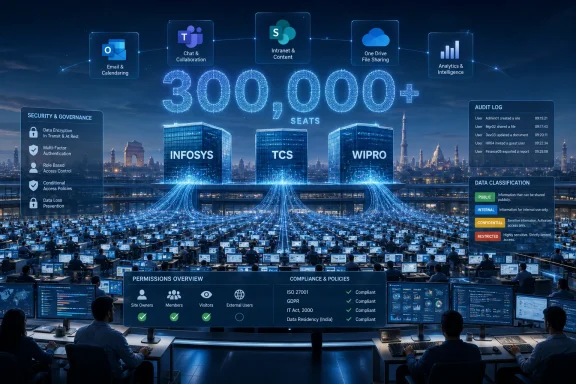
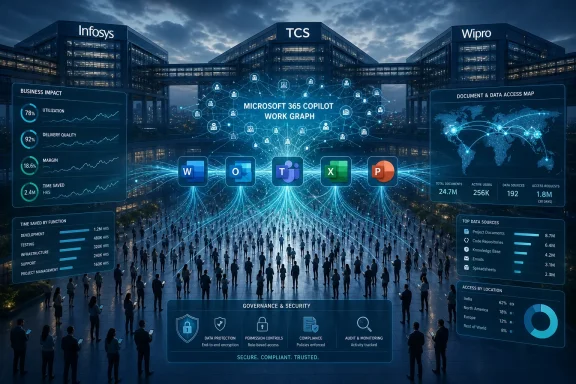
Office workers collaborate beneath a futuristic AI/secure cloud network with synced apps and dashboards.Microsoft Finds Its AI Proving Ground in the Outsourcing Machine​

The Copilot story has often been told from Redmond outward: Microsoft embeds AI into Word, Excel, Outlook, Teams, Windows, and the broader Microsoft 365 stack, then waits for enterprise customers to validate the thesis. This announcement flips the camera around. The most interesting action is not in the demo, but inside the firms whose business is to make technology usable for everyone else.
TCS, Infosys, and Wipro are not ordinary customers. They are global systems integrators, outsourcing vendors, software maintenance shops, modernization partners, and trusted execution arms for thousands of enterprises. If they standardize their own workforce on Microsoft 365 Copilot, they are not simply buying productivity software. They are training a vast class of consultants and engineers to treat Microsoft’s AI layer as the default operating surface for white-collar technology work.
That is why Microsoft’s framing around “frontier firms” should be read as both marketing and strategy. The phrase flatters the buyer, but it also describes the role Microsoft wants these firms to play. The Indian IT services sector becomes a live proving ground where Copilot is stress-tested across large populations, repetitive workflows, compliance-heavy customer environments, and highly measurable labor economics.
The scale is striking because it compresses what many enterprises still treat as a cautious, department-by-department rollout. In December 2025, the relevant commitments were around 50,000 seats per firm. By June 2026, Microsoft says each had moved beyond 100,000 employees. In corporate software terms, that is not a pilot becoming a production deployment; it is a production deployment becoming a cultural mandate.

The License Count Is a Business Model Story, Not Just an Adoption Story​

Microsoft 365 Copilot has always carried a blunt commercial proposition: pay a premium per user, then justify it through time saved, better output, faster execution, or new revenue. At list price, Copilot’s business edition has been positioned as a substantial add-on rather than a casual feature toggle. That makes 300,000 seats a serious statement, even if large enterprise discounts mean the public sticker price is not the real invoice.
For Microsoft, the benefits are obvious. A few hundred thousand additional seats deepen recurring revenue, help defend Microsoft 365 against rival AI workspaces, and make Copilot harder to dislodge once it is embedded in meetings, email, documents, spreadsheets, and internal knowledge flows. The larger prize is not the subscription line item, however. It is habituation.
Every time an Infosys consultant drafts a client note in Word with Copilot, every time a TCS delivery manager summarizes a Teams thread, and every time a Wipro associate builds an internal agent, Microsoft’s AI becomes part of the muscle memory of enterprise work. The employee may later move to a client, advise a client, train a client, or design a client’s operating model. In each case, the default assumption increasingly becomes that Microsoft’s productivity cloud has an AI layer and that this layer is where work begins.
That is a powerful distribution mechanism. Microsoft does not need every enterprise CIO to independently decide that Copilot is the future if the consultants sitting across the table already use it to produce proposals, manage delivery, and automate internal processes. The sell becomes less abstract. It becomes visible in the behavior of the people enterprises already pay to modernize their systems.
The risk for Microsoft is that license count is easier to announce than durable value. Enterprises have spent the past two years learning that generative AI demos well, pilots quickly, and disappoints expensively when governance, data quality, identity, and process redesign lag behind. The three Indian firms now have to prove that Copilot is not merely a more expensive way to summarize meetings.

India’s IT Majors Are Rehearsing the Post-Headcount Era​

The uncomfortable part of the announcement is what it says about labor. India’s IT services industry has long been built on the ability to scale skilled human effort: more engineers, more delivery centers, more offshore capacity, more managed services, more billable hours. Generative AI does not end that model overnight, but it does force a renegotiation of what the model sells.
If Copilot can reduce manual effort in research, content production, reporting, documentation, knowledge retrieval, or review cycles, then the old equation between headcount and output starts to weaken. That is attractive to clients, who want faster delivery and lower costs. It is also threatening to vendors whose revenue models have historically depended, in part, on people-intensive execution.
This does not mean 300,000 Copilot licenses translate directly into 300,000 jobs at risk. That would be a crude reading of both the technology and the industry. The more plausible near-term impact is work compression. Tasks that once filled hours become drafts, summaries, structured outputs, and first-pass analyses produced in minutes, with humans still responsible for judgment, accuracy, client context, and accountability.
But work compression changes hiring. Entry-level roles that once gave junior employees a route into the industry by handling documentation, testing support, knowledge gathering, and maintenance chores may become thinner. The firms will still need talent, but they may need fewer people doing purely procedural work and more people who can supervise AI outputs, understand systems, manage clients, and stitch business context into technical execution.
That is why this rollout should be read alongside the industry’s broader tension over hiring, layoffs, utilization, and reskilling. Copilot is not the sole cause of those changes, but it gives management a new lever. When executives talk about a “human plus AI” operating model, they are also describing a future in which productivity gains are expected to show up in delivery economics.

Copilot Becomes the New Office Macro​

For longtime Windows and Office users, the right analogy may not be the chatbot. It may be the macro. In the 1990s and 2000s, Office automation quietly transformed business processes because it lived where workers already lived: Excel, Word, Outlook, Access, and later SharePoint. Much of enterprise computing happened not in pristine enterprise resource planning systems, but in messy spreadsheets, mailboxes, templates, and departmental workflows.
Copilot is Microsoft’s attempt to repeat that pattern with natural language and agents. It does not ask employees to leave the Microsoft 365 environment. It offers to draft the email, summarize the meeting, rewrite the document, analyze the spreadsheet, search the tenant, and increasingly trigger actions across business systems. The strategic genius is not that Copilot is always the best AI model available. It is that it is present in the flow of work.
For sysadmins, that makes Copilot both convenient and dangerous. Convenience comes from integration with Entra ID, Microsoft 365 permissions, compliance controls, and the existing enterprise stack. Danger comes from the same place. An assistant that can reason over documents, emails, chats, calendars, and enterprise data will expose poor permission hygiene faster than any audit memo ever could.
The more Copilot is used, the more old information architecture sins become AI problems. Over-permissioned SharePoint sites, stale Teams channels, badly classified documents, forgotten distribution lists, and inconsistent retention policies are no longer background clutter. They become material the assistant may retrieve, summarize, and place in front of a user with unwarranted confidence.
That is why Copilot adoption at this scale is not just a productivity program. It is an identity, security, records management, and data governance program disguised as an AI rollout. The organizations that treat it as a license deployment will learn that lesson the hard way.

The Metrics Are Impressive, but They Are Also Vendor-Shaped​

Microsoft and the participating firms are offering concrete usage signals. Infosys reports high monthly active usage. TCS says a large share of licensed associates actively use AI in daily work. Wipro reports more than 95 percent monthly active usage, millions of prompts per month, and a large number of employee-developed agents. These numbers are important because they move the conversation beyond “we bought the licenses” toward “people are actually touching the product.”
Still, the industry should be careful about confusing activity with value. Prompt counts tell us that employees are asking Copilot to do things. Monthly active usage tells us the tool has not been ignored. Reported time savings indicate that teams perceive, estimate, or measure reductions in effort. None of those metrics automatically prove better client outcomes, lower defect rates, higher margins, safer delivery, or more reliable software.
That distinction matters. Enterprise AI is entering the phase where the easy numbers will be plentiful and the hard numbers will be contested. Prompts per month are easy. FTE days saved are more complicated. Revenue impact, delivery quality, customer satisfaction, and risk reduction are harder still.
The most credible case for Copilot will come when firms can connect usage to operational outcomes that survive scrutiny. Did incident resolution improve? Did proposal turnaround accelerate without quality loss? Did software maintenance teams reduce rework? Did client delivery become more predictable? Did junior staff learn faster, or did they become dependent on tools they cannot evaluate?
Until those answers arrive, the safest interpretation is that the adoption curve is real, the productivity signal is plausible, and the financial impact is still being proven. That is not a dismissal. It is the difference between a rollout and a transformation.

Agents Move the Battle From Documents to Operations​

The announcement’s most consequential word may not be Copilot. It may be agents. Microsoft’s enterprise AI strategy is steadily moving from assistive chat toward systems that can perform tasks, coordinate workflows, and operate across business processes. For IT services companies, that is where the technology becomes more than an Office enhancement.
A document assistant can save time. An agent that helps manage appraisal workflows, generate delivery artifacts, triage requests, inspect project evidence, or automate support actions starts to alter process design. That is where outsourcing firms can build repeatable internal playbooks and then sell similar patterns to clients.
Wipro’s reported use of tens of thousands of end-user-developed agents is especially notable because it hints at a bottom-up automation culture. In one sense, that is exactly what Microsoft wants: employees building small, contextual helpers without waiting for central IT to design every workflow. In another sense, it creates a governance challenge that will feel familiar to anyone who lived through spreadsheet sprawl, Access databases, shadow IT, or low-code proliferation.
Agent sprawl can be productive. It can also be chaotic. Enterprises will need inventories, ownership, lifecycle controls, data access boundaries, testing practices, and retirement plans. An agent that helps one employee summarize internal knowledge is one thing. An agent that touches client data, performance reviews, financial information, or regulated records is another.
This is where Microsoft’s “trust” language will be tested. Trust is not a press-release adjective; it is a set of operational disciplines. If agents become a normal part of work, then auditing, policy enforcement, model behavior, prompt logging, data residency, and administrator visibility become core infrastructure, not optional extras.

Windows Is the Endpoint, Even When the Story Is Cloud​

At first glance, this is a Microsoft 365 story rather than a Windows story. The licenses sit in the cloud productivity suite. The usage happens across Office apps, Teams, Outlook, browsers, and enterprise services. But for WindowsForum readers, the endpoint still matters because Copilot’s enterprise value depends on where people actually work all day.
Windows PCs remain the default workstations for much of the enterprise services world. The more Copilot is normalized in Microsoft 365, the more pressure there will be to make the Windows desktop feel like part of the same AI fabric. That includes local app integration, Edge, Teams, Outlook, file search, device management, and eventually the boundary between cloud reasoning and on-device assistance.
This is also why Microsoft’s hardware and Windows messaging around AI PCs should not be dismissed as consumer gloss. The first wave of enterprise Copilot usage is largely cloud-mediated, but the long-term direction points toward a blend of cloud agents, local context, and managed endpoints. Enterprises will want performance, privacy, latency, and policy control. Microsoft will want Windows to remain the place where that entire stack feels native.
For administrators, this means AI adoption will increasingly collide with familiar endpoint questions. Which devices are eligible? Which apps expose Copilot features? What data can be indexed? How are browser sessions governed? How do data loss prevention policies apply when AI-generated summaries contain sensitive information? What telemetry is available to prove compliance?
The Copilot seat is only the beginning. The operational burden lands across Microsoft 365 administration, endpoint management, security operations, and user training. Enterprises that buy licenses faster than they modernize those foundations will discover that AI amplifies both productivity and disorder.

The Systems Integrators Are Also Microsoft’s Channel​

There is another strategic layer here: TCS, Infosys, and Wipro are not just consuming Copilot; they are part of Microsoft’s route to market. These firms advise CIOs, run transformation programs, manage application estates, migrate workloads, implement security controls, and operate service desks. Their internal adoption becomes a credential.
When a consulting team recommends Copilot to a bank, retailer, manufacturer, insurer, or public-sector agency, it can now say it has used the same tools at large scale. That changes the sales conversation from aspiration to pattern replication. The pitch becomes: we have already done this to ourselves, and we can help you do it without repeating our mistakes.
This could entrench Microsoft’s position in enterprise AI more effectively than consumer mindshare. OpenAI, Anthropic, Google, and others may compete aggressively on model quality and developer enthusiasm, but enterprise adoption often follows procurement paths, integration comfort, compliance posture, and partner ecosystems. Microsoft is strongest where those forces matter most.
The caveat is that systems integrators are pragmatic. They will partner with Microsoft, but they will also partner with OpenAI, Anthropic, Google Cloud, AWS, ServiceNow, Salesforce, SAP, Oracle, and whoever else their clients demand. The Copilot rollout strengthens Microsoft’s hand, but it does not make the market exclusive.
In fact, the Indian IT majors may become brokers in a multi-model enterprise world. Copilot may dominate Microsoft 365 workflows, while other models handle software engineering, domain-specific analytics, customer service automation, or industry applications. The winners will not be chosen by slogans about “agentic AI.” They will be chosen by integration depth, governance, price, reliability, and measurable business outcomes.

The Real Test Is Whether Clients Stop Buying Hours​

The hardest question for the IT services sector is not whether Copilot works. It is whether clients will use AI productivity gains to renegotiate commercial models. If a vendor can produce the same deliverable with fewer person-hours, the client will eventually ask why it should keep paying as if the old labor curve still applies.
That pressure will push providers toward outcome-based pricing, platform-led services, managed AI operations, and intellectual property wrapped around delivery. The firms that adapt fastest may improve margins by using AI internally while selling higher-value services externally. The firms that move slowly may find themselves squeezed between client demands for savings and employee costs that no longer map cleanly to billable output.
This is where Copilot’s success could become disruptive even without mass job displacement. A productivity gain inside a fixed-price contract accrues differently than a productivity gain inside a time-and-materials contract. In one case, the vendor may keep more margin. In another, the client may demand fewer billed hours. Over time, both sides will try to capture the value.
Microsoft benefits either way. If Copilot becomes part of the cost structure of modern delivery, the license becomes easier to justify. The more enterprises redesign contracts, workflows, and staffing around AI-assisted work, the more Microsoft’s product becomes embedded not only in software usage but in commercial assumptions.
For workers, the implication is blunt. Familiarity with AI tools will become table stakes, but mere tool usage will not be enough. The career premium will shift toward people who can validate outputs, understand business context, orchestrate workflows, communicate with clients, and know when the machine is confidently wrong.

The Copilot Rollout Turns Governance Into a Competitive Skill​

The next phase of enterprise AI will separate firms that can use Copilot from firms that can govern it. That difference will matter to clients, regulators, auditors, and boards. It will also matter to employees who need clear rules about what can be pasted, generated, summarized, stored, shared, and automated.
In a 300,000-seat environment, edge cases become daily cases. Someone will ask Copilot to summarize a sensitive client meeting. Someone will generate code from internal materials. Someone will build an agent that saves a team hours but quietly depends on data it should not access. Someone will treat a plausible answer as a verified answer.
The solution is not to ban the tool. That battle is already lost in most knowledge-work environments. The solution is to make AI governance as ordinary as patching, identity management, and endpoint compliance. That means policies users can understand, controls administrators can enforce, and audit trails security teams can investigate.
This is a major opportunity for Microsoft’s ecosystem. If Copilot adoption creates governance demand, then Microsoft Purview, Defender, Entra, Intune, Sentinel, and the broader security stack become part of the AI conversation. The more Copilot is framed as enterprise infrastructure, the more Microsoft can sell the surrounding control plane.
It is also an opportunity for WindowsForum’s core audience. The administrators who understand permissions, data classification, endpoint management, and user behavior are suddenly central to AI strategy. The glamour may sit with models and agents, but the practical success of these deployments will be decided by the people who keep tenants sane.

The Numbers Make Sense Only If the Work Changes​

Here is the compact version of what this rollout actually tells us. Microsoft has found a large-scale enterprise validation point, India’s IT services firms are using Copilot to rehearse a new delivery model, and the rest of the market should watch the operational consequences rather than the headline license count.
  • Microsoft’s June 2026 announcement puts TCS, Infosys, and Wipro at more than 100,000 Microsoft 365 Copilot seats each, taking the combined commitment beyond 300,000 employees.
  • The move represents a rapid expansion from roughly 50,000-seat commitments per company announced in late 2025.
  • The most important effect may be channel influence, because these firms advise and operate technology programs for thousands of enterprise customers.
  • The productivity claims are promising, but the durable test will be whether Copilot improves delivery quality, cycle time, margins, and client outcomes.
  • The rollout increases pressure on IT administrators to fix permissions, data governance, retention, compliance, and endpoint policy before AI exposes weak foundations.
  • The bigger industry shift is commercial, because AI-assisted delivery will challenge billing models built around human effort and billable hours.
The headline says 300,000 Copilot licenses, but the real story is that Microsoft’s AI stack is being normalized inside the companies that normalize technology for everyone else. If TCS, Infosys, and Wipro can turn Copilot from a licensed assistant into a disciplined operating layer, the next wave of enterprise AI adoption will look less like experimentation and more like outsourcing’s new default machinery. If they cannot, the industry will have learned an equally useful lesson: buying seats is easy, but changing work is still the hardest software problem in the room.

References​

  1. Primary source: LinkedIn
    Published: Wed, 03 Jun 2026 07:34:40 GMT
  2. Independent coverage: moneycontrol.com
    Published: Wed, 03 Jun 2026 07:21:19 GMT
  3. Official source: news.microsoft.com
  4. Related coverage: livemint.com
  5. Related coverage: business-standard.com
  6. Related coverage: dtnext.in
  1. Related coverage: images.moneycontrol.com
  2. Official source: microsoft.com
  3. Official source: support.microsoft.com
  4. Related coverage: windowscentral.com
  5. Related coverage: computerworld.com
  6. Official source: learn.microsoft.com
  7. Related coverage: licenseq.com
  8. Official source: blogs.microsoft.com
  9. Related coverage: letsdatascience.com
  10. Related coverage: theplanettools.ai
  11. Related coverage: techtarget.com
  12. Related coverage: techradar.com
  13. Official source: cdn-dynmedia-1.microsoft.com
  14. Official source: techcommunity.microsoft.com
  15. Related coverage: pubsec.ai
  16. Related coverage: tomsguide.com
 

Microsoft said on June 3, 2026, that Infosys, Tata Consultancy Services, and Wipro have each expanded Microsoft 365 Copilot access to more than 100,000 employees, pushing the three Indian IT services giants past 300,000 combined seats in under six months. That is not just another adoption statistic for Microsoft’s AI slide deck. It is a signal that Copilot has moved from executive experiment to operating-layer bet inside companies that build and run technology for everyone else. The real story is not whether workers can draft emails faster; it is whether the services industry is beginning to reorganize itself around AI-mediated work.

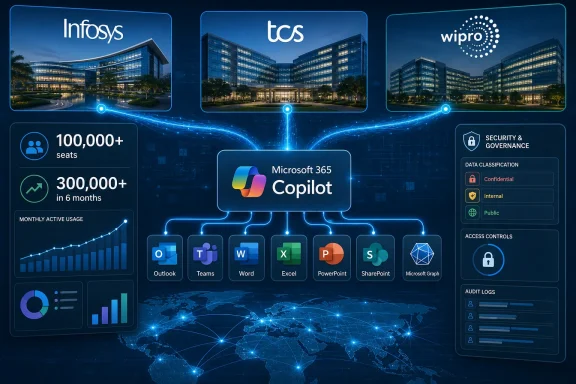
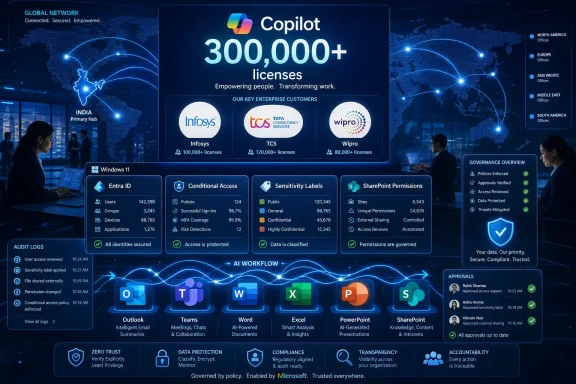
Cloud dashboard shows Microsoft 365 Copilot connected to office apps, security governance, and global network analytics.Microsoft Finds Its Copilot Proof Point in India’s Services Machine​

For the past two years, Microsoft has sold Copilot as the inevitable front end for knowledge work. The pitch has been simple: if your company already lives in Outlook, Teams, Word, Excel, PowerPoint, SharePoint, and the Microsoft Graph, the AI assistant should sit there too. What has been harder to prove is whether enterprises would deploy it broadly enough to change behavior rather than merely decorate the productivity suite with a new button.
Infosys, TCS, and Wipro give Microsoft the kind of answer vendors crave. These are not boutique deployments, innovation-lab showcases, or a few thousand privileged early adopters in a headquarters function. They are sprawling, process-heavy, global services businesses whose margins depend on repeatability, utilization, documentation, delivery cadence, and the ability to turn human expertise into billable output.
That is why the scale matters. A 100,000-seat Copilot deployment is not just a procurement event; it forces questions about training, governance, prompt quality, information hygiene, data boundaries, help-desk support, license utilization, and managerial expectations. When three Indian IT services majors cross that threshold almost simultaneously, Microsoft gets to argue that Copilot is not merely a feature of Microsoft 365 but a component of the new enterprise work stack.
There is a convenient symmetry here. Microsoft needs reference customers that prove the AI workplace is real, while IT services firms need to show clients they are not being disintermediated by the very automation they recommend. Large-scale Copilot adoption lets both sides tell a story: Microsoft can claim enterprise pull, and the services companies can claim they are becoming AI-first operators rather than yesterday’s outsourcing factories.

The 300,000-Seat Number Is a Sales Metric, but Usage Is the Better Tell​

Enterprise software announcements are famously slippery. A “deployment” can mean purchased seats, assigned licenses, technically enabled users, active users, or people who tried the tool once because their manager asked them to. Microsoft’s announcement leans on licensing scale, but the supporting usage claims are what make the rollout more interesting.
Infosys reportedly has more than 91 percent monthly active usage among its Copilot-enabled employees. TCS says about 86 percent of licensed associates are actively using AI in daily work. Wipro claims more than 95 percent monthly active usage and roughly 7.5 million prompts per month. Those numbers, if sustained, are more meaningful than seat counts because they suggest Copilot is being pulled into routine work rather than left as an expensive icon in the ribbon.
Still, usage is not value. A prompt submitted is not the same thing as a correct answer, a better decision, a shorter project cycle, or a safer customer environment. Anyone who has watched enterprise collaboration tools metastasize knows that activity metrics can inflate quickly when a product becomes mandatory, fashionable, or embedded in workflow defaults. The harder question is whether Copilot changes the economics of service delivery.
That is where TCS’s reported 20 to 25 percent productivity gains in research and content creation, along with 25 to 35 percent reductions in certain work-cycle times, become important. Wipro’s claim of more than 250,000 full-time-equivalent days saved per quarter is even more dramatic. These are the kinds of figures that will make CIOs pay attention and finance departments reach for calculators.
They should also make them ask what exactly is being measured. Research summaries, meeting notes, first-draft documentation, and content production are natural early wins for generative AI. They are also domains where quality control, review burden, and hidden rework can be difficult to capture. The first wave of productivity gains may be real, but the second wave depends on whether organizations redesign processes rather than simply asking employees to squeeze AI into old ones.

Copilot’s Real Beachhead Is the Boring Work Everyone Underestimated​

Microsoft 365 Copilot is often described in consumer-friendly terms: it drafts emails, summarizes meetings, creates slides, analyzes spreadsheets, and helps users write reports. That framing is useful because it maps neatly to familiar office frustrations. It is also too small for what Microsoft is trying to build.
The more consequential beachhead is knowledge-work plumbing. In large enterprises, enormous amounts of labor are spent turning conversations into action items, action items into status updates, status updates into reports, reports into decisions, and decisions back into execution. The waste is not always visible because it looks like normal office life: meetings, follow-ups, spreadsheet reconciliation, document archaeology, and endless context reconstruction.
For IT services companies, that plumbing is the business. Delivery teams need to understand client requirements, summarize incidents, document architecture decisions, generate test plans, produce compliance evidence, prepare proposals, and hand work across time zones. If Copilot can reduce the friction in those handoffs, its value is not confined to individual productivity; it becomes a lubricant for the operating model.
That is also why agents are becoming central to the story. A chatbot that answers questions is useful, but an agent that can operate within controlled workflows, retrieve context, draft artifacts, trigger approvals, and update systems starts to look like a junior process participant. Microsoft’s language around “agentic intelligence” is marketing-heavy, but the underlying ambition is clear: Copilot is meant to become a coordination layer across apps, data, and business processes.
The risk is that the same boring work that makes Copilot valuable also makes it dangerous when implemented carelessly. Summaries can omit nuance. Drafts can launder assumptions into polished prose. Automated status updates can create false confidence. A service-delivery organization that depends on precision cannot simply replace tedious human synthesis with fluent machine synthesis and declare victory.

India’s IT Giants Are Selling Transformation While Transforming Themselves​

There is a reason this announcement lands differently when the companies involved are Infosys, TCS, and Wipro. These firms are not just large employers adopting a productivity tool. They are global systems integrators and outsourcing providers whose clients are wrestling with the same AI transition.
For decades, India’s IT services model scaled by combining deep technical labor pools, process maturity, offshore delivery, and client-specific knowledge. Generative AI challenges parts of that model by automating tasks that once justified large teams. But it also creates a new consulting opportunity: helping clients re-engineer work around AI, governance, data readiness, security, and application modernization.
By rolling Copilot out internally at massive scale, these firms create a living reference architecture. They can tell clients that they have dealt with adoption curves, resistance, training, metrics, data access, and workflow redesign inside their own organizations. That does not automatically make them right, but it gives them a stronger claim than a consultant waving a generic AI maturity model.
It also shifts the competitive terrain among services firms. If one provider can show shorter proposal cycles, faster knowledge retrieval, better documentation, and more automated project management, rivals will have to respond. The market will not patiently distinguish between genuine productivity and polished AI theater, so every major provider will feel pressure to produce its own metrics.
The uncomfortable question is what happens to labor demand. Executives generally describe AI as augmentation, and in the near term that is often true. But if AI reduces work-cycle times by 25 to 35 percent in repeatable tasks, clients will eventually expect that efficiency to appear in pricing, staffing models, or delivery speed. The services firms adopting Copilot are trying to ride the wave before it breaks over them.

Microsoft Is Turning Office Into an Enterprise AI Distribution Network​

Microsoft’s advantage in workplace AI has never been that it owns the only capable models. It is that Microsoft 365 already sits where corporate work happens. The company does not need to persuade employees to visit a new destination if it can inject AI into Teams meetings, Outlook threads, Word documents, Excel models, PowerPoint decks, SharePoint repositories, and business workflows.
That distribution advantage matters more than the model leaderboard on any given week. Enterprises buy trust, integration, admin controls, compliance posture, identity management, and procurement simplicity. Microsoft can bundle Copilot into the language of existing IT governance, which is exactly where many standalone AI tools struggle.
The India announcement strengthens that story because it suggests enterprises are willing to pay for broad access when Copilot is tied to everyday systems of work. Microsoft has said paid Copilot seats are growing globally, and the more it can point to massive rollouts with active usage, the more it can counter the narrative that enterprise AI is overhyped shelfware.
But Microsoft is also walking a narrow path. If Copilot becomes the assumed AI layer for office work, customers will scrutinize its cost, accuracy, security, auditability, and measurable return with unusual intensity. A tool used by a few thousand early adopters can survive fuzzy value claims. A tool deployed to hundreds of thousands of workers becomes infrastructure, and infrastructure gets judged by harsher standards.
That is especially true for WindowsForum’s core audience: admins, IT pros, and technically literate users who understand that “turning on AI” is not a plan. Behind every Copilot rollout are Entra ID configurations, sensitivity labels, retention policies, access reviews, SharePoint sprawl, data-loss-prevention rules, endpoint controls, and user education. The magic assistant is only as safe as the tenant it can see.

The Data Governance Bill Comes Due Before the Productivity Dividend​

Copilot’s deepest integration with Microsoft 365 is both its selling point and its operational hazard. It can summarize, retrieve, and generate because it is connected to organizational data. That means bad permissions, stale documents, overshared folders, and poorly classified content are no longer passive hygiene problems; they become AI-amplified exposure risks.
This is not a reason to reject Copilot. It is a reason to treat adoption as an information-governance project rather than a morale-boosting software rollout. If a worker can ask Copilot for sensitive content they technically have access to but should not meaningfully see, the problem is not the prompt. The problem is the permissions model the enterprise tolerated for years because search was clumsy and humans were busy.
Large IT services companies are better positioned than many enterprises to confront this because they already live under client audits, contractual security obligations, and process discipline. Even so, the scale of these deployments raises the stakes. A 100,000-user Copilot environment has too many edge cases for purely manual oversight.
The practical implication for admins is blunt: Copilot readiness is tenant readiness. Before organizations chase prompt academies and agent marketplaces, they need to know who can access what, which repositories contain regulated data, how external sharing is controlled, where retention applies, and how AI interactions are logged and reviewed. The flashy demo depends on unglamorous controls.
There is also a cultural governance challenge. Employees need to understand when AI-generated material is acceptable as a draft, when it requires verification, and when it should not be used at all. The more Copilot disappears into everyday work, the more organizations must define accountability. A bad slide is annoying; a bad compliance response, client deliverable, or production-change summary can become expensive.

Productivity Claims Will Decide Whether Copilot Becomes a Platform or a Perk​

The strongest version of Microsoft’s argument is that Copilot changes the shape of work. The weaker version is that it helps people do the same work a little faster. Both may be true, but only the first justifies the strategic language now surrounding enterprise AI.
Microsoft’s 2026 Work Trend Index frames the shift around AI agents, human agency, and the emergence of “frontier” firms that rebuild their operating models for AI. The report’s claims that nearly half of analyzed Copilot conversations support cognitive work, and that many AI users say they are producing work they could not have done a year earlier, are designed to move the conversation beyond typing assistance. Microsoft wants leaders to believe the constraint is no longer tool capability but organizational redesign.
That argument has merit. A company that merely gives employees Copilot licenses may get faster email drafts and better meeting recaps. A company that redesigns workflows around AI-assisted research, human review, agent-triggered processes, and shared knowledge capture may get compounding gains. The gap between those two outcomes is management, not magic.
Infosys, TCS, and Wipro are useful test cases because they have the incentive and the scale to move beyond casual usage. If Copilot helps them compress delivery cycles, improve proposal velocity, automate internal reviews, and reuse institutional knowledge more effectively, it becomes part of the production system. If it mainly produces nicer meeting notes, the economics become harder to defend.
For Microsoft, the distinction is existential to Copilot’s enterprise future. A perk can be cut in a budget cycle. A platform becomes embedded in process, training, reporting, and customer delivery. The 300,000-seat milestone is impressive, but the renewal conversation will be won or lost on whether customers can trace Copilot from activity to outcome.

The Windows Angle Is Bigger Than the Copilot Button​

For Windows users, the Indian services rollout may seem distant at first glance. It is a Microsoft 365 enterprise story, not a Windows feature update. But the direction of travel matters because Microsoft is increasingly treating Windows, Microsoft 365, Copilot, cloud identity, and endpoint management as pieces of one AI workplace environment.
That has practical consequences. The PC becomes not just a device running local applications but a managed access point into AI-assisted organizational memory. Security baselines, browser controls, Teams clients, Office builds, Edge policies, identity posture, and endpoint telemetry all become part of the Copilot experience. The old boundary between “desktop support” and “business productivity” keeps getting thinner.
This is why sysadmins should pay attention even if they are not writing Copilot strategy documents. Users will ask why Copilot cannot see a file, why it surfaced something unexpected, why meeting summaries are missing, why sensitivity labels block an action, or why an agent cannot complete a workflow. Many of those tickets will land with the same teams that already own Microsoft 365, Windows endpoints, and identity.
There is also a hardware story forming in the background. Microsoft and its partners continue to push AI PCs, neural processing units, and local AI capabilities, while enterprise Copilot remains heavily tied to cloud services and Microsoft Graph data. The near-term workplace AI experience will be hybrid in the broadest sense: cloud intelligence, local devices, managed browsers, identity controls, and app-specific agents working together.
The result is that Copilot adoption is not an isolated SaaS decision. It is part of a broader Microsoft strategy to make the enterprise desktop, productivity suite, and cloud control plane feel like one AI-mediated workspace. Whether customers experience that as coherence or lock-in will depend on execution, pricing, and how much freedom they retain to mix competing AI tools into the same workflows.

The Services Industry Is Becoming the Test Lab for AI Labor Economics​

The most important unanswered question is not whether Copilot can save time. It can. The question is where the saved time goes.
In optimistic deployments, employees spend less time on rote synthesis and more time on judgment, architecture, client engagement, security analysis, and creative problem-solving. In harsher deployments, productivity gains become headcount pressure, higher quotas, faster delivery expectations, and more surveillance of output. Most large enterprises will produce a mixture of both.
IT services firms sit directly in that tension. Their clients want efficiency, but their business models still depend on people, utilization, and trust. If AI lets a smaller team deliver the same managed service, the provider can improve margins only until clients demand a share of the savings. If AI lets the same team deliver more valuable work, the provider can defend pricing. The difference will shape the next decade of outsourcing.
This is why Microsoft’s language about “AI as an operating model” is more than vendor poetry. It describes the battle over who captures the value of automation. Workers may gain leverage if AI makes them more capable and their judgment more valuable. Employers may gain leverage if AI standardizes and monitors work more tightly. Clients may gain leverage if they can benchmark AI-driven delivery across providers.
The Indian IT giants are not passive subjects in this shift. They are trying to define the model before it is defined for them. By adopting Copilot internally, building agents, integrating AI into delivery, and advertising productivity gains, they are telling the market they can convert disruption into a managed service. Whether employees experience that as empowerment or intensification will vary by team, role, and leadership culture.

The Numbers Are Big Enough to Matter and Early Enough to Doubt​

There is a danger in treating today’s Copilot statistics as destiny. Six months is a short window in enterprise transformation. Early usage can be inflated by executive attention, training campaigns, novelty, and the natural enthusiasm of technically skilled workers. Long-term adoption will depend on whether the tool remains useful after the first wave of obvious use cases has been absorbed.
There is also the matter of measurement. Productivity in knowledge work is notoriously difficult to quantify. A faster document is not always a better document. A shorter research cycle may still require deeper expert review. A meeting summary may save time for ten people while quietly shifting verification labor to one person. The best organizations will measure end-to-end outcomes, not isolated moments of AI assistance.
That said, skepticism should not become denial. The scale of these deployments suggests a real shift in enterprise behavior. Large companies do not casually assign more than 100,000 licenses to a premium tool unless senior leadership believes there is strategic value, competitive pressure, or both. The services sector in particular has little choice but to experiment aggressively because its product is work itself.
The sensible reading is that Copilot has crossed an adoption threshold but not a proof threshold. It is now credible as enterprise infrastructure; it still has to prove durable return on investment, responsible governance, and better outcomes across messy real-world workflows. Microsoft has won the right to be taken seriously here, not the right to be believed uncritically.

The Copilot Rollout Playbook Is Being Written in Public​

The most useful lesson from the Infosys, TCS, and Wipro deployments is that Copilot success appears to be less about individual cleverness than organizational choreography. Workers need training, but training alone is not enough. Teams need examples, managers need metrics, security teams need controls, and business leaders need to identify which workflows are worth redesigning.
The early enterprise mistake is to treat AI adoption like the launch of a new app. Announce availability, publish a few how-to guides, run webinars, and wait for productivity to happen. That approach may generate usage, but it rarely changes how work moves through an organization.
The better pattern is to start with high-friction workflows where the input, output, review process, and risk level are understood. Meeting follow-ups, knowledge-base search, proposal drafting, incident summaries, test documentation, internal reporting, and performance-review preparation are obvious candidates. They are frequent enough to matter and structured enough to govern.
But as Wipro’s agent-building activity suggests, the next phase will not be limited to generic Copilot prompts. Enterprises will create specialized agents for HR, finance, delivery, engineering, compliance, and customer operations. That is where governance becomes more complex because each agent embodies assumptions about process, authority, data access, and acceptable automation.
For IT leaders, the mandate is to avoid both paralysis and recklessness. Waiting for perfect certainty means falling behind competitors that are learning by doing. Deploying AI broadly without controls means turning organizational data and business processes into a live-fire experiment. The middle path is disciplined iteration: narrow use cases, measurable outcomes, strong access controls, human review, and a willingness to retire agents that do not earn trust.

The 300,000 Seats Point to a New Enterprise AI Baseline​

The headline number is large, but the operational lesson is more specific: enterprise AI is becoming a managed capability rather than a novelty. Infosys, TCS, and Wipro are not simply giving employees a chatbot. They are trying to normalize AI assistance inside the rhythms of delivery, documentation, decision-making, and internal operations.
That shift leaves several concrete takeaways for WindowsForum readers watching Copilot move from announcement stage to workplace reality:
  • Microsoft 365 Copilot is best understood as an AI layer across Microsoft’s productivity, collaboration, identity, and data ecosystem, not as a standalone writing assistant.
  • The Infosys, TCS, and Wipro deployments matter because each company has crossed 100,000 employees with access, creating a combined footprint above 300,000 seats in less than six months.
  • Reported active-usage rates above 86 percent suggest these deployments are more serious than ordinary enterprise shelfware, though independent outcome measurement remains essential.
  • The strongest early use cases are clustered around research, documentation, meetings, reporting, analysis, and repeatable knowledge-work processes.
  • Security and governance teams should treat Copilot readiness as a permissions, data classification, retention, and auditability project before they treat it as a productivity campaign.
  • The next competitive phase will center on agents that perform workflow-specific tasks, which will make process design and human accountability more important, not less.
Microsoft now has the showcase it wanted: three of the world’s most visible IT services firms putting Copilot into the hands of hundreds of thousands of employees and describing AI not as an experiment but as an operating model. The next chapter will be less forgiving. Seat counts made Copilot look inevitable; renewals, audits, employee trust, client outcomes, and measurable workflow redesign will decide whether that inevitability becomes durable enterprise change.

References​

  1. Primary source: Business Today
    Published: 2026-06-03T07:24:16.155425
  2. Independent coverage: Punjab Kesari English
    Published: 2026-06-03T05:50:16.158263
  3. Independent coverage: DT Next
    Published: 2026-06-03T05:50:16.149845
  4. Official source: news.microsoft.com
  5. Official source: microsoft.com
  6. Related coverage: forbes.com
  1. Related coverage: windowsforum.com
  2. Related coverage: nojitter.com
  3. Official source: microsoftpartners.microsoft.com
  4. Related coverage: techradar.com
  5. Related coverage: pcgamer.com
  6. Related coverage: theneuron.ai
  7. Related coverage: windowscentral.com
  8. Official source: marketingassets.microsoft.com
 

Microsoft said on June 3, 2026, that Infosys, Tata Consultancy Services, and Wipro have each expanded Microsoft 365 Copilot access to more than 100,000 employees, pushing combined licensing beyond 300,000 seats in under six months. That makes the announcement less a routine customer win than a stress test of Microsoft’s biggest enterprise AI argument: that Copilot is not just a chatbot bolted onto Office, but a new work layer for large organizations. The Indian IT services majors are useful proof points because their business is knowledge work at scale, priced by efficiency, repeatability, and customer trust. If Copilot works there, Microsoft can claim it belongs at the center of the modern enterprise desktop.

Tech-themed office scene with teams and Microsoft Graph workflow UI overlay showing Word/Excel/Office agents.Microsoft’s Copilot Pitch Has Moved From Helper to Operating Model​

Microsoft 365 Copilot is the company’s AI assistant for the Microsoft 365 workplace: Word, Excel, PowerPoint, Outlook, Teams, Loop, SharePoint, OneDrive, and the broader Microsoft Graph. In plain English, it is supposed to understand the context of a user’s work — emails, chats, meetings, documents, permissions, and organizational data — and help turn that context into drafts, summaries, analyses, presentations, plans, and increasingly, automated workflows.
That distinction matters. A consumer chatbot waits for a prompt and answers from the outside. Microsoft 365 Copilot is sold as something embedded inside the enterprise fabric, where the AI can draft a client update in Word, summarize a missed Teams meeting, extract spreadsheet patterns in Excel, or find the relevant SharePoint file without asking the employee to become a search operator.
The word Microsoft wants customers to hear now is not just Copilot but agents. Copilot is the user-facing assistant; agents are task-focused AI components that can carry out repeatable processes, interact with business systems, and encode institutional knowledge into workflow. In Microsoft’s ideal future, the employee does not merely ask Copilot to summarize a meeting. They ask a sales, HR, finance, support, or delivery agent to advance a process.
That is why the Infosys-TCS-Wipro announcement is bigger than a license count. Microsoft is not simply saying three large customers bought more software. It is saying the consultancies that advise other large companies on digital transformation are reorganizing their own work around the product.

India’s IT Giants Are the Perfect Copilot Test Lab​

Infosys, TCS, and Wipro are not ordinary reference customers. They are among the largest IT services firms in the world, with sprawling workforces, global delivery centers, regulated customers, and thousands of projects that turn meetings, documents, code, tickets, reports, proposals, and compliance artifacts into revenue.
That makes them both a lucrative market and a proving ground. A bank adding Copilot to 10,000 office workers can demonstrate productivity. An IT services firm adding Copilot to 100,000-plus employees can demonstrate whether AI changes the economics of knowledge labor itself.
These companies operate on the repetitive-but-variable work that generative AI is designed to compress. Delivery teams write status reports. Engineers document architectures. Consultants prepare presentations. Managers review performance cycles. Account teams summarize customer conversations. Analysts search internal repositories. None of these jobs disappears because Copilot exists, but many of the small frictions around them can be reduced if the tool is accurate, governed, and adopted widely enough.
Microsoft’s announcement also arrives at a moment when India is central to the enterprise AI story. The country is not merely a large software market; it is a global back office, engineering hub, and services multiplier. If India’s biggest IT firms standardize around Copilot, they do not just consume Microsoft’s AI stack. They carry it into customer engagements across industries.

The Numbers Are Designed to Signal Escape Velocity​

The headline number is simple: more than 300,000 Microsoft 365 Copilot licenses across Infosys, TCS, and Wipro, with each company above 100,000 employees. Microsoft says the three firms reached that scale in less than six months, after earlier deployments of roughly 50,000 seats each were announced in late 2025.
That pace is the story. Enterprise software adoption usually crawls through pilots, steering committees, risk reviews, procurement cycles, training waves, and security exceptions. Scaling from tens of thousands to hundreds of thousands of users in half a year suggests these firms are no longer treating Copilot as a novelty for executives or innovation teams.
Infosys says more than 100,000 employees across delivery, engineering, and corporate functions are using Copilot, with more than 91 percent monthly active usage. TCS says 86 percent of licensed employees use AI in daily work, and it is reporting productivity gains of 20 to 25 percent in research and content creation tasks, along with 25 to 35 percent reductions in work-cycle times. Wipro says it has more than 95 percent monthly active usage, 7.5 million prompts per month, and more than 250,000 full-time-equivalent days saved per quarter.
Those figures should be read carefully. Vendor-supplied productivity claims are not the same as audited economic outcomes, and “days saved” is a softer metric than margin expansion or revenue per employee. But even allowing for marketing gloss, the scale of usage matters. A bad enterprise tool can be purchased widely and ignored. Microsoft’s claim here is that the software is being touched often enough to become habit.

Copilot’s Real Product Is Permissioned Context​

The most important technical idea behind Microsoft 365 Copilot is not that it uses large language models. Every major AI assistant does that. The differentiator is that Copilot is grounded in the Microsoft Graph — the web of identity, files, meetings, chats, mail, calendars, and permissions that already defines Microsoft 365 inside a company.
That grounding is both the selling point and the risk. On the selling side, Copilot can answer questions with the user’s work context, not just generic internet knowledge. It can summarize the meeting a worker missed, find a document buried in SharePoint, draft a reply based on the last email thread, or assemble a PowerPoint from an approved Word document.
On the risk side, Copilot can surface what a user is technically allowed to access, even if the organization has been living with years of messy permissions. The old SharePoint problem — overshared files, stale groups, permissive links, abandoned sites — becomes more visible when an AI assistant can synthesize across it. Copilot does not need to break access controls to create anxiety; it only needs to make existing access easier to exploit.
That is why serious Copilot deployments are also governance projects. The work is not simply assigning licenses. It is reviewing data exposure, enforcing identity hygiene, setting retention and sensitivity labels, auditing meeting transcript policies, training users on prompt discipline, and deciding which agents can touch which systems.
The Indian IT services giants understand that better than most buyers because they must satisfy their own compliance teams and their customers’ compliance teams. Their adoption says less about reckless enthusiasm than about the belief that AI assistance is becoming unavoidable — and that the governance problem is manageable if treated as core infrastructure.

The Services Firms Are Also Selling What They Are Learning​

There is a circular logic in Microsoft’s announcement, and it is commercially important. Infosys, TCS, and Wipro are not only customers of Microsoft 365 Copilot. They are also Microsoft partners and systems integrators that can help other enterprises deploy, customize, govern, and extend the product.
That means every internal rollout doubles as a training exercise. The more these firms use Copilot across engineering, delivery, HR, reporting, and knowledge management, the more credible they become when pitching Copilot transformation to banks, retailers, manufacturers, insurers, telecom operators, and government agencies.
This is the classic enterprise platform flywheel. Microsoft supplies the platform. Services firms supply change management, integration, migration, and industry-specific adaptation. Customers get a vendor-backed product and a consulting army that can make it fit their messy reality.
The difference this time is that the consultants’ own labor model is in the blast radius. If Copilot meaningfully reduces time spent on documentation, research, presentation building, meeting administration, and internal reporting, then services firms must decide where the gains go. They can expand margins, lower prices, deliver faster, move employees into higher-value work, or some combination of all three.
That is the strategic tension underneath the upbeat quotes. “Human plus AI” sounds collaborative, but it is also a statement about productivity pressure. Firms that sell human expertise by the hour now need to show that AI makes that expertise more valuable rather than merely cheaper.

Wipro’s Agent Factory Shows Where Microsoft Wants the Market to Go​

Among the three examples, Wipro’s numbers are the most revealing because they point beyond personal productivity. The company says employees are generating 7.5 million prompts per month, averaging 23 AI-assisted actions per week, and have created more than 29,000 agents and more than 60 enterprise-grade AI solutions.
That is the future Microsoft is trying to normalize. The first phase of Copilot was “help me write this email.” The second phase is “help me complete this process.” The third phase is “let the organization encode its work into managed AI agents that can be reused, measured, and governed.”
Wipro’s performance review example is a useful illustration. An appraisal process is paperwork-heavy, structured, repetitive, and emotionally consequential. If an AI-powered appraisal agent reduces performance review effort by nearly 70 percent, as Wipro says, the business case is obvious. So is the governance burden.
Performance reviews contain sensitive personal data, managerial judgment, compensation implications, and potential legal exposure. An agent that drafts or accelerates that process must be auditable, explainable enough for HR, constrained by policy, and monitored for bias or hallucination. The bigger the productivity gain, the more important the guardrails become.
This is where Microsoft’s enterprise advantage is clearest. Consumer AI products can be brilliant but difficult to govern. Microsoft’s pitch is that Copilot, Purview, Entra, Intune, Defender, SharePoint controls, and the Microsoft 365 admin stack provide an enterprise wrapper around the AI. Whether that wrapper is always sufficient is a different question, but it is the right question for CIOs to ask.

The ROI Debate Is Still Unsettled​

The strongest case for Copilot is that knowledge workers waste enormous time converting context into artifacts. They sit through meetings, search for information, write status updates, build decks, reconcile spreadsheets, and repeat explanations that already exist somewhere in the company. If AI can reduce that drag by even a modest percentage, the value at 100,000-seat scale is substantial.
The weaker case is that much of this savings is hard to measure. A worker who saves 20 minutes on an email may spend the time reviewing Copilot’s output, correcting tone, or checking facts. A manager who gets a meeting summary faster may attend more meetings. A team that produces more documents may not produce better decisions.
That does not make Copilot useless. It means enterprise AI ROI will not be captured by stopwatch math alone. The more mature question is whether organizations can redesign work so the saved effort becomes better throughput, faster delivery, improved quality, or reduced burnout.
TCS’s reported gains in research and content creation tasks are plausible because those are exactly the activities where generative AI tends to perform well. Wipro’s prompt volume suggests real behavioral adoption. Infosys’s high monthly active usage indicates the tool has moved beyond a demo. But the market will eventually ask for harder proof: project economics, cycle-time benchmarks, defect rates, customer satisfaction, attrition effects, and operating margin impact.
Microsoft knows this. That is why its language has shifted from individual productivity to operating models. Time saved is a feature. Work redesigned is the product.

Windows and Microsoft 365 Are Becoming the AI Control Plane​

For WindowsForum readers, the significance is not limited to large Indian outsourcers. The same architectural move is happening across Windows, Microsoft 365, Azure, GitHub, and endpoint management. Microsoft wants AI to be the control plane for work, and Windows is one of the surfaces where that control plane appears.
That does not mean every Windows PC suddenly becomes an autonomous AI workstation. It means the boundary between operating system, productivity suite, identity layer, cloud storage, search, and workflow automation is blurring. Copilot in Windows, Copilot in Edge, Copilot in Teams, Copilot in Office apps, Copilot Studio agents, and Microsoft Graph connectors are all parts of the same strategic direction.
For administrators, this changes the job. AI enablement is no longer just a license assignment in the Microsoft 365 admin center. It touches data classification, access reviews, endpoint compliance, conditional access, browser policy, meeting transcription defaults, DLP rules, app governance, and user training.
For users, it changes expectations. The office suite is no longer a set of blank canvases. It is becoming a set of AI-mediated workspaces that can draft, summarize, recommend, retrieve, and increasingly act. That can feel magical when it works and intrusive when it does not.
For Microsoft, the prize is enormous. If Copilot becomes the default interface to workplace knowledge, Microsoft strengthens its grip on the enterprise even as applications become more abstract. Users may care less whether they opened Word, Teams, or SharePoint if the Copilot layer can traverse them all.

The Security Story Is Both Stronger and More Complicated Than the Marketing​

Microsoft is right to argue that enterprise AI cannot be separated from security and compliance. Copilot’s ability to respect existing permissions, operate inside tenant boundaries, and integrate with Microsoft’s compliance stack is a major reason CIOs consider it safer than unmanaged chatbot use.
But “safer than shadow AI” is not the same as safe by default. Copilot can amplify the consequences of sloppy information architecture. It can make forgotten documents discoverable. It can summarize sensitive material in ways that are technically permitted but culturally surprising. It can create new records, drafts, and prompts that require retention and audit policies.
The agent layer adds another level of concern. A chat assistant that answers badly is a quality problem. An agent that takes action badly can become an operational problem. The more agents are connected to HR, finance, ticketing, CRM, code repositories, or customer systems, the more organizations must treat them like privileged software components rather than clever macros.
The Indian IT services rollouts will therefore be watched not only for productivity, but for governance patterns. How do they approve agents? How do they prevent data leakage between customers? How do they monitor prompt behavior? How do they separate internal knowledge from client-confidential knowledge? How do they prove to customers that AI-assisted delivery is compliant?
Those answers will matter to every enterprise considering a large Copilot deployment. The technology may be horizontal, but the risk is always local.

The 300,000-Seat Signal Microsoft Wanted​

The concrete lesson from the Infosys, TCS, and Wipro deployments is that Microsoft 365 Copilot has crossed from experimentation into scaled enterprise adoption among firms whose business depends on repeatable knowledge work. The caveat is that license growth does not settle the ROI question by itself. The next phase will be judged by measurable workflow redesign, not launch-day seat counts.
  • Microsoft 365 Copilot is an AI assistant embedded across Microsoft 365 apps and grounded in organizational data through Microsoft Graph.
  • Infosys, TCS, and Wipro have each expanded access to more than 100,000 employees, taking their combined Copilot licensing beyond 300,000 seats.
  • The strongest use cases are emerging in documentation, research, reporting, meeting management, content creation, knowledge retrieval, and repeatable business workflows.
  • Wipro’s large-scale agent creation shows that Microsoft’s strategy is shifting from personal productivity assistance toward managed enterprise automation.
  • The biggest administrative challenge is not prompting skill but data governance, permissions hygiene, agent control, and compliance oversight.
  • The real test will be whether reported productivity gains translate into faster delivery, better service quality, stronger margins, and safer enterprise operations.
The Infosys, TCS, and Wipro rollouts do not prove that Copilot will transform every workplace, but they do show that Microsoft has found the right early battlefield: companies where knowledge work is industrialized, measured, and sold. If those firms can turn Copilot from a writing assistant into a governed operating layer for delivery, the rest of the enterprise market will follow with less skepticism and more urgency. If they cannot, the 300,000-seat milestone will still be impressive — but it will look more like the high-water mark of AI enthusiasm than the beginning of a new enterprise standard.

References​

  1. Primary source: Business Today
    Published: 2026-06-03T07:50:26.050064
  2. Official source: news.microsoft.com
  3. Related coverage: windowsforum.com
  4. Related coverage: livemint.com
  5. Related coverage: qz.com
  6. Related coverage: techradar.com
  1. Related coverage: finance.yahoo.com
  2. Related coverage: itpro.com
  3. Related coverage: resultsense.com
  4. Related coverage: business-standard.com
  5. Related coverage: dtnext.in
  6. Related coverage: thenextweb.com
  7. Official source: microsoft.com
  8. Official source: info.microsoft.com
  9. Official source: wwps.microsoft.com
  10. Related coverage: infosys.com
 

Microsoft said on June 3, 2026, that Infosys, Tata Consultancy Services, and Wipro have each expanded Microsoft 365 Copilot licensing to more than 100,000 employees, pushing their combined commitment beyond 300,000 seats in less than six months. The headline number is impressive, but the more important story is that three of the world’s largest IT services firms are turning Copilot from a productivity add-on into part of their operating machinery. This is not a consumer AI story, nor even just a Microsoft 365 story. It is a preview of how white-collar outsourcing, enterprise software, and Windows-centric IT administration are about to be reorganized around measured, governed, and increasingly unavoidable AI use.

Global cloud office with secure data governance dashboard, “300,000+ seats,” and office logos in a futuristic tech scene.The Pilot Phase Is Over When the Outsourcers Start Measuring It​

Enterprise AI has spent the past two years trapped between two extremes: breathless vendor demos on one side and cynical “nobody uses this stuff” skepticism on the other. The new Copilot deployments at Infosys, TCS, and Wipro land somewhere more interesting. They do not prove that generative AI has transformed work everywhere, but they do show that the biggest service-delivery machines in the industry now see enough value to move beyond pilot theater.
That matters because these firms are not casual adopters. Infosys, TCS, and Wipro sell technology transformation to other enterprises, run managed services at massive scale, and operate under brutal pressure to convert labor hours into margin. If they are expanding paid Copilot seats, they are not merely buying into Microsoft’s brand narrative; they are also testing whether AI-assisted knowledge work can alter the economics of delivery.
Microsoft says the three companies moved from roughly 50,000-seat deployments each in December 2025 to more than 100,000 seats each by June 2026. In enterprise software terms, that is a fast ramp. In IT services terms, it is also a statement to clients: the same companies advising customers on AI transformation are now using Microsoft’s stack internally to reshape documentation, reporting, analysis, meeting work, and agent-driven workflows.
The nuance is that seats are not outcomes. A license assigned to an employee does not tell us whether the employee uses the tool well, whether the output is reliable, or whether the savings survive careful accounting. But the reported usage figures are high enough to make the deployment harder to dismiss as shelfware.

Microsoft Has Found Its Most Useful AI Sales Channel​

For Microsoft, the significance is not simply that 300,000 more Copilot seats have landed with marquee customers. It is that the customers are also systems integrators, managed services providers, and AI transformation partners. Infosys, TCS, and Wipro are not just consuming Copilot; they are likely to normalize it for thousands of downstream clients.
That is the cleverest part of Microsoft’s enterprise AI strategy. The company does not need every CIO to be persuaded by a glossy keynote if the firms already inside those CIOs’ transformation programs bring Copilot into the delivery model. Once AI-assisted documentation, analysis, and workflow automation become standard inside outsourcing engagements, clients may encounter Copilot not as a speculative tool but as the substrate of the service they are already buying.
This creates a feedback loop. Microsoft sells Copilot into large IT services firms; those firms use it to claim productivity gains and build reusable agents; those agents and practices then become part of client pitches; and Microsoft gains another channel for expanding its AI footprint across Microsoft 365, Teams, SharePoint, Outlook, Power Platform, and Azure.
That loop is especially potent in Windows-heavy enterprises. Copilot is not being positioned as a standalone chatbot that competes with the rest of the software estate. It is being folded into the already-governed world of identity, files, meetings, calendars, mailboxes, compliance boundaries, and administrator controls. For CIOs, that is the difference between an interesting demo and something procurement can actually approve.

The Numbers Are Big, but the Definitions Matter​

The reported metrics deserve careful reading. Infosys says monthly active Copilot usage exceeds 91 percent. TCS says 86 percent of licensed employees actively use AI in daily work. Wipro says more than 95 percent of its Copilot users are active every month and generate roughly 7.5 million prompts monthly.
Those are not small engagement numbers. If accurate and consistently measured, they suggest Copilot has become a routine tool for large numbers of employees rather than a novelty used by a narrow cohort of enthusiasts. Microsoft also says paid Copilot seats globally have reached 20 million, with a sharp increase in very large deployments.
Still, enterprise AI metrics are slippery. “Monthly active usage” can hide enormous variation between a worker who asks Copilot to summarize one meeting and another who has rebuilt a daily workflow around it. “Prompts per month” measures interaction volume, not necessarily value. “FTE days saved” sounds concrete, but it depends heavily on assumptions about baseline effort, avoided rework, and whether time saved becomes actual capacity, margin, or merely more meetings.
This is where the IT services context becomes both helpful and suspect. These firms are sophisticated enough to instrument work and identify process improvements, but they also have every incentive to present AI adoption as proof of operational modernity. Their clients want evidence that AI can produce measurable efficiency; their investors want evidence that labor-heavy models can adapt; their employees want reassurance that the tool is augmentation, not just automation by another name.
The reality is probably mixed. Copilot is likely very useful for some tasks and underwhelming for others. It can summarize meetings, draft documents, structure analysis, generate first-pass content, and help workers navigate internal knowledge. It is less magical when source data is messy, permissions are chaotic, business context is tacit, or the task requires judgment that cannot be reduced to plausible text.

The New Productivity Story Is About Workflows, Not Chatbots​

The most important shift in Microsoft’s language is the move from “Copilot as assistant” to “AI as operating model.” That phrase sounds like vendor perfume, but it points to a real transition. The first wave of enterprise generative AI was about chat: ask a question, get a draft, summarize a document. The second wave is about embedding AI into workflows where the tool has context, permissions, memory, and a defined job.
TCS says employees are using Copilot across reporting, meeting management, documentation, analysis, and knowledge work. Some teams reportedly saw productivity improvements of 20 to 25 percent in research and content production tasks, two-times faster insight generation, and 25 to 35 percent reductions in selected work-cycle times. Those are exactly the kinds of tasks where generative AI has an obvious opening: work with a lot of language, repetition, synthesis, and formatting.
Wipro’s figures push the story further into agents. The company says it has more than 60 enterprise-grade agentic solutions and more than 29,000 employee-created agents. That is where the industry is heading: not one general chatbot, but many constrained agents tied to specific business functions, approval flows, data sources, and accountability models.
For WindowsForum readers, this is the practical turn. The Copilot story is no longer limited to whether a button appears in Word or whether Windows has one more AI entry point in the taskbar. The real deployment work is happening in Entra ID, Microsoft Graph, SharePoint permissions, Teams governance, sensitivity labels, data loss prevention policies, audit logs, endpoint management, and user training. The assistant is the visible surface; the enterprise plumbing is the product.

India Becomes the Test Bed for Microsoft’s Enterprise AI Ambition​

Microsoft’s announcement frames India as one of its fastest-growing AI markets in Asia, and that claim is plausible for reasons that go beyond national boosterism. India’s IT services giants employ vast numbers of engineers, analysts, project managers, support staff, and consultants doing exactly the kinds of document-heavy, process-heavy, collaboration-heavy work that Microsoft 365 Copilot targets.
The country’s role in global technology outsourcing also gives Microsoft a special kind of scale laboratory. A deployment at a single large manufacturer might show how Copilot works inside one corporate culture. Deployments at Infosys, TCS, and Wipro show how Copilot performs inside organizations that themselves serve many industries, geographies, compliance regimes, and client operating models.
That makes India a proving ground not only for adoption but for repeatability. If a firm can use Copilot to speed up internal reporting, it may next try to apply similar patterns to client service delivery. If an agent reduces appraisal effort or accelerates knowledge retrieval, it becomes a template. If those templates can be packaged, governed, and sold, Copilot stops being a seat-license story and becomes part of the service catalog.
This is also why the news will make some enterprise workers uneasy. The IT services industry has always been built on the conversion of labor into process. AI gives those firms a new lever: capture expert workflows, turn them into repeatable prompts or agents, and redeploy human effort toward higher-value work — or, less comfortably, toward fewer people doing the same volume of work.

The Security Story Is the Story Microsoft Wants IT to Hear​

Microsoft’s competitive advantage in this phase is not that it has the only capable language models. It does not. Its advantage is that Copilot can be sold as AI inside the existing enterprise trust boundary. That is why the company keeps emphasizing security, compliance, governance, and the use of organizational data.
For administrators, this is both reassuring and dangerous. Reassuring, because Copilot operating within Microsoft 365 can inherit identity, permissioning, retention, and compliance controls that many rogue AI tools simply bypass. Dangerous, because inherited permissions are only as clean as the tenant. If SharePoint is a swamp, Copilot may become a very efficient swamp dredger.
The classic enterprise problem of over-permissioned data becomes sharper when an AI assistant can surface information faster than any human would have found it. Files that were technically accessible but practically obscure may become functionally discoverable. Meeting transcripts, emails, shared folders, and legacy sites all become richer fuel for AI-assisted synthesis.
That does not mean organizations should avoid Copilot. It means large deployments should begin with data governance, not end with it. The successful rollouts will be the ones that treat Copilot readiness as an audit of the Microsoft 365 estate: permissions, labels, retention, external sharing, guest access, privileged roles, and logging. The failed ones will be the organizations that buy licenses first and discover their information architecture later.

The Windows Desktop Is Becoming the Front End for Managed AI​

There is a temptation to separate Microsoft 365 Copilot from Windows, but that distinction will matter less over time. For most enterprise employees, Windows remains the place where Outlook, Teams, Office apps, browsers, security agents, VPN clients, endpoint policies, and line-of-business workflows converge. AI that changes Microsoft 365 work inevitably changes the Windows workday.
The most visible consumer-facing Copilot experiments in Windows have been uneven, and Microsoft has already shown a willingness to adjust how aggressively it surfaces AI entry points. But enterprise Copilot adoption is a different beast. IT departments do not primarily care whether a consumer chatbot icon is trendy; they care whether AI can reduce ticket volume, accelerate reporting, improve documentation, and help employees move through approved workflows without leaking data.
That means the desktop becomes a managed AI terminal. Endpoint security, browser policy, app control, identity, and device compliance all become part of the AI governance perimeter. A Copilot deployment at 100,000 employees is not just a Microsoft 365 licensing event; it is an endpoint management event, a training event, a compliance event, and a support event.
For sysadmins, this changes the job. The question is not simply “Do we enable Copilot?” It becomes “Which users get which capabilities, under what policies, against which data, with what logging, and with what remediation path when the model produces something wrong?” That is a more mature conversation than the AI hype cycle usually permits.

The Labor Question Will Not Stay Buried Under Productivity Claims​

The official language around these deployments is relentlessly positive: better decisions, faster execution, human ambition, higher-value outcomes. Some of that is fair. Anyone who has spent years producing status reports, meeting summaries, slide drafts, ticket notes, and internal research briefs can understand why AI assistance might be welcome.
But IT services is a labor-arbitrage industry, and productivity claims carry consequences. If Wipro says AI tools help save more than 250,000 full-time-equivalent workdays every quarter, workers and clients will hear different things. Workers may hear that the same output could eventually require fewer people. Clients may hear that delivery should become cheaper, faster, or both.
The likely near-term outcome is not a clean replacement of employees by Copilot. Enterprise work is too tangled for that. More likely, teams will be expected to produce more output with the same headcount, junior employees will be pushed to move faster through tasks that previously trained them, and managers will use AI-derived metrics to compare teams and workflows.
That creates a subtle risk. If AI removes the early, repetitive work through which new employees learn context, firms may improve short-term productivity while weakening long-term expertise. A junior analyst who never has to assemble the first draft of a research brief may also never learn why the final brief is structured the way it is. AI can accelerate work, but it can also hide the apprenticeship layer that makes work intelligible.

The Vendor Narrative Is Ahead of the Evidence, but Not Detached From It​

Microsoft’s announcement uses the language of “Frontier Firms,” “agentic AI,” and “Intelligence + Trust.” Much of that reads like a corporate slogan generator. Yet behind the marketing is a real pattern: large enterprises are choosing to standardize AI inside existing productivity suites rather than let every department improvise with disconnected tools.
That pattern favors Microsoft. It also favors Google in Google Workspace environments, ServiceNow in workflow-heavy enterprises, Salesforce in CRM-led organizations, and other platforms that can attach AI to existing data and permissions. The standalone chatbot is not disappearing, but the enterprise money is moving toward embedded AI with administrative controls.
The evidence still needs scrutiny. We should ask how productivity gains were measured, whether quality improved or merely speed, whether employees feel helped or monitored, and whether savings translate into business outcomes. We should also ask whether Copilot adoption is being driven by genuine utility, executive mandate, reseller incentives, or some combination of all three.
But skepticism should not become denial. The fact that some AI demos disappoint does not mean large-scale AI deployments are fake. The fact that some metrics are inflated does not mean all usage is meaningless. The more grounded view is that Copilot is becoming a normal enterprise tool before it has become a universally excellent one.

The Real Test Arrives After the License Expansion​

The next phase will be harder than doubling seat counts. Going from 50,000 to 100,000 licensed users is a procurement, deployment, and adoption challenge. Turning that footprint into durable business advantage is an operating challenge.
That requires better process design. A generic prompt in Word may save minutes; a well-designed workflow connected to approved templates, internal knowledge, ticketing systems, and review checkpoints can save hours. The latter requires business owners, IT admins, security teams, and workers to collaborate in ways many organizations struggle to sustain.
It also requires governance that does not smother experimentation. Wipro’s 29,000 employee-created agents suggest real bottom-up energy, but citizen-developed automation can become a shadow IT problem if not cataloged, reviewed, and retired when necessary. Enterprises learned this lesson with macros, Access databases, SharePoint workflows, and Power Platform apps. AI agents are the same governance problem with a more persuasive interface.
Microsoft will keep pushing the message that Copilot is grounded in enterprise data and protected by enterprise controls. That is a strong starting point. It is not a substitute for human accountability, model evaluation, change management, or domain-specific validation.

The 300,000-Seat Signal Windows Shops Should Not Ignore​

The Copilot expansion at Infosys, TCS, and Wipro is not a mandate for every organization to buy licenses at the same scale. It is a signal that the enterprise AI conversation has moved from novelty to operational deployment. The most useful lessons are practical rather than promotional.
  • Large Microsoft 365 Copilot deployments are now happening at IT services scale, with Infosys, TCS, and Wipro each passing 100,000 licensed employees.
  • High monthly active usage suggests these rollouts are more than symbolic, though usage quality and business value still need careful measurement.
  • The strongest early use cases remain document-heavy and collaboration-heavy work such as research, reporting, meeting management, analysis, and knowledge retrieval.
  • AI agents are becoming the next battleground, especially when they are tied to governed enterprise workflows rather than loose personal experimentation.
  • Windows and Microsoft 365 administrators should treat Copilot readiness as a data governance and endpoint management project, not just a licensing decision.
  • Productivity claims should be evaluated alongside quality, security, worker training, and the long-term health of expertise inside the organization.
The 300,000-seat milestone is therefore less a finish line than a warning flare. Microsoft has found a way to make enterprise AI feel administratively familiar, India’s largest IT services firms have found a way to make it part of their delivery narrative, and the rest of the Windows enterprise world will now be pressured to decide whether Copilot is a tool to be tested, a platform to be governed, or a new layer of work that cannot be ignored.

References​

  1. Primary source: financialexpress.com
    Published: 2026-06-03T16:36:34.919596
  2. Independent coverage: Indiatimes
    Published: 2026-06-03T15:50:34.905464
  3. Official source: news.microsoft.com
  4. Related coverage: techcrunch.com
  5. Related coverage: newsbytesapp.com
  6. Related coverage: timesofindia.indiatimes.com
  1. Related coverage: techgig.com
  2. Related coverage: livemint.com
  3. Related coverage: windowsforum.com
  4. Related coverage: techradar.com
  5. Related coverage: computerworld.com
  6. Related coverage: selfemployed.com
  7. Related coverage: nojitter.com
  8. Related coverage: windowscentral.com
 

India’s three largest IT services companies, Tata Consultancy Services, Infosys and Wipro, have expanded Microsoft 365 Copilot deployments to more than 300,000 employees combined as of June 3, 2026, with each company now licensing the AI assistant for over 100,000 workers. That is not just another vendor milestone dressed up as transformation. It is a live test of whether generative AI can become ordinary office infrastructure rather than a novelty demo. For Microsoft, the win is obvious; for the Indian IT services industry, the bet is more complicated.

Microsoft 365 Copilot rollout graphic showing 300,000 users empowered across apps with governance and security.The Copilot Rollout Has Moved From Experiment to Operating Model​

For the past two years, enterprise AI has lived in a twilight zone between boardroom urgency and desk-level uncertainty. Executives have wanted the productivity story, vendors have sold the productivity story, and many employees have been left wondering whether the tool in the sidebar is a breakthrough or another place to search for things they already know.
The TCS, Infosys and Wipro deployment matters because it moves the conversation away from pilots. These are not 500-seat trials with innovation teams and carefully chosen champions. Microsoft says each company has crossed 100,000 Copilot users, pushing the combined deployment past 300,000 seats in less than six months after earlier commitments of roughly 50,000 licenses apiece.
That scale changes the question. A pilot asks whether generative AI can help a motivated worker produce a faster summary, draft, slide, or code snippet. A 100,000-seat rollout asks whether an organization can change how work itself moves through email, documents, meetings, research, delivery teams, support processes, and internal knowledge systems.
The distinction is not academic. Microsoft 365 Copilot sits inside the apps many large organizations already use every hour: Outlook, Teams, Word, Excel, PowerPoint, SharePoint, and the wider Microsoft Graph. That makes it less like a standalone chatbot and more like a new layer over the existing bureaucracy of modern work. If it succeeds, it does so by disappearing into routine.

India’s IT Giants Are Selling the Future by Becoming the Reference Customer​

There is a reason this story is bigger than Microsoft’s licensing counter. TCS, Infosys and Wipro are not merely customers; they are also global systems integrators that advise other enterprises on cloud, AI, productivity software, cybersecurity, process redesign, and application modernization. Their internal adoption is, by design, a sales argument.
That creates a feedback loop. If these firms can show that Copilot improves internal engineering, research, documentation, customer service, and delivery workflows, they gain credibility when they ask clients to fund similar transformations. If the gains are uneven, the same firms will still learn where governance, training, data quality, and workflow redesign make or break deployment.
Infosys says it has crossed 100,000 Copilot users, with monthly active usage above 91 percent. TCS says 86 percent of licensed employees actively use the tool in daily work. Wipro claims monthly active usage above 95 percent, around 7.5 million prompts per month, more than 250,000 full-time-equivalent workdays saved each quarter, over 29,000 internal AI agents built, and more than 60 enterprise-grade agentic AI solutions developed.
Those are vendor-friendly numbers, and they should be read as such. Usage is not the same as value, prompts are not the same as outcomes, and claimed time savings are notoriously slippery. But they are still meaningful because they indicate that these deployments have escaped the graveyard where many corporate software rollouts go to die: bought, announced, trained once, and quietly ignored.
For WindowsForum readers, the more interesting point is not whether every metric survives a forensic audit. It is that three of the world’s largest IT services employers are reorganizing at least part of their workforce around AI assistance inside Microsoft’s productivity stack. That makes Copilot less of an optional app and more of a workplace dependency.

Microsoft Finally Has the Enterprise AI Story It Wanted​

Microsoft’s Copilot strategy has always had two halves. The first is the familiar consumer-facing story: an AI assistant in Windows, Edge, Bing, and mobile apps. The second is the enterprise story: attach AI to Microsoft 365, charge a premium, and make the model useful by grounding it in corporate data, permissions, and workflows.
The enterprise story has always been the stronger one. Windows users may or may not want Copilot on the taskbar, and many still treat it as a search box with better manners. But enterprise workers already spend their days inside Microsoft’s collaboration and document environment. If an AI assistant can summarize a Teams meeting, locate a file, draft a client update, generate a first-pass deck, or extract patterns from scattered internal material, the value proposition becomes much easier to explain.
That is why the India rollout gives Microsoft something more valuable than another AI press release. It gives the company a proof point in one of the most operationally demanding sectors of the global economy. IT services firms run on utilization, delivery velocity, documentation discipline, knowledge reuse, and margin management. If Copilot works there, Microsoft can argue that it can work almost anywhere.
The company’s “Frontier Firms” framing is predictably grandiose, but the underlying idea is real. Microsoft is trying to move customers from tool adoption to process redesign. In plain English, that means the company does not want Copilot to be treated as a clever autocomplete feature; it wants Copilot to become part of how teams plan, execute, measure, and repeat work.
The risk is that this language can blur the difference between transformation and software consumption. A company can deploy 100,000 licenses without becoming more intelligent. The hard part is not turning on Copilot. The hard part is deciding which work should be delegated, which decisions require human review, which data sources are trustworthy, and which automated outputs are dangerous because they are plausible but wrong.

The Productivity Claims Are Impressive, but the Measurement Problem Has Not Gone Away​

TCS says some teams have seen 20 to 25 percent productivity improvements in research and content-related tasks, twice-faster insight generation, and 25 to 35 percent reductions in selected work-cycle times. Wipro’s claimed quarterly savings of more than 250,000 full-time-equivalent workdays is the kind of number that will travel quickly through board decks. It is also the kind of number that deserves careful interrogation.
Productivity in knowledge work is hard to measure because the unit of output is rarely clean. A developer can generate more code and still increase technical debt. A consultant can draft a proposal faster and still miss the client’s real problem. A support worker can answer more tickets while quietly degrading customer satisfaction. AI can accelerate good work, but it can also accelerate mediocrity at industrial scale.
The more defensible claim is narrower: generative AI is often useful for first drafts, summarization, translation between formats, meeting follow-up, internal search, boilerplate generation, and repetitive synthesis. Those categories map well to the work of large IT services firms, where employees constantly move between tickets, requirements, documents, emails, code, policies, delivery notes, and client-specific context.
That does not make the transformation fake. It makes it uneven. The best deployments will treat Copilot as a force multiplier for already well-governed work. The worst will treat it as a magic layer poured over messy permissions, stale SharePoint sites, incoherent documentation, and inconsistent process ownership.
Enterprises should be especially wary of measuring AI success by activity alone. High monthly active usage may indicate genuine value, but it may also indicate managerial pressure, novelty, or lack of alternatives. Prompt counts are even trickier. Seven and a half million prompts per month sounds huge, but a prompt can represent anything from a high-value workflow to a worker asking the tool to rephrase an email for the third time.

Copilot’s Real Advantage Is Not the Model, but the Office Monopoly​

The uncomfortable truth for Microsoft’s AI rivals is that Copilot does not need to be the best general-purpose chatbot to win large parts of the enterprise. It needs to be good enough, secure enough, integrated enough, governable enough, and already present where work happens. That is a lower bar in some respects and a higher one in others.
Microsoft’s advantage is distribution. The company owns the productivity surface, the identity stack in many enterprises, the collaboration fabric, and a large share of the cloud infrastructure conversation. Copilot can ride those rails in a way that standalone AI products cannot easily replicate.
That matters to CIOs. A tool that works with existing Microsoft identity, compliance, data-loss prevention, audit, and admin controls is easier to buy than a separate AI service that requires new contracts, new risk reviews, and new user behavior. In a regulated or client-sensitive environment, the procurement path is part of the product.
But distribution can also conceal weakness. Users will forgive a clumsy tool if it is already in the workflow, but only for so long. If Copilot produces shallow answers, hallucinates internal context, struggles with complex spreadsheets, or cannot reliably operate across fragmented enterprise data, employees will route around it. Shadow AI does not disappear just because the sanctioned assistant has a Microsoft logo.
The likely future is mixed. Copilot may become the default AI layer for everyday Microsoft 365 work while specialist teams continue using domain-specific tools for software engineering, data science, design, customer operations, cybersecurity, and legal analysis. Microsoft can still win that world, but it will win as the platform baseline rather than the sole AI brain.

The Indian IT Services Sector Is Also Automating Its Own Labor Model​

The strategic tension for TCS, Infosys and Wipro is sharper than it first appears. These companies are using AI to improve internal productivity while also serving clients who expect AI to reduce costs, compress delivery timelines, and change outsourcing economics. The tool that helps employees work faster may also pressure the billing models that have long underpinned the sector.
Traditional IT services revenue has often depended on large teams, long engagements, and labor-intensive delivery. Generative AI challenges that model by promising fewer hours for certain tasks, faster documentation, automated test generation, accelerated support triage, and better reuse of institutional knowledge. That does not eliminate services demand, but it changes what clients are willing to pay for.
The smarter services firms know this. Their public language increasingly emphasizes platforms, accelerators, AI agents, industry solutions, and business outcomes rather than raw headcount. Wipro’s claim of more than 29,000 internally built AI agents is striking not because every agent will matter, but because it shows the firm encouraging employees to encode repeatable work into software-like artifacts.
That shift could be healthy. IT services firms have spent years promising digital transformation to clients while running parts of their own operations through heroic human coordination. If AI forces better process design, better knowledge management, and clearer accountability, the industry may become more efficient and more valuable.
It could also be disruptive for workers. When a company says Copilot saves hundreds of thousands of workdays, employees hear both opportunity and warning. The official story is that AI reduces repetitive work so people can focus on higher-value activity. That can be true. It can also become a euphemism for doing the same amount of client work with fewer people.

The Agent Story Is Where the Stakes Get Higher​

Microsoft’s Copilot push is no longer just about chat in Office documents. The company, like the rest of the AI industry, is moving toward agents: systems that can perform multi-step tasks, call tools, interact with data, and execute workflows with varying degrees of human supervision. That is where the TCS-Infosys-Wipro deployment becomes more than a productivity-suite story.
An AI assistant that summarizes a meeting is useful. An agent that updates a project tracker, drafts follow-up emails, checks policy documents, generates test cases, files a ticket, or prepares a client status report begins to touch the operating machinery of a business. At that point, governance becomes as important as capability.
Wipro’s internal agent numbers suggest how quickly experimentation can spread once employees are given tools to build or configure AI workflows. Thousands of agents can be a sign of creativity. They can also become a new form of sprawl if organizations do not track ownership, permissions, data access, model behavior, lifecycle management, and failure modes.
Enterprise IT has seen this movie before. Macros, Access databases, SharePoint workflows, low-code apps, robotic process automation bots, and SaaS integrations all promised local empowerment. Many delivered value. Many also created hidden dependencies that later became security, compliance, and maintenance problems.
The difference with AI agents is that the failure mode can be less visible. A brittle workflow may simply break. A poorly governed AI agent may produce confident but wrong analysis, expose sensitive context, take inappropriate action, or quietly bias a process. The more these systems move from drafting to doing, the more enterprises need auditability, not just adoption dashboards.

Security and Data Hygiene Are the Unsexy Core of the Story​

Microsoft 365 Copilot’s enterprise pitch depends heavily on respecting existing permissions and grounding responses in organizational data. That is reassuring, but it does not solve the underlying problem: many organizations have messy permissions. If employees have access to too much information, Copilot may make that oversharing easier to discover.
This is why serious Copilot deployments often begin with data readiness rather than model enthusiasm. SharePoint sites need owners. Files need labels. Sensitive data needs classification. Guest access needs review. Old teams and groups need cleanup. Retention policies need to match reality. The AI layer does not create these governance problems, but it can expose them with brutal efficiency.
For large IT services firms, the challenge is multiplied by client confidentiality. Employees may work across accounts, geographies, industries, and delivery units. Internal knowledge reuse is valuable, but accidental cross-contamination of client-specific data would be damaging. The more AI becomes embedded in research, proposals, delivery documentation, and support workflows, the more carefully firms must separate reusable knowledge from restricted context.
This is also where Microsoft benefits from being the incumbent. CIOs are more likely to trust Copilot if they already trust Microsoft Purview, Entra ID, Defender, compliance tooling, audit logs, and tenant-level controls. That trust is not unconditional, but it is a major commercial advantage.
Still, buyers should resist the idea that a Microsoft deployment is automatically a safe deployment. Security is not a property of the vendor alone. It is a property of architecture, configuration, identity hygiene, data governance, user training, monitoring, and incident response. Copilot can be part of a mature enterprise environment; it cannot magically create one.

The Cost Question Is Waiting Behind the Adoption Numbers​

The economics of Copilot remain one of the most important unresolved questions in enterprise AI. Large organizations can negotiate, phase deployments, bundle services, or absorb costs as part of broader Microsoft agreements. But at list-price scale, AI productivity tools represent a substantial recurring expense.
That makes usage statistics necessary but insufficient. If a company pays for 100,000 licenses, it needs more than enthusiastic anecdotes. It needs a defensible view of which roles benefit, which workflows improve, which tasks shrink, which quality metrics hold steady or improve, and which licenses should be reassigned or cut.
The first wave of enterprise AI spending has been shaped by fear of missing out. Boards ask management what the AI strategy is. Management asks CIOs and business heads for deployment plans. Vendors arrive with roadmaps and benchmarks. Before long, license counts become a proxy for seriousness.
The second wave will be less forgiving. Finance teams will ask whether productivity gains translate into margin improvement, faster delivery, better customer retention, reduced outsourcing costs, or higher revenue per employee. Workers will ask whether the gains accrue to them as less drudgery or to management as higher expectations. Clients will ask why they should pay the same for work that AI helps produce faster.
TCS, Infosys and Wipro are well positioned to answer those questions because they live at the intersection of technology adoption and measurable delivery. They also face a sharper version of the same pressure. If AI makes their employees more productive, clients will eventually expect pricing and delivery models to reflect it.

Windows Users Will Feel This Through Work, Not Through the Start Menu​

For many Windows enthusiasts, Copilot has been most visible as a shifting presence in Windows 11: a sidebar, a web app, a keyboard key, a brand layer, a promise. That consumer-facing story has sometimes been confusing because Microsoft has used the Copilot name across products with different capabilities, constraints, and business models.
The enterprise rollout at TCS, Infosys and Wipro is a reminder that Microsoft’s most consequential AI work may not be the part individual PC users notice first. The real deployment surface is the managed workplace: Entra-joined devices, Microsoft 365 tenants, Teams meetings, Outlook threads, SharePoint repositories, compliance policies, and admin centers.
That has practical consequences for IT pros. Help desks will need to handle AI-related user questions that are not traditional break-fix problems. Administrators will need to understand licensing, data boundaries, retention, audit, and plugin or agent governance. Security teams will need to monitor not only access to data but AI-mediated access to synthesized data.
Training will also change. The old model of showing users where a button lives is inadequate for a tool whose usefulness depends on context, prompting habits, judgment, and workflow design. Organizations will need role-specific enablement: what Copilot means for a project manager is not what it means for a developer, finance analyst, HR specialist, or service desk engineer.
The better Windows shops will treat Copilot as both an application and a change-management program. The worse ones will enable it broadly, send a few training links, and wonder why employees either ignore it or misuse it.

The Hype Cycle Is Entering Its Enterprise Accounting Phase​

Every major platform shift produces a period when executives confuse deployment with transformation. Cloud had it. Mobile had it. Collaboration software had it. Low-code had it. AI is now having it at higher speed and with larger promises.
The Copilot deployments at TCS, Infosys and Wipro are impressive because of their scale and because the reported usage rates suggest real engagement. But they do not settle the larger debate about enterprise AI’s return on investment. They start the more important phase of that debate.
This phase is slower and less glamorous. It involves comparing teams, tracking workflow changes, auditing outputs, measuring quality, identifying failure patterns, refining permissions, retiring unused agents, and deciding where automation should stop. It also involves admitting that some tasks are not worth automating and some human bottlenecks exist for good reasons.
Microsoft’s challenge is to keep customers from reaching the conclusion that Copilot is a useful feature set but an expensive universal license. The company needs flagship deployments to show that broad access creates compounding value. TCS, Infosys and Wipro need to show that value inside their own organizations and then convert the lesson into client-facing services.
If they succeed, the Indian IT services giants will become evidence for Microsoft’s claim that AI belongs in the center of work. If they stumble, they will become evidence for a more cautious conclusion: that AI assistants are powerful, but only when applied selectively, governed tightly, and measured honestly.

The 300,000-Seat Bet Comes Down to Execution​

The headline number is large enough to matter, but not large enough to answer the deeper questions. What matters now is whether these deployments produce durable operational change rather than temporary usage spikes.
  • TCS, Infosys and Wipro have each expanded Microsoft 365 Copilot licensing beyond 100,000 employees, taking the combined deployment past 300,000 users.
  • Microsoft’s strongest enterprise AI argument is integration with the Microsoft 365 work graph, not simply access to a large language model.
  • Reported usage rates above 86 percent suggest serious adoption, but usage metrics alone do not prove productivity or financial return.
  • The move gives Indian IT services firms a reference case for selling AI transformation to global clients while also pressuring their own labor-based delivery models.
  • AI agents will create the next governance challenge as companies move from assisted drafting and summarization toward semi-automated workflows.
  • The practical burden will fall on IT, security, compliance, and business-process owners who must make Copilot useful without letting it become another uncontrolled automation layer.
The story to watch is not whether more enterprises announce six-figure Copilot deployments; they will. The story is whether those deployments survive the accounting phase, when boards stop applauding license counts and start asking what changed in delivery speed, quality, margins, risk, and employee workload. TCS, Infosys and Wipro have helped Microsoft prove that enterprise AI can scale quickly; now they have to prove that scaling quickly was the easy part.

References​

  1. Primary source: WION
    Published: Wed, 03 Jun 2026 17:41:00 GMT
  2. Official source: news.microsoft.com
  3. Related coverage: techgig.com
  4. Related coverage: newsbytesapp.com
  5. Related coverage: timesofindia.indiatimes.com
  6. Related coverage: livemint.com
  1. Related coverage: windowsforum.com
  2. Related coverage: newkerala.com
  3. Related coverage: dtnext.in
  4. Related coverage: itpro.com
  5. Official source: wwps.microsoft.com
  6. Related coverage: infosys.com
  7. Official source: info.microsoft.com
  8. Official source: microsoft.com
 

Back
Top