

Ingram Micro has ended its 10-month Windows 11 Pro: Race to Upgrade partner campaign in Australia by awarding a BMW iX2 electric vehicle to Blue Connections IT after a June 2025-to-March 2026 sales push backed by Microsoft, AMD, Dell Technologies, HP, and Lenovo. The prize is the shiny part of the story, but not the most important one. The real signal is that the Windows 10 deadline has turned endpoint refresh from a background IT chore into a boardroom-adjacent sales motion. Ingram Micro’s claimed 39 percent year-on-year growth in Windows 11 Pro unit sales across calendar 2025 suggests the channel did not merely ride the migration wave; it helped manufacture urgency around it.
There is something almost too neat about a BMW iX2 being handed over at the end of a Windows 11 upgrade campaign. It is an electric vehicle prize attached to an endpoint modernization drive, wrapped in the language of security, AI readiness, and customer transformation. The optics are obvious because they are supposed to be obvious.
Partner incentive programs are rarely subtle instruments. They turn an abstract vendor priority into a spreadsheet-friendly contest: sell 50 devices, earn entries, repeat until the deadline does its work. Ingram Micro’s campaign was built around that very logic, giving partners a reason to put Windows 11 Pro devices in front of customers who might otherwise have treated the Windows 10 end-of-support date as another distant calendar warning.
Blue Connections IT winning the vehicle is the human-interest hook. The broader story is that distributors and OEMs are using the last phase of Windows 10’s lifecycle to tighten the connection between operating-system migration, hardware replacement, and AI PC positioning. That is where the economics sit.
A Windows upgrade used to be mostly a software discussion. This cycle is different because Windows 11’s hardware requirements, the post-pandemic age of many business fleets, and Microsoft’s Copilot-era ambitions have converged. For partners, that makes the conversation less about “Do you want a new OS?” and more about “How much risk are you willing to carry on old endpoints?”
That is why Ingram Micro’s 10-month campaign landed in a commercially useful window. Running from June 2025 through March 2026, it straddled the final months before Windows 10’s end of support and the awkward after-period when laggards could no longer pretend the deadline was theoretical. The strongest upgrade campaigns do not peak on the deadline itself; they harvest the months before and after it, when IT teams are turning planning decks into purchase orders.
The channel also had a cleaner story than in some previous Windows transitions. Windows 11 was not just “the new Windows.” It was the supported Windows, the security-forward Windows, and increasingly the Windows tied to AI-era hardware branding. That gave resellers several doors into the same customer conversation.
For small and mid-sized businesses, the pitch was often operational: replace aging devices, reduce support friction, and avoid unsupported desktops. For larger customers, it became a governance conversation about fleet visibility, compliance, identity, endpoint management, and application compatibility. In both cases, the OS deadline gave partners permission to reopen accounts that might otherwise have deferred refresh decisions for another budget cycle.
Microsoft wanted supported Windows 11 adoption. AMD wanted modern processors in the refresh mix. Dell, HP, and Lenovo wanted device replacement cycles to accelerate. Ingram Micro wanted partners moving volume through its distribution engine. Those incentives were unusually aligned, and that alignment is what the BMW dramatizes.
The key phrase from Ingram Micro sales director Anthony Ianni was that the program was meant to move partners beyond short-term hardware refreshes and toward “meaningful discussions around modernisation.” That is classic channel language, but it is not empty. A reseller that simply quotes replacement laptops is easier to substitute than one that maps the customer’s endpoint estate, security posture, lifecycle risk, and future AI requirements.
That is the commercial shift hiding under the marketing gloss. The Windows 11 migration gave partners a reason to act less like box movers and more like advisers. Whether every partner actually did that is another matter, but the campaign rewarded the behavior distributors increasingly want: attach services, shape refresh roadmaps, and use vendor programs as a wedge into broader customer planning.
There are at least two AI stories running in parallel. One is the practical story of better CPUs, more memory, stronger security baselines, and endpoint designs that can handle modern collaboration and management workloads. The other is the more ambitious Copilot+ PC story, where local neural processing units and new Windows features promise a different kind of client computing.
Not every Windows 11 Pro device is a Copilot+ PC, and not every customer needs one today. That distinction matters. Windows 11 readiness, AI PC readiness, and Copilot+ qualification are related but not interchangeable, and sloppy messaging can blur them in ways that make procurement teams overbuy or misunderstand what they are getting.
Still, the direction of travel is clear. Microsoft and its hardware partners want the endpoint estate to become the place where cloud AI, local AI acceleration, identity protection, and device management meet. In that world, the PC refresh is no longer just about replacing a failing battery or a slow SSD. It becomes part of a wider argument about where work happens and how much intelligence should sit on the device itself.
Security teams understand this distinction. The danger is not that every Windows 10 machine explodes on October 15, 2025. The danger is that each unsupported endpoint becomes a growing exception in patch governance, vulnerability management, incident response, and cyber insurance conversations. Exceptions are tolerable when they are rare and documented; they become dangerous when they are numerous and invisible.
Microsoft’s Extended Security Updates program gives some organizations more time, but time is not the same thing as strategy. ESU is a bridge, not a destination. It can buy breathing room for critical devices, difficult applications, or budget-constrained environments, but it does not modernize hardware, improve manageability, or make an old fleet ready for the next several years of Windows development.
That is why the channel’s role matters. Customers do not just need to know that Windows 10 support ended. They need help deciding which devices can be upgraded in place, which should be replaced, which workloads can move to cloud PCs or virtual desktops, and which line-of-business applications will make the project painful. A good partner turns the deadline into a migration plan. A weak one turns it into a quote.
That created frustration for users and opportunity for the channel. A business with a mixed fleet of aging Windows 10 devices did not simply face a software deployment project. It faced a segmentation exercise: upgrade, replace, defer with ESU, repurpose, or retire. That is a more complex sale, but also a more valuable one.
The hardware angle also explains why OEMs had every reason to participate in Ingram Micro’s program. Dell, HP, and Lenovo were not merely supporting a Microsoft migration; they were competing for the refresh wave that migration unlocked. AMD’s presence similarly reflects the processor-level battle beneath the Windows 11 story, especially as AI PC messaging makes silicon capabilities more visible to buyers.
This is where endpoint refresh starts to resemble infrastructure modernization. The customer is not just buying laptops. It is choosing a baseline for security features, manageability, performance, battery life, collaboration quality, and potentially local AI acceleration. Once framed that way, the old “sweat the asset for another year” habit becomes harder to justify.
A distributor sits in a useful middle position. Microsoft can set the platform agenda, OEMs can build the hardware, and partners can manage customer relationships, but someone still has to package the incentive, coordinate the vendors, track performance, and keep thousands of sales conversations pointed in roughly the same direction. That is where distribution earns its margin.
The BMW prize is just the visible reward mechanism. The more important machinery is partner enablement: giving resellers talking points, campaign structure, device options, and a reason to revisit customers before competitors do. In a market where many businesses delayed refresh spending after the pandemic boom, that structure matters.
This is also why the campaign’s “race” branding is more than decorative. Windows 10 end of support created a race against technical debt. The channel version of that race was a contest to see which partners could convert urgency into pipeline before the deadline passed and customer attention shifted elsewhere.
Australia’s business technology market has its own rhythms, budgets, and procurement cycles, but the Windows 11 migration sits inside a wider international refresh. Hybrid work left many organizations with fleets that were both distributed and unevenly managed. Security pressure increased. AI messaging arrived before many companies had finished standardizing their endpoint estates. The result was a messy but commercially powerful convergence.
For a partner such as Blue Connections IT, success in a program like this is not just about selling enough devices to win a draw. It indicates that the company was active in the kind of customer conversations vendors now prize: Windows 11 Pro, modern endpoint security, hardware lifecycle planning, and future workplace capability. The prize is random; the qualification path is not.
That distinction is important because channel contests can look frivolous from the outside. The mechanics may be gamified, but the work they are trying to provoke is real. Someone has to move customers through assessment, procurement, deployment, user disruption, and post-migration support. The partner community is where much of that labor lands.
The practical starting point is inventory. Organizations need to know which devices are still on Windows 10, which meet Windows 11 requirements, which are business-critical, and which are simply forgotten assets that reappear only when auditors ask awkward questions. Without that baseline, refresh campaigns can become reactive spending.
The next step is persona-based planning. Executives, developers, frontline staff, designers, call-center workers, and field employees do not all need the same endpoint. AI-readiness may be sensible for some roles and premature for others. Windows 11 Pro may be the right baseline, but hardware tiers should still follow workload reality.
Finally, customers should be wary of treating ESU as a way to avoid decisions indefinitely. Extended security updates can be a legitimate tool for phased migration, especially where application testing or supply constraints are real. But they should live inside a documented exit plan. Otherwise, they become a subscription to procrastination.
Incentives help cut through that hesitation. They do not eliminate the hard work of migration, but they sharpen the attention of the partner salesforce. In a channel model, attention is currency. Vendors can publish lifecycle notices forever, but a distributor-backed campaign can turn those notices into calls, workshops, quotes, and deployments.
There is a risk here too. When urgency is overused, it becomes noise. Windows 10’s end of support was a legitimate deadline, but AI readiness is a more fluid concept. If every device is sold as urgently necessary for an AI future that remains unevenly distributed across real workplaces, customers will eventually discount the message.
The best partners will avoid that trap. They will use the Windows 10 deadline as the reason to clean up the estate, then use AI readiness as a planning lens rather than a blanket upsell. That is a subtler sale, but it is also more durable.
The concrete lessons are refreshingly plain:
Source: ARNnet Blue Connections IT wins BMW in Ingram Micro’s Windows 11 upgrade drive - ARN
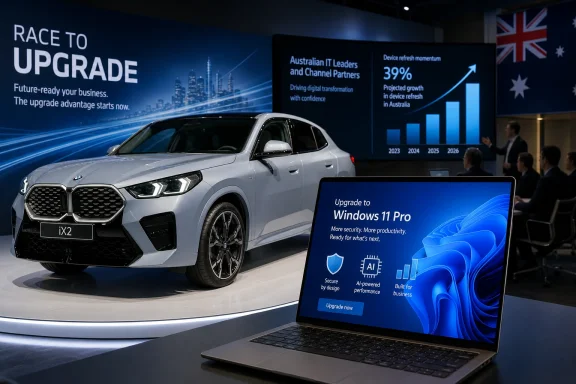 A Car Prize Makes the Channel Math Visible
There is something almost too neat about a BMW iX2 being handed over at the end of a Windows 11 upgrade campaign. It is an electric vehicle prize attached to an endpoint modernization drive, wrapped in the language of security, AI readiness, and customer transformation. The optics are obvious because they are supposed to be obvious.Partner incentive programs are rarely subtle instruments. They turn an abstract vendor priority into a spreadsheet-friendly contest: sell 50 devices, earn entries, repeat until the deadline does its work. Ingram Micro’s campaign was built around that very logic, giving partners a reason to put Windows 11 Pro devices in front of customers who might otherwise have treated the Windows 10 end-of-support date as another distant calendar warning.
Blue Connections IT winning the vehicle is the human-interest hook. The broader story is that distributors and OEMs are using the last phase of Windows 10’s lifecycle to tighten the connection between operating-system migration, hardware replacement, and AI PC positioning. That is where the economics sit.
A Windows upgrade used to be mostly a software discussion. This cycle is different because Windows 11’s hardware requirements, the post-pandemic age of many business fleets, and Microsoft’s Copilot-era ambitions have converged. For partners, that makes the conversation less about “Do you want a new OS?” and more about “How much risk are you willing to carry on old endpoints?”
Windows 10’s Deadline Became the Channel’s Opening
Microsoft ended mainstream support for most Windows 10 users on October 14, 2025. That date has been repeated so often that it risks becoming wallpaper, but in procurement terms it was a forcing function. Any organization still running unsupported Windows 10 devices after that date had to choose between migration, replacement, extended security updates, or accepting more exposure than auditors and insurers usually like.That is why Ingram Micro’s 10-month campaign landed in a commercially useful window. Running from June 2025 through March 2026, it straddled the final months before Windows 10’s end of support and the awkward after-period when laggards could no longer pretend the deadline was theoretical. The strongest upgrade campaigns do not peak on the deadline itself; they harvest the months before and after it, when IT teams are turning planning decks into purchase orders.
The channel also had a cleaner story than in some previous Windows transitions. Windows 11 was not just “the new Windows.” It was the supported Windows, the security-forward Windows, and increasingly the Windows tied to AI-era hardware branding. That gave resellers several doors into the same customer conversation.
For small and mid-sized businesses, the pitch was often operational: replace aging devices, reduce support friction, and avoid unsupported desktops. For larger customers, it became a governance conversation about fleet visibility, compliance, identity, endpoint management, and application compatibility. In both cases, the OS deadline gave partners permission to reopen accounts that might otherwise have deferred refresh decisions for another budget cycle.
The 39 Percent Figure Is Less About Windows Than Timing
Ingram Micro says the campaign helped deliver 39 percent year-on-year growth in Windows 11 Pro unit sales across calendar 2025, ahead of the broader market. Vendor and distributor metrics always deserve a little daylight; they are selected because they tell the story the company wants told. Even so, the number matters because it captures how effective deadline-driven channel motions can be when multiple vendors point in the same direction.Microsoft wanted supported Windows 11 adoption. AMD wanted modern processors in the refresh mix. Dell, HP, and Lenovo wanted device replacement cycles to accelerate. Ingram Micro wanted partners moving volume through its distribution engine. Those incentives were unusually aligned, and that alignment is what the BMW dramatizes.
The key phrase from Ingram Micro sales director Anthony Ianni was that the program was meant to move partners beyond short-term hardware refreshes and toward “meaningful discussions around modernisation.” That is classic channel language, but it is not empty. A reseller that simply quotes replacement laptops is easier to substitute than one that maps the customer’s endpoint estate, security posture, lifecycle risk, and future AI requirements.
That is the commercial shift hiding under the marketing gloss. The Windows 11 migration gave partners a reason to act less like box movers and more like advisers. Whether every partner actually did that is another matter, but the campaign rewarded the behavior distributors increasingly want: attach services, shape refresh roadmaps, and use vendor programs as a wedge into broader customer planning.
AI Readiness Is the New Refresh Justification
The phrase AI-ready endpoint devices has quickly become one of the most useful pieces of sales language in the PC market. It is broad enough to include today’s premium Windows 11 machines, specific enough to imply that older fleets are inadequate, and future-facing enough to make a three-year-old laptop feel strategically stale. That does not mean it is meaningless, but it does mean buyers should listen carefully.There are at least two AI stories running in parallel. One is the practical story of better CPUs, more memory, stronger security baselines, and endpoint designs that can handle modern collaboration and management workloads. The other is the more ambitious Copilot+ PC story, where local neural processing units and new Windows features promise a different kind of client computing.
Not every Windows 11 Pro device is a Copilot+ PC, and not every customer needs one today. That distinction matters. Windows 11 readiness, AI PC readiness, and Copilot+ qualification are related but not interchangeable, and sloppy messaging can blur them in ways that make procurement teams overbuy or misunderstand what they are getting.
Still, the direction of travel is clear. Microsoft and its hardware partners want the endpoint estate to become the place where cloud AI, local AI acceleration, identity protection, and device management meet. In that world, the PC refresh is no longer just about replacing a failing battery or a slow SSD. It becomes part of a wider argument about where work happens and how much intelligence should sit on the device itself.
The Upgrade Pitch Works Because the Risk Is Real
It is easy to mock a car giveaway attached to a Windows campaign. It is harder to dismiss the underlying risk that made the campaign work. Unsupported operating systems do not become instantly unusable the morning after support ends, but they do become harder to defend.Security teams understand this distinction. The danger is not that every Windows 10 machine explodes on October 15, 2025. The danger is that each unsupported endpoint becomes a growing exception in patch governance, vulnerability management, incident response, and cyber insurance conversations. Exceptions are tolerable when they are rare and documented; they become dangerous when they are numerous and invisible.
Microsoft’s Extended Security Updates program gives some organizations more time, but time is not the same thing as strategy. ESU is a bridge, not a destination. It can buy breathing room for critical devices, difficult applications, or budget-constrained environments, but it does not modernize hardware, improve manageability, or make an old fleet ready for the next several years of Windows development.
That is why the channel’s role matters. Customers do not just need to know that Windows 10 support ended. They need help deciding which devices can be upgraded in place, which should be replaced, which workloads can move to cloud PCs or virtual desktops, and which line-of-business applications will make the project painful. A good partner turns the deadline into a migration plan. A weak one turns it into a quote.
Hardware Requirements Turned Migration Into Segmentation
Windows 11’s hardware requirements changed the emotional texture of this upgrade cycle. In previous Windows transitions, many organizations could assume a large share of their installed base would come along with enough testing and patience. With Windows 11, older but still functional machines were often pushed into a harder category: technically useful, but not officially suitable for the next supported client OS.That created frustration for users and opportunity for the channel. A business with a mixed fleet of aging Windows 10 devices did not simply face a software deployment project. It faced a segmentation exercise: upgrade, replace, defer with ESU, repurpose, or retire. That is a more complex sale, but also a more valuable one.
The hardware angle also explains why OEMs had every reason to participate in Ingram Micro’s program. Dell, HP, and Lenovo were not merely supporting a Microsoft migration; they were competing for the refresh wave that migration unlocked. AMD’s presence similarly reflects the processor-level battle beneath the Windows 11 story, especially as AI PC messaging makes silicon capabilities more visible to buyers.
This is where endpoint refresh starts to resemble infrastructure modernization. The customer is not just buying laptops. It is choosing a baseline for security features, manageability, performance, battery life, collaboration quality, and potentially local AI acceleration. Once framed that way, the old “sweat the asset for another year” habit becomes harder to justify.
The Distributor Is Becoming the Campaign Architect
Ingram Micro’s role in this story is worth lingering on because distributors are often treated as the plumbing of the technology industry. They move product, extend credit, manage logistics, and support partner ecosystems. But campaigns like Race to Upgrade show how distribution has become more strategic in vendor-led market shifts.A distributor sits in a useful middle position. Microsoft can set the platform agenda, OEMs can build the hardware, and partners can manage customer relationships, but someone still has to package the incentive, coordinate the vendors, track performance, and keep thousands of sales conversations pointed in roughly the same direction. That is where distribution earns its margin.
The BMW prize is just the visible reward mechanism. The more important machinery is partner enablement: giving resellers talking points, campaign structure, device options, and a reason to revisit customers before competitors do. In a market where many businesses delayed refresh spending after the pandemic boom, that structure matters.
This is also why the campaign’s “race” branding is more than decorative. Windows 10 end of support created a race against technical debt. The channel version of that race was a contest to see which partners could convert urgency into pipeline before the deadline passed and customer attention shifted elsewhere.
Blue Connections’ Win Is a Local Marker in a Global Migration
Blue Connections IT’s prize win is specifically an Australian channel story, but the conditions behind it are global. Windows 10’s retirement did not respect national borders. Every Microsoft partner ecosystem, from Australia to North America to Europe, had to contend with the same broad customer problem: millions of devices were aging out of the supported Windows mainstream.Australia’s business technology market has its own rhythms, budgets, and procurement cycles, but the Windows 11 migration sits inside a wider international refresh. Hybrid work left many organizations with fleets that were both distributed and unevenly managed. Security pressure increased. AI messaging arrived before many companies had finished standardizing their endpoint estates. The result was a messy but commercially powerful convergence.
For a partner such as Blue Connections IT, success in a program like this is not just about selling enough devices to win a draw. It indicates that the company was active in the kind of customer conversations vendors now prize: Windows 11 Pro, modern endpoint security, hardware lifecycle planning, and future workplace capability. The prize is random; the qualification path is not.
That distinction is important because channel contests can look frivolous from the outside. The mechanics may be gamified, but the work they are trying to provoke is real. Someone has to move customers through assessment, procurement, deployment, user disruption, and post-migration support. The partner community is where much of that labor lands.
The Customer Should Still Separate Urgency From Upsell
The strongest buyer response to programs like this is neither cynicism nor blind acceptance. It is disciplined skepticism. Windows 10 end of support was real, and Windows 11 migration is prudent for most organizations. But not every refresh needs to be premium, not every user needs an AI PC, and not every vendor roadmap should become a customer’s purchasing policy.The practical starting point is inventory. Organizations need to know which devices are still on Windows 10, which meet Windows 11 requirements, which are business-critical, and which are simply forgotten assets that reappear only when auditors ask awkward questions. Without that baseline, refresh campaigns can become reactive spending.
The next step is persona-based planning. Executives, developers, frontline staff, designers, call-center workers, and field employees do not all need the same endpoint. AI-readiness may be sensible for some roles and premature for others. Windows 11 Pro may be the right baseline, but hardware tiers should still follow workload reality.
Finally, customers should be wary of treating ESU as a way to avoid decisions indefinitely. Extended security updates can be a legitimate tool for phased migration, especially where application testing or supply constraints are real. But they should live inside a documented exit plan. Otherwise, they become a subscription to procrastination.
The Prize Was Flashy Because the Market Needed Motion
The most revealing thing about Ingram Micro’s campaign is not that it used a major prize. It is that a major prize made sense. The Windows ecosystem needed motion at precisely the moment when many customers had reasons to hesitate: budget pressure, Windows 11 familiarity concerns, application dependencies, and uncertainty about how seriously to take the first wave of AI PC messaging.Incentives help cut through that hesitation. They do not eliminate the hard work of migration, but they sharpen the attention of the partner salesforce. In a channel model, attention is currency. Vendors can publish lifecycle notices forever, but a distributor-backed campaign can turn those notices into calls, workshops, quotes, and deployments.
There is a risk here too. When urgency is overused, it becomes noise. Windows 10’s end of support was a legitimate deadline, but AI readiness is a more fluid concept. If every device is sold as urgently necessary for an AI future that remains unevenly distributed across real workplaces, customers will eventually discount the message.
The best partners will avoid that trap. They will use the Windows 10 deadline as the reason to clean up the estate, then use AI readiness as a planning lens rather than a blanket upsell. That is a subtler sale, but it is also more durable.
The BMW Is Gone, but the Endpoint Bill Is Still Coming Due
Ingram Micro’s campaign ended with a vehicle handover, but the larger Windows transition is still working its way through IT estates. For organizations that used 2025 to modernize, the next challenge is extracting value from the refresh rather than merely celebrating compliance. For those still carrying Windows 10 exceptions, the problem is no longer theoretical.The concrete lessons are refreshingly plain:
- Windows 10’s end of support turned endpoint modernization into a risk-management issue, not merely a desktop engineering task.
- Ingram Micro’s 39 percent Windows 11 Pro unit growth claim shows how strongly a coordinated channel campaign can amplify a platform deadline.
- Blue Connections IT’s prize win is less important than the sales behavior the contest rewarded: repeatable customer conversations around lifecycle, security, and modernization.
- AI-ready PC messaging is useful only when buyers distinguish ordinary Windows 11 readiness from higher-end Copilot+ and NPU-based hardware requirements.
- Extended Security Updates can buy time for difficult migrations, but they should not become a substitute for a documented replacement plan.
Source: ARNnet Blue Connections IT wins BMW in Ingram Micro’s Windows 11 upgrade drive - ARN
