

 Instacart Users Report Fresh Problems After Three Days of Earlier Outages
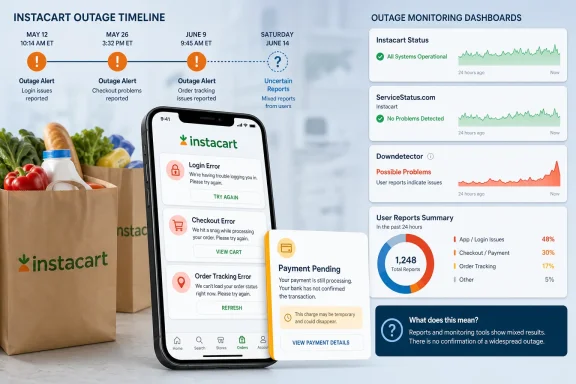
Instacart users reported fresh access problems across the United States on Saturday morning after three documented outages from July 2 through July 4 disrupted logins, ordering, delivery tracking, and payments. The answer as of Saturday afternoon was clear but qualified: the new reports were real, yet Instacart had not declared an active incident and major monitoring services had not confirmed another large-scale outage. Saturday’s scope and cause therefore remained unclear.What Customers and Shoppers Should Do Now
If Instacart fails during checkout, order tracking, or delivery, the safest response is to preserve evidence and avoid creating a second transaction while the first remains unresolved.For customers
- Check the order history first. Look for a new order, an existing order whose status has changed, or an order that appears pending even if checkout displayed an error.
- Review confirmation emails and notifications. An email, text message, push notification, or receipt may show that an order was accepted even when the app failed to display confirmation.
- Inspect payment activity. Check the payment method used for pending or completed activity, but remember that a pending entry alone may not establish whether the order was completed.
- Do not submit the same order again until the first attempt is resolved. Repeating checkout while the original transaction remains ambiguous can create duplicate orders or additional payment confusion.
- Save screenshots and order IDs. Capture error messages, order status, timestamps, confirmation numbers, and relevant payment activity.
- Contact official Instacart support if the order or payment remains ambiguous. Provide the order ID, approximate checkout time, store, total, and screenshots rather than relying on repeated attempts to fix the transaction.
For shoppers
Shoppers should preserve screenshots, timestamps, receipts, order identifiers, and any available delivery evidence when an app problem interrupts a live workflow. Avoid assuming that an on-screen error means the platform recorded nothing. Use official Instacart support channels for unresolved order status or account issues and retain a record of each support attempt.The immediate objective is not to diagnose the infrastructure. It is to establish what Instacart recorded, prevent duplicate actions, and preserve enough information for support to reconcile the transaction later.
Saturday’s Reports Did Not Yet Amount to a Confirmed Large-Scale Outage
The latest alarm began with social-media reports Saturday morning and a post from the outage-tracking account @status_is_down asking whether followers were also experiencing problems. International Business Times Australia reported that the scale and cause remained unclear around midday.IsDown supplied the clearest counterweight to the social-media alarm. The monitoring service considered Instacart generally operational and said reports received during the preceding 24 hours remained within the normal range rather than indicating a broader failure.
Instacart’s official status page also showed no active company-acknowledged incident as of Saturday afternoon. The company had not issued a public statement addressing the complaints highlighted by @status_is_down.
The core finding is therefore straightforward: users were reporting genuine problems Saturday, but no confirmed large-scale outage had been declared by Saturday afternoon. The reports deserved attention because they followed three recent disruptions, not because the available evidence established that Instacart was unavailable throughout the country.
Three Outages in Three Days Raised the Level of Concern
Saturday’s complaints carried additional weight because they followed a concentrated series of earlier incidents affecting central parts of the Instacart experience.GV Wire reported that more than 2,000 users submitted reports during the July 2 disruption, based on Downdetector data. Access and login problems dominated those complaints, placing the failure at the entry point to the service.
AOL described another widespread interruption on July 3, when more than 1,800 reports had accumulated by late morning. It characterized the incident as a second consecutive day of widespread access trouble.
FingerLakes1.com reported another outage on July 4. Reported customer symptoms included an inability to log in, place orders, check delivery status, or complete payments.
Downdetector totals should not be interpreted as a census of every affected customer. They represent reports voluntarily submitted by users, and the totals can be influenced by awareness, location, time of day, and whether people know where to report a problem. A sudden increase can nevertheless show that an issue is shared rather than confined to one account, device, or household.
The documented report spikes on July 2 and July 3, followed by the broader set of customer-facing problems reported on July 4, established a meaningful pattern of instability. They did not establish that all three incidents had the same root cause.
Timeline
July 2: More than 2,000 users reported Instacart problems, according to Downdetector data cited by GV Wire. Access and login failures were the dominant complaints.July 3: More than 1,800 reports had accumulated by late morning, according to AOL, marking a second consecutive day of widespread access issues.
July 4: FingerLakes1.com reported that customers were unable to log in, place orders, check delivery status, or complete payments.
Saturday morning: @status_is_down highlighted another round of user complaints and asked followers whether they were also experiencing problems.
Saturday afternoon: Instacart’s status page showed no active incident, IsDown considered the service generally operational, and major monitoring services had not confirmed a large-scale outage.
The sequence does not prove that one defect persisted from July 2 onward. Similar user-facing symptoms can come from separate incidents, and the available reporting does not provide the technical detail needed to connect them.
What the sequence does establish is that users encountered recurring trouble in essential workflows over a short period. That makes fresh reports more significant than an isolated complaint, even when the latest event has not crossed the threshold for formal confirmation.
What Was Actually Reported
The verified effects were concentrated in core customer functions:| Platform area | Verified reported symptom | Immediate user risk |
|---|---|---|
| Account access | Customers reported login and access failures | Users could not reliably reach account or order information |
| Ordering | Customers reported being unable to place orders | Groceries could be delayed, and repeated attempts could create confusion |
| Delivery tracking | Customers reported being unable to check delivery status | Users could not determine whether an existing order was still progressing |
| Payments | Customers reported problems completing payments | The result of a checkout attempt could remain uncertain |
| Public incident communication | No active Instacart incident was displayed Saturday afternoon | Users had limited official information about the new reports |
That distinction is important because an outage report should not become a vehicle for adding unverified allegations. The absence of technical detail may be frustrating, but it does not justify filling the gaps with assumptions about internal architecture or individual account outcomes.
AWS Reports Provide Context, Not a Confirmed Cause
Outage.report connected discussion of earlier Instacart disruptions with reports involving Amazon Web Services. That provides relevant context, particularly when multiple online services experience trouble around the same period.It does not prove that AWS caused each Instacart incident, nor does it identify which dependency, if any, produced the reported symptoms. The available facts do not establish a precise architecture, cloud region, failed component, or chain of technical events.
The careful conclusion is that AWS-related reports were part of the discussion surrounding the earlier outages. Any stronger claim about causation would require confirmation from Instacart, AWS, or a credible technical incident report.
This distinction also applies to individual symptoms. A payment failure, login problem, or frozen order status can indicate a broader platform incident, but the symptom alone does not identify the underlying provider or component.
Short Analysis: How to Interpret Conflicting Signals
A green status page, normal tracker reading, and individual user complaints can appear contradictory. In practice, they answer different questions.A user report establishes that a person encountered a problem. A burst of consistent reports can indicate that the issue is shared. A monitoring service determines whether available evidence exceeds its standard for identifying an incident. A company status page shows incidents the company has chosen to acknowledge publicly.
For readers, the useful approach is to focus on corroboration:
- Are unrelated users reporting the same symptom at approximately the same time?
- Is report volume clearly rising rather than remaining at its usual level?
- Are multiple major monitoring services showing a disruption?
- Has Instacart posted an incident notice?
- Are reports focused on a common workflow such as login, checkout, or order tracking?
Status Pages and Trackers Need Careful Reading
The various public sources involved in outage coverage should not be treated as interchangeable.Downdetector data was cited in reports about the July 2 and July 3 incidents. Those user-submitted totals were useful for showing a sharp concentration of complaints, but they did not reveal the full number of affected users or the technical cause.
IsDown considered Instacart generally operational during the 24-hour period surrounding Saturday’s fresh reports. It also listed three Instacart incidents during the preceding 90 days and gave a median incident duration of approximately one hour and 17 minutes.
Those figures describe IsDown’s recorded incident history. They do not establish the severity of every incident, the exact experience of every user, or a common cause connecting the events.
Social-media posts can provide early warnings, particularly when users describe similar failures at the same time. They can also lack context, repeat earlier information, or magnify isolated account and device problems. They are most useful when other sources begin to corroborate them.
Instacart’s status page is the company’s public record of acknowledged incidents. Its green state Saturday afternoon meant that Instacart had not declared an active incident there. It did not convert every complaint into user error, but it prevented the available reports from supporting a definitive large-scale outage declaration.
The most reliable conclusion comes from comparing these sources without assigning any one of them more certainty than it provides.
Why Order and Payment Ambiguity Matters Most
An app that refuses to open presents an obvious problem. An app that accepts an action but fails before clearly displaying the result presents a more complicated one.Consider a customer who submits an order and sees an error instead of a confirmation screen. Several outcomes may remain possible from the customer’s perspective:
- The order may not have been created.
- The order may exist even though the confirmation screen failed.
- A notification or email may have been generated while the app remained unresponsive.
- Payment activity may appear before the customer can confirm the order’s final status.
The same principle applies after an order has been placed. If delivery tracking stops updating, the customer should not assume that the order has been canceled or abandoned. Save the visible status and order ID, monitor official notifications, and contact support if the ambiguity persists.
This guidance does not require a confirmed platform-wide outage. It protects customers during individual account problems, retailer-specific disruptions, payment errors, or a broader Instacart incident.
The July Pattern Also Highlights a Communication Gap
Instacart had not publicly acknowledged the Saturday reports through an active status-page incident by Saturday afternoon. That may mean the company found no broad incident, was still evaluating the complaints, or did not consider the event large enough to post publicly. The available facts do not distinguish among those possibilities.For users, however, the result was the same: limited official guidance at a moment when recent outages made new complaints more credible.
An effective early incident message does not have to claim that the entire service is down. A company can say that it is investigating reports involving a specific function, advise customers not to repeat uncertain orders, and promise an update when the scope becomes clearer.
That kind of communication would be particularly valuable when checkout and payments are involved. Users need practical direction before the technical cause is known. Telling them to verify order history, preserve confirmation details, and avoid duplicate submissions can reduce the harm from an ambiguous transaction.
Post-incident communication would also help distinguish separate outages from a continuing problem. Without a public explanation, users may reasonably perceive a series of similar incidents as one unresolved period of instability, even if the technical causes differ.
Customers and Administrators Need Evidence More Than Speculative Fixes
Basic troubleshooting remains useful when a problem appears isolated. Customers can test another network, reopen the app, check for an update, or try the website. Those steps can help determine whether the issue is limited to one device or connection.Once an order or payment has been attempted, the priority should shift. Reinstalling an app or repeatedly restarting a transaction may obscure what happened without resolving the underlying ambiguity. The user should first preserve the current screen, record the time, and check whether Instacart generated an order or confirmation.
Retail and IT administrators may encounter an Instacart-related problem through customer complaints, failed transactions, or delayed fulfillment before a public incident is declared. Their task is to document what failed and prevent uncertain requests from being submitted repeatedly.
Action checklist for admins
- Confirm whether the reported failure involves account access, ordering, delivery tracking, payments, or more than one customer workflow.
- Record exact timestamps, error messages, affected stores, payment types, order identifiers, and the device or connection used.
- Determine whether the failure can be reproduced from a separate device or network without resubmitting an uncertain order.
- Check Instacart’s official status page and at least one major independent monitoring service.
- Preserve local transaction evidence even when public dashboards show normal service.
- Warn support and store teams not to repeatedly resubmit orders or payments whose original status remains unclear.
- Save confirmation emails, receipts, screenshots, payment records, and fulfillment information needed for reconciliation.
- Escalate unresolved order and payment issues through official Instacart support or established partner-support channels.
- After service normalizes, review incomplete orders, duplicate attempts, payment exceptions, and delayed deliveries.
What the Available Evidence Does and Does Not Establish
The reporting supports several firm conclusions.First, Instacart experienced three documented disruptions from July 2 through July 4. The first two generated report totals exceeding 2,000 and 1,800, respectively, according to news coverage citing Downdetector. The July 4 reporting included login, ordering, tracking, and payment problems.
Second, users raised fresh complaints Saturday morning. The complaints were significant enough for @status_is_down to highlight them and for International Business Times Australia to report on the uncertainty surrounding their scale and cause.
Third, Saturday’s reports had not developed into a confirmed large-scale outage by the afternoon. Instacart’s status page showed no active incident, IsDown considered the platform generally operational, and no major monitor had provided the corroboration necessary for a stronger declaration.
The evidence does not establish that every reported incident shared one cause. It does not prove that AWS caused the Instacart failures. It does not reveal the company’s precise architecture or identify a failed technical component. It also does not support adding unverified claims about shopper account actions, support-ticket failures, retailer systems, or internal risk controls.
Keeping those boundaries clear makes the outage update more useful. Readers need to know what happened, what remains uncertain, and what actions can protect an order or payment. They do not benefit from technical narratives that go beyond the reported facts.
Instacart’s Immediate Reliability Challenge Is User Confidence
The three earlier outages and Saturday’s fresh reports create a trust problem even without confirmation of another broad failure. Customers need confidence that an order submitted once will be recorded once, that its status will remain visible, and that payment activity can be matched to an identifiable transaction.When that confidence weakens, users may repeat actions, abandon an order that actually exists, or spend additional time trying to determine whether groceries are still coming. The operational problem can therefore outlast the visible interruption.
Instacart can limit that damage through prompt, specific communication. An investigation notice, even before the cause is known, can tell users which functions may be affected and what not to do. A resolution notice can explain whether customers need to review orders or payment activity. A later incident summary can clarify whether closely timed disruptions were connected.
Until Instacart provides that level of confirmation, Saturday’s event should remain described according to the evidence: a fresh cluster of user-reported problems following three documented July outages, but not a confirmed large-scale outage as of Saturday afternoon.
What to Watch Next
Three developments would justify upgrading the report:- An Instacart incident notice acknowledging a service disruption or identifying affected functions.
- Corroboration from major outage monitors showing a clear and sustained rise beyond normal report levels.
- A clear spike in consistent user reports describing the same failures across multiple locations and independent accounts.
References
- Primary source: International Business Times Australia
Published: 2026-07-11T16:50:08.288292
Is Instacart Down Today? Users Nationwide Report App and Website Outages Amid a String of Recent Disruptions
Instacart users report ongoing outages, with recent disruptions linked to AWS issues. Users face difficulties accessing the app, raising concerns about the platform's reliability and cloud dependency.www.ibtimes.com.au - Related coverage: aol.com
Users reporting problems with Instacart this morning. What we know - AOL
According to Downdetector, Instacart users began complaining about the app shortly after 3 a.m., June 2, and problems persisted after.www.aol.com - Related coverage: docs.instacart.com
Instacart Enterprise Technical Support | Instacart Docs
The Instacart Enterprise Technical Support team supports Instacart's enterprise customers. Enterprise customers are retailers, partners, and advertisers who use Instacart Enterprise technologies in their e-commerce solutions. The Instacart Enterprise Technical Support team handles technical...docs.instacart.com
- Related coverage: chshyd.in
Instacart Down Today Users Report App and Website Outage Issues
Instacart Down reports are rising as users experience app and website issues affecting orders checkouts and grocery deliveries across regions.chshyd.in - Related coverage: boyx.in
Is Instacart Down Right Now? Outage Updates, What's Happening and When It'll Be Fixed - BoyX
Instacart is down for the second day in a row. Over 1,800 Downdetector reports on July 3 as the app, checkout and shopper app fail for users. Here's what's happening, why, and what to do right now. boyx.in
- Related coverage: entireweb.com
- Related coverage: downforeveryoneorjustme.com
Is Instacart down? Live status and problems past 24 hours
Live problems for Instacart. Error received? Down? Slow? Check what is going on. downforeveryoneorjustme.com
- Related coverage: shoppers.instacart.com
Instacart
Shop and deliver groceries and everyday essentials with Instacart. Set your own schedule, be a household hero, and earn money quickly. Get started with your application to be an Instacart shopper today.shoppers.instacart.com - Related coverage: gvwire.com
Instacart Down for Thousands of Users, Downdetector Reports - GV Wire
Instacart is experiencing widespread outages, affecting thousands of users. Learn more about the reported issues.gvwire.com - Related coverage: instacart.gcs-web.com
- Related coverage: techradar.com
Yahoo and AOL mail suffered hours of outage – here's how it played out | TechRadar
It appeared that users couldn't access their emails for some four hourswww.techradar.com - Related coverage: tomsguide.com
Yahoo Mail and AOL were down for thousands — live updates on the outage | Tom's Guide
You don't have mail! Here's the latest on Yahoo being downwww.tomsguide.com - Related coverage: itpro.com
Amazon Web Services outage live: Hundreds of apps including Slack, mobile carriers, banking services down
Web users globally have been impacted by an outage at Amazon Web Services - keep tabs on all the latest updates in our rolling live coveragewww.itpro.com - Related coverage: aws.amazon.com
Mitigating Bot Traffic Using AWS Edge Services with Instacart
Online grocery marketplace Instacart deployed Amazon CloudFront, AWS WAF, and AWS Shield Advanced to increase stability and security for its website and mobile app.aws.amazon.com
- Related coverage: instacart.com
Instacart Terms
Order delivery or pickup from more than 300 retailers and grocers. Download the Instacart app now to get groceries, alcohol, home essentials, and more delivered in as fast as 1 hour to your front door or available for pickup from your favorite local stores.www.instacart.com
- Related coverage: company.instacart.com
Instacart Company | Instacart Developer Platform
Full-stack end-to-end fulfillment technologies to power pickup and delivery in as fast as 1-hour—whether you’re on the Instacart platform or not.company.instacart.com - Related coverage: fingerlakes1.com
- Related coverage: investors.instacart.com

ALDI U.S. Debuts New Nationwide Digital Experience Using Instacart's Enterprise Technology | Instacart
The upgraded website and app deliver a simpler online shopping experience for ALDI customers nationwide Instacart is now the exclusive fulfillment partner across aldi.us and the ALDI app SAN FRANCISCO and BATAVIA, Ill., March 30, 2026 /PRNewswire/ -- Instacart (Nasdaq: CART), the leading grocery
investors.instacart.com