

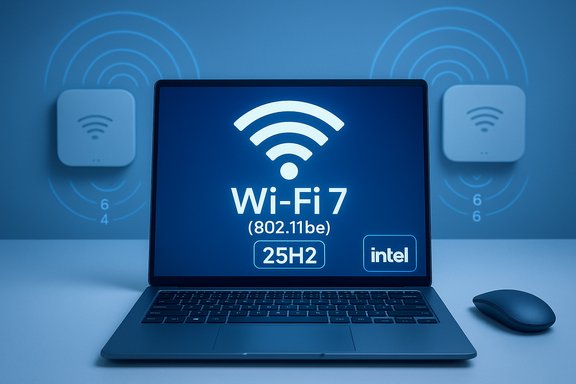
Intel has quietly published new unified wireless packages — Intel Wireless Wi‑Fi Drivers and Intel Wireless Bluetooth Drivers, version 23.170.0 — and both are now validated to support Windows 11, version 25H2, bringing client‑side readiness for Wi‑Fi 7 enterprise features, updated Bluetooth functionality, and refinements to Windows’ Wi‑Fi sensing behavior.
Windows 11’s 25H2 release is an enablement-style update that activates platform features already staged in the servicing branch. One of the platform-level capabilities Microsoft prepared for 25H2 is native readiness for Wi‑Fi 7 (802.11be / EHT), but OS-level readiness is only half the equation: endpoint vendors and driver stacks must supply matching client drivers to make the new wireless features usable on real devices. Intel’s 23.170.0 packages are the vendor-supplied client drivers that align the endpoint side of the stack with Microsoft’s platform changes.
Why that matters: Wi‑Fi 7 promises higher aggregate throughput, lower latency, and better reliability through features such as Multi‑Link Operation (MLO) and expanded channel widths, but the technology requires the full ecosystem — OS, driver, firmware, and access point (AP) — to be in sync. Intel’s 23.170.0 validation for Windows 11 25H2 is a necessary step in that path.
(Release and package details referenced above are available in Intel’s driver download pages and release‑note PDFs; independent reporting and community threads have documented the 23.170.0 rollout and the 25H2 validation.
Source: Neowin Intel releases new Wi-Fi and Bluetooth drivers with Windows 11 25H2 support
 Background / Overview
Windows 11’s 25H2 release is an enablement-style update that activates platform features already staged in the servicing branch. One of the platform-level capabilities Microsoft prepared for 25H2 is native readiness for Wi‑Fi 7 (802.11be / EHT), but OS-level readiness is only half the equation: endpoint vendors and driver stacks must supply matching client drivers to make the new wireless features usable on real devices. Intel’s 23.170.0 packages are the vendor-supplied client drivers that align the endpoint side of the stack with Microsoft’s platform changes.Why that matters: Wi‑Fi 7 promises higher aggregate throughput, lower latency, and better reliability through features such as Multi‑Link Operation (MLO) and expanded channel widths, but the technology requires the full ecosystem — OS, driver, firmware, and access point (AP) — to be in sync. Intel’s 23.170.0 validation for Windows 11 25H2 is a necessary step in that path.
What Intel shipped in 23.170.0
The packages at a glance
- Intel Wireless Wi‑Fi Drivers — 23.170.0
- Described by Intel as validated to support Microsoft Windows 11, version 25H2.
- Adds client‑side support needed to interoperate with Wi‑Fi 7 enterprise access points, including support for features introduced or enabled by the OS update (MLO/EHT and native Wi‑Fi sensing support where applicable).
- Includes drivers for a broad line of Intel adapters (Wi‑Fi 7, Wi‑Fi 6E/6, and many legacy Wireless‑AC modules).
- Intel Wireless Bluetooth Drivers — 23.170.0
- Also validated for Windows 11 25H2 and described as containing functional updates intended to improve performance and stability across supported adapters.
Supported adapters (high‑value list)
Intel’s packages continue the consolidated approach (one package supporting modern BE2xx Wi‑Fi 7 hardware alongside Wi‑Fi 6/6E and many older cards). Notable families included in the 23.170.x line are:- Intel Wi‑Fi 7: BE202, BE201, BE200
- Intel Wi‑Fi 6E: AX411, AX211, AX210
- Intel Wi‑Fi 6: AX203, AX201, AX200, AX101
- Legacy Intel Wireless‑AC: 9560, 9461/9462, 9260
What’s actually new (feature breakdown)
Wi‑Fi 7 support and enterprise readiness
Wi‑Fi 7 (IEEE 802.11be, a.k.a. Extremely High Throughput / EHT) is defined by a set of features intended to raise local network throughput and lower latency. The most important for enterprise deployments are:- Multi‑Link Operation (MLO) —allows concurrent use of multiple links across bands (2.4 / 5 / 6 GHz) to increase capacity, balance load, and reduce latency.
- Wider channel widths and higher modulation (up to 320 MHz contiguous channels and higher QAM rates) — increases theoretical peak throughput.
- Improved scheduling and resource allocation—helps in high‑density scenarios and enterprise WLANs.
- A Wi‑Fi 7‑capable adapter (BE2xx family),
- A Wi‑Fi 7 enterprise AP that supports MLO and enterprise roaming, and
- Mature firmware and controller/AP configurations from the AP vendor.
Native Wi‑Fi sensing
Windows has been incrementally adding Wi‑Fi sensing features — low‑power background presence and motion detection using radio signatures — and Intel’s driver notes indicate updates that add or refine native Wi‑Fi sensing support. That is likely to improve how quickly Windows surfaces nearby networks and may affect background scan behavior that powers certain contextual features. These improvements were part of prior Intel driver updates as well and appear again in 23.170.0.Bluetooth functional updates
The Bluetooth 23.170.0 package is described as including functional and stability updates, without a long list of consumer‑visible features. Historically, Bluetooth releases fix pairing edge cases and performance regressions and occasionally recommend unpairing/re‑pairing sequences for specific legacy cards during a major version transition. Intel’s support pages and release notes continue to advise caution and provide adapter‑specific instructions when needed.Verification: What the release notes and external reporting confirm
- Intel’s release notes and download center explicitly list the 23.170.x packages and state that the Wi‑Fi driver has been validated for Windows 11 25H2 and that Wi‑Fi 7‑family adapters (BE2xx) are included.
- Independent enthusiast and trade outlets that track Intel driver rollouts have mirrored Intel’s public notes and confirmed the 25H2 validation and the presence of BE2xx device support in the package. These secondary reports provide corroboration beyond Intel’s own pages.
- Community discussion and forum indexing show WHQL and package-level metadata with a release date and the 23.170.0 version string, consistent with Intel’s published assets.
Practical guidance: how to manage adoption
For single‑machine power users
- Confirm your adapter model: Settings → Network & Internet → Wi‑Fi → Hardware properties. If you have a BE2xx adapter and you’re running Windows 11 25H2, 23.170.0 is the Intel package that exposes Wi‑Fi 7 features on the client side.
- Prefer the Intel Download Center or the Intel Driver & Support Assistant for detection + install unless your OEM strongly recommends the vendor‑supplied driver. Intel’s assistant can simplify matching the correct package.
- Create a system restore point and note the current driver version in Device Manager (Properties → Driver tab) before updating, in case you need to roll back.
- Reboot and verify functionality: verify Wi‑Fi connectivity, Bluetooth pairing state, and any new OS features (for Wi‑Fi 7, check AP-side MLO settings and ensure AP firmware is current).
For IT admins and enterprises
- Pilot first: deploy to a representative ring of devices (diverse hardware models, endpoint security agents, and network configurations).
- Check OEM guidance: many OEMs ship OEM‑customized wireless stacks. Installing Intel’s vanilla packages on managed devices can remove vendor customizations or break OEM utilities. Intel itself recommends working with the device manufacturer when appropriate.
- Install method:
- For single machines: use the Intel installer package.
- For mass deployment: use the IT administrator ZIP packages or distribution bundles (Intel PROSet/PROSet for IT Admins) and standard deployment mechanisms (SCCM/Intune). Intel publishes driver‑only packages for IT distribution.
- Validation checklist:
- Confirm driver and firmware versions on BE2xx endpoints.
- Validate AP firmware and controller code — MLO and enterprise roaming benefits are realized only when APs and controllers support the necessary features.
- Test in a high‑density or latency‑sensitive scenario to detect behavioral regressions (e.g., roaming, power management).
- Rollback plan: retain the OEM driver package or the previously validated driver; ensure the Windows rollback window and image restore options are available in your recovery plan. Intel and community guidance has long recommended keeping OEM backups handy.
Risks, community reports, and mitigation
Early teething issues are common
Large wireless driver rollouts that coincide with OS enables often generate mixed telemetry in the wild. Community and early‑adopter reports in discussion forums and user sites show both smooth installs and isolated regressions — most commonly:- Bluetooth pairing regressions or device‑specific disconnects after upgrades.
- Rare crashes or instability in driver subversions that impact particular card models and platforms.
- Windows Update occasionally rolling drivers back if it detects instability on a device.
OEM compatibility and feature parity
- OEM‑provided drivers may include firmware blobs, vendor‑specific power management tweaks, or diagnostic utilities — replacing them with Intel’s generic packages can remove those customizations and, in some cases, cause functional regressions on OEM hardware. Intel’s pages and release notes explicitly recommend checking with the OEM before swapping drivers on factory systems.
Wi‑Fi 7 expectations vs. reality
- Home consumers: most home networks will not see an immediate internet‑link speed difference after updating drivers; home broadband or router backhaul is usually the limiting factor. Wi‑Fi 7 delivers its clearest gains for local high‑bandwidth device‑to‑device use and dense enterprise deployments with high‑quality APs and controllers.
- Enterprise rollouts: vendors vary in how they implement MLO and scheduling features. Thorough lab validation is essential before enabling Wi‑Fi 7 features in a production WLAN.
Step‑by‑step: recommended technical validation (for IT teams)
- Inventory endpoints to identify adapter models (PowerShell or management tool):
- Quick manual check: Settings → Network & Internet → Wi‑Fi → Hardware properties.
- Scripting (example): use your inventory agent or PowerShell to enumerate PnP devices and driver versions; ensure BE2xx devices are clearly flagged for testing.
- Confirm OS baseline: ensure test devices are fully patched and on Windows 11 25H2 (or have the 25H2 enablement package applied).
- Download 23.170.0 release notes and SHA256 hash from Intel’s download center and verify checksum prior to deployment.
- Pilot install: apply the driver to a small ring via Intel’s driver installer or your managed package; verify:
- Wi‑Fi connectivity (speed, roaming, MLO link establishment if AP supports it),
- Bluetooth pairing stability (audio and HID devices),
- Power management (suspend/resume behavior).
- Telemetry & rollback: monitor telemetry, helpdesk tickets, and automated watchdogs; if you see regression, revert to the known‑good OEM or prior driver image using your standard rollback process.
Strengths and notable benefits
- Consolidated driver package: Intel’s single‑package approach simplifies distribution and ensures modern and many legacy adapters are supported by the same maintenance cadence.
- Platform alignment: Validation against Windows 11 25H2 removes an important barrier for enterprises wishing to test and adopt Wi‑Fi 7 on client endpoints.
- Incremental feature rollout: Improvements like refined Wi‑Fi sensing and Bluetooth functional fixes are practical, incremental wins that reduce day‑to‑day friction for users and IT.
Cautions and unresolved items
- Ecosystem dependency: Real Wi‑Fi 7 value depends on AP/controller support (MLO implementation), which is uneven across vendors and firmware versions. Don’t assume instant, full‑stack benefits after a client driver update.
- Possible adapter‑specific quirks: Intel’s historical upgrade notes sometimes recommend unpairing Bluetooth devices for certain legacy cards when jumping across major Bluetooth driver versions. Read the adapter‑specific notes in the release PDF before broad deployment.
- OEM constraints: Replacing OEM drivers with Intel vanilla packages can remove vendor‑specific features and lead to unsupported configurations on factory devices — check OEM guidance first.
- Early community reports: monitor forums and your support channels for first‑wave regressions; be prepared to pause or roll back in mid‑deployment if a pervasive problem emerges.
Final takeaways and actionable checklist
Intel’s 23.170.0 Wi‑Fi and Bluetooth driver bundles are the practical client‑side ingredient needed to unlock Windows 11 25H2’s Wi‑Fi 7 readiness on compatible hardware — an important milestone for enterprises planning to evaluate next‑gen WLAN architectures. However, the update is one piece in a larger puzzle: AP firmware, controller code, and rigorous validation remain essential to harvest the promised throughput, latency, and reliability gains of Wi‑Fi 7. Actionable checklist:- Verify adapter models and make a list of BE2xx endpoints.
- Pilot 23.170.0 on a small, representative device ring (including mixed OEM models).
- Coordinate with AP/controller vendors to align firmware levels that support MLO and enterprise roaming.
- Keep OEM driver packages and a tested rollback plan available before mass deployment.
- Monitor user reports closely during the first weeks after deployment and be ready to roll back if instability appears.
(Release and package details referenced above are available in Intel’s driver download pages and release‑note PDFs; independent reporting and community threads have documented the 23.170.0 rollout and the 25H2 validation.
Source: Neowin Intel releases new Wi-Fi and Bluetooth drivers with Windows 11 25H2 support
