

Intel and AMD are being pulled into a new supply squeeze in mid-2026 as agentic AI workloads increase demand for server CPUs, turning what looked like a GPU-and-memory boom into a broader data-center compute shortage. The important shift is not that CPUs have suddenly become fashionable again; it is that AI systems are becoming more operational, more distributed, and more dependent on general-purpose orchestration. That makes the shortage less like a cyclical PC parts crunch and more like a warning about the shape of the next AI infrastructure buildout. If the first phase of the AI race was about buying enough accelerators, the second is about whether the rest of the server can keep up.
For most of the generative AI era, the market story has been easy to tell: Nvidia sold the scarce thing, memory makers sold the next-scarcest thing, and everyone else fought for relevance around the edges. CPUs were present in every AI server, of course, but they rarely got the valuation premium or supply-chain panic attached to GPUs, HBM, or advanced packaging.
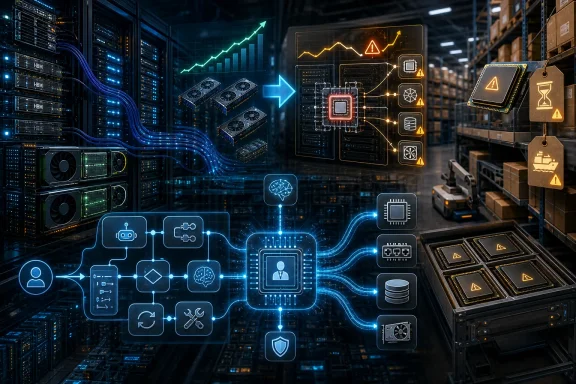
That framing is now too simple. Agentic AI changes the server from a box that feeds tensors into accelerators into a system that coordinates tools, calls APIs, routes work, evaluates outputs, manages memory, schedules tasks, and keeps a long-running workflow alive. A GPU may still do the most glamorous arithmetic, but the CPU increasingly acts as the executive layer that makes the workload useful.
This is why the CPU shortage story matters to WindowsForum readers even if most of the immediate pressure is in hyperscale data centers. Enterprise AI deployments do not live in a vacuum. They shape server procurement, cloud pricing, workstation refresh cycles, OEM roadmaps, and eventually the availability and pricing of high-end silicon across the stack.
The Chosunbiz report captures the right market anxiety: the memory crunch has been obvious because prices move quickly, while CPU scarcity is easier to miss until lead times stretch and procurement teams start asking for multi-year commitments. That delayed visibility is exactly what makes this moment dangerous. By the time a CPU shortage is visible to ordinary buyers, the largest customers have usually already locked up much of the capacity.
Training workloads rewarded dense accelerator utilization. If the goal was to keep thousands of GPUs fed during a massive pretraining run, the CPU could be relatively modest compared with the accelerator budget. Inference and agent workloads are messier. They involve branching, small jobs, orchestration overhead, security boundaries, network calls, storage interaction, and business logic that does not map neatly onto a GPU.
That does not make the GPU less important. It makes the GPU less alone. An AI rack built for agents needs high-bandwidth memory, fast networking, storage, accelerators, and CPUs capable of keeping the system from devolving into an expensive queue of idle silicon. The bottleneck moves around, and the CPU is once again one of the places where it can land.
This explains why Intel and AMD are suddenly getting a more serious hearing from investors. Intel’s Xeon franchise and AMD’s EPYC line are not merely legacy server businesses catching a lucky wave. They are the standard control plane for much of the infrastructure that enterprises and cloud providers actually run. When AI leaves the demo stage and becomes production workflow automation, the control plane matters.
The irony is sharp. For years, the industry’s hottest narrative implied that CPUs were losing strategic gravity to GPUs and custom accelerators. Now the accelerator boom is helping revive CPU demand because customers are discovering that a pile of GPUs is not an AI system. It is a very expensive ingredient.
But the company is not being rewarded for nostalgia. Investors are looking at whether Intel can convert renewed CPU relevance into actual execution: higher data-center revenue, better margins, cleaner product transitions, and credible progress on manufacturing. The CPU shortage gives Intel breathing room, but it does not erase the structural questions that have dogged the company for years.
There is also a factual wrinkle worth handling carefully. Some reports still attach Pat Gelsinger’s name to Intel’s current commentary, but Intel appointed Lip-Bu Tan as CEO in March 2025 after Gelsinger’s departure in late 2024. That matters because Intel’s turnaround story is no longer the same strategy under the same leader. The market is judging a company that has changed management while trying to preserve the best parts of its manufacturing and product ambitions.
Intel’s reported first-quarter 2026 data-center performance gave bulls something to work with. The Data Center and AI group posted a strong year-over-year gain, suggesting that demand is not confined to investor decks or conference-stage rhetoric. If lead times are stretching, that is not automatically good news for customers, but it does imply that Intel has more order visibility than it had during the worst of its recent slump.
Still, scarcity can flatter a supplier. When customers are desperate, they may tolerate prices, lead times, and product compromises they would reject in a looser market. The test for Intel is what happens when the panic buying settles into normal architecture decisions. If the company cannot deliver competitive parts on time and improve its manufacturing credibility, the shortage will have bought time rather than solved the problem.
The company’s recent server CPU record is important because it shows demand is not limited to one vendor’s recovery story. AMD’s data-center business has become a central pillar of the company, and its server CPU sales have reportedly continued setting records even as the company also pursues AI accelerator growth. That dual exposure is exactly what investors want in a market where the accelerator story is lucrative but brutally competitive.
AMD also benefits from the procurement psychology of the moment. If hyperscalers and large enterprises believe CPUs will become a bottleneck, they will diversify supply, secure commitments early, and prefer vendors with a track record of delivering performance per watt. That is favorable terrain for EPYC, especially in dense data centers where power and cooling constraints are as real as chip availability.
But AMD has constraints of its own. It depends heavily on external manufacturing capacity, and it competes for leading-edge wafers with an entire ecosystem of high-margin AI chips, mobile processors, networking silicon, and custom cloud designs. A world in which everyone wants advanced compute silicon is good for AMD’s pricing power, but it is not a world in which supply becomes easy.
The strategic question for AMD is whether it can use this moment to deepen platform lock-in. Selling a CPU into a server is good. Becoming the default architecture for AI-era cloud instances, enterprise virtualization clusters, and agentic inference nodes is better. The shortage opens doors, but long-term share gains will depend on software, platform validation, OEM availability, and predictable roadmaps.
Historically, CPUs were strategic, but procurement was often tied to platform cycles, quarterly demand, and predictable server refresh patterns. Memory, by contrast, has long been treated as a commodity with violent price cycles, making long-term volume commitments a rational hedge when shortages loom. If CPUs are moving into similar contract behavior, buyers are effectively saying that compute availability itself has become a planning risk.
That changes the balance of power. The largest cloud providers can lock in supply, negotiate allocations, and absorb commitments that smaller enterprises cannot. Server OEMs can try to reserve inventory, but they sit between hyperscalers with enormous pull and enterprise customers who expect predictable delivery. Smaller buyers may find themselves buying what is left, when it is available, at pricing that reflects someone else’s urgency.
For sysadmins and IT procurement teams, this is where the story leaves Wall Street and enters the ticket queue. A six-month server lead time is not an abstraction if a virtualization cluster is due for refresh, a SQL Server environment is running hot, or an AI pilot suddenly becomes a board-level priority. Procurement strategy becomes architecture strategy.
The practical answer is not to hoard servers blindly. It is to understand which workloads genuinely need new hardware, which can be shifted to cloud instances, which can tolerate older CPU generations, and which depend on specific platform features. In a shortage, flexibility has financial value.
This is not simply a fight over instruction sets. It is a fight over who defines the rack. Nvidia’s advantage has been its ability to sell a system-level vision: GPUs, networking, software, libraries, and reference architectures that make customers feel they are buying an outcome rather than a pile of parts. Adding or emphasizing CPUs strengthens that system story.
Arm’s opportunity is different but equally serious. Hyperscalers have already shown a willingness to deploy Arm-based processors when they can control the software environment and extract efficiency gains. Agentic AI workloads could expand that opportunity if parts of the stack value throughput, power efficiency, and customization over strict x86 continuity.
For Windows-heavy enterprises, x86 remains deeply entrenched. Active Directory estates, Windows Server licensing models, virtualization platforms, endpoint management assumptions, and decades of application compatibility do not disappear because a cloud provider likes Arm economics. But the data-center market is no longer governed solely by traditional enterprise compatibility. Hyperscale demand can reshape supply chains even for customers who never deploy a single Arm server.
That is the hidden pressure on Intel and AMD. They are not merely competing against each other. They are defending the relevance of merchant x86 CPUs in a world where the largest buyers increasingly consider custom silicon a normal tool of infrastructure planning.
Semiconductor companies allocate engineering attention, wafer starts, packaging capacity, substrate supply, and executive urgency. When server CPUs command better margins and strategic importance, client roadmaps can feel the gravitational pull. That may show up as fewer aggressive discounts, slower availability of certain high-end SKUs, or OEM systems that become more expensive because memory, storage, and other components are also under pressure.
The more immediate PC impact may come through memory and platform costs. If AI infrastructure continues to absorb DRAM, NAND, advanced packaging, and power delivery components, the bill of materials for ordinary PCs can rise even without a direct shortage of desktop CPUs. A gaming PC buyer may not care about agentic inference, but the supply chain does not care what the buyer cares about.
There is also a workstation angle. Developers, AI researchers, media professionals, and engineers increasingly want local machines with large memory footprints, strong CPUs, and capable GPUs. If enterprises decide that local AI development and edge inference are strategically useful, workstation-class components could face more competition from corporate buyers. The boundary between “server demand” and “high-end PC demand” is already blurrier than it used to be.
For Windows enthusiasts, the lesson is not panic. It is timing. If a build depends on a specific high-end CPU, motherboard platform, or memory capacity, waiting for permanent price normalization may be a gamble. The AI cycle has already lasted longer than skeptics expected, and agentic workloads give it a new source of infrastructure demand.
Windows Server environments are especially sensitive to these choices. Features such as virtualization-based security, secure boot chains, TPM-backed attestation, hardware-assisted isolation, and confidential VM options depend on platform support. A rushed procurement decision can create a fleet with uneven capabilities, making baseline enforcement harder for administrators.
There is a second-order patching problem as well. Data centers under capacity pressure are less willing to take systems offline, and organizations waiting months for replacement hardware may defer upgrades longer than they should. If older servers remain in production because new servers are delayed, vulnerability management becomes more awkward. The shortage does not create the vulnerability, but it can extend the life of vulnerable infrastructure.
Intel and AMD both know this. CPU security issues are not side stories in the AI era; they are part of enterprise buying criteria. If agentic AI systems are given more access to internal tools, code repositories, ticketing systems, databases, and business workflows, the hardware root beneath those systems matters more, not less.
The industry likes to talk about AI safety in terms of model behavior. Enterprise IT will also have to talk about it in terms of firmware, isolation, identity, and boring hardware lifecycle discipline. The agent may be new, but the blast radius still depends on infrastructure hygiene.
This matters because not every AI workload is GPU-bound. Retrieval pipelines, vector databases, orchestration layers, application servers, build systems, data preprocessing, and monitoring stacks can all consume substantial CPU resources. An enterprise that budgets only for GPU inference may discover that the surrounding CPU fleet is a significant and rising cost.
The cloud also hides shortages until it does not. A customer may not see a delayed shipment, but they may see quota denials, regional constraints, reserved-instance pressure, or a sales team nudging them toward a different architecture. Scarcity becomes an API response, a procurement conversation, or a finance surprise.
For Microsoft customers, this intersects with Azure planning, Windows Server estates, SQL workloads, GitHub-based development pipelines, and Copilot-adjacent enterprise automation. The AI application may be sold as software, but its economics are still grounded in hardware. If the CPU layer tightens, the software layer inherits the cost.
This is where the AI boom becomes less magical and more industrial. Every agent that checks a document, queries a database, invokes a model, calls a tool, and writes back a result is consuming ordinary infrastructure in extraordinary volume. The market is beginning to price that reality.
But investors often turn supply constraints into simple bullish stories too quickly. A shortage can indicate strong demand, but it can also reveal limited capacity, brittle supply chains, poor forecasting, and the risk of customer frustration. If buyers are forced into long-term agreements at elevated prices, they may also accelerate the search for alternatives.
Intel’s reported stock surge is particularly fraught. A massive rebound after a period of weakness can be both justified and fragile. The company still has to prove foundry execution, process competitiveness, product cadence, and financial discipline. AI-driven CPU demand improves the backdrop, but it does not repeal the laws of semiconductor execution.
AMD’s valuation challenge is different. The company has earned credibility in server CPUs, but expectations now assume continued data-center success across CPUs and accelerators. Any supply stumble, platform delay, or margin pressure can be punished severely when investors have priced in a long runway.
The more sober conclusion is that both companies have been handed a rare strategic opening. Intel can reassert the importance of Xeon in AI infrastructure while repairing its broader execution story. AMD can consolidate EPYC’s gains and prove that its data-center business is not merely riding Intel’s weakness. Neither outcome is automatic.
That mismatch is becoming the defining feature of the AI infrastructure cycle. The software industry keeps discovering new ways to consume compute faster than the hardware industry can add disciplined supply. Every new AI pattern becomes a demand forecast, and every demand forecast becomes a capital allocation fight.
This is especially uncomfortable for enterprise IT because the old refresh calendar assumed a degree of predictability. A company could plan server replacement cycles, negotiate with vendors, and stage deployments around budgets and maintenance windows. AI urgency compresses that process and introduces executive pressure from outside the infrastructure team.
The result is a more political procurement environment. AI teams want capacity. Security teams want modern platforms. Finance wants cost control. Operations wants standardization. Vendors want commitments. In a shortage, these interests collide earlier and harder.
The organizations that handle this best will be the ones that treat CPU capacity as part of AI strategy from the beginning. They will model orchestration overhead, database load, storage traffic, security isolation, and monitoring costs before declaring a pilot ready for production. The organizations that treat CPUs as incidental will discover the bottleneck after the purchase order is already late.
That integration consumes Windows infrastructure in direct and indirect ways. Domain controllers, SQL Server instances, application servers, monitoring agents, backup systems, and security tools all become part of the workflow once AI moves from chat interface to operational automation. The CPU demand may not carry an “AI” label in the budget, but it can still be caused by AI adoption.
Virtualization planning also gets harder. Many organizations have already been rethinking VMware costs, Hyper-V capacity, Azure Stack options, and hybrid-cloud placement. A server CPU shortage adds another variable to that decision. If hardware refreshes stretch, software migration plans may need to adapt.
There is also the licensing dimension. CPU cores are not just performance units; in many enterprise products, they are billing units. A move toward higher-core-count servers can improve consolidation, but it can also change software costs. In a market where hardware is scarce, the cheapest available server may not be the cheapest system to operate.
The sensible Windows admin response is to map dependencies now. Know which workloads are tied to old hardware, which can move to cloud capacity, which require specific CPU features, and which licensing models punish careless consolidation. The AI boom may be glamorous, but the defense is still inventory, telemetry, and planning.
Large buyers understand this. They are not merely buying chips; they are buying optionality. A guaranteed allocation lets them launch regions, offer instance types, support enterprise contracts, and respond to internal AI demand. Without that allocation, even the best software roadmap becomes aspirational.
Smaller enterprises cannot play the same game at the same scale, but they can still borrow the lesson. Vendor relationships, standard platform choices, realistic lead-time assumptions, and early renewal planning matter more in a constrained market. Waiting until the quarter a server is needed may no longer be responsible.
This is not a call for panic buying. Panic buying often creates the very scarcity it fears. But it is a call for treating infrastructure availability as a risk category. If CPUs are joining memory and GPUs in the strategic-scarcity bucket, then procurement belongs in architecture reviews, not just budget meetings.
IT leaders should also be wary of vendor simplification. Every supplier will describe its own roadmap as the safe path through scarcity. The better question is which commitments preserve flexibility. A long-term agreement that locks an organization into the wrong platform can become a very expensive form of certainty.
 The AI Boom Has Found Its Missing Middle
For most of the generative AI era, the market story has been easy to tell: Nvidia sold the scarce thing, memory makers sold the next-scarcest thing, and everyone else fought for relevance around the edges. CPUs were present in every AI server, of course, but they rarely got the valuation premium or supply-chain panic attached to GPUs, HBM, or advanced packaging.That framing is now too simple. Agentic AI changes the server from a box that feeds tensors into accelerators into a system that coordinates tools, calls APIs, routes work, evaluates outputs, manages memory, schedules tasks, and keeps a long-running workflow alive. A GPU may still do the most glamorous arithmetic, but the CPU increasingly acts as the executive layer that makes the workload useful.
This is why the CPU shortage story matters to WindowsForum readers even if most of the immediate pressure is in hyperscale data centers. Enterprise AI deployments do not live in a vacuum. They shape server procurement, cloud pricing, workstation refresh cycles, OEM roadmaps, and eventually the availability and pricing of high-end silicon across the stack.
The Chosunbiz report captures the right market anxiety: the memory crunch has been obvious because prices move quickly, while CPU scarcity is easier to miss until lead times stretch and procurement teams start asking for multi-year commitments. That delayed visibility is exactly what makes this moment dangerous. By the time a CPU shortage is visible to ordinary buyers, the largest customers have usually already locked up much of the capacity.
Agentic AI Turns the CPU Back Into a Strategic Component
The most important technical point is also the least mystical one. Agentic AI systems do not simply ask a model to generate a block of text; they ask software to plan, call functions, inspect results, loop, retry, retrieve data, write code, execute code, and sometimes coordinate multiple models or specialized accelerators. That is a very different computing pattern from the one that drove the earliest GPU cluster rush.Training workloads rewarded dense accelerator utilization. If the goal was to keep thousands of GPUs fed during a massive pretraining run, the CPU could be relatively modest compared with the accelerator budget. Inference and agent workloads are messier. They involve branching, small jobs, orchestration overhead, security boundaries, network calls, storage interaction, and business logic that does not map neatly onto a GPU.
That does not make the GPU less important. It makes the GPU less alone. An AI rack built for agents needs high-bandwidth memory, fast networking, storage, accelerators, and CPUs capable of keeping the system from devolving into an expensive queue of idle silicon. The bottleneck moves around, and the CPU is once again one of the places where it can land.
This explains why Intel and AMD are suddenly getting a more serious hearing from investors. Intel’s Xeon franchise and AMD’s EPYC line are not merely legacy server businesses catching a lucky wave. They are the standard control plane for much of the infrastructure that enterprises and cloud providers actually run. When AI leaves the demo stage and becomes production workflow automation, the control plane matters.
The irony is sharp. For years, the industry’s hottest narrative implied that CPUs were losing strategic gravity to GPUs and custom accelerators. Now the accelerator boom is helping revive CPU demand because customers are discovering that a pile of GPUs is not an AI system. It is a very expensive ingredient.
Intel Gets a Tailwind, but Not a Free Pass
Intel’s position in this story is complicated, which is another way of saying it is very Intel. The company still has enormous server CPU reach, deep enterprise relationships, and a brand that remains embedded in the mental model of corporate infrastructure. When demand for general-purpose compute rises, Intel benefits almost by default.But the company is not being rewarded for nostalgia. Investors are looking at whether Intel can convert renewed CPU relevance into actual execution: higher data-center revenue, better margins, cleaner product transitions, and credible progress on manufacturing. The CPU shortage gives Intel breathing room, but it does not erase the structural questions that have dogged the company for years.
There is also a factual wrinkle worth handling carefully. Some reports still attach Pat Gelsinger’s name to Intel’s current commentary, but Intel appointed Lip-Bu Tan as CEO in March 2025 after Gelsinger’s departure in late 2024. That matters because Intel’s turnaround story is no longer the same strategy under the same leader. The market is judging a company that has changed management while trying to preserve the best parts of its manufacturing and product ambitions.
Intel’s reported first-quarter 2026 data-center performance gave bulls something to work with. The Data Center and AI group posted a strong year-over-year gain, suggesting that demand is not confined to investor decks or conference-stage rhetoric. If lead times are stretching, that is not automatically good news for customers, but it does imply that Intel has more order visibility than it had during the worst of its recent slump.
Still, scarcity can flatter a supplier. When customers are desperate, they may tolerate prices, lead times, and product compromises they would reject in a looser market. The test for Intel is what happens when the panic buying settles into normal architecture decisions. If the company cannot deliver competitive parts on time and improve its manufacturing credibility, the shortage will have bought time rather than solved the problem.
AMD’s Server Momentum Looks Less Like a Challenger Story Now
AMD enters this phase from a different angle. EPYC has spent years eating into Intel’s server dominance by offering strong core counts, power efficiency, and platform value. What once looked like a challenger gaining share in a stagnant x86 market now looks like a supplier sitting directly in the path of a new infrastructure buildout.The company’s recent server CPU record is important because it shows demand is not limited to one vendor’s recovery story. AMD’s data-center business has become a central pillar of the company, and its server CPU sales have reportedly continued setting records even as the company also pursues AI accelerator growth. That dual exposure is exactly what investors want in a market where the accelerator story is lucrative but brutally competitive.
AMD also benefits from the procurement psychology of the moment. If hyperscalers and large enterprises believe CPUs will become a bottleneck, they will diversify supply, secure commitments early, and prefer vendors with a track record of delivering performance per watt. That is favorable terrain for EPYC, especially in dense data centers where power and cooling constraints are as real as chip availability.
But AMD has constraints of its own. It depends heavily on external manufacturing capacity, and it competes for leading-edge wafers with an entire ecosystem of high-margin AI chips, mobile processors, networking silicon, and custom cloud designs. A world in which everyone wants advanced compute silicon is good for AMD’s pricing power, but it is not a world in which supply becomes easy.
The strategic question for AMD is whether it can use this moment to deepen platform lock-in. Selling a CPU into a server is good. Becoming the default architecture for AI-era cloud instances, enterprise virtualization clusters, and agentic inference nodes is better. The shortage opens doors, but long-term share gains will depend on software, platform validation, OEM availability, and predictable roadmaps.
The Long-Term Agreement Comes for the CPU
The most revealing part of the Chosunbiz report is not the stock movement or even the lead-time chatter. It is the suggestion that CPU procurement is beginning to resemble memory procurement, with large buyers pursuing long-term agreements to secure supply years in advance. That is a meaningful shift in how the industry thinks about CPUs.Historically, CPUs were strategic, but procurement was often tied to platform cycles, quarterly demand, and predictable server refresh patterns. Memory, by contrast, has long been treated as a commodity with violent price cycles, making long-term volume commitments a rational hedge when shortages loom. If CPUs are moving into similar contract behavior, buyers are effectively saying that compute availability itself has become a planning risk.
That changes the balance of power. The largest cloud providers can lock in supply, negotiate allocations, and absorb commitments that smaller enterprises cannot. Server OEMs can try to reserve inventory, but they sit between hyperscalers with enormous pull and enterprise customers who expect predictable delivery. Smaller buyers may find themselves buying what is left, when it is available, at pricing that reflects someone else’s urgency.
For sysadmins and IT procurement teams, this is where the story leaves Wall Street and enters the ticket queue. A six-month server lead time is not an abstraction if a virtualization cluster is due for refresh, a SQL Server environment is running hot, or an AI pilot suddenly becomes a board-level priority. Procurement strategy becomes architecture strategy.
The practical answer is not to hoard servers blindly. It is to understand which workloads genuinely need new hardware, which can be shifted to cloud instances, which can tolerate older CPU generations, and which depend on specific platform features. In a shortage, flexibility has financial value.
Nvidia and Arm Smell the Same Opportunity
The renewed CPU focus is also why Nvidia and Arm matter in this story. If the CPU is becoming more important to AI infrastructure, neither company wants to leave that layer entirely to Intel and AMD. Nvidia’s Grace and related CPU ambitions, along with Arm’s broader data-center push, are signs that the market is being re-segmented around AI systems rather than traditional component categories.This is not simply a fight over instruction sets. It is a fight over who defines the rack. Nvidia’s advantage has been its ability to sell a system-level vision: GPUs, networking, software, libraries, and reference architectures that make customers feel they are buying an outcome rather than a pile of parts. Adding or emphasizing CPUs strengthens that system story.
Arm’s opportunity is different but equally serious. Hyperscalers have already shown a willingness to deploy Arm-based processors when they can control the software environment and extract efficiency gains. Agentic AI workloads could expand that opportunity if parts of the stack value throughput, power efficiency, and customization over strict x86 continuity.
For Windows-heavy enterprises, x86 remains deeply entrenched. Active Directory estates, Windows Server licensing models, virtualization platforms, endpoint management assumptions, and decades of application compatibility do not disappear because a cloud provider likes Arm economics. But the data-center market is no longer governed solely by traditional enterprise compatibility. Hyperscale demand can reshape supply chains even for customers who never deploy a single Arm server.
That is the hidden pressure on Intel and AMD. They are not merely competing against each other. They are defending the relevance of merchant x86 CPUs in a world where the largest buyers increasingly consider custom silicon a normal tool of infrastructure planning.
The Desktop Will Feel This Indirectly Before It Feels It Directly
Consumers should not expect every Ryzen or Core desktop chip to vanish from retail shelves next week because hyperscalers are buying server CPUs. Client and server processors are different products, with different platforms, validation paths, margins, and supply commitments. But the idea that data-center shortages remain neatly contained is wishful thinking.Semiconductor companies allocate engineering attention, wafer starts, packaging capacity, substrate supply, and executive urgency. When server CPUs command better margins and strategic importance, client roadmaps can feel the gravitational pull. That may show up as fewer aggressive discounts, slower availability of certain high-end SKUs, or OEM systems that become more expensive because memory, storage, and other components are also under pressure.
The more immediate PC impact may come through memory and platform costs. If AI infrastructure continues to absorb DRAM, NAND, advanced packaging, and power delivery components, the bill of materials for ordinary PCs can rise even without a direct shortage of desktop CPUs. A gaming PC buyer may not care about agentic inference, but the supply chain does not care what the buyer cares about.
There is also a workstation angle. Developers, AI researchers, media professionals, and engineers increasingly want local machines with large memory footprints, strong CPUs, and capable GPUs. If enterprises decide that local AI development and edge inference are strategically useful, workstation-class components could face more competition from corporate buyers. The boundary between “server demand” and “high-end PC demand” is already blurrier than it used to be.
For Windows enthusiasts, the lesson is not panic. It is timing. If a build depends on a specific high-end CPU, motherboard platform, or memory capacity, waiting for permanent price normalization may be a gamble. The AI cycle has already lasted longer than skeptics expected, and agentic workloads give it a new source of infrastructure demand.
The Security Story Is Bigger Than Patch Tuesday
A CPU shortage also complicates security. Modern server CPUs are not interchangeable lumps of compute; they carry platform security features, firmware dependencies, virtualization capabilities, confidential computing support, and microcode histories. When buyers are forced to take what they can get, they may make compromises that echo for years.Windows Server environments are especially sensitive to these choices. Features such as virtualization-based security, secure boot chains, TPM-backed attestation, hardware-assisted isolation, and confidential VM options depend on platform support. A rushed procurement decision can create a fleet with uneven capabilities, making baseline enforcement harder for administrators.
There is a second-order patching problem as well. Data centers under capacity pressure are less willing to take systems offline, and organizations waiting months for replacement hardware may defer upgrades longer than they should. If older servers remain in production because new servers are delayed, vulnerability management becomes more awkward. The shortage does not create the vulnerability, but it can extend the life of vulnerable infrastructure.
Intel and AMD both know this. CPU security issues are not side stories in the AI era; they are part of enterprise buying criteria. If agentic AI systems are given more access to internal tools, code repositories, ticketing systems, databases, and business workflows, the hardware root beneath those systems matters more, not less.
The industry likes to talk about AI safety in terms of model behavior. Enterprise IT will also have to talk about it in terms of firmware, isolation, identity, and boring hardware lifecycle discipline. The agent may be new, but the blast radius still depends on infrastructure hygiene.
Cloud Buyers Will Pay for Scarcity Twice
Cloud customers are likely to experience the CPU squeeze in two ways: through instance availability and through pricing discipline. Hyperscalers have the purchasing power to secure supply, but they also have every incentive to steer scarce capacity toward the highest-value workloads. That could make the most desirable CPU-heavy instance types harder to get in certain regions or less aggressively discounted.This matters because not every AI workload is GPU-bound. Retrieval pipelines, vector databases, orchestration layers, application servers, build systems, data preprocessing, and monitoring stacks can all consume substantial CPU resources. An enterprise that budgets only for GPU inference may discover that the surrounding CPU fleet is a significant and rising cost.
The cloud also hides shortages until it does not. A customer may not see a delayed shipment, but they may see quota denials, regional constraints, reserved-instance pressure, or a sales team nudging them toward a different architecture. Scarcity becomes an API response, a procurement conversation, or a finance surprise.
For Microsoft customers, this intersects with Azure planning, Windows Server estates, SQL workloads, GitHub-based development pipelines, and Copilot-adjacent enterprise automation. The AI application may be sold as software, but its economics are still grounded in hardware. If the CPU layer tightens, the software layer inherits the cost.
This is where the AI boom becomes less magical and more industrial. Every agent that checks a document, queries a database, invokes a model, calls a tool, and writes back a result is consuming ordinary infrastructure in extraordinary volume. The market is beginning to price that reality.
Wall Street Is Right to Notice and Wrong to Relax
The stock-market reaction around Intel and AMD reflects a reasonable insight: CPU demand has more upside than the old consensus assumed. Server CPUs are not dead-end components in a GPU-dominated world. They are critical to the next phase of AI deployment.But investors often turn supply constraints into simple bullish stories too quickly. A shortage can indicate strong demand, but it can also reveal limited capacity, brittle supply chains, poor forecasting, and the risk of customer frustration. If buyers are forced into long-term agreements at elevated prices, they may also accelerate the search for alternatives.
Intel’s reported stock surge is particularly fraught. A massive rebound after a period of weakness can be both justified and fragile. The company still has to prove foundry execution, process competitiveness, product cadence, and financial discipline. AI-driven CPU demand improves the backdrop, but it does not repeal the laws of semiconductor execution.
AMD’s valuation challenge is different. The company has earned credibility in server CPUs, but expectations now assume continued data-center success across CPUs and accelerators. Any supply stumble, platform delay, or margin pressure can be punished severely when investors have priced in a long runway.
The more sober conclusion is that both companies have been handed a rare strategic opening. Intel can reassert the importance of Xeon in AI infrastructure while repairing its broader execution story. AMD can consolidate EPYC’s gains and prove that its data-center business is not merely riding Intel’s weakness. Neither outcome is automatic.
The Real Bottleneck Is the Calendar
The CPU shortage is ultimately a timing problem. AI demand can change in a quarter; semiconductor capacity cannot. Customers can decide in March that agentic AI must be deployed across the enterprise by year-end, but wafers, packaging, validation, server assembly, data-center power, and procurement approvals do not move at software speed.That mismatch is becoming the defining feature of the AI infrastructure cycle. The software industry keeps discovering new ways to consume compute faster than the hardware industry can add disciplined supply. Every new AI pattern becomes a demand forecast, and every demand forecast becomes a capital allocation fight.
This is especially uncomfortable for enterprise IT because the old refresh calendar assumed a degree of predictability. A company could plan server replacement cycles, negotiate with vendors, and stage deployments around budgets and maintenance windows. AI urgency compresses that process and introduces executive pressure from outside the infrastructure team.
The result is a more political procurement environment. AI teams want capacity. Security teams want modern platforms. Finance wants cost control. Operations wants standardization. Vendors want commitments. In a shortage, these interests collide earlier and harder.
The organizations that handle this best will be the ones that treat CPU capacity as part of AI strategy from the beginning. They will model orchestration overhead, database load, storage traffic, security isolation, and monitoring costs before declaring a pilot ready for production. The organizations that treat CPUs as incidental will discover the bottleneck after the purchase order is already late.
Windows Shops Should Read the CPU Shortage as an Architecture Warning
For Windows-centric environments, the renewed CPU crunch should prompt a practical reassessment of architecture assumptions. The easy mistake is to think of AI infrastructure as something separate from the Microsoft estate: a GPU cluster here, an API subscription there, a few Copilot licenses somewhere else. In reality, production AI tends to integrate with identity, file shares, databases, endpoint telemetry, collaboration systems, and line-of-business applications.That integration consumes Windows infrastructure in direct and indirect ways. Domain controllers, SQL Server instances, application servers, monitoring agents, backup systems, and security tools all become part of the workflow once AI moves from chat interface to operational automation. The CPU demand may not carry an “AI” label in the budget, but it can still be caused by AI adoption.
Virtualization planning also gets harder. Many organizations have already been rethinking VMware costs, Hyper-V capacity, Azure Stack options, and hybrid-cloud placement. A server CPU shortage adds another variable to that decision. If hardware refreshes stretch, software migration plans may need to adapt.
There is also the licensing dimension. CPU cores are not just performance units; in many enterprise products, they are billing units. A move toward higher-core-count servers can improve consolidation, but it can also change software costs. In a market where hardware is scarce, the cheapest available server may not be the cheapest system to operate.
The sensible Windows admin response is to map dependencies now. Know which workloads are tied to old hardware, which can move to cloud capacity, which require specific CPU features, and which licensing models punish careless consolidation. The AI boom may be glamorous, but the defense is still inventory, telemetry, and planning.
The Procurement Desk Becomes the New Control Plane
The industry’s move toward long-term CPU agreements signals that procurement is becoming a technical control plane. That sounds absurd until a delayed server shipment pushes back a data-center expansion, a security upgrade, or an AI deployment. At that point, the person who secured capacity six months earlier has shaped the architecture as much as the person who drew the diagram.Large buyers understand this. They are not merely buying chips; they are buying optionality. A guaranteed allocation lets them launch regions, offer instance types, support enterprise contracts, and respond to internal AI demand. Without that allocation, even the best software roadmap becomes aspirational.
Smaller enterprises cannot play the same game at the same scale, but they can still borrow the lesson. Vendor relationships, standard platform choices, realistic lead-time assumptions, and early renewal planning matter more in a constrained market. Waiting until the quarter a server is needed may no longer be responsible.
This is not a call for panic buying. Panic buying often creates the very scarcity it fears. But it is a call for treating infrastructure availability as a risk category. If CPUs are joining memory and GPUs in the strategic-scarcity bucket, then procurement belongs in architecture reviews, not just budget meetings.
IT leaders should also be wary of vendor simplification. Every supplier will describe its own roadmap as the safe path through scarcity. The better question is which commitments preserve flexibility. A long-term agreement that locks an organization into the wrong platform can become a very expensive form of certainty.
The CPU Shortage Leaves Five Practical Signals on the Table
The most useful way to read this moment is not as a simple win for Intel and AMD, or as another AI hype cycle headline. It is a signal that production AI is becoming infrastructure-hungry in less obvious places. The GPU is still central, but the surrounding system is where many enterprise constraints will surface.- Agentic AI increases CPU demand because orchestration, tool use, scheduling, retrieval, and workflow control rely heavily on general-purpose compute.
- Intel and AMD both benefit from the shortage, but Intel still has to prove manufacturing and execution while AMD has to scale supply without losing its platform momentum.
- Long-term CPU procurement agreements suggest large buyers now see compute availability as a strategic risk rather than a routine purchasing function.
- Windows and enterprise IT teams should expect indirect effects through server lead times, cloud instance availability, platform pricing, and delayed hardware refreshes.
- Security planning must account for older servers staying in production longer and for uneven hardware capabilities across rushed or constrained purchases.
- The smartest buyers will preserve architectural flexibility instead of assuming today’s preferred CPU platform will remain the only rational choice through the AI buildout.
References
- Primary source: Chosunbiz
Published: Thu, 02 Jul 2026 21:00:00 GMT
Loading…
biz.chosun.com - Related coverage: tomshardware.com
Loading…
www.tomshardware.com - Related coverage: techradar.com
Loading…
www.techradar.com - Related coverage: futurumgroup.com
Loading…
futurumgroup.com - Related coverage: thebuildout.ai
Loading…
thebuildout.ai - Related coverage: weex.com
Loading…
www.weex.com
- Related coverage: pcgamer.com
Intel CEO commits to building new GPUs and has hired the engineer who designed some of AMD's greatest graphics card hits to design them | PC Gamer
But, yup, you guessed it, this is all for AI, not gaming. Probably.www.pcgamer.com - Related coverage: beri.net
Loading…
www.beri.net - Related coverage: druckfin.com
Loading…
www.druckfin.com - Related coverage: newsroom.intel.com
Intel Appoints Lip-Bu Tan as Chief Executive Officer - Intel Newsroom
Tan to join Intel board of directors.newsroom.intel.com - Related coverage: intc.com
Loading…
www.intc.com - Related coverage: abhs.in
Loading…
abhs.in - Related coverage: download.intel.com
Loading…
download.intel.com - Related coverage: techcrunch.com
Intel appoints Lip-Bu Tan as its next CEO | TechCrunch
Intel has appointed Lip-Bu Tan, a respected figure in the semiconductor industry, as CEO.techcrunch.com - Related coverage: fullstackevolved.com
Loading…
www.fullstackevolved.com - Related coverage: pcworld.com
Loading…
www.pcworld.com - Related coverage: windowscentral.com
Loading…
www.windowscentral.com