

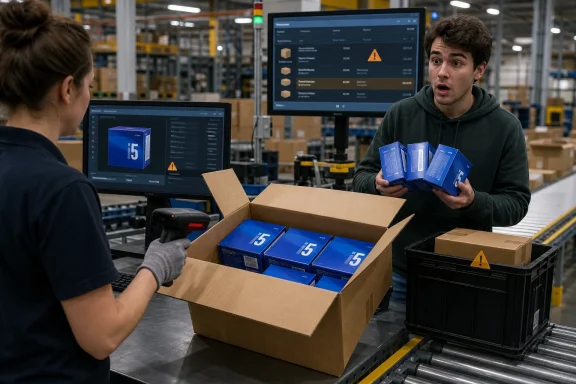
A Japanese Amazon customer who ordered a single Intel Core i5-14400 reportedly opened the delivery to find five sealed retail processors instead of one, turning an ordinary PC upgrade into an unusually valuable fulfillment error. Rather than sell the four unexpected CPUs or quietly keep them, the buyer contacted Amazon and arranged their return, leaving with exactly the processor originally purchased. The episode is amusing on the surface, but it also exposes a serious weakness in high-speed retail logistics: when an outer distribution carton can be mistaken for one sellable unit, a single scan may create hundreds of dollars in losses, corrupt inventory records, and leave another customer wondering why a paid-for processor never arrived.
The customer reportedly contacted Amazon rather than following suggestions to keep or resell the extras. Four processors were then returned, while the buyer retained the single Core i5-14400 covered by the original transaction.
Amazon has not publicly confirmed the precise chain of events. The most plausible theory is that a warehouse employee or automated receiving system treated a five-unit distribution carton as one individual retail item, allowing the complete carton to move through picking and packing without being opened.
Manufacturers and distributors frequently consolidate individual products into larger cartons for transport. Those outer cartons may carry logistics labels, manufacturer barcodes, product identifiers, shipping labels, or multiple machine-readable codes intended for different stages of the supply chain.
If the wrong barcode maps to the customer-facing stock-keeping unit, the warehouse management system can interpret an outer carton containing five retail products as one pickable item. From that point onward, every later checkpoint may confirm the same incorrect assumption rather than detect it.
This incident reverses the loss. Amazon or the marketplace seller appears to have absorbed the immediate risk, while the customer temporarily possessed four additional CPUs. The buyer’s decision to return them prevented a warehouse mistake from becoming a permanent inventory loss, but a dependable fulfillment network cannot rely on individual honesty as its final control layer.
Its Performance cores can boost to 4.7 GHz, while the Efficient cores reach up to 3.5 GHz. The chip includes 20MB of Intel Smart Cache, has a 65-watt processor base power rating, and can reach a maximum turbo power of 148 watts under Intel’s published specification.
Those characteristics make it suitable for a broad range of Windows systems, including mainstream gaming PCs, home productivity machines, development workstations, and modest content-creation builds. It is not Intel’s newest desktop architecture in 2026, but it remains a useful replacement or upgrade option for compatible LGA1700 systems.
For system builders, integrated graphics can also simplify deployment. A business workstation, office desktop, home server, or general-purpose PC may not need a separate graphics card at all.
The processor supports Intel Quick Sync Video, which can accelerate compatible encoding and decoding tasks. For Windows users working with video-conferencing software, media servers, editing applications, or streaming tools, that capability can be more useful than raw gaming performance alone.
It also provides PCI Express 5.0 and 4.0 connectivity through the platform, with support for up to 20 processor PCIe lanes. In practical terms, a compatible motherboard can support a modern graphics card and fast NVMe storage without forcing the buyer into an entirely new ecosystem.
A five-processor delivery therefore represented much more than a box of low-value accessories. At Intel’s original recommended pricing, the complete shipment carried a nominal value comfortably above $1,000, although actual Japanese retail prices in July 2026 could differ substantially.
The warehouse system must know not merely what product a barcode represents, but also what quantity and packaging level it represents. If that distinction is lost, a completely accurate scan can still produce an inaccurate transaction.
Possible failure points include:
Suppose the system believes one i5-14400 is a carton of a particular size and weight. The picker scans the carton, the tote or conveyor accepts it, and the packing station sees an order for one unit matched to one scanned object. Unless a separate control compares the parcel’s measured weight with the known weight of a single retail CPU box, no contradiction may appear.
Automation is exceptionally effective at repeating a valid rule. It is equally effective at scaling a bad mapping when the underlying data is wrong.
That discrepancy can remain hidden until another event exposes it. A picker may visit the expected storage location and discover an empty bin, an inventory audit may identify the shortage, or several customer orders may be accepted before the system recognizes that stock is unavailable.
A single incorrect shipment can therefore create a chain of secondary failures:
When physical and digital inventory diverge, several departments inherit the problem. Operations must locate the product, customer service must manage delayed orders, finance must account for the loss, and seller support may have to decide whether a third-party merchant deserves reimbursement.
For a marketplace seller using fulfillment services, the consequences can be especially frustrating. The seller may possess records showing that five units were delivered to the warehouse, while Amazon’s system believes all five remain available even after the full case has been shipped to one customer.
If the return workflow treats them as four conventional customer returns, the system could add four units and accidentally deepen the overstatement. The warehouse instead needs to identify the original quantity error, reconcile the outbound shipment, verify the serial or batch information where available, and restore the physical products without duplicating their digital count.
A clean correction should connect the original order, shipping weight, pick record, packing event, customer-service case, and returned units. Without that linkage, a well-intentioned return can generate yet another inventory anomaly.
A fulfillment error involving paper towels may be bulky and obvious. A fulfillment error involving four additional CPUs can fit in a modest parcel while representing hundreds of dollars in excess merchandise.
This value density also attracts deliberate abuse. Retailers must distinguish innocent operational mistakes from return fraud, account takeover, package interception, product substitution, and internal theft—all without making legitimate customers prove their innocence at every step.
A CPU box might contain:
That economic imbalance encourages risk-based inspection. Expensive or frequently abused products may receive more scrutiny, while lower-risk items move rapidly back into stock.
Processors occupy an awkward position. They are valuable enough to attract fraud but small enough that detailed inspection, serial tracking, functional testing, and repackaging can consume a significant portion of the retailer’s margin.
A sensible process is:
Consumer law varies by jurisdiction, and the rules governing inertia selling, accidental overdelivery, mistaken transfer, and a recipient’s duty after notification are not interchangeable. The Japanese buyer’s legal position should not be inferred from simplified summaries of United States, British, European, or other national laws.
The safest practical approach is to notify the seller and request written instructions. Customers should not pay to correct a retailer’s mistake unless they knowingly agree to do so; the retailer should provide a prepaid, trackable method and avoid placing unreasonable burdens on the recipient.
Customers should retain:
Retailers sometimes treat this labor as invisible because no direct fee appears on the customer’s account. Yet every unnecessary support interaction imposes a cost through lost time, uncertainty, travel, printing, storage, and the risk of a later dispute.
A customer who acts honestly should not be punished with a complicated correction process. The best response is a clear acknowledgment, prepaid collection or convenient drop-off, written closure, and assurance that no refund or warranty issue has been introduced on the legitimately purchased unit.
Every public account of an incorrect processor or swapped SSD raises the perceived risk of remote purchasing. Even if the statistical error rate is low, memorable failures can influence behavior more strongly than millions of routine deliveries.
Some buyers respond by recording every unboxing. Others choose physical retailers for expensive components, inspect packages at pickup, or avoid marketplace listings where the seller and fulfillment chain are unclear. Those defensive behaviors represent a trust tax on the entire e-commerce model.
Retailers should avoid canceling or restructuring the original order merely to process excess units. Doing so could unintentionally alter the invoice, return window, payment record, or proof of purchase for the processor the customer legitimately owns.
The cleanest outcome preserves the original sale of one i5-14400 and records the other four as recovered fulfillment inventory, not as returned portions of a five-unit customer purchase.
If a seller’s five-unit case is misidentified as one unit and shipped away, the seller may see an apparently normal sale followed by an unexplained stock shortage. Obtaining reimbursement can require invoices, shipment records, carton quantities, receiving documents, and repeated contact with support.
The seller’s immediate loss is not limited to four processors. Missing inventory can suppress sales, interrupt advertising campaigns, damage ranking momentum, and force emergency replenishment at less favorable prices.
Enterprise-grade controls should validate relationships among:
For the five-CPU shipment, investigators would ideally review the inbound receiving scan, case-pack declaration, storage location, pick instruction, employee or robot interaction, packing-station image, measured parcel weight, and outbound tracking record. The return should then attach to that same chain.
Without a unified event trail, each department sees only a fragment. Customer service sees an unexpected delivery, warehouse operations see a quantity mismatch, and seller support sees missing inventory—while nobody sees the complete failure.
A control system could compare the measured parcel against a tolerance range derived from previous correctly fulfilled orders. If the expected shipment contains one processor but resembles a five-unit case, the order could be diverted for manual inspection.
This approach does not require the system to know exactly what went wrong. It only needs to recognize that the physical parcel does not match the expected profile.
Tolerance bands that are too narrow will generate excessive false alarms, slowing operations and encouraging employees to override alerts. Bands that are too broad may fail to distinguish one CPU from several.
The most effective model would combine weight with other signals, including dimensions, package count, scan history, case-pack data, item value, and known fraud patterns. No single measurement should carry the full burden of verification.
For example, an order requesting one processor should not normally produce an image showing five branded CPU boxes. If the boxes remain inside an opaque distribution carton, vision can still inspect printed case markings or compare carton dimensions with the expected retail unit.
The goal is not surveillance for its own sake. It is to create an independent physical check that does not rely on the same barcode mapping that may have caused the mistake.
The distinction matters because the remedies differ. Training may address an isolated handling error, while incorrect master data requires a broader inventory audit and software correction.
Amazon may choose not to discuss an individual order publicly. Even without a statement, similar reports involving identical quantities or packaging could reveal whether the issue extends beyond one Japanese fulfillment center.
The items should then be reconciled against the inventory discrepancy rather than processed blindly as ordinary returns. If that distinction is missed, the company could restore four physical units while leaving its digital records inaccurate.
Customers purchasing the same SKU may never know whether they receive one of the recovered processors. That is acceptable if the products are verified as new and handled correctly, but the episode makes accurate condition grading especially important.
A sensible control hierarchy would be:
Amazon and other large merchants should design an explicit overdelivery workflow rather than forcing agents to improvise with ordinary return tools. The customer should be able to report the quantity, receive written acknowledgment, choose a prepaid collection method, and retain confirmation that the purchased unit’s order and warranty remain intact.
Such a workflow would also improve internal data. A structured “received more than ordered” reason code is far more useful than a generic return category that conceals the operational cause.
This five-CPU delivery ended without an apparent victim because the Japanese buyer returned the four processors that were never purchased, but the favorable outcome should not obscure the underlying warning. A fulfillment system that mistakes a distribution carton for one retail unit has failed at the boundary between digital inventory and physical reality, and the same weakness can just as easily leave another PC builder with an empty box, the wrong processor, or a canceled order. Amazon’s opportunity is to treat this not as a quirky viral anecdote but as a traceable engineering defect—one that better packaging data, independent weight checks, clearer audit trails, and customer-friendly exception handling can prevent from becoming the next expensive shipment mystery.
 Background
How the incident unfolded
The buyer posted a photograph of five Intel Core i5-14400 retail boxes on X on July 20, 2026, explaining that only one processor had been ordered. Subsequent reporting said all five packages appeared sealed, making this different from the familiar stories involving opened boxes, swapped processors, or suspicious customer returns.The customer reportedly contacted Amazon rather than following suggestions to keep or resell the extras. Four processors were then returned, while the buyer retained the single Core i5-14400 covered by the original transaction.
Amazon has not publicly confirmed the precise chain of events. The most plausible theory is that a warehouse employee or automated receiving system treated a five-unit distribution carton as one individual retail item, allowing the complete carton to move through picking and packing without being opened.
Why five processors is a revealing number
The quantity itself is an important clue. Five identical, sealed processors suggest a packaging-unit mistake rather than a picker grabbing several loose boxes one by one.Manufacturers and distributors frequently consolidate individual products into larger cartons for transport. Those outer cartons may carry logistics labels, manufacturer barcodes, product identifiers, shipping labels, or multiple machine-readable codes intended for different stages of the supply chain.
If the wrong barcode maps to the customer-facing stock-keeping unit, the warehouse management system can interpret an outer carton containing five retail products as one pickable item. From that point onward, every later checkpoint may confirm the same incorrect assumption rather than detect it.
The unusually positive ending
Most high-profile PC hardware delivery stories involve a customer receiving less than expected. A processor may be missing, a cheaper chip may be placed in an expensive box, or an old component may be substituted for a new one before the product returns to inventory.This incident reverses the loss. Amazon or the marketplace seller appears to have absorbed the immediate risk, while the customer temporarily possessed four additional CPUs. The buyer’s decision to return them prevented a warehouse mistake from becoming a permanent inventory loss, but a dependable fulfillment network cannot rely on individual honesty as its final control layer.
What the Buyer Actually Received
The Core i5-14400 remains a practical Windows processor
Intel launched the Core i5-14400 in the first quarter of 2024 as part of its 14th-generation desktop family. It uses the LGA1700 socket and combines six Performance cores with four Efficient cores, producing 10 physical cores and 16 processing threads.Its Performance cores can boost to 4.7 GHz, while the Efficient cores reach up to 3.5 GHz. The chip includes 20MB of Intel Smart Cache, has a 65-watt processor base power rating, and can reach a maximum turbo power of 148 watts under Intel’s published specification.
Those characteristics make it suitable for a broad range of Windows systems, including mainstream gaming PCs, home productivity machines, development workstations, and modest content-creation builds. It is not Intel’s newest desktop architecture in 2026, but it remains a useful replacement or upgrade option for compatible LGA1700 systems.
Integrated graphics adds practical value
Unlike the Core i5-14400F, the standard i5-14400 includes Intel UHD Graphics 730. That integrated GPU is not designed to replace a modern gaming card, but it can run a Windows desktop, accelerate supported media workloads, and provide a valuable troubleshooting path if a discrete GPU fails.For system builders, integrated graphics can also simplify deployment. A business workstation, office desktop, home server, or general-purpose PC may not need a separate graphics card at all.
The processor supports Intel Quick Sync Video, which can accelerate compatible encoding and decoding tasks. For Windows users working with video-conferencing software, media servers, editing applications, or streaming tools, that capability can be more useful than raw gaming performance alone.
Compatibility keeps the chip commercially relevant
The i5-14400 supports both DDR4-3200 and DDR5-4800 memory, depending on the motherboard. That flexibility helped extend the life of Intel’s LGA1700 platform by allowing budget-conscious builders to retain affordable DDR4 configurations while higher-end systems moved to DDR5.It also provides PCI Express 5.0 and 4.0 connectivity through the platform, with support for up to 20 processor PCIe lanes. In practical terms, a compatible motherboard can support a modern graphics card and fast NVMe storage without forcing the buyer into an entirely new ecosystem.
A five-processor delivery therefore represented much more than a box of low-value accessories. At Intel’s original recommended pricing, the complete shipment carried a nominal value comfortably above $1,000, although actual Japanese retail prices in July 2026 could differ substantially.
How a Warehouse Can Mistake Five CPUs for One
The hierarchy of packaging units
Modern fulfillment systems must distinguish among several levels of packaging:- An each is one product intended for sale to one customer.
- An inner pack contains multiple individual products for easier handling.
- A case pack or master carton contains a defined quantity of inner packs or sellable units.
- A pallet combines multiple cases for freight movement and warehouse receiving.
The warehouse system must know not merely what product a barcode represents, but also what quantity and packaging level it represents. If that distinction is lost, a completely accurate scan can still produce an inaccurate transaction.
The barcode may have been readable but semantically wrong
A scanning error does not always mean that a laser or camera failed to read a label. The scanner may have captured the code perfectly while the catalog, receiving configuration, or packaging relationship assigned the wrong meaning to it.Possible failure points include:
- The outer-carton barcode may have been associated with the individual retail SKU rather than a five-unit case.
- A warehouse worker may have scanned an inner product code visible through or printed on the outer packaging.
- An inventory label may have been placed over the correct logistics barcode.
- The carton may have entered inventory as one unit during receiving and retained that identity throughout the warehouse.
- A problem-solving workflow may have created a replacement label mapped to the wrong unit of measure.
Automation can preserve rather than correct the mistake
Amazon’s logistics network makes extensive use of conveyors, cameras, dimensioning equipment, routing software, mobile scanners, and automated decision systems. These tools reduce manual effort and support enormous transaction volumes, but they operate on identifiers and expected states.Suppose the system believes one i5-14400 is a carton of a particular size and weight. The picker scans the carton, the tote or conveyor accepts it, and the packing station sees an order for one unit matched to one scanned object. Unless a separate control compares the parcel’s measured weight with the known weight of a single retail CPU box, no contradiction may appear.
Automation is exceptionally effective at repeating a valid rule. It is equally effective at scaling a bad mapping when the underlying data is wrong.
The Inventory Damage Extends Beyond Four Missing CPUs
The customer-facing error is only the visible symptom
When five units leave a fulfillment center while the system subtracts one, the warehouse’s digital record becomes overstated by four units. The inventory screen may continue to show processors available for sale even though they are no longer physically present.That discrepancy can remain hidden until another event exposes it. A picker may visit the expected storage location and discover an empty bin, an inventory audit may identify the shortage, or several customer orders may be accepted before the system recognizes that stock is unavailable.
A single incorrect shipment can therefore create a chain of secondary failures:
- Another customer’s order may be delayed or canceled.
- A marketplace seller may be told that inventory is missing.
- The product may remain listed as available when the shelf is empty.
- Warehouse employees may spend time performing searches and cycle counts.
- Reimbursement disputes may arise over who owned the misplaced stock.
- Restocking decisions may be based on an inaccurate quantity.
Inventory accuracy is a financial control
Retail inventory is not merely a count of objects on shelves. It is a financial asset tied to customer promises, seller balances, tax records, purchasing plans, fraud analysis, and revenue recognition.When physical and digital inventory diverge, several departments inherit the problem. Operations must locate the product, customer service must manage delayed orders, finance must account for the loss, and seller support may have to decide whether a third-party merchant deserves reimbursement.
For a marketplace seller using fulfillment services, the consequences can be especially frustrating. The seller may possess records showing that five units were delivered to the warehouse, while Amazon’s system believes all five remain available even after the full case has been shipped to one customer.
Returns can complicate reconciliation
The buyer’s decision to return the extra CPUs is admirable, but the return itself creates another technical challenge. Amazon must receive four processors that were never correctly deducted from inventory in the first place.If the return workflow treats them as four conventional customer returns, the system could add four units and accidentally deepen the overstatement. The warehouse instead needs to identify the original quantity error, reconcile the outbound shipment, verify the serial or batch information where available, and restore the physical products without duplicating their digital count.
A clean correction should connect the original order, shipping weight, pick record, packing event, customer-service case, and returned units. Without that linkage, a well-intentioned return can generate yet another inventory anomaly.
Why Computer Components Are Especially Vulnerable
High value and small size create an attractive target
Processors, SSDs, memory modules, and compact graphics products combine high resale value with relatively small packaging. That makes them easy to ship, easy to conceal, and easy to sell through secondary marketplaces.A fulfillment error involving paper towels may be bulky and obvious. A fulfillment error involving four additional CPUs can fit in a modest parcel while representing hundreds of dollars in excess merchandise.
This value density also attracts deliberate abuse. Retailers must distinguish innocent operational mistakes from return fraud, account takeover, package interception, product substitution, and internal theft—all without making legitimate customers prove their innocence at every step.
Retail packaging is not a complete security boundary
PC enthusiasts often assume that factory-looking shrink-wrap or intact seals prove the contents are authentic. Unfortunately, packaging can be opened, copied, resealed, relabeled, or substituted at several points in the retail chain.A CPU box might contain:
- The correct processor in unused condition.
- The correct model that has already been installed or damaged.
- A cheaper processor with a similar physical package.
- An obsolete chip placed in a newer box.
- An empty plastic tray or unrelated object used to mimic expected weight.
- A counterfeit or remarked component.
Returns introduce asymmetric verification costs
A fraudulent customer needs only one successful return to profit. A retailer, by contrast, must inspect millions of legitimate returns without spending more on verification than it saves through fraud prevention.That economic imbalance encourages risk-based inspection. Expensive or frequently abused products may receive more scrutiny, while lower-risk items move rapidly back into stock.
Processors occupy an awkward position. They are valuable enough to attract fraud but small enough that detailed inspection, serial tracking, functional testing, and repackaging can consume a significant portion of the retailer’s margin.
What Windows PC Builders Should Do When a Delivery Looks Wrong
Document the package before opening everything
Customers should treat an unexpected quantity, damaged seal, incorrect product, or suspiciously light package as a recordkeeping problem first. Photographs and video cannot guarantee a favorable resolution, but they provide context that may be difficult to reconstruct later.A sensible process is:
- Photograph the shipping label and all visible sides of the parcel before opening it further.
- Record the condition of the tape, seams, seals, and any signs of relabeling.
- Compare the packing slip, order page, model number, and quantity.
- Photograph the retail boxes together so the delivered quantity is unambiguous.
- Contact the retailer through the official order-support channel.
- Preserve chat transcripts, return instructions, tracking numbers, and drop-off receipts.
- Avoid installing, opening, or selling disputed extra units while the issue is unresolved.
Do not assume another country’s “free goods” rule applies
Online discussions often claim that anything delivered unexpectedly can automatically be kept. That advice commonly confuses deliberately unsolicited merchandise with an obvious fulfillment mistake connected to a legitimate order.Consumer law varies by jurisdiction, and the rules governing inertia selling, accidental overdelivery, mistaken transfer, and a recipient’s duty after notification are not interchangeable. The Japanese buyer’s legal position should not be inferred from simplified summaries of United States, British, European, or other national laws.
The safest practical approach is to notify the seller and request written instructions. Customers should not pay to correct a retailer’s mistake unless they knowingly agree to do so; the retailer should provide a prepaid, trackable method and avoid placing unreasonable burdens on the recipient.
Preserve evidence after returning the goods
Dropping a parcel at a counter does not necessarily end the issue. Return packages can be delayed, misrouted, damaged, or received without being correctly associated with the support case.Customers should retain:
- The retailer’s written acknowledgment of the quantity mistake.
- The return authorization and prepaid label.
- The carrier receipt showing acceptance and package weight.
- The tracking history showing delivery.
- Photographs of the returned items and sealed return carton.
- Confirmation that the case has been closed without additional charges.
Consumer Impact
Honest customers still bear operational friction
The Japanese buyer ultimately kept what was paid for and returned the rest, but the transaction still demanded time and attention. The customer had to identify the error, contact support, understand the proposed resolution, pack the items, and participate in the return process.Retailers sometimes treat this labor as invisible because no direct fee appears on the customer’s account. Yet every unnecessary support interaction imposes a cost through lost time, uncertainty, travel, printing, storage, and the risk of a later dispute.
A customer who acts honestly should not be punished with a complicated correction process. The best response is a clear acknowledgment, prepaid collection or convenient drop-off, written closure, and assurance that no refund or warranty issue has been introduced on the legitimately purchased unit.
Mistakes weaken trust in expensive online purchases
PC builders routinely buy fragile, high-value parts online because selection and pricing are often better than at local stores. That model depends on confidence that the product page, warehouse item, retail box, and component inside all refer to the same thing.Every public account of an incorrect processor or swapped SSD raises the perceived risk of remote purchasing. Even if the statistical error rate is low, memorable failures can influence behavior more strongly than millions of routine deliveries.
Some buyers respond by recording every unboxing. Others choose physical retailers for expensive components, inspect packages at pickup, or avoid marketplace listings where the seller and fulfillment chain are unclear. Those defensive behaviors represent a trust tax on the entire e-commerce model.
Warranty questions can surface later
The buyer who kept one processor must still ensure that the retained unit is properly associated with a valid purchase record. If the order history shows one CPU, that should generally support the transaction, but serial-number or batch-level discrepancies could complicate a future claim.Retailers should avoid canceling or restructuring the original order merely to process excess units. Doing so could unintentionally alter the invoice, return window, payment record, or proof of purchase for the processor the customer legitimately owns.
The cleanest outcome preserves the original sale of one i5-14400 and records the other four as recovered fulfillment inventory, not as returned portions of a five-unit customer purchase.
Enterprise and Marketplace Seller Impact
Sellers may absorb losses they did not cause
Amazon’s marketplace combines first-party retail stock with products owned by independent merchants and handled through fulfillment services. From the customer’s perspective, the parcel may look like a standard Amazon delivery regardless of who owns the processor.If a seller’s five-unit case is misidentified as one unit and shipped away, the seller may see an apparently normal sale followed by an unexplained stock shortage. Obtaining reimbursement can require invoices, shipment records, carton quantities, receiving documents, and repeated contact with support.
The seller’s immediate loss is not limited to four processors. Missing inventory can suppress sales, interrupt advertising campaigns, damage ranking momentum, and force emergency replenishment at less favorable prices.
Data quality matters more than warehouse speed
Fulfillment centers are optimized for throughput, but raw speed has diminishing value if catalog and packaging data are unreliable. A parcel shipped in minutes is not a successful order if it contains five times the requested quantity.Enterprise-grade controls should validate relationships among:
- The manufacturer part number.
- The marketplace listing identifier.
- The unit barcode.
- The case-pack barcode.
- The expected quantity per case.
- The measured dimensions and weight.
- The seller’s inbound shipment declaration.
- The customer’s ordered quantity.
Audit trails should support rapid reconstruction
A mature warehouse system needs an event history that explains how each physical object moved. That does not necessarily mean tracking every consumer product by serial number, but it does require enough data to reconstruct exceptions.For the five-CPU shipment, investigators would ideally review the inbound receiving scan, case-pack declaration, storage location, pick instruction, employee or robot interaction, packing-station image, measured parcel weight, and outbound tracking record. The return should then attach to that same chain.
Without a unified event trail, each department sees only a fragment. Customer service sees an unexpected delivery, warehouse operations see a quantity mismatch, and seller support sees missing inventory—while nobody sees the complete failure.
The Role of Weight and Dimension Checks
A simple comparison could catch a large discrepancy
Five retail CPU boxes should weigh substantially more and occupy more volume than one. That makes this type of error a strong candidate for automated weight and dimension validation at the packing stage.A control system could compare the measured parcel against a tolerance range derived from previous correctly fulfilled orders. If the expected shipment contains one processor but resembles a five-unit case, the order could be diverted for manual inspection.
This approach does not require the system to know exactly what went wrong. It only needs to recognize that the physical parcel does not match the expected profile.
Product data must account for packaging variability
Weight controls are not infallible. Retail products may ship with different coolers, manuals, regional labels, packaging revisions, or protective materials. Multiple suppliers can also use different outer cartons for the same SKU.Tolerance bands that are too narrow will generate excessive false alarms, slowing operations and encouraging employees to override alerts. Bands that are too broad may fail to distinguish one CPU from several.
The most effective model would combine weight with other signals, including dimensions, package count, scan history, case-pack data, item value, and known fraud patterns. No single measurement should carry the full burden of verification.
Machine vision can provide another layer
Packing stations can use cameras to identify the number and type of visible retail boxes. Computer vision does not need to make the final decision; it can flag an obvious mismatch for human confirmation.For example, an order requesting one processor should not normally produce an image showing five branded CPU boxes. If the boxes remain inside an opaque distribution carton, vision can still inspect printed case markings or compare carton dimensions with the expected retail unit.
The goal is not surveillance for its own sake. It is to create an independent physical check that does not rely on the same barcode mapping that may have caused the mistake.
Strengths and Opportunities
The incident highlights several ways retailers can turn an embarrassing exception into a more resilient fulfillment process.- Amazon can use the returned carton as a complete forensic example. Investigators can compare the original inbound labels, digital inventory record, outbound weight, customer report, and returned units to identify the first incorrect event.
- Case-pack identifiers can be separated more aggressively from consumer-unit identifiers. Distinct label placement, formatting, and software rules would make it harder to scan a master carton as one sellable product.
- High-value compact items can receive stronger exception checks. CPUs, SSDs, memory, smartphones, and similar products justify tighter weight tolerances and more detailed audit trails.
- Marketplace sellers can improve inbound declarations. Accurate case quantities, scannable labels, unambiguous packaging, and removal or covering of conflicting barcodes reduce opportunities for misidentification.
- Customer service can reward cooperative reporting with convenience. Fast pickup, clear written instructions, and immediate case closure encourage recipients to report mistakes rather than treat support as an additional burden.
- Returns can feed warehouse-quality analytics. An overdelivery should not be closed as a generic return; it should become a structured operational defect tied to a facility, workflow, packaging type, and catalog relationship.
Risks and Concerns
The most serious risk is not that one customer briefly possessed extra hardware. It is that the same underlying error may operate in both directions and at a larger scale.- Incorrect case-pack mapping can create systematic losses. If multiple cartons share the same bad configuration, repeated overdeliveries may occur before the pattern becomes visible.
- Inventory overstatement can lead to canceled orders. Products shown as available may not physically exist, damaging customer trust during time-sensitive builds or repairs.
- Sellers can face unfair reimbursement disputes. The warehouse may blame inbound preparation while the merchant argues that Amazon mishandled a correctly labeled carton.
- Returned extras can be counted twice. If the reconciliation workflow does not understand the original overdelivery, recovered units may be added to inventory that was never deducted.
- Public stories can encourage opportunistic behavior. Some recipients may interpret isolated mistakes as an invitation to conceal valuable merchandise or exploit support processes.
- Excessive fraud controls can harm legitimate buyers. Retailers responding too aggressively may impose burdensome identity checks, limited returns, delayed refunds, or accusations against innocent customers.
- Automated systems can amplify faulty catalog data. A bad unit-of-measure relationship can travel through receiving, storage, picking, packing, shipping, and accounting without triggering a conventional scan failure.
What to Watch Next
Whether Amazon explains the failure
Amazon had not publicly confirmed the warehouse-scanning theory when the incident was reported on July 21, 2026. A formal explanation would help distinguish a one-off employee mistake from a catalog, labeling, or case-pack configuration problem.The distinction matters because the remedies differ. Training may address an isolated handling error, while incorrect master data requires a broader inventory audit and software correction.
Amazon may choose not to discuss an individual order publicly. Even without a statement, similar reports involving identical quantities or packaging could reveal whether the issue extends beyond one Japanese fulfillment center.
Whether the returned CPUs re-enter stock correctly
The four processors should be inspected before resale, even if the customer says they remained unopened. Warehouse staff need to confirm the model, condition, seals, packaging identifiers, and relationship to the original overdelivery.The items should then be reconciled against the inventory discrepancy rather than processed blindly as ordinary returns. If that distinction is missed, the company could restore four physical units while leaving its digital records inaccurate.
Customers purchasing the same SKU may never know whether they receive one of the recovered processors. That is acceptable if the products are verified as new and handled correctly, but the episode makes accurate condition grading especially important.
Whether PC component fulfillment gains stronger controls
Processors provide an ideal test case for risk-aware automation because they are compact, standardized, valuable, and relatively easy to profile by weight. Retailers could establish stricter rules without applying costly inspection to every low-value item.A sensible control hierarchy would be:
- The receiving system validates whether the scanned object is an individual unit or a case.
- Storage records preserve that packaging level instead of flattening it into a generic SKU count.
- The pick system requires the expected quantity and packaging type.
- The packing station checks weight, dimensions, and visual evidence.
- The shipping system blocks extreme mismatches pending review.
- Returns and customer reports feed back into the original inventory event.
Whether customer support becomes less adversarial
The buyer’s honesty deserves a response that is simple and respectful. If returning extra goods becomes difficult, expensive, or risky, retailers unintentionally teach customers not to report future mistakes.Amazon and other large merchants should design an explicit overdelivery workflow rather than forcing agents to improvise with ordinary return tools. The customer should be able to report the quantity, receive written acknowledgment, choose a prepaid collection method, and retain confirmation that the purchased unit’s order and warranty remain intact.
Such a workflow would also improve internal data. A structured “received more than ordered” reason code is far more useful than a generic return category that conceals the operational cause.
This five-CPU delivery ended without an apparent victim because the Japanese buyer returned the four processors that were never purchased, but the favorable outcome should not obscure the underlying warning. A fulfillment system that mistakes a distribution carton for one retail unit has failed at the boundary between digital inventory and physical reality, and the same weakness can just as easily leave another PC builder with an empty box, the wrong processor, or a canceled order. Amazon’s opportunity is to treat this not as a quirky viral anecdote but as a traceable engineering defect—one that better packaging data, independent weight checks, clearer audit trails, and customer-friendly exception handling can prevent from becoming the next expensive shipment mystery.
References
- Primary source: TweakTown
Published: 2026-07-21T21:00:07+00:00
Amazon customer orders an Intel Core i5-14400, receives 5 CPUs instead
Amazon accidentally sent a Japanese buyer five Core i5-14400 CPUs instead of one, and perhaps more interestingly, they kindly returned the extras. www.tweaktown.com
- Related coverage: intel.com
- Related coverage: videocardz.com
- Related coverage: tomshardware.com
I managed to snag a Core i5 CPU for $10, because someone scammed Amazon out of an i7-14700 | Tom's Hardware
A corporation’s loss is this editor’s gain.www.tomshardware.com