

Intel is reportedly preparing Dunlow, an LGA1954 platform for entry-level servers and workstations that would succeed Catlow and pair presumed Xeon E-class Nova Lake-S processors with as many as 28 cores, dual-channel memory, and a restrained 95W processor base power. The headline number is intriguing, but the platform boundaries matter more than the core count. Dunlow appears designed to occupy the missing middle between desktop-derived Xeons and costly, memory-heavy server platforms. If the shipping records reflect a product Intel ultimately releases, Dunlow could become one of the company’s most strategically important small-server platforms in years.
The evidence begins with shipment manifests in the NBD database located by hardware researcher @x86deadandback, according to Tom’s Hardware. Those records reportedly identify Dunlow as a platform supporting a 28-core processor in an LGA1954 package, with dual-channel memory and a 95W processor base power.
That is meaningful evidence of engineering activity, but it is not equivalent to a launch announcement, architectural disclosure, or final product specification. Shipment databases regularly expose preproduction processors, development boards, validation hardware, and components moving between Intel, manufacturers, and engineering partners. They can establish that a project exists inside the supply chain without proving that every recorded configuration will survive qualification and become a retail product.
Tom’s Hardware frames Dunlow as the successor to Catlow, Intel’s current platform for Xeon 6300P-series processors. Intel’s own Catlow documentation confirms that the existing platform serves the entry-level server market and uses a dual-channel memory architecture, reinforcing the idea that Dunlow is not intended to compete directly with the largest Xeon systems.
The magnitude of the apparent core-count increase is nevertheless striking. Current Catlow products remain modest by modern server standards, while the Dunlow manifest points to as many as 28 cores without abandoning the low-cost dual-channel design or moving beyond a 95W base-power envelope.
There is one discrepancy worth flagging before building too much analysis on the comparison. Tom’s Hardware characterizes the Xeon 6300P generation as reaching up to 12 P-cores, while Intel’s current Xeon 6300-series product brief lists four-, six-, and eight-core models, with eight cores as the published ceiling. The conflict does not alter the larger conclusion that Dunlow would represent a major increase, but it illustrates why leaked platform records and preliminary reporting must be separated from Intel’s shipping specifications.
Wccftech, covering the same Dunlow discovery, goes further than Tom’s Hardware by describing the prospective processor as a hybrid P-core and E-core design. Tom’s Hardware is more cautious: it argues that a conventional hybrid configuration is possible, but also explores the much more consequential possibility that Intel has developed a specialized 28-P-core compute tile.
That disagreement is the real story. A 28-core hybrid Xeon would be a substantial update to Intel’s entry server line. A 28-P-core Xeon operating at 95W would amount to an entirely different class of silicon.
A 28-core Dunlow processor cannot be cleanly explained by taking that maximum desktop layout and applying ordinary product segmentation. The reported desktop compute tile contains 48 conventional compute cores before the four low-power cores are counted. Reducing that tile to 28 active cores would mean disabling 20 cores, an unusually large amount of silicon to discard in a product intended to make economic sense.
The notebook comparison is no cleaner. A referenced mobile design of eight P-cores and 16 E-cores contains 24 primary compute cores; even after adding four low-power cores, it would reach 28 only by counting cores intended for different power and scheduling roles. Such a configuration could explain the number mathematically, but it would not naturally explain why Dunlow is being positioned as an entry server and workstation platform rather than a repackaged notebook design.
This is why the Dunlow core count cannot be treated as just another leak in the desktop SKU ladder. It raises an architectural question: is Intel adapting an existing hybrid Nova Lake tile, creating a specialized tile, or packaging a derivative of another Xeon design for a cheaper socket and memory subsystem?
Each route carries different consequences. A fused-down desktop die would prioritize reuse and yield recovery. A hybrid tile would bring Intel’s heterogeneous client philosophy deeper into entry Xeon systems. A specialized all-P-core tile would indicate that Intel believes there is enough demand between desktop and mainstream Xeon to justify dedicated silicon.
At present, the manifest cannot distinguish among those possibilities. It tells us that Intel has associated Dunlow with 28 cores, not what kind of cores they are or how they are physically arranged.
The current entry-level line follows that pattern. Xeon 6300P-series processors, based on the Raptor Lake-E family, use performance cores rather than the hybrid arrangement familiar from Intel’s mainstream desktop CPUs. That allows Intel to prioritize sustained all-core frequency, predictable performance characteristics, and a more uniform execution environment.
A 28-P-core Dunlow processor would extend that philosophy dramatically. It would offer substantially more high-performance cores than an enthusiast desktop design capped at 16 P-cores, yet avoid the platform weight associated with the larger Xeon families.
There is a historical precedent, although not a successful one. Intel previously developed Raptor Lake-32C, an all-P-core design aimed at workstations and entry servers. That processor was canceled, but its existence demonstrated that Intel saw a potential market for a CPU positioned above mainstream desktop silicon and below the full server stack.
A 28-P-core Nova Lake derivative would look like a second attempt at that idea, with four fewer cores and a newer platform. It could provide the kind of dense, uniform compute that is useful for compilation, rendering, simulation, software development, smaller virtualization hosts, and certain dedicated server workloads without requiring customers to buy an octa-channel Xeon system.
The 95W figure makes that theory both more interesting and more difficult. Processor base power is not necessarily the same as peak socket consumption, and a 95W rating does not prove that 28 performance cores could operate at desktop-class frequencies. Intel could achieve the target through lower clocks, aggressive voltage management, workload-dependent boost behavior, or a platform definition that allows higher short-term power.
Even so, 28 high-performance cores inside that base-power class would require careful binning and a deliberate performance strategy. Dunlow would probably be designed around sustained efficiency rather than chasing the highest single-threaded boost numbers.
The alternative theory is that Intel may be adapting a smaller Xeon die to LGA1954 and constraining it to dual-channel memory. That could give Dunlow server-oriented cores without requiring Intel to transform a 48-core desktop compute tile into an awkward 28-core product. It would also make the platform a packaging and segmentation exercise rather than a wholly new compute design.
Neither explanation can yet be proved. But the fact that the ordinary desktop configurations fit so poorly is a warning against assuming Dunlow is simply a renamed Core Ultra processor with Xeon branding.
A hybrid design could plausibly use a configuration related to the eight-P-core, 16-E-core and four-low-power-core layout discussed for notebook-class Nova Lake. It could also use another combination that has not yet appeared in public reporting. The manifest supplies only a total, leaving core taxonomy entirely unresolved.
For entry servers, adding E-cores would not automatically be a bad decision. Intel itself positions performance cores and efficiency cores for different kinds of server work: P-cores for compute-intensive and latency-sensitive tasks, and E-cores for highly parallel workloads such as microservices and scale-out services.
The difficulty is that Dunlow would be mixing those roles inside one socket rather than offering administrators a homogeneous P-core or E-core platform. That introduces questions about operating-system scheduling, virtual-machine placement, performance monitoring, licensing models, thread affinity, and the consistency of latency-sensitive work.
Modern Windows schedulers can distinguish between heterogeneous core classes on supported client platforms, but server qualification is a broader problem than simple thread placement. Hypervisors, management agents, backup software, monitoring tools, endpoint security products, and workload orchestration systems all need to report and handle the topology correctly.
A hybrid entry Xeon would therefore need more than a processor specification. Intel and its system partners would have to explain how the cores are exposed to Windows Server and other operating systems, whether administrators can partition or disable core classes, and how performance counters behave across the heterogeneous design.
That is not an argument against hybrid servers. It is an argument that a hybrid Dunlow would be a platform transition rather than a routine core-count upgrade.
The low-power cores create a further ambiguity. On client processors, those cores can handle background and low-intensity work while the main compute tile remains in a lower-power state. In a server, where systems may run continuously and remain under sustained load, their practical role could be narrower. Until Intel specifies whether Dunlow actually includes such cores, it would be premature to count them as equivalent to the cores hosting primary services.
The safest conclusion is that 28 cores means exactly that—and nothing more. It does not yet mean 28 equal cores, 28 server-class P-cores, or a specific hybrid arrangement.
At first glance, combining 28 cores with only two DDR5 channels seems unbalanced. More cores generate more concurrent memory requests, and memory-intensive software can reach a bandwidth ceiling before the CPU’s execution resources are fully used.
But entry servers are not miniature high-performance computing clusters. Many small-business and dedicated-service workloads are limited by storage, network traffic, software serialization, latency, or per-thread compute long before they exhaust the theoretical bandwidth of two DDR5 channels.
Web hosting, infrastructure services, lightweight application servers, storage appliances, build systems, branch-office workloads, and smaller virtualized environments can benefit from additional cores without continuously streaming large datasets from memory. Tom’s Hardware specifically identifies storage and web-hosting applications as examples where two channels may be sufficient.
Dual-channel memory also lowers platform complexity. It reduces motherboard routing requirements, limits the number of memory slots and traces, simplifies socket packaging, and gives system vendors more freedom to build compact towers, short-depth servers, and lower-cost workstation boards.
That cost distinction is crucial. A processor does not become expensive only because of its die. A wider memory controller requires a larger socket, more board layers and traces, additional DIMMs, more validation work, and often a physically larger chassis. The memory installed to utilize all those channels can become a major part of the system bill.
ServeTheHome’s reporting on Intel’s decision to remove an eight-channel Diamond Rapids variant from its roadmap underscores the importance of this issue. Intel confirmed to the outlet that it was focusing Diamond Rapids on a wider 16-channel design, eliminating the lower-channel version that would have served more mainstream server configurations.
Tom’s Hardware’s Dunlow analysis describes the canceled Diamond Rapids option as octa-channel, reflecting the roadmap gap Dunlow may be intended to address. The broader point survives the evolving roadmap details: Intel’s future high-end server platforms are becoming wider, larger, and more expensive just as many customers still need something more capable than a desktop but less elaborate than a full data-center socket.
Dunlow’s two-channel design is therefore not evidence that Intel forgot how servers work. It is the mechanism that keeps the platform out of the high-end Xeon cost structure.
This segmentation makes Dunlow easier to understand. It is not trying to deliver every server feature at the lowest price. It is attempting to deliver much more compute while retaining the economic shape of an entry platform.
That figure belongs to the most aggressive end of the desktop-performance discussion, not Dunlow’s operating target. It represents a platform built to restore Intel’s competitive position among enthusiasts, where short-duration boost behavior, benchmark leadership, premium cooling, and high-end motherboards are accepted parts of the market.
Dunlow’s reported 95W processor base power signals a more conservative objective. Entry servers are purchased as systems, often deployed in offices, equipment rooms, remote locations, or hosting environments where heat, noise, power provisioning, and long-term operating cost matter more than winning a benchmark.
A 95W base rating also makes it plausible for system manufacturers to build conventional tower workstations and compact rack systems without exotic cooling. That expands the pool of potential designs and reduces the engineering burden for vendors already familiar with lower-power single-socket platforms.
Administrators should not confuse base power with a guaranteed power ceiling. Intel processors can operate above their base rating under boost conditions, and the eventual Dunlow platform will need documented limits for sustained, turbo, and motherboard-configured power.
Still, the contrast with the reported 474W desktop maximum is central to the product’s identity. Dunlow appears designed to turn Nova Lake’s architectural generation into a manageable business platform rather than transplant the enthusiast product’s most extreme behavior into a server chassis.
That distinction could also influence clock speeds. If Dunlow offers 28 P-cores, they are unlikely to behave like 28 individually maximized desktop cores under simultaneous load. The platform would instead trade peak frequency for throughput within a defined thermal envelope.
For workstation buyers, that can be a sensible exchange. Rendering, compilation, encoding, simulation, and other parallel tasks often benefit more from additional sustained cores than from the last increment of lightly threaded boost frequency.
For servers, predictability matters even more. A lower, steadier performance profile can be preferable to highly variable burst behavior, provided Intel and its OEM partners expose power controls and thermal telemetry clearly.
At one end, enthusiast desktops may offer as many as 16 P-cores, supplemented by a much larger number of E-cores. Those systems provide strong general-purpose performance but do not automatically include the validation, manageability, reliability features, lifecycle commitments, or platform support expected from a Xeon product.
At the other end, Xeon 6 systems can begin at comparable total core counts while imposing a much larger memory and motherboard architecture. An octa-channel platform may be desirable for analytics, database servers, virtualization clusters, and memory-bandwidth-sensitive applications, but it is unnecessary overhead for a small dedicated server or departmental workstation.
The planned removal of the lower-channel Diamond Rapids design makes that division sharper. According to ServeTheHome, Intel confirmed that the eight-channel Diamond Rapids platform had been removed from the roadmap in favor of a 16-channel focus. Tom’s Hardware argues that, by 2028, the resulting space between desktop and high-end server products risks becoming too wide.
Dunlow is a logical answer to that problem. It keeps two memory channels but raises compute density far beyond today’s entry Xeons. In effect, Intel would be selling customers more processor without forcing them to buy an entire data-center-class platform around it.
That strategy depends on discipline. If Dunlow lacks enough memory capacity, I/O, manageability, or validated system support, it risks becoming an expensive desktop platform with a Xeon label. If Intel equips it too generously, it could undercut more profitable workstation and server families.
The socket change to LGA1954 gives Intel room to establish a new boundary. A dedicated platform can receive its own chipset, firmware, board validation, power limits, ECC policies, networking options, and remote-management capabilities without being constrained by current Catlow systems.
It also means there should be no expectation of a drop-in upgrade. Dunlow will require new motherboards, new firmware, and vendor-qualified systems. Organizations evaluating it will be choosing a new platform generation, not replacing a processor in an existing Catlow server.
The workstation side may be just as important as entry servers. Professional users often need more CPU throughput and stronger validation than consumer desktops provide, but cannot justify large multi-channel workstation platforms. A 28-core, 95W Xeon could be attractive to software developers, engineers, small studios, scientific teams, and businesses running compute-heavy applications at desks rather than in data centers.
This is where platform economics becomes more important than headline performance. Dunlow does not need to outperform every Xeon 6 system. It needs to deliver enough server and workstation capability at a sufficiently lower total system cost.
A hybrid processor is more complicated. Windows must understand which threads belong on performance cores, which can be assigned to efficiency cores, and how virtualized workloads should be distributed when a guest operating system may not see the underlying topology directly.
Core counts also affect capacity planning. Twenty-eight cores can support more parallel services or virtual machines than today’s small Xeon platforms, but two memory channels may prevent administrators from scaling memory bandwidth proportionally. A server that looks compute-rich on a specification sheet could still become constrained when multiple memory-intensive guests operate simultaneously.
That makes workload characterization essential. A build server running many independent compilation tasks may respond very differently from an analytics service scanning large datasets. A storage appliance performing checksums, compression, encryption, or deduplication may benefit from additional compute, but its final throughput could still be limited by network and storage I/O.
Windows Server support cannot be assumed merely because Dunlow uses x86 processors and a familiar Intel platform model. OEM validation, chipset drivers, firmware servicing, management-controller integration, error reporting, power telemetry, virtualization support, and device certification determine whether a machine functions as a dependable server rather than merely booting the operating system.
The same applies to workstations. Professional application certification can matter more than peak benchmark performance, especially in engineering, design, simulation, and media-production environments. Intel and system vendors will need to identify which workloads and applications Dunlow systems are formally validated to run.
Reliability features remain another open question. Dual-channel memory does not inherently exclude ECC—the current entry Xeon platform already demonstrates that the two can coexist—but the manifests do not establish Dunlow’s memory capacities, supported DIMM types, error-correction behavior, or serviceability features.
I/O is similarly unresolved. Entry servers increasingly depend on fast networking, multiple NVMe devices, accelerators, storage controllers, and high-speed peripherals. Twenty-eight cores are less useful if the surrounding platform cannot keep enough devices fed or forces vendors into restrictive lane-sharing arrangements.
Until Intel publishes those details, Dunlow should be understood as a promising platform concept rather than a procurement target.
The more powerful the processor becomes, the more visible the platform bottlenecks become. A current eight-core entry Xeon can live comfortably with dual-channel memory because the CPU itself limits how many concurrent tasks can demand bandwidth. A 28-core replacement could expose memory contention that never appeared on Catlow.
Intel will need to explain the intended balance through real workload data rather than generic claims. Benchmarks should include sustained all-core work, multiple virtual machines, storage services, web hosting, software compilation, rendering, database activity, and mixed workloads that stress both compute and memory.
OEM configuration will also matter. Two systems using the same processor can perform differently because of memory population, firmware limits, cooling, power-delivery design, or I/O allocation. A workstation tower with ample cooling may sustain higher clocks than a short-depth server tuned for acoustics and density.
The 95W rating may encourage vendors to build compact products, but compact systems can still struggle with sustained boost power, dense memory modules, high-speed networking, and several NVMe drives. Buyers should expect meaningful variation among Dunlow implementations if the platform reaches market.
There is also the possibility that 28 cores describe an engineering maximum rather than the most common shipping configuration. Intel could offer a family with fewer active cores, different power levels, or different core mixes. A platform often makes more commercial sense as a stack than as one flagship processor.
That would mirror the role of Catlow: not one chip, but a basis for multiple server configurations. Dunlow’s success will depend on whether Intel can create a coherent range rather than an attention-grabbing top model.
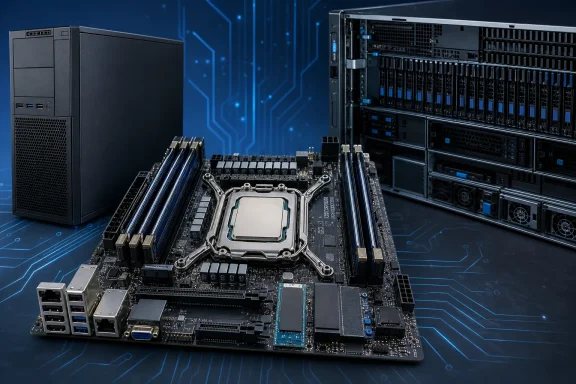 Dunlow Is a Platform Leak, Not Yet a Processor Announcement
The evidence begins with shipment manifests in the NBD database located by hardware researcher @x86deadandback, according to Tom’s Hardware. Those records reportedly identify Dunlow as a platform supporting a 28-core processor in an LGA1954 package, with dual-channel memory and a 95W processor base power.That is meaningful evidence of engineering activity, but it is not equivalent to a launch announcement, architectural disclosure, or final product specification. Shipment databases regularly expose preproduction processors, development boards, validation hardware, and components moving between Intel, manufacturers, and engineering partners. They can establish that a project exists inside the supply chain without proving that every recorded configuration will survive qualification and become a retail product.
Tom’s Hardware frames Dunlow as the successor to Catlow, Intel’s current platform for Xeon 6300P-series processors. Intel’s own Catlow documentation confirms that the existing platform serves the entry-level server market and uses a dual-channel memory architecture, reinforcing the idea that Dunlow is not intended to compete directly with the largest Xeon systems.
The magnitude of the apparent core-count increase is nevertheless striking. Current Catlow products remain modest by modern server standards, while the Dunlow manifest points to as many as 28 cores without abandoning the low-cost dual-channel design or moving beyond a 95W base-power envelope.
There is one discrepancy worth flagging before building too much analysis on the comparison. Tom’s Hardware characterizes the Xeon 6300P generation as reaching up to 12 P-cores, while Intel’s current Xeon 6300-series product brief lists four-, six-, and eight-core models, with eight cores as the published ceiling. The conflict does not alter the larger conclusion that Dunlow would represent a major increase, but it illustrates why leaked platform records and preliminary reporting must be separated from Intel’s shipping specifications.
Wccftech, covering the same Dunlow discovery, goes further than Tom’s Hardware by describing the prospective processor as a hybrid P-core and E-core design. Tom’s Hardware is more cautious: it argues that a conventional hybrid configuration is possible, but also explores the much more consequential possibility that Intel has developed a specialized 28-P-core compute tile.
That disagreement is the real story. A 28-core hybrid Xeon would be a substantial update to Intel’s entry server line. A 28-P-core Xeon operating at 95W would amount to an entirely different class of silicon.
Twenty-Eight Cores Do Not Fit the Obvious Nova Lake Templates
Intel’s expected Core Ultra 400-series desktop family, codenamed Nova Lake-S, has been associated with an alleged maximum configuration of 52 cores. According to the reporting cited by Tom’s Hardware, that configuration consists of up to 16 Coyote Cove performance cores and 32 Arctic Wolf efficiency cores in the compute tile, plus four low-power Arctic Wolf cores presumed to reside in the SoC tile.A 28-core Dunlow processor cannot be cleanly explained by taking that maximum desktop layout and applying ordinary product segmentation. The reported desktop compute tile contains 48 conventional compute cores before the four low-power cores are counted. Reducing that tile to 28 active cores would mean disabling 20 cores, an unusually large amount of silicon to discard in a product intended to make economic sense.
The notebook comparison is no cleaner. A referenced mobile design of eight P-cores and 16 E-cores contains 24 primary compute cores; even after adding four low-power cores, it would reach 28 only by counting cores intended for different power and scheduling roles. Such a configuration could explain the number mathematically, but it would not naturally explain why Dunlow is being positioned as an entry server and workstation platform rather than a repackaged notebook design.
This is why the Dunlow core count cannot be treated as just another leak in the desktop SKU ladder. It raises an architectural question: is Intel adapting an existing hybrid Nova Lake tile, creating a specialized tile, or packaging a derivative of another Xeon design for a cheaper socket and memory subsystem?
Each route carries different consequences. A fused-down desktop die would prioritize reuse and yield recovery. A hybrid tile would bring Intel’s heterogeneous client philosophy deeper into entry Xeon systems. A specialized all-P-core tile would indicate that Intel believes there is enough demand between desktop and mainstream Xeon to justify dedicated silicon.
At present, the manifest cannot distinguish among those possibilities. It tells us that Intel has associated Dunlow with 28 cores, not what kind of cores they are or how they are physically arranged.
The All-P-Core Theory Would Make Dunlow Far More Important
Tom’s Hardware’s most provocative interpretation is that Dunlow may contain 28 P-cores. The reasoning begins with the history of Intel’s Xeon segmentation: apart from Xeon 6700E, Xeon 6+, and certain Atom-based products intended for specialty applications, Intel has generally kept efficiency-core configurations separate from the Xeon products built for strong per-core performance.The current entry-level line follows that pattern. Xeon 6300P-series processors, based on the Raptor Lake-E family, use performance cores rather than the hybrid arrangement familiar from Intel’s mainstream desktop CPUs. That allows Intel to prioritize sustained all-core frequency, predictable performance characteristics, and a more uniform execution environment.
A 28-P-core Dunlow processor would extend that philosophy dramatically. It would offer substantially more high-performance cores than an enthusiast desktop design capped at 16 P-cores, yet avoid the platform weight associated with the larger Xeon families.
There is a historical precedent, although not a successful one. Intel previously developed Raptor Lake-32C, an all-P-core design aimed at workstations and entry servers. That processor was canceled, but its existence demonstrated that Intel saw a potential market for a CPU positioned above mainstream desktop silicon and below the full server stack.
A 28-P-core Nova Lake derivative would look like a second attempt at that idea, with four fewer cores and a newer platform. It could provide the kind of dense, uniform compute that is useful for compilation, rendering, simulation, software development, smaller virtualization hosts, and certain dedicated server workloads without requiring customers to buy an octa-channel Xeon system.
The 95W figure makes that theory both more interesting and more difficult. Processor base power is not necessarily the same as peak socket consumption, and a 95W rating does not prove that 28 performance cores could operate at desktop-class frequencies. Intel could achieve the target through lower clocks, aggressive voltage management, workload-dependent boost behavior, or a platform definition that allows higher short-term power.
Even so, 28 high-performance cores inside that base-power class would require careful binning and a deliberate performance strategy. Dunlow would probably be designed around sustained efficiency rather than chasing the highest single-threaded boost numbers.
The alternative theory is that Intel may be adapting a smaller Xeon die to LGA1954 and constraining it to dual-channel memory. That could give Dunlow server-oriented cores without requiring Intel to transform a 48-core desktop compute tile into an awkward 28-core product. It would also make the platform a packaging and segmentation exercise rather than a wholly new compute design.
Neither explanation can yet be proved. But the fact that the ordinary desktop configurations fit so poorly is a warning against assuming Dunlow is simply a renamed Core Ultra processor with Xeon branding.
A Hybrid Xeon Would Trade Simplicity for Density
Wccftech’s interpretation is more conventional: the 28-core Dunlow processor will reportedly combine P-cores and E-cores. That would align the product with the broader direction of Nova Lake-S and avoid the need to posit an unconfirmed 28-P-core tile.A hybrid design could plausibly use a configuration related to the eight-P-core, 16-E-core and four-low-power-core layout discussed for notebook-class Nova Lake. It could also use another combination that has not yet appeared in public reporting. The manifest supplies only a total, leaving core taxonomy entirely unresolved.
For entry servers, adding E-cores would not automatically be a bad decision. Intel itself positions performance cores and efficiency cores for different kinds of server work: P-cores for compute-intensive and latency-sensitive tasks, and E-cores for highly parallel workloads such as microservices and scale-out services.
The difficulty is that Dunlow would be mixing those roles inside one socket rather than offering administrators a homogeneous P-core or E-core platform. That introduces questions about operating-system scheduling, virtual-machine placement, performance monitoring, licensing models, thread affinity, and the consistency of latency-sensitive work.
Modern Windows schedulers can distinguish between heterogeneous core classes on supported client platforms, but server qualification is a broader problem than simple thread placement. Hypervisors, management agents, backup software, monitoring tools, endpoint security products, and workload orchestration systems all need to report and handle the topology correctly.
A hybrid entry Xeon would therefore need more than a processor specification. Intel and its system partners would have to explain how the cores are exposed to Windows Server and other operating systems, whether administrators can partition or disable core classes, and how performance counters behave across the heterogeneous design.
That is not an argument against hybrid servers. It is an argument that a hybrid Dunlow would be a platform transition rather than a routine core-count upgrade.
The low-power cores create a further ambiguity. On client processors, those cores can handle background and low-intensity work while the main compute tile remains in a lower-power state. In a server, where systems may run continuously and remain under sustained load, their practical role could be narrower. Until Intel specifies whether Dunlow actually includes such cores, it would be premature to count them as equivalent to the cores hosting primary services.
The safest conclusion is that 28 cores means exactly that—and nothing more. It does not yet mean 28 equal cores, 28 server-class P-cores, or a specific hybrid arrangement.
Dual-Channel Memory Is the Product Boundary, Not an Embarrassment
The most revealing Dunlow specification may be its dual-channel memory subsystem. That is dramatically narrower than the octa-channel design associated with the larger Xeon 6 products discussed in Tom’s Hardware’s comparison, and it would impose a firm limit on aggregate memory bandwidth.At first glance, combining 28 cores with only two DDR5 channels seems unbalanced. More cores generate more concurrent memory requests, and memory-intensive software can reach a bandwidth ceiling before the CPU’s execution resources are fully used.
But entry servers are not miniature high-performance computing clusters. Many small-business and dedicated-service workloads are limited by storage, network traffic, software serialization, latency, or per-thread compute long before they exhaust the theoretical bandwidth of two DDR5 channels.
Web hosting, infrastructure services, lightweight application servers, storage appliances, build systems, branch-office workloads, and smaller virtualized environments can benefit from additional cores without continuously streaming large datasets from memory. Tom’s Hardware specifically identifies storage and web-hosting applications as examples where two channels may be sufficient.
Dual-channel memory also lowers platform complexity. It reduces motherboard routing requirements, limits the number of memory slots and traces, simplifies socket packaging, and gives system vendors more freedom to build compact towers, short-depth servers, and lower-cost workstation boards.
That cost distinction is crucial. A processor does not become expensive only because of its die. A wider memory controller requires a larger socket, more board layers and traces, additional DIMMs, more validation work, and often a physically larger chassis. The memory installed to utilize all those channels can become a major part of the system bill.
ServeTheHome’s reporting on Intel’s decision to remove an eight-channel Diamond Rapids variant from its roadmap underscores the importance of this issue. Intel confirmed to the outlet that it was focusing Diamond Rapids on a wider 16-channel design, eliminating the lower-channel version that would have served more mainstream server configurations.
Tom’s Hardware’s Dunlow analysis describes the canceled Diamond Rapids option as octa-channel, reflecting the roadmap gap Dunlow may be intended to address. The broader point survives the evolving roadmap details: Intel’s future high-end server platforms are becoming wider, larger, and more expensive just as many customers still need something more capable than a desktop but less elaborate than a full data-center socket.
Dunlow’s two-channel design is therefore not evidence that Intel forgot how servers work. It is the mechanism that keeps the platform out of the high-end Xeon cost structure.
| Platform or family | Intended position | Reported core structure | Memory subsystem | Power or socket detail |
|---|---|---|---|---|
| Catlow / Xeon 6300P-series | Current entry-level server platform | Raptor Lake-E, P-core products | Dual-channel | Current predecessor to Dunlow |
| Dunlow / presumed Xeon E-class Nova Lake-S | Entry-level servers and workstations | Up to 28 cores; core types unconfirmed | Dual-channel | Up to 95W PBP, LGA1954 |
| Core Ultra 400-series Nova Lake-S | Enthusiast desktop | Allegedly up to 16 Coyote Cove P-cores, 32 Arctic Wolf E-cores, and four low-power cores | Desktop platform configuration | Reportedly up to 474W maximum draw |
| Xeon 6 | Larger server and workstation systems | May begin at 16 cores in the comparison cited by Tom’s Hardware | Octa-channel | Higher-cost platform described as excessive for some uses |
Ninety-Five Watts Separates Dunlow From Nova Lake’s Desktop Arms Race
The alleged maximum desktop Nova Lake-S configuration is a very different product. That 52-core design reportedly combines 16 P-cores, 32 E-cores, and four low-power cores, with maximum power draw reaching as high as 474W.That figure belongs to the most aggressive end of the desktop-performance discussion, not Dunlow’s operating target. It represents a platform built to restore Intel’s competitive position among enthusiasts, where short-duration boost behavior, benchmark leadership, premium cooling, and high-end motherboards are accepted parts of the market.
Dunlow’s reported 95W processor base power signals a more conservative objective. Entry servers are purchased as systems, often deployed in offices, equipment rooms, remote locations, or hosting environments where heat, noise, power provisioning, and long-term operating cost matter more than winning a benchmark.
A 95W base rating also makes it plausible for system manufacturers to build conventional tower workstations and compact rack systems without exotic cooling. That expands the pool of potential designs and reduces the engineering burden for vendors already familiar with lower-power single-socket platforms.
Administrators should not confuse base power with a guaranteed power ceiling. Intel processors can operate above their base rating under boost conditions, and the eventual Dunlow platform will need documented limits for sustained, turbo, and motherboard-configured power.
Still, the contrast with the reported 474W desktop maximum is central to the product’s identity. Dunlow appears designed to turn Nova Lake’s architectural generation into a manageable business platform rather than transplant the enthusiast product’s most extreme behavior into a server chassis.
That distinction could also influence clock speeds. If Dunlow offers 28 P-cores, they are unlikely to behave like 28 individually maximized desktop cores under simultaneous load. The platform would instead trade peak frequency for throughput within a defined thermal envelope.
For workstation buyers, that can be a sensible exchange. Rendering, compilation, encoding, simulation, and other parallel tasks often benefit more from additional sustained cores than from the last increment of lightly threaded boost frequency.
For servers, predictability matters even more. A lower, steadier performance profile can be preferable to highly variable burst behavior, provided Intel and its OEM partners expose power controls and thermal telemetry clearly.
Intel Is Trying to Rebuild the Middle of the Xeon Market
The gap Dunlow could fill is not merely technical. It is a consequence of how Intel has segmented its client and server businesses.At one end, enthusiast desktops may offer as many as 16 P-cores, supplemented by a much larger number of E-cores. Those systems provide strong general-purpose performance but do not automatically include the validation, manageability, reliability features, lifecycle commitments, or platform support expected from a Xeon product.
At the other end, Xeon 6 systems can begin at comparable total core counts while imposing a much larger memory and motherboard architecture. An octa-channel platform may be desirable for analytics, database servers, virtualization clusters, and memory-bandwidth-sensitive applications, but it is unnecessary overhead for a small dedicated server or departmental workstation.
The planned removal of the lower-channel Diamond Rapids design makes that division sharper. According to ServeTheHome, Intel confirmed that the eight-channel Diamond Rapids platform had been removed from the roadmap in favor of a 16-channel focus. Tom’s Hardware argues that, by 2028, the resulting space between desktop and high-end server products risks becoming too wide.
Dunlow is a logical answer to that problem. It keeps two memory channels but raises compute density far beyond today’s entry Xeons. In effect, Intel would be selling customers more processor without forcing them to buy an entire data-center-class platform around it.
That strategy depends on discipline. If Dunlow lacks enough memory capacity, I/O, manageability, or validated system support, it risks becoming an expensive desktop platform with a Xeon label. If Intel equips it too generously, it could undercut more profitable workstation and server families.
The socket change to LGA1954 gives Intel room to establish a new boundary. A dedicated platform can receive its own chipset, firmware, board validation, power limits, ECC policies, networking options, and remote-management capabilities without being constrained by current Catlow systems.
It also means there should be no expectation of a drop-in upgrade. Dunlow will require new motherboards, new firmware, and vendor-qualified systems. Organizations evaluating it will be choosing a new platform generation, not replacing a processor in an existing Catlow server.
The workstation side may be just as important as entry servers. Professional users often need more CPU throughput and stronger validation than consumer desktops provide, but cannot justify large multi-channel workstation platforms. A 28-core, 95W Xeon could be attractive to software developers, engineers, small studios, scientific teams, and businesses running compute-heavy applications at desks rather than in data centers.
This is where platform economics becomes more important than headline performance. Dunlow does not need to outperform every Xeon 6 system. It needs to deliver enough server and workstation capability at a sufficiently lower total system cost.
The Windows Story Will Be Defined by Topology and Validation
For Windows administrators, the eventual core configuration will matter as much as the final benchmark results. A homogeneous 28-P-core processor presents a relatively straightforward topology: cores may differ in boost behavior, but the operating system and hypervisor can broadly treat them as equivalent execution resources.A hybrid processor is more complicated. Windows must understand which threads belong on performance cores, which can be assigned to efficiency cores, and how virtualized workloads should be distributed when a guest operating system may not see the underlying topology directly.
Core counts also affect capacity planning. Twenty-eight cores can support more parallel services or virtual machines than today’s small Xeon platforms, but two memory channels may prevent administrators from scaling memory bandwidth proportionally. A server that looks compute-rich on a specification sheet could still become constrained when multiple memory-intensive guests operate simultaneously.
That makes workload characterization essential. A build server running many independent compilation tasks may respond very differently from an analytics service scanning large datasets. A storage appliance performing checksums, compression, encryption, or deduplication may benefit from additional compute, but its final throughput could still be limited by network and storage I/O.
Windows Server support cannot be assumed merely because Dunlow uses x86 processors and a familiar Intel platform model. OEM validation, chipset drivers, firmware servicing, management-controller integration, error reporting, power telemetry, virtualization support, and device certification determine whether a machine functions as a dependable server rather than merely booting the operating system.
The same applies to workstations. Professional application certification can matter more than peak benchmark performance, especially in engineering, design, simulation, and media-production environments. Intel and system vendors will need to identify which workloads and applications Dunlow systems are formally validated to run.
Reliability features remain another open question. Dual-channel memory does not inherently exclude ECC—the current entry Xeon platform already demonstrates that the two can coexist—but the manifests do not establish Dunlow’s memory capacities, supported DIMM types, error-correction behavior, or serviceability features.
I/O is similarly unresolved. Entry servers increasingly depend on fast networking, multiple NVMe devices, accelerators, storage controllers, and high-speed peripherals. Twenty-eight cores are less useful if the surrounding platform cannot keep enough devices fed or forces vendors into restrictive lane-sharing arrangements.
Until Intel publishes those details, Dunlow should be understood as a promising platform concept rather than a procurement target.
Action checklist for admins
- Classify candidate workloads by compute demand, memory bandwidth, memory capacity, storage throughput, and network throughput rather than by core count alone.
- Do not budget around the assumption that all 28 cores are P-cores; treat the topology as unconfirmed until Intel or an OEM publishes it.
- Require explicit Windows Server, hypervisor, ECC, firmware-servicing, and remote-management support from the system vendor.
- Compare total platform cost, including memory population, motherboard, networking, storage, support contracts, and power—not just CPU price.
- Benchmark mixed virtual-machine loads before deployment, particularly if the final processor combines P-cores and E-cores.
- Plan for a new LGA1954 system rather than an in-place Catlow processor upgrade.
Dunlow’s Biggest Risk Is Becoming Too Narrow for Its Own CPU
The apparent design has an obvious tension: Intel may be placing an unusually capable processor behind a deliberately limited memory interface. That can produce excellent results in carefully selected workloads and disappointing scaling elsewhere.The more powerful the processor becomes, the more visible the platform bottlenecks become. A current eight-core entry Xeon can live comfortably with dual-channel memory because the CPU itself limits how many concurrent tasks can demand bandwidth. A 28-core replacement could expose memory contention that never appeared on Catlow.
Intel will need to explain the intended balance through real workload data rather than generic claims. Benchmarks should include sustained all-core work, multiple virtual machines, storage services, web hosting, software compilation, rendering, database activity, and mixed workloads that stress both compute and memory.
OEM configuration will also matter. Two systems using the same processor can perform differently because of memory population, firmware limits, cooling, power-delivery design, or I/O allocation. A workstation tower with ample cooling may sustain higher clocks than a short-depth server tuned for acoustics and density.
The 95W rating may encourage vendors to build compact products, but compact systems can still struggle with sustained boost power, dense memory modules, high-speed networking, and several NVMe drives. Buyers should expect meaningful variation among Dunlow implementations if the platform reaches market.
There is also the possibility that 28 cores describe an engineering maximum rather than the most common shipping configuration. Intel could offer a family with fewer active cores, different power levels, or different core mixes. A platform often makes more commercial sense as a stack than as one flagship processor.
That would mirror the role of Catlow: not one chip, but a basis for multiple server configurations. Dunlow’s success will depend on whether Intel can create a coherent range rather than an attention-grabbing top model.
What the Manifest Already Tells IT Buyers
The Dunlow leak is preliminary, but it is detailed enough to reveal the direction of Intel’s thinking. The platform is not simply chasing the largest possible core count; it is attempting to combine substantially more compute with the cost structure of an entry server.- Dunlow reportedly succeeds Catlow and targets entry-level servers and workstations.
- The recorded platform supports up to 28 cores, dual-channel memory, LGA1954, and a 95W processor base power.
- The 28-core total does not map neatly onto the reported maximum desktop Nova Lake-S compute-tile configuration.
- A specialized 28-P-core design is plausible but remains speculation; other reporting expects a P-core and E-core mixture.
- Two DDR5 channels will keep system costs down but may constrain memory-intensive workloads.
- Dunlow’s strategic role grows as Intel’s larger Xeon platforms move toward wider and more expensive memory architectures.
References
- Primary source: Tom's Hardware
Published: Thu, 09 Jul 2026 14:24:21 GMT
Loading…
www.tomshardware.com - Related coverage: trendforce.com
Loading…
www.trendforce.com - Related coverage: servethehome.com
Loading…
www.servethehome.com - Related coverage: en.wikichip.org
Loading…
en.wikichip.org - Related coverage: cdrdv2-public.intel.com
Loading…
cdrdv2-public.intel.com - Related coverage: techspot.com
Loading…
www.techspot.com
- Related coverage: newsroom.intel.com
Loading…
newsroom.intel.com - Related coverage: pcgamesn.com
Loading…
www.pcgamesn.com - Related coverage: topcpu.net
Loading…
www.topcpu.net - Related coverage: videocardz.com
Loading…
videocardz.com - Related coverage: computerbase.de
Loading…
www.computerbase.de - Related coverage: download.intel.com
Loading…
download.intel.com - Related coverage: intel.com
Loading…
www.intel.com - Related coverage: d3qpfyfioyv8j5.cloudfront.net
Loading…
d3qpfyfioyv8j5.cloudfront.net - Related coverage: techradar.com
Loading…
www.techradar.com - Related coverage: intel.de
Loading…
www.intel.de - Related coverage: thailand.intel.com
Loading…
www.thailand.intel.com - Related coverage: intel.la
Loading…
www.intel.la - Related coverage: wccftech.com
Loading…
wccftech.com - Related coverage: geizhals.at
Loading…
geizhals.at - Related coverage: wvculture.org
Loading…
wvculture.org