

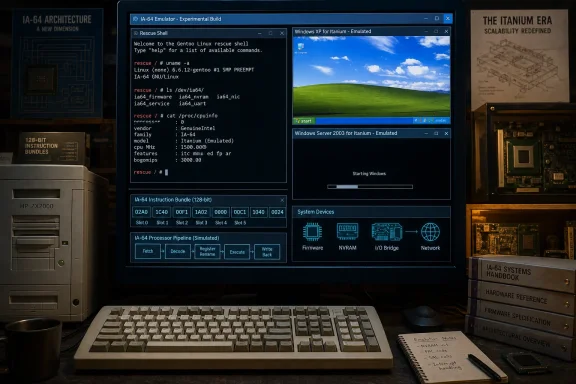
Intel Itanium, the ambitious 64-bit architecture that promised to replace the industry’s aging processor families before becoming one of computing’s most famous strategic failures, is unexpectedly sailing again through software emulation. Developers Yufeng Gao and gdwnldsKSC have produced an experimental IA-64 system emulator capable of reaching a Gentoo Linux rescue shell and running parts of Windows XP and Windows Server 2003 for Itanium, offering retrocomputing enthusiasts a rare route into an ecosystem previously trapped behind scarce, power-hungry enterprise hardware. The software is only at version 0.1, performance is extremely limited, and major operating systems remain unbootable, but successfully executing these unusually demanding guests is already a substantial technical and preservation milestone.
Intel and Hewlett-Packard began collaborating on the technology that became Itanium during the 1990s, when the server market looked considerably more diverse than it does today. Enterprises could choose among HP PA-RISC, Digital Equipment Corporation Alpha, Sun SPARC, IBM POWER, Silicon Graphics MIPS, and several other processor families, each surrounded by its own operating systems, compilers, management tools, and application ecosystem.
Itanium was intended to consolidate much of that fragmented high-end market around a common 64-bit architecture. Rather than extending the familiar x86 design, Intel and HP pursued a fundamentally different execution model known as Explicitly Parallel Instruction Computing, or EPIC.
Itanium shifted more of that burden to the compiler. Software tools were expected to examine programs in advance, find parallel work, and arrange instructions into bundles that told the processor which operations could safely execute together.
The concept was intellectually attractive. If compilers could reliably uncover enough parallelism, processors might devote fewer resources to complex scheduling hardware and more resources to performing useful work.
In practice, real software proved unpredictable. Pointer-heavy code, branches, cache misses, dependencies known only at runtime, and workloads compiled years before a new processor appeared all complicated the model.
The nickname “Itanic” captured both the scale of the original ambition and the perception that the platform was heading toward an iceberg. It was an effective insult, although it can obscure the architecture’s genuine technical sophistication and its long service in business-critical systems.
Itanium did not disappear immediately. Hewlett-Packard—and later Hewlett Packard Enterprise—continued selling Integrity servers around it, while Intel delivered multiple generations culminating in Kittson. Intel announced the processor family’s discontinuation in 2019, with final orders and shipments extending beyond that announcement rather than ending the architecture overnight.
The experimental ZX2000-oriented work attempts to reproduce enough of an HP workstation-class platform to execute firmware and begin booting unmodified operating-system media. That distinction is important: an instruction simulator can run selected binaries, whereas a useful system emulator must also imitate the machine surrounding the processor.
The current command structure exposes a ZX2000 mode, a firmware image, an NVRAM file, configurable guest memory, a CD-ROM image, and a raw hard-disk image. Serial output is directed through the host’s terminal, while emulator diagnostics can be separated through standard error.
That remains far removed from the polished experience of creating a Hyper-V or VMware virtual machine. Users must obtain legally usable firmware and installation media, prepare disk images manually, tolerate incomplete device emulation, and expect crashes or indefinite hangs.
A modern AMD Ryzen or Intel Core processor cannot execute Itanium instructions directly. Every guest operation must therefore be interpreted or translated into native host code, while preserving behavior expected by the guest.
The emulator cannot simply read one familiar variable-length x86 instruction after another. It must decode the bundle, interpret the template, apply stop semantics, evaluate predicates, and reproduce the architectural effects of operations that the original processor could issue in parallel.
A basic interpreter can handle this process sequentially, but that approach usually performs poorly. Dynamic binary translation can improve speed by converting blocks of IA-64 code into host instructions, caching the results, and reusing them, yet the translator must preserve subtle architectural guarantees.
This feature can reduce branch penalties on physical hardware, but it expands the state an emulator must track. Register rotation, speculative loads, deferred exceptions, advanced loads, branch registers, application registers, and other IA-64 mechanisms further increase complexity.
Correctness errors may not trigger an immediate crash. A mistake in predicate handling or speculative state can corrupt a value that causes a failure millions of instructions later, making diagnosis exceptionally difficult.
That register-stack engine is one of the architecture’s distinctive features. Software sees rotating and stacked registers, while the processor manages backing-store behavior when the active register frame exceeds available physical resources.
An emulator must reproduce those transitions, faults, and memory interactions accurately. Operating-system kernels and firmware are precisely the types of software likely to exercise obscure behavior that ordinary application-level tests miss.
Itanium adopted the Extensible Firmware Interface well before UEFI became standard on consumer PCs. Modern Windows users may recognize concepts such as EFI variables and boot entries, but early Itanium firmware environments reflected a different stage of that technology’s evolution.
The emulator must present enough firmware behavior for the boot manager to locate media, load an executable, establish memory mappings, and transfer control correctly. It must then continue supporting runtime services or configuration data that the operating system expects after startup.
Persistent NVRAM is particularly significant. The version 0.1 instructions require users to generate an NVRAM image and occasionally delete or recreate related files when the emulated system produces a blank screen.
A small discrepancy can halt the machine without producing an obvious error. Boot failures that resemble CPU bugs may instead result from an inaccurate timer, missing interrupt, unexpected PCI register value, or race condition exposed only after the kernel enables multitasking.
This explains why one operating system may reach a shell while another hangs much earlier. Different kernels probe hardware differently, depend on different firmware services, and make different assumptions about timing.
Windows XP 64-Bit Edition for Itanium is not Windows XP Professional x64 Edition. They target incompatible instruction sets and emerged from different phases of Microsoft’s 64-bit transition.
Windows XP Professional x64 Edition arrived later for AMD64 and Intel 64 processors. That product is the one most users mean when discussing x64 Windows XP, and it can run on many ordinary 64-bit PCs or virtual machines.
The Itanium edition cannot boot on a standard x86-64 processor merely because both are “64-bit.” IA-64 and x86-64 differ at the instruction-set level, just as an ARM executable cannot run natively on an x86 processor without an appropriate translation layer.
Even so, Windows never became Itanium’s dominant identity. The platform’s strongest deployments remained associated with HP-UX, OpenVMS, and HPE’s Integrity and NonStop environments.
Getting Windows Server 2003 to a desktop is nevertheless a powerful validation target. It exercises graphical output, storage, input, kernel scheduling, drivers, firmware interfaces, and a broad range of CPU instructions that a simple command-line test might never touch.
That turns an obscure release from a static curiosity into an inspectable system. Researchers can compare IA-64 binaries with x86 builds, examine Microsoft’s portability work, and study how Windows NT adapted to a radically different processor architecture.
The Linux kernel removed IA-64 architecture support after the 6.6 series. Toolchain and user-space projects have also retired or frozen relevant code as physical deployments decline and maintainers lose access to working systems.
For preservation purposes, Linux 6.6 and earlier kernels therefore represent a critical body of software. They remain recent enough to support relatively modern infrastructure while retaining the architecture-specific code needed to boot.
Older Ski documentation often focuses on specially configured Linux 4.19 kernels and simulator-specific virtual devices. The ZX2000-oriented work moves toward booting more realistic platform software, but compatibility still depends on kernel configuration, firmware assumptions, and available drivers.
That makes Linux an ideal debugging partner even when Windows is the more visually impressive demonstration. A Linux failure can expose missing CPU semantics or platform behavior in a way that allows a precise correction.
The same open code also provides tests for atomic operations, exception delivery, memory ordering, context switching, floating-point behavior, and system calls. Each repaired subsystem makes success with proprietary guests more likely.
Their absence from version 0.1 is therefore disappointing but unsurprising. These systems expect specific HPE hardware behavior, and legal access to firmware, media, patches, and licenses presents challenges beyond programming.
That strategy also helped end HP’s investment in its own general-purpose processor architecture. Customers moved applications to Itanium with the expectation that the new platform would remain a durable enterprise foundation.
Some of those environments survived for decades because they ran databases, manufacturing systems, billing software, and customized applications that were difficult to replace. Emulation could eventually help organizations inspect old installations or recover data, but an alpha emulator must not be mistaken for production continuity technology.
That port preserved OpenVMS through another hardware generation, but it also tied the platform to Intel and HP’s uncertain processor roadmap. VMS Software later brought OpenVMS to x86-64, creating a modern migration route unavailable during Itanium’s early years.
An IA-64 emulator would still be valuable because not every historical application, driver, clustered configuration, or system image has moved to x86-64. It could provide a laboratory for studying migration behavior without acquiring an Integrity server.
The sequence for improving compatibility will probably involve:
A Windows installation designed for a workstation with an Itanium processor and substantial memory becomes painful when every guest operation passes through a complex software translation layer. Tasks that took minutes on physical hardware can stretch into hours.
Dynamic translation can process a block of guest instructions and generate equivalent host code. The translated block is cached so subsequent executions avoid repeating much of the decoding work.
Ski includes dynamic-translation work, but adapting it to modern hosts and a fuller platform is not a trivial path to instant speed. IA-64’s instruction grouping, predication, memory ordering, faults, register stack, and self-modifying-code rules all constrain optimization.
Aggressive optimization performed too early can hide bugs or make failures nondeterministic. If Windows boots only because a timing accident masks an interrupt problem, making the CPU core faster may expose the underlying defect.
For version 0.1, reaching operating-system shells matters far more than producing attractive benchmark numbers. Performance work becomes safer after firmware, exception handling, storage, timers, and memory management behave consistently.
Multithreading also offers no automatic rescue. A single emulated processor contains ordering relationships that cannot always be divided safely among host cores, while adding symmetric multiprocessing multiplies the complexity of interrupts, atomic operations, and memory consistency.
Enterprise servers are especially vulnerable because they were expensive, produced in smaller numbers, and often discarded through controlled recycling rather than entering private collections.
A sufficiently accurate emulator preserves an interactive model. It can provide reproducible starting states, virtual disks that can be copied safely, instruction traces, snapshots, and controlled failure injection.
That is valuable for museums, universities, software historians, and engineers studying old systems. It may also help organizations document legacy applications before migration, although any operational use would require far more maturity and legal review.
Microsoft’s current translation technologies for Windows on Arm reflect lessons learned across decades of platform transitions. Users expect existing applications to run, often without understanding or caring which instruction set executes underneath.
Itanium placed unusually high expectations on compiler technology and software recompilation. AMD64 succeeded partly because it extended the x86 environment instead of demanding that the market abandon it.
A future stable build could let enthusiasts compare interfaces, binaries, service packs, drivers, and installation behavior across the IA-32, IA-64, and AMD64 editions of the Windows NT line.
The IA-64 project must emulate a foreign architecture. That places it closer to QEMU’s cross-architecture system emulation, DEC Alpha emulators, or classic Macintosh emulation than to an ordinary Windows virtual machine.
Users should therefore calibrate expectations accordingly. Slow booting and incomplete devices are normal at this stage, not evidence that the project has failed.
Windows Server 2008 and Server 2008 R2 would provide more demanding targets. Their later kernels could expose architectural omissions that Windows Server 2003 does not encounter.
Standardized virtual devices could also improve maintainability. Moving away from simulator-specific devices toward broadly understood interfaces may make guest support easier, although firmware and historical operating systems will still expect period-appropriate hardware.
Physical-hardware comparison will be crucial. Owners of functioning ZX2000, ZX6000, or related Integrity systems may be able to capture firmware screens, PCI layouts, ACPI data, and diagnostic behavior that public manuals do not fully describe.
A reusable CPU core would be especially valuable. The existing Ski code relies on global state in ways that complicate integration into modular emulators, so separating processor instances and platform devices could eventually support multiprocessing or incorporation into a broader framework.
Performance claims will also need standardized measurements. Reporting host CPU, compiler, guest configuration, storage image, emulator revision, and timed workloads would allow developers to distinguish genuine improvements from differences in setup.
Itanium will never reclaim the future once predicted for it, and this emulator will not reverse the market verdict that favored x86-64. Its importance lies elsewhere: it offers a path toward preserving one of the most ambitious and consequential detours in modern computer architecture, including Windows editions that most users have never seen running. If development continues from fragile shells and slow boot demonstrations toward accurate firmware, stable devices, reproducible installations, and eventual HP-UX or OpenVMS support, the so-called “Itanic” may finally find a durable harbor—not in a data center, but inside the portable software museums that keep computing history alive.
 Background
Intel and Hewlett-Packard began collaborating on the technology that became Itanium during the 1990s, when the server market looked considerably more diverse than it does today. Enterprises could choose among HP PA-RISC, Digital Equipment Corporation Alpha, Sun SPARC, IBM POWER, Silicon Graphics MIPS, and several other processor families, each surrounded by its own operating systems, compilers, management tools, and application ecosystem.Itanium was intended to consolidate much of that fragmented high-end market around a common 64-bit architecture. Rather than extending the familiar x86 design, Intel and HP pursued a fundamentally different execution model known as Explicitly Parallel Instruction Computing, or EPIC.
A processor designed around compiler intelligence
Conventional superscalar processors inspect an incoming instruction stream and dynamically identify operations that can execute at the same time. That approach requires significant hardware devoted to dependency analysis, scheduling, speculation, and out-of-order execution.Itanium shifted more of that burden to the compiler. Software tools were expected to examine programs in advance, find parallel work, and arrange instructions into bundles that told the processor which operations could safely execute together.
The concept was intellectually attractive. If compilers could reliably uncover enough parallelism, processors might devote fewer resources to complex scheduling hardware and more resources to performing useful work.
In practice, real software proved unpredictable. Pointer-heavy code, branches, cache misses, dependencies known only at runtime, and workloads compiled years before a new processor appeared all complicated the model.
Why “Itanic” became unavoidable
The first Itanium processor, code-named Merced, arrived later than originally expected and failed to deliver the performance revolution customers had been promised. Its weak handling of existing x86 applications further reduced its appeal, while competing server processors continued improving.The nickname “Itanic” captured both the scale of the original ambition and the perception that the platform was heading toward an iceberg. It was an effective insult, although it can obscure the architecture’s genuine technical sophistication and its long service in business-critical systems.
Itanium did not disappear immediately. Hewlett-Packard—and later Hewlett Packard Enterprise—continued selling Integrity servers around it, while Intel delivered multiple generations culminating in Kittson. Intel announced the processor family’s discontinuation in 2019, with final orders and shipments extending beyond that announcement rather than ending the architecture overnight.
What the New IA-64 Emulator Actually Does
The new emulator builds on Ski, an IA-64 instruction-set simulator with roots in Intel’s original software-development environment. Ski historically allowed developers to experiment with Itanium code without relying exclusively on physical machines, but operating a complete commercial system requires far more than decoding processor instructions.The experimental ZX2000-oriented work attempts to reproduce enough of an HP workstation-class platform to execute firmware and begin booting unmodified operating-system media. That distinction is important: an instruction simulator can run selected binaries, whereas a useful system emulator must also imitate the machine surrounding the processor.
The reported version 0.1 capabilities
The early compatibility results are uneven but promising:- Gentoo Linux can reach a rescue shell, although the boot process may stall when decompressing its SquashFS environment.
- Windows XP for Itanium can run Setup far enough to open a command shell, even though installation is reportedly too slow to be practical.
- Windows Server 2003 for Itanium has reportedly booted in development demonstrations, providing the most visually striking evidence of progress.
- FreeBSD approaches a shell before hanging, suggesting that the CPU and platform implementations are already sufficiently complete to execute substantial amounts of kernel code.
- Ubuntu and Debian begin booting but stall, potentially because of kernel expectations, timing behavior, missing devices, or incomplete platform support.
- HP-UX and OpenVMS do not yet boot, leaving the two operating-system families most closely associated with mature Itanium deployments out of reach.
Emulating an HP ZX2000-style machine
The HP workstation environment presents the guest with more than an IA-64 CPU. The emulator must provide firmware, nonvolatile configuration storage, memory, serial communication, optical and hard-disk devices, interrupts, timers, and sufficient chipset behavior for an operating system to recognize the machine.The current command structure exposes a ZX2000 mode, a firmware image, an NVRAM file, configurable guest memory, a CD-ROM image, and a raw hard-disk image. Serial output is directed through the host’s terminal, while emulator diagnostics can be separated through standard error.
That remains far removed from the polished experience of creating a Hyper-V or VMware virtual machine. Users must obtain legally usable firmware and installation media, prepare disk images manually, tolerate incomplete device emulation, and expect crashes or indefinite hangs.
Why IA-64 Is So Difficult to Emulate
Every full-system emulator must translate the behavior of one machine into operations that another machine can perform. IA-64 makes that task unusually demanding because its architectural state, instruction representation, memory behavior, privilege model, and firmware environment differ sharply from today’s mainstream x86-64 hosts.A modern AMD Ryzen or Intel Core processor cannot execute Itanium instructions directly. Every guest operation must therefore be interpreted or translated into native host code, while preserving behavior expected by the guest.
Instruction bundles and execution templates
IA-64 instructions are grouped into 128-bit bundles. Each bundle contains three instruction slots and a template describing their types and relationships, including where execution groups stop.The emulator cannot simply read one familiar variable-length x86 instruction after another. It must decode the bundle, interpret the template, apply stop semantics, evaluate predicates, and reproduce the architectural effects of operations that the original processor could issue in parallel.
A basic interpreter can handle this process sequentially, but that approach usually performs poorly. Dynamic binary translation can improve speed by converting blocks of IA-64 code into host instructions, caching the results, and reusing them, yet the translator must preserve subtle architectural guarantees.
Predication and speculative execution
Itanium makes extensive use of predicated instructions. Rather than branching around a small operation, the compiler can arrange for that operation to execute only when an associated predicate register contains the appropriate value.This feature can reduce branch penalties on physical hardware, but it expands the state an emulator must track. Register rotation, speculative loads, deferred exceptions, advanced loads, branch registers, application registers, and other IA-64 mechanisms further increase complexity.
Correctness errors may not trigger an immediate crash. A mistake in predicate handling or speculative state can corrupt a value that causes a failure millions of instructions later, making diagnosis exceptionally difficult.
A large architectural register set
IA-64 exposes 128 general-purpose integer registers and 128 floating-point registers, alongside predicate registers, branch registers, control registers, application registers, and specialized state. It also supports a register stack mechanism designed to reduce the overhead of procedure calls.That register-stack engine is one of the architecture’s distinctive features. Software sees rotating and stacked registers, while the processor manages backing-store behavior when the active register frame exceeds available physical resources.
An emulator must reproduce those transitions, faults, and memory interactions accurately. Operating-system kernels and firmware are precisely the types of software likely to exercise obscure behavior that ordinary application-level tests miss.
Firmware Is as Important as the Processor
A CPU emulator alone does not create a bootable computer. Operating systems expect a defined platform with firmware services, hardware-description tables, interrupt controllers, timers, storage controllers, and persistent settings.Itanium adopted the Extensible Firmware Interface well before UEFI became standard on consumer PCs. Modern Windows users may recognize concepts such as EFI variables and boot entries, but early Itanium firmware environments reflected a different stage of that technology’s evolution.
EFI before it became ordinary PC infrastructure
Microsoft’s Itanium editions of Windows were built to boot through EFI rather than the legacy PC BIOS process associated with contemporary 32-bit Windows systems. Linux and commercial Unix platforms also relied on Itanium-specific firmware and platform conventions.The emulator must present enough firmware behavior for the boot manager to locate media, load an executable, establish memory mappings, and transfer control correctly. It must then continue supporting runtime services or configuration data that the operating system expects after startup.
Persistent NVRAM is particularly significant. The version 0.1 instructions require users to generate an NVRAM image and occasionally delete or recreate related files when the emulated system produces a blank screen.
ACPI, PCI, interrupts, and timers
Once the operating-system loader starts, platform emulation becomes increasingly demanding. The kernel queries ACPI information, discovers devices, initializes interrupt routing, configures timers, establishes virtual-memory structures, and begins scheduling work.A small discrepancy can halt the machine without producing an obvious error. Boot failures that resemble CPU bugs may instead result from an inaccurate timer, missing interrupt, unexpected PCI register value, or race condition exposed only after the kernel enables multitasking.
This explains why one operating system may reach a shell while another hangs much earlier. Different kernels probe hardware differently, depend on different firmware services, and make different assumptions about timing.
Windows on Itanium Returns to View
For Windows enthusiasts, the emulator’s most immediately compelling achievement is its apparent ability to run Itanium editions of Windows XP and Windows Server 2003. These releases occupy an unusual corner of Microsoft history and are frequently confused with the much more familiar x64 editions designed for AMD64-compatible processors.Windows XP 64-Bit Edition for Itanium is not Windows XP Professional x64 Edition. They target incompatible instruction sets and emerged from different phases of Microsoft’s 64-bit transition.
Two different meanings of 64-bit Windows XP
Microsoft initially released Windows XP 64-Bit Edition for first-generation Itanium systems in 2001. A revised Version 2003 followed for Itanium 2 hardware and shared more of its foundation with Windows Server 2003.Windows XP Professional x64 Edition arrived later for AMD64 and Intel 64 processors. That product is the one most users mean when discussing x64 Windows XP, and it can run on many ordinary 64-bit PCs or virtual machines.
The Itanium edition cannot boot on a standard x86-64 processor merely because both are “64-bit.” IA-64 and x86-64 differ at the instruction-set level, just as an ARM executable cannot run natively on an x86 processor without an appropriate translation layer.
Why Windows Server 2003 matters
Windows Server 2003 was a more strategically important Itanium product than desktop XP. Microsoft offered Itanium editions for workloads requiring large memory capacity and enterprise scalability, while later Windows Server releases continued supporting the platform through Windows Server 2008 R2.Even so, Windows never became Itanium’s dominant identity. The platform’s strongest deployments remained associated with HP-UX, OpenVMS, and HPE’s Integrity and NonStop environments.
Getting Windows Server 2003 to a desktop is nevertheless a powerful validation target. It exercises graphical output, storage, input, kernel scheduling, drivers, firmware interfaces, and a broad range of CPU instructions that a simple command-line test might never touch.
A museum exhibit users can eventually operate
Screenshots preserve appearance, but emulation preserves behavior. A functioning Windows IA-64 installation can reveal its control panels, architecture-specific system files, device assumptions, administrative tools, installation process, and software limitations.That turns an obscure release from a static curiosity into an inspectable system. Researchers can compare IA-64 binaries with x86 builds, examine Microsoft’s portability work, and study how Windows NT adapted to a radically different processor architecture.
Linux Support Exposes a Closing Preservation Window
Linux supported IA-64 for more than two decades, providing an invaluable open-source record of the architecture’s boot process, memory management, exception handling, and device initialization. That support has now largely receded from active upstream development.The Linux kernel removed IA-64 architecture support after the 6.6 series. Toolchain and user-space projects have also retired or frozen relevant code as physical deployments decline and maintainers lose access to working systems.
Why Linux 6.6 is a practical boundary
An emulator does not automatically restore architecture support to current kernels. If upstream Linux no longer contains IA-64 code, a new kernel cannot target Itanium without maintaining an external port or reversing the removal.For preservation purposes, Linux 6.6 and earlier kernels therefore represent a critical body of software. They remain recent enough to support relatively modern infrastructure while retaining the architecture-specific code needed to boot.
Older Ski documentation often focuses on specially configured Linux 4.19 kernels and simulator-specific virtual devices. The ZX2000-oriented work moves toward booting more realistic platform software, but compatibility still depends on kernel configuration, firmware assumptions, and available drivers.
The importance of open source in emulator debugging
Linux offers one advantage that HP-UX and Windows cannot: developers can inspect the complete kernel source. When booting stops, emulator authors can trace the guest program counter to a specific function, examine expected register state, insert diagnostics, and compare behavior with the architectural manuals.That makes Linux an ideal debugging partner even when Windows is the more visually impressive demonstration. A Linux failure can expose missing CPU semantics or platform behavior in a way that allows a precise correction.
The same open code also provides tests for atomic operations, exception delivery, memory ordering, context switching, floating-point behavior, and system calls. Each repaired subsystem makes success with proprietary guests more likely.
HP-UX and OpenVMS Remain the Critical Targets
Windows may attract the broadest retrocomputing audience, but HP-UX and OpenVMS are the operating systems that would transform this emulator from an impressive experiment into a major preservation platform. Both became deeply intertwined with Itanium’s enterprise history.Their absence from version 0.1 is therefore disappointing but unsurprising. These systems expect specific HPE hardware behavior, and legal access to firmware, media, patches, and licenses presents challenges beyond programming.
HP-UX and the end of PA-RISC
HP-UX began long before Itanium and ran on several generations of Hewlett-Packard hardware, most notably PA-RISC. HP’s commitment to IA-64 gave customers an officially supported migration path from PA-RISC servers to Integrity systems.That strategy also helped end HP’s investment in its own general-purpose processor architecture. Customers moved applications to Itanium with the expectation that the new platform would remain a durable enterprise foundation.
Some of those environments survived for decades because they ran databases, manufacturing systems, billing software, and customized applications that were difficult to replace. Emulation could eventually help organizations inspect old installations or recover data, but an alpha emulator must not be mistaken for production continuity technology.
OpenVMS after Alpha
OpenVMS followed an equally consequential path. The operating system originated on VAX, transitioned to DEC Alpha, and was subsequently ported to Itanium after Compaq announced that Alpha development would end.That port preserved OpenVMS through another hardware generation, but it also tied the platform to Intel and HP’s uncertain processor roadmap. VMS Software later brought OpenVMS to x86-64, creating a modern migration route unavailable during Itanium’s early years.
An IA-64 emulator would still be valuable because not every historical application, driver, clustered configuration, or system image has moved to x86-64. It could provide a laboratory for studying migration behavior without acquiring an Integrity server.
Why these guests will be harder
HP-UX and OpenVMS may rely on platform features that Windows and Linux do not use in the same way. They may also validate hardware identities, expect particular storage controllers, depend on management processors, or use firmware interfaces whose behavior is poorly documented publicly.The sequence for improving compatibility will probably involve:
- Capturing the earliest point of failure through serial output, firmware logs, or instruction tracing.
- Determining whether the failure originates in CPU semantics, firmware, memory layout, or a device model.
- Comparing behavior against physical ZX2000 or Integrity hardware whenever a suitable machine remains available.
- Implementing the missing behavior without breaking guests that already boot.
- Building repeatable regression tests so future performance work does not silently reduce accuracy.
Performance Is the Project’s Most Visible Limitation
Reports describing performance as roughly comparable to a 486-class machine on a Ryzen 5000-series host should be treated as an informal impression rather than a controlled benchmark. Even so, they communicate the essential reality: the emulator is currently extremely slow.A Windows installation designed for a workstation with an Itanium processor and substantial memory becomes painful when every guest operation passes through a complex software translation layer. Tasks that took minutes on physical hardware can stretch into hours.
Interpretation versus dynamic translation
The simplest emulator repeatedly fetches a guest instruction, decodes it, performs the equivalent operation, updates guest state, and moves to the next instruction. This is easier to validate but imposes enormous overhead.Dynamic translation can process a block of guest instructions and generate equivalent host code. The translated block is cached so subsequent executions avoid repeating much of the decoding work.
Ski includes dynamic-translation work, but adapting it to modern hosts and a fuller platform is not a trivial path to instant speed. IA-64’s instruction grouping, predication, memory ordering, faults, register stack, and self-modifying-code rules all constrain optimization.
Accuracy must come before speed
Early emulator development frequently alternates between two modes. A slower, easily inspected path establishes correct behavior, while a faster translation engine handles code only after its semantics are trusted.Aggressive optimization performed too early can hide bugs or make failures nondeterministic. If Windows boots only because a timing accident masks an interrupt problem, making the CPU core faster may expose the underlying defect.
For version 0.1, reaching operating-system shells matters far more than producing attractive benchmark numbers. Performance work becomes safer after firmware, exception handling, storage, timers, and memory management behave consistently.
Host hardware will not solve everything
Moving from a Ryzen 5000 system to a newer high-end desktop could improve raw speed, but it will not eliminate architectural translation costs. Emulator design, code-cache efficiency, memory-access patterns, branch behavior, and synchronization overhead may matter more than the host’s advertised frequency.Multithreading also offers no automatic rescue. A single emulated processor contains ordering relationships that cannot always be divided safely among host cores, while adding symmetric multiprocessing multiplies the complexity of interrupts, atomic operations, and memory consistency.
The Broader Value of Architecture Emulation
Retrocomputing emulators are sometimes dismissed as entertainment, but they perform an increasingly important archival function. Physical computers decay, documentation disappears, installation media degrades, and specialized knowledge leaves the workforce.Enterprise servers are especially vulnerable because they were expensive, produced in smaller numbers, and often discarded through controlled recycling rather than entering private collections.
Preserving systems rather than screenshots
A photograph can show an Integrity server’s front panel. A video can demonstrate Windows or OpenVMS running on it. Neither allows a researcher to issue commands, inspect the filesystem, test an application, or observe the boot process.A sufficiently accurate emulator preserves an interactive model. It can provide reproducible starting states, virtual disks that can be copied safely, instruction traces, snapshots, and controlled failure injection.
That is valuable for museums, universities, software historians, and engineers studying old systems. It may also help organizations document legacy applications before migration, although any operational use would require far more maturity and legal review.
Lessons for current processor transitions
Itanium’s history remains relevant as Windows expands across x86-64 and Arm. The central challenge has not changed: processor architectures succeed through software compatibility, developer tooling, performance, availability, and economic momentum—not architectural elegance alone.Microsoft’s current translation technologies for Windows on Arm reflect lessons learned across decades of platform transitions. Users expect existing applications to run, often without understanding or caring which instruction set executes underneath.
Itanium placed unusually high expectations on compiler technology and software recompilation. AMD64 succeeded partly because it extended the x86 environment instead of demanding that the market abandon it.
Implications for Windows Enthusiasts
The emulator will not turn Itanium Windows into a practical daily operating system. Its value lies in making a nearly inaccessible branch of the Windows family available for examination.A future stable build could let enthusiasts compare interfaces, binaries, service packs, drivers, and installation behavior across the IA-32, IA-64, and AMD64 editions of the Windows NT line.
What prospective users will need
Anyone experimenting with the alpha should expect a developer-oriented process rather than a consumer virtualization product. A typical workflow involves:- Preparing a supported Linux host, with Ubuntu 24.04 identified as the tested environment for the available version 0.1 build.
- Obtaining appropriate firmware and operating-system media legally, because the emulator does not erase licensing or copyright obligations.
- Creating NVRAM and raw disk images using command-line utilities.
- Launching the emulator with explicit firmware, memory, CD-ROM, and disk parameters.
- Monitoring serial output and preserving logs when the guest hangs.
- Expecting to recreate NVRAM state if firmware configuration becomes unusable.
- Keeping the environment offline, especially when running unsupported Windows releases.
Not a replacement for Hyper-V
Hyper-V, VMware, VirtualBox, and similar products generally virtualize machines whose guests share the host’s basic processor architecture. Most guest instructions can execute directly on the CPU, with hardware virtualization extensions controlling privileged operations.The IA-64 project must emulate a foreign architecture. That places it closer to QEMU’s cross-architecture system emulation, DEC Alpha emulators, or classic Macintosh emulation than to an ordinary Windows virtual machine.
Users should therefore calibrate expectations accordingly. Slow booting and incomplete devices are normal at this stage, not evidence that the project has failed.
Strengths and Opportunities
The emulator’s early condition should not hide the importance of what has already been demonstrated. Several characteristics give the project meaningful potential:- It addresses a major preservation gap. IA-64 operating systems have remained difficult to access without physical HP hardware.
- It builds on established Ski technology. Reusing an existing instruction simulator provides a stronger foundation than beginning with an entirely new CPU core.
- It has reached real operating-system code. Gentoo and Windows shells exercise substantially more functionality than isolated instruction tests.
- Its ZX2000 focus provides a concrete hardware target. Reproducing one defined workstation is more manageable than attempting to emulate every Integrity server.
- Linux offers a powerful debugging environment. Source availability can help developers identify architectural and platform defects.
- Windows creates broad community interest. Visible Windows XP and Server 2003 demonstrations can attract testers, documentation, and development assistance.
- OpenVMS and HP-UX offer high historical value. Supporting either would preserve systems that played a central role in Itanium’s commercial life.
- The work may eventually benefit other emulators. A cleaner, reusable IA-64 core or improved device models could contribute to broader QEMU-style system emulation.
Risks and Concerns
The project also faces substantial technical, legal, and practical obstacles that could prevent it from becoming a broadly usable preservation environment:- Version 0.1 is highly experimental. Boot screenshots do not establish complete instruction accuracy, stable storage, reliable networking, or repeatable installations.
- Performance may discourage testers. If routine installations require many hours, the feedback cycle becomes slow and expensive.
- Firmware availability can be restrictive. Users may need platform firmware that cannot legally be redistributed with the emulator.
- Operating-system licensing remains complicated. Commercial HP-UX, OpenVMS, and Windows media cannot automatically be treated as freely distributable historical artifacts.
- Hardware documentation may be incomplete. Proprietary chipset behavior and management interfaces can require reverse engineering.
- Timing bugs can masquerade as CPU failures. Differences in interrupt delivery, storage latency, and scheduling may cause guest-specific hangs.
- Security is effectively absent for old guests. Unsupported operating systems should be isolated from production networks and sensitive data.
- Project sustainability is uncertain. Highly specialized emulators often depend on a very small number of contributors.
- Enterprise users could misinterpret the project’s purpose. An alpha emulator is not a supported disaster-recovery platform or a substitute for migrating legacy workloads.
What to Watch Next
The next phase will reveal whether this release is a fascinating demonstration or the beginning of a sustainable IA-64 preservation ecosystem. Progress should be evaluated through repeatability and technical coverage rather than screenshots alone.More complete Windows installations
A full installation of Windows XP or Windows Server 2003 that survives reboots, detects stable storage, and reaches a consistently usable desktop would be a significant milestone. Driver availability and graphical acceleration are less important initially than reliable basic devices.Windows Server 2008 and Server 2008 R2 would provide more demanding targets. Their later kernels could expose architectural omissions that Windows Server 2003 does not encounter.
A reproducible modern Linux boot
A documented Linux configuration based on the final IA-64-supporting kernel line would give developers a relatively modern and inspectable test environment. Repeatable boot scripts, known disk images, and automated regression checks would substantially lower the barrier for contributors.Standardized virtual devices could also improve maintainability. Moving away from simulator-specific devices toward broadly understood interfaces may make guest support easier, although firmware and historical operating systems will still expect period-appropriate hardware.
OpenVMS or HP-UX firmware progress
Even reaching an OpenVMS or HP-UX boot loader would provide useful evidence about missing platform features. Serial-console output from early kernel initialization could turn an opaque blank screen into a tractable engineering problem.Physical-hardware comparison will be crucial. Owners of functioning ZX2000, ZX6000, or related Integrity systems may be able to capture firmware screens, PCI layouts, ACPI data, and diagnostic behavior that public manuals do not fully describe.
A public, maintainable code path
The long-term outlook will depend on how much of the newest work becomes available in a clearly maintained repository. Source access encourages review, portability fixes, regression testing, and preservation beyond the original developers’ involvement.A reusable CPU core would be especially valuable. The existing Ski code relies on global state in ways that complicate integration into modular emulators, so separating processor instances and platform devices could eventually support multiprocessing or incorporation into a broader framework.
Meaningful performance improvements
Optimization should follow correctness, but users will eventually need faster execution. Useful developments could include improved block translation, better register-state mapping, more efficient memory access, translation-cache persistence, and specialized handling for frequently executed firmware or kernel paths.Performance claims will also need standardized measurements. Reporting host CPU, compiler, guest configuration, storage image, emulator revision, and timed workloads would allow developers to distinguish genuine improvements from differences in setup.
Itanium will never reclaim the future once predicted for it, and this emulator will not reverse the market verdict that favored x86-64. Its importance lies elsewhere: it offers a path toward preserving one of the most ambitious and consequential detours in modern computer architecture, including Windows editions that most users have never seen running. If development continues from fragile shells and slow boot demonstrations toward accurate firmware, stable devices, reproducible installations, and eventual HP-UX or OpenVMS support, the so-called “Itanic” may finally find a durable harbor—not in a data center, but inside the portable software museums that keep computing history alive.
References
- Primary source: Hackaday
Published: 2026-07-20T23:00:00+00:00
Loading…
hackaday.com