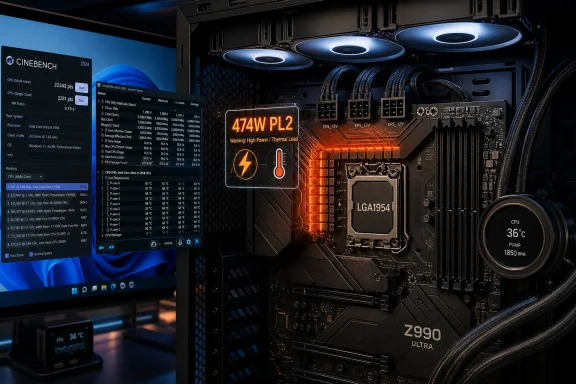
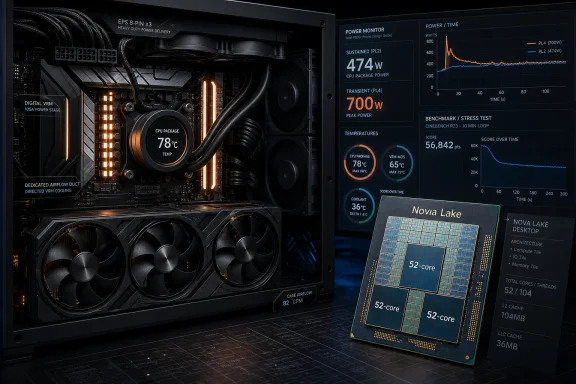
Intel’s rumored Nova Lake-S flagship desktop processor may allow a short-duration PL2 turbo limit of up to 474 watts on some Z990 motherboards, according to fresh June 26, 2026 leaks describing revised Intel platform power guidance. If accurate, that number would not mean every next-generation Intel desktop suddenly becomes a space heater. It would mean Intel is preparing the electrical and motherboard ecosystem for a much more aggressive top-end part than today’s Arrow Lake chips. The real story is not the third power connector; it is Intel’s apparent willingness to make the enthusiast desktop platform look more like a compact workstation.
For the past two years, Intel’s desktop problem has been as much narrative as silicon. Arrow Lake brought a new tiled architecture and better efficiency characteristics in some workloads, but it did not deliver the clean across-the-board performance reset enthusiasts wanted after the Raptor Lake instability saga and AMD’s sustained pressure with Ryzen X3D parts. Nova Lake has therefore become the next big promise: the point where Intel is supposed to reassert itself on the high-end desktop.
The leaked 474W PL2 figure gives that promise a very specific shape. A 52-core desktop chip, reportedly built from dual compute tiles, is not merely a faster successor to a 24-core Core Ultra 9 285K. It is a different kind of product wearing a consumer-platform suit.
That matters because Intel’s mainstream desktop socket has long carried two competing identities. It must serve the ordinary Windows gaming tower, the boutique liquid-cooled showpiece, the compile box under a developer’s desk, and the prosumer workstation that someone insists is “just a desktop.” A nearly 500W turbo ceiling pushes that last identity to the front.
The number also arrives with a caveat large enough to print on the motherboard box. These are leaks, not launch specifications. Intel has confirmed Nova Lake for the end of 2026, but it has not publicly confirmed a 52-core flagship, a 474W PL2 target, Z990 connector rules, or the final segmentation of its 900-series boards.
Still, platform leaks are often revealing even when individual details shift. Motherboards have long lead times, vendors need electrical guidance early, and power delivery choices are hard to hide once prototype boards begin circulating. If the exact 474W figure changes, the direction of travel is harder to dismiss.
That distinction is important because enthusiast motherboards have spent years turning electrical overprovisioning into a marketing language. More phases, bigger heatsinks, extra connectors, heavier PCBs, and dramatic shrouds all imply headroom, even when the practical difference for stock users is modest. A board vendor can add connector capacity because it wants cleaner current distribution, better thermals under sustained stress, overclocking margin, or simply a louder spec sheet.
The reporting around the latest leak already points in that direction. One leaker described revised Z990 power design guidance reserving 474W for nominal performance on dual-compute-tile parts, while another pushed back that triple connectors are a vendor-enabled convenience rather than a new CPU performance tier. In plain English: some high-end Z990 boards may ship with three CPU power inputs, but that does not mean a two-connector board is automatically second-class for stock operation.
This is the sort of nuance that gets lost when motherboard photographs hit social media. The visual drama of three connectors is obvious. The electrical story is duller and more consequential: Intel and its partners appear to be planning a platform where the top chip can demand enormous short-term current while remaining inside the officially intended performance envelope.
That would put Z990 board selection under a brighter light than usual. For years, many builders have treated the chipset name as the practical dividing line: buy the Z-series board, get the unlocked CPU, move on. Nova Lake may make the board’s power class more important than the badge on the heatsink.
That does not make it irrelevant. A 474W PL2 target, if it survives into retail guidance, would still shape cooling recommendations, motherboard validation, PSU sizing, case airflow, acoustic expectations, and the outer edge of stock behavior. Even if the CPU only visits that region during heavy all-core boost, it still has to be fed, cooled, and controlled.
The comparison to Arrow Lake is stark. Intel’s Core Ultra 9 285K is a 24-core, 24-thread desktop flagship with a 125W processor base power and a 250W maximum turbo power in Intel’s official materials. A rumored 52-core Nova Lake chip with a 474W PL2 would almost double the maximum turbo envelope while more than doubling the core count.
That does not automatically mean worse efficiency. If Nova Lake delivers substantially more throughput at that higher limit, performance per watt could still improve in heavily threaded workloads. But it does mean Intel’s top desktop part would be using a bigger absolute power window to chase leadership, and absolute power is what users experience as heat, noise, motherboard cost, and PSU anxiety.
There is also a psychological dimension. Intel spent much of the last several product cycles trying to defend itself against the perception that high-end performance came from brute force. A nearly 500W headline, fairly or not, will revive that argument unless the benchmark wins are large enough to drown it out.
The rumored structure—widely discussed as up to 16 performance cores, 32 efficiency cores, and additional low-power cores in some configurations—would give Intel a far denser desktop part than its current mainstream offerings. That would be meaningful for rendering, compiling, encoding, virtualization, simulation, software development, and other tasks that scale beyond the usual gaming sweet spot. It would also give Intel a desktop answer to the kind of core-count escalation that has historically forced users into Threadripper or Xeon territory.
But Windows users should be careful about what “52 cores” means. Hybrid CPU scheduling has matured since Alder Lake, and Windows 11 is much better at handling Intel’s mix of P-cores and E-cores than early adopters remember. Even so, not every workload scales cleanly across heterogeneous cores, and not every application benefits from a massive thread pool.
Gaming is the obvious pressure point. The fastest gaming CPU is often not the one with the most cores or the largest PL2 value. AMD’s X3D chips have repeatedly shown that cache topology, latency, scheduler behavior, and power efficiency can beat raw package ambition in many games. Intel’s reported big last-level cache plans for Nova Lake may be aimed squarely at that lesson, but core count alone will not settle the matter.
That is why the 474W rumor should be read less as a gaming claim and more as a platform claim. Intel appears to be preparing a consumer-accessible board ecosystem capable of feeding a processor that straddles gaming, creation, and workstation-adjacent workloads. The question is whether buyers will see that as flexibility or as overreach.
That is not unusual for Intel transitions, but this one has sharper edges. Arrow Lake already required a move to LGA1851 and 800-series boards. Nova Lake is expected to move again, reportedly to LGA1954 and 900-series chipsets. For Windows enthusiasts who built new systems recently, that is another reminder that Intel’s desktop roadmap has not been kind to long-lived sockets.
The rumored segmentation is also more complex than the old “cheap board versus expensive board” split. Leakers have described board classes around 35W, 65W, 125W, and 175W targets, along with Baseline, Value, and Performance positioning. If that framework is accurate, CPU behavior may depend more explicitly on whether the board is rated for the processor’s intended power profile.
That would be a healthy development if it is communicated clearly. The industry has spent too long hiding real-world CPU behavior behind vague motherboard defaults, multi-core enhancement toggles, and “unlimited” settings that differ by vendor. Clearer board classes could help buyers understand what they are actually purchasing.
The danger is that the opposite happens. If vendors treat power class as another branding layer instead of a transparent capability, users will face a thicket of Z990 boards that look similar but behave differently under a 44-core or 52-core CPU. The enthusiast market can tolerate complexity; it has less patience for surprises after a $500 motherboard purchase.
That makes the rumored “nominal performance” framing around 474W notable. If Intel is telling board partners to reserve that much power for the intended stock behavior of dual-tile parts, it suggests an attempt to define the line between supported boost and overclocking more cleanly. The phrase reportedly attached to the leak—power above 474W being associated with dual-die overclocking—matters because it draws a boundary.
Boundaries are good. The old enthusiast bargain too often blurred the line between stock, enhanced, and overclocked operation until users discovered the distinction only when thermals, stability, or warranty conversations became inconvenient. A high official limit may look alarming, but a clearly specified high limit is preferable to a lower nominal number that board vendors quietly ignore.
For sysadmins and small-business workstation buyers, this is not academic. A machine used for code builds, local AI experimentation, virtualization, or video work must be predictable. If a CPU’s true behavior depends on whichever motherboard default happened to ship with BIOS version 0603, platform trust suffers.
Intel’s challenge is to prove that Nova Lake’s top-end aggression is engineered rather than improvised. That means launch-day documentation, BIOS discipline, validation consistency, and honest language about cooling. A 474W PL2 can be defended as a burst ceiling for a monster desktop chip; it becomes harder to defend if the retail experience turns into another motherboard-default lottery.
That does not mean the CPU will run at 474W continuously. Many modern processors are thermally limited before they are electrically limited, and firmware may pull power down quickly depending on temperature and workload. But transient heat still matters. A cooler that cannot absorb and move that heat efficiently will force clocks down, increase noise, or both.
The socket and package design will matter too. Dual compute tiles may distribute heat differently from monolithic dies or smaller chiplet arrangements. A cooler can have excellent total dissipation capacity and still struggle if heat density or contact geometry is unfavorable. Enthusiasts learned similar lessons across earlier generations where cold-plate design, mounting pressure, and hotspot placement affected results.
Case design is another quiet casualty. The GPU has already become the dominant thermal object in many gaming systems, with high-end cards routinely occupying several slots and dumping hundreds of watts into the chassis. Add a CPU capable of very high short-term package power, and the old mid-tower with decorative glass and two tired intake fans starts to look less like a gaming PC and more like a convection experiment.
For WindowsForum’s audience, this is where the rumor becomes actionable even before launch. If Nova Lake is on your upgrade horizon, the motherboard is not the only component to scrutinize. PSU capacity, EPS cable quality, radiator placement, VRM airflow, and chassis ventilation all become part of the CPU decision.
The good news is that a 474W CPU turbo target does not mean a system needs a 474W bigger PSU than before. Real workloads vary, GPU and CPU peaks do not always align, and quality power supplies can handle short excursions gracefully. The bad news is that builders have become accustomed to spec-sheet optimism and cable reuse habits that do not age well.
A plausible Nova Lake flagship paired with a high-end GPU could make 1000W feel like the new sensible floor for serious builds, with 1200W or more becoming unsurprising for quiet operation and overclocking headroom. That will not apply to mainstream Nova Lake systems. It will apply to the kind of machine that buys a 52-core K-series chip on day one.
The connector detail also raises an old but important warning: do not improvise high-current cabling. Splitters, adapters, mixed modular PSU cables, and reused leads from a different supply are where expensive systems go to become forum troubleshooting threads. If Z990 boards arrive with two or three CPU power inputs, builders should follow the motherboard and PSU vendor guidance rather than treating every 8-pin plug as interchangeable decoration.
This is especially relevant to Windows power users who build once and then upgrade piecemeal. A PSU that was reasonable for a 12th-gen or 13th-gen system may not be the right companion for a dual-tile Nova Lake flagship and a contemporary GPU. The power supply is no longer the boring box you overbuy and forget for a decade.
That is why reports of big last-level cache on Nova Lake are more strategically important than the raw PL2 figure. If Intel can combine high core counts with a cache structure that materially improves gaming and creator workloads, Nova Lake becomes more than a brute-force response. If not, the 474W headline becomes ammunition for every critic who thinks Intel’s desktop strategy is still addicted to wattage.
There is also the segmentation problem. A 52-core flagship may be spectacular in productivity tests and unnecessary for most gamers. Intel will need compelling lower-tier Nova Lake parts that deliver the architecture’s benefits without requiring exotic boards or cooling. The real volume battle will not be fought by the most absurd SKU.
This is where Z970, B960, and more modest Nova Lake configurations could matter. A healthy platform is not defined solely by its halo CPU; it is defined by whether the architecture scales down gracefully into systems people actually buy. Intel can win headlines with 52 cores, but it wins back desktop trust with parts that make sense at 65W, 125W, and ordinary case temperatures.
The best version of Nova Lake is therefore not a single monster chip. It is a stack where the monster establishes capability, the midrange restores competitiveness, and the platform does not punish users for choosing something below the flagship.
Microsoft and Intel have improved this dance since the earliest Alder Lake days. Thread Director-style hints, Windows 11 scheduling updates, and application awareness have made hybrid desktops much less exotic than they once were. But “less exotic” is not the same as invisible, especially for older software, anti-cheat systems, virtual machines, audio production tools, and latency-sensitive workloads.
Security features add another wrinkle. Many Windows 11 systems run with virtualization-based security, memory integrity, TPM-backed features, and background Defender activity enabled. These features are not optional in many managed environments, and they can interact with performance claims in ways that benchmark charts do not always reflect. Intel’s launch comparisons will need to be read carefully for configuration details.
Administrators should also watch manageability segmentation. Intel’s commercial desktop features, stable platform programs, and firmware support policies often matter more to business fleets than peak Cinebench scores. If Nova Lake’s most interesting silicon lands primarily in enthusiast-class boards, small shops may face a choice between raw local compute and the predictable lifecycle features they prefer.
For developers and power users, though, the appeal is obvious. A 44-core or 52-core desktop-class box that runs Windows, fits under a desk, and compiles large projects or hosts multiple test VMs could be enormously useful. The trick is making sure it behaves like a workstation, not a science project.
The useful part is real engineering. Higher-current designs need robust VRMs, sensible heatsinks, good PCB layout, and firmware that enforces Intel’s intended profiles. The best boards will not simply advertise more connectors; they will sustain the right behavior quietly and consistently under heavy load.
The theater will be familiar. Expect boards with armored everything, unnecessary displays, inflated overclocking language, and price tags that treat “Nova Lake ready” as a license to print margin. Enthusiasts know this game, but the stakes rise when the CPU itself may have different default behavior depending on board capability.
Reviewers will have a larger burden than usual. Testing Nova Lake only on a flagship board with unconstrained settings will not tell buyers how the platform behaves across the stack. The difference between a 175W Performance board, a lower-rated board, and a vendor-overbuilt halo model could be central to the ownership experience.
This is where transparent BIOS defaults become essential. If Intel has learned from the last few years, it should push vendors toward profiles that are named clearly, documented honestly, and easy to restore. The market can handle “Intel default,” “performance,” and “overclocked” as long as those words mean something.
Intel’s tiled architecture is part of that shift. Once compute tiles can be combined, product planning becomes more flexible but also more complicated. The line between mainstream desktop, high-end desktop, and workstation begins to blur not because the labels disappear, but because the same socket may host configurations that used to live in different categories.
That may be exactly what Intel wants. Traditional HEDT platforms have been inconsistent in recent years, and many enthusiasts have either stayed on mainstream sockets or moved to AMD’s Threadripper ecosystem when they needed serious core counts. A monster Nova Lake-S part could give Intel a way to bring some HEDT energy back to the consumer desktop without resurrecting the old platform model wholesale.
But convergence has costs. The more the mainstream platform is stretched upward, the more buyers must understand which parts of the platform they actually need. A gamer does not need to pay for a motherboard designed to pamper a 52-core CPU at heavy all-core boost. A developer who does need that capability should not cheap out on the board and then blame the silicon.
This is the uncomfortable future of PC building: more capability, more specialization, and fewer one-size-fits-all recommendations. The days when “buy the i7, buy the Z board, buy a decent cooler” covered most serious builds are gone.
For most Windows gamers, the answer may be that the 52-core part is irrelevant. The more interesting Nova Lake SKUs will be the ones with strong gaming cache behavior, high single-thread performance, reasonable thermals, and prices that do not require a motherboard worthy of a lab bench. If Intel nails those, the flagship can be as excessive as it wants.
For creators and developers, the calculus is different. A high-core-count desktop CPU can save time every day, and time is the one component nobody can upgrade later. If Nova Lake offers workstation-like throughput on a consumer-adjacent platform, the power draw may be acceptable as long as the system is stable, coolable, and well documented.
For IT pros, the question is supportability. A nearly 500W turbo ceiling inside a desktop tower introduces noise, thermal density, and lifecycle concerns that matter in offices and labs. If these machines are deployed for local compute, they will need workstation discipline: validated parts, consistent BIOS profiles, monitored thermals, and sober expectations.
The worst use of this rumor would be to turn it into a brand-war slogan. The best use is to recognize that Intel’s next desktop generation may demand more careful platform matching than any mainstream Intel launch in years.
 Intel’s Desktop Comeback Now Has a Power Budget Attached
For the past two years, Intel’s desktop problem has been as much narrative as silicon. Arrow Lake brought a new tiled architecture and better efficiency characteristics in some workloads, but it did not deliver the clean across-the-board performance reset enthusiasts wanted after the Raptor Lake instability saga and AMD’s sustained pressure with Ryzen X3D parts. Nova Lake has therefore become the next big promise: the point where Intel is supposed to reassert itself on the high-end desktop.The leaked 474W PL2 figure gives that promise a very specific shape. A 52-core desktop chip, reportedly built from dual compute tiles, is not merely a faster successor to a 24-core Core Ultra 9 285K. It is a different kind of product wearing a consumer-platform suit.
That matters because Intel’s mainstream desktop socket has long carried two competing identities. It must serve the ordinary Windows gaming tower, the boutique liquid-cooled showpiece, the compile box under a developer’s desk, and the prosumer workstation that someone insists is “just a desktop.” A nearly 500W turbo ceiling pushes that last identity to the front.
The number also arrives with a caveat large enough to print on the motherboard box. These are leaks, not launch specifications. Intel has confirmed Nova Lake for the end of 2026, but it has not publicly confirmed a 52-core flagship, a 474W PL2 target, Z990 connector rules, or the final segmentation of its 900-series boards.
Still, platform leaks are often revealing even when individual details shift. Motherboards have long lead times, vendors need electrical guidance early, and power delivery choices are hard to hide once prototype boards begin circulating. If the exact 474W figure changes, the direction of travel is harder to dismiss.
The Third 8-Pin Connector Is the Least Interesting Part
The most clickable detail in the latest rumor is the prospect of Z990 boards with three 8-pin CPU-side power connectors. It is also the easiest detail to misunderstand. A third connector does not automatically mean the CPU requires three connectors to run, nor does it necessarily unlock a higher stock power state.That distinction is important because enthusiast motherboards have spent years turning electrical overprovisioning into a marketing language. More phases, bigger heatsinks, extra connectors, heavier PCBs, and dramatic shrouds all imply headroom, even when the practical difference for stock users is modest. A board vendor can add connector capacity because it wants cleaner current distribution, better thermals under sustained stress, overclocking margin, or simply a louder spec sheet.
The reporting around the latest leak already points in that direction. One leaker described revised Z990 power design guidance reserving 474W for nominal performance on dual-compute-tile parts, while another pushed back that triple connectors are a vendor-enabled convenience rather than a new CPU performance tier. In plain English: some high-end Z990 boards may ship with three CPU power inputs, but that does not mean a two-connector board is automatically second-class for stock operation.
This is the sort of nuance that gets lost when motherboard photographs hit social media. The visual drama of three connectors is obvious. The electrical story is duller and more consequential: Intel and its partners appear to be planning a platform where the top chip can demand enormous short-term current while remaining inside the officially intended performance envelope.
That would put Z990 board selection under a brighter light than usual. For years, many builders have treated the chipset name as the practical dividing line: buy the Z-series board, get the unlocked CPU, move on. Nova Lake may make the board’s power class more important than the badge on the heatsink.
PL2 Is Not Your Electric Bill, but It Is Not Fiction Either
The phrase PL2 has always been a trap for casual interpretation. Intel’s processor power limits are not the same thing as constant wall power, and a turbo limit is not a promise that the chip will sit at that number all day. PL2 describes a higher power state available under boost conditions, typically constrained by firmware policy, thermals, workload type, current limits, and time behavior.That does not make it irrelevant. A 474W PL2 target, if it survives into retail guidance, would still shape cooling recommendations, motherboard validation, PSU sizing, case airflow, acoustic expectations, and the outer edge of stock behavior. Even if the CPU only visits that region during heavy all-core boost, it still has to be fed, cooled, and controlled.
The comparison to Arrow Lake is stark. Intel’s Core Ultra 9 285K is a 24-core, 24-thread desktop flagship with a 125W processor base power and a 250W maximum turbo power in Intel’s official materials. A rumored 52-core Nova Lake chip with a 474W PL2 would almost double the maximum turbo envelope while more than doubling the core count.
That does not automatically mean worse efficiency. If Nova Lake delivers substantially more throughput at that higher limit, performance per watt could still improve in heavily threaded workloads. But it does mean Intel’s top desktop part would be using a bigger absolute power window to chase leadership, and absolute power is what users experience as heat, noise, motherboard cost, and PSU anxiety.
There is also a psychological dimension. Intel spent much of the last several product cycles trying to defend itself against the perception that high-end performance came from brute force. A nearly 500W headline, fairly or not, will revive that argument unless the benchmark wins are large enough to drown it out.
Nova Lake Looks Less Like a Gaming CPU and More Like a Socketed Workstation Play
The reported 52-core configuration changes the audience for Intel’s flagship desktop. Today’s Core Ultra 9 285K is recognizably an enthusiast CPU: eight performance cores, sixteen efficiency cores, strong single-thread ambitions, and enough multi-threaded capability for creators who do not want to step up to workstation platforms. A dual-tile Nova Lake flagship would be playing a different game.The rumored structure—widely discussed as up to 16 performance cores, 32 efficiency cores, and additional low-power cores in some configurations—would give Intel a far denser desktop part than its current mainstream offerings. That would be meaningful for rendering, compiling, encoding, virtualization, simulation, software development, and other tasks that scale beyond the usual gaming sweet spot. It would also give Intel a desktop answer to the kind of core-count escalation that has historically forced users into Threadripper or Xeon territory.
But Windows users should be careful about what “52 cores” means. Hybrid CPU scheduling has matured since Alder Lake, and Windows 11 is much better at handling Intel’s mix of P-cores and E-cores than early adopters remember. Even so, not every workload scales cleanly across heterogeneous cores, and not every application benefits from a massive thread pool.
Gaming is the obvious pressure point. The fastest gaming CPU is often not the one with the most cores or the largest PL2 value. AMD’s X3D chips have repeatedly shown that cache topology, latency, scheduler behavior, and power efficiency can beat raw package ambition in many games. Intel’s reported big last-level cache plans for Nova Lake may be aimed squarely at that lesson, but core count alone will not settle the matter.
That is why the 474W rumor should be read less as a gaming claim and more as a platform claim. Intel appears to be preparing a consumer-accessible board ecosystem capable of feeding a processor that straddles gaming, creation, and workstation-adjacent workloads. The question is whether buyers will see that as flexibility or as overreach.
Z990 Becomes the Real Product
When CPUs get this large, the motherboard stops being a passive carrier. Z990 is shaping up as a major part of the Nova Lake story, with leaks pointing to a new LGA 1954 socket, richer PCIe 5.0 connectivity, more chipset segmentation, and higher board power design classes. In other words, the platform around Nova Lake may be as consequential as the silicon itself.That is not unusual for Intel transitions, but this one has sharper edges. Arrow Lake already required a move to LGA1851 and 800-series boards. Nova Lake is expected to move again, reportedly to LGA1954 and 900-series chipsets. For Windows enthusiasts who built new systems recently, that is another reminder that Intel’s desktop roadmap has not been kind to long-lived sockets.
The rumored segmentation is also more complex than the old “cheap board versus expensive board” split. Leakers have described board classes around 35W, 65W, 125W, and 175W targets, along with Baseline, Value, and Performance positioning. If that framework is accurate, CPU behavior may depend more explicitly on whether the board is rated for the processor’s intended power profile.
That would be a healthy development if it is communicated clearly. The industry has spent too long hiding real-world CPU behavior behind vague motherboard defaults, multi-core enhancement toggles, and “unlimited” settings that differ by vendor. Clearer board classes could help buyers understand what they are actually purchasing.
The danger is that the opposite happens. If vendors treat power class as another branding layer instead of a transparent capability, users will face a thicket of Z990 boards that look similar but behave differently under a 44-core or 52-core CPU. The enthusiast market can tolerate complexity; it has less patience for surprises after a $500 motherboard purchase.
Intel Is Trying to Avoid Another Power-Policy Debacle
The context Intel cannot escape is the recent history of desktop power limits. Raptor Lake and Raptor Lake Refresh delivered formidable performance, but the ecosystem around unlocked CPUs became messy: aggressive motherboard defaults, unclear stability assumptions, and eventually a bruising public reckoning over instability reports. Intel has since had every incentive to make future platform guidance more explicit.That makes the rumored “nominal performance” framing around 474W notable. If Intel is telling board partners to reserve that much power for the intended stock behavior of dual-tile parts, it suggests an attempt to define the line between supported boost and overclocking more cleanly. The phrase reportedly attached to the leak—power above 474W being associated with dual-die overclocking—matters because it draws a boundary.
Boundaries are good. The old enthusiast bargain too often blurred the line between stock, enhanced, and overclocked operation until users discovered the distinction only when thermals, stability, or warranty conversations became inconvenient. A high official limit may look alarming, but a clearly specified high limit is preferable to a lower nominal number that board vendors quietly ignore.
For sysadmins and small-business workstation buyers, this is not academic. A machine used for code builds, local AI experimentation, virtualization, or video work must be predictable. If a CPU’s true behavior depends on whichever motherboard default happened to ship with BIOS version 0603, platform trust suffers.
Intel’s challenge is to prove that Nova Lake’s top-end aggression is engineered rather than improvised. That means launch-day documentation, BIOS discipline, validation consistency, and honest language about cooling. A 474W PL2 can be defended as a burst ceiling for a monster desktop chip; it becomes harder to defend if the retail experience turns into another motherboard-default lottery.
Cooling Becomes a First-Class Compatibility Requirement
The practical effect of a nearly 500W turbo target is not that every Nova Lake owner needs a chiller. It is that the cooling conversation moves from preference to compatibility. A high-end air cooler may remain fine for lower-tier Nova Lake chips, but the rumored dual-tile flagship would clearly be aimed at large liquid coolers, strong case airflow, and builders willing to tune fan curves like adults.That does not mean the CPU will run at 474W continuously. Many modern processors are thermally limited before they are electrically limited, and firmware may pull power down quickly depending on temperature and workload. But transient heat still matters. A cooler that cannot absorb and move that heat efficiently will force clocks down, increase noise, or both.
The socket and package design will matter too. Dual compute tiles may distribute heat differently from monolithic dies or smaller chiplet arrangements. A cooler can have excellent total dissipation capacity and still struggle if heat density or contact geometry is unfavorable. Enthusiasts learned similar lessons across earlier generations where cold-plate design, mounting pressure, and hotspot placement affected results.
Case design is another quiet casualty. The GPU has already become the dominant thermal object in many gaming systems, with high-end cards routinely occupying several slots and dumping hundreds of watts into the chassis. Add a CPU capable of very high short-term package power, and the old mid-tower with decorative glass and two tired intake fans starts to look less like a gaming PC and more like a convection experiment.
For WindowsForum’s audience, this is where the rumor becomes actionable even before launch. If Nova Lake is on your upgrade horizon, the motherboard is not the only component to scrutinize. PSU capacity, EPS cable quality, radiator placement, VRM airflow, and chassis ventilation all become part of the CPU decision.
The PSU Math Is Getting Less Forgiving
A third 8-pin connector is easy to laugh off until you remember what else lives in a 2026 enthusiast tower. A high-end graphics card, multiple NVMe drives, USB4 devices, RGB controllers, pumps, fans, capture hardware, and transient-heavy workloads all compete for a power supply’s attention. CPU PL2 is only one line in the budget.The good news is that a 474W CPU turbo target does not mean a system needs a 474W bigger PSU than before. Real workloads vary, GPU and CPU peaks do not always align, and quality power supplies can handle short excursions gracefully. The bad news is that builders have become accustomed to spec-sheet optimism and cable reuse habits that do not age well.
A plausible Nova Lake flagship paired with a high-end GPU could make 1000W feel like the new sensible floor for serious builds, with 1200W or more becoming unsurprising for quiet operation and overclocking headroom. That will not apply to mainstream Nova Lake systems. It will apply to the kind of machine that buys a 52-core K-series chip on day one.
The connector detail also raises an old but important warning: do not improvise high-current cabling. Splitters, adapters, mixed modular PSU cables, and reused leads from a different supply are where expensive systems go to become forum troubleshooting threads. If Z990 boards arrive with two or three CPU power inputs, builders should follow the motherboard and PSU vendor guidance rather than treating every 8-pin plug as interchangeable decoration.
This is especially relevant to Windows power users who build once and then upgrade piecemeal. A PSU that was reasonable for a 12th-gen or 13th-gen system may not be the right companion for a dual-tile Nova Lake flagship and a contemporary GPU. The power supply is no longer the boring box you overbuy and forget for a decade.
AMD’s X3D Lesson Haunts the Whole Rumor
Intel is not designing Nova Lake in a vacuum. AMD’s modern desktop advantage has often come from making the right trade-off for the workload rather than simply chasing the largest power envelope. Ryzen X3D parts in particular have made gaming leadership look almost annoyingly efficient: add cache, manage clocks, keep latency in check, and let the benchmark charts do the talking.That is why reports of big last-level cache on Nova Lake are more strategically important than the raw PL2 figure. If Intel can combine high core counts with a cache structure that materially improves gaming and creator workloads, Nova Lake becomes more than a brute-force response. If not, the 474W headline becomes ammunition for every critic who thinks Intel’s desktop strategy is still addicted to wattage.
There is also the segmentation problem. A 52-core flagship may be spectacular in productivity tests and unnecessary for most gamers. Intel will need compelling lower-tier Nova Lake parts that deliver the architecture’s benefits without requiring exotic boards or cooling. The real volume battle will not be fought by the most absurd SKU.
This is where Z970, B960, and more modest Nova Lake configurations could matter. A healthy platform is not defined solely by its halo CPU; it is defined by whether the architecture scales down gracefully into systems people actually buy. Intel can win headlines with 52 cores, but it wins back desktop trust with parts that make sense at 65W, 125W, and ordinary case temperatures.
The best version of Nova Lake is therefore not a single monster chip. It is a stack where the monster establishes capability, the midrange restores competitiveness, and the platform does not punish users for choosing something below the flagship.
Windows Users Will Feel This in Scheduling, Security, and Support
For Windows enthusiasts, the hardware story quickly becomes a software story. Hybrid CPU designs rely on the operating system to place work intelligently, and the more complex the core topology becomes, the more important that coordination gets. A dual-tile, many-core Nova Lake desktop part would be another stress test for Windows scheduling policy.Microsoft and Intel have improved this dance since the earliest Alder Lake days. Thread Director-style hints, Windows 11 scheduling updates, and application awareness have made hybrid desktops much less exotic than they once were. But “less exotic” is not the same as invisible, especially for older software, anti-cheat systems, virtual machines, audio production tools, and latency-sensitive workloads.
Security features add another wrinkle. Many Windows 11 systems run with virtualization-based security, memory integrity, TPM-backed features, and background Defender activity enabled. These features are not optional in many managed environments, and they can interact with performance claims in ways that benchmark charts do not always reflect. Intel’s launch comparisons will need to be read carefully for configuration details.
Administrators should also watch manageability segmentation. Intel’s commercial desktop features, stable platform programs, and firmware support policies often matter more to business fleets than peak Cinebench scores. If Nova Lake’s most interesting silicon lands primarily in enthusiast-class boards, small shops may face a choice between raw local compute and the predictable lifecycle features they prefer.
For developers and power users, though, the appeal is obvious. A 44-core or 52-core desktop-class box that runs Windows, fits under a desk, and compiles large projects or hosts multiple test VMs could be enormously useful. The trick is making sure it behaves like a workstation, not a science project.
The Leak Says as Much About Motherboard Vendors as Intel
Motherboard vendors love an opportunity to differentiate, and Nova Lake appears ready to hand them one. If some Z990 boards ship with two CPU power connectors and others with three, vendors will turn that into product tiers, diagrams, stickers, and launch-event talking points. Some of that will be useful. Some of it will be theater.The useful part is real engineering. Higher-current designs need robust VRMs, sensible heatsinks, good PCB layout, and firmware that enforces Intel’s intended profiles. The best boards will not simply advertise more connectors; they will sustain the right behavior quietly and consistently under heavy load.
The theater will be familiar. Expect boards with armored everything, unnecessary displays, inflated overclocking language, and price tags that treat “Nova Lake ready” as a license to print margin. Enthusiasts know this game, but the stakes rise when the CPU itself may have different default behavior depending on board capability.
Reviewers will have a larger burden than usual. Testing Nova Lake only on a flagship board with unconstrained settings will not tell buyers how the platform behaves across the stack. The difference between a 175W Performance board, a lower-rated board, and a vendor-overbuilt halo model could be central to the ownership experience.
This is where transparent BIOS defaults become essential. If Intel has learned from the last few years, it should push vendors toward profiles that are named clearly, documented honestly, and easy to restore. The market can handle “Intel default,” “performance,” and “overclocked” as long as those words mean something.
The Number Is Shocking Because the Desktop Is Changing Shape
A 474W PL2 figure sounds outrageous if your mental model of the desktop CPU is still a single die under a tower cooler, paired with a graphics card and a few drives. It sounds less surprising if you see the desktop becoming a convergence point for gaming, content creation, local AI, software builds, streaming, and workstation-style multitasking. The workloads have become less polite.Intel’s tiled architecture is part of that shift. Once compute tiles can be combined, product planning becomes more flexible but also more complicated. The line between mainstream desktop, high-end desktop, and workstation begins to blur not because the labels disappear, but because the same socket may host configurations that used to live in different categories.
That may be exactly what Intel wants. Traditional HEDT platforms have been inconsistent in recent years, and many enthusiasts have either stayed on mainstream sockets or moved to AMD’s Threadripper ecosystem when they needed serious core counts. A monster Nova Lake-S part could give Intel a way to bring some HEDT energy back to the consumer desktop without resurrecting the old platform model wholesale.
But convergence has costs. The more the mainstream platform is stretched upward, the more buyers must understand which parts of the platform they actually need. A gamer does not need to pay for a motherboard designed to pamper a 52-core CPU at heavy all-core boost. A developer who does need that capability should not cheap out on the board and then blame the silicon.
This is the uncomfortable future of PC building: more capability, more specialization, and fewer one-size-fits-all recommendations. The days when “buy the i7, buy the Z board, buy a decent cooler” covered most serious builds are gone.
The Practical Reading for Builders Is Narrower Than the Headline
The correct response to the 474W rumor is not panic. It is categorization. Ask what class of Nova Lake system you are likely to build, what workloads you actually run, and whether a flagship dual-tile CPU would solve a real problem or merely satisfy upgrade fever.For most Windows gamers, the answer may be that the 52-core part is irrelevant. The more interesting Nova Lake SKUs will be the ones with strong gaming cache behavior, high single-thread performance, reasonable thermals, and prices that do not require a motherboard worthy of a lab bench. If Intel nails those, the flagship can be as excessive as it wants.
For creators and developers, the calculus is different. A high-core-count desktop CPU can save time every day, and time is the one component nobody can upgrade later. If Nova Lake offers workstation-like throughput on a consumer-adjacent platform, the power draw may be acceptable as long as the system is stable, coolable, and well documented.
For IT pros, the question is supportability. A nearly 500W turbo ceiling inside a desktop tower introduces noise, thermal density, and lifecycle concerns that matter in offices and labs. If these machines are deployed for local compute, they will need workstation discipline: validated parts, consistent BIOS profiles, monitored thermals, and sober expectations.
The worst use of this rumor would be to turn it into a brand-war slogan. The best use is to recognize that Intel’s next desktop generation may demand more careful platform matching than any mainstream Intel launch in years.
The 474W Leak Leaves Buyers With a Shorter Checklist and a Bigger Decision
The useful lesson from the Nova Lake power leak is not that Intel has lost its mind or that motherboard vendors have discovered a new way to sell copper. It is that the top of the desktop market is moving into territory where electrical design, firmware policy, and cooling capacity are inseparable from CPU performance.- A rumored 474W PL2 limit would describe short-duration turbo headroom for top dual-tile Nova Lake chips, not the constant power draw of every Nova Lake desktop processor.
- Three 8-pin CPU-side power connectors on some Z990 boards appear to be a vendor design choice, not a guaranteed requirement for stock 52-core performance.
- Board power classes may become more important than chipset branding if lower-rated motherboards enforce lower default CPU performance profiles.
- Builders considering flagship Nova Lake should budget for a high-quality PSU, serious cooling, and a case designed for airflow rather than aesthetics alone.
- The real competitive test will be whether Nova Lake converts its larger power envelope into clear wins against AMD, especially in gaming workloads where cache and latency often matter more than core count.
- Intel’s launch documentation and motherboard default profiles will matter almost as much as benchmark results after the company’s recent history with desktop power and stability controversies.
References
- Primary source: Wccftech
Published: 2026-06-26T15:30:12.319012
Intel Nova Lake Dual-Tile CPUs Reportedly Feature Up To 474W PL2 Power Limit
Intel's Nova Lake flagship may push PL2 power to 474W with a 52-core setup, featuring a revised Z990 design and three 8-pin connectors.wccftech.com
- Related coverage: techspot.com
Intel Core Ultra 9 285K Specs | TechSpot
The Intel Core Ultra 9 285K is a desktop 24-core, 24-thread processor featuring a 3.7 GHz base clock, built on the TSMC N3B (3nm) Arrow Lake‑S architecture for the Socket LGA 1851 platform.www.techspot.com - Related coverage: nanoreview.net
Intel Core Ultra 9 285K: benchmarks and specs | NR
Performance tests in benchmarks and full specifications of Intel Core Ultra 9 285K with 24 cores, 3700 MHz.nanoreview.net - Related coverage: tomshardware.com
Intel's one-two punch plan in desktop CPUs is taking shape — Z990 spotted, Nova Lake detailed, ‘Raptor Lake Next’ teased | Tom's Hardware
Intel’s upcoming plans were a big topic at Computex. This is what we learned.www.tomshardware.com - Related coverage: windowscentral.com
Intel Core Ultra 9 285K review: Ultra-efficient productivity | Windows Central
Intel heads back to the top of my benchmarking charts with breakthrough performance-per-watt in productivity testing but doesn't offer any significant boost to 14th Gen gamers.www.windowscentral.com - Related coverage: pchardware.org
Intel Core Ultra 9 285K — Processors — pchardware.org
Intel Core Ultra 9 285K processor: 24-core Arrow Lake desktop CPU, 3 nm, 5.7 GHz boost, DDR5 support, FCLGA1851 socket, released 2024.pchardware.org
- Related coverage: eatyourbytes.com
Details of Intel Core Ultra 9 processor 285K
Details of Intel Core Ultra 9 processor 285K www.eatyourbytes.com
- Related coverage: intel.com
- Related coverage: pcgamer.com
The rumour that Intel's next-gen Nova Lake chips will consume up to 700 W of power is nothing to worry about—Core Ultra 400 gaming PCs aren't going to be melting your house down | PC Gamer
And it's simply because games just don't max out every single CPU core.www.pcgamer.com - Related coverage: techradar.com
Rumor suggests Intel's next-gen flagship CPU could eat your PC's power supply for breakfast — but don't panic yet | TechRadar
Intel's Nova Lake flagship CPU spotted with 700W power usagewww.techradar.com - Related coverage: newsroom.intel.com
CES 2026: Intel Core Ultra Series 3 Debut as First Built on Intel 18A - Intel Newsroom
Intel ushers in the next generation of AI PCs with exceptional performance, graphics and battery life; available this monthnewsroom.intel.com - Related coverage: download.intel.com