

Integrated graphics are no longer synonymous with the low-end office PC, but claims that they are becoming the backbone of data-center AI need a firmer distinction between client silicon and server accelerators.
A July 17 report from BigGo Finance traces the long arc from Intel’s old shared-memory graphics platforms—once derided as “graphics decelerators”—to modern processors carrying far more capable GPU blocks. That part is uncontroversial. Integrated graphics now handle mainstream Windows desktops, media work, light gaming, and some local AI workloads without a discrete card. PCWorld, citing Jon Peddie Research figures for late 2025, put Intel’s total PC GPU share at 61%, largely because Intel graphics are present in so many processors.
For Windows PCs, the important change is not that an iGPU suddenly replaces a high-end RTX card. It is that the CPU, iGPU, NPU and system memory increasingly operate as one platform.
Modern integrated graphics can use a large shared pool of DDR5 or LPDDR5X memory rather than being limited to a small fixed allocation. That gives developers another compute resource for GPU-accelerated workloads, particularly when a model or data set does not fit in the limited memory of entry-level discrete cards. The trade-off remains bandwidth: system RAM is far slower than the dedicated GDDR or HBM memory attached to serious discrete GPUs.
That makes iGPUs useful for display, media processing, local inference and lower-intensity GPU compute, but not a drop-in replacement for a workstation-class or data-center accelerator. Windows users should also remember that memory assigned dynamically to graphics is still system memory unavailable to other workloads under pressure.
That is not the same thing as conventional Intel UHD or Arc integrated graphics. It signals a future category of x86 PCs that could pair Intel CPU technology with much more capable Nvidia GPU silicon in a tightly integrated package. Intel has not announced a shipping product, specifications, Windows system requirements, or a release date. Reporting by Tom’s Hardware has suggested first client products could take until late 2027 or early 2028, but that remains an estimate rather than a vendor commitment.
Intel has explored unusual CPU-GPU combinations before. Its Kaby Lake-G processors combined Intel CPUs with AMD Radeon RX Vega graphics and HBM2 memory in one package, illustrating that “integrated” can describe several very different engineering approaches.
For Windows buyers and IT admins, the immediate implication is simple: expect more capable integrated graphics and more heterogeneous AI-PC designs, but size local AI workloads around available memory, bandwidth, drivers and software support—not the “integrated” label alone.
A July 17 report from BigGo Finance traces the long arc from Intel’s old shared-memory graphics platforms—once derided as “graphics decelerators”—to modern processors carrying far more capable GPU blocks. That part is uncontroversial. Integrated graphics now handle mainstream Windows desktops, media work, light gaming, and some local AI workloads without a discrete card. PCWorld, citing Jon Peddie Research figures for late 2025, put Intel’s total PC GPU share at 61%, largely because Intel graphics are present in so many processors.
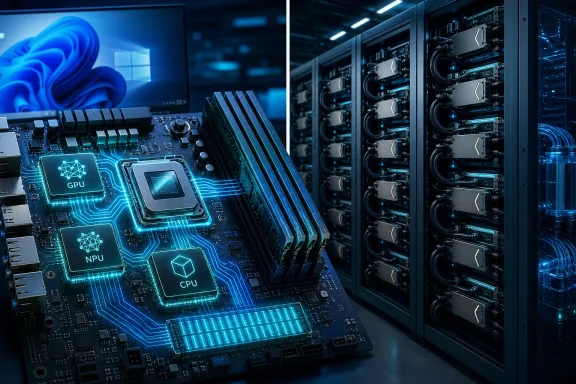 The AI-PC angle is real
For Windows PCs, the important change is not that an iGPU suddenly replaces a high-end RTX card. It is that the CPU, iGPU, NPU and system memory increasingly operate as one platform.Modern integrated graphics can use a large shared pool of DDR5 or LPDDR5X memory rather than being limited to a small fixed allocation. That gives developers another compute resource for GPU-accelerated workloads, particularly when a model or data set does not fit in the limited memory of entry-level discrete cards. The trade-off remains bandwidth: system RAM is far slower than the dedicated GDDR or HBM memory attached to serious discrete GPUs.
That makes iGPUs useful for display, media processing, local inference and lower-intensity GPU compute, but not a drop-in replacement for a workstation-class or data-center accelerator. Windows users should also remember that memory assigned dynamically to graphics is still system memory unavailable to other workloads under pressure.
Intel and Nvidia are the larger story
The report’s most consequential point is Intel and Nvidia’s September 18, 2025 agreement. Per Intel’s announcement, Intel is developing custom x86 CPUs for Nvidia’s data-center AI platforms and x86 system-on-chips that integrate Nvidia RTX GPU chiplets for PCs. The companies said the designs would use Nvidia NVLink to connect their architectures.That is not the same thing as conventional Intel UHD or Arc integrated graphics. It signals a future category of x86 PCs that could pair Intel CPU technology with much more capable Nvidia GPU silicon in a tightly integrated package. Intel has not announced a shipping product, specifications, Windows system requirements, or a release date. Reporting by Tom’s Hardware has suggested first client products could take until late 2027 or early 2028, but that remains an estimate rather than a vendor commitment.
Intel has explored unusual CPU-GPU combinations before. Its Kaby Lake-G processors combined Intel CPUs with AMD Radeon RX Vega graphics and HBM2 memory in one package, illustrating that “integrated” can describe several very different engineering approaches.
Don’t confuse AI racks with iGPUs
MiTAC’s WAIC 2026 announcement is evidence of continued investment in dense, liquid-cooled AI infrastructure, but not evidence that integrated GPUs are taking over the server room. Its flagship 52U rack uses up to 96 AMD Instinct MI355X GPUs alongside AMD EPYC processors—discrete, high-power accelerators with their own dedicated memory.For Windows buyers and IT admins, the immediate implication is simple: expect more capable integrated graphics and more heterogeneous AI-PC designs, but size local AI workloads around available memory, bandwidth, drivers and software support—not the “integrated” label alone.
References
- Primary source: finance.biggo.com
Published: 2026-07-17T22:29:40+00:00
Loading…
finance.biggo.com