

Intel Foundry has begun high-volume manufacturing of a subset of its Core Ultra Series 3 processors, code-named Panther Lake, using ASML’s High-NA EUV lithography technology. ASML announced the milestone on July 15, making Intel the first chipmaker to ship a high-volume logic product produced with the newer class of EUV equipment.
The important qualification is “subset.” High-NA EUV is not suddenly handling every layer of every Panther Lake die. Per ASML’s announcement, Intel has dual-qualified specific Intel 18A layers on the High-NA tools in Oregon, while the broader process continues to use its existing EUV fleet. ASML says the parts are shipping at yields matching its earlier NXE EUV platform.
High-NA—high numerical aperture—EUV improves the resolution of lithography, the light-based process used to pattern chip features. That can reduce manufacturing complexity for particularly dense layers, but the machines are extraordinarily expensive and difficult to integrate into a fab flow.
Reuters reports the systems cost roughly $400 million each, about twice the price of conventional EUV tools. Intel received the first commercial High-NA machine at its Hillsboro, Oregon R&D site in 2024, then installed and accepted ASML’s newer TWINSCAN EXE:5200B system.
That makes Panther Lake a real manufacturing proving ground rather than merely a lab demonstration. Intel and ASML will use the production run to tune tool uptime, process control and deployment practices before deciding how broadly to use High-NA on future nodes. Intel says its current tool fleet still gives it production flexibility while it develops subsequent process options.
It does, however, remove one uncertainty around Intel’s manufacturing roadmap: the company has now put High-NA EUV into a shipping client product, rather than reserving it for research wafers. For Intel, that experience matters as it tries to establish 18A and follow-on technologies as credible options for both its own products and external foundry customers.
ASML paired the announcement with stronger quarterly results. The company reported €9.3 billion in second-quarter sales and €2.9 billion in net income, then raised its 2026 revenue outlook to €43 billion to €45 billion. ASML also said it plans to add about 30% to its 2026 low-NA EUV capacity in 2027, while assessing another 30% increase for 2028.
For now, there is nothing for Windows users or IT administrators to change; the practical next signal will be Panther Lake system availability and independent testing of the finished laptops.
The important qualification is “subset.” High-NA EUV is not suddenly handling every layer of every Panther Lake die. Per ASML’s announcement, Intel has dual-qualified specific Intel 18A layers on the High-NA tools in Oregon, while the broader process continues to use its existing EUV fleet. ASML says the parts are shipping at yields matching its earlier NXE EUV platform.
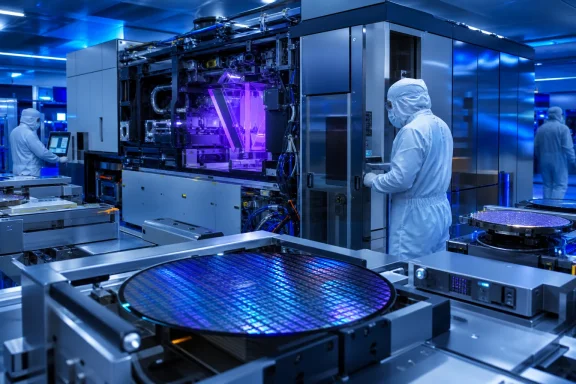 A production test, not a wholesale transition
High-NA—high numerical aperture—EUV improves the resolution of lithography, the light-based process used to pattern chip features. That can reduce manufacturing complexity for particularly dense layers, but the machines are extraordinarily expensive and difficult to integrate into a fab flow.Reuters reports the systems cost roughly $400 million each, about twice the price of conventional EUV tools. Intel received the first commercial High-NA machine at its Hillsboro, Oregon R&D site in 2024, then installed and accepted ASML’s newer TWINSCAN EXE:5200B system.
That makes Panther Lake a real manufacturing proving ground rather than merely a lab demonstration. Intel and ASML will use the production run to tune tool uptime, process control and deployment practices before deciding how broadly to use High-NA on future nodes. Intel says its current tool fleet still gives it production flexibility while it develops subsequent process options.
Why Windows PC buyers should care
Panther Lake is Intel’s next Core Ultra laptop platform and is built on the company’s 18A process. High-NA EUV by itself does not promise a specific performance, battery-life or pricing gain for a future Windows laptop. Those outcomes depend on the full chip design, node yields, product configuration and OEM implementation.It does, however, remove one uncertainty around Intel’s manufacturing roadmap: the company has now put High-NA EUV into a shipping client product, rather than reserving it for research wafers. For Intel, that experience matters as it tries to establish 18A and follow-on technologies as credible options for both its own products and external foundry customers.
ASML paired the announcement with stronger quarterly results. The company reported €9.3 billion in second-quarter sales and €2.9 billion in net income, then raised its 2026 revenue outlook to €43 billion to €45 billion. ASML also said it plans to add about 30% to its 2026 low-NA EUV capacity in 2027, while assessing another 30% increase for 2028.
For now, there is nothing for Windows users or IT administrators to change; the practical next signal will be Panther Lake system availability and independent testing of the finished laptops.
References
- Primary source: TipRanks
Published: 2026-07-15T09:29:55+00:00
Loading…
www.tipranks.com - Related coverage: investing.com
Loading…
www.investing.com - Related coverage: live.euronext.com
Loading…
live.euronext.com - Related coverage: datacenterdynamics.com
Loading…
www.datacenterdynamics.com - Related coverage: digitimes.com
Loading…
www.digitimes.com - Related coverage: tomshardware.com
Intel becomes the first company to ship high-volume logic chips made with ASML's High NA EUV — select Panther Lake layers on 18A are now dual-qualified for 0.55 NA scanners | Tom's Hardware
Milestone marks the technology's transition from R&D to full commercial deploymentwww.tomshardware.com