

Intel has begun routing more of its customer and partner support through an AI assistant called Ask Intel, built on Microsoft’s Copilot Studio, as part of a broader shift to a “digital‑first” support model that scales back phone and social‑media intake and pushes case initiation into web channels.
Intel’s support reorganization — which accelerated after a 2025 internal restructuring of sales, marketing, and global support operations — has been repositioned around automation, self‑service, and partner portals. The company has removed inbound public phone numbers for support in most countries and has curtailed direct support over certain social platforms, directing customers and partners to begin interactions online. That policy change became effective in mid‑December and is framed internally as a move to a “digital‑first experience.”
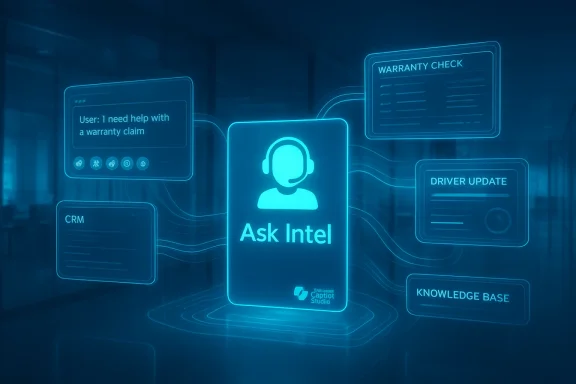
The new assistant, Ask Intel, is live on Intel’s support site and is intended to perform a range of front‑line tasks: triage issues, check warranty coverage, open or update support cases, offer troubleshooting guidance, and escalate complex problems to human agents when necessary. Intel describes the tool as the next phase of its earlier virtual support efforts that began in 2021, signaling a strategic move to centralize intake through an AI layer.
Intel has told partners that early feedback has been positive and that preliminary performance metrics show improvements in customer satisfaction and case resolution rates compared to prior quarters, though Intel has not released specific figures. The company says it plans deeper integration with intel.com and expanded capabilities such as automatically identifying driver updates and autonomously creating warranty claims.
But scaling back phone numbers and removing social media intake means the human‑in‑the‑loop is now downstream and accessible only after the AI triage. That design choice changes experience expectations: customers must be willing to accept web‑first intake and wait for callbacks or staged escalations instead of immediate live voice support. For high‑value enterprise customers, that trade‑off may require explicit contractual protections (e.g., premium support tiers, guaranteed response times).
However, where hardware vendors differ from pure‑software firms is the physical supply‑chain and warranty dimension: incorrect advice can lead to unnecessary RMA shipping, degraded inventory management, and service partner disputes. That makes verification, audit trails, and accuracy guarantees more consequential in the semiconductor and PC hardware space. Intel’s own public stance — warning users and noting limitations — is an acknowledgment of that practical complexity.
For partners and enterprise customers, the pragmatic path forward is cautious adoption: take advantage of faster automated triage for routine issues, but insist on contractual protections, exportable logs, human‑first escalation guarantees for critical cases, and controlled testing for any workflow that will act on warranties or device replacement logic. Intel’s own disclosure that Ask Intel’s answers “cannot be guaranteed” is a prudent reminder that the assistant is a tool — not a replacement for well‑documented processes, rigorous governance, and human judgment where it matters most.
Source: Tom's Hardware https://www.tomshardware.com/tech-i...customer-support-to-microsoft-copilot-studio/
 Background
Intel’s support reorganization — which accelerated after a 2025 internal restructuring of sales, marketing, and global support operations — has been repositioned around automation, self‑service, and partner portals. The company has removed inbound public phone numbers for support in most countries and has curtailed direct support over certain social platforms, directing customers and partners to begin interactions online. That policy change became effective in mid‑December and is framed internally as a move to a “digital‑first experience.”The new assistant, Ask Intel, is live on Intel’s support site and is intended to perform a range of front‑line tasks: triage issues, check warranty coverage, open or update support cases, offer troubleshooting guidance, and escalate complex problems to human agents when necessary. Intel describes the tool as the next phase of its earlier virtual support efforts that began in 2021, signaling a strategic move to centralize intake through an AI layer.
What Ask Intel does — capabilities and the pitch
Ask Intel is presented as an AI‑driven agent that can:- Open and update service tickets on behalf of customers and partners.
- Check warranty eligibility and coverage quickly against internal systems.
- Guide users through diagnostic steps and provide documented troubleshooting.
- Escalate to human agents when the assistant determines it cannot resolve the issue.
- Provide status updates on existing cases.
Intel has told partners that early feedback has been positive and that preliminary performance metrics show improvements in customer satisfaction and case resolution rates compared to prior quarters, though Intel has not released specific figures. The company says it plans deeper integration with intel.com and expanded capabilities such as automatically identifying driver updates and autonomously creating warranty claims.
Microsoft Copilot Studio: the technology under the hood
Ask Intel is built on Microsoft Copilot Studio, Microsoft’s low‑code platform for creating enterprise AI agents that connect to internal data and workflow systems. Copilot Studio provides:- A low‑code visual design and prompt canvas for building agents.
- Connectors to enterprise data sources (Dataverse, SharePoint, Dynamics, Azure services).
- Agent Flows or workflow orchestration features to call APIs and trigger actions across systems (for example: creating a CRM ticket, updating a warranty record, sending notifications).
- Controls for identity, permissions, and auditing within a Microsoft 365/Azure tenant context.
Why Intel is doing this: cost, scale, and experience
The shift is driven by several internal pressures and strategic incentives:- Efficiency and economics: consolidating intake through an AI layer reduces the need for large numbers of live agents to handle routine queries. Intel’s internal restructuring emphasized finding efficiency and savings across non‑manufacturing functions.
- Faster routing and resolution: a consistent triage layer can surface the correct knowledge articles, apply warranty rules instantly, and route complex problems to specialized engineers — ideally reducing handoffs and repeat contacts. Intel reports early satisfaction improvements in partner feedback.
- Centralizing data and telemetry: a Copilot Studio agent can be wired into CRM, warranty systems, knowledge bases, and site telemetry, enabling a single conversational interface to access live data and run workflows. This capability is attractive to companies with sprawling product lines and distributed support teams.
Strengths: what Ask Intel can realistically deliver
- Predictable triage and faster routine workflows
- The assistant can immediately apply warranty rules and known fixes, removing manual checks and reducing time‑to‑first‑action. This is precisely the kind of repetitive, rules‑based work AI agents excel at when fed quality data.
- Centralized telemetry that helps human agents
- When Ask Intel captures diagnostic outputs and conversation history, human engineers downstream get a structured starting point rather than raw inbound calls. That can reduce cognitive load and improve mean time to resolution on complex tickets.
- Multilingual and multi‑channel potential
- Intel has rolled out Ask Intel in English and German to start, with plans for more languages. Copilot Studio supports deployment across web and collaboration platforms, enabling Intel to broaden reach without scaling phone centers in every language and region.
- Faster product updates and driver identification
- Planned capabilities to identify required driver updates and create warranty claims autonomously could materially improve patch‑and‑driver workflows for both consumer and enterprise hardware. If implemented with care, this reduces friction for administrators and end users.
Risks and limitations: the other side of automation
While the potential benefits are clear, Ask Intel and the architectural choices around it raise several substantive risks that partners, enterprise customers, and regulators should watch closely.Accuracy and hallucination risk
Generative models and agentic workflows can produce plausible but incorrect conclusions. Intel’s own support documentation states that the assistant’s accuracy cannot be guaranteed and that answers may be incomplete or erroneous. In the context of warranty adjudication, firmware updates, or critical device diagnosis, an incorrect recommendation could cause product downtime, unnecessary hardware swaps, or misapplied warranty actions.Data privacy and retention
Intel warns that chat logs may be retained and processed by Intel and third‑party providers under its privacy notice, with no opt‑out for those who use the assistant. That raises several concerns:- Sensitive diagnostics can contain device identifiers, serial numbers, MAC addresses, or even snippets of user logs and configuration — all of which may be stored and processed by external vendors.
- For regulated jurisdictions (for example, certain EU rules, or sectoral privacy regulations), automatic retention and third‑party processing without clear opt‑out or data minimization guarantees can create compliance exposure. Enterprises that handle customer data often require contractual guarantees and audit rights for third‑party data processing.
Loss of human context and edge cases
AI triage works best where problems match documented patterns. For edge cases — intermittent electrical issues, intermittent BIOS incompatibilities, or warranty disputes with incomplete records — the assistant may lack the nuance a human expert brings, and it might either give incorrect advice or escalate unnecessarily. That could increase downstream workload or lead to poor customer experience when the automation fails.Overreliance and deskilling
Shifting routine work to AI carries a risk of deskilling support teams if engineers are increasingly exposed only to escalated, high‑complexity tickets. Over time, organizations can lose institutional knowledge about common fixes and system idiosyncrasies—ironically increasing the difficulty of diagnosing novel issues.Contractual, compliance, and vendor lock‑in issues
Deploying Copilot Studio ties Intel’s support automation to Microsoft’s enterprise ecosystem for connectivity, identity, and runtime. While Copilot Studio supports many connectors and enterprise controls, bringing third‑party models into the loop (or future model changes) can shift contractual obligations and data protection responsibilities among Intel, Microsoft, and other model vendors. Enterprises should demand clear SLAs, DPAs, and audit mechanisms.The human element: escalation and “human‑in‑the‑loop”
Intel and industry commentators have stressed that Ask Intel incorporates escalation paths to human agents and that the company intends to keep human support available for complex problems. Early community feedback — at least from channel partners polled — suggests a conditional acceptance: automation is helpful so long as the escalation path to a human is easy and timely.But scaling back phone numbers and removing social media intake means the human‑in‑the‑loop is now downstream and accessible only after the AI triage. That design choice changes experience expectations: customers must be willing to accept web‑first intake and wait for callbacks or staged escalations instead of immediate live voice support. For high‑value enterprise customers, that trade‑off may require explicit contractual protections (e.g., premium support tiers, guaranteed response times).
Data handling, auditability, and regulatory concerns
Companies using Copilot Studio and agentic flows must consider audit trails, data residency, and model choice disclosure:- Auditability: Organizations must be able to export transcripts, see which internal system calls the assistant performed, and correlate those actions to the supporting knowledge artifacts. Without end‑to‑end audit trails, troubleshooting support failures or compliance incidents becomes difficult.
- Data residency and third‑party processors: If Copilot Studio or any connected model routes data outside specific regions (for instance, invoking third‑party models hosted outside Microsoft cloud), enterprises must ensure contractual coverage for data transfers and model usage. This is especially important where warranty claims or device serial numbers may intersect with regulated personal or corporate data.
- Consumer consent and transparency: Intel’s published guidance warns users about retention and indicates that by using the feature they consent to this processing. From a best‑practice standpoint, enterprises should provide granular choices (data minimization, redaction, or human‑only channels) — an option Intel currently does not surface as an opt‑out on the assistant itself.
Practical advice for customers, partners, and administrators
Whether you’re an OEM partner, an enterprise IT admin, or an individual consumer, there are practical steps to protect yourself while benefiting from AI‑powered support:- Understand and document your support entitlements
- If you are an enterprise customer with a support contract, confirm whether Ask Intel’s web triage is an allowable intake path under your SLA and whether premium contacts remain. Ask for written guarantees on escalation timeframes.
- Limit sensitive data shared with the assistant
- Avoid pasting full crash logs or configuration files into chat dialogs that contain personal data, serial numbers, or customer PII unless you have contractual assurance about data handling and retention.
- Request contractual data protections
- Partners who exchange diagnostic data at scale should request DPAs, audit rights, and exportable logs that show how Ask Intel made decisions and which internal sources it consulted.
- Test workflows in non‑production
- If you manage a fleet of devices, test driver‑identification and warranty claim workflows in a controlled environment before rolling them into production. Validate that the assistant does not incorrectly flag devices for warranty replacement.
- Keep human contact points documented
- Maintain a documented process for escalating to human engineers, including internal contacts and time expectations. If Intel’s public phone intake has been removed in your region, secure alternative escalation arrangements via contract.
Industry context: Intel isn’t alone — broader trends
Intel’s move mirrors a wider industry trend where large technology and hardware vendors funnel routine support into automated, AI‑driven triage layers to reduce cost and improve scale. Microsoft’s Copilot Studio, Google’s enterprise conversational tools, and other vendor platforms are increasingly marketed to companies aiming to replace repetitive phone and email queues with integrated agent flows.However, where hardware vendors differ from pure‑software firms is the physical supply‑chain and warranty dimension: incorrect advice can lead to unnecessary RMA shipping, degraded inventory management, and service partner disputes. That makes verification, audit trails, and accuracy guarantees more consequential in the semiconductor and PC hardware space. Intel’s own public stance — warning users and noting limitations — is an acknowledgment of that practical complexity.
Governance checklist for enterprises evaluating Ask Intel or similar systems
- Insist on exportable, time‑stamped logs that show: user query → knowledge sources consulted → actions performed (APIs called) → outcome. This is essential for troubleshooting and compliance.
- Require data residency guarantees or contractual DPA addenda for third‑party processors.
- Verify that the agent respects role‑based access controls and cannot perform actions outside the intended scope (for example, creating warranty claims only against confirmed, authorized serial numbers).
- Conduct red‑team testing focused on adversarial inputs (malformed logs, spoofed serials, or social engineering prompts) to identify where the agent may make unsafe or incorrect actions.
- Negotiate explicit SLAs for escalation to human support and, if necessary, maintain a parallel human‑first intake channel for high‑risk scenarios.
What to watch next
- Integration depth: Will Ask Intel truly identify and push driver updates automatically, and if so, how will Intel validate those recommendations in mixed‑vintage environments?
- Transparency and metrics: Intel has reported improved satisfaction and resolution metrics in preliminary results; the community will want to see concrete numbers and independent validation of those claims.
- Regulatory scrutiny: As more enterprises automate intake for regulated systems, expect greater attention from privacy and consumer protection regulators that may demand opt‑out mechanisms or stricter consent flows around diagnostic data.
- Platform dependencies: Continued reliance on Copilot Studio ties enterprise support automation strategy to Microsoft’s roadmap and contractual terms — any substantial platform change could ripple through support operations.
Conclusion
Ask Intel represents a clear and consequential example of how major hardware vendors are embracing AI to centralize and automate the front lines of support. The approach promises real operational wins: faster triage, standardized workflows, and the potential to reduce routine human labor. But the technology also surfaces acute risks: accuracy and hallucination hazards, data‑retention and privacy concerns, the need for end‑to‑end auditability, and the possible loss of contextual expertise.For partners and enterprise customers, the pragmatic path forward is cautious adoption: take advantage of faster automated triage for routine issues, but insist on contractual protections, exportable logs, human‑first escalation guarantees for critical cases, and controlled testing for any workflow that will act on warranties or device replacement logic. Intel’s own disclosure that Ask Intel’s answers “cannot be guaranteed” is a prudent reminder that the assistant is a tool — not a replacement for well‑documented processes, rigorous governance, and human judgment where it matters most.
Source: Tom's Hardware https://www.tomshardware.com/tech-i...customer-support-to-microsoft-copilot-studio/
