

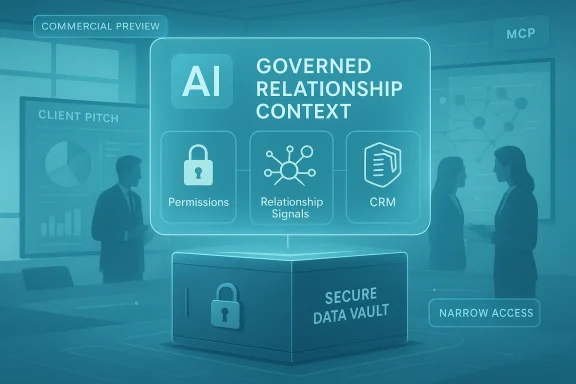
This is also a refleer enterprise AI market has gone in 2026. Microsoft has been expanding connector-driven Copilot experiences, with documentation stressing that external data can be brought into Copilot while still respecting permissions and source-system access controls. At the same time, Microsoft’s own guidance warns that connector permissions must be configured carefully to avoid oversharing sensitive content. Introhive’s announcement fits neatly into that world: it is an attempt to make relationship intelligence available to agents in a way that is permission-aware, context-rich, and limited to what the user needs for the task at hand.
The legal sector is an especially strong proving ground for this approach because law firms already live with a constant tension between knowledge reuse and confidentiality. They need to identify who knows whom, how strong those ties are, and where revenue is at risk, but they cannot simply flatten every interaction into a shared prompt for an AI model. Introhive says its server returns only the context required for the question asked and inherits existing governance policies, which is exactly the kind of narrow access design that regulated buyers tend to prefer. In practical terms, the company is arguing that AI should not rummage through every email or document to infer relationship context when a structured intelligence layer cadirectly.
There is also a broader market logic here. Relationship intelligence has always been useful, but it was often underused because it sat outside the day-to-day workflow. MCP changes that by making the intelligence consumable inside assistants, copilots, and agents that professionals already use. That means the product is no longer just a reporting tool; it becomes an operational dependency for business development, partner transitions, and client retention. In enterprise software terms, that is a big step up tat Introhive Is Actually Announcing
Introhive says its commercial preview MCP Server can connect relationship intelligence to AI assistants such as Microsoft Copilot, with the goal of helping law firms ask highly specific questions and get immediate recommendations back. The company’s own example is telling: instead of searching through calendars, inboxes, and CRM notes, a user can ask which partner has the strongest relationship with a target company’s CEO, and the system can synthesize an answer based on interaction history and relationship scores. That is not just search; it is guided decision support.
Why thhe significance of MCP is that it standardizes how an AI tool asks for context from external systems. Anthropic’s official MCP documentation describes it as a protocol for connecting models to tools and data sources, while Microsoft Learn now documents MCP-style connectors in the context of agentic features and Windows integration. In other words, this is becoming part of the broader plumbing of AI software, not a niche experiment. Introhive’s move is therefore less about novelty and more about being early in a protocol shift that enterprises are increasingly treating as strategic infrastructure.
That matters because law firms are conservative about workflow change. They may tolerate a new AI interface if it clearly respects existing permissioning, but they are less likely to accept a system that ingests broad swaths of sensitive data into an opaque model. Introhive appears to be betting that firms want structured retrieval more than raw generative reach. That is an important distinction, and it aligns with the way Microsoft positions connector content: access should be limited to what users are already authorized to see.
The commercial preview label also signals caution. Introhive is not claiming fully finished, frictionless autonomy; it is saying the market is ready to test the concept in controlled environments. For enterprise buyers, that is often preferable to a loud general release. A preview gives IT, security, and practice leaders room to validate the data model, the permissions model, and the usefulness of the answers before broader rollout. rs* in legal AI, where bad context can become a governance problem very quickly.
Why Law Firms Need Relationship Intelligence Now
Law firms have always depended on relationships, but the economics of those relationships have become harder to manage. Modern firms are more distributed, partner mobility is higher, and institutional knowledge is more fragile than many leaders would like to admit. Introhive’s announcement leans heavily on that reality, arguing that relationship knowledge is spread across individuals and disconnected systems, which makes it difficult for AI to deliver relevant recommendations. In practice, that means a firm may know it has a strong client relationship somewherep, but not know where the strongest signal actually lives.
The timing is not accidental. Legal AI has shifted from point tools for drafting and summarization toward broader operational systems that touch business development, staffing, and client service. WindowsForum’s recent legal-AI coverage has highlighted how firms are moving from experimentation to workflow embedding, with the current wave focused less on flashy demos and more on governed deployment. Introhive is entering that same conversation from a different angle: instead of helping lawyers write faster, it is helping firms know more about the people and firms they already work with.
The Client Relationship Problem
One of the hardest parts of law firm growth is that the client relationship is often not institutionalized in a way software can easily capture. A partner may have deep trust with a GC, but the firm’s CRM may only show sporadic notes, old activities, or stale contact records. Introhive’s pitch is that relationship strength, recent activity, and network context can be normalized into a form that agents can query. That gives the firm a better shot at identifying who should make the next call, who should handle an introduction, and where the risk of drift is highesy important for larger firms where the distance between revenue owners and client-facing attorneys can be substantial. When a client relationship is scattered across practice groups, geographies, and sectors, even a well-maintained CRM may not tell the full story. The value of the MCP layer is that it can expose a synthesized view at decision time instead of forcing people to reconstruct the picture manually. That is a major productivity gain, but it is also a governance gain because it reduces reliance on memory and anecdote.
Law firms are als and lateral movement, which increases the risk that client context does not travel with the people who leave or switch roles. Introhive’s chief product and technology officer framed this as a fragmentation problem: relationship context often disappears when partners move, even though the business still needs it. The MCP approach is a way of preserving the institutional memory that firms spend years building. It is not a silver bullet, but it is a serious attempt to turn invisible context into usable signal.
The Architecture: Context Withoost interesting claim in the announcement is that Introhive can provide context without exposing raw underlying data. That sounds simple, but it is actually a very hard design problem. If an AI system sees too little, it becomes useless; if it sees too much, it becomes a security and privacy risk. Introhive is trying to walk the narrow path between those outcomes by returning only the context needed for the question asked.
Permissioning Is the Product
This is where the announcemst thinking in Microsoft’s connector ecosystem. Microsoft Learn repeatedly emphasizes that Copilot connectors should respect the source system’s ACLs, and that incorrect permission settings can overshare sensitive content. Introhive’s server is described as inheriting existing permissioning and respecting data governance policies, which is exactly the kind of assurance enterprise buyers want when they evaluate data-connected AI. In effect, the permissions layer is not just a compliance feature; it is part of the product value proposition.
That matters because relationship intelligence is intrinsically sensitive. If a system tells a partner which colleague has the best connection to a target CEO, it may also reveal who has been meeting, how often, and how recently. Those are business-sensitive facts even when they are not formally confidential in the same way a legal memo might be. The system therefore needs to be selective not just about who can see the answer, but about how much of the underlying signal is exposed. Selective disclosure is the right phrase here.
The comis revealing for another reason: it synthesizes a recommendation rather than dumping raw records. That is the right model for AI in professional services. Lawyers and BD teams do not want a timeline for its own sake; they want a recommendation they can act on. If the answer suggests a warm introduction, a pitch strategy, or a follow-up sequence, the assistant is doing real work rather than merely summarizing data.
A safer architecture also creory. Security teams are more comfortable with systems that can explain their boundaries, while practice leaders care that the assistant will not wander beyond its lane. Introhive’s pitch addresses both camps by making the model answer questions with a constrained context window. That is not flashy marketing, but it is the kind of architecture enterprises are increasingly willing to pay for.
Microsoft Copilot and the Growing Connectormention of Microsoft Copilot is not incidental. Microsoft has been pushing connectors and agentic experiences throughout 2025 and 2026, and its documentation now treats external data grounding as a formal part of Microsoft 365 Copilot extensibility. Microsoft Learn says connectors can bring external line-of-business data into Microsoft 365 Copilot so users can search, reason over, and act on enterprise content. That means vendors like Introhive are not building around Copilot; they are building into the direction Copilot is already heading.
Why This Is a Platform Story
The platform implication is bigger than one law firm use case. If relationship intelligence can be queried through MCP from within Copilot, then similar specialized knowledge layers can be exposed to other enterprise assistants too. That creates a market in which vendors compete not just on dashboards, but on whether their data can be made AI-readable in a trusted way. In that sense, MCP is becoming the modern equivalent of an enterprise integration bus for agentic workflows.
Microsoft’s own permission model reinforces the opportunity. Its connector guidance emphasizes that users only see what they are authorized to see, and that admins can review connector permissions to prevent oversharing. That framework should make enterprise buyers more comfortable with specialized data sources such as Introhive because the security model is already familiar. The lesson is straightforward: when AI becomes a front end to enterprise knowledge, permissioning becomes the real interface.
There is, however, a subtle competitive shift underneath this. As Microsoft expands native Copilot features and connectors, third-party vendors must prove they offer something beyond what Microsoft can build itself. Introhive’s answer is domain depth. Microsoft can provide the shell, but Introhive claims to provide the relationship semantics that generic tooling lacks. That is a credible strategy if the data model is rich enough and the answers are good enough to change behavior.
For law firms, this is likely to be the main question: do they want a general assistant that can access some relationship data, or a purpose-built intel be queried through a general assistant? Introhive is clearly betting on the second option. That bet makes sense in a profession where specificity often matters more than breadth.
Real-World Workflows: Where the ROI Could Show Up
Introhive is wise to anchor the announcement in practical use cases, because legal buyers tend to care less about protocol elegance than about whether the tool saves time or preserves revenue. The company highlights client pitch prep, cross-practice growth, relationship risk monitoring, and partner transitions.e workflow categories because they connect directly to revenue generation and client retention. They are also areas where missing information can be expensive.
Client Pitch Preparation
Pitch prep is probably the most obvious win. If a lawyer can ask who has the strongest relationship with a target executive and receive a concise answer with supporting context, the firm can move faster and appear more informed. That improves both preparation quality and responsivenhe difference between a generic pitch and a tailored one. In a competitive legal market, speed with relevance is a real differentiator.
Cross-practice growth is another strong use case because firms already struggle to identify hidden opportunities inside existing client accounts. Relationship intelligence can reveal which partners are close to a client, which practices are underpenetrated, and where introductions might open new revenue streams. If the MCP server can surface nside an assistant workflow, the firm is more likely to act on it because the answer arrives at the moment of work.
Relationship risk monitoring may be the most quietly valuable of the bunch. Firms often lose revenue not because a client actively leaves, but because engagement weakens slowly and no one notices until late. Introhive says the server can help flag changes in engagement or billing patterns early. That creates a proactive model of accounan a reactive one, which is exactly where AI should be adding value in professional services.
Partner transitions and succession planning may ultimately be the most strategic use case. When a rainmaker leaves, retires, or shifts focus, the firm needs to know which relationships are transferable and who can credibly step in. An AI assistant that can identify relationship strength and continuity signals could make that handoff much less ad hoc. In that sense, Introhive is not j more; it is helping them preserve the value of what they already have.
The common thread is that all these workflows are decision workflows, not just information retrieval workflows. That is the right place to deploy AI in law because the work is expensive, repetitive, and high stakes, but still heavily dependent on human judgment. The assistant should not replace the lawyer or the partner; it should surface thnough that human judgment can be better informed.
Competitive Implications for Legal Tech
Introhive’s announcement puts pressure on several adjacent categories at once. CRM vendors, legal business development tools, knowledge management platforms, and broader AI assistants all want to be the layer where firm intelligence becomes useful. The MCP Server suggests that the next competitive frontier may not be who stores the data, but who can make it actionable inside the assissubtle but important shift.
The Specialist Advantage
Specialist vendors still have an advantage because they know the semantics of the domain. A relationship score in a law firm is not the same thing as a generic engagement metric in sales software. It reflects layers of history, trust, interaction frequency, and social connectivity that broader tools may not capture well. Introhive’s long history in professional services gives it credibility that a generic AI platform whing.
At the same time, platform vendors are getting stronger. Microsoft’s connector ecosystem, Copilot grounding, and permission-aware data exposure make it easier for general-purpose AI to enter specialized workflows. That means specialist vendors can no longer survive by merely owning a niche database. They have to expose that database in a way that is secure, useful, and easy to embed in existing enterprise AI environments. Introhive seems to understand that well.
For competitors, the challenge is that AI value is moving closer to workflow execution. A dashboard can tell you who the key contact is, but an assistant that can answer the question in Microsoft Copilot with enough context to trigger a warm introduction is more operational. That raises the bar for everyone else. The winners will be the vendors whose data models survive contact with real-world prompts, not just with sales demos. That is the new standard.
There is also an ecosystem effect. If Introhive succeeds in legal, it may create a template for accounting, consulting, and other professional services firms where relationship context is equally important. The legal market may be the first mover, but it will not be the only one with this pain point. If the MCP model proves reliableet could expand quickly.
Strengths and Opportunities
Introhive’s announcement has several obvious strengths, and most of them come down to the company solving a genuine enterprise problem instead of chasing AI novelty. The best enterprise AI products are not the ones that do the most; they are the ones that deliver the right answer inside the right workflow with the least friction. Introhive’s MCP Server isa.
- It addresses a real pain point: fragmented relationship knowledge across people and systems.
- It fits the direction of the market, where MCP and connector-based AI are becoming mainstream infrastructure.
- It aligns with Microsoft Copilot and similar assistant ecosystems rather than competing head-on with them.
- It offers a permission-aware approach that should appeal to regulated buyers.
- It focuses on revenue-linked workflows like pitch prep, cross-sell, and retention.
- It reduces the need for manual data reconstruction across CRM, billing, and relationship systems.
- It turns relationship intelligence into an operational layer rather than a passive reporting tool.
The commercial preview format is another strength because it invites validation without overpromising. Enterprises want to see how a new AI layer behaves with their own governance and their own data quality issues. A controlohive room to refine the experience while building trust. That is often how enterprise products earn permanence.
Risks and Concerns
The biggest risk is that firms will underestimate how hard relationship data governance really is. A system that synthesizes recommendations can still produce misleading confidence if the underlying CRM or activity data is incomplete, stale, or inconsistently maintainlly fix bad inputs; it can make them look more authoritative. That is a serious concern.
- Poor data quality could reduce the reliability of recommendations.
- Permission mistakes could expose sensitive relationship signals too broadly.
- Firms may overtrust AI-generated relationship suggestions without checking nuance.
- Adoption could stall if partners do not trust the underlying scores.
- Integration complexity may slow deployment in large, multi-system firms.
- The product could be seen as additive rather than transformative if it is not deeply embedded.
- Microsoft and other platform vendors may replicate parts of the value proposition over time.
Another concern is workflow legitimacy. Lawyers and business development professionals may like the idea of asking an assistant for the best relationship, but they will still need to understand why the assistant chose that answer. If the explanation is too opaque, adoption will suffer. In legal seer is not enough; users often need a defensible answer. That is especially true when the recommendation affects a client pitch, a succession plan, or a retention strategy.
There is also a broader ecosystem risk: as AI assistants become easier to connect to enterprise data, organizations may create a false sense of control. Connector-based systems are only as safe as the policies, mappings, and review practices behind them. Microsoft’s own documentation repeatedly warns that access controls must be set carefully, and that should be read as a warning to any vendor operating in this space. Good design helps, but governance still has to be operationalized.
Finally, there is the question of whether firms will treat relationship intelligence as a strategic asset or just another conveniion stays shallow, the product may not achieve the network effects needed to become indispensable. In enterprise software, the gap between “nice demo” and “embedded behavior” is enormous. Introhive’s challenge is to cross it.
Looking Ahead
The most important thing to watch next is whether Introhive can show that the MCP Server changes actual law firm behavior, not just user sentiment. If it helps firms win more pitches, identify more cross-sell opportunities, or catch relationship drift earlier, then the product hastory. If it merely surfaces prettier versions of information the firm already had, the market will move on quickly. That is the difference between a useful preview and a category-defining platform move.
What Could Happen Next
- More law firms may test MCP-based assistants for business development and account management.
- Vendors in adjacent categories may add their own permission-aware AI layers.
- Microsoft’s connector and Copilot ecosystem may become the default distribution path for enterprise knowledge tools.
- Relationship intelligence could become a standard feature in legal AI stacks rather than a standalone category.
- Security teams may push for tighter auditing and clearer explanation of AI recommendations.
- Professional services firms outside law may adopt similar context layers if the legal preview succeeds.
The broader trend is already clear: enterprise AI is becoming less about answering general questions and more about answering specific questions with the right company context attached. That favors vendors who can supply structured, governed intelligence rather than raw data dumps. Introhive’s MCP Server is interesting because it understands that shift and tries to operationalize it in one of the most relationship-sensitive industries in the economy. If the company gets the balance right, it could become a model for how professional services firms bring AI into the heart of business development without surrendering control of their own knowledge base.