

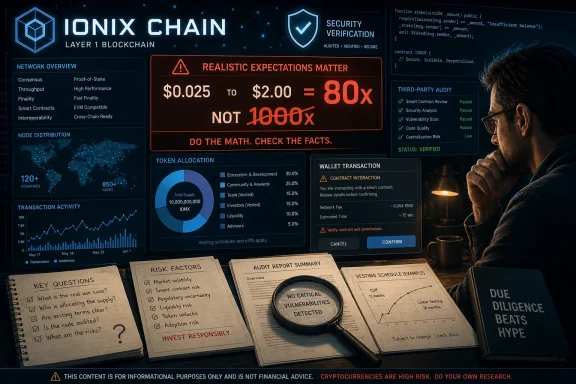
 IONIX CHAIN’s “1000x” Presale Pitch Runs Ahead of the Evidence
IONIX CHAIN is presented in a CoinQuantWire promotional release distributed through OpenPR as an AI-branded Layer 1 crypto presale that has raised more than $6.7 million, offers $IONX at around $0.025, and targets mainnet deployment and exchange listings in 2026. The release also discusses a possible $2 token price and uses “1000x” framing, but those figures do not match: a move from $0.025 to $2 would be 80x, not 1000x. Both remain promotional claims—not forecasts supported by a functioning network, public market, or independently reproducible performance data.What exists in the CoinQuantWire release is a token sale wrapped around an ambitious technical proposal. What buyers are being asked to price is everything that must still be built, tested, secured, launched, adopted, listed, and made liquid.
That distinction matters because the promotional language collapses several separate bets into one irresistible-looking number. A buyer is not merely betting that crypto markets rise. The buyer is betting that IONIX CHAIN’s developers can deliver the network described in the release, that its proposed AI layer provides measurable value, that the token’s allocation and release schedule do not undermine demand, that exchange listings materialize, and that sufficient liquidity exists when presale holders become eligible to claim or sell.
What to do now
- Do not treat the release’s $2 target or “1000x” framing as a forecast.
- Independently verify the official domain and every contract address before connecting a wallet or sending funds.
- Do not assume this article verifies a payment, presale, token, or claim contract address; no such address is established here.
- Use a separate, low-balance wallet that does not hold unrelated or high-value assets.
- Never share a seed phrase, private key, recovery file, or wallet password with the project, support staff, or anyone contacting you.
- Wait for an independently verifiable public testnet, clearly defined audit scope, complete token allocation and vesting details, and credible liquidity evidence before considering exposure.
The “1000x” Headline Is the Product
The supplied CoinQuantWire promotional material foregrounds price-upside framing over independently reproducible evidence. It tells readers that early investors are accumulating tokens, presents the project as a possible breakout cryptocurrency, and emphasizes an entry price of around $0.025. That is familiar presale framing: establish urgency, portray early participation as informed accumulation, and present the current price as a temporary discount against a much larger possible future value.The release was published under the CoinQuantWire name and distributed through OpenPR as project-focused promotional material. That does not make every statement false, but it establishes the correct editorial category. It is not an independently verified technical assessment, an audit report, or a disinterested market analysis.
The arithmetic should be separated from the slogan. Based solely on the release’s stated figures, a move from approximately $0.025 to $2 equals 80 times the starting price. A genuine 1000x move from $0.025 would require a price of $25 per token. Applying $25 to the stated total supply of 600 million tokens produces a fully diluted valuation of $15 billion if the entire supply were valued at that level.
Those are arithmetic illustrations based on the release’s stated $0.025 price and 600 million total supply. They are not valuation forecasts, achievable exit prices, or predictions that the market will support either $2 or $25.
A promotional headline is easiest to evaluate when readers translate it into the conditions required for success. A large nominal return would require more than a token being created or appearing briefly on an exchange. It would require meaningful demand, sufficient trading depth, manageable token unlocks, operational infrastructure, credible security, and buyers willing to support the implied valuation after presale participants can sell.
The practical lesson is concise: promotional visibility can bring a project to a reader’s attention, but verification requires artifacts that can be inspected independently.
A $6.7 Million Counter Does Not Prove $6.7 Million of Independent Demand
The CoinQuantWire release reports that the IONIX CHAIN presale has raised more than $6.7 million. On its face, that would be meaningful fundraising for an early-stage project. It indicates that the project publicly claims substantial participation in its token sale.A reported presale total is not equivalent to audited revenue, available development capital, exchange liquidity, market capitalization, or independent demand. Buyers need to know how the amount was calculated, which assets were received, whether all funds remain under project control, and whether identifiable blockchain transactions reconcile with the reported total.
The CoinQuantWire material characterizes participation positively, but the fundraising description should not be treated as independently proven merely because it appears in a promotional release. A token-sale campaign can demonstrate interest in buying a discounted asset without demonstrating demand for the eventual network.
Demand from presale buyers is different from demand from developers deploying applications, users paying transaction fees, validators securing the network, or traders supporting durable liquidity. That gap is the central economic issue. IONIX CHAIN is selling exposure to a proposed future ecosystem, while the $6.7 million figure reported by CoinQuantWire describes activity inside the sale.
Until independently observable testnet usage, mainnet transactions, external developer activity, and post-listing liquidity exist, the reported total is better understood as a project-supplied sales metric carried in the CoinQuantWire release—not proof of product-market fit.
Timeline
Presale period — The CoinQuantWire release says $IONX is offered at approximately $0.025 and reports more than $6.7 million in fundraising. The release does not independently reconcile that total with a complete set of on-chain payment addresses or audited financial records.Promotional target period — The CoinQuantWire material discusses a speculative $2 post-launch price. This is promotional price-upside framing, not a guaranteed listing price or an independently produced valuation.
2026 roadmap — According to the CoinQuantWire release, the project targets mainnet deployment and exchange-listing activity during 2026. A roadmap target is not evidence that a milestone has been completed.
After the presale — The five-step process described in the release says buyers will later claim tokens after the presale concludes and the token generation event occurs. That remains dependent on the project delivering a functioning and secure claim process.
The chronology demonstrates why promotional dates require careful reading. Terms such as “targeted” and “planned” describe intentions, not completed products or enforceable guarantees. Buyers should distinguish an announced window from released software.
Quantum AI Consensus Is a Name, Not Yet a Performance Result
According to the CoinQuantWire release, IONIX CHAIN proposes a “Quantum AI” consensus design that combines Proof-of-Stake with a Directed Acyclic Graph architecture and targets throughput above 500,000 transactions per second with near-zero fees. Those are extraordinary targets for a general-purpose Layer 1 expected, in the release’s description, to support multiple categories of blockchain applications.Proof-of-Stake and DAG designs are established categories, but combining familiar concepts does not automatically produce the advertised throughput. Nor does it automatically solve finality, validator coordination, state synchronization, storage growth, smart-contract contention, denial-of-service resistance, decentralization, or cross-chain security.
This is general technical risk analysis, not evidence that IONIX CHAIN has failed a particular test. The key issue is whether the performance proposition in the CoinQuantWire release can be reproduced by independent testers under clearly documented conditions.
In the release, “Quantum AI” functions as the project’s name for a proposed design involving Proof-of-Stake, DAG architecture, and AI-oriented optimization. Readers should not infer from that branding that the network uses quantum computers, has demonstrated quantum-resistant cryptography, or has achieved a cryptographic breakthrough.
The CoinQuantWire material says AI could assist with functions such as anomaly monitoring, network optimization, congestion prediction, and intelligent applications. Each proposed function still requires a concrete architecture. Buyers should be able to identify where a model runs, what data it receives, who trains or updates it, whether its outputs are deterministic, how validators use those outputs, and what happens if the model is manipulated or produces an incorrect recommendation.
As a general engineering principle, independent nodes must agree on network state. If an AI component merely monitors traffic and recommends operational changes, it is an optimization tool rather than the foundation of consensus. If it directly influences validation, ordering, or transaction acceptance, the project needs a rigorous public explanation of how safety and finality survive probabilistic or nondeterministic output.
The release’s throughput target also needs a test definition. Buyers should ask whether the figure comes from an estimate, simulation, private prototype, or geographically distributed public testnet. They should ask whether it counts simple transfers or complex smart-contract calls, how many validators participated, what hardware and bandwidth they used, what payload sizes were tested, and what finality guarantees were preserved.
| Project proposition | Figure or feature stated by CoinQuantWire | Current evidentiary status | Evidence needed before confidence is justified |
|---|---|---|---|
| Network throughput | More than 500,000 transactions per second | Project target reported in promotional material | Reproducible public testnet benchmarks under realistic load |
| Transaction cost | Near-zero fees | Project target reported in promotional material | Published fee model, congestion tests, and sustainable validator economics |
| Consensus | Proof-of-Stake plus DAG under the “Quantum AI” name | Proposed architecture described in the release | Technical specification, implementation, source code, and adversarial testing |
| Token supply | 600 million $IONX | Tokenomics figure stated in the release | Allocation ledger, vesting schedule, deployed contracts, and on-chain verification |
| Staking | Approximately 12% APY | Planned incentive stated in the release | Reward source, emissions schedule, duration, lock conditions, and sustainability model |
| Token value | Speculative $2 post-launch target | Promotional claim in the release | Actual listing, liquid order books, circulating-supply data, and sustained market demand |
The Difference Between 600 Million Tokens and a $2 Dream
The CoinQuantWire release states a total supply of 600 million $IONX tokens, a presale price of around $0.025, and a speculative post-launch target of $2. Those figures are the mathematical engine beneath the headline.A move from $0.025 to $2 would be an 80-fold increase before accounting for transaction costs, vesting restrictions, liquidity, slippage, or the effective price at which a holder could sell. That is substantial, but it is not 1000x.
A 1000x result from $0.025 would require $25 per token. Applying that price to the stated 600 million-token supply produces a $15 billion fully diluted valuation. This is arithmetic based on two figures in the CoinQuantWire release, not a prediction that the token will reach or sustain that valuation.
The $2 scenario can be tested the same way. If all 600 million tokens were valued at $2, the implied fully diluted valuation would be $1.2 billion. Again, that is an arithmetic illustration—not a forecast. It does not mean all tokens would circulate immediately, that every token could be sold at $2, or that a market would provide enough liquidity for holders to realize that price.
For a pre-mainnet project, sustaining a valuation at that scale would require the market to price in successful execution, significant future usage, credible liquidity, and confidence that token unlocks would not overwhelm demand. A headline price can appear in a thin market; maintaining it after presale tokens become claimable is another matter.
Presale buyers can confuse the first displayed trade with the realizable value of their position. If a small amount trades at $2 in a shallow pool, that can establish a quoted price without creating enough liquidity for many holders to exit near the same level. Pool depth, order-book depth, slippage, market-maker arrangements, transfer restrictions, lockups, circulating supply, and simultaneous unlocks determine whether a displayed price is economically meaningful.
The approximately 12% staking APY stated in the CoinQuantWire release deserves similar scrutiny. As a general tokenomics principle, an annual percentage yield is not automatically economic profit. Rewards may come from token inflation, treasury subsidies, transaction fees, or a combination of sources. If the token’s market value falls faster than the staking balance grows, a holder can earn more units while losing purchasing power.
The verified project facts available for this article do not establish a holder-focused revenue-sharing mechanism tied to network fees. Readers should therefore evaluate the stated staking proposition on its own terms and should not assume that $IONX holders receive fee revenue unless the project publishes a verifiable mechanism and supporting contracts.
Complete allocation and vesting information remains essential. A 600 million-token cap, as stated in the CoinQuantWire release, says little about near-term selling pressure without details covering presale allocations, team holdings, treasury reserves, ecosystem grants, exchange liquidity, market-making inventory, staking emissions, and release schedules.
Audit Names Matter, but Scope Matters More
The CoinQuantWire release names CertiK and Solid Proof in connection with IONIX CHAIN. The verified information available for this article does not establish that either firm completed an audit, what code or product any engagement covered, whether findings were remediated, or whether a final public report exists. Their names should therefore be treated as project claims requiring direct confirmation—not proof that the presale, token, consensus system, bridge, or future Layer 1 has been audited.If audit information is published, buyers should verify it independently through the named firm’s own records. They should confirm the exact client identity, official domain, contract addresses, code revision, audit date, scope, findings, remediation status, and report status.
Scope is critical. A review of a presale contract is not the same as a review of a token contract, staking system, bridge, validator client, consensus implementation, or complete blockchain. A clean token-sale contract would not validate the proposed consensus protocol, confirm the release’s throughput target, guarantee a mainnet launch, establish liquidity, or verify the economic assumptions behind a $2 price.
The project’s most difficult engineering work lies beyond an ordinary token contract. A Layer 1 blockchain generally requires secure peer-to-peer networking, validator software, transaction ordering, execution, state storage, finality, key management, upgrade procedures, economic penalties, and resistance to malicious peers. Bridges and AI-influenced components can add further attack surfaces.
This is general security analysis rather than proof of a project-specific vulnerability. An audit can reduce known code risk within a defined scope and at a particular revision. It cannot eliminate governance risk, insider risk, compromised websites, misleading tokenomics, liquidity risk, regulatory uncertainty, or the possibility that deployed software differs from the reviewed version.
For Windows users, the most immediate threat may not be the proposed blockchain. It may be the browser session used to participate. The five-step purchasing process in the CoinQuantWire release tells users to visit the project website, connect MetaMask or a WalletConnect-compatible wallet, acquire a supported payment asset, select a purchase amount, authorize the transaction, and later return to claim $IONX.
Those are the purchasing instructions established by the supplied source. The additional wallet and endpoint warnings below are general security examples, not claims that IONIX CHAIN has instructed users to perform any other step.
A mistyped or substituted domain can lead to an impersonation site. A malicious advertisement can imitate an official page. A compromised social account can publish a false claim link. A wallet prompt can request broader permissions than the user expects, while fake support agents can target buyers waiting for a token generation event.
The Five-Step Purchase Flow Makes the Risk Feel Smaller Than It Is
The CoinQuantWire release describes participation as a five-step process: visit the project site, connect MetaMask or WalletConnect, obtain a supported asset, select a purchase amount, and claim tokens after the presale and token generation event.That process may be mechanically straightforward. It is not financially or technically simple.
First, the buyer moves from an exchange environment into a self-custody wallet. Withdrawal networks, destination addresses, transaction fees, seed-phrase protection, and irreversible transfers become the user’s responsibility. Sending an asset over the wrong network can strand funds or require difficult recovery steps.
Second, connecting a wallet allows an application to request signatures or transactions. A connection alone does not necessarily transfer funds, but users often approve prompts without understanding what they authorize. The familiar appearance of MetaMask or WalletConnect cannot make an untrusted application trustworthy.
Third, the process in the CoinQuantWire release says tokens will be claimed after the presale and token generation event rather than delivered as an ordinary liquid asset at the moment of purchase. Buyers therefore exchange liquid assets for an expectation of future token delivery.
That creates counterparty and execution exposure despite the use of a self-custody wallet. The buyer may control the wallet, but successful participation still depends on the project delivering the token and claim mechanism and on an eventual market providing liquidity. “Non-custodial” should not be misread as “trustless” when the purchased asset is not immediately transferable.
A small test transaction can help detect an incorrect address or network, but it cannot validate the investment. A successful transfer proves only that the specified payment flow accepted funds. It does not prove that the proposed Layer 1 will launch, that its performance targets will be met, that exchange listings will occur, or that a liquid market will value the token above the purchase price.
One Verified Official Domain Still Requires Independent Checking
The verified project facts provided for this article identify ionixaichain.com as the official project website and @IonixChain as the project’s X account. These identifiers are also presented in the supplied project material.An official website and a verified smart-contract address are not the same thing. This article identifies the project domain and X account, but it does not provide or verify an exact presale payment contract, token contract, or future claim contract. Readers must not assume that any contract address is verified merely because it appears on a page reached through the official domain or because it resembles an address shown in promotional material.
Wallet-connected presales are attractive targets for impersonation. Search advertisements, copied social profiles, typo-squatted domains, cloned pages, and fake support messages can direct users to convincing look-alikes. A legitimate domain can also be compromised, making independent contract verification necessary even after the domain itself has been checked.
Users should not rely on search rank, logos, article links, or unsolicited direct messages. They should manually compare the domain and contract information across established channels reached independently. Any unexplained difference in spelling, top-level domain, wallet network, contract address, recipient, or claim instruction should stop the transaction.
Before you send funds
- Manually enter
ionixaichain.comin the browser. Do not begin from a search advertisement, direct message, pop-up, or unsolicited email. - Compare the site with the project’s
@IonixChainX account. Reach the account independently rather than following a link sent by a stranger. - Locate the exact payment or claim contract address. Do not substitute a general website address, treasury wallet, or token ticker for the actual contract or recipient involved in the transaction.
- Verify that exact address through at least two project channels reached independently. Two pages that merely copy the same press release are not independent verification paths.
- Inspect the wallet prompt before signing. Confirm the network, recipient or contract, asset, amount, transaction type, and approval scope.
- Stop if any detail differs. Do not proceed because a support account says the discrepancy is normal, because a timer is expiring, or because the amount is small.
The eventual claim process may be particularly attractive to criminals. Once presale participants expect a future distribution, attackers can send messages announcing an urgent claim window, required wallet “validation,” contract migration, or time-limited eligibility check. Legitimate support should never need a seed phrase or private key and should not require remote access to a user’s Windows PC.
Action checklist for admins
- Treat crypto-presale and wallet-connection sites as high-risk financial applications on managed Windows devices.
- Restrict unapproved wallet extensions and unmanaged browser profiles where organizational policy permits.
- Warn help-desk staff that legitimate support should never request a seed phrase, private key, recovery file, wallet password, or remote-control session.
- Independently verify the official domain and exact contract address before allowing access or signing transactions.
- Do not treat identification of
ionixaichain.comor@IonixChainas verification of a smart contract. - Use browser isolation or a separate non-corporate device for approved blockchain testing.
- Use a separate, low-balance wallet that contains no unrelated or high-value assets.
- Read every wallet signature, approval, and transaction request; reject prompts that are unclear or broader than expected.
- Preserve suspicious domains, wallet prompts, transaction hashes, advertisements, and messages as incident evidence instead of repeatedly visiting a potentially malicious page.
- Revoke unnecessary token approvals after testing, using a trusted tool reached independently rather than through an unsolicited link.
- Treat urgent token-claim notices as potential phishing until confirmed through established project channels.
The Roadmap Must Move From Announcements to Artifacts
According to the CoinQuantWire release, IONIX CHAIN’s roadmap includes mainnet deployment, exchange listings, and efforts to build an application ecosystem. Those are appropriate milestones for a proposed Layer 1. They are also the points at which promotional propositions can begin to meet observable reality.A credible public test environment should give outside developers software they can run, documentation they can challenge, and performance they can reproduce. A block explorer should expose transactions, blocks, timestamps, validator or node activity, fees, contract interactions, and network status without requiring users to rely on screenshots supplied by the project.
A repository should show more than a recent upload of static documentation. Reviewers should be able to inspect meaningful implementation history, build instructions, issue tracking, release tags, dependencies, licensing, and contributions from identifiable maintainers. Node software should be reproducible from documented source or distributed with verifiable signatures and hashes.
Performance evidence should define the test rather than repeat the result. For the CoinQuantWire release’s target of more than 500,000 transactions per second, the project would need to disclose transaction type, validator count, node locations, hardware, bandwidth, test duration, finality threshold, failure rate, state growth, and behavior under adversarial or congested conditions.
Security evidence should connect a named report to exact code. A useful audit record identifies the auditor, client, repository or contract, commit or deployed address, review date, severity findings, remediation status, and limitations. Merely naming a security company does not establish that the relevant production system was reviewed.
Token evidence should include the exact deployed contract address, chain, verified source code, supply controls, administrator privileges, minting permissions, pause or blacklist functions, upgrade authority, allocation schedule, and vesting contracts. If the native asset will exist only after a new Layer 1 launches, the project should explain how presale entitlements map to that asset and whether any interim token is involved.
Liquidity evidence should identify confirmed venues through announcements that can be independently checked with the venue itself. It should also explain initial circulating supply, liquidity sources, market-making arrangements, lock conditions, and whether insiders or presale holders can sell immediately.
Artifact checklist
Before treating IONIX CHAIN as a functioning network rather than a presale proposition, readers should look for:- A public technical specification for the proposed consensus mechanism.
- Source code with meaningful development history and reproducible build instructions.
- Downloadable node or validator software with signed releases.
- A public testnet that outside participants can join without private permission.
- A working block explorer exposing live, independently inspectable network activity.
- Reproducible performance tests documenting hardware, validator count, workload, finality, and test duration.
- Independent security reports tied to exact code revisions or deployed contract addresses.
- The exact presale payment, token, and claim contract addresses, where applicable.
- Verified contract source code and a clear explanation of privileged functions.
- A complete 600 million-token allocation table consistent with the supply stated in the CoinQuantWire release.
- Team, treasury, ecosystem, staking, liquidity, and presale vesting schedules.
- Identification of upgrade keys, multisignature signers, and emergency powers.
- A documented claim process that does not depend on direct messages or undisclosed address changes.
- Exchange announcements confirmed independently by the exchanges themselves.
- Initial circulating-supply and liquidity information sufficient to estimate slippage and unlock pressure.
- Developer documentation, software-development tools, and example applications that outsiders can test.
- A vulnerability-disclosure process and an incident-response plan.
- Identifiable technical leadership with responsibility for network releases and security decisions.
- Clear legal terms covering the sale, issuer, applicable jurisdiction, buyer eligibility, and dispute handling.
A Practical Decision Framework
A reader considering the presale can divide the decision into four gates.Gate 1: Identity and transaction verification. Can the reader manually reach
ionixaichain.com, confirm its relationship to @IonixChain, identify the exact contract or recipient, and verify that address through at least two independently reached project channels? If not, no transaction should occur.Gate 2: Technical evidence. Is there runnable software, a public network, meaningful source history, a working explorer, and a benchmark that outside testers can reproduce? If not, the throughput and consensus descriptions should remain classified as targets.
Gate 3: Security and control. Are audit reports tied to exact code and addresses? Are administrator powers, upgrade keys, minting controls, vesting contracts, and claim mechanics disclosed? If not, buyers cannot reliably measure contract, governance, or insider risk.
Gate 4: Economics and liquidity. Are allocation, circulating supply, vesting, staking emissions, liquidity arrangements, and independently confirmed listings available? If not, the arithmetic upside cannot be converted into a realistic estimate of what holders might be able to sell.
Failure at the first gate creates an immediate security risk. Failure at the remaining gates creates uncertainty that should be reflected in the amount of exposure—or in a decision not to participate.
The Evidence Has to Catch Up With the Price Story
IONIX CHAIN’s promotional proposition is easy to summarize. The CoinQuantWire release describes a low-priced presale token, reports more than $6.7 million raised, states a 600 million-token supply, presents a Proof-of-Stake and DAG-based “Quantum AI” Layer 1, targets more than 500,000 transactions per second, mentions approximately 12% staking APY, discusses a possible $2 price, and points toward mainnet and exchange activity in 2026.The harder task is verifying each part outside the promotional narrative.
The 80x, $25, $15 billion, and $1.2 billion figures in this article are arithmetic derived from the release’s stated $0.025 price and 600 million total supply. They show the scale implied by the marketing; they do not forecast a price or valuation.
The official domain identified here is not a substitute for a verified smart-contract address. The reported fundraising total is not audited network demand. The name “Quantum AI” is not a benchmark. An audit firm’s name is not a completed audit report. A roadmap is not deployed infrastructure, and a future listing is not guaranteed liquidity.
IONIX CHAIN may eventually publish the code, contracts, test results, audits, allocation records, and live network artifacts needed for a stronger assessment. If it does, those artifacts should be evaluated on their own merits.
Until then, the responsible conclusion is narrower than the promotional headline: IONIX CHAIN is a presale making ambitious technical and financial claims through a CoinQuantWire release distributed by OpenPR. Readers should verify the exact transaction path before sending anything and require independently reproducible evidence before treating the project’s upside narrative as more than a proposal.
References
- Primary source: openpr.com
Published: 2026-07-11T13:50:10.703899
Next 1000x Crypto Exposed - IonixAIChain Early Investors
Press release - CoinQuantWire - Next 1000x Crypto Exposed - IonixAIChain Early Investors Loading Bags Fast - published on openPR.comwww.openpr.com - Related coverage: ionixchain.com
- Related coverage: ionixaichain.com
ICO Hot List - $IONIX Chain is the best presale in 2026
In the fast-moving world of cryptocurrency, the ICO hot list has become one of the most helpful tools for anyone trying to spot promising new projects before they hit the mainstream. As February 2026 unfolds, the list is full of interesting entries, but one name keeps rising to the top in...ionixaichain.com - Related coverage: coingabbar.com
Ionix Chain Presale: IONX Price, AI Claims & Risks
Ionix Chain presale is in Stage 18-19 at $0.025-0.030 per IONX with $6.7M+ raised. Review the fabricated AI-endorsement claims & red flagswww.coingabbar.com