

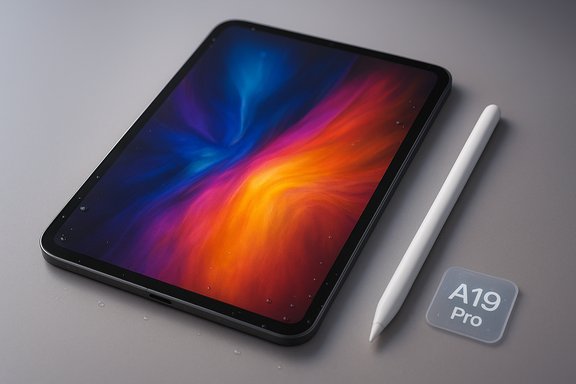
Apple’s smallest tablet is about to get a big technological makeover: leaks and reporting now point to an OLED-equipped iPad Mini 8 arriving in 2026, paired with the A19 Pro silicon, a more water-resistant chassis, and an innovative vibration-based speaker system — all changes that could reset expectations for what a compact tablet can do and command in price.
The iPad Mini line has long occupied a distinct corner of Apple’s tablet family: ultra-portable for reading, note-taking, and one-handed use, but traditionally conservative when it comes to the bleeding edge of display and chassis technology. Apple introduced OLED to the iPad family with the iPad Pro models, and industry coverage in 2024–2025 has tracked the company’s gradual plan to expand OLED across more iPads and MacBooks as panel supply and manufacturing yields allow. That roadmap places the iPad Mini among the early non‑Pro candidates for OLED, while the iPad Air and MacBook lines are expected to follow on staggered timetables. This apparent strategy — reserve the most advanced display tech for Pro models, then diffuse improvements down the lineup — helps Apple manage cost and yield risks while creating clear product tiers. For the iPad Mini 8, the rumored combination of OLED, stronger silicon, and a sealed chassis would shift the device from a niche compact option to a serious mobile creative and media machine, albeit with trade-offs and unanswered technical questions.
Apple’s alleged plan to bring OLED, stronger silicon, and a sturdier acoustic design to the iPad Mini shows how hardware iterations can reframe a product’s value proposition without changing its core identity. The rumored iPad Mini 8 promises a brighter — and literally deeper — experience for users who want top‑tier image quality in a pocketable tablet, but the absence of ProMotion and the possibility of a higher price mean the Mini’s golden age will be defined by who values screen fidelity over refresh fluidity and who accepts a higher cost for that premium. Until Apple confirms the details, the industry’s best reporting gives a solid preview — and a long checklist of technical questions that matter to buyers and reviewers alike.
Source: The Hans India Apple Prepares iPad Mini 8 Launch With Major OLED Upgrade in 2026
 Background
The iPad Mini line has long occupied a distinct corner of Apple’s tablet family: ultra-portable for reading, note-taking, and one-handed use, but traditionally conservative when it comes to the bleeding edge of display and chassis technology. Apple introduced OLED to the iPad family with the iPad Pro models, and industry coverage in 2024–2025 has tracked the company’s gradual plan to expand OLED across more iPads and MacBooks as panel supply and manufacturing yields allow. That roadmap places the iPad Mini among the early non‑Pro candidates for OLED, while the iPad Air and MacBook lines are expected to follow on staggered timetables. This apparent strategy — reserve the most advanced display tech for Pro models, then diffuse improvements down the lineup — helps Apple manage cost and yield risks while creating clear product tiers. For the iPad Mini 8, the rumored combination of OLED, stronger silicon, and a sealed chassis would shift the device from a niche compact option to a serious mobile creative and media machine, albeit with trade-offs and unanswered technical questions. What’s changing: the headline upgrades
OLED replaces LCD — what that means in practice
The most eye-catching claim is straightforward: Apple will replace the iPad Mini’s traditional LCD with an OLED panel, marking the first time a non‑Pro iPad mini uses OLED. OLED’s core advantages are well known: per‑pixel illumination for true blacks, higher contrast ratios, wider color gamuts, and better viewing angles. For a device often used for reading, streaming, and sketching in tight spaces, these improvements will be immediately perceptible. However, not all OLED implementations are equal. Reporting suggests the iPad Mini will likely use a single‑stack LTPS OLED panel rather than the two‑stack or tandem OLED used in higher-end iPad Pro models. That matters because single‑stack panels typically deliver lower peak brightness and may consume more power at high brightness levels compared with tandem LTPO designs. In plain terms: colors and contrast will be a big step up from LCD, but the panel may not match the Pro’s peak brightness, power economy, or advanced refresh features. Multiple leaks also point to an 8.3–8.7 inch class display — broadly similar to the current Mini’s footprint but possibly tweaked slightly for an improved viewing experience. Those size adjustments are credible given historical iPad Mini revisions and supplier panel sizes.No ProMotion: a 60Hz panel likely remains
A recurring detail in coverage is Apple’s decision not to equip the iPad Mini 8 with ProMotion 120Hz variable refresh. Instead, the device is expected to ship with a 60Hz panel, leaving high‑refresh benefits (smoother scrolling, lower stylus latency in some use cases) to the iPad Pro line for the time being. For users who prioritize fluid motion — pro‑grade drawing, fast-paced games, or ultra‑responsive UI animation — that limitation matters, even if OLED still brings superior image quality. That omission appears to be driven by the choice of OLED architecture: single‑stack LTPS panels generally don’t support LTPO-style variable refresh in the way the tandem OLEDs used on Pro models do. The result is an OLED screen with improved color and contrast but without the motion advantages that have become a hallmark of the Pro tablet experience.A19 Pro silicon — an important internal leap
Under the hood, leaked code references and reporting indicate the iPad Mini 8 will be powered by Apple’s A19 Pro family of chips — the same class of silicon appearing in the iPhone 17 Pro and related iPhone Air configurations. The A19 Pro is built on an advanced 3‑nanometer-class node (N3P in reporting), promising modest but meaningful jumps in CPU/GPU performance and energy efficiency versus the A17 Pro currently in the Mini 7. The A19 Pro variants are reported to be configured differently across Apple’s product stack — with some devices getting a 6‑core GPU and others a 5‑core binned version. Public reporting indicates the iPad Mini may use the mid‑tier A19 Pro configuration (a strong match for its compact thermal envelope) — which still represents a material boost for gaming, image processing, and any on‑device ML workloads. That step would make the Mini notably more capable for multitasking, creative apps, and local AI features.Chassis and acoustics: water resistance and a speaker rethink
Bloomberg reporting, amplified by follow‑on coverage, suggests Apple is pursuing a more water‑resistant iPad Mini with a novel acoustic system that removes traditional speaker grilles. The proposed solution uses vibration‑based sound exciters (sometimes called surface or panel exciters) that cause the device’s display or chassis to act as the vibrating surface, producing sound without open speaker ports. Eliminating speaker holes reduces potential ingress points for water and dust and could materially raise the Mini’s durability in everyday use. This is not theoretical: Apple has patents covering mechanically actuated panel acoustic systems, and other consumer devices (including certain phones and TVs) have experimented with exciter‑based audio. The practical trade‑offs are familiar: exciters can reproduce mids and highs effectively but struggle with deep bass, and touch interactions can dampen vibration‑based output unless the system compensates with software and multiple actuators. Apple’s likely approach would pair smart DSP, careful mechanical design, and possibly hybrid drivers to achieve a satisfying sound profile.Pricing and timeline: how much and when
Industry reporting converges on a launch window in 2026 — with some leakers and supply‑chain timelines suggesting Q3 or late‑2026 availability as the earliest realistic release. That schedule reflects panel production ramps and component timing rather than any single source’s claim. Observers who track panel manufacturing note Samsung Display and other suppliers are expanding tablet‑sized OLED production, but mass production timing remains the gating factor for any 2026 rollouts. On price, Bloomberg and subsequent coverage have floated the possibility of an approximate $100 price increase over the Mini 7’s base MSRP — moving a starting price from $499 to roughly $599 in the U.S. That figure is plausible given the cost delta for OLED panels, the upgraded A19 Pro chipset, and a more sealed chassis; however, Apple’s final pricing will reflect competitive positioning, margin strategy, and component costs at the time of launch. Treat the $100 estimate as a well‑sourced rumor rather than a confirmation.Technical verification and cross‑checks
- OLED adoption: multiple industry outlets and supply‑chain analysts agree the iPad Mini is slated to get OLED in 2026, with the iPad Air likely following later. This claim is corroborated across independent reporting and panel‑supply analysis.
- Panel type and refresh rate: coverage consistently indicates a single‑stack LTPS OLED for mid‑range models — a panel type that tends not to support LTPO/ProMotion, implying the Mini will likely stay at 60Hz. This analysis aligns with display‑industry commentary and Apple’s own product engineering tradeoffs.
- A19 Pro presence: leaked code references and multiple MacRumors investigations show the A19 Pro family appearing across Apple’s internal device references; independent outlets have mapped the variant differences (GPU cores, Neural Engine improvements) and the 3nm process claims. These silicon details are consistent across reporting, though Apple has not publicly confirmed them for the Mini.
- Vibration speaker and water resistance: Bloomberg (reporting by Mark Gurman) is the main origin for the vibration‑speaker claim; MacRumors and other outlets have corroborated the description and pointed to existing Apple patents and third‑party examples of panel exciters. The technology is real and plausible, but the final acoustic tuning and any IP rating remain unconfirmed until Apple announces specifics.
Strengths and opportunities
- Major visual upgrade for compact form factors. OLED will transform the Mini’s display by delivering much deeper blacks and richer color rendition, which benefits reading, sketching, and video consumption on the go. The jump from LCD to OLED is immediately visible and impactful for everyday use.
- Performance uplift without thermal excess. The A19 Pro — even in a binned mid‑tier form — represents a notable performance jump that should keep the Mini snappy for games, AI‑assisted features, and creative apps while fitting into the Mini’s thermal constraints.
- Improved durability and water resistance. A sealed chassis with no speaker holes is an elegant path to a more robust device and better real‑world reliability. For a portable device used in travel and near water, that’s a practical advantage beyond marketing copy.
- Differentiation for the compact tablet market. If Apple prices and positions the Mini well, an OLED Mini could attract buyers who want a premium display in a truly pocketable tablet — a category where few competitors currently match Apple’s ecosystem and hardware polish.
Risks, trade‑offs, and unanswered questions
- Brightness, battery life, and LTPS limits. Single‑stack LTPS OLEDs are a cost‑effective compromise but typically yield lower peak brightness and less power efficiency than tandem LTPO panels. In bright outdoor conditions or with HDR video, the Mini’s OLED may not match the Pro’s peak capability. Buyers should not assume parity with Pro displays.
- No ProMotion — perceptible difference for some tasks. The absence of 120Hz will be a real downside for users who prioritize stylus responsiveness or ultra‑smooth scrolling. For digital artists or pro users who rely on fluid input, the Pro models will remain the superior choice.
- Audio compromises with panel exciters. Vibration‑based speakers can change how the device sounds and how it performs with different hand positions. Bass reproduction is the usual shortcoming; Apple would need either hybrid drivers or aggressive DSP to avoid a hollow audio signature. That engineering challenge is solvable, but not guaranteed.
- Price elasticity and market positioning. A rumored $100 bump would push the Mini closer to the iPad Air entry points in absolute price. Apple must balance revenue opportunity with potential buyer pushback; if consumers view the Mini as losing its "affordable pocketable" identity, demand could shift in unpredictable ways.
- Supply and timing uncertainty. Panel production ramp schedules, yield rates, and supplier allocations could delay availability or constrain initial inventory. Reports vary on whether OLED Mini mass production begins mid‑2026 or later, and past product cycles show Apple sometimes staggers releases when parts become constrained. Buyers expecting an immediate 2026 rollout should temper expectations.
Competitive context and the iPad family roadmap
Apple’s broader OLED migration strategy matters here. Analysts and industry outlets place the iPad Air and some MacBook models on later stages of the OLED roll‑out, with the Air likely following the Mini in the product lifecycle and MacBooks lagging until panel sizes and yield economics improve. This phased approach preserves product differentiation for the Pro family while enabling Apple to gradually modernize the rest of the lineup. From a market standpoint, an OLED Mini puts Apple in a strong position against small Android tablets and compact Windows devices that have tried to match portability with premium screens. Apple’s competitive advantage remains its silicon, OS integration, and accessory ecosystem (Apple Pencil, iPadOS apps), but an OLED Mini would remove a display weakness that some competitors have used as a talking point.Who should consider upgrading — and who should wait
- Power users who prioritize a premium display on a truly pocketable device and who value single‑device portability for reading and media will find the OLED Mini very attractive. The combination of OLED and A19 Pro makes the Mini a compelling on‑the‑go creative tool.
- Buyers who prioritize stylus performance, ultra‑smooth animations, or professional drawing workflows should wait for Pro models or confirm whether Apple eventually enables higher refresh options in later Mini revisions.
- Value‑minded shoppers concerned about price jumping $100 or more might be better off holding out for sales, refurbished options, or the current Mini model — especially if the primary need is a small, portable tablet rather than the best possible screen.
Final assessment and caveats
The iPad Mini 8, as reported, represents the kind of incremental but meaningful evolution that characterizes mature product lines: better display tech, stronger silicon, and targeted design changes that increase durability. If the leaks prove accurate, the Mini will look and feel more premium than previous generations while still retaining its defining compactness. The A19 Pro makes the Mini future‑proof for several high‑performance use cases, and the sealed chassis would be a welcome practical upgrade. That said, multiple elements remain rumors. Precise launch timing, final panel specs (peak nits, color volume, exact refresh characteristics), real‑world battery impact, acoustic fidelity from the vibration speakers, and final pricing are all subject to change. Coverage from Bloomberg, MacRumors, AppleInsider, and other outlets converges on a consistent story, but differences in supply‑chain forecasts and the lack of public confirmation mean readers should treat current details as a well‑sourced preview rather than product specifications. Until Apple announces official specs and prices, the most reliable posture is cautious optimism tempered by the practical caveats above.Apple’s alleged plan to bring OLED, stronger silicon, and a sturdier acoustic design to the iPad Mini shows how hardware iterations can reframe a product’s value proposition without changing its core identity. The rumored iPad Mini 8 promises a brighter — and literally deeper — experience for users who want top‑tier image quality in a pocketable tablet, but the absence of ProMotion and the possibility of a higher price mean the Mini’s golden age will be defined by who values screen fidelity over refresh fluidity and who accepts a higher cost for that premium. Until Apple confirms the details, the industry’s best reporting gives a solid preview — and a long checklist of technical questions that matter to buyers and reviewers alike.
Source: The Hans India Apple Prepares iPad Mini 8 Launch With Major OLED Upgrade in 2026
