

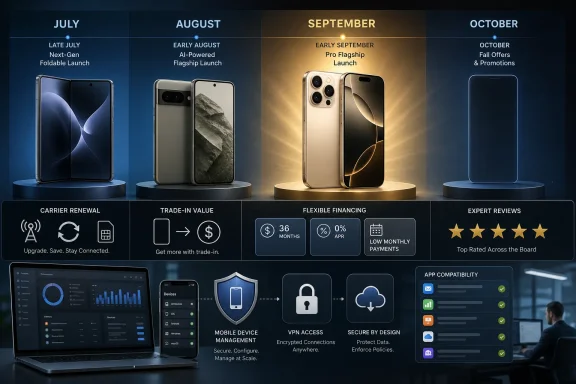
Apple is expected to introduce the iPhone 18 Pro, iPhone 18 Pro Max, and iPhone Ultra in early September 2026, according to Forbes, following the late-July and early-August windows associated with Samsung and Google. The important point is not simply that Apple may arrive later. Forbes’ framing suggests that the interval gives Android devices only a limited period of full-price selling before buyers, carriers, and reviewers turn their attention toward Apple’s expected event and the September–October contract-renewal market.
That outcome is not guaranteed. Samsung and Google can use their earlier timing to secure sales, reviews, and customer commitments before Apple presents its products. But buyers should treat the summer and early-fall launches as parts of one purchasing season rather than as isolated events. Apple’s incoming CEO, John Ternus, adds leadership significance to the cycle, although no supported handover date should be inferred from the product calendar.
Smartphone launches are usually discussed through processors, cameras, displays, batteries, software features, and industrial design. Timing can appear to be a secondary logistical detail, but it directly affects how long a device is sold before the next major announcement changes customer expectations and promotional activity.
The central argument in Forbes’ July 11, 2026 analysis is that Apple’s expected calendar gives it a useful competitive position. By waiting until early September to introduce the iPhone 18 Pro family, Apple would allow Samsung and Google to present their devices first while still arriving before those earlier releases have enjoyed a long, uninterrupted premium-sales period.
Forbes estimates that Samsung will have roughly six weeks of full-price sales before Apple’s expected arrival. It gives Google a shorter interval of approximately four weeks. Those estimates should not be read as expiration dates. The Samsung and Google devices can remain current, attractive, and widely available after Apple’s event. The windows instead describe the period in which those phones may be sold without the newest iPhone simultaneously dominating comparisons and carrier advertising.
That distinction matters to shoppers. Someone considering an expensive phone in July may be comfortable buying immediately. By August, however, another customer may decide that waiting several weeks is worthwhile—not necessarily because that customer has already chosen an iPhone, but because Apple’s event could affect competing offers.
Samsung and Google can turn their earlier positions into advantages. They can establish review narratives, attract customers who do not want to wait, and give buyers a chance to evaluate shipping products rather than anticipated ones. They can also use opening incentives to make delay less appealing.
Apple’s expected timing creates a different opportunity. It can enter after the initial Android coverage while carriers and customers are moving into an active fall purchasing period. WindowsForum’s interpretation is that this may concentrate attention around Apple, but the calendar alone does not prove that Apple will control the season or prevent its rivals from succeeding.
The timing requires careful qualification. The supplied facts support late-July and early-August windows for Samsung and Google, along with the named devices and software. They do not establish that every window is the exact hardware release date of every named model. They also do not establish that iOS 27 will be released on the same day as Apple’s expected hardware announcement.
Similarly, references to Android 17, OneUI 9, and iOS 27 describe the software identified in the competitive comparison. They should not be treated as independent confirmation from Google, Samsung, or Apple about beta programs, deployment dates, eligible devices, or final release plans.
Even with those limits, the sequence gives buyers a useful framework. A premium Android phone offered in July or August is not competing only against products already in stores. It is also competing against the option to wait for Apple’s expected September announcement and then compare the full market.
That waiting behavior can affect even committed Android buyers. Apple’s event may prompt carriers and retailers to revise trade-in offers or financing packages across multiple brands. A customer can therefore benefit from waiting without ultimately buying an iPhone.
The opposite is also possible. An early Samsung or Google package may provide unusually strong value, and waiting could mean losing a limited promotion, preferred configuration, or immediate trade-in opportunity. The sensible response is not automatically to delay. It is to compare the entire transaction, preserve copies of offer terms, and understand whether incentives depend on a particular service plan or long-term bill credit.
Late July 2026 — The Samsung window described by Forbes begins, allowing an estimated six weeks of full-price selling before Apple’s expected event.
Early August 2026 — The Google window described by Forbes follows, leaving an estimated four weeks before Apple’s expected event. This should not be treated as independent confirmation of an exact Pixel 11 launch date.
Early September 2026 — Forbes expects Apple to introduce the iPhone 18 Pro, iPhone 18 Pro Max, and iPhone Ultra. This is an attributed expectation, not a settled launch date.
September–October 2026 — The contract-renewal period identified in the Forbes analysis may increase carrier and customer activity across the premium-phone market.
That audience differs from general summer traffic. A customer entering a carrier store or website for a renewal may be ready to consider several connected decisions at once: the device, trade-in, installment schedule, service plan, insurance, accessories, and additional lines.
An expected Apple announcement gives carriers another major product event around which to organize offers. That does not mean every promotion will favor Apple or that every Android deal will weaken. It means buyers may see the terms of the comparison change as carriers update their fall campaigns.
This is why sticker price alone can be misleading. A phone advertised at one price can have a substantially different effective cost after bill credits, mandatory plan changes, trade-in conditions, activation charges, insurance, taxes, and early-upgrade restrictions are included.
Businesses face an additional complication: an attractive per-device price may depend on service terms that are less favorable over the full agreement. Procurement teams should request written quotes that separate hardware cost from wireless service, management licensing, support, and termination obligations.
For consumers, the key question is whether an opening Android promotion is valuable enough to justify buying before Apple’s expected event. For enterprises, the question is broader: whether the offer still makes sense after compatibility, support, repair, and lifecycle requirements have been considered.
This does not mean Apple can redesign an iPhone in the final weeks before an event. Major hardware and production decisions would necessarily precede the public launch period. Nor does it prove that Apple has access to a complete or reliable picture of competitor demand.
The more defensible point is about presentation. A company can adjust the order in which features are discussed, the comparisons emphasized in advertising, the questions addressed in briefings, and the demonstrations selected for retail environments.
Under that interpretation, Samsung and Google are not conducting a controlled experiment for Apple, and Apple is not simply receiving definitive results. Rather, the earlier launches create public market signals that Apple may be able to observe before its own expected presentation.
That opportunity can be useful without being decisive. Early products may earn excellent reviews, secure strong preorders, or establish a message that Apple struggles to answer. A later event can also disappoint customers who waited. Timing creates an opening; it does not determine product quality or demand.
This evidence-led explanation is more useful than claiming that Apple decides when the season begins. The calendar may help Apple concentrate attention, but buyers, carriers, reviewers, and competing manufacturers retain substantial influence over how the season develops.
It would therefore be premature to state that Apple developer materials confirm iOS 27 beta testing. No supporting Apple developer source has been provided. It would also be inappropriate to claim that Google has issued a specific official Android 17 rollout statement or that Samsung has published official OneUI 9 material when the supplied sourcing does not establish those statements.
The valid strategic comparison is narrower. Apple controls the iPhone and iOS product relationship, while Android devices can combine Google’s underlying platform with software and deployment decisions made by individual manufacturers. That structural difference affects how IT teams and buyers approach compatibility testing.
A new iPhone model and a named iOS release should not automatically be assumed to ship together merely because they appear in the same market analysis. The same caution applies to Android hardware and software pairings until final availability and eligibility are confirmed by the relevant manufacturers.
For consumers, these distinctions may matter most when a promoted feature depends on a specific model, region, account, language, or later software update. Buyers should check whether the capabilities that influenced their decision are available at purchase rather than relying solely on an event demonstration or a broad platform label.
For enterprises, the version number is only the beginning. Administrators need to validate the actual combinations deployed across their fleets: device model, operating-system build, manufacturer interface, carrier configuration, security software, identity provider, certificates, and managed applications.
Coordination can simplify communication, but it does not guarantee a trouble-free release. A concentrated transition can expose many users to the same compatibility issue quickly. A distributed transition can create more versions to track while also allowing organizations to stage deployment.
The practical choice is not between a perfectly unified platform and a hopelessly fragmented one. It is between different testing and management burdens.
Buyers can still make a rigorous price comparison without relying on those assumptions.
Start with the device’s unlocked retail price, then add or subtract every condition attached to the offer:
This is why the July-through-October calendar should be treated as a comparison period. A shopper evaluating Samsung or Google in the summer can record the opening terms and compare them with updated offers surrounding Forbes’ expected Apple event.
There is no assurance that waiting will produce a lower price. Inventory may change, trade-in values may fall, and introductory bundles may expire. The goal is not to predict the market perfectly. It is to avoid mistaking the first advertised offer for the only meaningful one.
The product cycle may still be interpreted as an important moment for Ternus. Major iPhone programs are developed over long periods, so the expected devices cannot reasonably be treated as the work of one incoming executive. They will reflect decisions made across engineering, design, software, operations, marketing, and other parts of Apple.
That makes the cycle an inherited test as much as a leadership debut. Observers may use it to assess how Ternus communicates Apple’s priorities and how the company presents the relationship among its premium phones and software. But the launch should not be framed as a definitive statement of his strategy before Apple has provided the necessary details.
Claims about Tim Cook’s operational methods, Apple’s supply-chain discipline, channel system, services-revenue strategy, or historical pattern of entering established categories also require appropriate sourcing. They are not necessary to explain the narrower Forbes thesis and should not be presented as supported facts in this article.
The defensible conclusion is straightforward: a major expected iPhone launch occurring around a leadership transition will attract scrutiny beyond product specifications. How much it reveals about the incoming CEO will depend on Apple’s actual announcements and Ternus’ visible role.
Apple and Android create different planning challenges. An iOS transition can concentrate employee interest and support demand into a relatively short period. Android environments may require teams to account for platform versions, manufacturer software, device eligibility, carrier-specific builds, and varied deployment schedules.
Neither platform is inherently effortless. The correct approach is to identify the device-and-software combinations the organization actually supports, validate them against business requirements, and use management controls to reduce unplanned change.
The expected iPhone 18 Pro family may also affect procurement negotiations during the September–October renewal period cited by Forbes. Organizations approaching a carrier renewal should obtain competitive quotes rather than assuming the launch promotion offered to consumers is also the best enterprise arrangement.
Headline device discounts can hide costs elsewhere in the agreement. An enterprise comparison should include support effort, repair turnaround, spare-device requirements, expected lifecycle, accessories, enrollment, management licensing, security tooling, and the cost of maintaining multiple platforms.
WindowsForum’s interpretation is that this compressed calendar can change buyer behavior before Apple’s event and promotional behavior after it. That is a strategic possibility, not demonstrated proof that Apple will determine the outcome of the premium-phone season.
Samsung and Google have their own opportunity. Earlier timing lets them place products before customers, earn independent reviews, and convert buyers who value immediate availability. Apple assumes the risk that people who wait may find its eventual products, prices, or offers less compelling than the alternatives already on sale.
The best response for buyers is therefore practical rather than tribal. Compare the devices that actually ship. Verify the software and features available at purchase. Read the conditions attached to trade-ins and financing. Evaluate the complete cost of ownership. For managed fleets, finish application and MDM testing before approving procurement or broad operating-system adoption.
Apple may arrive later, as Forbes expects, but later does not automatically mean stronger. It means the market may still be changing when the first Android launch prices appear. Consumers and enterprises should use that interval to gather information instead of treating the opening offer—or the expected September event—as the inevitable final answer.
That outcome is not guaranteed. Samsung and Google can use their earlier timing to secure sales, reviews, and customer commitments before Apple presents its products. But buyers should treat the summer and early-fall launches as parts of one purchasing season rather than as isolated events. Apple’s incoming CEO, John Ternus, adds leadership significance to the cycle, although no supported handover date should be inferred from the product calendar.
What this means for buyers — WindowsForum analysis
These recommendations are WindowsForum’s interpretation of the competitive calendar, not claims made by Forbes about any buyer’s individual circumstances.
- Do not assume that the advertised July or August launch price of a new Android flagship will remain its most competitive effective price.
- Compare carrier financing, trade-in credits, storage promotions, and plan requirements through Forbes’ expected early-September iPhone event.
- Enterprise purchasers should delay final procurement decisions until required applications, security tools, and mobile-device-management policies have been validated.
 Apple Is Treating the Calendar as a Competitive Asset
Smartphone launches are usually discussed through processors, cameras, displays, batteries, software features, and industrial design. Timing can appear to be a secondary logistical detail, but it directly affects how long a device is sold before the next major announcement changes customer expectations and promotional activity.The central argument in Forbes’ July 11, 2026 analysis is that Apple’s expected calendar gives it a useful competitive position. By waiting until early September to introduce the iPhone 18 Pro family, Apple would allow Samsung and Google to present their devices first while still arriving before those earlier releases have enjoyed a long, uninterrupted premium-sales period.
Forbes estimates that Samsung will have roughly six weeks of full-price sales before Apple’s expected arrival. It gives Google a shorter interval of approximately four weeks. Those estimates should not be read as expiration dates. The Samsung and Google devices can remain current, attractive, and widely available after Apple’s event. The windows instead describe the period in which those phones may be sold without the newest iPhone simultaneously dominating comparisons and carrier advertising.
That distinction matters to shoppers. Someone considering an expensive phone in July may be comfortable buying immediately. By August, however, another customer may decide that waiting several weeks is worthwhile—not necessarily because that customer has already chosen an iPhone, but because Apple’s event could affect competing offers.
Samsung and Google can turn their earlier positions into advantages. They can establish review narratives, attract customers who do not want to wait, and give buyers a chance to evaluate shipping products rather than anticipated ones. They can also use opening incentives to make delay less appealing.
Apple’s expected timing creates a different opportunity. It can enter after the initial Android coverage while carriers and customers are moving into an active fall purchasing period. WindowsForum’s interpretation is that this may concentrate attention around Apple, but the calendar alone does not prove that Apple will control the season or prevent its rivals from succeeding.
Six Weeks for Samsung, Four for Google, and an Expected September Event for Apple
The competitive schedule described by Forbes presents three different positions rather than three interchangeable launch events. Samsung receives the longest interval before Apple’s expected announcement, Google receives a shorter one, and Apple is expected to arrive as September–October contract renewals build.| Company | Premium device discussed | Timing supported by the Forbes framing | Software named in the comparison | Practical implication |
|---|---|---|---|---|
| Samsung | Galaxy Z Fold | Late-July window | OneUI 9 on Android 17 | Approximately six weeks of full-price sales before Apple’s expected event |
| Pixel 11 | Early-August window associated with Google’s offering | Android 17 | Approximately four weeks of full-price sales before Apple’s expected event | |
| Apple | iPhone 18 Pro, iPhone 18 Pro Max, and iPhone Ultra | Forbes expects an early-September introduction | iOS 27 | Expected to enter during the September–October renewal period |
Similarly, references to Android 17, OneUI 9, and iOS 27 describe the software identified in the competitive comparison. They should not be treated as independent confirmation from Google, Samsung, or Apple about beta programs, deployment dates, eligible devices, or final release plans.
Even with those limits, the sequence gives buyers a useful framework. A premium Android phone offered in July or August is not competing only against products already in stores. It is also competing against the option to wait for Apple’s expected September announcement and then compare the full market.
That waiting behavior can affect even committed Android buyers. Apple’s event may prompt carriers and retailers to revise trade-in offers or financing packages across multiple brands. A customer can therefore benefit from waiting without ultimately buying an iPhone.
The opposite is also possible. An early Samsung or Google package may provide unusually strong value, and waiting could mean losing a limited promotion, preferred configuration, or immediate trade-in opportunity. The sensible response is not automatically to delay. It is to compare the entire transaction, preserve copies of offer terms, and understand whether incentives depend on a particular service plan or long-term bill credit.
Timeline
July 11, 2026 — Forbes publishes its analysis of the timing surrounding Apple’s expected iPhone 18 Pro introduction.Late July 2026 — The Samsung window described by Forbes begins, allowing an estimated six weeks of full-price selling before Apple’s expected event.
Early August 2026 — The Google window described by Forbes follows, leaving an estimated four weeks before Apple’s expected event. This should not be treated as independent confirmation of an exact Pixel 11 launch date.
Early September 2026 — Forbes expects Apple to introduce the iPhone 18 Pro, iPhone 18 Pro Max, and iPhone Ultra. This is an attributed expectation, not a settled launch date.
September–October 2026 — The contract-renewal period identified in the Forbes analysis may increase carrier and customer activity across the premium-phone market.
September Matters Because Contract Renewals Move With It
Apple’s expected timing overlaps with a part of the smartphone business that specification comparisons often overlook: contract renewals and upgrade eligibility. Forbes identifies September and October as an important renewal period, creating a pool of customers who may already be prepared to reconsider their devices, financing, and wireless plans.That audience differs from general summer traffic. A customer entering a carrier store or website for a renewal may be ready to consider several connected decisions at once: the device, trade-in, installment schedule, service plan, insurance, accessories, and additional lines.
An expected Apple announcement gives carriers another major product event around which to organize offers. That does not mean every promotion will favor Apple or that every Android deal will weaken. It means buyers may see the terms of the comparison change as carriers update their fall campaigns.
This is why sticker price alone can be misleading. A phone advertised at one price can have a substantially different effective cost after bill credits, mandatory plan changes, trade-in conditions, activation charges, insurance, taxes, and early-upgrade restrictions are included.
Businesses face an additional complication: an attractive per-device price may depend on service terms that are less favorable over the full agreement. Procurement teams should request written quotes that separate hardware cost from wireless service, management licensing, support, and termination obligations.
For consumers, the key question is whether an opening Android promotion is valuable enough to justify buying before Apple’s expected event. For enterprises, the question is broader: whether the offer still makes sense after compatibility, support, repair, and lifecycle requirements have been considered.
The Strategic Value Is Information, Not a Guaranteed Victory
The strongest interpretation of the Forbes argument is that later timing may give Apple more information before it finalizes its public presentation. Samsung and Google can reveal their product positioning, prices, demonstrations, and launch promotions first. Reviews and early customer responses then show which messages are receiving attention.This does not mean Apple can redesign an iPhone in the final weeks before an event. Major hardware and production decisions would necessarily precede the public launch period. Nor does it prove that Apple has access to a complete or reliable picture of competitor demand.
The more defensible point is about presentation. A company can adjust the order in which features are discussed, the comparisons emphasized in advertising, the questions addressed in briefings, and the demonstrations selected for retail environments.
Under that interpretation, Samsung and Google are not conducting a controlled experiment for Apple, and Apple is not simply receiving definitive results. Rather, the earlier launches create public market signals that Apple may be able to observe before its own expected presentation.
That opportunity can be useful without being decisive. Early products may earn excellent reviews, secure strong preorders, or establish a message that Apple struggles to answer. A later event can also disappoint customers who waited. Timing creates an opening; it does not determine product quality or demand.
This evidence-led explanation is more useful than claiming that Apple decides when the season begins. The calendar may help Apple concentrate attention, but buyers, carriers, reviewers, and competing manufacturers retain substantial influence over how the season develops.
Software Coordination Remains an Important Comparison—With Limits
Forbes’ comparison associates Apple’s expected hardware family with iOS 27, Samsung’s Galaxy Z Fold with OneUI 9 on Android 17, and Google’s Pixel 11 with Android 17. Those names provide a framework for comparing platform approaches, but the supplied material does not independently confirm any company’s beta schedule or final software rollout plan.It would therefore be premature to state that Apple developer materials confirm iOS 27 beta testing. No supporting Apple developer source has been provided. It would also be inappropriate to claim that Google has issued a specific official Android 17 rollout statement or that Samsung has published official OneUI 9 material when the supplied sourcing does not establish those statements.
The valid strategic comparison is narrower. Apple controls the iPhone and iOS product relationship, while Android devices can combine Google’s underlying platform with software and deployment decisions made by individual manufacturers. That structural difference affects how IT teams and buyers approach compatibility testing.
A new iPhone model and a named iOS release should not automatically be assumed to ship together merely because they appear in the same market analysis. The same caution applies to Android hardware and software pairings until final availability and eligibility are confirmed by the relevant manufacturers.
For consumers, these distinctions may matter most when a promoted feature depends on a specific model, region, account, language, or later software update. Buyers should check whether the capabilities that influenced their decision are available at purchase rather than relying solely on an event demonstration or a broad platform label.
For enterprises, the version number is only the beginning. Administrators need to validate the actual combinations deployed across their fleets: device model, operating-system build, manufacturer interface, carrier configuration, security software, identity provider, certificates, and managed applications.
Coordination can simplify communication, but it does not guarantee a trouble-free release. A concentrated transition can expose many users to the same compatibility issue quickly. A distributed transition can create more versions to track while also allowing organizations to stage deployment.
The practical choice is not between a perfectly unified platform and a hopelessly fragmented one. It is between different testing and management burdens.
Buyers Should Compare Effective Cost, Not Launch Price
The supplied Forbes facts do not support broader claims that memory or storage costs are rising, that all 2026 flagship prices will increase, or that earlier Android pricing will normalize a more expensive iPhone. Those possibilities should not be presented as established explanations for the launch order.Buyers can still make a rigorous price comparison without relying on those assumptions.
Start with the device’s unlocked retail price, then add or subtract every condition attached to the offer:
- Trade-in value and the method used to deliver it
- Immediate discount versus monthly bill credits
- Required service-plan tier
- Length of the financing or credit period
- Activation and upgrade fees
- Taxes charged before promotional credits
- Storage capacity included in the offer
- Insurance or protection-plan requirements
- Early-payoff and cancellation consequences
- Resale or redeployment options at the end of the lifecycle
This is why the July-through-October calendar should be treated as a comparison period. A shopper evaluating Samsung or Google in the summer can record the opening terms and compare them with updated offers surrounding Forbes’ expected Apple event.
There is no assurance that waiting will produce a lower price. Inventory may change, trade-in values may fall, and introductory bundles may expire. The goal is not to predict the market perfectly. It is to avoid mistaking the first advertised offer for the only meaningful one.
Leadership Adds Significance, but Not a Supported Handover Date
John Ternus is Apple’s incoming CEO, making the expected iPhone 18 Pro cycle relevant to the company’s leadership story. The supplied facts do not, however, establish that Apple announced a September 1, 2026 handover or that the transition will occur on any specific date.The product cycle may still be interpreted as an important moment for Ternus. Major iPhone programs are developed over long periods, so the expected devices cannot reasonably be treated as the work of one incoming executive. They will reflect decisions made across engineering, design, software, operations, marketing, and other parts of Apple.
That makes the cycle an inherited test as much as a leadership debut. Observers may use it to assess how Ternus communicates Apple’s priorities and how the company presents the relationship among its premium phones and software. But the launch should not be framed as a definitive statement of his strategy before Apple has provided the necessary details.
Claims about Tim Cook’s operational methods, Apple’s supply-chain discipline, channel system, services-revenue strategy, or historical pattern of entering established categories also require appropriate sourcing. They are not necessary to explain the narrower Forbes thesis and should not be presented as supported facts in this article.
The defensible conclusion is straightforward: a major expected iPhone launch occurring around a leadership transition will attract scrutiny beyond product specifications. How much it reveals about the incoming CEO will depend on Apple’s actual announcements and Ternus’ visible role.
Enterprise Buyers Should Look Beyond the Launch-Day Spectacle
For corporate IT, the consumer calendar has practical consequences even when an organization does not purchase phones on launch day. New operating-system versions can affect application compatibility, employee-owned devices can update before internal validation is complete, and carrier promotions can change the economics of a planned fleet refresh.Apple and Android create different planning challenges. An iOS transition can concentrate employee interest and support demand into a relatively short period. Android environments may require teams to account for platform versions, manufacturer software, device eligibility, carrier-specific builds, and varied deployment schedules.
Neither platform is inherently effortless. The correct approach is to identify the device-and-software combinations the organization actually supports, validate them against business requirements, and use management controls to reduce unplanned change.
The expected iPhone 18 Pro family may also affect procurement negotiations during the September–October renewal period cited by Forbes. Organizations approaching a carrier renewal should obtain competitive quotes rather than assuming the launch promotion offered to consumers is also the best enterprise arrangement.
Headline device discounts can hide costs elsewhere in the agreement. An enterprise comparison should include support effort, repair turnaround, spare-device requirements, expected lifecycle, accessories, enrollment, management licensing, security tooling, and the cost of maintaining multiple platforms.
Pre-Release IT Checklist
- Inventory current devices and operating systems. Record supported iOS and Android versions, manufacturer variants, device models, ownership type, patch status, and remaining lifecycle.
- Verify MDM enrollment. Identify corporate and BYOD devices that are missing from mobile-device-management or unified-endpoint-management enrollment, are not checking in, or are failing compliance policies.
- Test VPN access. Validate connection establishment, always-on behavior, per-app VPN rules, split tunneling, certificate authentication, and reconnect behavior after network changes.
- Test SSO and identity. Confirm sign-in flows, multifactor authentication, conditional-access policies, passwordless methods, application handoff, and account recovery.
- Test EDR and mobile security tools. Check installation, permissions, threat reporting, network inspection, compliance signals, and integration with security operations.
- Test certificates. Validate enrollment, renewal, revocation, Wi-Fi authentication, VPN authentication, email signing, and any device-bound certificate workflows.
- Test line-of-business applications. Cover native apps, managed web apps, virtual desktop clients, document workflows, camera or barcode functions, notifications, offline operation, and background processing.
- Set update-deferral policies before beta or general availability. Confirm that MDM policies are configured before employees begin updating, and document the conditions for moving from deferral to approved deployment.
- Define BYOD support boundaries. State which device models and operating-system versions are supported, what IT can troubleshoot, what data the organization can manage, and when access will be blocked for noncompliance.
- Obtain carrier quotes during September–October renewals. Request written, comparable proposals covering devices, service plans, financing, trade-ins, activation, roaming, pooled data, early termination, and account support.
- Compare total cost rather than device price. Include support labor, repair, downtime, loaner inventory, accessories, expected lifecycle, resale or redeployment value, security tools, and management licensing.
- Prepare communications and rollback procedures. Tell users when updates are approved, how to report failures, what temporary workarounds exist, and whether affected devices can be restored or replaced.
- Create a staged deployment group. Use IT staff and representative business users to test real workflows before broad approval, including remote employees and users on different carriers.
- Document the final support matrix. Publish approved models, minimum and maximum OS versions, required apps, known issues, and escalation paths for the service desk.
The Calendar Creates Leverage, Not Certainty
Forbes’ expected sequence gives Apple a potentially valuable position: Samsung in a late-July window, Google in an early-August window, and the iPhone 18 Pro, iPhone 18 Pro Max, and iPhone Ultra expected in early September as contract renewals build.WindowsForum’s interpretation is that this compressed calendar can change buyer behavior before Apple’s event and promotional behavior after it. That is a strategic possibility, not demonstrated proof that Apple will determine the outcome of the premium-phone season.
Samsung and Google have their own opportunity. Earlier timing lets them place products before customers, earn independent reviews, and convert buyers who value immediate availability. Apple assumes the risk that people who wait may find its eventual products, prices, or offers less compelling than the alternatives already on sale.
The best response for buyers is therefore practical rather than tribal. Compare the devices that actually ship. Verify the software and features available at purchase. Read the conditions attached to trade-ins and financing. Evaluate the complete cost of ownership. For managed fleets, finish application and MDM testing before approving procurement or broad operating-system adoption.
Apple may arrive later, as Forbes expects, but later does not automatically mean stronger. It means the market may still be changing when the first Android launch prices appear. Consumers and enterprises should use that interval to gather information instead of treating the opening offer—or the expected September event—as the inevitable final answer.
References
- Primary source: Forbes
Published: Sat, 11 Jul 2026 17:24:07 GMT
Loading…
www.forbes.com - Related coverage: tomsguide.com
Loading…
www.tomsguide.com - Related coverage: digitalcameraworld.com
Apple is reportedly making 10 million folding iPhones – but that's just one of five new phones in a massive iPhone 18 lineup, even as other firms retreat | Digital Camera World
Leaker reveals Apple's massive component hoard for the upcoming iPhone 18 series, including a surprising five modelswww.digitalcameraworld.com - Related coverage: t3.com
iPhone Ultra could be the hottest foldable of 2026, although you might have to wait a bit longer to get your hands on one | T3
Patience is a virtue as the saying goeswww.t3.com - Related coverage: techcrunch.com
Loading…
techcrunch.com - Official source: developer.apple.com
Loading…
developer.apple.com
- Related coverage: builtin.com
Loading…
builtin.com - Related coverage: bloomberg.com
Loading…
www.bloomberg.com - Related coverage: 9to5mac.com
iPhone 18 Pro release date: Here’s when Apple’s new model is coming - 9to5Mac
Apple has new iPhones coming this fall, here’s when to expect the iPhone 18 lineup’s announcement, release date, and more.9to5mac.com - Related coverage: macrumors.com
Loading…
www.macrumors.com - Related coverage: goiam.org
CPC Letter Urging Apple to Protect Workers at Unionized Apple Store in Towson MD 06 01 2026
PDF documentwww.goiam.org
- Related coverage: qualifications.pearson.com
Loading…
qualifications.pearson.com - Official source: apple.com
Loading…
www.apple.com