

Apple’s unreleased iPhone 18 Pro has been exposed through a reported Tata Electronics data breach in India, with Reuters and AppleInsider saying stolen files posted by World Leaks include supplier lists, component documents, and early-2026 test photos of Pro models. The leak is not just another prelaunch rumor cycle dressed up as drama. It is a reminder that Apple’s secrecy now depends less on Cupertino’s walls than on a sprawling manufacturing web that must share tomorrow’s hardware with today’s contractors. The most interesting iPhone 18 Pro story, in other words, may not be the phone at all.
The consumer version of this story is straightforward: a future iPhone may have appeared before Apple wanted it to. Geeky Gadgets, building on Max Tech’s video coverage, framed the breach as an unusually detailed glimpse at the iPhone 18 Pro, including alleged information about the A20 Pro chip, camera changes, thermal design, and satellite-enabled connectivity. AOL, carrying Reuters reporting, emphasized the darker part of the same picture: files reportedly stolen from Tata Electronics and posted on the dark web after an apparent ransomware incident.
Those are related stories, but they are not the same story. One is about what Apple might ship. The other is about what Apple must reveal to its suppliers long before it can ship anything at all.
That distinction matters because Apple’s mystique has always rested on a carefully managed contradiction. The company sells products as though they emerge fully formed from an immaculate design culture, yet the iPhone is actually the product of a huge, distributed industrial system. Hundreds of parts, multiple suppliers, regional manufacturing bets, test lines, certification workflows, and logistics plans all have to move in coordination. Secrecy survives only if every link in that chain behaves like Apple.
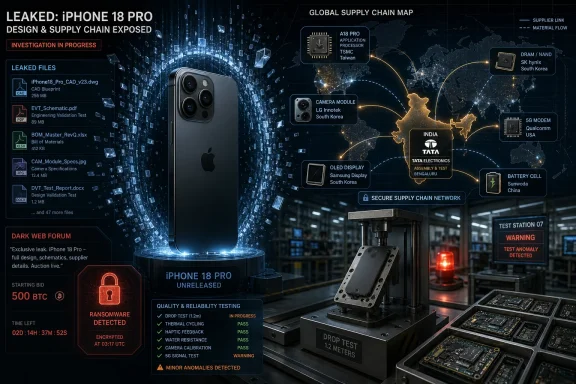
Reuters’ reporting makes clear why this breach has teeth even if every single iPhone 18 Pro specification circulating online should be treated cautiously. The documents reportedly map many components in iPhone 18 Pro models to specific suppliers, including chips on the main circuit board and parts of the battery and camera systems. That is the kind of information Apple does not disclose in its public supplier database, because it reveals bargaining leverage, single-source dependencies, and the quiet architecture of Apple’s hardware empire.
The correct posture is disciplined skepticism. Reuters said it had not independently verified the authenticity of all the data, and Apple and Tata did not respond to its queries in the AOL-published version of the report. That does not mean the material is fake; it means the responsible reading is that the breach is real enough to worry Apple, while the consumer-facing feature list remains a moving target.
The most valuable material in such a leak is often not the glamorous part. A photo of a grey slab-shaped iPhone undergoing drop testing may dominate social feeds, but a spreadsheet tying a particular power-management component, camera module, RF part, or battery element to a named supplier can be more commercially sensitive. It can tell rivals where Apple is experimenting, tell counterfeiters what to imitate, and tell vendors where Apple has fewer alternatives than it would like the market to believe.
This is why the “biggest Apple leak since the iPhone 4” framing is both understandable and slightly misleading. The iPhone 4 bar incident in 2010 was cinematic because it involved a physical prototype. This episode is more bureaucratic and more modern: the alleged leakage of design artifacts, supplier intelligence, internal photographs, and manufacturing records from a partner’s systems. A lost prototype embarrasses a company. A supplier data breach maps the company.
The reported numbers explain the stakes. Counterpoint, cited in the AOL/Reuters account, estimates that India is on track to make 26 percent of the world’s iPhones in 2026, up from 6 percent four years earlier. Whether that exact share moves up or down over time, the trend is unmistakable. India is no longer an Apple manufacturing experiment; it is part of the core strategy.
That strategy carries benefits Apple badly wants. A broader manufacturing footprint reduces exposure to China-specific political risk, labor disruption, pandemic-style shutdowns, tariff pressure, and logistics bottlenecks. It also gives Apple more leverage over its manufacturing partners by avoiding overdependence on any one geography or assembler.
But diversification does not magically reduce risk. It redistributes it. Every new site, partner, contractor, test workflow, and local network becomes another place where highly sensitive information must be stored, accessed, copied, rendered, printed, and protected. The iPhone supply chain is not simply moving from China to India; it is becoming more globally redundant and therefore more informationally porous.
That creates a basic asymmetry. Apple can impose strict contractual obligations on partners, demand security controls, compartmentalize access, watermark files, and punish leaks. Attackers need only find one weak system with enough valuable material to make the operation worthwhile. Ransomware groups have learned that supplier ecosystems are often softer targets than the flagship brands they serve.
World Leaks reportedly posted more than 200,000 files and about 630GB of material from Tata Electronics, with Reuters earlier reporting that the cache included purported Apple and Tesla material as well as documents connected to TSMC and Qualcomm. The inclusion of several major technology firms is important because it suggests the breach is not merely an Apple embarrassment. It is a lesson in how concentrated industrial suppliers can become data crossroads for multiple blue-chip clients.
For IT pros, the familiar phrase is third-party risk. For Apple, that phrase is not an audit checkbox; it is the operating system of the business. The company’s premium hardware margins depend on letting partners know enough to build at scale while preventing those partners, their employees, their subcontractors, and their compromised systems from becoming windows into the future product roadmap.
The 2nm angle is the headline because process nodes are easy to sell. For years, Apple has used TSMC’s leading-edge manufacturing to turn silicon efficiency into product advantage: longer battery life, sustained performance, better image processing, and more headroom for machine-learning features. If the A20 generation moves to a 2nm-class process, the point is not simply a faster benchmark. The point is to preserve the iPhone’s thermal and battery envelope while the phone takes on more AI, camera, modem, and display workload.
The alleged packaging changes are more interesting than the node label. Moving memory closer to or differently around the application processor, widening the bus, and rethinking the physical layout are the kinds of choices that affect sustained performance under real workloads. They also hint at how constrained the modern smartphone has become. Apple is no longer just chasing peak CPU numbers; it is fighting heat, board space, signal integrity, and battery volume inside a sealed glass-and-metal rectangle that consumers still expect to feel elegant.
That is why the reported thermal changes make sense. A larger vapor chamber and a chip position designed to move heat outward would fit a world where phones are asked to run console-style games, on-device AI models, computational photography pipelines, satellite features, and high-bitrate video workloads. The iPhone’s future may be thinner bezels and prettier colors on the outside, but inside it increasingly looks like a thermal engineering exercise.
Apple wants modem independence for the same reason it wanted CPU independence. Owning the stack gives Apple control over power behavior, integration, feature timing, board design, and long-term cost. But cellular modems are brutally hard. They must work across carriers, regions, bands, regulatory environments, edge cases, and real-world radio conditions that do not care about Apple’s design preferences.
Satellite connectivity adds another layer. Apple already made emergency satellite communication a consumer-visible feature, and the broader industry has been moving toward direct-to-device satellite messaging and coverage for places where terrestrial networks are weak or absent. “5G over satellite” is a phrase that sounds simple and futuristic, but the implementation details matter enormously. Capacity, latency, supported services, regional availability, carrier partnerships, battery draw, antenna design, and regulatory approvals will decide whether it is transformative or merely another line in a keynote.
Still, the direction is clear. The iPhone is becoming a connectivity device that cannot assume the cell tower is always nearby. For travelers, first responders, rural users, and disaster scenarios, satellite-adjacent features are not gimmicks. They are part of a broader reshaping of the smartphone from a network client into a resilient communications terminal.
A better front camera would not be a trivial change. The iPhone has become a video-call, creator, authentication, and social camera as much as a rear-camera photography tool. Front-facing camera quality still lags the rear systems in many phones because of physical constraints, display cutouts, and the need to integrate biometric hardware. If Apple can improve the sensor while shrinking or hiding Face ID components, that is the sort of refinement users notice every day without necessarily knowing which component changed.
The under-display Face ID thread is also part of Apple’s slow march toward the all-screen iPhone it has been chasing for years. Apple rarely makes these transitions in one dramatic leap. It trims notches, reshapes cutouts, integrates sensors, improves display behavior, and waits until the technology is good enough not to damage the user experience. A smaller Dynamic Island would fit that pattern.
The rear camera rumors are less concrete in the provided material, but the logic is familiar there too. Smartphone imaging is now a contest among optics, sensor size, ISP throughput, machine-learning models, and thermal tolerance. A future iPhone camera upgrade will not be just about megapixels; it will be about how long the phone can sustain complex capture and processing without heat, battery, or storage becoming the limiting factor.
That should not surprise anyone. Apple’s Pro iPhones have converged on a recognizable design language because that design solves a lot of practical problems. It accommodates camera modules, MagSafe, wireless charging, antennas, display durability, battery volume, and manufacturing scale. The more mature the product becomes, the less likely Apple is to rip it up for the sake of novelty.
The alleged cherry red finish and seamless back glass details are interesting, but colors and surface treatments are not the core of the story. Apple can make a new finish feel culturally large because it controls the presentation. A supply-chain leak strips that presentation away and leaves something more mundane: test units, component lists, and factory records.
That mundanity is precisely what makes the breach important. Product leaks are usually consumed as entertainment. This one should be read as operational intelligence escaping into the wild.
That changes the incentive structure. A factory supplier may recover systems quickly and keep production moving, yet the damage can continue if stolen files are posted, mirrored, analyzed, and redistributed. Once component mappings or design documents are outside the perimeter, the victim cannot patch them back into secrecy.
Tata has reportedly restricted internal access to sensitive systems while investigating and hired a global consultant to conduct a forensic audit, according to Reuters as reflected in AOL’s report. Those are expected steps, but they are remedial. The strategic question is whether Apple and its partners can reduce the amount of high-value data any one supplier environment can expose.
That is harder than it sounds. Manufacturing requires specificity. A supplier cannot build or test a part using only vague requirements. Contract manufacturers need part numbers, drawings, tolerances, tooling instructions, quality procedures, test criteria, and escalation channels. Security architects can segment access, watermark documents, track downloads, and enforce least privilege, but manufacturing reality keeps dragging sensitive information toward the shop floor.
Windows administrators already live with this problem. A modern Windows estate depends on endpoint management agents, security tools, VPN clients, BIOS and firmware updates, printer drivers, identity providers, SaaS integrations, and outsourced support teams. Each vendor relationship expands operational capability while creating another trust boundary.
The lesson from the Tata episode is not that Apple is uniquely vulnerable. It is that even one of the world’s most disciplined consumer hardware companies cannot escape the basic physics of shared data. If a partner has the files needed to perform its work, that partner’s security posture becomes part of the customer’s security posture.
For enterprises, this should sharpen vendor-risk conversations that too often stay abstract. The question is not merely whether a supplier has a SOC 2 report or says it uses encryption. The question is what sensitive data the supplier can access, how long it retains it, who can export it, whether access is monitored in near real time, how quickly credentials can be revoked, and what happens when the supplier’s extortion event becomes your disclosure event.
That is not a knock on India. It is a recognition of what happens when any region becomes central to a premium global supply chain. Attackers follow value. The more important Indian plants become to Apple, Tesla, and other firms, the more those plants and their contractors become targets for extortion groups, industrial espionage, and opportunistic credential theft.
India’s reported investigation into the breach, noted by Reuters and carried by several outlets, is therefore more than a local regulatory event. It is part of the country’s bid to prove that it can host not just assembly lines, but trusted nodes in the world’s most valuable technology supply chains. Manufacturing sovereignty now includes data governance.
Apple, meanwhile, will have to balance urgency with diplomacy. Tata is strategically important. A public rupture would be costly and counterproductive. More likely is a quiet tightening: stricter segmentation, revised access controls, shorter data-retention windows, enhanced auditing, more aggressive watermarking, and perhaps a narrower distribution of unreleased-product material across partner systems.
If leaked files show where Apple relies on a small number of suppliers, they may reveal weak spots in Apple’s procurement posture. If they show alternate suppliers for certain parts, they may reveal where Apple has room to squeeze pricing. If they show new component classes or upgraded specifications, they may help outsiders estimate bill-of-materials changes before Apple announces pricing.
Apple’s public magic trick is to make a finished iPhone feel inevitable. Behind the scenes, every dollar of component cost is negotiated, modeled, offset, absorbed, or passed along. A leak that illuminates the supplier map intrudes on that machinery.
This is one reason the breach may matter more to Apple than to consumers. A buyer may glance at a leaked drop-test photo and move on. A rival, supplier, analyst, or counterfeiter may spend weeks mining the data for leverage. The consumer sees the silhouette; the industry sees the spreadsheet.
There is a public-interest argument for reporting that the breach occurred, that Apple is concerned, that Tata is investigating, and that supplier information for unreleased products may have been exposed. There is a much weaker argument for laundering every stolen schematic into a clickable feature roundup. The line is not always clean, but it exists.
Geeky Gadgets’ summary focuses on alleged product capabilities, while AOL’s Reuters-based piece places more emphasis on the breach, supplier exposure, and Apple-Tata relationship. Both approaches reflect common tech-media instincts. Readers want to know what the next iPhone may do. But the more valuable journalism is the part that explains why the leak happened and who is harmed by the disclosure.
That does not mean feature reporting should stop. It means every alleged detail should carry the caveat that leaked development documents can be incomplete, outdated, misinterpreted, or deliberately mixed with unrelated files. A component list may reflect one engineering build, one region, one test variant, or one abandoned configuration. Apple’s final shipping product may differ.
But the internal consequences should be more durable. This breach strikes at Apple’s operational trust model. It tells Apple that a strategic supplier in a strategic geography can become the origin point for one of the most sensitive product leaks in years. It tells other suppliers that their security controls will be judged not just by uptime, but by their ability to protect Apple’s future.
The uncomfortable truth is that Apple’s secrecy problem is partly a success problem. The iPhone is too big, too global, and too complex to be built inside a sealed Apple-only universe. The company’s control culture now has to operate through partners that are themselves large, complex, and attractive targets.
That makes the next phase of Apple secrecy less romantic and more procedural. Expect fewer people with broader access, more granular permissions, tighter logging, harsher contractual requirements, and a greater emphasis on detecting unusual access before stolen files become bargaining chips on a leak site. The future of the surprise keynote may depend on the least glamorous parts of enterprise security.
 Apple’s Next iPhone Leak Is Really a Supply Chain Leak
The consumer version of this story is straightforward: a future iPhone may have appeared before Apple wanted it to. Geeky Gadgets, building on Max Tech’s video coverage, framed the breach as an unusually detailed glimpse at the iPhone 18 Pro, including alleged information about the A20 Pro chip, camera changes, thermal design, and satellite-enabled connectivity. AOL, carrying Reuters reporting, emphasized the darker part of the same picture: files reportedly stolen from Tata Electronics and posted on the dark web after an apparent ransomware incident.Those are related stories, but they are not the same story. One is about what Apple might ship. The other is about what Apple must reveal to its suppliers long before it can ship anything at all.
That distinction matters because Apple’s mystique has always rested on a carefully managed contradiction. The company sells products as though they emerge fully formed from an immaculate design culture, yet the iPhone is actually the product of a huge, distributed industrial system. Hundreds of parts, multiple suppliers, regional manufacturing bets, test lines, certification workflows, and logistics plans all have to move in coordination. Secrecy survives only if every link in that chain behaves like Apple.
Reuters’ reporting makes clear why this breach has teeth even if every single iPhone 18 Pro specification circulating online should be treated cautiously. The documents reportedly map many components in iPhone 18 Pro models to specific suppliers, including chips on the main circuit board and parts of the battery and camera systems. That is the kind of information Apple does not disclose in its public supplier database, because it reveals bargaining leverage, single-source dependencies, and the quiet architecture of Apple’s hardware empire.
The Phone Details Are Tempting, but the Metadata Is the Weapon
The alleged iPhone 18 Pro details are catnip for Apple watchers. Geeky Gadgets says the leak points to an A20 Pro chip built with advanced packaging, a 96-bit memory bus, a larger vapor chamber, upgraded front camera hardware, under-display Face ID components, and Apple’s next modem work under the “Ganymede” codename. AppleInsider has separately reported that iPhone 18 Pro schematics and documents were among the files taken from Tata, while Reuters says it reviewed documents showing supplier-to-component mappings for unreleased models.The correct posture is disciplined skepticism. Reuters said it had not independently verified the authenticity of all the data, and Apple and Tata did not respond to its queries in the AOL-published version of the report. That does not mean the material is fake; it means the responsible reading is that the breach is real enough to worry Apple, while the consumer-facing feature list remains a moving target.
The most valuable material in such a leak is often not the glamorous part. A photo of a grey slab-shaped iPhone undergoing drop testing may dominate social feeds, but a spreadsheet tying a particular power-management component, camera module, RF part, or battery element to a named supplier can be more commercially sensitive. It can tell rivals where Apple is experimenting, tell counterfeiters what to imitate, and tell vendors where Apple has fewer alternatives than it would like the market to believe.
This is why the “biggest Apple leak since the iPhone 4” framing is both understandable and slightly misleading. The iPhone 4 bar incident in 2010 was cinematic because it involved a physical prototype. This episode is more bureaucratic and more modern: the alleged leakage of design artifacts, supplier intelligence, internal photographs, and manufacturing records from a partner’s systems. A lost prototype embarrasses a company. A supplier data breach maps the company.
India Has Become Central Enough to Become a Target
Tata Electronics is not a peripheral name in this story. Reuters has described Tata as both a supplier and contract manufacturer for Apple, and AOL’s report notes that the company has become one of Apple’s most important manufacturing partners outside China. That transformation sits inside a larger geopolitical and industrial shift: Apple has been reducing its dependence on China by expanding production in India, while India’s government has pushed hard to become a global electronics manufacturing hub.The reported numbers explain the stakes. Counterpoint, cited in the AOL/Reuters account, estimates that India is on track to make 26 percent of the world’s iPhones in 2026, up from 6 percent four years earlier. Whether that exact share moves up or down over time, the trend is unmistakable. India is no longer an Apple manufacturing experiment; it is part of the core strategy.
That strategy carries benefits Apple badly wants. A broader manufacturing footprint reduces exposure to China-specific political risk, labor disruption, pandemic-style shutdowns, tariff pressure, and logistics bottlenecks. It also gives Apple more leverage over its manufacturing partners by avoiding overdependence on any one geography or assembler.
But diversification does not magically reduce risk. It redistributes it. Every new site, partner, contractor, test workflow, and local network becomes another place where highly sensitive information must be stored, accessed, copied, rendered, printed, and protected. The iPhone supply chain is not simply moving from China to India; it is becoming more globally redundant and therefore more informationally porous.
Apple’s Secrecy Model Was Built for a Smaller World
Apple is famously secretive, but the company’s secrecy was always easier to describe than to enforce. Hardware secrecy is not just about employees staying quiet. It is about CAD files, factory software, inspection rigs, tooling data, component bills of material, test photographs, supplier contracts, shipment records, and dozens of categories of files that must leave Apple’s direct control to make manufacturing possible.That creates a basic asymmetry. Apple can impose strict contractual obligations on partners, demand security controls, compartmentalize access, watermark files, and punish leaks. Attackers need only find one weak system with enough valuable material to make the operation worthwhile. Ransomware groups have learned that supplier ecosystems are often softer targets than the flagship brands they serve.
World Leaks reportedly posted more than 200,000 files and about 630GB of material from Tata Electronics, with Reuters earlier reporting that the cache included purported Apple and Tesla material as well as documents connected to TSMC and Qualcomm. The inclusion of several major technology firms is important because it suggests the breach is not merely an Apple embarrassment. It is a lesson in how concentrated industrial suppliers can become data crossroads for multiple blue-chip clients.
For IT pros, the familiar phrase is third-party risk. For Apple, that phrase is not an audit checkbox; it is the operating system of the business. The company’s premium hardware margins depend on letting partners know enough to build at scale while preventing those partners, their employees, their subcontractors, and their compromised systems from becoming windows into the future product roadmap.
The A20 Pro Rumors Point to Apple’s Real Direction
If the alleged technical details are accurate, the iPhone 18 Pro appears to continue Apple’s recent pattern: incremental exterior refinement paired with aggressive internal efficiency work. Geeky Gadgets’ account highlights a future A20 Pro chip using advanced packaging, RAM placement changes, a wider memory bus, and a larger neural-processing footprint. AppleInsider’s leak coverage has also pointed to A20-related details, camera upgrades, and modem options.The 2nm angle is the headline because process nodes are easy to sell. For years, Apple has used TSMC’s leading-edge manufacturing to turn silicon efficiency into product advantage: longer battery life, sustained performance, better image processing, and more headroom for machine-learning features. If the A20 generation moves to a 2nm-class process, the point is not simply a faster benchmark. The point is to preserve the iPhone’s thermal and battery envelope while the phone takes on more AI, camera, modem, and display workload.
The alleged packaging changes are more interesting than the node label. Moving memory closer to or differently around the application processor, widening the bus, and rethinking the physical layout are the kinds of choices that affect sustained performance under real workloads. They also hint at how constrained the modern smartphone has become. Apple is no longer just chasing peak CPU numbers; it is fighting heat, board space, signal integrity, and battery volume inside a sealed glass-and-metal rectangle that consumers still expect to feel elegant.
That is why the reported thermal changes make sense. A larger vapor chamber and a chip position designed to move heat outward would fit a world where phones are asked to run console-style games, on-device AI models, computational photography pipelines, satellite features, and high-bitrate video workloads. The iPhone’s future may be thinner bezels and prettier colors on the outside, but inside it increasingly looks like a thermal engineering exercise.
The Modem Story Is Apple’s Longest Unfinished Argument
The most strategically loaded rumor in the provided reports is not the camera, the color, or even the chip. It is the modem. Geeky Gadgets describes a C2 modem codenamed “Ganymede” with support for 5G over satellite, while AppleInsider’s coverage has discussed Qualcomm and Apple C2 modem possibilities. As always with modem rumors, caution is warranted, because Apple’s modem transition has been long, expensive, and more complicated than enthusiasts expected.Apple wants modem independence for the same reason it wanted CPU independence. Owning the stack gives Apple control over power behavior, integration, feature timing, board design, and long-term cost. But cellular modems are brutally hard. They must work across carriers, regions, bands, regulatory environments, edge cases, and real-world radio conditions that do not care about Apple’s design preferences.
Satellite connectivity adds another layer. Apple already made emergency satellite communication a consumer-visible feature, and the broader industry has been moving toward direct-to-device satellite messaging and coverage for places where terrestrial networks are weak or absent. “5G over satellite” is a phrase that sounds simple and futuristic, but the implementation details matter enormously. Capacity, latency, supported services, regional availability, carrier partnerships, battery draw, antenna design, and regulatory approvals will decide whether it is transformative or merely another line in a keynote.
Still, the direction is clear. The iPhone is becoming a connectivity device that cannot assume the cell tower is always nearby. For travelers, first responders, rural users, and disaster scenarios, satellite-adjacent features are not gimmicks. They are part of a broader reshaping of the smartphone from a network client into a resilient communications terminal.
Camera and Display Leaks Show Apple Refining the Familiar
The alleged camera changes are easier to understand because Apple’s priorities here are well established. Geeky Gadgets says the iPhone 18 Pro leak points to a 24MP front-facing camera, a larger sensor, improved lens hardware, and under-display Face ID components that could reduce the visible footprint of the Dynamic Island. Notebookcheck and other outlets have also echoed claims around camera sensor changes and Pro-model imaging upgrades, though again the sourcing ultimately traces back to leaked material that has not been fully verified in public.A better front camera would not be a trivial change. The iPhone has become a video-call, creator, authentication, and social camera as much as a rear-camera photography tool. Front-facing camera quality still lags the rear systems in many phones because of physical constraints, display cutouts, and the need to integrate biometric hardware. If Apple can improve the sensor while shrinking or hiding Face ID components, that is the sort of refinement users notice every day without necessarily knowing which component changed.
The under-display Face ID thread is also part of Apple’s slow march toward the all-screen iPhone it has been chasing for years. Apple rarely makes these transitions in one dramatic leap. It trims notches, reshapes cutouts, integrates sensors, improves display behavior, and waits until the technology is good enough not to damage the user experience. A smaller Dynamic Island would fit that pattern.
The rear camera rumors are less concrete in the provided material, but the logic is familiar there too. Smartphone imaging is now a contest among optics, sensor size, ISP throughput, machine-learning models, and thermal tolerance. A future iPhone camera upgrade will not be just about megapixels; it will be about how long the phone can sustain complex capture and processing without heat, battery, or storage becoming the limiting factor.
The Design Leak Looks Less Radical Than the Security Failure
The reported drop-test photos described by Reuters show a conventional slab-shaped grey handset with three rear cameras and an Apple logo. That is almost comically normal for a leak that has been billed in some corners as one of the biggest in Apple history. If those images are authentic, the visual message is not revolution. It is continuity.That should not surprise anyone. Apple’s Pro iPhones have converged on a recognizable design language because that design solves a lot of practical problems. It accommodates camera modules, MagSafe, wireless charging, antennas, display durability, battery volume, and manufacturing scale. The more mature the product becomes, the less likely Apple is to rip it up for the sake of novelty.
The alleged cherry red finish and seamless back glass details are interesting, but colors and surface treatments are not the core of the story. Apple can make a new finish feel culturally large because it controls the presentation. A supply-chain leak strips that presentation away and leaves something more mundane: test units, component lists, and factory records.
That mundanity is precisely what makes the breach important. Product leaks are usually consumed as entertainment. This one should be read as operational intelligence escaping into the wild.
Ransomware Has Found the Product Roadmap
For years, ransomware was discussed mainly as a business continuity threat: encrypted files, disrupted operations, downtime, recovery costs. The newer extortion model is more corrosive. Attackers steal data first, then use publication as leverage. In the case of a contract manufacturer serving companies like Apple and Tesla, the stolen material can include not only internal corporate data but also client trade secrets and future product information.That changes the incentive structure. A factory supplier may recover systems quickly and keep production moving, yet the damage can continue if stolen files are posted, mirrored, analyzed, and redistributed. Once component mappings or design documents are outside the perimeter, the victim cannot patch them back into secrecy.
Tata has reportedly restricted internal access to sensitive systems while investigating and hired a global consultant to conduct a forensic audit, according to Reuters as reflected in AOL’s report. Those are expected steps, but they are remedial. The strategic question is whether Apple and its partners can reduce the amount of high-value data any one supplier environment can expose.
That is harder than it sounds. Manufacturing requires specificity. A supplier cannot build or test a part using only vague requirements. Contract manufacturers need part numbers, drawings, tolerances, tooling instructions, quality procedures, test criteria, and escalation channels. Security architects can segment access, watermark documents, track downloads, and enforce least privilege, but manufacturing reality keeps dragging sensitive information toward the shop floor.
Windows Shops Should Recognize the Pattern
WindowsForum readers may reasonably ask why an Apple hardware leak belongs in a Windows-centric IT conversation. The answer is that the breach model is platform-agnostic. The same third-party exposure risk that can reveal an iPhone roadmap can compromise firmware vendors, driver suppliers, OEM imaging workflows, cloud integrators, managed service providers, and enterprise software contractors.Windows administrators already live with this problem. A modern Windows estate depends on endpoint management agents, security tools, VPN clients, BIOS and firmware updates, printer drivers, identity providers, SaaS integrations, and outsourced support teams. Each vendor relationship expands operational capability while creating another trust boundary.
The lesson from the Tata episode is not that Apple is uniquely vulnerable. It is that even one of the world’s most disciplined consumer hardware companies cannot escape the basic physics of shared data. If a partner has the files needed to perform its work, that partner’s security posture becomes part of the customer’s security posture.
For enterprises, this should sharpen vendor-risk conversations that too often stay abstract. The question is not merely whether a supplier has a SOC 2 report or says it uses encryption. The question is what sensitive data the supplier can access, how long it retains it, who can export it, whether access is monitored in near real time, how quickly credentials can be revoked, and what happens when the supplier’s extortion event becomes your disclosure event.
Apple’s India Bet Now Has a Security Test
Apple’s manufacturing shift toward India has been treated largely as a geopolitical and economic story. That framing remains valid, but the Tata breach adds a security dimension that cannot be separated from the rest. If India is to become a larger iPhone manufacturing base, the ecosystem around Apple’s Indian operations must mature not only in yield and scale but also in cyber resilience.That is not a knock on India. It is a recognition of what happens when any region becomes central to a premium global supply chain. Attackers follow value. The more important Indian plants become to Apple, Tesla, and other firms, the more those plants and their contractors become targets for extortion groups, industrial espionage, and opportunistic credential theft.
India’s reported investigation into the breach, noted by Reuters and carried by several outlets, is therefore more than a local regulatory event. It is part of the country’s bid to prove that it can host not just assembly lines, but trusted nodes in the world’s most valuable technology supply chains. Manufacturing sovereignty now includes data governance.
Apple, meanwhile, will have to balance urgency with diplomacy. Tata is strategically important. A public rupture would be costly and counterproductive. More likely is a quiet tightening: stricter segmentation, revised access controls, shorter data-retention windows, enhanced auditing, more aggressive watermarking, and perhaps a narrower distribution of unreleased-product material across partner systems.
The Price Pressure Makes the Leak Even More Awkward
AOL’s version of the Reuters report notes that the leak comes as Apple faces cost pressure, including recent price increases on iPads and MacBooks attributed to soaring memory and storage chip costs, with analysts expecting possible iPhone price increases in the coming months. That timing matters because component intelligence is not just a technical secret. It is a commercial secret.If leaked files show where Apple relies on a small number of suppliers, they may reveal weak spots in Apple’s procurement posture. If they show alternate suppliers for certain parts, they may reveal where Apple has room to squeeze pricing. If they show new component classes or upgraded specifications, they may help outsiders estimate bill-of-materials changes before Apple announces pricing.
Apple’s public magic trick is to make a finished iPhone feel inevitable. Behind the scenes, every dollar of component cost is negotiated, modeled, offset, absorbed, or passed along. A leak that illuminates the supplier map intrudes on that machinery.
This is one reason the breach may matter more to Apple than to consumers. A buyer may glance at a leaked drop-test photo and move on. A rival, supplier, analyst, or counterfeiter may spend weeks mining the data for leverage. The consumer sees the silhouette; the industry sees the spreadsheet.
The iPhone 18 Pro Rumor Cycle Has Already Been Contaminated
There is another practical effect: the iPhone 18 rumor cycle is now poisoned by proximity to stolen data. Ordinary leaks often come from analyst notes, supply-chain chatter, regulatory filings, accessory makers, or controlled whispers. This one reportedly involves ransomware-published files from a hacked supplier. That changes how responsible outlets should handle it.There is a public-interest argument for reporting that the breach occurred, that Apple is concerned, that Tata is investigating, and that supplier information for unreleased products may have been exposed. There is a much weaker argument for laundering every stolen schematic into a clickable feature roundup. The line is not always clean, but it exists.
Geeky Gadgets’ summary focuses on alleged product capabilities, while AOL’s Reuters-based piece places more emphasis on the breach, supplier exposure, and Apple-Tata relationship. Both approaches reflect common tech-media instincts. Readers want to know what the next iPhone may do. But the more valuable journalism is the part that explains why the leak happened and who is harmed by the disclosure.
That does not mean feature reporting should stop. It means every alleged detail should carry the caveat that leaked development documents can be incomplete, outdated, misinterpreted, or deliberately mixed with unrelated files. A component list may reflect one engineering build, one region, one test variant, or one abandoned configuration. Apple’s final shipping product may differ.
Cupertino Can’t Keynote Its Way Out of This
Apple’s normal response to leaks is to outlast them. The company says little, ships the product later, and lets the keynote reset the narrative. That may still work for consumers. By September, if Apple is indeed on its expected iPhone 18 Pro launch cadence, most buyers will care more about battery life, camera quality, trade-in values, and carrier deals than about a dark-web supplier cache.But the internal consequences should be more durable. This breach strikes at Apple’s operational trust model. It tells Apple that a strategic supplier in a strategic geography can become the origin point for one of the most sensitive product leaks in years. It tells other suppliers that their security controls will be judged not just by uptime, but by their ability to protect Apple’s future.
The uncomfortable truth is that Apple’s secrecy problem is partly a success problem. The iPhone is too big, too global, and too complex to be built inside a sealed Apple-only universe. The company’s control culture now has to operate through partners that are themselves large, complex, and attractive targets.
That makes the next phase of Apple secrecy less romantic and more procedural. Expect fewer people with broader access, more granular permissions, tighter logging, harsher contractual requirements, and a greater emphasis on detecting unusual access before stolen files become bargaining chips on a leak site. The future of the surprise keynote may depend on the least glamorous parts of enterprise security.
The Leak Leaves Apple With Fewer Illusions
The concrete lessons from the Tata breach are less about whether the iPhone 18 Pro gets a 24MP selfie camera or a new red finish, and more about how fragile hardware secrecy has become when manufacturing scale meets extortion economics. Apple will still sell the next iPhone on polish, performance, and ecosystem gravity. Behind that polish, however, the company is being reminded that product strategy is now inseparable from supplier cybersecurity.- Apple’s reported iPhone 18 Pro leak appears to stem from a Tata Electronics breach rather than a traditional insider leak from Apple itself.
- Reuters and AppleInsider give the supplier-document angle more weight than the viral feature rumors, because component mappings and test records can expose commercial leverage.
- The alleged A20 Pro, thermal, camera, and modem details should be treated as plausible but unconfirmed until Apple ships hardware or more verifiable evidence emerges.
- Tata’s role matters because Apple’s expansion in India has become strategically central to reducing dependence on China.
- The breach is a third-party-risk case study for every IT organization that shares sensitive operational data with contractors, OEMs, MSPs, or manufacturing partners.
- The long-term damage may come less from leaked photos than from rivals, suppliers, and counterfeiters studying how Apple’s unreleased hardware is sourced and assembled.
References
- Primary source: Geeky Gadgets
Published: 2026-07-05T07:03:18.755976
iPhone 18 Pro Upgrades Include Under-Display Face ID 2.0 - Geeky Gadgets
A massive data breach at Tata Electronics reveals the iPhone 18 Pro features an A20 Pro chip, a 24MP selfie camera, and under-display Face ID.www.geeky-gadgets.com - Independent coverage: aol.com
Published: 2026-07-04T14:20:18.740390
iPhone 18: New Apple handset seemingly revealed in huge leak - AOL
Leak includes sensitive list of components and pictures of new modelwww.aol.com - Related coverage: techradar.com
Forget the dull iPhone 18 Pro leak — hackers took 181 files from Apple's India assembly partner, and we should brace for more | TechRadar
A tip of the breach icebergwww.techradar.com - Related coverage: tomsguide.com
'Easily the biggest leak in Apple's history': iPhone 18 Pro final design may have just been revealed in a stolen drop test video | Tom's Guide
Videos allegedly showing a pre-release iPhone 18 Pro undergoing a drop test have been circulating on social media following a vast data breach at an Apple supplier.www.tomsguide.com - Related coverage: t3.com
iPhone 18 Pro revealed in "biggest leak in Apple's history" – and it could get even worse, here's why | T3
A huge data leak at an Apple supplier has resulted in iPhone 18 Pro images and documents hitting the 'netwww.t3.com - Related coverage: creativebloq.com
The iPhone 18 Pro just leaked, and it might be the single biggest Apple leak since the iPhone 4 | Creative Bloq
Here's what it looks like, apparently.www.creativebloq.com
- Related coverage: macrumors.com
Apple 'Concerned' Over iPhone 18 Pro Data Leak From Supplier Tata
Apple is "concerned" about a recent data leak from Tata Electronics, one of its manufacturing partners in India, reports Reuters. Tata Electronics was the target of a cyberattack, with confidential Apple documents stolen and shared on the dark web. Hackers were able to steal...www.macrumors.com - Related coverage: appleinsider.com
iPhone 18 Pro leaks: Qualcomm & C2 modem options, camera upgrades
After a closer look at some new data, Apple's iPhone 18 Pro modem situation may not be cut-and-dried. Here's what the latest leaks say is in store for cellular connectivity, the A20 chip, and possible camera improvements.appleinsider.com - Related coverage: phonearena.com
Massive iPhone 18 Pro leak reveals internals, changes in cooling, Dynamic Island - PhoneArena
A massive data breach has revealed over 200,000 confidential files, including iPhone 18 Pro drop test photos, internal components, design elements, and more.www.phonearena.com - Related coverage: gadgets360.com
- Related coverage: techrepublic.com
iPhone 18 Leak: Apple’s Next Pro Design May Have Appeared Online
Leaked Tata files reportedly show possible iPhone 18 Pro design details, factory images, and supplier records ahead of Apple’s expected September launch.www.techrepublic.com
- Related coverage: khaleejtimes.com
India investigating Tata data leak that exposed Apple iPhone 18 Pro secrets
The breach threatens the carefully negotiated, highly sensitive business of building the iPhone, which Apple assembles using a collection of suppliers worldwidewww.khaleejtimes.com - Related coverage: dawn.com
India investigating Tata data leak that exposed Apple iPhone secrets - World - DAWN.COM
Sensitive lists of components and suppliers as well as photos of iPhone 18 Pro models are among files that were posted on the dark web.www.dawn.com - Related coverage: notebookcheck.net
iPhone 18 Pro: Camera sensor upgrade and two different modems practically confirmed by major Apple-leak - Notebookcheck News
Given the extensive Tata leak, we can now safely assume that Apple will not only upgrade the main camera of the iPhone 18 Pro and iPhone 18 Pro Max with a variable aperture but also a completely new image sensor. The 630 GB data leak also indicates a regionally very different modem strategy for... www.notebookcheck.net