

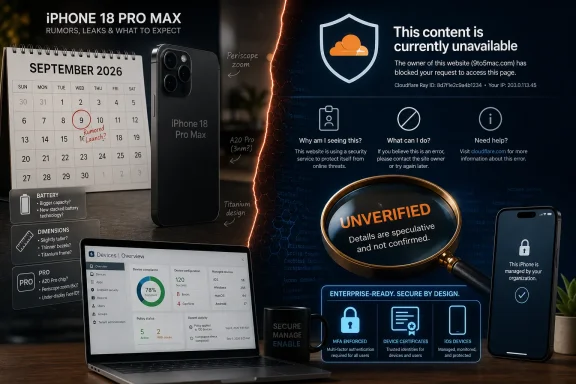
Apple is being framed by three Indonesian tech-news headlines as preparing a September 2026 iPhone 18 Pro Max launch, but the underlying Akses.co.id, asatunews.co.id, and sekbernews.id pages currently expose only Cloudflare origin-server errors rather than verifiable leak details for readers, buyers, or IT planners. The story, then, is not that Apple has confirmed anything; it is that the rumor market is already behaving as if the next Pro iPhone cycle is settled. That distinction matters because the iPhone 18 Pro Max is likely to sit at the center of Apple’s next hardware argument: premium phones first, mainstream phones later, and a possible foldable model complicating the lineup. For Windows users and enterprise admins, the practical lesson is simple: treat September 2026 as a plausible planning window, not a procurement fact.
The three provided source articles point in the same direction: Apple is allegedly preparing a September 2026 iPhone 18 Pro Max launch, the iPhone 18 Pro line is allegedly leaking key specifications, and battery or dimensional changes are allegedly part of the story. But the pages themselves do not currently provide the underlying evidence. Each returns a Cloudflare message saying there is an unknown connection issue between Cloudflare and the origin web server.
That is not a minor inconvenience for a rumor story. In consumer tech, the difference between a headline and a sourced leak is the difference between “someone says a thing is coming” and “there is a supply-chain, regulatory, firmware, case-maker, analyst, or code-based reason to believe it.” Here, the headlines survive, but the reporting payload does not.
The broader rumor ecosystem does give the September 2026 claim some context. MacRumors, Macworld, 9to5Mac, TechRadar, Tom’s Guide, and other Apple-focused outlets are also treating the iPhone 18 Pro and iPhone 18 Pro Max as likely candidates for Apple’s usual fall launch window. Several of those reports also describe a possible split in Apple’s release cadence, with higher-end models expected first and lower-end models potentially arriving later.
But the important journalistic move is not to mash those claims into certainty. Apple has not announced the iPhone 18 Pro Max. Apple’s official product and newsroom pages, as checked against current Apple material, show the existing iPhone lineup and prior Pro launches, not a confirmed iPhone 18 event. The strongest defensible version of the story is therefore narrower: the rumor consensus increasingly points to September 2026 for the Pro models, while the specific Indonesian articles supplied here cannot currently substantiate their own details because the pages are inaccessible beyond Cloudflare error text.
That makes this a story about credibility as much as hardware. The iPhone rumor economy has become large enough that headlines can travel faster than evidence, and the iPhone 18 Pro Max is already being pulled into that machinery.
That means there is no accessible specification list, no named analyst, no supply-chain note, no case schematic, no battery certification filing, and no quoted Apple statement in the supplied text. The most precise confirmed fact from these pages is the existence of the headlines and the fact that the pages were unavailable at the origin when captured.
This is why the correct reading is cautious. The three headlines may be reflecting the same larger rumor cycle circulating elsewhere, or they may be derivative rewrites of more established reporting. Without the underlying article bodies, there is no way to know whether the pages contained original sourcing, aggregation, speculation, or automated paraphrase.
Cloudflare errors also create a subtle problem for readers: they make a page look temporarily broken rather than editorially empty. A reader may assume the details exist just beyond a retry. A careful editor has to assume the opposite until the original body, archive, or independently corroborating source is available.
That does not make the September 2026 claim implausible. It makes the specific chain of evidence weak. In Apple reporting, those are very different things.
That is why a September 2026 iPhone 18 Pro Max launch rumor does not arrive in a vacuum. Other Apple rumor outlets are also describing the Pro and Pro Max as the models most likely to appear in the fall window. Macworld has framed the iPhone 18 Pro and Pro Max rumors around a possible September 2026 launch, with speculation about design, chip, camera, and modem changes. MacRumors has similarly treated the Pro models as central to the fall cycle, while separately discussing the possibility that the standard iPhone 18 may not arrive at the same time.
9to5Mac has also covered the rumored release timing as part of a broader Apple lineup shift, and TechRadar has emphasized the consumer confusion that could result if Apple separates Pro, foldable, Air-style, and standard models across different launch windows. Tom’s Guide has focused on how a possible foldable iPhone could change the meaning of “flagship” while leaving the iPhone 18 Pro Max as the familiar slab-style premium option.
The pattern is clear: the iPhone 18 Pro Max rumor is not isolated. The specific pages supplied here are weak, but the general launch-window claim fits a wider consensus among Apple rumor trackers. The danger is that this wider consensus can make every individual headline look more solid than it is.
Apple benefits from that ambiguity. It does not need to announce a product for the market to begin organizing itself around one. Case makers start modeling, consumers delay upgrades, carriers prepare promotions, and IT buyers begin asking whether a refresh is worth waiting for. Rumor becomes a form of pre-launch infrastructure.
Several rumor roundups and Apple-focused reports have described that possibility. In this version of the lineup, the iPhone 18 Pro and iPhone 18 Pro Max would remain fall products, while the standard iPhone 18 could be pushed into a later window. Some reports also place a foldable iPhone in the premium launch conversation, which would make the fall event less about the whole iPhone family and more about the most expensive, most technically ambitious part of it.
That would be a meaningful change in how Apple manages demand. The traditional iPhone launch gives consumers a complete ladder: standard, plus-sized, Pro, Pro Max, and whatever special variant Apple happens to be emphasizing. A split cycle turns that ladder into two buying seasons. If the rumor is accurate, Apple would be asking mainstream buyers to wait while giving enthusiasts and high-margin customers the first shot at the new hardware narrative.
There are obvious reasons Apple might do this. Premium phones carry higher average selling prices. More complex hardware may need more careful supply planning. A foldable device, if real, would likely be supply constrained and expensive. Separating models could reduce launch congestion and allow Apple to keep the iPhone conversation alive across more of the year.
There are also risks. A staggered lineup can confuse buyers, irritate carriers, and create awkward upgrade timing for enterprise fleets. It may also make the standard iPhone feel second-tier before it even ships. Apple can manage that better than most companies, but it cannot eliminate the trade-off.
For WindowsForum readers, the split-cycle rumor matters because many iPhone deployments are not purely consumer purchases. They are part of mixed environments: Windows laptops, Microsoft 365 accounts, Entra ID sign-ins, Intune-managed devices, iCloud for Windows, Outlook, Teams, OneDrive, passkeys, and conditional-access rules. If Apple changes its release cadence, procurement timing changes with it.
That matters because spec leaks are where rumor inflation is most aggressive. A launch window can be inferred from Apple’s habits. A display size can sometimes be inferred from case-maker templates or supply-chain chatter. A chip process, modem strategy, battery capacity, or dimensional change is much harder to treat as reliable without seeing the provenance.
Other outlets have floated claims around the iPhone 18 Pro family, including possible display changes, chip upgrades, camera changes, modem updates, and design refinements. But those claims vary by source and confidence level. Some are framed as analyst expectations, some as supply-chain reports, and some as rumor aggregation. They should not be collapsed into a single spec sheet.
The safest reading is that the Pro models will likely be the hardware showcase if Apple launches iPhones in September 2026. That is what Pro iPhones are for. But the exact “key specifications” remain unconfirmed unless tied to a named, accessible, and corroborated source.
Battery and dimensions deserve special skepticism. Those details are often among the last to become clear because they depend on final mechanical design, thermal envelope, display stack, camera module size, and regional certification documents. A small change in thickness may be interpreted as a battery gain. A case schematic may be mistaken for final chassis data. A supply-chain rumor may describe a prototype rather than a shipping device.
The iPhone 18 Pro Max also carries a special burden: it is the model people expect to have the biggest battery, the largest screen, and the most aggressive camera system. That expectation creates a rumor vacuum. Any claim about a larger battery or modified dimensions feels intuitive, even when the evidence is thin.
This is where buyers should resist the spec-sheet trap. The difference between “Apple is likely to launch a premium iPhone in September” and “the battery and dimensions are upgraded in a particular way” is enormous. The first is a plausible forecast. The second requires hard evidence the supplied pages do not provide.
If a foldable model arrives near the iPhone 18 Pro and Pro Max, the Pro Max may no longer be Apple’s most exotic phone. It may instead become the safe flagship: the large-screen, high-performance, conventional iPhone for buyers who want maximum capability without first-generation foldable risk. That would be a very Apple-like segmentation move.
A foldable iPhone would likely dominate launch coverage if introduced alongside the Pro models. It would be the new form factor, the new status object, and the product with the most obvious competitive storyline against Samsung and other foldable makers. But the iPhone 18 Pro Max could still be the more important device by volume, reliability, and enterprise suitability.
That distinction matters. Early foldables tend to come with trade-offs around durability, repair cost, app layout, thickness, weight, supply, and price. Even if Apple solves many of those problems better than rivals, the first generation of a new category is rarely the default enterprise buy. The Pro Max, by contrast, would be the known quantity: big screen, strong battery expectation, mature accessory ecosystem, predictable MDM behavior, and compatibility with existing workflows.
For enthusiasts, the foldable may be the dream. For IT departments, the Pro Max may be the ceiling of what can be justified. That makes the iPhone 18 Pro Max not less important in a foldable year, but more important. It becomes the premium iPhone for people who want Apple’s best conventional phone while letting someone else beta-test the hinge.
That means iPhone launch timing affects Windows environments. If a company standardizes on iPhones for executives, field staff, or frontline workers, Apple’s hardware cycle becomes part of the Microsoft stack by implication. Intune enrollment flows, app protection policies, certificate deployment, VPN profiles, Wi-Fi trust, conditional access, and data-loss prevention all have to work on whatever iOS and hardware combination employees bring to the network.
A September 2026 Pro launch window would also land in the usual season when Apple ships major platform software. Even when the hardware is the headline, the software is what IT departments feel first. A new iPhone generation can expose old assumptions in identity, backup, device compliance, app compatibility, and support scripts.
The consumer angle is equally practical. Windows users who rely on iCloud for Windows, Phone Link-style continuity features, Outlook synchronization, browser passkeys, shared photo workflows, or USB-C accessory setups need to know whether an upgrade will improve or disrupt their existing habits. A bigger battery or new dimensions may be interesting; the real question is whether the device fits into a cross-platform life without friction.
This is why rumor discipline matters. If users delay purchases for a September 2026 device based on thin headlines, they are making real budget and productivity decisions on unverifiable information. If admins delay refresh planning because they assume the iPhone 18 Pro Max will land on a particular schedule, they may create avoidable procurement gaps.
The right posture is readiness, not belief. Plan for the possibility. Do not act as if Apple has already announced it.
That does not mean the sites did anything wrong. Cloudflare origin errors happen for ordinary operational reasons: overloaded servers, misconfigured hosts, downtime, DNS problems, firewall rules, or temporary infrastructure faults. But for a story built on leaks, unavailability has consequences. A broken page cannot carry evidentiary weight.
In a forum context, this is especially important. Headlines are often shared as proof. Screenshots circulate. Summaries get repeated. A page title becomes a claim, and a claim becomes a “known” rumor. By the time the original page recovers—or disappears—the rumor may already have been absorbed into a dozen derivative posts.
The responsible approach is to separate three layers. First, the headline exists. Second, the claim in the headline may align with broader rumor coverage. Third, the specific article body is not currently available to verify any underlying details. Those layers should not be merged.
This is also why “leaks reveal” is one of the most abused phrases in consumer technology. A leak can be a regulatory filing, a supply-chain note, a prototype image, a case mold, a line of code, an analyst forecast, or a Weibo post with no visible provenance. The word tells you almost nothing until the evidence is shown.
For the iPhone 18 Pro Max, the evidence shown in the supplied material is not enough. The surrounding rumor market helps explain why the headline is plausible, but it does not rescue missing article bodies.
If, however, your current iPhone is healthy and you prefer large Pro models, waiting may be reasonable. The rumor consensus does suggest that Apple’s highest-end conventional iPhone is likely to be part of the fall conversation. But that is a different argument from believing specific leaked specs.
For business buyers, the advice is stricter. Do not plan deployments around unconfirmed hardware claims. Plan around support windows, management compatibility, app readiness, carrier contracts, and budget cycles. A rumored September device can be a scenario in the planning document; it should not be the foundation of the plan.
The same applies to accessory purchases. If the sekbernews.id headline’s battery-and-dimensions angle turns out to reflect real chassis changes, cases, mounts, cradles, vehicle docks, gimbals, barcode sleds, and rugged enclosures may need updates. But without verified dimensions, buying early accessories is gambling. Wait for final hardware or trusted accessory certification.
For developers, the September 2026 window is a prompt to test assumptions rather than chase rumors. Apps should already be resilient across screen sizes, camera capabilities, biometric flows, and background-policy changes. If a foldable device appears, adaptive layouts will matter even more. If only the Pro models arrive first, premium users may become the early test population for new software features.
For Windows users, the most useful preparation is cross-platform hygiene. Make sure photos are backed up in a way you understand. Make sure passkeys, MFA methods, and recovery contacts are not tied to a single fragile device. Make sure iCloud for Windows, Outlook, OneDrive, Teams, and browser sync are configured before the day you trade in the old phone.
That creates a familiar asymmetry. Supply-chain analysts, accessory makers, leakers, and rumor sites can discuss the next iPhone for months. Buyers and admins must make decisions during that fog. Apple then collapses the uncertainty in a single event, with pricing, availability, features, and positioning revealed all at once.
The iPhone 18 Pro Max is especially vulnerable to this dynamic because it sits at the top of a mature category. A truly radical change would be huge news. A modest refinement would still sell. Either way, months of rumors can shape expectations before Apple says a word.
If a foldable iPhone is also in the mix, Apple’s silence becomes even more useful. The company can let the market debate whether the foldable is the new flagship while preserving the Pro Max as a safer premium option. It can gauge consumer appetite, manage supply expectations, and avoid freezing sales of current models more than necessary.
This is why rumor coverage should be read as market weather, not product documentation. It tells you where attention is moving. It does not tell you what Apple will ship.
But because the pages surface only Cloudflare origin errors in the provided material, they do not add verifiable new information. They do not confirm a date beyond the September 2026 framing in the headline. They do not provide specific specifications. They do not establish battery capacity, chassis measurements, display size, camera hardware, pricing, storage tiers, availability, or Apple’s launch plan.
That does not make them irrelevant. They show how far the iPhone 18 Pro Max narrative has spread. Rumors that begin in analyst notes or Apple-specialist publications often get repackaged across regional tech sites, translated, simplified, and re-headlined for local audiences. By the time they reach broader readers, the caveats are often gone.
This is exactly how “expected” becomes “prepared,” how “rumored” becomes “leaked,” and how “could” becomes “will.” The transformation is not always malicious. It is often just the economics of search-driven tech publishing. But readers pay the price in certainty inflation.
The better headline would be less exciting: “iPhone 18 Pro Max September 2026 Rumors Align With Broader Apple Launch Chatter, but Specific Claims Remain Unverified.” That is clunkier. It is also closer to the truth.
Apple’s official silence will remain the hard boundary. Until Apple announces the device, every claim about the iPhone 18 Pro Max is provisional. But provisional does not mean useless. It simply means readers need to rank claims by strength.
The launch-window claim is comparatively strong because it aligns with Apple’s long-standing fall iPhone pattern and with multiple rumor outlets. The split-cycle claim is plausible because it appears across several reports and would fit a strategy of separating premium and mainstream demand. Claims about exact specifications, battery upgrades, dimensions, and pricing are weaker unless backed by accessible evidence.
For IT departments, the biggest thing to watch is not whether the phone is slightly thinner or thicker. It is whether Apple changes the deployment assumptions around the lineup. A staggered release could alter carrier promotions, employee upgrade expectations, support timing, and app testing calendars. A foldable model could introduce new policy questions around durability, screen replacement, and approved-device lists.
For consumers, the decision tree is simpler. If you want the next large Pro iPhone and can comfortably wait, September 2026 is a reasonable rumor window. If you need a phone now, buy based on the products Apple actually sells. The opportunity cost of waiting is real, especially if your current phone is already compromising battery life, security, or daily reliability.
The concrete points are few, but they are enough to guide sane planning:
 The iPhone 18 Pro Max Rumor Has Momentum, Not Proof
The three provided source articles point in the same direction: Apple is allegedly preparing a September 2026 iPhone 18 Pro Max launch, the iPhone 18 Pro line is allegedly leaking key specifications, and battery or dimensional changes are allegedly part of the story. But the pages themselves do not currently provide the underlying evidence. Each returns a Cloudflare message saying there is an unknown connection issue between Cloudflare and the origin web server.That is not a minor inconvenience for a rumor story. In consumer tech, the difference between a headline and a sourced leak is the difference between “someone says a thing is coming” and “there is a supply-chain, regulatory, firmware, case-maker, analyst, or code-based reason to believe it.” Here, the headlines survive, but the reporting payload does not.
The broader rumor ecosystem does give the September 2026 claim some context. MacRumors, Macworld, 9to5Mac, TechRadar, Tom’s Guide, and other Apple-focused outlets are also treating the iPhone 18 Pro and iPhone 18 Pro Max as likely candidates for Apple’s usual fall launch window. Several of those reports also describe a possible split in Apple’s release cadence, with higher-end models expected first and lower-end models potentially arriving later.
But the important journalistic move is not to mash those claims into certainty. Apple has not announced the iPhone 18 Pro Max. Apple’s official product and newsroom pages, as checked against current Apple material, show the existing iPhone lineup and prior Pro launches, not a confirmed iPhone 18 event. The strongest defensible version of the story is therefore narrower: the rumor consensus increasingly points to September 2026 for the Pro models, while the specific Indonesian articles supplied here cannot currently substantiate their own details because the pages are inaccessible beyond Cloudflare error text.
That makes this a story about credibility as much as hardware. The iPhone rumor economy has become large enough that headlines can travel faster than evidence, and the iPhone 18 Pro Max is already being pulled into that machinery.
Three Headlines, One Verification Problem
The provided source set is unusually revealing because all three articles fail in the same way. Akses.co.id carries the headline “Apple Prepares September 2026 iPhone 18 Pro Max Launch.” Asatunews.co.id carries “Apple iPhone 18 Pro Leaks Reveal Key Specifications.” Sekbernews.id carries “Apple Leaks Reveal Upgraded iPhone 18 Pro Battery and Dimensions.” Yet the visible body of each page is not a leak report; it is a Cloudflare origin error.That means there is no accessible specification list, no named analyst, no supply-chain note, no case schematic, no battery certification filing, and no quoted Apple statement in the supplied text. The most precise confirmed fact from these pages is the existence of the headlines and the fact that the pages were unavailable at the origin when captured.
| Source outlet | Headline claim | Model focus | What the supplied text actually confirms | Verification status |
|---|---|---|---|---|
| Akses.co.id | Apple prepares a September 2026 iPhone 18 Pro Max launch | iPhone 18 Pro Max | Headline and Cloudflare origin-server error | Headline-only, not independently substantiated by the page body |
| asatunews.co.id | iPhone 18 Pro leaks reveal key specifications | iPhone 18 Pro | Headline and Cloudflare origin-server error | No accessible specifications in supplied material |
| sekbernews.id | Leaks reveal upgraded iPhone 18 Pro battery and dimensions | iPhone 18 Pro | Headline and Cloudflare origin-server error | No accessible battery or dimension details in supplied material |
Cloudflare errors also create a subtle problem for readers: they make a page look temporarily broken rather than editorially empty. A reader may assume the details exist just beyond a retry. A careful editor has to assume the opposite until the original body, archive, or independently corroborating source is available.
That does not make the September 2026 claim implausible. It makes the specific chain of evidence weak. In Apple reporting, those are very different things.
Apple’s Fall Machine Is the Reason the Rumor Feels Believable
The reason these headlines sound credible is that Apple has trained the market to expect a major iPhone cycle in the fall. Retailers, carriers, accessory makers, app developers, and enterprise mobility teams all plan around that rhythm. Even when Apple changes the shape of the lineup, the gravitational pull of a fall iPhone event remains powerful.That is why a September 2026 iPhone 18 Pro Max launch rumor does not arrive in a vacuum. Other Apple rumor outlets are also describing the Pro and Pro Max as the models most likely to appear in the fall window. Macworld has framed the iPhone 18 Pro and Pro Max rumors around a possible September 2026 launch, with speculation about design, chip, camera, and modem changes. MacRumors has similarly treated the Pro models as central to the fall cycle, while separately discussing the possibility that the standard iPhone 18 may not arrive at the same time.
9to5Mac has also covered the rumored release timing as part of a broader Apple lineup shift, and TechRadar has emphasized the consumer confusion that could result if Apple separates Pro, foldable, Air-style, and standard models across different launch windows. Tom’s Guide has focused on how a possible foldable iPhone could change the meaning of “flagship” while leaving the iPhone 18 Pro Max as the familiar slab-style premium option.
The pattern is clear: the iPhone 18 Pro Max rumor is not isolated. The specific pages supplied here are weak, but the general launch-window claim fits a wider consensus among Apple rumor trackers. The danger is that this wider consensus can make every individual headline look more solid than it is.
Apple benefits from that ambiguity. It does not need to announce a product for the market to begin organizing itself around one. Case makers start modeling, consumers delay upgrades, carriers prepare promotions, and IT buyers begin asking whether a refresh is worth waiting for. Rumor becomes a form of pre-launch infrastructure.
The Real Story May Be a Split iPhone Cycle
If there is a genuinely interesting strategic thread in the iPhone 18 reporting, it is not merely “new Pro phone in September.” That is the least surprising claim in the Apple universe. The more consequential rumor is that Apple may be moving toward a split iPhone release cycle, where premium models arrive first and mainstream models follow later.Several rumor roundups and Apple-focused reports have described that possibility. In this version of the lineup, the iPhone 18 Pro and iPhone 18 Pro Max would remain fall products, while the standard iPhone 18 could be pushed into a later window. Some reports also place a foldable iPhone in the premium launch conversation, which would make the fall event less about the whole iPhone family and more about the most expensive, most technically ambitious part of it.
That would be a meaningful change in how Apple manages demand. The traditional iPhone launch gives consumers a complete ladder: standard, plus-sized, Pro, Pro Max, and whatever special variant Apple happens to be emphasizing. A split cycle turns that ladder into two buying seasons. If the rumor is accurate, Apple would be asking mainstream buyers to wait while giving enthusiasts and high-margin customers the first shot at the new hardware narrative.
There are obvious reasons Apple might do this. Premium phones carry higher average selling prices. More complex hardware may need more careful supply planning. A foldable device, if real, would likely be supply constrained and expensive. Separating models could reduce launch congestion and allow Apple to keep the iPhone conversation alive across more of the year.
There are also risks. A staggered lineup can confuse buyers, irritate carriers, and create awkward upgrade timing for enterprise fleets. It may also make the standard iPhone feel second-tier before it even ships. Apple can manage that better than most companies, but it cannot eliminate the trade-off.
For WindowsForum readers, the split-cycle rumor matters because many iPhone deployments are not purely consumer purchases. They are part of mixed environments: Windows laptops, Microsoft 365 accounts, Entra ID sign-ins, Intune-managed devices, iCloud for Windows, Outlook, Teams, OneDrive, passkeys, and conditional-access rules. If Apple changes its release cadence, procurement timing changes with it.
Specs Are the Least Reliable Part of This Leak Cycle
The asatunews.co.id headline claims key iPhone 18 Pro specifications have leaked. The sekbernews.id headline claims upgraded battery and dimensions. The problem is that neither supplied article body contains those specifications. It contains only the Cloudflare origin-error text.That matters because spec leaks are where rumor inflation is most aggressive. A launch window can be inferred from Apple’s habits. A display size can sometimes be inferred from case-maker templates or supply-chain chatter. A chip process, modem strategy, battery capacity, or dimensional change is much harder to treat as reliable without seeing the provenance.
Other outlets have floated claims around the iPhone 18 Pro family, including possible display changes, chip upgrades, camera changes, modem updates, and design refinements. But those claims vary by source and confidence level. Some are framed as analyst expectations, some as supply-chain reports, and some as rumor aggregation. They should not be collapsed into a single spec sheet.
The safest reading is that the Pro models will likely be the hardware showcase if Apple launches iPhones in September 2026. That is what Pro iPhones are for. But the exact “key specifications” remain unconfirmed unless tied to a named, accessible, and corroborated source.
Battery and dimensions deserve special skepticism. Those details are often among the last to become clear because they depend on final mechanical design, thermal envelope, display stack, camera module size, and regional certification documents. A small change in thickness may be interpreted as a battery gain. A case schematic may be mistaken for final chassis data. A supply-chain rumor may describe a prototype rather than a shipping device.
The iPhone 18 Pro Max also carries a special burden: it is the model people expect to have the biggest battery, the largest screen, and the most aggressive camera system. That expectation creates a rumor vacuum. Any claim about a larger battery or modified dimensions feels intuitive, even when the evidence is thin.
This is where buyers should resist the spec-sheet trap. The difference between “Apple is likely to launch a premium iPhone in September” and “the battery and dimensions are upgraded in a particular way” is enormous. The first is a plausible forecast. The second requires hard evidence the supplied pages do not provide.
The Foldable Shadow Changes the Pro Max’s Job
The iPhone 18 Pro Max rumor is also being shaped by the expected arrival of a foldable iPhone, sometimes described by rumor sites as an Ultra-class device. Apple has not confirmed such a product, but the foldable rumor has become persistent enough that it now affects how the Pro Max is discussed.If a foldable model arrives near the iPhone 18 Pro and Pro Max, the Pro Max may no longer be Apple’s most exotic phone. It may instead become the safe flagship: the large-screen, high-performance, conventional iPhone for buyers who want maximum capability without first-generation foldable risk. That would be a very Apple-like segmentation move.
A foldable iPhone would likely dominate launch coverage if introduced alongside the Pro models. It would be the new form factor, the new status object, and the product with the most obvious competitive storyline against Samsung and other foldable makers. But the iPhone 18 Pro Max could still be the more important device by volume, reliability, and enterprise suitability.
That distinction matters. Early foldables tend to come with trade-offs around durability, repair cost, app layout, thickness, weight, supply, and price. Even if Apple solves many of those problems better than rivals, the first generation of a new category is rarely the default enterprise buy. The Pro Max, by contrast, would be the known quantity: big screen, strong battery expectation, mature accessory ecosystem, predictable MDM behavior, and compatibility with existing workflows.
For enthusiasts, the foldable may be the dream. For IT departments, the Pro Max may be the ceiling of what can be justified. That makes the iPhone 18 Pro Max not less important in a foldable year, but more important. It becomes the premium iPhone for people who want Apple’s best conventional phone while letting someone else beta-test the hinge.
Why Windows Users Should Care About an iPhone Rumor
At first glance, an iPhone 18 Pro Max launch rumor looks like Apple-world noise, not a WindowsForum story. But the modern iPhone is not an isolated device. It is a credential store, camera, hotspot, MFA endpoint, Teams device, Outlook client, OneDrive scanner, passkey authenticator, travel computer, and sometimes the only managed device an employee actually carries all day.That means iPhone launch timing affects Windows environments. If a company standardizes on iPhones for executives, field staff, or frontline workers, Apple’s hardware cycle becomes part of the Microsoft stack by implication. Intune enrollment flows, app protection policies, certificate deployment, VPN profiles, Wi-Fi trust, conditional access, and data-loss prevention all have to work on whatever iOS and hardware combination employees bring to the network.
A September 2026 Pro launch window would also land in the usual season when Apple ships major platform software. Even when the hardware is the headline, the software is what IT departments feel first. A new iPhone generation can expose old assumptions in identity, backup, device compliance, app compatibility, and support scripts.
The consumer angle is equally practical. Windows users who rely on iCloud for Windows, Phone Link-style continuity features, Outlook synchronization, browser passkeys, shared photo workflows, or USB-C accessory setups need to know whether an upgrade will improve or disrupt their existing habits. A bigger battery or new dimensions may be interesting; the real question is whether the device fits into a cross-platform life without friction.
This is why rumor discipline matters. If users delay purchases for a September 2026 device based on thin headlines, they are making real budget and productivity decisions on unverifiable information. If admins delay refresh planning because they assume the iPhone 18 Pro Max will land on a particular schedule, they may create avoidable procurement gaps.
The right posture is readiness, not belief. Plan for the possibility. Do not act as if Apple has already announced it.
Cloudflare Errors Are a Reminder That Tech News Has a Supply Chain Too
There is an irony in these three source pages failing behind Cloudflare. The articles are about Apple’s hardware supply chain, but the visible evidence is a failure in the news supply chain. The reader cannot inspect the reporting because the origin server is not serving it.That does not mean the sites did anything wrong. Cloudflare origin errors happen for ordinary operational reasons: overloaded servers, misconfigured hosts, downtime, DNS problems, firewall rules, or temporary infrastructure faults. But for a story built on leaks, unavailability has consequences. A broken page cannot carry evidentiary weight.
In a forum context, this is especially important. Headlines are often shared as proof. Screenshots circulate. Summaries get repeated. A page title becomes a claim, and a claim becomes a “known” rumor. By the time the original page recovers—or disappears—the rumor may already have been absorbed into a dozen derivative posts.
The responsible approach is to separate three layers. First, the headline exists. Second, the claim in the headline may align with broader rumor coverage. Third, the specific article body is not currently available to verify any underlying details. Those layers should not be merged.
This is also why “leaks reveal” is one of the most abused phrases in consumer technology. A leak can be a regulatory filing, a supply-chain note, a prototype image, a case mold, a line of code, an analyst forecast, or a Weibo post with no visible provenance. The word tells you almost nothing until the evidence is shown.
For the iPhone 18 Pro Max, the evidence shown in the supplied material is not enough. The surrounding rumor market helps explain why the headline is plausible, but it does not rescue missing article bodies.
The Buying Advice Is Boring, Which Usually Means It Is Right
For consumers, the rational buying advice is not to wait blindly for the iPhone 18 Pro Max unless the current phone is still doing its job. If your battery is failing, your storage is full, your device is no longer meeting security or app needs, or your trade-in window is favorable, a rumor about September 2026 should not become a personal productivity tax.If, however, your current iPhone is healthy and you prefer large Pro models, waiting may be reasonable. The rumor consensus does suggest that Apple’s highest-end conventional iPhone is likely to be part of the fall conversation. But that is a different argument from believing specific leaked specs.
For business buyers, the advice is stricter. Do not plan deployments around unconfirmed hardware claims. Plan around support windows, management compatibility, app readiness, carrier contracts, and budget cycles. A rumored September device can be a scenario in the planning document; it should not be the foundation of the plan.
The same applies to accessory purchases. If the sekbernews.id headline’s battery-and-dimensions angle turns out to reflect real chassis changes, cases, mounts, cradles, vehicle docks, gimbals, barcode sleds, and rugged enclosures may need updates. But without verified dimensions, buying early accessories is gambling. Wait for final hardware or trusted accessory certification.
For developers, the September 2026 window is a prompt to test assumptions rather than chase rumors. Apps should already be resilient across screen sizes, camera capabilities, biometric flows, and background-policy changes. If a foldable device appears, adaptive layouts will matter even more. If only the Pro models arrive first, premium users may become the early test population for new software features.
For Windows users, the most useful preparation is cross-platform hygiene. Make sure photos are backed up in a way you understand. Make sure passkeys, MFA methods, and recovery contacts are not tied to a single fragile device. Make sure iCloud for Windows, Outlook, OneDrive, Teams, and browser sync are configured before the day you trade in the old phone.
Action checklist for admins
- Treat September 2026 as a plausible iPhone Pro refresh window, not a confirmed Apple launch date.
- Avoid committing fleet budgets to unverified iPhone 18 Pro or Pro Max specifications.
- Audit Intune, Entra ID, MFA, VPN, Wi-Fi, and certificate workflows for iOS device replacement scenarios.
- Delay bulk purchases of cases, docks, sleds, and mounts until final dimensions are confirmed by Apple or trusted accessory vendors.
- Prepare user guidance for backup, passkeys, authenticator migration, eSIM transfer, and corporate app re-enrollment.
- Track Apple’s official announcements separately from rumor roundups and derivative headline-only reports.
Apple’s Silence Is Part of the Product Strategy
Apple’s refusal to pre-announce iPhones is not just secrecy for secrecy’s sake. It protects current sales, preserves launch drama, and prevents competitors from responding to confirmed details. The company wants the market to speculate, but it does not want to validate the speculation until it controls the stage.That creates a familiar asymmetry. Supply-chain analysts, accessory makers, leakers, and rumor sites can discuss the next iPhone for months. Buyers and admins must make decisions during that fog. Apple then collapses the uncertainty in a single event, with pricing, availability, features, and positioning revealed all at once.
The iPhone 18 Pro Max is especially vulnerable to this dynamic because it sits at the top of a mature category. A truly radical change would be huge news. A modest refinement would still sell. Either way, months of rumors can shape expectations before Apple says a word.
If a foldable iPhone is also in the mix, Apple’s silence becomes even more useful. The company can let the market debate whether the foldable is the new flagship while preserving the Pro Max as a safer premium option. It can gauge consumer appetite, manage supply expectations, and avoid freezing sales of current models more than necessary.
This is why rumor coverage should be read as market weather, not product documentation. It tells you where attention is moving. It does not tell you what Apple will ship.
The Indonesian Headlines Fit the Trend, but They Do Not Advance It
The Akses.co.id, asatunews.co.id, and sekbernews.id headlines are interesting because they mirror the broader rumor narrative almost perfectly. One focuses on the September 2026 Pro Max launch. One suggests key Pro specifications. One points to battery and dimensions. Together, they look like the skeleton of a standard pre-launch rumor cycle.But because the pages surface only Cloudflare origin errors in the provided material, they do not add verifiable new information. They do not confirm a date beyond the September 2026 framing in the headline. They do not provide specific specifications. They do not establish battery capacity, chassis measurements, display size, camera hardware, pricing, storage tiers, availability, or Apple’s launch plan.
That does not make them irrelevant. They show how far the iPhone 18 Pro Max narrative has spread. Rumors that begin in analyst notes or Apple-specialist publications often get repackaged across regional tech sites, translated, simplified, and re-headlined for local audiences. By the time they reach broader readers, the caveats are often gone.
This is exactly how “expected” becomes “prepared,” how “rumored” becomes “leaked,” and how “could” becomes “will.” The transformation is not always malicious. It is often just the economics of search-driven tech publishing. But readers pay the price in certainty inflation.
The better headline would be less exciting: “iPhone 18 Pro Max September 2026 Rumors Align With Broader Apple Launch Chatter, but Specific Claims Remain Unverified.” That is clunkier. It is also closer to the truth.
What Actually Matters Between Now and September
Between now and any possible September 2026 Apple event, the most important signals will not be anonymous spec lists. They will be convergence and provenance. Do multiple reliable outlets report the same lineup structure? Are claims attributed to analysts with track records, supply-chain documentation, regulatory filings, or developer-facing evidence? Do case makers, carriers, and accessory vendors begin behaving as if dimensions are settled?Apple’s official silence will remain the hard boundary. Until Apple announces the device, every claim about the iPhone 18 Pro Max is provisional. But provisional does not mean useless. It simply means readers need to rank claims by strength.
The launch-window claim is comparatively strong because it aligns with Apple’s long-standing fall iPhone pattern and with multiple rumor outlets. The split-cycle claim is plausible because it appears across several reports and would fit a strategy of separating premium and mainstream demand. Claims about exact specifications, battery upgrades, dimensions, and pricing are weaker unless backed by accessible evidence.
For IT departments, the biggest thing to watch is not whether the phone is slightly thinner or thicker. It is whether Apple changes the deployment assumptions around the lineup. A staggered release could alter carrier promotions, employee upgrade expectations, support timing, and app testing calendars. A foldable model could introduce new policy questions around durability, screen replacement, and approved-device lists.
For consumers, the decision tree is simpler. If you want the next large Pro iPhone and can comfortably wait, September 2026 is a reasonable rumor window. If you need a phone now, buy based on the products Apple actually sells. The opportunity cost of waiting is real, especially if your current phone is already compromising battery life, security, or daily reliability.
The Signal Beneath the Noise
The iPhone 18 Pro Max rumor cycle is useful if you read it as a signal about Apple’s direction rather than a confirmed spec sheet. The signal is that Apple’s premium phones may increasingly define the fall, while mainstream models may no longer be guaranteed to arrive in the same wave. The Pro Max may become the conservative flagship in a year when Apple’s more dramatic story could be a foldable device.The concrete points are few, but they are enough to guide sane planning:
- Apple has not officially announced the iPhone 18 Pro Max.
- The supplied Akses.co.id, asatunews.co.id, and sekbernews.id pages currently provide only headlines plus Cloudflare origin-error text.
- A September 2026 Pro Max launch is plausible because it aligns with broader Apple rumor coverage and Apple’s familiar fall iPhone rhythm.
- Specific claims about iPhone 18 Pro specifications, battery upgrades, and dimensions are not verifiable from the supplied article bodies.
- Windows users and IT admins should prepare for possible iPhone refresh activity without making procurement or support decisions on headline-only leaks.
- The rumored split between premium and mainstream iPhone releases may matter more than any single hardware tweak.
References
- Primary source: akses.co.id
Published: 2026-07-09T00:10:10.689266
Apple Prepares September 2026 iPhone 18 Pro Max Launch
Reports suggest Apple will unveil the iPhone 18 Pro series in September 2026 featuring a 2nm A20 chip, variable aperture cameras, and a price increase.www.akses.co.id - Independent coverage: asatunews.co.id
Published: 2026-07-08T21:10:10.699278
Apple iPhone 18 Pro Leaks Reveal Key Specifications
Leaked details for Apple's upcoming iPhone 18 Pro reveal a smaller Dynamic Island, an advanced A20 chip, upgraded cameras, and expected price increases.www.asatunews.co.id - Independent coverage: sekbernews.id
Published: 2026-07-08T19:10:10.698972
Apple Leaks Reveal Upgraded iPhone 18 Pro Battery and Dimensions
Regulatory filings and supply chain leaks reveal larger batteries, increased thickness, and a variable aperture camera for the upcoming iPhone 18 Pro.www.sekbernews.id - Related coverage: tomsguide.com
iPhone Ultra vs iPhone 18 Pro Max: 5 biggest expected differences | Tom's Guide
Apple’s upcoming flagships will offer plenty of features for a price, but what are their key differences?www.tomsguide.com - Related coverage: androidcentral.com
These Xiaomi 18 Pro Max leaks make me think the brand wants to go all-in this year | Android Central
Xiaomi's next Pro Max finds itself wrapped in some intriguing rumors.www.androidcentral.com - Related coverage: digitalcameraworld.com
Apple is reportedly making 10 million folding iPhones – but that's just one of five new phones in a massive iPhone 18 lineup, even as other firms retreat | Digital Camera World
Leaker reveals Apple's massive component hoard for the upcoming iPhone 18 series, including a surprising five modelswww.digitalcameraworld.com
- Related coverage: t3.com
iPhone Ultra could be the hottest foldable of 2026, although you might have to wait a bit longer to get your hands on one | T3
Patience is a virtue as the saying goeswww.t3.com - Related coverage: macrumors.com
iPhone 18: Rumors and Release Date
Apple is splitting its iPhone 18 lineup, with the more expensive Pro and Fold models to launch in fall 2026 and the more affordable iPhone 18 and...www.macrumors.com - Related coverage: macworld.com
iPhone 18 Pro & Pro Max Rumors: Release Date, A20 Chip, Dynamic Island Changes and more | Macworld
The latest iPhone 18 Pro and Pro Max rumors suggest a smaller Dynamic Island, A20 2nm chip, camera upgrades, Apple’s C2 modem.www.macworld.com - Related coverage: techadvisor.com
Apple iPhone 18 Potential Release Date, Price & Specs Rumours - Tech Advisor
Here's what to expect from the iPhone 18 series, including the first foldable iPhone, the Air 2, and the iPhone 18 Pro and Pro Maxwww.techadvisor.com - Related coverage: 9to5mac.com
iPhone 18 Pro release date: Here’s when Apple’s new model is coming - 9to5Mac
Apple has new iPhones coming this fall, here’s when to expect the iPhone 18 lineup’s announcement, release date, and more.9to5mac.com - Related coverage: macobserver.com
iPhone 18 Pro Max Release Date, Specs, and What to Expect
iPhone 18 Pro Max launch date, specs, colors, chip, camera, and Apple Fold timing, based on leaks, analysts, and trusted insiders.www.macobserver.com - Related coverage: phonearena.com
Apple iPhone 18 Pro Max: release date expectations, price estimates and upgrades - PhoneArena
Here's everything rumors and leaks are saying about Apple's yet-unannounced flagship, the iPhone 18 Pro Max.www.phonearena.com - Related coverage: techradar.com
iPhone 18 rumored release schedule explained — why there (probably) won’t be an iPhone 18 this year, and when to expect the iPhone 18 Pro, iPhone Air 2, and more | TechRadar
Intentionally upsetting the Apple cartwww.techradar.com - Related coverage: cincodias.elpais.com
Confirmado: el primer iPhone plegable será presentado en septiembre de este año | Smartphones | Smartlife | Cinco Días
Su pantalla entrará en producción muy prontocincodias.elpais.com - Official source: apple.com
Apple unveils iPhone 17 Pro and iPhone 17 Pro Max - Apple
Apple today introduced iPhone 17 Pro and iPhone 17 Pro Max with a striking new design that delivers a dramatic leap in performance.www.apple.com