

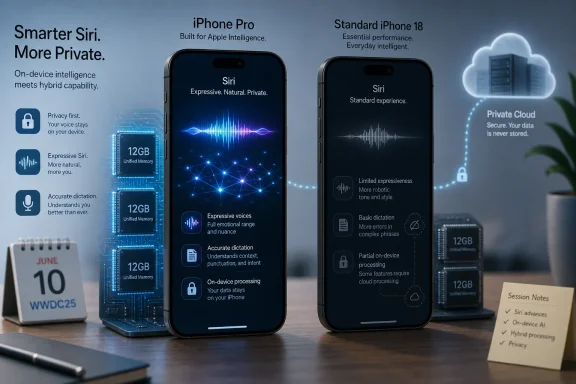
The standard iPhone 18, expected in spring 2027 rather than alongside the fall 2026 Pro models, may reportedly ship without two higher-end Siri AI capabilities: more expressive Siri voices and Apple’s upgraded systemwide dictation accuracy. That is the narrow claim behind a small Apple rumor with larger consequences. Digital Trends and Forbes both picked up the reported split, while Apple’s own WWDC 2026 materials explain why the line exists: some Siri AI features require the company’s most powerful on-device model, and that model is tied to memory.
The story is not that the next regular iPhone will be “left out of Siri AI.” That would be cleaner, more dramatic, and apparently wrong. The more interesting story is that Apple’s AI era is turning the iPhone lineup into something closer to the PC market: same operating system, same brand promise, but increasingly different local model capabilities depending on memory, silicon, and the thermals Apple chooses to sell you.
For WindowsForum readers, that should sound familiar. PC buyers have spent the last two years watching “AI PC” badges, NPU TOPS requirements, Copilot+ eligibility, and local model support turn laptop spec sheets into software destiny. Apple has spent years mocking that mess by selling integration; now Siri AI is forcing Cupertino to admit that even a tightly controlled platform cannot make hardware limits disappear.
Apple used WWDC 2026 to relaunch Siri as “Siri AI,” a more conversational assistant meant to draw on personal context, onscreen awareness, web knowledge, app actions, Visual Intelligence, and writing tools. In Apple’s newsroom announcement, Craig Federighi framed it as a rebuilt assistant that can operate across apps and products while still leaning on Apple Intelligence and Private Cloud Compute for privacy-preserving server help.
That is the headline Apple wanted: Siri is finally getting the kind of AI overhaul users expected when Apple Intelligence was first pitched. But buried in Apple’s own availability notes is the more consequential detail. The company says its most advanced on-device model enables more expressive Siri voices and a major improvement in systemwide dictation, and that model is limited to devices with enough memory.
MacRumors previously summarized the constraint bluntly: Apple’s most powerful on-device AI model requires 12GB of RAM, which is why the iPhone Air, iPhone 17 Pro, and iPhone 17 Pro Max can support those two enhancements while the regular iPhone 17, reportedly equipped with 8GB, cannot. Digital Trends and Forbes are now extending that logic to the next regular iPhone 18, reporting that it may miss the same two advanced Siri AI features if Apple ships it below the relevant memory threshold.
That distinction matters. The missing features are not the entire Siri AI stack. They are the more lifelike Siri voice controls and the more accurate dictation engine, not the whole conversational assistant, personal-context layer, Visual Intelligence surface, or writing system. If the reporting holds, Apple is not cutting the standard iPhone out of AI; it is cutting it out of the best local version of two speech-related AI experiences.
That is a less viral story, but a more important one. It suggests Apple’s AI roadmap is no longer just about software rollout timing. It is about how much Apple is willing to put into the base iPhone before the base iPhone starts looking too much like the Pro.
AI changes the psychology of that bargain. When a phone lacks a telephoto lens, the missing feature is obvious and bounded. When a phone lacks an on-device model capability, the difference can surface in tiny moments all day: a voice that sounds flatter, dictation that makes more mistakes, a response that falls back to cloud processing, or an assistant that behaves almost like the one in the keynote but not quite.
This is where Apple’s messaging gets hard. The company wants Siri AI to feel like a platform-level rebirth, not a bundle of optional features. Yet the fine print turns Siri into a spectrum: some devices get the broad assistant, some get the advanced local model, and some regions do not get the whole thing at launch because of regulatory constraints.
For the base iPhone 18, that is awkward. Forbes, citing the latest reporting, says the regular iPhone 18 may not run two advanced Siri AI upgrades. Digital Trends frames the same issue as the regular model missing two major Siri AI features. Both accounts point toward the same emerging truth: Apple’s mainstream phone may not be the cleanest showcase for Apple’s most mainstream AI product.
That is not fatal. Most users do not buy phones by reading neural engine constraints, and many will care more about battery life, camera quality, price, and trade-in offers. But Siri is supposed to be the front door to Apple Intelligence. If the front door opens differently depending on which iPhone you bought, Apple has a platform coherence problem.
But local AI models are memory-hungry. The more work a device performs without handing data to the cloud, the more pressure it puts on RAM, bandwidth, thermal design, and battery. Apple can hide much of that behind its own silicon story, but it cannot hide all of it. At some point, a device either has enough memory to keep a model resident and responsive, or it does not.
This is the same wall Microsoft and its OEM partners hit with Copilot+ PCs. The industry can sell AI as magic, but the magic has minimum requirements. Microsoft landed on a class of NPUs for certain Windows AI experiences. Apple appears to be landing on a memory-and-silicon boundary for its highest-end local Siri model.
The difference is cultural. Windows users expect fragmentation because the Windows ecosystem is built on hardware variety. Apple users expect continuity because Apple controls the stack. When Apple says an iPhone supports iOS 27 and Siri AI, users reasonably assume the core experience will be the core experience. The more Apple slices that experience into tiers, the more it inherits the support burden it spent decades avoiding.
That burden will not fall only on Apple Store staff. It will hit enterprise mobility teams, help desks, school IT departments, accessibility coordinators, and anyone writing internal guidance for device refreshes. “Does this iPhone support Siri AI?” is no longer a yes-or-no question if the real answer is “yes, except for the local model features that improve voice expressiveness and dictation.”
For many users, dictation is not a gimmick. It is an accessibility tool, a productivity layer, a hands-free input method, and in some workflows a replacement for typing. A “major boost in accuracy,” Apple’s phrase, is not cosmetic if you spend hours entering text by voice or if you use dictation because typing is slow, painful, or impractical.
That makes the reported iPhone 18 split more sensitive than a camera downgrade. A weaker ultrawide lens is a product segmentation choice. A weaker dictation engine can feel like Apple has placed a productivity and accessibility improvement behind a hardware tier. Apple may argue, fairly, that the feature requires a larger local model and that the base device cannot run it well. But users rarely experience constraints as engineering realities; they experience them as product decisions.
There is also a trust issue. Apple’s pitch for on-device AI is not only speed. It is privacy. If the best dictation and voice behavior require the strongest local model, then the premium iPhone becomes the best expression of Apple’s privacy-forward AI promise. That does not mean cheaper devices become insecure, but it does mean the most private, most capable implementation may belong to the more expensive hardware.
For enterprise and regulated environments, that distinction matters. Local processing is attractive because it reduces data exposure and latency. If Apple’s best local speech model is not available on the standard iPhone, IT buyers evaluating devices for voice-heavy workflows may need to think beyond the usual “current iPhone equals current capabilities” assumption.
That is a sophisticated answer to the AI privacy dilemma. Local models are fast and private but constrained. Cloud models are powerful but raise trust questions. Apple’s pitch is that it can combine both without becoming Google, Microsoft, or OpenAI in the eyes of its customers.
The problem is that hybrid systems still create tiers. If a high-end iPhone can do more locally, it may feel faster, more reliable, or more private in practice. If a base iPhone leans more often on server help or lacks certain local-only features entirely, the user’s experience changes even if the brand name remains the same.
This is where Apple’s old simplicity collides with AI’s messy physics. A cloud-assisted Siri can keep many features available across a wide installed base. But the moment Apple markets “most advanced on-device model” features, it admits that some devices are more Apple Intelligence-capable than others.
Microsoft has been more explicit about this because it has no choice. Copilot+ PCs are a separate category. Apple, by contrast, tends to bury the segmentation in availability notes and product pages. That may preserve the elegance of the keynote, but it also makes the eventual buyer confusion more likely.
If that timing holds, the standard iPhone 18 will arrive after the first wave of iOS 27 and Siri AI attention has already washed over the market. That creates a strange sales dynamic. Apple could spend fall 2026 selling premium iPhones as the best Siri AI devices, then follow months later with a mainstream iPhone that may not include two of the advanced speech features associated with the new assistant.
That is the sort of sequencing Apple usually avoids. The base iPhone is supposed to be the safe recommendation: modern, supported, not cheap exactly, but sensible. A delayed base model with a weaker AI spec risks becoming the “new” iPhone that feels slightly behind the AI story Apple just told.
Of course, rumors about future iPhones are still rumors. Apple has not announced the iPhone 18 lineup, confirmed its memory configuration, or published final Siri AI availability for that hardware. Digital Trends properly notes that the lineup is unannounced, and Forbes is working from the same pre-release reporting ecosystem that can shift as Apple finalizes products.
But even if this specific iPhone 18 claim changes, the underlying pattern is already real. Apple has publicly tied two Siri AI features to its most powerful on-device model and published a list of current devices that support it. The only open question is how aggressively Apple closes that gap in future base models.
That is a powerful sales tool. It is also risky. If users believe Apple is holding back AI experiences for product segmentation rather than technical necessity, the company’s carefully cultivated trust takes a hit. Apple can justify camera differences with hardware modules. It can justify display differences with panel cost. AI segmentation feels more abstract, and abstract limits are easier for customers to resent.
The reality is probably mixed. There are real technical reasons to limit local AI models to devices with more RAM. There are also real business reasons not to give the base iPhone every capability that makes the Pro line special. Apple lives at the intersection of those two truths, and it rarely volunteers which one mattered more.
That ambiguity is not unique to Apple. Microsoft’s AI PC push is also a blend of genuine hardware requirements and ecosystem marketing. Qualcomm, Intel, AMD, and OEMs all benefit when AI features encourage hardware refreshes. The difference is that Apple sells one of the most tightly integrated consumer computing platforms in the world, so its compromises are more visible when they finally appear.
The Siri AI split is therefore less about two features than about a new product grammar. Apple is teaching users that AI capability is not simply an operating system feature. It is a hardware class.
The Copilot+ PC rollout made that fragmentation explicit. Some Windows 11 machines can run the newest AI experiences locally. Others can run Windows 11 but not those features. Still others are perfectly capable productivity machines but sit outside Microsoft’s newest AI branding. The OS version alone no longer tells the whole story.
Apple has historically had the cleaner story because it owns the hardware roadmap. But AI workloads erode that advantage. The assistant is no longer a simple app waiting for a server response; it is a set of models, indexes, permissions, local actions, cloud fallbacks, and memory budgets. That architecture naturally produces tiers.
For sysadmins, the lesson is straightforward: mobile device management policy will need to track AI capability more explicitly. It will not be enough to say “iOS 27 supported” or “Apple Intelligence supported.” Organizations will need to know which devices support which local models, whether cloud processing is allowed, which languages and regions are eligible, and whether users can rely on consistent dictation behavior across a fleet.
That is not an Apple-only problem. It is the next phase of endpoint management. AI features are becoming part of the hardware compatibility matrix.
Apple is already dealing with regional complexity. Its WWDC 2026 availability notes say Siri AI will not initially be available on iOS, iPadOS, and watchOS in the European Union, while Mac and Vision Pro users in the EU will be able to access it when set to a supported language. Apple also says Siri AI and other new Apple Intelligence features will not be available in China while it works through regulatory requirements.
Add hardware tiers to regional restrictions, language availability, beta timing, and cloud-versus-local processing, and the old Apple clarity starts to blur. A user’s Siri AI experience may depend on the country, language, device class, memory configuration, OS version, and whether a particular feature is processed locally. That is not the end of the world, but it is a very different Apple story.
The support nightmare is not that power users will read the fine print. They will. The problem is that ordinary buyers will not, and they will discover the line only when a feature shown in a demo is absent, delayed, or subtly worse on their device. That is how confidence erodes: not through one missing feature, but through many small mismatches between marketing and lived experience.
Apple can manage this if it communicates plainly. It can say that standard Siri AI runs broadly, while certain advanced speech features require newer hardware with more memory. It can publish clean comparison charts and avoid implying that every iOS 27 iPhone gets the same assistant. The question is whether Apple’s marketing culture will allow that much bluntness.
If Siri AI is a curiosity to you, the base model may still be perfectly reasonable. If you mostly care about messaging, photos, battery life, app support, and normal voice assistant tasks, losing the two advanced local speech features may not justify paying Pro prices. Apple’s broader Siri AI rollout is still designed to reach a wide device base.
If you depend on dictation, accessibility workflows, hands-free text entry, or the most responsive local AI behavior, the calculus changes. In that case, memory and model eligibility should be treated like storage or camera specs: not an afterthought, but a core purchase criterion. A cheaper iPhone that misses the dictation upgrade may be the wrong bargain.
For organizations, the safer move is to wait for Apple’s final compatibility documents before standardizing on a model for AI-heavy use. Rumors are useful for planning, not procurement. But Apple’s published 12GB-linked feature split on current devices is already enough to justify a more careful device matrix.
The story is not that the next regular iPhone will be “left out of Siri AI.” That would be cleaner, more dramatic, and apparently wrong. The more interesting story is that Apple’s AI era is turning the iPhone lineup into something closer to the PC market: same operating system, same brand promise, but increasingly different local model capabilities depending on memory, silicon, and the thermals Apple chooses to sell you.
For WindowsForum readers, that should sound familiar. PC buyers have spent the last two years watching “AI PC” badges, NPU TOPS requirements, Copilot+ eligibility, and local model support turn laptop spec sheets into software destiny. Apple has spent years mocking that mess by selling integration; now Siri AI is forcing Cupertino to admit that even a tightly controlled platform cannot make hardware limits disappear.
 Apple’s Siri Comeback Now Has a Spec Sheet Problem
Apple used WWDC 2026 to relaunch Siri as “Siri AI,” a more conversational assistant meant to draw on personal context, onscreen awareness, web knowledge, app actions, Visual Intelligence, and writing tools. In Apple’s newsroom announcement, Craig Federighi framed it as a rebuilt assistant that can operate across apps and products while still leaning on Apple Intelligence and Private Cloud Compute for privacy-preserving server help.That is the headline Apple wanted: Siri is finally getting the kind of AI overhaul users expected when Apple Intelligence was first pitched. But buried in Apple’s own availability notes is the more consequential detail. The company says its most advanced on-device model enables more expressive Siri voices and a major improvement in systemwide dictation, and that model is limited to devices with enough memory.
MacRumors previously summarized the constraint bluntly: Apple’s most powerful on-device AI model requires 12GB of RAM, which is why the iPhone Air, iPhone 17 Pro, and iPhone 17 Pro Max can support those two enhancements while the regular iPhone 17, reportedly equipped with 8GB, cannot. Digital Trends and Forbes are now extending that logic to the next regular iPhone 18, reporting that it may miss the same two advanced Siri AI features if Apple ships it below the relevant memory threshold.
That distinction matters. The missing features are not the entire Siri AI stack. They are the more lifelike Siri voice controls and the more accurate dictation engine, not the whole conversational assistant, personal-context layer, Visual Intelligence surface, or writing system. If the reporting holds, Apple is not cutting the standard iPhone out of AI; it is cutting it out of the best local version of two speech-related AI experiences.
That is a less viral story, but a more important one. It suggests Apple’s AI roadmap is no longer just about software rollout timing. It is about how much Apple is willing to put into the base iPhone before the base iPhone starts looking too much like the Pro.
The Base iPhone Is Becoming Apple’s AI Compromise
Apple has always segmented iPhones. Cameras, display refresh rates, titanium frames, storage tiers, GPU cores, and optical zoom have long been part of the upsell ladder. Buyers understood that a Pro phone took better photos and looked smoother; that was the bargain.AI changes the psychology of that bargain. When a phone lacks a telephoto lens, the missing feature is obvious and bounded. When a phone lacks an on-device model capability, the difference can surface in tiny moments all day: a voice that sounds flatter, dictation that makes more mistakes, a response that falls back to cloud processing, or an assistant that behaves almost like the one in the keynote but not quite.
This is where Apple’s messaging gets hard. The company wants Siri AI to feel like a platform-level rebirth, not a bundle of optional features. Yet the fine print turns Siri into a spectrum: some devices get the broad assistant, some get the advanced local model, and some regions do not get the whole thing at launch because of regulatory constraints.
For the base iPhone 18, that is awkward. Forbes, citing the latest reporting, says the regular iPhone 18 may not run two advanced Siri AI upgrades. Digital Trends frames the same issue as the regular model missing two major Siri AI features. Both accounts point toward the same emerging truth: Apple’s mainstream phone may not be the cleanest showcase for Apple’s most mainstream AI product.
That is not fatal. Most users do not buy phones by reading neural engine constraints, and many will care more about battery life, camera quality, price, and trade-in offers. But Siri is supposed to be the front door to Apple Intelligence. If the front door opens differently depending on which iPhone you bought, Apple has a platform coherence problem.
Memory Is the New Camera Bump
The 12GB threshold is the kind of number Apple usually tries to keep out of consumer conversation. Unlike PC makers, Apple does not want mainstream buyers thinking in RAM tables. It wants them thinking in experiences: faster, smarter, more private, more personal.But local AI models are memory-hungry. The more work a device performs without handing data to the cloud, the more pressure it puts on RAM, bandwidth, thermal design, and battery. Apple can hide much of that behind its own silicon story, but it cannot hide all of it. At some point, a device either has enough memory to keep a model resident and responsive, or it does not.
This is the same wall Microsoft and its OEM partners hit with Copilot+ PCs. The industry can sell AI as magic, but the magic has minimum requirements. Microsoft landed on a class of NPUs for certain Windows AI experiences. Apple appears to be landing on a memory-and-silicon boundary for its highest-end local Siri model.
The difference is cultural. Windows users expect fragmentation because the Windows ecosystem is built on hardware variety. Apple users expect continuity because Apple controls the stack. When Apple says an iPhone supports iOS 27 and Siri AI, users reasonably assume the core experience will be the core experience. The more Apple slices that experience into tiers, the more it inherits the support burden it spent decades avoiding.
That burden will not fall only on Apple Store staff. It will hit enterprise mobility teams, help desks, school IT departments, accessibility coordinators, and anyone writing internal guidance for device refreshes. “Does this iPhone support Siri AI?” is no longer a yes-or-no question if the real answer is “yes, except for the local model features that improve voice expressiveness and dictation.”
Dictation Is Not a Toy Feature for the People Who Depend on It
It is easy to dismiss expressive Siri voices as polish. Voice tuning is nice, but few IT departments will prioritize it in procurement. Dictation accuracy is different.For many users, dictation is not a gimmick. It is an accessibility tool, a productivity layer, a hands-free input method, and in some workflows a replacement for typing. A “major boost in accuracy,” Apple’s phrase, is not cosmetic if you spend hours entering text by voice or if you use dictation because typing is slow, painful, or impractical.
That makes the reported iPhone 18 split more sensitive than a camera downgrade. A weaker ultrawide lens is a product segmentation choice. A weaker dictation engine can feel like Apple has placed a productivity and accessibility improvement behind a hardware tier. Apple may argue, fairly, that the feature requires a larger local model and that the base device cannot run it well. But users rarely experience constraints as engineering realities; they experience them as product decisions.
There is also a trust issue. Apple’s pitch for on-device AI is not only speed. It is privacy. If the best dictation and voice behavior require the strongest local model, then the premium iPhone becomes the best expression of Apple’s privacy-forward AI promise. That does not mean cheaper devices become insecure, but it does mean the most private, most capable implementation may belong to the more expensive hardware.
For enterprise and regulated environments, that distinction matters. Local processing is attractive because it reduces data exposure and latency. If Apple’s best local speech model is not available on the standard iPhone, IT buyers evaluating devices for voice-heavy workflows may need to think beyond the usual “current iPhone equals current capabilities” assumption.
Apple’s Cloud Story Softens the Blow but Does Not Erase the Line
Apple is not pretending everything happens on device. Its WWDC 2026 Siri AI announcement describes a hybrid architecture using next-generation Apple Foundation Models on device and servers using Private Cloud Compute. The company’s privacy claim is that when Private Cloud Compute handles a request, personal data is not stored or made accessible to Apple, and outside experts can verify those protections.That is a sophisticated answer to the AI privacy dilemma. Local models are fast and private but constrained. Cloud models are powerful but raise trust questions. Apple’s pitch is that it can combine both without becoming Google, Microsoft, or OpenAI in the eyes of its customers.
The problem is that hybrid systems still create tiers. If a high-end iPhone can do more locally, it may feel faster, more reliable, or more private in practice. If a base iPhone leans more often on server help or lacks certain local-only features entirely, the user’s experience changes even if the brand name remains the same.
This is where Apple’s old simplicity collides with AI’s messy physics. A cloud-assisted Siri can keep many features available across a wide installed base. But the moment Apple markets “most advanced on-device model” features, it admits that some devices are more Apple Intelligence-capable than others.
Microsoft has been more explicit about this because it has no choice. Copilot+ PCs are a separate category. Apple, by contrast, tends to bury the segmentation in availability notes and product pages. That may preserve the elegance of the keynote, but it also makes the eventual buyer confusion more likely.
The iPhone 18 Timing Makes the Rumor Even Messier
The iPhone 18 cycle is already expected to be unusual. Multiple reports over the past year have suggested Apple is moving toward a staggered release cadence, with higher-end models arriving in the fall and standard models shifting later. MacRumors has reported that the base iPhone 18 is expected in spring 2027 alongside other non-Pro models, while Pro-tier devices are expected earlier.If that timing holds, the standard iPhone 18 will arrive after the first wave of iOS 27 and Siri AI attention has already washed over the market. That creates a strange sales dynamic. Apple could spend fall 2026 selling premium iPhones as the best Siri AI devices, then follow months later with a mainstream iPhone that may not include two of the advanced speech features associated with the new assistant.
That is the sort of sequencing Apple usually avoids. The base iPhone is supposed to be the safe recommendation: modern, supported, not cheap exactly, but sensible. A delayed base model with a weaker AI spec risks becoming the “new” iPhone that feels slightly behind the AI story Apple just told.
Of course, rumors about future iPhones are still rumors. Apple has not announced the iPhone 18 lineup, confirmed its memory configuration, or published final Siri AI availability for that hardware. Digital Trends properly notes that the lineup is unannounced, and Forbes is working from the same pre-release reporting ecosystem that can shift as Apple finalizes products.
But even if this specific iPhone 18 claim changes, the underlying pattern is already real. Apple has publicly tied two Siri AI features to its most powerful on-device model and published a list of current devices that support it. The only open question is how aggressively Apple closes that gap in future base models.
The Pro Upsell Is Moving From Cameras to Cognition
The iPhone Pro used to be mostly about media creation. Better cameras, better screens, better materials, better performance for games and video editing. Those differences still matter, but AI gives Apple a more pervasive upsell: the Pro phone can simply be smarter in more places.That is a powerful sales tool. It is also risky. If users believe Apple is holding back AI experiences for product segmentation rather than technical necessity, the company’s carefully cultivated trust takes a hit. Apple can justify camera differences with hardware modules. It can justify display differences with panel cost. AI segmentation feels more abstract, and abstract limits are easier for customers to resent.
The reality is probably mixed. There are real technical reasons to limit local AI models to devices with more RAM. There are also real business reasons not to give the base iPhone every capability that makes the Pro line special. Apple lives at the intersection of those two truths, and it rarely volunteers which one mattered more.
That ambiguity is not unique to Apple. Microsoft’s AI PC push is also a blend of genuine hardware requirements and ecosystem marketing. Qualcomm, Intel, AMD, and OEMs all benefit when AI features encourage hardware refreshes. The difference is that Apple sells one of the most tightly integrated consumer computing platforms in the world, so its compromises are more visible when they finally appear.
The Siri AI split is therefore less about two features than about a new product grammar. Apple is teaching users that AI capability is not simply an operating system feature. It is a hardware class.
Windows Users Have Already Seen This Movie
For the Windows crowd, Apple’s predicament feels less like a scandal than a delayed arrival. Windows users have been living with capability fragmentation forever. TPM requirements, CPU support lists, DirectX levels, driver models, virtualization extensions, and now NPU thresholds have all shaped what a “supported” PC can actually do.The Copilot+ PC rollout made that fragmentation explicit. Some Windows 11 machines can run the newest AI experiences locally. Others can run Windows 11 but not those features. Still others are perfectly capable productivity machines but sit outside Microsoft’s newest AI branding. The OS version alone no longer tells the whole story.
Apple has historically had the cleaner story because it owns the hardware roadmap. But AI workloads erode that advantage. The assistant is no longer a simple app waiting for a server response; it is a set of models, indexes, permissions, local actions, cloud fallbacks, and memory budgets. That architecture naturally produces tiers.
For sysadmins, the lesson is straightforward: mobile device management policy will need to track AI capability more explicitly. It will not be enough to say “iOS 27 supported” or “Apple Intelligence supported.” Organizations will need to know which devices support which local models, whether cloud processing is allowed, which languages and regions are eligible, and whether users can rely on consistent dictation behavior across a fleet.
That is not an Apple-only problem. It is the next phase of endpoint management. AI features are becoming part of the hardware compatibility matrix.
The Real Risk Is Not Missing Siri’s Nicer Voice
The consumer version of this story will focus on whether the regular iPhone 18 gets a better-sounding Siri. That is understandable but too narrow. The larger risk is that AI turns Apple’s clean product ladder into a maze of partial support.Apple is already dealing with regional complexity. Its WWDC 2026 availability notes say Siri AI will not initially be available on iOS, iPadOS, and watchOS in the European Union, while Mac and Vision Pro users in the EU will be able to access it when set to a supported language. Apple also says Siri AI and other new Apple Intelligence features will not be available in China while it works through regulatory requirements.
Add hardware tiers to regional restrictions, language availability, beta timing, and cloud-versus-local processing, and the old Apple clarity starts to blur. A user’s Siri AI experience may depend on the country, language, device class, memory configuration, OS version, and whether a particular feature is processed locally. That is not the end of the world, but it is a very different Apple story.
The support nightmare is not that power users will read the fine print. They will. The problem is that ordinary buyers will not, and they will discover the line only when a feature shown in a demo is absent, delayed, or subtly worse on their device. That is how confidence erodes: not through one missing feature, but through many small mismatches between marketing and lived experience.
Apple can manage this if it communicates plainly. It can say that standard Siri AI runs broadly, while certain advanced speech features require newer hardware with more memory. It can publish clean comparison charts and avoid implying that every iOS 27 iPhone gets the same assistant. The question is whether Apple’s marketing culture will allow that much bluntness.
The Buying Advice Hiding Inside the Rumor
For anyone considering an iPhone purchase over the next year, the practical lesson is not to panic. The regular iPhone 18 has not been announced, and reports can change. But the direction of travel is clear enough to inform cautious buying.If Siri AI is a curiosity to you, the base model may still be perfectly reasonable. If you mostly care about messaging, photos, battery life, app support, and normal voice assistant tasks, losing the two advanced local speech features may not justify paying Pro prices. Apple’s broader Siri AI rollout is still designed to reach a wide device base.
If you depend on dictation, accessibility workflows, hands-free text entry, or the most responsive local AI behavior, the calculus changes. In that case, memory and model eligibility should be treated like storage or camera specs: not an afterthought, but a core purchase criterion. A cheaper iPhone that misses the dictation upgrade may be the wrong bargain.
For organizations, the safer move is to wait for Apple’s final compatibility documents before standardizing on a model for AI-heavy use. Rumors are useful for planning, not procurement. But Apple’s published 12GB-linked feature split on current devices is already enough to justify a more careful device matrix.
The Fine Print Is Now the Feature
The most concrete read of the current reporting is simple: Apple’s next regular iPhone may not be the full Siri AI showcase, and buyers should stop assuming that “new iPhone” means “all new AI features.” That does not make the standard iPhone 18 obsolete before launch. It makes it a test case for how honestly Apple can sell AI segmentation.- The reported missing features are more expressive Siri voices and a major systemwide dictation accuracy upgrade.
- The broader Siri AI experience is not the same thing as those two advanced on-device speech features.
- Apple’s own WWDC 2026 materials tie those speech upgrades to its most powerful on-device model.
- Reports around current devices indicate that the model requires 12GB of RAM, which explains why some recent non-Pro iPhones miss out.
- The regular iPhone 18 remains unannounced, so final memory, pricing, release timing, and feature support are not confirmed.
- Buyers who rely on dictation or local AI behavior should treat RAM and Apple Intelligence feature eligibility as first-class specifications.
References
- Primary source: Digital Trends
Published: Sun, 05 Jul 2026 01:18:36 GMT
The regular iPhone 18 may miss out on two major Siri AI features - Digital Trends
The iPhone 18 and iPhone 18e may fall short of Apple’s AFM Core Advanced hardware requirement, meaning two major Siri AI features might not be available on these devices.www.digitaltrends.com - Independent coverage: Forbes
Published: Sat, 04 Jul 2026 09:15:04 GMT
Apple iPhone 18 Won’t Run Two Advanced Siri AI Upgrades
The iPhone 18 will see an uptick in memory but not enough to support some new Apple Intelligence features, according to a new report from a reliable analyst.www.forbes.com - Related coverage: techradar.com
5 WWDC features I’ll actually use more than Apple’s new Siri AI | TechRadar
There were plenty of other things to get excited about at WWDC besides Siri AIwww.techradar.com - Related coverage: macrumors.com
The iPhone 17 Can't Do This With Siri. The iPhone 18 Will
During WWDC 2026, Apple confirmed that its most powerful on-device AI model is currently only compatible with the latest iPhone Air, iPhone 17 Pro, and iPhone 17 Pro Max. The reason for the device limitation is that the AI model requires 12GB of RAM to run, and only the above iPhones have that...www.macrumors.com - Related coverage: latimes.com
Apple revamps Siri as it tries to catch up in the AI race
The California smartphone maker unveiled more details about its AI strategy at its developer conference on Monday.www.latimes.com - Official source: apple.com
Apple introduces Siri AI, a profoundly more capable and personal assistant - Apple
Apple introduces Siri AI, a profoundly more capable and personal assistant powered by Apple Intelligence, with personal context, world knowledge, and onscreen awareness.www.apple.com
- Related coverage: forbes.es
iPhone Archivos - Forbes España
Todas las noticias de última hora de iPhone en Forbes España. También puedes leer más noticias sobre economía, negocios y lifestyle.forbes.es - Related coverage: axios.com
Apple's Siri AI is the latest in Apple Intelligence, but Anthropic and OpenAI have moved on
OpenAI and Anthropic have been locked in a hype battle promoting their agentic AI tools for both coders and office workers.www.axios.com
- Related coverage: 9to5mac.com
Gurman: iOS 18 AI features to be powered by 'entirely on-device' LLM, offering privacy and speed benefits - 9to5Mac
As indicated by much of the research material Apple has been publishing in recent months, the company is investing heavily...9to5mac.com - Related coverage: tomsguide.com
Apple just completely rebuilt Siri AI — here are the 7 biggest upgrades coming to your iPhone | Tom's Guide
Apple just announced its biggest Siri update since 2011. Here's every new AI feature, upgrade and capability revealed at WWDC.www.tomsguide.com - Related coverage: t3.com
While iOS 27 will run on older iPhones, new Apple Intelligence features are another matter | T3
Apple will release iOS 27 for iPhone 11 and above, but to get the new Siri AI you'll need something much more recentwww.t3.com - Related coverage: tomshardware.com
Apple demonstrates cross-platform Siri upgrades in macOS 27 Golden Gate at WWDC — update brings Liquid Glass improvements and unifies AI strategy | Tom's Hardware
macOS 27 brings new AI features and, finally, matching corner radii.www.tomshardware.com - Related coverage: creativebloq.com
Apple has finally caught up on AI with the new Siri for iPhone, iPad and Mac – but there's one problem | Creative Bloq
Every Apple WWDC 2026 update live as it happened.www.creativebloq.com