
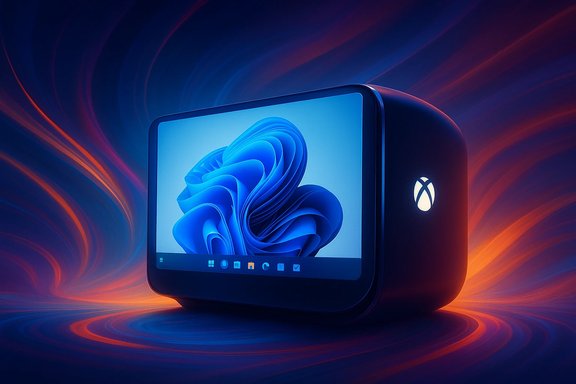
Microsoft’s next living‑room console is increasingly being described not as a sealed, custom operating‑system appliance but as a TV‑focused Windows 11 PC that boots into a console‑style interface — driven by the Xbox Full Screen Experience (FSE), co‑engineered AMD silicon, and a new emphasis on OEM hardware and cross‑store access that could reshape what “console” means in 2027 and beyond.
Since the Xbox debut in 2001, Microsoft’s console strategy has alternated between fighting for dedicated hardware share and expanding gaming across PC and cloud. The Xbox 360 era showed Microsoft could outpace Sony on performance and momentum; the Xbox One cycle brought strategic missteps and messaging problems; and the current Xbox Series generation has left analysts and industry watchers debating whether hardware-first console economics still serve Microsoft’s broader services ambitions. Recent moves — an official multi‑year silicon partnership with AMD, the launch of the ASUS ROG Xbox Ally family (Windows 11 handhelds that boot into an Xbox‑style UI), and the Windows 11 Full Screen Experience rollout — have crystallized a new hypothesis: Microsoft may deliver the “next Xbox” as a Windows‑rooted, PC‑class device that behaves like a console at the front end.
The idea is straightforward in principle: ship a premium, TV‑optimized hardware platform running Windows 11 and booting into the Xbox Full Screen Experience (FSE) as the default launcher. Users who want a traditional console plug‑and‑play experience would remain inside the Xbox shell; power users could exit to a full Windows desktop and install or run PC storefronts like Steam, Epic, GOG, and Battle.net. That hybrid model promises developer convenience, broader game availability, and faster iteration — but it also introduces technical, certification, and business tradeoffs that are still unresolved.
However, several core business, technical, and user‑experience questions remain unresolved. Anti‑cheat and DRM realities, update and support discipline, supply‑chain and component cost pressures, and the delicate UX balance between openness and simplicity are all critical. Until Microsoft publishes official product specs, dev‑kit policies and pricing, the “Windows‑as‑console” narrative should be regarded as a strategic direction and experiment — plausible and well‑supported by current signals — rather than a definitive product announcement.
For developers: a unified Windows runtime reduces porting friction and simplifies toolchains — but certification matrices, anti‑cheat support and performance tuning across a wider range of hardware profiles will still matter. Developers should watch Microsoft’s dev documentation and certification guidelines closely.
For the market: Microsoft’s pivot compresses the historical gap between consoles and PCs, forcing competitors and publishers to rethink exclusivity, storefront economics, and the role of hardware as a loss leader versus a premium device. The outcome will depend on execution: a polished, curated experience on top of an open stack could expand the Xbox audience; a confusing, expensive product might push players back to simpler alternatives.
Caution: many of the most consequential claims about the next Xbox — retail pricing, final hardware specs, exact launch timing, and sweeping policy changes like free online multiplayer — remain unverified at the corporate announcement level. Treat those items as industry reporting and rumor until Microsoft confirms the details.
Microsoft’s experiment with the Xbox Full Screen Experience and OEM partners gives us a clear window into a possible future: consoles that are, in effect, curated Windows PCs. That future could offer unprecedented choice and library continuity — but it will only deliver if Microsoft can reconcile the technical, policy and pricing tradeoffs that come with bringing Windows into the living room.
Source: Tech4Gamers Next Xbox Console May Turn Out To Be A Windows PC, Providing Pure Gaming Interface Arriving Early 2027
 Background / Overview
Since the Xbox debut in 2001, Microsoft’s console strategy has alternated between fighting for dedicated hardware share and expanding gaming across PC and cloud. The Xbox 360 era showed Microsoft could outpace Sony on performance and momentum; the Xbox One cycle brought strategic missteps and messaging problems; and the current Xbox Series generation has left analysts and industry watchers debating whether hardware-first console economics still serve Microsoft’s broader services ambitions. Recent moves — an official multi‑year silicon partnership with AMD, the launch of the ASUS ROG Xbox Ally family (Windows 11 handhelds that boot into an Xbox‑style UI), and the Windows 11 Full Screen Experience rollout — have crystallized a new hypothesis: Microsoft may deliver the “next Xbox” as a Windows‑rooted, PC‑class device that behaves like a console at the front end.The idea is straightforward in principle: ship a premium, TV‑optimized hardware platform running Windows 11 and booting into the Xbox Full Screen Experience (FSE) as the default launcher. Users who want a traditional console plug‑and‑play experience would remain inside the Xbox shell; power users could exit to a full Windows desktop and install or run PC storefronts like Steam, Epic, GOG, and Battle.net. That hybrid model promises developer convenience, broader game availability, and faster iteration — but it also introduces technical, certification, and business tradeoffs that are still unresolved.
What is the Xbox Full Screen Experience (FSE)?
The essentials
- Full Screen Experience (FSE) is a controller‑first, console‑style session layered on top of Windows 11. It launches a “home app” (the Xbox PC app by default) in full screen and defers or suppresses many desktop services and Explorer subsystems during that session to reduce background resource use.
- The feature has been trialed and shipped on Windows handhelds — most notably the ASUS ROG Xbox Ally and Ally X — and Microsoft rolled FSE into Windows Insider preview builds and began a broader staged rollout for compatible handhelds in late 2025. Multiple outlets and community testers reported measurable performance and battery gains on handheld hardware.
The performance claims — what’s verified
Independent hands‑on tests and coverage show that FSE can reclaim memory and reduce background CPU wakeups by skipping desktop services and startup apps, with many reports citing roughly 1–2 GB of memory reclaimed in favorable configurations. These gains translate to higher sustained FPS and better battery life on thermally constrained handheld systems, because the mode reduces non‑essential background tasks. That said, the exact benefit varies by system configuration, running software, drivers, and whether users disable other startup services.Important technical nuance
FSE is a session posture — a shell and policy layer — not a kernel‑level replacement of Windows. It doesn’t rewrite drivers or remove Windows security primitives. That distinction is crucial: the platform retains Windows’ kernel, driver model, and compatibility with existing middleware (including anti‑cheat systems), and the UX switch is accomplished by changing which userland components start at sign‑in.Evidence the next Xbox might be Windows‑based
Multiple signals point toward Microsoft exploring a Windows‑rooted next‑gen device:- Xbox leadership publicly signaled a platform‑level pivot and confirmed a multi‑year co‑engineering partnership with AMD to build silicon across consoles, handhelds, PCs, and cloud infrastructure. That partnership creates the technical runway for high‑performance, Windows‑capable hardware in a living‑room form factor.
- Microsoft and OEM partners shipped the ROG Xbox Ally / Ally X, Windows handhelds that boot into the Xbox FSE and act as a public testbed for the console‑style Windows experience. Hands‑on reporting from multiple outlets found that the Ally family demonstrates the viability of a controller‑first shell on Windows.
- Reporting from Windows Central’s Jez Corden — amplified across the trade press — specifically claims the next Xbox “will run full‑bore Windows” with a TV‑optimized FSE front end and that Microsoft is building major Xbox PC app updates to support that vision. Jez’s reporting has been cited and echoed by other outlets analyzing the same signals. While not an official product reveal, this reporting maps to the other public signals (AMD partnership, Ally testbed, Xbox PC app changes).
What Microsoft has already shipped (and why it matters)
- ASUS ROG Xbox Ally and Ally X: Windows 11 handhelds preinstalled with an Xbox FSE launcher that give a console‑like experience on handheld hardware. The Ally hardware demonstrates the UX model and is a deliberate experiment for cross‑device continuity.
- Windows 11 FSE plumbing in Insider builds (Windows 11 25H2 preview, specific build numbers exposed to Insiders). Microsoft placed the FSE controls into Settings → Gaming → Full screen experience and is enabling the feature via OEM gating and staged rollouts. This indicates Microsoft intends FSE to be a supported, official Windows mode — not a one‑off OEM hack.
- Xbox PC app aggregation: the Xbox PC app is being updated to discover installed titles across Steam, Epic, GOG, Battle.net and Microsoft Store, creating the software plumbing needed for a single, controller‑first library view on a living‑room device.
What’s likely — and what remains rumor
What looks credible today- The next Xbox hardware will be built around AMD silicon (multi‑year partnership in public view).
- Microsoft will continue to leverage FSE as a console‑grade front end on Windows devices, extending it beyond handhelds to other form factors via Insider and OEM channels.
- Microsoft will evolve the Xbox PC app into a robust aggregation/orchestration layer so users can find and launch titles from multiple stores in a unified interface.
- That Microsoft will ship the next living‑room Xbox with the full Windows 11 desktop accessible by default at retail day‑one. Journalists and sources describe a layered model (console shell over Windows), but Microsoft has not published a day‑one software guarantee that every retail unit will be an unconstrained Windows PC. Treat claims that the next Xbox is simply “Windows 11 in a box” as shorthand for a layered Windows stack; details matter.
- Pricing and exact hardware specs (memory budgets, TDP, GDDR generation, NPU TOPS) remain leaked and rumor‑driven. Early reporting calls the device premium and high‑end, but precise MSRP or memory counts are not confirmed. Expect component supply, GDDR pricing, and thermal design constraints to materially shape final spec and cost.
- Policy changes like a permanent removal of the multiplayer paywall for the next Xbox remain rumors and would require formal Microsoft announcements and contractual changes with third‑party publishers. These remain unverified strategic possibilities, not confirmed product facts.
Technical and platform implications
Anti‑cheat, DRM and certification
Moving to a Windows‑based platform that allows multiple storefronts introduces immediate questions about kernel‑level anti‑cheat, DRM, and matchmaking integrity. Many popular competitive and multiplayer titles rely on kernel drivers or platform integrations that are tested and certified on specific OS configurations; expanding the permitted installation surface increases the number of compatibility permutations publishers must validate. Publishers and middleware vendors will likely determine on a title‑by‑title basis whether their games are supported natively on an open Xbox device.Update channels and reliability
Windows routinely ships more frequent updates than traditional console OSes. Microsoft will need to design conservative, curated update channels for living‑room devices (rollback paths, strict QA rings) to preserve the “plug‑and‑play” console promise while enabling faster iteration. Insider and OEM gating used for FSE on handhelds provide a template but living‑room consoles will demand stricter shipping discipline.Performance and thermal design
FSE’s memory/foreground trimming helps handheld performance, where reclaiming ~1–2 GB of RAM matters. For a 4K living‑room console, the benefits are less dramatic — high‑TDP silicon, chassis cooling, acoustics and power delivery dominate real‑world performance outcomes. Designing a quiet, consumer‑friendly 4K box around high‑power silicon (rumored “Magnus” class APUs) is non‑trivial and influences final product cost and adoption.Security and attack surface
Exposing multiple storefronts and allowing arbitrary desktop installs widens the attack surface compared with a locked console OS. Microsoft will need to harden default configurations, sandbox third‑party storefronts, and maintain robust anti‑tamper systems to preserve user safety and platform stability.Strengths of a Windows‑based Xbox strategy
- Developer efficiency: A common Windows runtime reduces porting overhead and enables studios to reuse existing PC toolchains, potentially accelerating release parity and reducing QA divergence.
- User flexibility: Gamers gain access to broader PC catalogs, existing Steam/Epic libraries, and PC‑only titles without needing a separate gaming PC. Aggregated libraries simplify discovery across storefronts.
- Faster iteration and service integration: Using Windows and evolving the Xbox PC app allows Microsoft to update the front end and services (Game Pass, cloud features) more frequently than the console OS cadence alone.
- Silicon synergy and AI capabilities: The AMD co‑engineering partnership suggests Microsoft can push on‑device AI features (upscaling, frame generation, Auto Super Resolution) that benefit both cloud and local play.
Risks, tradeoffs and likely user friction points
- Premium pricing risk: A high‑end Windows‑based console with larger memory and AI accelerators will likely raise the bill‑of‑materials, potentially pushing MSRP into a premium segment. A narrower install base could impact first‑party economics and third‑party incentives.
- Certification complexity for multiplayer titles: Anti‑cheat integration and certification for multiple storefronts complicate matchmaking and online safety. Publishers may opt to withhold certain titles from native running on the device, pushing users to cloud streaming for compatibility.
- Support and fragmentation: Allowing desktop installs and third‑party clients could increase support load for Microsoft and retailers, and it risks confusing mainstream buyers who expect a single, curated console experience.
- Privacy and telemetry concerns: Aggregated launchers and library discovery involve local metadata collection. Microsoft must be transparent about telemetry and offer enterprise/parental controls to preserve trust.
- Perception of “console identity” erosion: For some players, the magic of a console is simplicity — curated titles, guaranteed parity, and minimal tinkering. A Windows‑first Xbox risks alienating that audience if the retail default is perceived as a PC with extra steps.
What consumers and developers should watch next
- Official Microsoft statements clarifying whether retail living‑room devices will ship with an opt‑in Windows desktop or a curated, locked default that preserves console simplicity.
- Microsoft/A MD published silicon specs and memory figures — these will determine thermal design, pricing, and whether the class of titles targeted is truly PC‑grade.
- Anti‑cheat and DRM vendor support statements: which middleware vendors validate native support on a Windows‑first Xbox? This will decide how many competitive online titles can run locally at launch.
- Xbox PC app feature parity and the aggregated library’s behavior on a TV: how seamless is launching Steam or Epic installs from the Xbox home UI?
- Pricing signals and SKU segmentation: expect Microsoft to consider a tiered approach — a premium, PC‑capable flagship and lower‑cost options — but the company must balance margin and install base.
Bottom line — the strategic logic and the practical reality
Microsoft’s public engineering work (FSE on Windows 11), its OEM experiments (ROG Xbox Ally), and the AMD partnership provide a credible foundation for a Windows‑centric next‑gen Xbox device that behaves like a console by default but exposes PC openness if the user wants it. This approach aligns with Microsoft’s broader services‑first strategy: maximize platform reach for Game Pass and cloud play while reducing engineering duplication between PC and console runtimes.However, several core business, technical, and user‑experience questions remain unresolved. Anti‑cheat and DRM realities, update and support discipline, supply‑chain and component cost pressures, and the delicate UX balance between openness and simplicity are all critical. Until Microsoft publishes official product specs, dev‑kit policies and pricing, the “Windows‑as‑console” narrative should be regarded as a strategic direction and experiment — plausible and well‑supported by current signals — rather than a definitive product announcement.
Conclusion — what this means for gamers, developers and the market
For gamers: a Windows‑based Xbox could be the most flexible living‑room device yet — surfacing Game Pass, your Steam library, and local PC titles from one interface. Expect wins for owners of large PC libraries, but don’t assume every PC title will run natively on day one; publisher and middleware constraints will determine compatibility.For developers: a unified Windows runtime reduces porting friction and simplifies toolchains — but certification matrices, anti‑cheat support and performance tuning across a wider range of hardware profiles will still matter. Developers should watch Microsoft’s dev documentation and certification guidelines closely.
For the market: Microsoft’s pivot compresses the historical gap between consoles and PCs, forcing competitors and publishers to rethink exclusivity, storefront economics, and the role of hardware as a loss leader versus a premium device. The outcome will depend on execution: a polished, curated experience on top of an open stack could expand the Xbox audience; a confusing, expensive product might push players back to simpler alternatives.
Caution: many of the most consequential claims about the next Xbox — retail pricing, final hardware specs, exact launch timing, and sweeping policy changes like free online multiplayer — remain unverified at the corporate announcement level. Treat those items as industry reporting and rumor until Microsoft confirms the details.
Microsoft’s experiment with the Xbox Full Screen Experience and OEM partners gives us a clear window into a possible future: consoles that are, in effect, curated Windows PCs. That future could offer unprecedented choice and library continuity — but it will only deliver if Microsoft can reconcile the technical, policy and pricing tradeoffs that come with bringing Windows into the living room.
Source: Tech4Gamers Next Xbox Console May Turn Out To Be A Windows PC, Providing Pure Gaming Interface Arriving Early 2027
Last edited:
