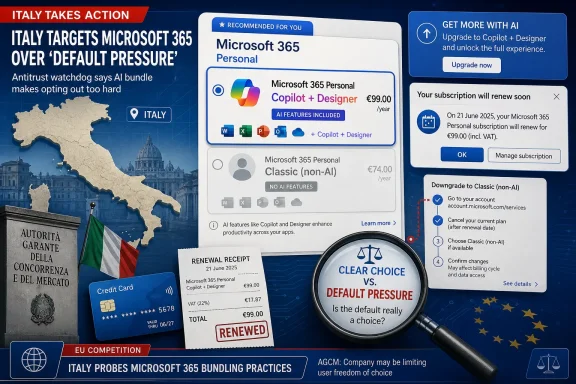
Italy’s antitrust authority opened an investigation on June 26, 2026, into Microsoft over alleged unfair commercial practices tied to Microsoft 365 subscription price increases after Copilot and Designer were folded into consumer plans. The case is not just another complaint about software getting more expensive. It is a test of whether the AI boom can be quietly financed through default bundles, renewal notices, and the inertia of subscribers who only wanted Word, Excel, Outlook, and OneDrive.
Microsoft has spent the last two years trying to make Copilot feel less like an add-on and more like the new surface area of Windows and Office. Italy is now asking the question many users have been muttering at renewal time: when a company changes the package, raises the price, and leaves the cheaper version hard to see, is that innovation — or pressure?
The Italian Competition Authority’s concern, according to early reporting on the proceeding, is that Microsoft may have presented the Microsoft 365 changes in a fragmented way, without making sufficiently clear that the subscription had been expanded with AI services such as Copilot and Designer. That distinction matters. Regulators are not merely objecting to a higher price; they are examining how that higher price was framed.
For consumers, Microsoft 365 has long been a comfort product. It is the annual tax many households pay for Office apps, cloud storage, and the reassurance that school documents, family spreadsheets, and résumés will open without drama. That makes it different from a discretionary AI subscription. Users do not necessarily wake up wanting generative text in Word or image tools in Designer, but they may feel trapped if those features arrive inside the thing they already depend on.
This is where Microsoft’s AI strategy meets consumer law. Bundling is not new in Redmond; Windows, Internet Explorer, Teams, OneDrive, Edge, Defender, and now Copilot have all benefited from the gravitational pull of Microsoft’s installed base. But Copilot changes the economics. Generative AI is expensive to run, expensive to market, and expensive to justify to investors. If customers will not voluntarily pay for it at scale, bundling becomes the shortest road from ambition to revenue.
The Italian probe lands because that road has toll booths. A subscriber who sees a renewal price go up may assume the old product has simply become more expensive. A subscriber who is told, clearly and prominently, that there is a cheaper non-AI version may make a different choice. The investigation is about the gap between those two experiences.
The harder case is whether Copilot belongs inside the default renewal path. AI assistants are still uneven tools. Some users find them helpful for drafting emails, summarizing documents, or generating first-pass slides. Others see them as bloat, risk, or an expensive novelty layered on top of apps they already know how to use.
That split in user value is precisely why transparency matters. If Microsoft believes Copilot is worth the extra money, it should be able to sell that proposition directly. “Pay more because we added AI” is a clean commercial offer. “Your subscription is changing, your price is rising, and the old-style plan still exists somewhere else” is a murkier transaction.
The company’s challenge is that AI has been positioned internally and externally as a platform shift, not a feature category. Microsoft does not want Copilot to be treated like clip art, grammar suggestions, or a premium template pack. It wants Copilot to be the new interface for work. That ambition creates pressure to make the AI tier the normal tier, and to make non-AI plans feel like legacy escape hatches rather than first-class options.
That earlier case is important because it gives Italy’s move a broader pattern. Regulators are converging on the same architecture of concern: the subscription notice, the price increase, the AI bundle, and the visibility of the lower-cost alternative. The question is not whether Microsoft can offer Copilot. It is whether Microsoft’s user journey nudged people into paying for it without a fair chance to decline.
Switzerland has also scrutinized Microsoft 365 pricing, particularly in a business and public-sector context. That is a different legal and commercial terrain, but it reinforces a common theme: Microsoft 365 is no longer just a software suite. It is infrastructure. When infrastructure pricing changes, regulators pay attention because the realistic ability to switch is limited.
The modern Microsoft 365 customer is not shopping from a blank slate each year. Files sit in OneDrive. Outlook identities are established. Family accounts are shared. Schools and workplaces assume Office compatibility. The more embedded the service becomes, the more a renewal notice resembles a controlled choice rather than an open market.
These interfaces are not neutral. A company can comply with the literal existence of choice while burying that choice behind friction. The old plan can exist, but if a subscriber learns about it only after beginning cancellation, the user experience has already done its work. In behavioral terms, the default has become the sale.
That is why regulators increasingly care about choice architecture. The question is not just what options existed in the database. It is what a reasonable consumer saw, understood, and could act on before paying more. If the old plan is available but not meaningfully presented, the commercial reality may be closer to a forced migration than an informed upgrade.
Microsoft is hardly alone in using renewal friction. Streaming services, cloud storage providers, mobile carriers, security vendors, and app stores all understand the revenue value of defaults. But Microsoft’s scale makes the practice consequential. A small increase on tens of millions of Microsoft 365 subscriptions becomes a major revenue event, especially if it also helps Microsoft report growing AI adoption.
At home, the pitch is softer. A student might use Copilot to outline an essay. A parent might use it to rewrite a letter. A hobbyist might use Designer for quick graphics. But many households subscribe to Microsoft 365 for the mundane reasons that made Office dominant in the first place: compatibility, storage, and continuity. AI is not necessarily the reason they are there.
That creates a trust problem when AI becomes the justification for a higher default price. Users who never asked for Copilot may read the move as a subsidy for Microsoft’s strategic priorities. The resentment is not only about money. It is about agency. People dislike feeling that a product they rely on has been used as a delivery mechanism for a feature they would not have bought separately.
Microsoft’s defenders will argue that bundled innovation has always worked this way. Nobody votes feature by feature on every addition to Office. Word gets new tools, Excel gets new functions, PowerPoint gets new design capabilities, and the subscription evolves. But generative AI is not perceived as just another toolbar. It brings cost, privacy anxiety, output reliability concerns, and cultural baggage. Treating it as a routine enhancement understates how contested the technology remains.
That recognition creates a duty of clarity. Once a company maintains two materially different versions of a service — one with AI at a higher price and one without AI at a lower price — it cannot fairly communicate as if the higher-priced path is the only continuation of service. The cheaper plan does not have to be advertised more aggressively than the premium plan, but it cannot be hidden in the shadows.
The Classic plan also punctures the argument that the price increase was simply the unavoidable cost of maintaining Microsoft 365. If the non-AI plan can continue at a lower price, then the delta is at least partly about the AI package. That is exactly the information a consumer needs before deciding whether the new price is worthwhile.
For Windows enthusiasts and IT professionals, this is familiar territory. Microsoft often introduces new defaults while preserving escape routes for those who know where to look. The problem is that consumers are not registry editors. A fair subscription market cannot depend on users knowing the secret path through cancellation screens, support pages, or region-specific account settings.
That should worry large platform companies because consumer law can move faster than abstract AI governance. It does not require regulators to solve the philosophy of machine intelligence. It requires them to inspect emails, screenshots, subscription flows, pricing tables, and customer communications. The evidence is concrete.
For Microsoft, the optics are particularly delicate. The company has spent years trying to present itself as the responsible AI adult in the room: enterprise-grade, secure, compliant, governed. A finding that consumers were nudged into paying for AI features without adequate disclosure would cut against that positioning. Responsible AI is not only about safety filters and data boundaries; it is also about whether people are clearly told when AI is being sold to them.
Italy’s move comes at a time when European authorities have become more comfortable challenging platform design. Dark patterns, default settings, consent flows, ranking systems, app-store rules, and interoperability limits are all now regulatory material. Microsoft 365 pricing fits comfortably into that broader enforcement mood.
Enterprise customers have more negotiating power than households, but they also face higher switching costs. Microsoft 365 is tangled through identity, compliance, retention, endpoint management, email security, document workflows, SharePoint, Teams, Power Platform, and third-party integrations. The practical cost of leaving can dwarf the license line item.
That gives Microsoft leverage when it changes packaging. A business may not be forced to buy Copilot, but it may find AI-related value increasingly woven into E3, E5, Teams, Office apps, Purview, security tooling, and administrative dashboards. Over time, the distinction between optional AI add-on and default suite behavior may blur.
The consumer cases are therefore a preview of enterprise arguments to come. Procurement teams will ask whether AI features are being itemized clearly, whether non-AI alternatives remain available, and whether price increases are tied to measurable value or portfolio-wide strategic bundling. Regulators may ask similar questions where public-sector agencies are locked into Microsoft ecosystems.
But distribution power is legally and politically sensitive. The more Microsoft uses its installed base to accelerate AI adoption, the more regulators will ask whether adoption reflects genuine demand or default placement. This is the same tension that shaped earlier Microsoft antitrust battles, even if the products and legal frameworks have changed.
The company’s post-2000s rehabilitation rested partly on appearing more open, more cloud-oriented, and less brutally exclusionary than the Windows monopoly era. The Copilot push risks reviving older suspicions in a new form. Instead of “you get the browser because you use Windows,” the concern becomes “you pay for AI because you use Office.”
That comparison is imperfect but powerful. Copilot is not Internet Explorer, and Microsoft 365 is not the Windows desktop monopoly of the late 1990s. Yet the underlying question rhymes: when a platform owner controls the default path, how much of the market’s behavior is choice, and how much is channel power?
That is why pricing investigations matter beyond fines. A regulator does not need to break Microsoft apart to change the economics of AI bundling. It can require clearer notices, easier downgrades, more prominent alternative plans, refunds, or changes to renewal flows. Each intervention reduces the revenue lift that comes from inertia.
For Wall Street, “attach rate” is a beautiful phrase. For regulators, the same phenomenon can look like steering. If Microsoft can persuade users that Copilot is worth paying for, attach rate is product-market fit. If users pay because the cheaper alternative is poorly disclosed, attach rate becomes evidence.
This is the uncomfortable middle ground Microsoft now occupies. It has the right to commercialize AI aggressively. It does not have the right to make refusal unnecessarily obscure. The line between those two positions will be drawn less in keynote demos than in account-management screens.
The Microsoft 365 case also reinforces a broader shift in personal computing. The operating system is no longer the only place where defaults matter. Subscriptions, cloud accounts, identity prompts, storage warnings, and AI feature gates now shape the user experience as much as desktop settings do. Control has moved from the Control Panel to the billing panel.
This is why the Italian case will resonate with WindowsForum readers. It is not just a European consumer-law story. It is part of a long-running contest over who gets to define the “normal” Windows-and-Office experience: the user who bought the subscription, or the platform owner that keeps revising what the subscription includes.
Microsoft can still handle this well. It could make non-AI plans plainly visible, explain the Copilot price delta, simplify downgrades, and stop treating opt-outs as retention failures. That would not end complaints about AI, but it would reduce the suspicion that the company is trying to monetize confusion.
Microsoft has spent the last two years trying to make Copilot feel less like an add-on and more like the new surface area of Windows and Office. Italy is now asking the question many users have been muttering at renewal time: when a company changes the package, raises the price, and leaves the cheaper version hard to see, is that innovation — or pressure?
 The AI Bundle Has Become the New Price Increase
The Italian Competition Authority’s concern, according to early reporting on the proceeding, is that Microsoft may have presented the Microsoft 365 changes in a fragmented way, without making sufficiently clear that the subscription had been expanded with AI services such as Copilot and Designer. That distinction matters. Regulators are not merely objecting to a higher price; they are examining how that higher price was framed.For consumers, Microsoft 365 has long been a comfort product. It is the annual tax many households pay for Office apps, cloud storage, and the reassurance that school documents, family spreadsheets, and résumés will open without drama. That makes it different from a discretionary AI subscription. Users do not necessarily wake up wanting generative text in Word or image tools in Designer, but they may feel trapped if those features arrive inside the thing they already depend on.
This is where Microsoft’s AI strategy meets consumer law. Bundling is not new in Redmond; Windows, Internet Explorer, Teams, OneDrive, Edge, Defender, and now Copilot have all benefited from the gravitational pull of Microsoft’s installed base. But Copilot changes the economics. Generative AI is expensive to run, expensive to market, and expensive to justify to investors. If customers will not voluntarily pay for it at scale, bundling becomes the shortest road from ambition to revenue.
The Italian probe lands because that road has toll booths. A subscriber who sees a renewal price go up may assume the old product has simply become more expensive. A subscriber who is told, clearly and prominently, that there is a cheaper non-AI version may make a different choice. The investigation is about the gap between those two experiences.
Microsoft’s Problem Is Not That Copilot Costs Money
There is nothing inherently scandalous about Microsoft charging more for Microsoft 365. The service has accumulated features over the years, inflation exists, cloud storage is not free, and Office remains one of the most valuable consumer software bundles in the world. The company can make a defensible case that Microsoft 365 in 2026 is not the same product it was when many subscribers first signed up.The harder case is whether Copilot belongs inside the default renewal path. AI assistants are still uneven tools. Some users find them helpful for drafting emails, summarizing documents, or generating first-pass slides. Others see them as bloat, risk, or an expensive novelty layered on top of apps they already know how to use.
That split in user value is precisely why transparency matters. If Microsoft believes Copilot is worth the extra money, it should be able to sell that proposition directly. “Pay more because we added AI” is a clean commercial offer. “Your subscription is changing, your price is rising, and the old-style plan still exists somewhere else” is a murkier transaction.
The company’s challenge is that AI has been positioned internally and externally as a platform shift, not a feature category. Microsoft does not want Copilot to be treated like clip art, grammar suggestions, or a premium template pack. It wants Copilot to be the new interface for work. That ambition creates pressure to make the AI tier the normal tier, and to make non-AI plans feel like legacy escape hatches rather than first-class options.
Italy Is Following a Trail Already Blazed Elsewhere
The Italian action does not appear in isolation. Australia’s competition watchdog previously took Microsoft to court over allegations that customers were misled when Copilot was integrated into Microsoft 365 Personal and Family plans. The Australian case centered on claims that subscribers were effectively presented with two choices — accept a higher-priced Copilot-inclusive plan or cancel — while cheaper “Classic” plans without Copilot were not adequately disclosed until later in the cancellation flow.That earlier case is important because it gives Italy’s move a broader pattern. Regulators are converging on the same architecture of concern: the subscription notice, the price increase, the AI bundle, and the visibility of the lower-cost alternative. The question is not whether Microsoft can offer Copilot. It is whether Microsoft’s user journey nudged people into paying for it without a fair chance to decline.
Switzerland has also scrutinized Microsoft 365 pricing, particularly in a business and public-sector context. That is a different legal and commercial terrain, but it reinforces a common theme: Microsoft 365 is no longer just a software suite. It is infrastructure. When infrastructure pricing changes, regulators pay attention because the realistic ability to switch is limited.
The modern Microsoft 365 customer is not shopping from a blank slate each year. Files sit in OneDrive. Outlook identities are established. Family accounts are shared. Schools and workplaces assume Office compatibility. The more embedded the service becomes, the more a renewal notice resembles a controlled choice rather than an open market.
The Renewal Screen Is Now a Regulatory Battlefield
For decades, software pricing fights were about license audits, enterprise agreements, and whether a vendor had abused dominance in one market to win another. The consumer subscription era has moved the battlefield into smaller spaces: the email, the account dashboard, the cancellation page, the toggle that appears only after a user threatens to leave.These interfaces are not neutral. A company can comply with the literal existence of choice while burying that choice behind friction. The old plan can exist, but if a subscriber learns about it only after beginning cancellation, the user experience has already done its work. In behavioral terms, the default has become the sale.
That is why regulators increasingly care about choice architecture. The question is not just what options existed in the database. It is what a reasonable consumer saw, understood, and could act on before paying more. If the old plan is available but not meaningfully presented, the commercial reality may be closer to a forced migration than an informed upgrade.
Microsoft is hardly alone in using renewal friction. Streaming services, cloud storage providers, mobile carriers, security vendors, and app stores all understand the revenue value of defaults. But Microsoft’s scale makes the practice consequential. A small increase on tens of millions of Microsoft 365 subscriptions becomes a major revenue event, especially if it also helps Microsoft report growing AI adoption.
Copilot’s Consumer Pitch Still Has a Trust Deficit
The consumer version of Copilot faces a different problem than the enterprise version. In business, Microsoft can pitch AI as a productivity tool tied to measurable workflows: summarize Teams meetings, search company data, draft documents, extract action items, and reduce knowledge-worker drag. Whether those claims hold up in every organization is another matter, but the use case is legible.At home, the pitch is softer. A student might use Copilot to outline an essay. A parent might use it to rewrite a letter. A hobbyist might use Designer for quick graphics. But many households subscribe to Microsoft 365 for the mundane reasons that made Office dominant in the first place: compatibility, storage, and continuity. AI is not necessarily the reason they are there.
That creates a trust problem when AI becomes the justification for a higher default price. Users who never asked for Copilot may read the move as a subsidy for Microsoft’s strategic priorities. The resentment is not only about money. It is about agency. People dislike feeling that a product they rely on has been used as a delivery mechanism for a feature they would not have bought separately.
Microsoft’s defenders will argue that bundled innovation has always worked this way. Nobody votes feature by feature on every addition to Office. Word gets new tools, Excel gets new functions, PowerPoint gets new design capabilities, and the subscription evolves. But generative AI is not perceived as just another toolbar. It brings cost, privacy anxiety, output reliability concerns, and cultural baggage. Treating it as a routine enhancement understates how contested the technology remains.
The Classic Plan Is More Than a Cheaper SKU
The existence of a non-AI “Classic” plan changes the entire argument. If Microsoft had simply replaced the old product with a new, more expensive AI-inclusive Microsoft 365 offering, the dispute would be more straightforward. Customers could complain, cancel, or accept that the product had changed. But a lower-cost plan without Copilot suggests Microsoft itself recognized that not every subscriber wanted or needed the AI bundle.That recognition creates a duty of clarity. Once a company maintains two materially different versions of a service — one with AI at a higher price and one without AI at a lower price — it cannot fairly communicate as if the higher-priced path is the only continuation of service. The cheaper plan does not have to be advertised more aggressively than the premium plan, but it cannot be hidden in the shadows.
The Classic plan also punctures the argument that the price increase was simply the unavoidable cost of maintaining Microsoft 365. If the non-AI plan can continue at a lower price, then the delta is at least partly about the AI package. That is exactly the information a consumer needs before deciding whether the new price is worthwhile.
For Windows enthusiasts and IT professionals, this is familiar territory. Microsoft often introduces new defaults while preserving escape routes for those who know where to look. The problem is that consumers are not registry editors. A fair subscription market cannot depend on users knowing the secret path through cancellation screens, support pages, or region-specific account settings.
Europe’s Consumer Regulators Are Reading the AI Fine Print
The Italian investigation also shows how AI regulation will not arrive only through grand AI Acts, model-risk classifications, or debates over copyright and training data. Some of the most meaningful AI oversight may come through ordinary consumer-protection law. Did the customer understand what changed? Was the price presented honestly? Were material alternatives disclosed? Was the interface designed to inform or to steer?That should worry large platform companies because consumer law can move faster than abstract AI governance. It does not require regulators to solve the philosophy of machine intelligence. It requires them to inspect emails, screenshots, subscription flows, pricing tables, and customer communications. The evidence is concrete.
For Microsoft, the optics are particularly delicate. The company has spent years trying to present itself as the responsible AI adult in the room: enterprise-grade, secure, compliant, governed. A finding that consumers were nudged into paying for AI features without adequate disclosure would cut against that positioning. Responsible AI is not only about safety filters and data boundaries; it is also about whether people are clearly told when AI is being sold to them.
Italy’s move comes at a time when European authorities have become more comfortable challenging platform design. Dark patterns, default settings, consent flows, ranking systems, app-store rules, and interoperability limits are all now regulatory material. Microsoft 365 pricing fits comfortably into that broader enforcement mood.
Enterprise IT Should Not Dismiss This as a Consumer Sideshow
At first glance, the Italian probe concerns consumer subscriptions, not enterprise Microsoft 365 tenants. CIOs and admins might be tempted to treat it as a home-user problem. That would be a mistake. The same strategic logic — embed AI, make it default, monetize through the suite — is moving through business licensing too.Enterprise customers have more negotiating power than households, but they also face higher switching costs. Microsoft 365 is tangled through identity, compliance, retention, endpoint management, email security, document workflows, SharePoint, Teams, Power Platform, and third-party integrations. The practical cost of leaving can dwarf the license line item.
That gives Microsoft leverage when it changes packaging. A business may not be forced to buy Copilot, but it may find AI-related value increasingly woven into E3, E5, Teams, Office apps, Purview, security tooling, and administrative dashboards. Over time, the distinction between optional AI add-on and default suite behavior may blur.
The consumer cases are therefore a preview of enterprise arguments to come. Procurement teams will ask whether AI features are being itemized clearly, whether non-AI alternatives remain available, and whether price increases are tied to measurable value or portfolio-wide strategic bundling. Regulators may ask similar questions where public-sector agencies are locked into Microsoft ecosystems.
Microsoft’s Installed Base Is Both Its Moat and Its Liability
Microsoft’s greatest advantage in AI is not that it invented the best chatbot interface. It is that it owns the applications where much of the world’s work already happens. Word, Excel, PowerPoint, Outlook, Teams, OneDrive, SharePoint, Windows, and Entra form a distribution channel that most AI startups can only envy.But distribution power is legally and politically sensitive. The more Microsoft uses its installed base to accelerate AI adoption, the more regulators will ask whether adoption reflects genuine demand or default placement. This is the same tension that shaped earlier Microsoft antitrust battles, even if the products and legal frameworks have changed.
The company’s post-2000s rehabilitation rested partly on appearing more open, more cloud-oriented, and less brutally exclusionary than the Windows monopoly era. The Copilot push risks reviving older suspicions in a new form. Instead of “you get the browser because you use Windows,” the concern becomes “you pay for AI because you use Office.”
That comparison is imperfect but powerful. Copilot is not Internet Explorer, and Microsoft 365 is not the Windows desktop monopoly of the late 1990s. Yet the underlying question rhymes: when a platform owner controls the default path, how much of the market’s behavior is choice, and how much is channel power?
The Stock Market Sees Revenue; Regulators See Friction
Investors have rewarded Microsoft for turning AI into a credible business line rather than a science project. Copilot, Azure AI, GitHub Copilot, and enterprise AI services give the company a story that connects capital expenditure to future revenue. Microsoft 365 is central to that story because it offers a vast base of paying users who can be moved up the value chain.That is why pricing investigations matter beyond fines. A regulator does not need to break Microsoft apart to change the economics of AI bundling. It can require clearer notices, easier downgrades, more prominent alternative plans, refunds, or changes to renewal flows. Each intervention reduces the revenue lift that comes from inertia.
For Wall Street, “attach rate” is a beautiful phrase. For regulators, the same phenomenon can look like steering. If Microsoft can persuade users that Copilot is worth paying for, attach rate is product-market fit. If users pay because the cheaper alternative is poorly disclosed, attach rate becomes evidence.
This is the uncomfortable middle ground Microsoft now occupies. It has the right to commercialize AI aggressively. It does not have the right to make refusal unnecessarily obscure. The line between those two positions will be drawn less in keynote demos than in account-management screens.
Windows Users Are Learning to Read the Fine Print Again
For ordinary Windows users, the practical lesson is depressingly familiar: when a subscription renewal arrives, assume the default path is optimized for the vendor. That does not mean every price increase is abusive or every AI feature is unwanted. It means the account page deserves the same scrutiny users once reserved for bundled installers and pre-checked toolbars.The Microsoft 365 case also reinforces a broader shift in personal computing. The operating system is no longer the only place where defaults matter. Subscriptions, cloud accounts, identity prompts, storage warnings, and AI feature gates now shape the user experience as much as desktop settings do. Control has moved from the Control Panel to the billing panel.
This is why the Italian case will resonate with WindowsForum readers. It is not just a European consumer-law story. It is part of a long-running contest over who gets to define the “normal” Windows-and-Office experience: the user who bought the subscription, or the platform owner that keeps revising what the subscription includes.
Microsoft can still handle this well. It could make non-AI plans plainly visible, explain the Copilot price delta, simplify downgrades, and stop treating opt-outs as retention failures. That would not end complaints about AI, but it would reduce the suspicion that the company is trying to monetize confusion.
The Copilot Tax Is Now Written Into the Renewal Notice
The most important facts are not buried in legal theory. They are visible in the renewal experience, the pricing structure, and the growing list of regulators asking whether Microsoft made the cheaper path clear enough.- Italy opened an investigation on June 26, 2026, into Microsoft’s Microsoft 365 price increase and the way AI features were presented to consumers.
- The central issue is not simply that Microsoft raised prices, but whether subscribers were clearly told that Copilot and Designer were part of the new bundle.
- Earlier Australian proceedings alleged that Microsoft failed to adequately disclose cheaper Classic plans without Copilot before users were pushed toward higher-priced options.
- The existence of a lower-cost non-AI plan makes disclosure critical because it shows customers may have had a materially different renewal choice.
- Enterprise IT should watch the case because the same bundling logic that affects consumers can eventually shape business licensing, procurement, and public-sector dependence.
- Microsoft’s AI strategy will be judged not only by Copilot’s usefulness, but by whether users can decline it without navigating a maze.
References
- Primary source: GuruFocus
Published: Fri, 26 Jun 2026 10:08:52 GMT
Stock News - GuruFocus.com
Stay updated with the latest stock market news, trends, and insights on GuruFocus Stock News Page. Get comprehensive coverage of stocks, investment strategies, financial forecasts, and more from top industry professionals. Equip yourself with the right knowledge to make informed investing decisions.www.gurufocus.com - Related coverage: investing.com
Italy regulator probes Microsoft over ’Microsoft 365’ price hike By Reuters
Italy regulator probes Microsoft over ’Microsoft 365’ price hikewww.investing.com - Related coverage: es.marketscreener.com
El regulador italiano investiga a Microsoft por el encarecimiento de 'Microsoft 365'
La autoridad de defensa de la competencia de Italia anunció este viernes la apertura de una investigación contra Microsoft por presuntas prácticas comerciales desleales relacionadas con el aumento...es.marketscreener.com
- Related coverage: lasicilia.it
Antitrust avvia istruttoria contro Microsoft: aumento "mascherato" di Microsoft 365 con Copilot e Designer - La Sicilia
Indagine sui rincari nascosti di Microsoft 365 dopo l'integrazione di Copilot e Designer e attivazione di un piano predefinito più carowww.lasicilia.it
- Related coverage: windowscentral.com
Microsoft apologizes to 2.7 million misled users for hiding subscription options after price hikes — and for broken refund links | Windows Central
Microsoft missed its chance to save face by sending users the wrong refund link for a costly M365-Copilot bundle.www.windowscentral.com - Related coverage: computerworld.com
Microsoft issues apology for misleading Microsoft 365 pricing plans – Computerworld
Microsoft’s U-turn after facing regulatory heat for pushing Copilot-linked price hikes could mark a turning point in how Big Tech discloses AI-driven software costs. www.computerworld.com
- Related coverage: techradar.com
Microsoft apologizes to 365 users over confusing software tiers | TechRadar
Australian customers will get a partial refundwww.techradar.com - Related coverage: accc.gov.au
Microsoft in court for allegedly misleading millions of Australians over Microsoft 365 subscriptions
The ACCC has commenced proceedings in the Federal Court against Microsoft Australia and its US-based parent company Microsoft Corporation for allegedly misleading approximately 2.7 million Australian customers when communicating subscription options and price increases, after it integrated its...www.accc.gov.au - Related coverage: itpro.com
Microsoft 365 price hikes have landed the tech giant in hot water | IT Pro
After Copilot was integrated into Microsoft 365, regulators allege users of personal and family plans were misleadingly told they had to pay morewww.itpro.com - Related coverage: tg24.sky.it
Microsoft 365 aumenta il prezzo degli abbonamenti con Copilot, come pagare di meno | Sky TG24
Leggi su Sky TG24 l'articolo Microsoft 365 aumenta il prezzo degli abbonamenti con Copilot, come pagare di meno tg24.sky.it
- Related coverage: livemint.com
Microsoft misled users into pricier AI-linked 365 plans, says Australian watchdog; files lawsuit | Mint
Australia’s competition regulator has sued Microsoft, alleging the tech giant misled 2.7 million customers into paying more for Microsoft 365 plans bundled with its AI assistant Copilot, without clearly disclosing a cheaper “classic” option still available. www.livemint.com
- Related coverage: macitynet.it
Microsoft 365 aggiunge AI e aumenta i prezzi - macitynet.it
Microsoft integra le funzionalità AI di Copilot negli abbonamenti Microsoft 365 Personal e Family, ma i prezzi aumentano www.macitynet.it
- Related coverage: tvsvizzera.it
COMCO: inchiesta preliminare contro Microsoft - TVS tvsvizzera.it
La Commissione della concorrenza (COMCO) ha aperto un'inchiesta preliminare contro Microsoft in merito ai prezzi delle licenze in Svizzera. I recenti aumenti potrebbero costituire indizi di restrizioni illecite della concorrenza, si legge in un comunicato.www.tvsvizzera.it - Related coverage: techxplore.com