Italy’s competition authority opened an investigation on June 26, 2026, into Microsoft Ireland Operations Ltd. and Microsoft S.r.l. over allegations that Microsoft inadequately explained Microsoft 365 subscription price increases tied to the addition of Copilot and Designer AI services. The case is not just about a few euros on a renewal notice. It is about whether the AI era’s favorite business model — bundle first, explain later — can survive contact with consumer law. For Microsoft, which has spent the last several years recasting Office as an AI delivery system, Italy’s move lands at an awkward but revealing moment.
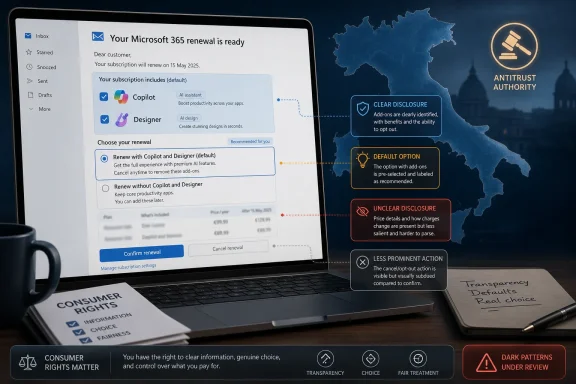
The Italian Autorità Garante della Concorrenza e del Mercato, better known as AGCM, says Microsoft may have presented the Microsoft 365 price increase in a fragmented way, without making clear enough that the subscription had been changed by the addition of Copilot and Designer. The regulator also says consumers were effectively placed by default into a more expensive plan unless they exercised a right to withdraw.
That phrasing matters. This is not being framed as a conventional antitrust case about monopoly foreclosure or a dominant firm squeezing rivals out of a market. It is being framed as a consumer-protection case about information, consent, and whether a subscription renewal can be treated as acceptance of a materially different product.
Microsoft’s defense, if it follows the company’s usual public positioning, will likely be that Microsoft 365 gained value. Copilot brings generative AI into Word, Excel, PowerPoint, Outlook, OneNote, and related apps; Designer adds image-generation and design assistance; AI credits give subscribers usage rights across a growing family of tools. From Redmond’s perspective, the price increase is the monetization of new features rather than a hidden surcharge.
But regulators do not usually ask only whether a product has more features. They ask whether the customer knew what changed, whether the customer understood the price consequence, and whether the alternative was realistically available. On that terrain, Microsoft’s AI bundle looks less like a clean product upgrade and more like a stress test for subscription consent.
Copilot changes that bargain because it is not merely another feature ribbon or a new template gallery. It is an expensive compute-backed service embedded into applications that millions of people use for ordinary household, school, freelance, and small-business work. The cost structure is different, the privacy questions are different, and the customer’s interest in the feature is far less universal than their interest in spellcheck or cloud storage.
That is why the Italian investigation should not be dismissed as a local fight over notification wording. It points to a deeper collision between the software industry’s subscription habit and the AI industry’s need to recover infrastructure spending. Microsoft has invested aggressively in AI capacity, AI integration, and AI branding. The most efficient way to monetize that investment is to attach it to products people already pay for.
The problem is that efficiency for Microsoft can feel like coercion to customers. If a consumer subscribed to Microsoft 365 for Office apps and OneDrive, a renewal that folds in AI and raises the price is not automatically a neutral upgrade. It is a vendor redefining the product at renewal time and relying on inertia to carry the user across the line.
Most subscribers do not study every plan matrix. They do not parse every renewal email like a procurement lawyer. They see an email, a price, perhaps a sentence about “new AI-powered features,” and a button or account page that nudges them toward continuity. If continuity now means a higher-cost AI plan, the default has done the commercial work.
Microsoft knows this because every large platform company knows this. The placement of a button, the wording of a cancellation flow, the visibility of a cheaper tier, and the order in which choices are presented can move millions of users without a single explicit mandate. This is why regulators increasingly treat subscription design as conduct, not decoration.
In the Microsoft 365 case, the consumer’s practical question is simple: can I keep the thing I had at the price I understood, without the new AI layer? If the answer exists but is buried, delayed, limited, or surfaced only after the user begins to cancel, then the legal question becomes sharper. A choice that appears only at the exit door is not the same as a choice presented at renewal.
For some users, especially those who already wanted AI assistance, the bundle may be attractive. A household that uses Word and PowerPoint heavily might see value in AI credits. A student may use Copilot to outline documents or polish emails. A small business owner may find that generating drafts inside the apps they already use is worth paying more for.
But a feature can be useful and still be improperly sold. That is the distinction that Microsoft and other AI vendors often blur. The existence of value does not erase the need for informed consent, particularly when the customer is being migrated from an existing subscription to a more expensive one.
This is also where the generative AI hype cycle creates a practical consumer problem. Microsoft markets Copilot as a broad productivity enhancer, but AI tools remain uneven. They can save time in one task and produce nonsense in another. They can be convenient for drafting and risky for sensitive material. They are neither universally desired nor universally appropriate, which makes the case for bundling them into default consumer renewals weaker than Microsoft’s marketing would suggest.
That matters because AI has become the industry’s favorite explanation for price increases. Cloud infrastructure is expensive. Model training and inference cost real money. Product teams are being reorganized around assistants, agents, and generative interfaces. Investors want evidence that AI spending will translate into revenue.
The easiest revenue is often not a new standalone product. It is a higher price on an existing subscription. That is why Microsoft 365 is such an important test case. Office is sticky, trusted, and deeply embedded in personal and professional life. If AI can be bundled into Office by default, it can be bundled almost anywhere.
Italian regulators are effectively asking whether the old consumer-law machinery is strong enough to police that maneuver. The answer will matter beyond Microsoft. Adobe, Google, Apple, security vendors, note-taking apps, design tools, and developer platforms are all exploring versions of the same commercial strategy: add AI, rename or re-tier the plan, raise the price, and let subscription inertia do the rest.
The details differ by jurisdiction, but the pattern is hard to miss. In both cases, the controversy is not simply that Microsoft charged more. It is that users allegedly were not given a clear, timely, and prominent understanding of the cheaper or non-AI path. When the same complaint appears in multiple markets, it stops looking like a translation problem and starts looking like a product strategy problem.
That is the risk for Microsoft. Even if each national regulator applies its own law, the public narrative can consolidate quickly: Microsoft used Copilot to raise Microsoft 365 prices and made the non-Copilot alternative harder to find than the more expensive default. For a company selling trust, security, compliance, and enterprise-grade governance, that is an uncomfortable story.
It also complicates Microsoft’s broader AI pitch. Copilot is supposed to be the friendly assistant that reduces friction. Yet the subscription path around it has generated exactly the kind of friction that makes users suspicious of platform companies. If customers feel they need a forum thread or a cancellation trick to find the plan they actually want, Microsoft has already lost part of the trust argument.
Microsoft’s enterprise customers already live in a world of plan changes, SKU reshuffling, bundled services, promotional transitions, and licensing footnotes. Admins are used to reading message-center posts, partner FAQs, and price-change notices with defensive skepticism. The arrival of AI has made that work harder because product value, security posture, compliance obligations, and licensing cost now move together.
A small organization may start with Microsoft 365 Business plans, then discover that AI functionality requires separate Copilot licensing, different admin controls, or a higher-tier subscription. A larger enterprise may face pressure to standardize on Copilot because Microsoft has woven it into the productivity stack. In both cases, the central question is similar to the consumer one: are customers being offered a clear choice, or are they being gradually carried into a more expensive AI baseline?
The enterprise market has more negotiation and procurement process than the consumer market, so the legal analysis differs. But the commercial pattern is related. Microsoft’s scale allows it to make AI feel like the natural next version of productivity software. Once that perception hardens, opting out begins to look like falling behind, even when the business case is incomplete.
The Microsoft 365 price investigation belongs to that same family of concerns. It asks whether users remain in control when a vendor changes the default. Can the user decline the AI layer without penalty? Can the user understand the renewal terms without spelunking through support pages? Can the user separate the value of Office from the value of Copilot?
Those questions matter because Microsoft’s consumer ecosystem is increasingly bundled across Windows, Microsoft accounts, OneDrive, Outlook.com, Microsoft 365, Designer, Copilot, Edge, and Bing. A change in one service can affect the perceived value of the others. The more integrated the ecosystem becomes, the more important it is that opt-outs are real rather than theatrical.
There is also a philosophical issue here that PC users tend to care about more than vendors expect. Many people pay for software precisely because they want predictability. They do not want their productivity suite to become a live pricing experiment driven by the AI roadmap. They want to know what they bought, what it costs, and what happens at renewal.
The Teams episode in Europe was about whether bundling collaboration software into productivity suites disadvantaged rivals. The Copilot consumer issue is more about whether bundling AI into paid renewals disadvantages consumers’ ability to choose. Both cases turn on the same underlying advantage: Microsoft controls the package.
That control is enormously valuable. A standalone AI assistant must persuade users to subscribe. A bundled AI assistant can arrive inside Word. A standalone design app must win attention. Designer can appear as part of an existing Microsoft 365 story. A new AI plan must be sold; a renewal can be nudged.
The regulatory risk is that Microsoft’s packaging starts to look less like innovation and more like inevitability. Competition authorities tend to become interested when a company’s product design removes meaningful choice. Consumer authorities become interested when users are carried into higher costs without clear understanding. Copilot sits at the intersection of both concerns.
A limited-time alternative is not necessarily unlawful. Companies retire plans all the time. But when a limited-time alternative is the only way to avoid a price increase tied to a new feature, its visibility becomes crucial. If the customer has to start canceling to discover it, the company is not merely offering choice; it is rationing awareness.
This is where support documentation and renewal communication can diverge. A Microsoft support page may explain that existing subscribers can switch to plans without Copilot or AI credits. But a support page is not the same as a renewal notice that plainly says, in the main flow, “You can keep your current non-AI plan at the previous price by choosing this option.” Regulators care about the actual consumer journey, not just whether the information existed somewhere.
Microsoft’s challenge is that software companies often design account flows for conversion, not deliberation. The ideal business flow minimizes cancellation and maximizes upgrade acceptance. The ideal consumer-law flow maximizes comprehension. Those goals can coexist, but only if the company is willing to make the cheaper path visible even when it reduces revenue.
Microsoft’s consumer AI features do not behave like a single unlimited service. Copilot availability can vary by app. Some features require files to be stored in OneDrive. Age restrictions may disable AI functionality for some users. Family plans may include AI features that are available only to the subscription owner rather than every family member. Some apps may allow Copilot to be disabled, while others do not offer the same control.
That complexity strengthens the case for clearer communication. If a customer is paying more for AI, they need to know not just that AI exists but what kind of AI access they are actually buying. A family subscriber may reasonably assume that a family plan’s new AI features are shared broadly across the family. If the most valuable AI capabilities are limited to the owner, the perceived value changes.
This is why the phrase “Microsoft 365 now includes Copilot” can be true and still incomplete. It compresses a messy licensing and feature-access reality into a marketing sentence. For a voluntary upgrade, that might be tolerable. For a default renewal at a higher price, it becomes more problematic.
Generative AI is useful, but unevenly distributed in value. Writers, analysts, consultants, students, marketers, and office-heavy professionals may find frequent uses. Other subscribers may open Word a few times a month, store photos in OneDrive, and maintain the subscription mostly because Office compatibility is convenient. For them, AI is not a productivity revolution; it is a surcharge attached to software they already had.
This creates a pricing dilemma. If Microsoft sells Copilot separately, adoption is slower and users must make an explicit value judgment. If Microsoft bundles it into Microsoft 365, adoption numbers improve and AI becomes part of the default productivity experience. But bundling also transfers the cost of Microsoft’s AI strategy to users who may not want it.
The Italian investigation is therefore about more than disclosure. It is an early regulatory challenge to the assumption that AI value can be averaged across a customer base. Microsoft may believe the bundle is a better deal overall. Consumer law asks whether each subscriber had a fair chance to decide that for themselves.
A renewal notice that raises the price because the product now includes AI is doing several things at once. It is announcing a price change. It is describing a product change. It is asking the user to accept a new value proposition. It may also be the user’s only practical opportunity to avoid being charged more. That makes clarity central, not cosmetic.
For Microsoft, the risk is magnified by scale. A small ambiguity multiplied across millions of subscribers becomes a major consumer issue. A buried option becomes a national enforcement matter. A confusing cancellation flow becomes evidence of aggressive commercial practice.
This is the lesson every subscription software vendor should take from the Italian probe. If a company adds AI and raises prices, it should assume regulators will examine the exact wording, timing, placement, and prominence of every choice offered to consumers. “We had a help article” will not be enough if the renewal path nudged users toward the more expensive plan.
That layered enforcement environment matters. Microsoft is not facing a single monolithic regulator; it is facing a network of institutions that can attack different parts of the same strategy. One authority may look at app-store rules, another at cloud interoperability, another at consumer subscriptions, another at AI transparency. The cumulative effect is to make “move fast and bundle” a riskier strategy.
Europe is also a particularly sensitive market for AI sovereignty and digital dependency. When a U.S. platform company raises productivity-suite prices to fund embedded AI, European consumers and policymakers may see more than a product update. They may see dependence deepening: local users paying more for tools controlled by a foreign cloud giant, with AI functionality governed by opaque product rules.
That does not mean the Italian case will become a sweeping anti-AI crusade. It probably will not. The narrower and more likely path is enforcement around notice, default settings, withdrawal rights, and clearer plan choice. But narrow enforcement can still change behavior if it forces Microsoft to redesign renewal flows across markets.
For families, the most important detail is whether the person paying for the subscription is also the person who benefits from the AI features. If Copilot access is concentrated in the subscription owner’s account, a household may be paying for functionality that other family members cannot fully use. That does not make the plan worthless, but it changes the value calculation.
For IT professionals advising small businesses or executives, the consumer story is a useful warning about communications. Users are increasingly primed to see AI add-ons as forced upsells. If an organization adopts Microsoft 365 Copilot, it should explain who gets it, what data protections apply, what it costs, and which workflows actually justify the license. Otherwise, internal rollout can inherit the same trust problem Microsoft is facing externally.
For Microsoft, the practical path is also obvious: make the non-AI option visible, make renewal notices plain, and stop treating cancellation flows as the place where better choices are revealed. If Copilot is valuable, Microsoft should not need dark-pattern-adjacent design to sell it.
That is precisely why the Italian probe matters. The AI boom will not be judged only by model benchmarks or keynote demos; it will be judged in account dashboards, billing emails, admin centers, and cancellation flows. If Microsoft wants Copilot to become the next layer of everyday computing, it has to prove that users are choosing it because it earns its place — not because the cheaper door was hidden behind the exit sign.
 Microsoft’s AI Upsell Has Reached the Regulator’s Desk
The Italian Autorità Garante della Concorrenza e del Mercato, better known as AGCM, says Microsoft may have presented the Microsoft 365 price increase in a fragmented way, without making clear enough that the subscription had been changed by the addition of Copilot and Designer. The regulator also says consumers were effectively placed by default into a more expensive plan unless they exercised a right to withdraw.That phrasing matters. This is not being framed as a conventional antitrust case about monopoly foreclosure or a dominant firm squeezing rivals out of a market. It is being framed as a consumer-protection case about information, consent, and whether a subscription renewal can be treated as acceptance of a materially different product.
Microsoft’s defense, if it follows the company’s usual public positioning, will likely be that Microsoft 365 gained value. Copilot brings generative AI into Word, Excel, PowerPoint, Outlook, OneNote, and related apps; Designer adds image-generation and design assistance; AI credits give subscribers usage rights across a growing family of tools. From Redmond’s perspective, the price increase is the monetization of new features rather than a hidden surcharge.
But regulators do not usually ask only whether a product has more features. They ask whether the customer knew what changed, whether the customer understood the price consequence, and whether the alternative was realistically available. On that terrain, Microsoft’s AI bundle looks less like a clean product upgrade and more like a stress test for subscription consent.
The Old Office Suite Is Now the Bait-and-Switch Battlefield
For decades, Microsoft Office was the opposite of experimental software. Word was Word, Excel was Excel, PowerPoint was PowerPoint, and the argument was mostly over whether you bought a boxed license, an enterprise agreement, or a cloud subscription. Microsoft 365 changed the cadence by turning productivity software into a service, but the core bargain remained familiar: pay regularly, get the apps, get storage, get updates.Copilot changes that bargain because it is not merely another feature ribbon or a new template gallery. It is an expensive compute-backed service embedded into applications that millions of people use for ordinary household, school, freelance, and small-business work. The cost structure is different, the privacy questions are different, and the customer’s interest in the feature is far less universal than their interest in spellcheck or cloud storage.
That is why the Italian investigation should not be dismissed as a local fight over notification wording. It points to a deeper collision between the software industry’s subscription habit and the AI industry’s need to recover infrastructure spending. Microsoft has invested aggressively in AI capacity, AI integration, and AI branding. The most efficient way to monetize that investment is to attach it to products people already pay for.
The problem is that efficiency for Microsoft can feel like coercion to customers. If a consumer subscribed to Microsoft 365 for Office apps and OneDrive, a renewal that folds in AI and raises the price is not automatically a neutral upgrade. It is a vendor redefining the product at renewal time and relying on inertia to carry the user across the line.
The Default Option Is the Real Product
The most important word in the Italian authority’s summary is default. Consumers were allegedly placed into the new, more expensive plan by default unless they opted out through withdrawal. That is the heart of the matter because defaults are not administrative trivia; in consumer software, defaults are market power expressed through interface design.Most subscribers do not study every plan matrix. They do not parse every renewal email like a procurement lawyer. They see an email, a price, perhaps a sentence about “new AI-powered features,” and a button or account page that nudges them toward continuity. If continuity now means a higher-cost AI plan, the default has done the commercial work.
Microsoft knows this because every large platform company knows this. The placement of a button, the wording of a cancellation flow, the visibility of a cheaper tier, and the order in which choices are presented can move millions of users without a single explicit mandate. This is why regulators increasingly treat subscription design as conduct, not decoration.
In the Microsoft 365 case, the consumer’s practical question is simple: can I keep the thing I had at the price I understood, without the new AI layer? If the answer exists but is buried, delayed, limited, or surfaced only after the user begins to cancel, then the legal question becomes sharper. A choice that appears only at the exit door is not the same as a choice presented at renewal.
Copilot Is Both Feature and Price Justification
Microsoft has a legitimate product story to tell. Copilot in Microsoft 365 can summarize documents, draft text, help build presentations, assist with spreadsheets, and generate or refine content across familiar apps. Designer brings image and design tools into workflows where many users previously bounced between Office, browser tools, and third-party services.For some users, especially those who already wanted AI assistance, the bundle may be attractive. A household that uses Word and PowerPoint heavily might see value in AI credits. A student may use Copilot to outline documents or polish emails. A small business owner may find that generating drafts inside the apps they already use is worth paying more for.
But a feature can be useful and still be improperly sold. That is the distinction that Microsoft and other AI vendors often blur. The existence of value does not erase the need for informed consent, particularly when the customer is being migrated from an existing subscription to a more expensive one.
This is also where the generative AI hype cycle creates a practical consumer problem. Microsoft markets Copilot as a broad productivity enhancer, but AI tools remain uneven. They can save time in one task and produce nonsense in another. They can be convenient for drafting and risky for sensitive material. They are neither universally desired nor universally appropriate, which makes the case for bundling them into default consumer renewals weaker than Microsoft’s marketing would suggest.
Italy Is Not Treating AI as a Magical Exception
The AGCM’s move fits a broader pattern in European consumer and competition enforcement: regulators are increasingly unwilling to treat AI as an exemption from ordinary rules. If a company changes a product, raises a price, and uses interface design to steer consumers, the fact that the new feature is “AI” does not make the transaction special. It may even make disclosure more important.That matters because AI has become the industry’s favorite explanation for price increases. Cloud infrastructure is expensive. Model training and inference cost real money. Product teams are being reorganized around assistants, agents, and generative interfaces. Investors want evidence that AI spending will translate into revenue.
The easiest revenue is often not a new standalone product. It is a higher price on an existing subscription. That is why Microsoft 365 is such an important test case. Office is sticky, trusted, and deeply embedded in personal and professional life. If AI can be bundled into Office by default, it can be bundled almost anywhere.
Italian regulators are effectively asking whether the old consumer-law machinery is strong enough to police that maneuver. The answer will matter beyond Microsoft. Adobe, Google, Apple, security vendors, note-taking apps, design tools, and developer platforms are all exploring versions of the same commercial strategy: add AI, rename or re-tier the plan, raise the price, and let subscription inertia do the rest.
Australia Already Showed the Weak Spot
Italy’s case also echoes a controversy that had already surfaced elsewhere. Australia’s competition regulator sued Microsoft over claims that millions of Microsoft 365 Personal and Family subscribers were misled about their options after Copilot-related price increases. The Australian allegation centered on whether Microsoft failed to clearly disclose cheaper “Classic” plans that preserved existing features without Copilot.The details differ by jurisdiction, but the pattern is hard to miss. In both cases, the controversy is not simply that Microsoft charged more. It is that users allegedly were not given a clear, timely, and prominent understanding of the cheaper or non-AI path. When the same complaint appears in multiple markets, it stops looking like a translation problem and starts looking like a product strategy problem.
That is the risk for Microsoft. Even if each national regulator applies its own law, the public narrative can consolidate quickly: Microsoft used Copilot to raise Microsoft 365 prices and made the non-Copilot alternative harder to find than the more expensive default. For a company selling trust, security, compliance, and enterprise-grade governance, that is an uncomfortable story.
It also complicates Microsoft’s broader AI pitch. Copilot is supposed to be the friendly assistant that reduces friction. Yet the subscription path around it has generated exactly the kind of friction that makes users suspicious of platform companies. If customers feel they need a forum thread or a cancellation trick to find the plan they actually want, Microsoft has already lost part of the trust argument.
The Consumer Case Has Enterprise Implications
At first glance, this is a consumer subscription story. The Italian authority’s concern is directed at consumer information and renewal choices, not the labyrinth of enterprise licensing. But IT administrators should pay attention because consumer enforcement often previews broader scrutiny of commercial software practices.Microsoft’s enterprise customers already live in a world of plan changes, SKU reshuffling, bundled services, promotional transitions, and licensing footnotes. Admins are used to reading message-center posts, partner FAQs, and price-change notices with defensive skepticism. The arrival of AI has made that work harder because product value, security posture, compliance obligations, and licensing cost now move together.
A small organization may start with Microsoft 365 Business plans, then discover that AI functionality requires separate Copilot licensing, different admin controls, or a higher-tier subscription. A larger enterprise may face pressure to standardize on Copilot because Microsoft has woven it into the productivity stack. In both cases, the central question is similar to the consumer one: are customers being offered a clear choice, or are they being gradually carried into a more expensive AI baseline?
The enterprise market has more negotiation and procurement process than the consumer market, so the legal analysis differs. But the commercial pattern is related. Microsoft’s scale allows it to make AI feel like the natural next version of productivity software. Once that perception hardens, opting out begins to look like falling behind, even when the business case is incomplete.
For Windows Users, This Is About Control
WindowsForum readers will recognize the pattern because Windows itself has been moving in the same direction. Microsoft has been inserting Copilot branding, AI features, cloud prompts, account nudges, and service integrations deeper into the operating system experience. Some changes are useful. Some are half-baked. Some feel like the company is treating the PC as an endpoint for Microsoft’s services strategy rather than a machine owned by the user.The Microsoft 365 price investigation belongs to that same family of concerns. It asks whether users remain in control when a vendor changes the default. Can the user decline the AI layer without penalty? Can the user understand the renewal terms without spelunking through support pages? Can the user separate the value of Office from the value of Copilot?
Those questions matter because Microsoft’s consumer ecosystem is increasingly bundled across Windows, Microsoft accounts, OneDrive, Outlook.com, Microsoft 365, Designer, Copilot, Edge, and Bing. A change in one service can affect the perceived value of the others. The more integrated the ecosystem becomes, the more important it is that opt-outs are real rather than theatrical.
There is also a philosophical issue here that PC users tend to care about more than vendors expect. Many people pay for software precisely because they want predictability. They do not want their productivity suite to become a live pricing experiment driven by the AI roadmap. They want to know what they bought, what it costs, and what happens at renewal.
Microsoft’s Bundling Muscle Is Once Again the Story
Microsoft is no stranger to scrutiny over bundling. The company’s history is inseparable from fights over browsers, media players, Teams, cloud licensing, and platform leverage. The Microsoft 365 Copilot issue is different in legal form, but familiar in instinct: Microsoft has a powerful distribution channel, and it is using that channel to accelerate adoption of a strategic product.The Teams episode in Europe was about whether bundling collaboration software into productivity suites disadvantaged rivals. The Copilot consumer issue is more about whether bundling AI into paid renewals disadvantages consumers’ ability to choose. Both cases turn on the same underlying advantage: Microsoft controls the package.
That control is enormously valuable. A standalone AI assistant must persuade users to subscribe. A bundled AI assistant can arrive inside Word. A standalone design app must win attention. Designer can appear as part of an existing Microsoft 365 story. A new AI plan must be sold; a renewal can be nudged.
The regulatory risk is that Microsoft’s packaging starts to look less like innovation and more like inevitability. Competition authorities tend to become interested when a company’s product design removes meaningful choice. Consumer authorities become interested when users are carried into higher costs without clear understanding. Copilot sits at the intersection of both concerns.
The “Classic” Plan Problem
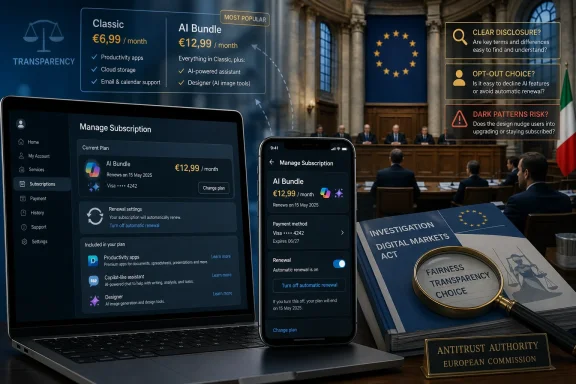
The existence of Classic-style plans without Copilot is central because it undermines any simplistic claim that the old product could not continue. If Microsoft can offer a version of Microsoft 365 without AI credits at the old or lower price, then the issue becomes how clearly that option was presented and how long it remained available.A limited-time alternative is not necessarily unlawful. Companies retire plans all the time. But when a limited-time alternative is the only way to avoid a price increase tied to a new feature, its visibility becomes crucial. If the customer has to start canceling to discover it, the company is not merely offering choice; it is rationing awareness.
This is where support documentation and renewal communication can diverge. A Microsoft support page may explain that existing subscribers can switch to plans without Copilot or AI credits. But a support page is not the same as a renewal notice that plainly says, in the main flow, “You can keep your current non-AI plan at the previous price by choosing this option.” Regulators care about the actual consumer journey, not just whether the information existed somewhere.
Microsoft’s challenge is that software companies often design account flows for conversion, not deliberation. The ideal business flow minimizes cancellation and maximizes upgrade acceptance. The ideal consumer-law flow maximizes comprehension. Those goals can coexist, but only if the company is willing to make the cheaper path visible even when it reduces revenue.
AI Credits Make the Bundle Harder to Understand
One reason this dispute is likely to resonate with ordinary users is that AI subscription value is inherently harder to evaluate than storage or app access. A terabyte of OneDrive storage is concrete. Word, Excel, and PowerPoint are concrete. AI credits are more abstract, especially when their usefulness depends on the user’s tasks, geography, age eligibility, app support, and Microsoft’s changing product limits.Microsoft’s consumer AI features do not behave like a single unlimited service. Copilot availability can vary by app. Some features require files to be stored in OneDrive. Age restrictions may disable AI functionality for some users. Family plans may include AI features that are available only to the subscription owner rather than every family member. Some apps may allow Copilot to be disabled, while others do not offer the same control.
That complexity strengthens the case for clearer communication. If a customer is paying more for AI, they need to know not just that AI exists but what kind of AI access they are actually buying. A family subscriber may reasonably assume that a family plan’s new AI features are shared broadly across the family. If the most valuable AI capabilities are limited to the owner, the perceived value changes.
This is why the phrase “Microsoft 365 now includes Copilot” can be true and still incomplete. It compresses a messy licensing and feature-access reality into a marketing sentence. For a voluntary upgrade, that might be tolerable. For a default renewal at a higher price, it becomes more problematic.
The Price Increase Is Also a Referendum on AI Value
Microsoft has spent years telling users that Copilot will transform productivity. The Microsoft 365 price increase forces a more specific question: transform it enough to justify a higher bill for everyone? The answer is not obvious.Generative AI is useful, but unevenly distributed in value. Writers, analysts, consultants, students, marketers, and office-heavy professionals may find frequent uses. Other subscribers may open Word a few times a month, store photos in OneDrive, and maintain the subscription mostly because Office compatibility is convenient. For them, AI is not a productivity revolution; it is a surcharge attached to software they already had.
This creates a pricing dilemma. If Microsoft sells Copilot separately, adoption is slower and users must make an explicit value judgment. If Microsoft bundles it into Microsoft 365, adoption numbers improve and AI becomes part of the default productivity experience. But bundling also transfers the cost of Microsoft’s AI strategy to users who may not want it.
The Italian investigation is therefore about more than disclosure. It is an early regulatory challenge to the assumption that AI value can be averaged across a customer base. Microsoft may believe the bundle is a better deal overall. Consumer law asks whether each subscriber had a fair chance to decide that for themselves.
The Renewal Email Is Now a Legal Document in Disguise
Subscription businesses often treat renewal notices as operational messages. They are transactional, templated, and optimized to satisfy formal notice requirements without inviting too much churn. In the AI era, that approach is dangerous.A renewal notice that raises the price because the product now includes AI is doing several things at once. It is announcing a price change. It is describing a product change. It is asking the user to accept a new value proposition. It may also be the user’s only practical opportunity to avoid being charged more. That makes clarity central, not cosmetic.
For Microsoft, the risk is magnified by scale. A small ambiguity multiplied across millions of subscribers becomes a major consumer issue. A buried option becomes a national enforcement matter. A confusing cancellation flow becomes evidence of aggressive commercial practice.
This is the lesson every subscription software vendor should take from the Italian probe. If a company adds AI and raises prices, it should assume regulators will examine the exact wording, timing, placement, and prominence of every choice offered to consumers. “We had a help article” will not be enough if the renewal path nudged users toward the more expensive plan.
The European Context Makes This More Than a Local Fight
Italy’s action comes in a region already skeptical of Big Tech’s ability to self-police. The European Union has the Digital Markets Act, aggressive privacy enforcement, consumer-protection coordination, and a long institutional memory of Microsoft cases. National authorities like AGCM can move on consumer issues even when Brussels handles broader competition architecture.That layered enforcement environment matters. Microsoft is not facing a single monolithic regulator; it is facing a network of institutions that can attack different parts of the same strategy. One authority may look at app-store rules, another at cloud interoperability, another at consumer subscriptions, another at AI transparency. The cumulative effect is to make “move fast and bundle” a riskier strategy.
Europe is also a particularly sensitive market for AI sovereignty and digital dependency. When a U.S. platform company raises productivity-suite prices to fund embedded AI, European consumers and policymakers may see more than a product update. They may see dependence deepening: local users paying more for tools controlled by a foreign cloud giant, with AI functionality governed by opaque product rules.
That does not mean the Italian case will become a sweeping anti-AI crusade. It probably will not. The narrower and more likely path is enforcement around notice, default settings, withdrawal rights, and clearer plan choice. But narrow enforcement can still change behavior if it forces Microsoft to redesign renewal flows across markets.
The Practical Advice Is Boring but Necessary
For users, the immediate lesson is not to panic-cancel Microsoft 365. It is to inspect the subscription page, renewal date, plan name, price, and available alternatives before the next charge. Microsoft’s plan names and AI entitlements have become fluid enough that relying on memory is a bad idea.For families, the most important detail is whether the person paying for the subscription is also the person who benefits from the AI features. If Copilot access is concentrated in the subscription owner’s account, a household may be paying for functionality that other family members cannot fully use. That does not make the plan worthless, but it changes the value calculation.
For IT professionals advising small businesses or executives, the consumer story is a useful warning about communications. Users are increasingly primed to see AI add-ons as forced upsells. If an organization adopts Microsoft 365 Copilot, it should explain who gets it, what data protections apply, what it costs, and which workflows actually justify the license. Otherwise, internal rollout can inherit the same trust problem Microsoft is facing externally.
For Microsoft, the practical path is also obvious: make the non-AI option visible, make renewal notices plain, and stop treating cancellation flows as the place where better choices are revealed. If Copilot is valuable, Microsoft should not need dark-pattern-adjacent design to sell it.
The Copilot Renewal Fight Leaves a Paper Trail
The Italian investigation is still an investigation, not a finding of liability. Microsoft may contest the regulator’s characterization, adjust its communications, offer commitments, or eventually face sanctions depending on how the process unfolds. But the core facts already give users and admins a concrete checklist.- Microsoft 365 consumer subscriptions have been materially reshaped by the addition of Copilot, Designer, and AI credits.
- Italy’s competition authority is investigating whether Microsoft adequately explained the price increase and the AI-related service changes.
- The regulator is also examining whether placing consumers by default into a more expensive plan improperly limited their freedom of choice.
- The controversy is not merely about price, but about whether a non-AI or lower-cost alternative was presented clearly enough at renewal.
- Windows users and IT administrators should treat AI bundle announcements as licensing events, not just feature updates.
- Microsoft’s broader AI strategy will face more resistance if customers conclude that Copilot adoption is being driven by inertia rather than demand.
That is precisely why the Italian probe matters. The AI boom will not be judged only by model benchmarks or keynote demos; it will be judged in account dashboards, billing emails, admin centers, and cancellation flows. If Microsoft wants Copilot to become the next layer of everyday computing, it has to prove that users are choosing it because it earns its place — not because the cheaper door was hidden behind the exit sign.
References
- Primary source: Italia Oggi
Published: 2026-06-26T06:18:12.139362
L’Antitrust avvia istruttoria sull’aumento del prezzo di abbonamento al servizio “Microsoft 365” - ItaliaOggi.it
La società non avrebbe evidenziato in modo adeguato che il servizio offerto in abbonamento è stato integrato dai servizi di intelligenza artificiale “Copilot” e “Designer” www.italiaoggi.it
- Official source: support.microsoft.com
Domande frequenti su Copilot negli abbonamenti a Microsoft 365 | Microsoft Support
Domande e risposte su Copilot e su come viene usata con un abbonamento Microsoft 365 Personal, Family e Premium.support.microsoft.com - Related coverage: teleborsa.ansa.it
- Related coverage: windowscentral.com
Australian watchdog sues Microsoft for misleading 2.7 million M365 users — deliberately hiding a cheaper Classic subscription plan without Copilot | Windows Central
Microsoft’s in hot water — Australia’s consumer watchdog claims it concealed a cheaper Microsoft 365 plan that retained all Classic features, excluding the Copilot AI integration.www.windowscentral.com - Related coverage: it.investing.com
Microsoft citata in giudizio dal regolatore della concorrenza australiano per Copilot e prezzi di 365 Da Investing.com
Microsoft citata in giudizio dal regolatore della concorrenza australiano per Copilot e prezzi di 365it.investing.com - Related coverage: antitrust-intelligence.com
Italy Opens Apple Cloud Probe under DMA – Antitrust Intelligence
Italy’s Competition and Markets Authority (AGCM) has opened a formal investigation into Apple Inc., Apple Distribution International Ltd., and Apple Italia S.r.l. to assess whether the tech giant is violating its strict interoperability obligations under the European Union’s Digital Markets Act...antitrust-intelligence.com
- Related coverage: siliconangle.com
Australian regulator sues Microsoft over Microsoft 365 Copilot pricing notifications - SiliconANGLE
Australian regulator sues Microsoft over Microsoft 365 Copilot pricing notifications - SiliconANGLE siliconangle.com
- Related coverage: investing.com
Italy closes antitrust probes into AI firms after commitments on ’hallucination’ risks By Reuters
Italy closes antitrust probes into AI firms after commitments on ’hallucination’ riskswww.investing.com - Related coverage: marketscreener.com
Italy regulator probes Microsoft over 'Microsoft 365' price hike
Italy's antitrust authority said on Friday it had opened an investigation into Microsoft over alleged unfair commercial practices linked to the price hike of its Microsoft 365 subscription. ...www.marketscreener.com
- Official source: learn.microsoft.com
Domande frequenti su Microsoft 365 Copilot Chat | Microsoft Learn
Vedere domande e risposte comuni su Microsoft 365 Copilot Chat.learn.microsoft.com - Related coverage: bakermckenzie.com
- Official source: microsoft.com
Copilot is now included in Microsoft 365 Personal and Family | Microsoft 365 Blog
Get access to Copilot with your Microsoft 365 Personal and Family subscription. Learn more.www.microsoft.com - Related coverage: tomshardware.com
Microsoft 365 sees 43% price hike thanks to Copilot — existing customers safe until renewal | Tom's Hardware
Personal plans now cost $9.99/mo or $99.99/yr, up from $6.99/mo or $69.99/yrwww.tomshardware.com - Related coverage: techspot.com
Microsoft 365 Personal and Family plans now include AI, with a $3 monthly price hike | TechSpot
Microsoft 365 Personal subscriptions will go from $7 monthly and $70 annually to $10 and $100, respectively. Family subscriptions will also rise from $10 a month and...www.techspot.com - Related coverage: howtogeek.com
Microsoft 365 Is Going Up in Price, and It’s Because of AI
You have some other options, though. www.howtogeek.com
- Related coverage: moneysavingexpert.com
Microsoft 365 subscriptions to rise – how to beat the hike
If you're a Microsoft 365 subscriber paying for Excel, OneNote, PowerPoint and Word, check if you have auto-renewal turned on, as your price is set to rise by up to £30 a year if so. But we've a way to beat the hike, at least for now. Here's how.www.moneysavingexpert.com
- Related coverage: pureinfotech.com
Microsoft 365 Personal and Family now cost more – The 2025 price increase explained - Pureinfotech
Microsoft 365 Family price increased to $129.99/y or $12.99/m and the Personal plan now costs $99.99/y and $9.99/m because new Copilot addon. pureinfotech.com
- Related coverage: dir.md

Compare All Microsoft 365 Products – Plans & Pricing for Personal & Family
Compare Microsoft 365 subscription plans — Personal, Family, Premium — with pricing, included apps like Word, Excel, OneDrive, Teams and Copilot AI features. See differences between plans and choose what suits you best.
dir.md
- Official source: news.microsoft.com
- Related coverage: techradar.com
Microsoft apologizes to 365 users over confusing software tiers | TechRadar
Australian customers will get a partial refundwww.techradar.com - Related coverage: apacs.ingrammicro.com