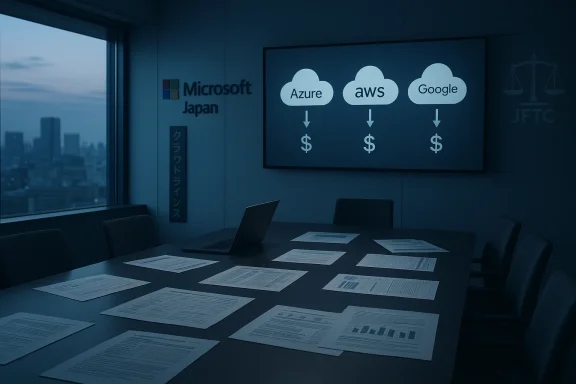
Japan’s competition enforcers have executed an on-site inspection of Microsoft’s Japanese offices after local media and international reporting said the Japan Fair Trade Commission (JFTC) is investigating whether Microsoft improperly limited customers’ ability to run Microsoft software on rival cloud platforms such as Amazon Web Services (AWS) and Google Cloud. The action—reported by major outlets citing the Nikkei and Reuters—centers on allegations that Microsoft used contractual or licensing practices to favor its own Azure cloud and thereby impede competition, including claims (still unproven) that Windows and Microsoft 365 were being restricted or made uneconomical to run on non-Azure infrastructure. Microsoft Japan had not publicly provided a substantive response at the time of initial reports; the JFTC’s inspection signals the regulator’s willingness to treat cloud licensing and platform behavior as potential antitrust issues in Japan’s fast-evolving digital economy.
Japan’s antitrust authority, the Japan Fair Trade Commission, has been visibly ramping up enforcement in digital markets since 2023–2025, moving from investigations and commitments to more forceful measures in some cases. The JFTC’s tools include on-site inspections (commonly called “dawn raids”), document production orders, interviews, and the power to issue administrative orders such as cease-and-desist directives and surcharge payments. In 2024–2025 the agency took high-profile action against other major technology companies and has signaled particular focus on platform conduct, bundling, and exclusionary contractual terms.
Microsoft’s presence in Japan is substantial: the company provides operating systems, server and database products, productivity suites, collaboration tools, and its Azure cloud platform to enterprises, public-sector organizations, and technology partners. That breadth of offerings creates complex licensing regimes—some of which are intentionally Azure-optimized—that intersect with global cloud operators and Japanese cloud service vendors. The JFTC’s inspection, therefore, comes at the intersection of regulatory scrutiny of platform dominance and the highly technical, contract-driven world of enterprise software licensing.
There are several reasons the JFTC may treat cloud licensing as a competition priority:
If the JFTC’s inquiry uncovers evidence that licensing practices deliberately prevented customers from using rival cloud services or inflated costs to the point of distortion, the consequences could be material for Microsoft, for its competitors, and for enterprise customers. Even if the inquiry results in a negotiated remedy or clearer guidance rather than punitive measures, the episode will likely force industry participants to clarify and, in some cases, simplify licensing contracts that today confuse customers and may inadvertently restrict choice.
For companies and IT leaders, the immediate takeaway is simple: assume licensing terms can change as regulators respond to market realities. Audit entitlements, model costs across platforms, and build contractual safeguards that preserve mobility. For regulators, the challenge will be to balance protecting competitive choice without undercutting legitimate product differentiation and innovation that cloud platforms deliver.
The JFTC’s inspection is not an automatic presumption of guilt; it is the beginning of an evidentiary process. But it is also a clear signal that Japan will actively enforce competition rules in cloud markets—a signal that global tech companies, local partners, and enterprise customers should heed.
Source: breakingthenews.net Japan's antitrust watchdog raids Microsoft offices
 Background and overview
Japan’s antitrust authority, the Japan Fair Trade Commission, has been visibly ramping up enforcement in digital markets since 2023–2025, moving from investigations and commitments to more forceful measures in some cases. The JFTC’s tools include on-site inspections (commonly called “dawn raids”), document production orders, interviews, and the power to issue administrative orders such as cease-and-desist directives and surcharge payments. In 2024–2025 the agency took high-profile action against other major technology companies and has signaled particular focus on platform conduct, bundling, and exclusionary contractual terms.Microsoft’s presence in Japan is substantial: the company provides operating systems, server and database products, productivity suites, collaboration tools, and its Azure cloud platform to enterprises, public-sector organizations, and technology partners. That breadth of offerings creates complex licensing regimes—some of which are intentionally Azure-optimized—that intersect with global cloud operators and Japanese cloud service vendors. The JFTC’s inspection, therefore, comes at the intersection of regulatory scrutiny of platform dominance and the highly technical, contract-driven world of enterprise software licensing.
What the inspection reportedly targets
The basic allegation
Initial reports indicate the JFTC is inspecting Microsoft Japan’s offices “on suspicion of breaching the Antimonopoly Act,” with a particular focus on whether Microsoft imposed restrictions that prevented customers from running Microsoft software on rival clouds or effectively penalized such use. The widely reported allegation can be broken down into two linked claims:- That Microsoft put contractual or licensing conditions in place that discourage or prevent customers from using Windows, Microsoft 365, or other Microsoft products on non-Azure clouds (for example AWS or Google Cloud).
- That Microsoft favored Azure either by making rival-cloud deployments prohibitively expensive or by withholding rights that make migration or multi-cloud use impractical—thereby interfering with competition.
How licensing can look like restriction in practice
To a regulator or a customer, certain licensing mechanics can have exclusionary effects even if they are framed as commercial or technical policy:- Azure-specific discounts and benefits: Microsoft’s licensing programs often include Azure-native pricing constructs (for example, programs that reduce license fees or offer favorable “hybrid” rights when workloads run on Azure). Those benefits can create a pricing differential that makes Azure materially cheaper for customers migrating Microsoft workloads, effectively steering demand.
- Bring-Your-Own-License (BYOL) and mobility rules: Microsoft historically has allowed some server software (e.g., SQL Server) to be moved to third-party clouds via “license mobility,” but Windows Server and certain rights have been treated differently. Rules that disallow certain BYOL patterns on third-party clouds—unless conditions are met—can raise the hurdle for customers to move workloads.
- Virtualization and VDI use rights: Productivity suites and client virtualization scenarios (running Microsoft 365 or Office apps inside a cloud-hosted virtual desktop) are governed by license terms that can be complex. If Microsoft’s terms make hosted desktop deployments on non-Azure providers more expensive or administratively cumbersome, that can functionally limit customers’ choices.
The regulatory context: why Japan is watching cloud licensing
Japan’s competition authority has been increasingly assertive toward big technology platforms. In recent years the JFTC has investigated and, in some cases, ordered changes to the behavior of major international tech firms for practices that favor their own services or impose restrictive terms on business partners. The agency’s remedies have ranged from commitments to formal cease-and-desist orders.There are several reasons the JFTC may treat cloud licensing as a competition priority:
- Market structure and tipping: Cloud markets exhibit network effects and economies of scale that encourage market concentration. When a major software vendor both supplies the software and operates a leading cloud platform, regulators worry about self-preferencing and practices that lock customers into the vendor’s cloud.
- National policy and digital sovereignty: Japan has emphasized the need for competitive and resilient domestic cloud ecosystems, particularly for public-sector and critical-industry workloads. Practices that channel demand exclusively to one foreign cloud provider (or to software vendors’ own platform) can attract scrutiny.
- Consumer and business harm: If licensing practices materially raise costs, reduce interoperability, or impede switching, customers suffer higher bills and reduced bargaining power—core concerns of antitrust enforcement.
Technical reality: Microsoft licensing mechanics that matter here
To assess the JFTC’s line of inquiry, it helps to understand the principal licensing mechanisms at stake and how they differ across clouds.- Azure Hybrid Benefit (AHB): A program that lets organizations apply existing Windows Server and SQL Server licenses to Azure workloads to reduce costs. AHB is specifically targeted at Azure and provides clear financial incentives for migration to Microsoft’s cloud.
- License Mobility through Software Assurance (SA): A benefit allowing certain server application licenses (for example, SQL Server, Exchange) to be reassigned to third-party cloud providers that meet Microsoft’s authorized mobility criteria. Windows Server historically has not been freely mobile to shared tenancy environments of other providers.
- Flexible Virtualization Benefit and Authorized Outsourcer models: Microsoft has introduced and modified programs to make certain licenses usable on third-party hosts under specified conditions—but these programs often exclude what Microsoft calls “Listed Providers” (commonly AWS, Google, Alibaba) or require dedicated hardware or additional steps for BYOL to apply.
- Microsoft 365 and hosted VDI rights: The right to run Office applications in virtualized multi-user environments has evolved. Microsoft 365 licensing for hosted virtual desktops may be available on some third-party clouds but subject to platform-specific clauses and proof of compliance.
- Additional licensing costs versus running the same workloads on Azure.
- Administrative hurdles (notifications, proof of entitlement, limited eligibility).
- Functional limitations for certain features or performance optimizations that Microsoft reserves for native Azure integrations.
Legal standards and what the JFTC is likely to examine
Antitrust enforcement in exclusionary conduct cases typically evaluates three core elements: market power, conduct, and anticompetitive effect.- Market power: Microsoft’s dominance in client and server operating systems, and its strong position in office productivity suites, are established facts in many jurisdictions. The JFTC may examine the extent to which that dominance gives Microsoft the ability to influence downstream cloud-market competition.
- Conduct: Investigators will review contracts, standard product terms, internal communications, pricing schedules, and program rules to determine whether Microsoft’s licensing terms were formulated and applied in ways that favored Azure or unlawfully restricted rivals.
- Effect: The regulator will investigate whether customers were actually prevented from reasonably using rival cloud services, faced inflated costs, or were otherwise harmed, and whether rivals’ market opportunities were materially impeded.
Possible outcomes and remedies
The JFTC’s range of remedies includes:- Cease-and-desist orders: Mandating that Microsoft stop the offending conduct or modify contractual terms.
- Administrative commitments: Negotiated changes that Microsoft may offer to avoid formal orders, as other tech companies have done with the JFTC elsewhere.
- Surcharge payments or fines: For certain violations, monetary penalties are possible (the JFTC can order surcharges for cartel-type behavior; for unfair trade practices the main tools tend to be corrective orders).
- Referral for criminal proceedings: In cases involving collusion or fraud, prosecutors may be involved, though that is less common in purely licensing disputes.
- Broader regulatory or policy follow-ups: The JFTC could recommend legislative clarifications or publish guidelines affecting how cloud licensing must be structured to preserve competition.
What this means for customers, cloud providers, and partners
The JFTC’s inspection—and the broader spotlight on cloud licensing—has immediate and practical implications for multiple stakeholders.- For enterprise customers: Expect short-term uncertainty. Organizations planning multi-cloud strategies should:
- Audit existing Microsoft licensing entitlements and how they apply to non-Azure environments.
- Re-run cost models for running Microsoft workloads on Azure versus AWS/GCP, explicitly accounting for BYOL eligibility, AHB benefits, and any required dedicated-host charges.
- Seek contractual flexibility where possible, adding termination or migration terms to limit vendor lock-in risk.
- For AWS, Google Cloud, and other cloud providers: The investigation may highlight competitive frictions they have long argued exist. If regulators force changes, rivals could see improved parity on licensing costs or clearer mobility rights—making it easier to win Microsoft-centric workloads.
- For Microsoft partners and system integrators in Japan: The episode raises questions about recommended architectures. Partners should be prepared to:
- Update migration plans and customer advisories based on any regulatory changes.
- Develop migration tools and licensing advisory services to help customers navigate rights across clouds.
- For the broader market: Any regulatory finding that forces greater portability or parity could accelerate true multi-cloud deployments. Conversely, prolonged disputes create uncertainty that can slow migrations and raise procurement complexity.
Risks, strengths, and broader strategic considerations
Strengths in Microsoft’s position
- Technical and product justifications exist: Microsoft can argue many licensing differences reflect real technical integration benefits (e.g., platform-specific performance, security telemetry, or unique Azure services) rather than anticompetitive intent.
- Contractual clarity and customer choice: Microsoft may point to a wide array of licensing options and migration programs as evidence it is not unlawfully excluding rivals.
- Global posture on cloud: Microsoft has made substantial investments in Azure and in-country infrastructure and commercial programs in Japan; the company can argue its business model rewards integration and service-level assurances that benefit customers.
Regulatory and reputational risks
- Regulatory precedent: A JFTC finding could embolden other jurisdictions to press Microsoft to change licensing terms, including the EU, UK, or U.S. agencies already scrutinizing platform behavior.
- Reputational cost: Allegations that Microsoft deliberately hindered customers’ ability to choose cloud providers strike at corporate narratives about openness and customer choice.
- Commercial exposure: If changes are ordered, Microsoft may need to adapt licensing constructs globally, which could reduce Azure’s differential advantage and affect revenue mix.
Risks for customers if nothing changes
- Vendor lock-in: Unclear or expensive BYOL rules can tilt customers toward Azure even when multi-cloud would better serve resilience or cost objectives.
- Hidden migration costs: Customers who later decide to switch may discover migration is far costlier than projected if license mobility is limited.
- Weak bargaining position: Enterprises that lack strong procurement leverage may be forced into less favorable deals.
What to watch next
- JFTC communications: Watch for any formal statements from the JFTC clarifying the scope of the inspection and whether it will proceed to a formal investigative phase or issue orders.
- Microsoft’s response: Expect a corporate statement—either contesting the characterization, explaining licensing policy rationale, or offering cooperation and additional transparency.
- Customer and partner reactions: Large enterprise customers and prime integrators in Japan may publicly seek clarifications; their feedback could influence the regulator.
- International spillover: Other competition authorities have recently coordinated on digital-platform probes; any outcome that alters Microsoft’s licensing might prompt cross-border interest.
- Contractual and product adjustments: If the JFTC presses for changes, Microsoft may rapidly adjust Japan-specific commercial programs, with potential global rollouts depending on the remedy.
Practical guidance for IT decision makers now
- Conduct a rapid licensing and architecture review focused on:
- Which Microsoft products you run, and whether they rely on license mobility or specialized Azure benefits.
- The exact costs and contractual commitments tying you to Azure versus alternative providers.
- Document migration and contingency plans that account for potential regulatory changes to licensing that could either help or complicate multi-cloud strategies.
- Engage procurement and legal teams early: secure termination, audit, and migration rights to limit future vendor-lock concerns.
- Ask vendors for clear, written explanations of how licensing differences are computed and what options exist for parity or exceptions.
Closing analysis: why this matters beyond Japan
The JFTC’s on-site inspection of Microsoft Japan underscores a larger regulatory trend: competition authorities are turning from abstract antitrust theory into practical enforcement steps addressing how licensing and contractual mechanics shape digital competition. Cloud computing is not only an infrastructure story; it is increasingly a competition policy battleground where software vendors’ licensing decisions can decide winners and losers in the global cloud market.If the JFTC’s inquiry uncovers evidence that licensing practices deliberately prevented customers from using rival cloud services or inflated costs to the point of distortion, the consequences could be material for Microsoft, for its competitors, and for enterprise customers. Even if the inquiry results in a negotiated remedy or clearer guidance rather than punitive measures, the episode will likely force industry participants to clarify and, in some cases, simplify licensing contracts that today confuse customers and may inadvertently restrict choice.
For companies and IT leaders, the immediate takeaway is simple: assume licensing terms can change as regulators respond to market realities. Audit entitlements, model costs across platforms, and build contractual safeguards that preserve mobility. For regulators, the challenge will be to balance protecting competitive choice without undercutting legitimate product differentiation and innovation that cloud platforms deliver.
The JFTC’s inspection is not an automatic presumption of guilt; it is the beginning of an evidentiary process. But it is also a clear signal that Japan will actively enforce competition rules in cloud markets—a signal that global tech companies, local partners, and enterprise customers should heed.
Source: breakingthenews.net Japan's antitrust watchdog raids Microsoft offices