

Jensen Huang’s “five-layer cake” frames artificial intelligence in 2026 as an industrial stack built from energy, chips, cloud infrastructure, models, and applications, with Nvidia’s CEO arguing that each layer must expand together for AI to become economically useful. That metaphor matters because it pulls the AI story away from chatbot demos and back toward steel, power, land, capital budgets, supply chains, and labor markets. The argument is simple: AI is not merely software eating the world; it is software demanding that the world be rebuilt underneath it. For Windows users, enterprise IT teams, developers, and investors, the cake metaphor is useful precisely because it shows where the bottlenecks, winners, and disappointments are likely to appear.
The first phase of the generative AI boom was easy to narrate. ChatGPT arrived, image generators improved, copilots appeared in development tools and office suites, and every executive deck suddenly contained a slide about productivity. It looked, at least from the user’s side of the screen, like a software revolution.
Huang’s five-layer cake is a rebuttal to that tidy version of events. It says the application layer is only the visible frosting. Beneath it sits a capital-intensive system that looks more like railroads, electrification, telecom, or cloud computing than a conventional app boom.
That distinction matters because software cycles can scale with comparatively little marginal cost once distribution is solved. AI, by contrast, keeps running into physical constraints. The model may live in a browser tab, but the inference request behind it consumes electricity, occupies accelerator capacity, moves through a data center network, and depends on a global chain of semiconductor manufacturing.
This is why the AI market can feel simultaneously magical and brutally industrial. A user asks a chatbot to summarize a document and gets an answer in seconds. A hyperscaler, meanwhile, is trying to secure power contracts, GPUs, memory, cooling capacity, fiber, substations, and enough technicians to keep the whole thing from melting.
The “cake” metaphor is not perfect, but it is clarifying. Cakes imply layers, dependency, and sequence. If the lower layers collapse, the decorative top layer does not matter.
That ordering is a warning to a technology industry that has spent decades treating compute as an abstraction. Cloud computing trained customers to think in virtual machines, containers, regions, and APIs. AI is forcing everyone to remember that all of those abstractions terminate in power-hungry facilities connected to real electrical grids.
The scale of modern AI workloads makes that impossible to ignore. Training frontier models requires immense bursts of compute. Serving those models to millions of users requires persistent, distributed inference capacity. As AI moves from novelty to workflow infrastructure, the energy problem becomes less about a few spectacular training runs and more about the always-on economics of answering billions of requests.
For enterprise IT, this is not an academic issue. The cost of AI services will eventually reflect the cost of energy, data center construction, cooling, and hardware depreciation. If those inputs become scarce or expensive, AI pricing will harden. The dreamy assumption that every employee will have unlimited model access at commodity rates may not survive contact with utility queues and constrained accelerator supply.
This is also where the public debate often gets stuck in the wrong binary. AI is not simply “good” or “bad” for energy systems. It is a new source of demand arriving at a moment when grids are already being asked to absorb electrification, reshoring, data center growth, and climate-driven resilience investments. Whether AI becomes a catalyst for cleaner infrastructure or a stressor on aging grids depends on planning, regulation, geography, and the willingness of hyperscalers to pay for more than marketing-friendly offsets.
Microsoft, Amazon, Google, Meta, and their peers increasingly have to behave like infrastructure developers, not just software companies. They must think about generation, transmission, backup power, water, heat, and local political resistance. The energy layer turns AI from a product roadmap into a zoning-board problem.
For WindowsForum’s audience, that should sound familiar. Every sysadmin knows the thing that fails is often not the glamorous component. It is the power supply, the cooling path, the cable, the UPS battery, the neglected dependency nobody wanted to budget for. AI at planetary scale is discovering the same lesson.
The chip layer is not just about GPUs, though GPUs remain the headline product. It includes high-bandwidth memory, advanced packaging, networking, interconnects, foundry capacity, and the software stack that lets developers actually use the silicon. Modern AI accelerators are less like isolated processors and more like nodes in a tightly engineered computational fabric.
That is why the market has rewarded companies across the semiconductor chain. Nvidia sells the accelerators and much of the surrounding platform. TSMC manufactures leading-edge chips. Samsung and SK Hynix compete in memory. Broadcom, AMD, Intel, Micron, and others sit in adjacent or competing positions. Each has a different exposure to the AI buildout, but all are tied to the same basic question: how much useful compute can the world produce, and at what cost?
The chip layer also explains why AI economics are so different from ordinary cloud economics. A traditional web service can often scale across general-purpose CPUs. AI workloads, especially at the high end, depend on specialized accelerators that are expensive, supply-constrained, and rapidly depreciating. A model provider may talk like a software company, but its gross margins are haunted by hardware utilization rates.
There is also a geopolitical dimension that the cake metaphor politely understates. Chips are not produced in a frictionless global market. Export controls, foundry concentration, packaging bottlenecks, and national industrial policies all shape who gets access to the best compute. If AI becomes a strategic technology for companies and countries, then the chip layer becomes a strategic chokepoint.
This is one reason Huang’s metaphor resonates beyond Nvidia’s investor base. It gives policymakers a simple picture of where sovereignty anxieties come from. A country that wants AI capability cannot merely fund a lab or license a chatbot. It needs access to power, chips, data centers, model talent, and application ecosystems. Miss one layer and the stack becomes dependent on someone else.
The irony, of course, is that Nvidia benefits from making this argument. The more AI is understood as infrastructure rather than featureware, the more valuable Nvidia’s position appears. But vendor self-interest does not make the diagnosis wrong. Sometimes the company selling shovels is still correctly describing the gold rush.
That factory metaphor marks a shift in how the tech industry talks about data centers. For years, cloud regions were discussed as elastic pools of compute. Customers did not need to know much about what happened inside. AI makes the internals newly important because performance depends on dense clusters, fast networking, cooling design, accelerator availability, and software orchestration.
This is why hyperscaler capital expenditure has become one of the most closely watched indicators in technology. Amazon, Microsoft, Alphabet, and Meta are spending at levels that would have sounded absurd before the generative AI boom. The money is not going only into chips. It is going into land, buildings, networking, power systems, cooling, and long-lived infrastructure bets whose payoff depends on sustained demand for AI services.
For IT leaders, this creates a new kind of platform dependency. The first cloud era asked enterprises to trust hyperscalers with compute elasticity, availability, and security. The AI era asks them to trust hyperscalers with access to intelligence capacity. If the best models, fastest inference, and most attractive enterprise integrations are tied to a handful of data center operators, then AI adoption may deepen the same concentration dynamics that cloud computing already created.
Microsoft’s role is especially important for the Windows ecosystem. Azure is not merely a place to run workloads; it is the substrate beneath Microsoft’s AI ambitions across Windows, Microsoft 365, GitHub, Dynamics, security tooling, and developer platforms. When Microsoft talks about Copilot, it is also implicitly talking about Azure capacity, model partnerships, and the economics of running AI inside products with enormous installed bases.
That is both powerful and risky. Microsoft can distribute AI through software that enterprises already use. But it also has to balance user expectations, privacy concerns, latency, regulatory obligations, and the hard cost of serving AI features at scale. A Copilot button is easy to add to an interface. Making that button economically sustainable for hundreds of millions of users is the infrastructure problem.
The data center layer is therefore where AI hype becomes balance-sheet reality. If demand continues to grow, the buildout looks visionary. If adoption disappoints, the same spending becomes overcapacity with better branding.
But the five-layer cake puts models in their place. They are essential, but they are not the entire stack. A model without affordable compute is a research artifact. A model without distribution is a demo. A model without useful applications is a cost center.
This is an uncomfortable truth for model companies. Frontier AI labs have extraordinary talent and cultural influence, but they sit in a financially demanding layer. Training costs are high, inference costs are persistent, and competition pushes capability improvements into the market quickly. Unless a model provider owns distribution or infrastructure, it risks becoming dependent on partners that do.
That dependency is visible across the industry. Model companies need cloud providers for compute. Cloud providers need model companies for differentiated services. Chipmakers need both to keep demand rising. Application vendors need models but do not want to be trapped by any single one. The AI stack is interconnected, but it is also full of negotiating leverage.
For enterprise buyers, the model layer is where confusion is highest. Vendor claims arrive faster than procurement teams can test them. A model that performs beautifully in a demo may fail on messy internal data. A tool that promises autonomous workflow execution may still require careful supervision. The gap between benchmark intelligence and operational reliability remains one of the defining problems of the AI market.
This is why many companies are moving cautiously despite executive enthusiasm. They are piloting AI in customer support, coding, document analysis, security operations, compliance review, sales enablement, and data analysis. But production deployment requires governance, identity controls, logging, access boundaries, data-loss prevention, and clear accountability when the system gets something wrong.
Models may be the glamour layer, but trust is the deployment layer. Without it, enterprises will keep AI close to the edges of decision-making rather than at the center.
It is also where the largest economic claims must eventually be proven. Productivity does not come from a model existing. It comes from people and organizations changing how work gets done. That means redesigning processes, retraining staff, integrating systems, and deciding which tasks should be automated, augmented, audited, or left alone.
The early evidence is mixed in the way serious technology transitions usually are. Developers can use AI assistants to generate boilerplate, explain unfamiliar code, and speed up debugging. Office workers can draft, summarize, and search more quickly. Analysts can explore data with less friction. Security teams can triage alerts and correlate signals. But every gain has a shadow: hallucinated output, overconfident summaries, brittle agents, data exposure risk, and the danger of employees trusting polished prose more than verified facts.
This is particularly relevant in Windows-heavy organizations because AI is being woven into the tools employees already use. When AI lives in the operating system, productivity suite, browser, endpoint security platform, and collaboration stack, adoption may happen by default rather than through a clean purchasing decision. That convenience is exactly why administrators need policy, telemetry, and governance from day one.
The application layer is also where software companies may feel the squeeze. If AI agents can automate workflows across multiple systems, customers may question why they need so many separate SaaS subscriptions. A company that once paid for specialized tools to handle narrow tasks may instead ask whether a general AI interface can perform enough of them inside an existing platform.
That threat should not be overstated. Enterprise software survives because of workflow depth, compliance features, auditability, integrations, and institutional inertia. But the pressure is real. AI turns the user interface into a contested surface. If the assistant becomes the place where work begins, the underlying applications risk becoming back-end systems rather than daily destinations.
This is the layer where the AI revolution either becomes durable or disappoints. Infrastructure spending can create capacity. Models can create capability. Applications must create habits, savings, revenue, or quality improvements. If they do not, the cake is expensive architecture with no paying party.
Huang’s five-layer framing helps explain why. The AI buildout creates demand for energy engineers, chip designers, data center technicians, electricians, construction workers, fiber specialists, cooling experts, facilities managers, security personnel, AI researchers, data engineers, software developers, compliance specialists, and product managers. At the same time, AI applications may reduce demand for some routine cognitive tasks in customer service, research, finance, legal operations, accounting, marketing, and software maintenance.
That does not mean every exposed occupation disappears. It means the bundle of tasks inside those occupations changes. A junior analyst may spend less time gathering background material and more time validating machine-generated synthesis. A developer may write less boilerplate but review more AI-produced code. A help desk worker may handle fewer password resets but more escalations from automated support flows.
The risk is that companies will treat AI as a headcount-cutting tool before they understand the operational consequences. Removing people from a process is easy on a spreadsheet. Replacing their judgment, exception handling, institutional knowledge, and informal coordination is harder. Many organizations will learn that automation changes where human work appears rather than eliminating it entirely.
There is also a training problem. If AI handles entry-level tasks, how do workers gain the experience needed for senior roles? The technology industry already struggles with apprenticeship models. AI could make that worse by automating the very work that teaches newcomers how systems behave.
For IT professionals, the sensible response is neither panic nor complacency. The durable skills will be the ones that combine technical fluency with operational judgment: understanding systems, validating outputs, securing workflows, managing identity and data access, and translating business needs into reliable automation. The person who can supervise AI well may become more valuable than the person who merely uses it casually.
A narrative is not a minor asset. In a market this large and uncertain, the company that supplies the dominant mental model can influence how investors, customers, and governments allocate capital. If AI is a five-layer industrial system, Nvidia is not merely selling GPUs into a temporary demand spike. It is positioned as a central supplier to a multi-decade infrastructure buildout.
That framing helps explain Nvidia’s interest in companies across the AI value chain. Investments and partnerships with model providers, infrastructure companies, telecom players, optical and networking firms, and design software vendors all make more sense if the goal is to accelerate the entire stack. Nvidia needs the layers above and below it to succeed because accelerator demand depends on the health of the whole system.
But the map also contains a risk for Nvidia. The more valuable the chip layer becomes, the more every major customer has an incentive to reduce dependency. Hyperscalers are designing custom silicon. AMD is competing aggressively. Governments want domestic capacity. Customers want multiple suppliers. Even a dominant company can face pressure when its margins become someone else’s strategic problem.
There is a second risk: if AI applications fail to produce enough revenue, the infrastructure cycle could slow. Nvidia’s customers are making giant bets on future demand. If enterprises adopt AI more slowly than expected, if inference economics remain difficult, or if model improvements become less commercially meaningful, the spending curve could bend.
That is not a prediction of collapse. It is a reminder that infrastructure booms are judged after utilization arrives. Railroads, fiber networks, cloud regions, and data centers can be both transformative and overbuilt at different points in the cycle. AI may follow the same pattern.
This has practical consequences. Administrators will need to decide which AI features are enabled, which data they can access, which logs are retained, which users are licensed, and which workflows require human review. The old question “Can this application run on our PCs?” becomes “What can this assistant see, generate, remember, and act upon?”
Security teams will have to think beyond traditional malware and phishing. AI expands the attack surface through prompt injection, data leakage, malicious document content, model-assisted social engineering, and automation mistakes at scale. If an AI assistant can summarize mail, access files, query systems, or trigger workflows, then controlling its permissions becomes a core security task.
Developers face a parallel shift. AI coding assistants can speed up work, but they also introduce questions about provenance, license risk, insecure patterns, dependency choices, and review discipline. The productivity gain is real only if organizations adapt their development process around verification. AI-generated code that nobody understands is technical debt with a cheerful autocomplete interface.
The Windows endpoint itself also becomes part of the AI distribution story. Local NPUs, hybrid inference, cloud-connected assistants, and privacy-sensitive workloads will create a new division of labor between device and data center. Some AI tasks will run locally for latency, cost, or privacy reasons. Others will require cloud-scale models. The user may not care where the answer comes from, but IT departments certainly will.
This is where Microsoft has an advantage and a burden. It controls enough of the enterprise stack to make AI feel seamless. It also controls enough of the enterprise stack that mistakes will be highly visible.
In the early buildout, chip suppliers and infrastructure providers can benefit before end-user applications fully mature. Customers have to buy capacity in anticipation of demand. That is why the market has rewarded companies tied to compute supply. The picks-and-shovels trade works when everyone is racing to build.
Over time, however, investors will look for proof that applications generate enough revenue or savings to justify the spending beneath them. If AI becomes embedded in existing software bundles, some value may accrue to platform incumbents. If specialized vertical applications solve high-value problems, startups and domain software firms may capture more. If models commoditize, infrastructure and distribution may matter more than raw capability.
There is also a timing mismatch. Infrastructure must be funded upfront. Productivity gains arrive unevenly, department by department, workflow by workflow. A data center can be announced in a quarter. Organizational transformation takes years.
This mismatch is why the market periodically swings between euphoria and skepticism. Both instincts have merit. The technology is powerful, and the spending is enormous. The productivity opportunity is real, and the monetization questions are unresolved. AI can be a genuine platform shift and still contain pockets of overinvestment.
The dot-com analogy is tempting but incomplete. The internet bubble included waste and fraud, but the internet also became the economy’s connective tissue. Cloud computing required years of investment before its most profitable forms emerged. AI may likewise produce both spectacular winners and embarrassing write-downs.
For enterprise buyers, the lesson is to avoid both vendor-led urgency and reflexive denial. AI should be evaluated through use cases, controls, costs, and measurable outcomes. The right question is not “Do we have an AI strategy?” It is whether specific AI deployments improve specific work enough to justify their operational and security implications.
For WindowsForum readers, the useful interpretation is practical rather than devotional. Huang is talking his book, as every CEO does, but he is also describing the system IT will have to manage. The future of AI will be decided as much by power contracts, admin policies, procurement discipline, and security architecture as by benchmark scores.
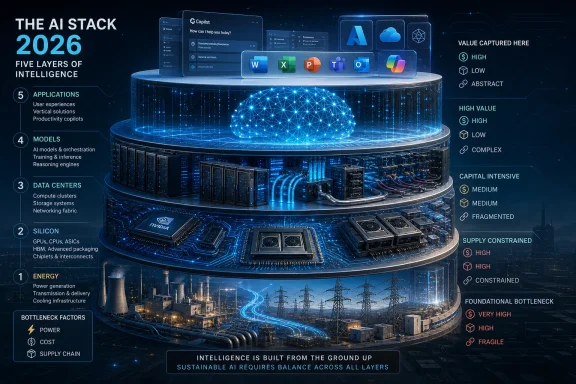 The AI Boom Has Stopped Looking Like a Software Cycle
The first phase of the generative AI boom was easy to narrate. ChatGPT arrived, image generators improved, copilots appeared in development tools and office suites, and every executive deck suddenly contained a slide about productivity. It looked, at least from the user’s side of the screen, like a software revolution.Huang’s five-layer cake is a rebuttal to that tidy version of events. It says the application layer is only the visible frosting. Beneath it sits a capital-intensive system that looks more like railroads, electrification, telecom, or cloud computing than a conventional app boom.
That distinction matters because software cycles can scale with comparatively little marginal cost once distribution is solved. AI, by contrast, keeps running into physical constraints. The model may live in a browser tab, but the inference request behind it consumes electricity, occupies accelerator capacity, moves through a data center network, and depends on a global chain of semiconductor manufacturing.
This is why the AI market can feel simultaneously magical and brutally industrial. A user asks a chatbot to summarize a document and gets an answer in seconds. A hyperscaler, meanwhile, is trying to secure power contracts, GPUs, memory, cooling capacity, fiber, substations, and enough technicians to keep the whole thing from melting.
The “cake” metaphor is not perfect, but it is clarifying. Cakes imply layers, dependency, and sequence. If the lower layers collapse, the decorative top layer does not matter.
Energy Is the Layer the Software Industry Tried Not to Notice
The most provocative part of Huang’s framing is that energy comes first. Not models. Not data. Not clever prompting. Energy.That ordering is a warning to a technology industry that has spent decades treating compute as an abstraction. Cloud computing trained customers to think in virtual machines, containers, regions, and APIs. AI is forcing everyone to remember that all of those abstractions terminate in power-hungry facilities connected to real electrical grids.
The scale of modern AI workloads makes that impossible to ignore. Training frontier models requires immense bursts of compute. Serving those models to millions of users requires persistent, distributed inference capacity. As AI moves from novelty to workflow infrastructure, the energy problem becomes less about a few spectacular training runs and more about the always-on economics of answering billions of requests.
For enterprise IT, this is not an academic issue. The cost of AI services will eventually reflect the cost of energy, data center construction, cooling, and hardware depreciation. If those inputs become scarce or expensive, AI pricing will harden. The dreamy assumption that every employee will have unlimited model access at commodity rates may not survive contact with utility queues and constrained accelerator supply.
This is also where the public debate often gets stuck in the wrong binary. AI is not simply “good” or “bad” for energy systems. It is a new source of demand arriving at a moment when grids are already being asked to absorb electrification, reshoring, data center growth, and climate-driven resilience investments. Whether AI becomes a catalyst for cleaner infrastructure or a stressor on aging grids depends on planning, regulation, geography, and the willingness of hyperscalers to pay for more than marketing-friendly offsets.
Microsoft, Amazon, Google, Meta, and their peers increasingly have to behave like infrastructure developers, not just software companies. They must think about generation, transmission, backup power, water, heat, and local political resistance. The energy layer turns AI from a product roadmap into a zoning-board problem.
For WindowsForum’s audience, that should sound familiar. Every sysadmin knows the thing that fails is often not the glamorous component. It is the power supply, the cooling path, the cable, the UPS battery, the neglected dependency nobody wanted to budget for. AI at planetary scale is discovering the same lesson.
Chips Turn Electricity Into Leverage
If energy is the base, chips are the conversion mechanism. This is where electricity becomes computation, and computation becomes capability. It is also the layer that made Nvidia the symbolic center of the AI economy.The chip layer is not just about GPUs, though GPUs remain the headline product. It includes high-bandwidth memory, advanced packaging, networking, interconnects, foundry capacity, and the software stack that lets developers actually use the silicon. Modern AI accelerators are less like isolated processors and more like nodes in a tightly engineered computational fabric.
That is why the market has rewarded companies across the semiconductor chain. Nvidia sells the accelerators and much of the surrounding platform. TSMC manufactures leading-edge chips. Samsung and SK Hynix compete in memory. Broadcom, AMD, Intel, Micron, and others sit in adjacent or competing positions. Each has a different exposure to the AI buildout, but all are tied to the same basic question: how much useful compute can the world produce, and at what cost?
The chip layer also explains why AI economics are so different from ordinary cloud economics. A traditional web service can often scale across general-purpose CPUs. AI workloads, especially at the high end, depend on specialized accelerators that are expensive, supply-constrained, and rapidly depreciating. A model provider may talk like a software company, but its gross margins are haunted by hardware utilization rates.
There is also a geopolitical dimension that the cake metaphor politely understates. Chips are not produced in a frictionless global market. Export controls, foundry concentration, packaging bottlenecks, and national industrial policies all shape who gets access to the best compute. If AI becomes a strategic technology for companies and countries, then the chip layer becomes a strategic chokepoint.
This is one reason Huang’s metaphor resonates beyond Nvidia’s investor base. It gives policymakers a simple picture of where sovereignty anxieties come from. A country that wants AI capability cannot merely fund a lab or license a chatbot. It needs access to power, chips, data centers, model talent, and application ecosystems. Miss one layer and the stack becomes dependent on someone else.
The irony, of course, is that Nvidia benefits from making this argument. The more AI is understood as infrastructure rather than featureware, the more valuable Nvidia’s position appears. But vendor self-interest does not make the diagnosis wrong. Sometimes the company selling shovels is still correctly describing the gold rush.
Data Centers Are Becoming AI Factories, Not Server Rooms
The infrastructure layer is where chips become systems. Huang and Nvidia often describe these facilities as “AI factories,” a phrase that sounds like marketing until one considers what the facilities actually do. They ingest energy and data, coordinate fleets of accelerators, and produce outputs that increasingly resemble a new industrial commodity: machine-generated intelligence.That factory metaphor marks a shift in how the tech industry talks about data centers. For years, cloud regions were discussed as elastic pools of compute. Customers did not need to know much about what happened inside. AI makes the internals newly important because performance depends on dense clusters, fast networking, cooling design, accelerator availability, and software orchestration.
This is why hyperscaler capital expenditure has become one of the most closely watched indicators in technology. Amazon, Microsoft, Alphabet, and Meta are spending at levels that would have sounded absurd before the generative AI boom. The money is not going only into chips. It is going into land, buildings, networking, power systems, cooling, and long-lived infrastructure bets whose payoff depends on sustained demand for AI services.
For IT leaders, this creates a new kind of platform dependency. The first cloud era asked enterprises to trust hyperscalers with compute elasticity, availability, and security. The AI era asks them to trust hyperscalers with access to intelligence capacity. If the best models, fastest inference, and most attractive enterprise integrations are tied to a handful of data center operators, then AI adoption may deepen the same concentration dynamics that cloud computing already created.
Microsoft’s role is especially important for the Windows ecosystem. Azure is not merely a place to run workloads; it is the substrate beneath Microsoft’s AI ambitions across Windows, Microsoft 365, GitHub, Dynamics, security tooling, and developer platforms. When Microsoft talks about Copilot, it is also implicitly talking about Azure capacity, model partnerships, and the economics of running AI inside products with enormous installed bases.
That is both powerful and risky. Microsoft can distribute AI through software that enterprises already use. But it also has to balance user expectations, privacy concerns, latency, regulatory obligations, and the hard cost of serving AI features at scale. A Copilot button is easy to add to an interface. Making that button economically sustainable for hundreds of millions of users is the infrastructure problem.
The data center layer is therefore where AI hype becomes balance-sheet reality. If demand continues to grow, the buildout looks visionary. If adoption disappoints, the same spending becomes overcapacity with better branding.
Models Are the Glamour Layer, but Not the Whole Business
Models attract the attention because they appear to do the thinking. OpenAI, Anthropic, Google DeepMind, Meta, xAI, Mistral, and others are competing to define what users expect from general-purpose AI systems. Benchmarks, context windows, reasoning claims, multimodal features, and agentic workflows dominate the conversation.But the five-layer cake puts models in their place. They are essential, but they are not the entire stack. A model without affordable compute is a research artifact. A model without distribution is a demo. A model without useful applications is a cost center.
This is an uncomfortable truth for model companies. Frontier AI labs have extraordinary talent and cultural influence, but they sit in a financially demanding layer. Training costs are high, inference costs are persistent, and competition pushes capability improvements into the market quickly. Unless a model provider owns distribution or infrastructure, it risks becoming dependent on partners that do.
That dependency is visible across the industry. Model companies need cloud providers for compute. Cloud providers need model companies for differentiated services. Chipmakers need both to keep demand rising. Application vendors need models but do not want to be trapped by any single one. The AI stack is interconnected, but it is also full of negotiating leverage.
For enterprise buyers, the model layer is where confusion is highest. Vendor claims arrive faster than procurement teams can test them. A model that performs beautifully in a demo may fail on messy internal data. A tool that promises autonomous workflow execution may still require careful supervision. The gap between benchmark intelligence and operational reliability remains one of the defining problems of the AI market.
This is why many companies are moving cautiously despite executive enthusiasm. They are piloting AI in customer support, coding, document analysis, security operations, compliance review, sales enablement, and data analysis. But production deployment requires governance, identity controls, logging, access boundaries, data-loss prevention, and clear accountability when the system gets something wrong.
Models may be the glamour layer, but trust is the deployment layer. Without it, enterprises will keep AI close to the edges of decision-making rather than at the center.
Applications Are Where the Economy Finds Out What AI Is Worth
The application layer is where AI becomes visible to ordinary users. ChatGPT, Claude, Gemini, Perplexity, Microsoft Copilot, GitHub Copilot, Adobe Firefly, Salesforce Einstein, ServiceNow AI agents, and countless vertical tools all live here. This is the layer where the technology stops being infrastructure and starts becoming a product.It is also where the largest economic claims must eventually be proven. Productivity does not come from a model existing. It comes from people and organizations changing how work gets done. That means redesigning processes, retraining staff, integrating systems, and deciding which tasks should be automated, augmented, audited, or left alone.
The early evidence is mixed in the way serious technology transitions usually are. Developers can use AI assistants to generate boilerplate, explain unfamiliar code, and speed up debugging. Office workers can draft, summarize, and search more quickly. Analysts can explore data with less friction. Security teams can triage alerts and correlate signals. But every gain has a shadow: hallucinated output, overconfident summaries, brittle agents, data exposure risk, and the danger of employees trusting polished prose more than verified facts.
This is particularly relevant in Windows-heavy organizations because AI is being woven into the tools employees already use. When AI lives in the operating system, productivity suite, browser, endpoint security platform, and collaboration stack, adoption may happen by default rather than through a clean purchasing decision. That convenience is exactly why administrators need policy, telemetry, and governance from day one.
The application layer is also where software companies may feel the squeeze. If AI agents can automate workflows across multiple systems, customers may question why they need so many separate SaaS subscriptions. A company that once paid for specialized tools to handle narrow tasks may instead ask whether a general AI interface can perform enough of them inside an existing platform.
That threat should not be overstated. Enterprise software survives because of workflow depth, compliance features, auditability, integrations, and institutional inertia. But the pressure is real. AI turns the user interface into a contested surface. If the assistant becomes the place where work begins, the underlying applications risk becoming back-end systems rather than daily destinations.
This is the layer where the AI revolution either becomes durable or disappoints. Infrastructure spending can create capacity. Models can create capability. Applications must create habits, savings, revenue, or quality improvements. If they do not, the cake is expensive architecture with no paying party.
The Labor Market Will Be Rewired Before It Is Replaced
The most careless version of the AI employment story says machines will simply replace people. The more realistic version is messier: AI changes tasks before it changes job titles, and it changes hiring patterns before it shows up cleanly in unemployment statistics.Huang’s five-layer framing helps explain why. The AI buildout creates demand for energy engineers, chip designers, data center technicians, electricians, construction workers, fiber specialists, cooling experts, facilities managers, security personnel, AI researchers, data engineers, software developers, compliance specialists, and product managers. At the same time, AI applications may reduce demand for some routine cognitive tasks in customer service, research, finance, legal operations, accounting, marketing, and software maintenance.
That does not mean every exposed occupation disappears. It means the bundle of tasks inside those occupations changes. A junior analyst may spend less time gathering background material and more time validating machine-generated synthesis. A developer may write less boilerplate but review more AI-produced code. A help desk worker may handle fewer password resets but more escalations from automated support flows.
The risk is that companies will treat AI as a headcount-cutting tool before they understand the operational consequences. Removing people from a process is easy on a spreadsheet. Replacing their judgment, exception handling, institutional knowledge, and informal coordination is harder. Many organizations will learn that automation changes where human work appears rather than eliminating it entirely.
There is also a training problem. If AI handles entry-level tasks, how do workers gain the experience needed for senior roles? The technology industry already struggles with apprenticeship models. AI could make that worse by automating the very work that teaches newcomers how systems behave.
For IT professionals, the sensible response is neither panic nor complacency. The durable skills will be the ones that combine technical fluency with operational judgment: understanding systems, validating outputs, securing workflows, managing identity and data access, and translating business needs into reliable automation. The person who can supervise AI well may become more valuable than the person who merely uses it casually.
Nvidia Is Selling the Map as Well as the Picks and Shovels
Nvidia’s strategic genius has been to avoid being seen as only a chip company. CUDA, networking, systems, software libraries, reference architectures, and partnerships all push Nvidia toward platform status. The five-layer cake extends that strategy into narrative form.A narrative is not a minor asset. In a market this large and uncertain, the company that supplies the dominant mental model can influence how investors, customers, and governments allocate capital. If AI is a five-layer industrial system, Nvidia is not merely selling GPUs into a temporary demand spike. It is positioned as a central supplier to a multi-decade infrastructure buildout.
That framing helps explain Nvidia’s interest in companies across the AI value chain. Investments and partnerships with model providers, infrastructure companies, telecom players, optical and networking firms, and design software vendors all make more sense if the goal is to accelerate the entire stack. Nvidia needs the layers above and below it to succeed because accelerator demand depends on the health of the whole system.
But the map also contains a risk for Nvidia. The more valuable the chip layer becomes, the more every major customer has an incentive to reduce dependency. Hyperscalers are designing custom silicon. AMD is competing aggressively. Governments want domestic capacity. Customers want multiple suppliers. Even a dominant company can face pressure when its margins become someone else’s strategic problem.
There is a second risk: if AI applications fail to produce enough revenue, the infrastructure cycle could slow. Nvidia’s customers are making giant bets on future demand. If enterprises adopt AI more slowly than expected, if inference economics remain difficult, or if model improvements become less commercially meaningful, the spending curve could bend.
That is not a prediction of collapse. It is a reminder that infrastructure booms are judged after utilization arrives. Railroads, fiber networks, cloud regions, and data centers can be both transformative and overbuilt at different points in the cycle. AI may follow the same pattern.
Windows Becomes Another Front Door to the Stack
For Windows users, the five-layer cake may sound distant until it appears in the Start menu, Office ribbon, browser sidebar, developer environment, or security console. Microsoft’s strategy is to make AI ambient across its ecosystem. That makes Windows not just an operating system, but one of the front doors to the application layer.This has practical consequences. Administrators will need to decide which AI features are enabled, which data they can access, which logs are retained, which users are licensed, and which workflows require human review. The old question “Can this application run on our PCs?” becomes “What can this assistant see, generate, remember, and act upon?”
Security teams will have to think beyond traditional malware and phishing. AI expands the attack surface through prompt injection, data leakage, malicious document content, model-assisted social engineering, and automation mistakes at scale. If an AI assistant can summarize mail, access files, query systems, or trigger workflows, then controlling its permissions becomes a core security task.
Developers face a parallel shift. AI coding assistants can speed up work, but they also introduce questions about provenance, license risk, insecure patterns, dependency choices, and review discipline. The productivity gain is real only if organizations adapt their development process around verification. AI-generated code that nobody understands is technical debt with a cheerful autocomplete interface.
The Windows endpoint itself also becomes part of the AI distribution story. Local NPUs, hybrid inference, cloud-connected assistants, and privacy-sensitive workloads will create a new division of labor between device and data center. Some AI tasks will run locally for latency, cost, or privacy reasons. Others will require cloud-scale models. The user may not care where the answer comes from, but IT departments certainly will.
This is where Microsoft has an advantage and a burden. It controls enough of the enterprise stack to make AI feel seamless. It also controls enough of the enterprise stack that mistakes will be highly visible.
The Cake Is Expensive Because Nobody Knows Which Slice Wins
The most important financial question is not whether AI is useful. It is who captures the value, when, and with what margin structure. The five-layer cake makes that question harder, not easier, because value may migrate between layers over time.In the early buildout, chip suppliers and infrastructure providers can benefit before end-user applications fully mature. Customers have to buy capacity in anticipation of demand. That is why the market has rewarded companies tied to compute supply. The picks-and-shovels trade works when everyone is racing to build.
Over time, however, investors will look for proof that applications generate enough revenue or savings to justify the spending beneath them. If AI becomes embedded in existing software bundles, some value may accrue to platform incumbents. If specialized vertical applications solve high-value problems, startups and domain software firms may capture more. If models commoditize, infrastructure and distribution may matter more than raw capability.
There is also a timing mismatch. Infrastructure must be funded upfront. Productivity gains arrive unevenly, department by department, workflow by workflow. A data center can be announced in a quarter. Organizational transformation takes years.
This mismatch is why the market periodically swings between euphoria and skepticism. Both instincts have merit. The technology is powerful, and the spending is enormous. The productivity opportunity is real, and the monetization questions are unresolved. AI can be a genuine platform shift and still contain pockets of overinvestment.
The dot-com analogy is tempting but incomplete. The internet bubble included waste and fraud, but the internet also became the economy’s connective tissue. Cloud computing required years of investment before its most profitable forms emerged. AI may likewise produce both spectacular winners and embarrassing write-downs.
For enterprise buyers, the lesson is to avoid both vendor-led urgency and reflexive denial. AI should be evaluated through use cases, controls, costs, and measurable outcomes. The right question is not “Do we have an AI strategy?” It is whether specific AI deployments improve specific work enough to justify their operational and security implications.
The Practical Reading of Huang’s Cake
The five-layer metaphor works because it gives a simple structure to a sprawling market. It also prevents the common mistake of judging AI solely by the chatbot in front of the user. The visible product depends on a hidden stack, and every layer has its own economics, politics, and failure modes.For WindowsForum readers, the useful interpretation is practical rather than devotional. Huang is talking his book, as every CEO does, but he is also describing the system IT will have to manage. The future of AI will be decided as much by power contracts, admin policies, procurement discipline, and security architecture as by benchmark scores.
- AI should be understood as an infrastructure cycle as well as a software cycle, because energy, chips, data centers, models, and applications all have to scale together.
- The energy and data center layers may become the binding constraints that shape AI pricing, availability, and regional deployment.
- Nvidia’s position is powerful because it sits near the conversion point between electricity and intelligence, but customers and competitors have strong incentives to reduce single-vendor dependence.
- Enterprise value will be proven in applications, not announcements, and organizations should demand measurable workflow improvements before expanding deployments.
- Windows administrators should treat AI assistants as permissioned actors inside the enterprise environment, not as harmless interface decorations.
- The labor impact will be uneven, with new demand for infrastructure and AI specialists arriving alongside pressure on routine cognitive workflows.
References
- Primary source: philstar.com
Published: 2026-05-31T16:30:10.202234
Five-layer cake | Philstar.com
AI is the current technological revolution that is shaping financial markets and the broad economywww.philstar.com - Related coverage: blogs.nvidia.com
AI Is a 5-Layer Cake | NVIDIA Blog
AI is one of the most powerful forces shaping the world today. It is not a clever app or a single model; it is essential infrastructure, like electricity and the internet.blogs.nvidia.com
