

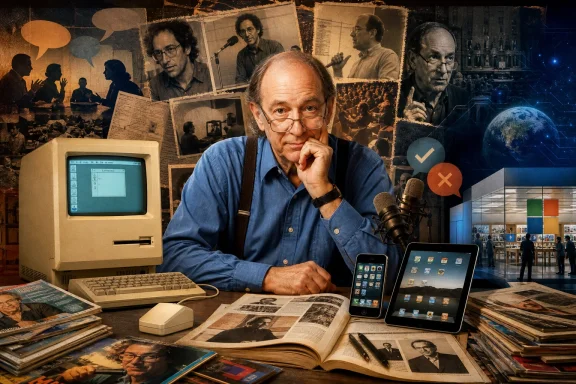
Reports of John C. Dvorak’s death have prompted the technology world to revisit a career defined by sharp opinions, memorable misfires, and an unusually durable ability to turn disagreement into a spectacle. The veteran columnist, broadcaster, author, and podcaster was one of personal computing’s most recognizable contrarians, whether he was dismissing the Macintosh mouse, doubting the iPhone, questioning the iPad, or declaring that Microsoft’s retail ambitions could match Apple’s store experience.
But the early reports require an important correction: the claim that Dvorak died at age 80 does not align with the widely documented April 5, 1952 birth date associated with him for decades. If that date is correct, he was 74 in July 2026. The discrepancy is more than a trivial obituary typo. It is a timely reminder that, in the always-on technology news cycle, the urge to publish a clever reaction can outrun basic verification.
Dvorak would probably have appreciated the irony. He spent much of his career thriving in the space between informed criticism, performative certainty, and provocation designed to make an audience respond.
John C. Dvorak belonged to the generation that helped make personal-computing journalism a mass-market pursuit. Long before technology commentary became an endless scroll of reaction videos, social-media posts, livestreams, and newsletter hot takes, the industry had magazine columns. They were physical real estate: limited in length, published on a schedule, and written to compete for attention alongside product reviews, advertisements, benchmark charts, and technical how-to guides.
Dvorak understood how to own that space.
His writing and broadcasting career crossed much of the early consumer technology landscape. He appeared in and wrote for outlets that chronicled the rise of the PC industry, the Windows ecosystem, networking, software, early internet culture, and the constant battle for relevance among hardware vendors. Later, he became familiar to a new generation through television appearances, technology roundtables, and long-form podcasting.
The formula was clear:
That insight made him an early model for the internet-era pundit. The tools changed, but the incentives did not.
Dvorak’s public persona was deliberately hard to separate from his arguments. He often seemed to enjoy the role of contrarian, skeptic, curmudgeon, and occasional troll. When an industry was declaring a product revolutionary, he was often ready to say it was overhyped, compromised, impractical, or doomed.
That posture brought real value at times.
Technology journalism needs people willing to puncture inflated launch narratives. Companies routinely overstate the importance of their newest platforms. Executives make broad promises that products cannot meet. Analysts can become overly attached to trend lines, and fans often confuse a successful brand with an infallible one.
A columnist willing to say “this does not make sense” can provide a useful corrective.
The problem arises when skepticism becomes a brand requirement. Once a writer is known for being the person who says the popular thing will fail, there is pressure to keep finding popular things that supposedly will fail. The criticism can become less about testing evidence and more about maintaining a recognizable role.
That was the risk built into Dvorak’s best-known forecasts. They were often remembered not because he challenged conventional wisdom, but because he did so with striking certainty.
It is easy to see why. The mouse went on to become one of the most important input devices in the history of desktop computing. Graphical user interfaces, including Microsoft Windows, became inseparable from pointing, clicking, dragging, selecting, and navigating visually structured applications. The mouse was not a side feature. It was a central piece of the interface model that defined mainstream computing for decades.
Still, the larger historical context matters.
In 1984, the Macintosh mouse was genuinely unfamiliar to much of the public. Most computer users worked primarily through keyboards and text-driven interfaces. Command-line systems had clear limitations, but they also had established habits, large software libraries, and users who knew how to operate them. A mouse-based graphical interface was not automatically destined for mass adoption simply because it looked modern.
Dvorak later objected to the way the quotation was reused, arguing that some retellings had simplified or distorted his original position. He also acknowledged that he had changed his view. That later reassessment is important because it demonstrates something too often lost in technology commentary: a forecast can be wrong without the underlying question being absurd at the time it was asked.
The lesson for Windows users is especially relevant. Windows did not become dominant merely because it had a graphical interface. It succeeded through years of hardware compatibility, software availability, enterprise adoption, OEM distribution, developer support, and iterative improvement. Interface paradigms become standard through ecosystems, not just novelty.
Dvorak’s mistake was not that he recognized uncertainty. His mistake was treating uncertainty as a reason for confident dismissal.
On television, he also expressed doubt that consumers would embrace a phone that abandoned the physical keyboard. At the time, BlackBerry, Palm, Samsung, and other vendors offered devices that aligned more closely with the prevailing business-mobile model: tactile keys, compact screens, messaging features, and familiar controls.
That context is worth acknowledging. The original iPhone was expensive, tied to a single carrier in the United States, lacked many features that later became expected, and faced a deeply entrenched mobile industry. It did not support third-party native apps at launch. It had no copy-and-paste function. It could not satisfy every business user who depended on BlackBerry-style email workflows.
Yet the conclusion was spectacularly wrong.
The iPhone did not simply succeed as another smartphone. It reshaped the smartphone category around the touchscreen, browser, app ecosystem, camera, and software platform. It pushed competitors toward larger displays, software-first interaction, app stores, touch-centric design, and eventually the collapse or marginalization of several once-dominant mobile brands.
The impact reached Microsoft directly.
Windows Mobile had a meaningful foothold in business and enthusiast circles before the iPhone changed consumer expectations. Its stylus-oriented interface and enterprise-friendly approach made sense in an earlier PDA-centered market. But the shift toward capacitive touch, finger-first design, polished software integration, and developer-driven app ecosystems exposed the limits of the existing strategy.
Microsoft’s later attempts to recover mobile relevance—from Windows Phone to the Nokia acquisition and the eventual retrenchment—showed how difficult it was to respond once the market’s center of gravity had moved. The iPhone forecast was therefore not merely a bad call on an Apple gadget. It was a missed reading of the direction in which the entire computing industry was heading.
But the touchscreen model was not trying to beat a physical keyboard only at typing.
It offered a configurable surface that could become:
That distinction is central to the history of Windows devices as well. Microsoft’s long struggle to unify desktop productivity with touch-first computing illustrated the tension between established interaction models and new device categories. Windows 8’s controversial interface decisions showed that it is not enough to recognize a platform shift; a company also has to implement that shift in a way users can understand and accept.
But the prediction still missed the scale and longevity of the iPad’s success.
The iPad became a major product category, changed how many consumers thought about portable computing, and helped establish a broad market for tablets in education, retail, aviation, healthcare, creative work, field services, and home media consumption. It did not render laptops obsolete, nor did it eliminate the need for desktop operating systems. Instead, it expanded the number of device types people used.
That outcome should be familiar to Windows enthusiasts. The technology industry often frames product launches as battles in which one category must destroy another. Reality is usually more complicated.
Desktop PCs remained essential for development, gaming, engineering, office work, content creation, and serious multitasking. Laptops expanded their role. Tablets created a third space. Smartphones became the most personal and widely carried computing devices. Wearables and connected devices added further layers.
The iPad did not need to replace Windows PCs to be a triumph. It needed to prove that a large number of people wanted a simpler, more direct, highly portable computing experience. It did that.
Dvorak’s recurring weakness was a tendency to evaluate emerging products against the dominant use cases of the existing category. The better question is often not, “Can this replace what we have?” but, “What new behavior becomes normal if this succeeds?”
Microsoft had legitimate reasons to pursue physical retail. Its stores offered a place to demonstrate Windows PCs, Xbox consoles, Surface hardware, Office products, and accessories. They gave the company more control over presentation than third-party retailers could provide. They also let Microsoft tell a cohesive story about an ecosystem that was often fragmented across dozens of PC makers.
Apple had already shown the value of tightly controlled retail environments. Its stores made products approachable, supported customers after purchase, and served as prominent marketing landmarks. Microsoft’s retail strategy had a logical business case.
But Apple’s stores were not successful because they were simply stores.
They were the retail expression of a tightly integrated business model. Apple controlled the hardware, operating system, key services, product roadmap, visual identity, and purchasing experience. Microsoft, by contrast, had long operated as a platform company. Its most significant strength was the breadth of the Windows ecosystem, not exclusive control over every device that ran it.
That made Microsoft retail more difficult to define.
Should a Microsoft Store prioritize Surface devices? Promote partner PCs? Sell Xbox? Provide Windows support? Function as a business showroom? Compete with electronics retailers? Match Apple’s minimalist experience while representing a much broader hardware ecosystem?
The answer was never as simple as opening more locations.
The later closure of most Microsoft Store locations demonstrated that retail scale cannot be willed into existence through imitation. It depends on product differentiation, consumer demand, economics, support requirements, geographic strategy, and the customer’s reason to visit in the first place.
For Microsoft, the long-term shift toward online sales, partner channels, cloud services, and direct device marketing made more strategic sense than a massive retail footprint.
People do not just buy computers, phones, and software. They build identities around them.
A Mac owner in the 1980s or 1990s was often making a statement about usability, design, creativity, and independence from the PC mainstream. A Windows user could argue for compatibility, software choice, hardware flexibility, performance, gaming, enterprise acceptance, and value. Linux advocates, early internet users, BlackBerry loyalists, Apple fans, and PC builders all developed their own cultures and defensive instincts.
Dvorak understood these fault lines. He knew that attacking a product could also challenge a community’s self-image. That is why his columns produced such strong reactions.
In the modern era, this strategy has become common enough to be almost invisible. Online creators constantly optimize for conflict, fandom, ridicule, and the promise that a product, company, or platform is either the future or a fraud. The metrics reward certainty. Nuance travels slowly. Anger travels quickly.
Dvorak did not invent this model, but he helped demonstrate its commercial power.
Dvorak rarely had that problem.
He took positions. People could remember them. They could evaluate them later. When he was wrong, he was wrong in a manner too obvious to escape.
That quality can be valuable in journalism when combined with evidence, humility, and a willingness to revise assumptions. Boldness is not the enemy of accuracy. The trouble begins when boldness substitutes for accuracy.
The question is whether a product establishes a platform that can improve rapidly through software, hardware iteration, developer support, and ecosystem investment.
Windows itself has survived partly because it evolved through changing hardware, interfaces, workloads, and business models. The Windows PC became successful not by freezing the industry in place, but by absorbing continual change.
This matters in current debates over AI PCs, ARM-based Windows devices, cloud gaming, and mixed reality. A new category may find a durable niche even if it does not become the sole future of computing.
The same standard applies to benchmark claims, security alarms, AI capability statements, rumored Windows features, and company strategy reports. A piece of information can be widely repeated and still be wrong.
Yet his importance to the technology press is difficult to deny.
He represented an earlier age when computer journalism had room for distinct personalities and when a columnist’s voice could become as recognizable as a product brand. He understood that technology was not just a collection of specifications. It was a contest of assumptions about how people would live, work, communicate, and spend money.
His worst predictions are now historical artifacts, quoted with delight by people eager to show that even veteran observers can miss the future. His better contribution was making the industry argue harder about its own assumptions.
That legacy deserves neither uncritical praise nor cheap dismissal. Dvorak’s career is a reminder that skepticism is necessary, certainty is dangerous, and the loudest technology opinion is not automatically the wisest one. In a field built on perpetual change, that may be the most enduring lesson he leaves behind.
But the early reports require an important correction: the claim that Dvorak died at age 80 does not align with the widely documented April 5, 1952 birth date associated with him for decades. If that date is correct, he was 74 in July 2026. The discrepancy is more than a trivial obituary typo. It is a timely reminder that, in the always-on technology news cycle, the urge to publish a clever reaction can outrun basic verification.
Dvorak would probably have appreciated the irony. He spent much of his career thriving in the space between informed criticism, performative certainty, and provocation designed to make an audience respond.
 A Giant of the Argument-Driven Tech Press
John C. Dvorak belonged to the generation that helped make personal-computing journalism a mass-market pursuit. Long before technology commentary became an endless scroll of reaction videos, social-media posts, livestreams, and newsletter hot takes, the industry had magazine columns. They were physical real estate: limited in length, published on a schedule, and written to compete for attention alongside product reviews, advertisements, benchmark charts, and technical how-to guides.Dvorak understood how to own that space.
His writing and broadcasting career crossed much of the early consumer technology landscape. He appeared in and wrote for outlets that chronicled the rise of the PC industry, the Windows ecosystem, networking, software, early internet culture, and the constant battle for relevance among hardware vendors. Later, he became familiar to a new generation through television appearances, technology roundtables, and long-form podcasting.
The formula was clear:
- Identify the consensus around a new product or company.
- Attack its weakest visible assumption.
- State the critique in language strong enough to guarantee a response.
- Let defenders, rivals, readers, and competitors distribute the argument for free.
That insight made him an early model for the internet-era pundit. The tools changed, but the incentives did not.
The “Bloated Gasbag” Persona Was Part of the Product
The joking description of Dvorak as a “bloated gasbag” was not a detached assessment of a stranger. It reflected the long-running, combative relationship he cultivated with Apple enthusiasts and technology communities. In the pre-social-media era, writers with a knack for aggravating devoted user bases could become famous far beyond their publications’ ordinary readership.Dvorak’s public persona was deliberately hard to separate from his arguments. He often seemed to enjoy the role of contrarian, skeptic, curmudgeon, and occasional troll. When an industry was declaring a product revolutionary, he was often ready to say it was overhyped, compromised, impractical, or doomed.
That posture brought real value at times.
Technology journalism needs people willing to puncture inflated launch narratives. Companies routinely overstate the importance of their newest platforms. Executives make broad promises that products cannot meet. Analysts can become overly attached to trend lines, and fans often confuse a successful brand with an infallible one.
A columnist willing to say “this does not make sense” can provide a useful corrective.
The problem arises when skepticism becomes a brand requirement. Once a writer is known for being the person who says the popular thing will fail, there is pressure to keep finding popular things that supposedly will fail. The criticism can become less about testing evidence and more about maintaining a recognizable role.
That was the risk built into Dvorak’s best-known forecasts. They were often remembered not because he challenged conventional wisdom, but because he did so with striking certainty.
The Macintosh Mouse: A Famous Misread, and a Fairer Reading
One of the most repeated Dvorak quotations dates to 1984, when he described the Macintosh’s mouse as an experimental pointing device and questioned whether people wanted to use such hardware. In hindsight, the line has become a staple of “worst tech predictions” lists.It is easy to see why. The mouse went on to become one of the most important input devices in the history of desktop computing. Graphical user interfaces, including Microsoft Windows, became inseparable from pointing, clicking, dragging, selecting, and navigating visually structured applications. The mouse was not a side feature. It was a central piece of the interface model that defined mainstream computing for decades.
Still, the larger historical context matters.
In 1984, the Macintosh mouse was genuinely unfamiliar to much of the public. Most computer users worked primarily through keyboards and text-driven interfaces. Command-line systems had clear limitations, but they also had established habits, large software libraries, and users who knew how to operate them. A mouse-based graphical interface was not automatically destined for mass adoption simply because it looked modern.
Dvorak later objected to the way the quotation was reused, arguing that some retellings had simplified or distorted his original position. He also acknowledged that he had changed his view. That later reassessment is important because it demonstrates something too often lost in technology commentary: a forecast can be wrong without the underlying question being absurd at the time it was asked.
The lesson for Windows users is especially relevant. Windows did not become dominant merely because it had a graphical interface. It succeeded through years of hardware compatibility, software availability, enterprise adoption, OEM distribution, developer support, and iterative improvement. Interface paradigms become standard through ecosystems, not just novelty.
Dvorak’s mistake was not that he recognized uncertainty. His mistake was treating uncertainty as a reason for confident dismissal.
The iPhone Predictions That Would Not Go Away
If the Macintosh mouse quote made Dvorak famous among Apple historians, his iPhone commentary made him permanently associated with the hazards of forecasting. When Apple introduced the original iPhone in 2007, Dvorak argued that the company should abandon it rather than risk damaging its reputation. He suggested Apple might be better served treating it as a reference design for others to build.On television, he also expressed doubt that consumers would embrace a phone that abandoned the physical keyboard. At the time, BlackBerry, Palm, Samsung, and other vendors offered devices that aligned more closely with the prevailing business-mobile model: tactile keys, compact screens, messaging features, and familiar controls.
That context is worth acknowledging. The original iPhone was expensive, tied to a single carrier in the United States, lacked many features that later became expected, and faced a deeply entrenched mobile industry. It did not support third-party native apps at launch. It had no copy-and-paste function. It could not satisfy every business user who depended on BlackBerry-style email workflows.
Yet the conclusion was spectacularly wrong.
The iPhone did not simply succeed as another smartphone. It reshaped the smartphone category around the touchscreen, browser, app ecosystem, camera, and software platform. It pushed competitors toward larger displays, software-first interaction, app stores, touch-centric design, and eventually the collapse or marginalization of several once-dominant mobile brands.
The impact reached Microsoft directly.
Windows Mobile had a meaningful foothold in business and enthusiast circles before the iPhone changed consumer expectations. Its stylus-oriented interface and enterprise-friendly approach made sense in an earlier PDA-centered market. But the shift toward capacitive touch, finger-first design, polished software integration, and developer-driven app ecosystems exposed the limits of the existing strategy.
Microsoft’s later attempts to recover mobile relevance—from Windows Phone to the Nokia acquisition and the eventual retrenchment—showed how difficult it was to respond once the market’s center of gravity had moved. The iPhone forecast was therefore not merely a bad call on an Apple gadget. It was a missed reading of the direction in which the entire computing industry was heading.
Why the Physical Keyboard Argument Made Sense—Until It Didn’t
Dvorak’s preference for physical keyboards reflected a reasonable understanding of the products that were succeeding at the time. BlackBerry devices were beloved by business users. Hardware buttons delivered feedback, supported rapid text entry for trained users, and made sense on small-screen devices.But the touchscreen model was not trying to beat a physical keyboard only at typing.
It offered a configurable surface that could become:
- A keyboard when text input was required.
- A game controller during play.
- A map when navigating.
- A camera interface when taking photos.
- A web browser with direct manipulation.
- A media player, remote control, or document viewer.
- An app platform that developers could continually redefine.
That distinction is central to the history of Windows devices as well. Microsoft’s long struggle to unify desktop productivity with touch-first computing illustrated the tension between established interaction models and new device categories. Windows 8’s controversial interface decisions showed that it is not enough to recognize a platform shift; a company also has to implement that shift in a way users can understand and accept.
The iPad Forecast and the Danger of Defining Products Too Narrowly
Dvorak’s skepticism toward the iPad followed a similar pattern. He predicted that Apple’s tablet would not become the company’s next runaway bestseller. In a narrow sense, tablets did not replace traditional PCs as completely as the most bullish launch narratives suggested. The category also matured into a more complicated market than early sales figures implied.But the prediction still missed the scale and longevity of the iPad’s success.
The iPad became a major product category, changed how many consumers thought about portable computing, and helped establish a broad market for tablets in education, retail, aviation, healthcare, creative work, field services, and home media consumption. It did not render laptops obsolete, nor did it eliminate the need for desktop operating systems. Instead, it expanded the number of device types people used.
That outcome should be familiar to Windows enthusiasts. The technology industry often frames product launches as battles in which one category must destroy another. Reality is usually more complicated.
Desktop PCs remained essential for development, gaming, engineering, office work, content creation, and serious multitasking. Laptops expanded their role. Tablets created a third space. Smartphones became the most personal and widely carried computing devices. Wearables and connected devices added further layers.
The iPad did not need to replace Windows PCs to be a triumph. It needed to prove that a large number of people wanted a simpler, more direct, highly portable computing experience. It did that.
Dvorak’s recurring weakness was a tendency to evaluate emerging products against the dominant use cases of the existing category. The better question is often not, “Can this replace what we have?” but, “What new behavior becomes normal if this succeeds?”
Microsoft Stores: Optimism in the Wrong Direction
Not every high-profile Dvorak prediction was anti-Apple. In 2012, he argued that Microsoft should have at least 300 retail stores within a decade and that they could perform as well as Apple Stores. The prediction highlights a different limitation in technology forecasting: assuming that a visible strategy can be copied from one successful company to another.Microsoft had legitimate reasons to pursue physical retail. Its stores offered a place to demonstrate Windows PCs, Xbox consoles, Surface hardware, Office products, and accessories. They gave the company more control over presentation than third-party retailers could provide. They also let Microsoft tell a cohesive story about an ecosystem that was often fragmented across dozens of PC makers.
Apple had already shown the value of tightly controlled retail environments. Its stores made products approachable, supported customers after purchase, and served as prominent marketing landmarks. Microsoft’s retail strategy had a logical business case.
But Apple’s stores were not successful because they were simply stores.
They were the retail expression of a tightly integrated business model. Apple controlled the hardware, operating system, key services, product roadmap, visual identity, and purchasing experience. Microsoft, by contrast, had long operated as a platform company. Its most significant strength was the breadth of the Windows ecosystem, not exclusive control over every device that ran it.
That made Microsoft retail more difficult to define.
Should a Microsoft Store prioritize Surface devices? Promote partner PCs? Sell Xbox? Provide Windows support? Function as a business showroom? Compete with electronics retailers? Match Apple’s minimalist experience while representing a much broader hardware ecosystem?
The answer was never as simple as opening more locations.
The later closure of most Microsoft Store locations demonstrated that retail scale cannot be willed into existence through imitation. It depends on product differentiation, consumer demand, economics, support requirements, geographic strategy, and the customer’s reason to visit in the first place.
For Microsoft, the long-term shift toward online sales, partner channels, cloud services, and direct device marketing made more strategic sense than a massive retail footprint.
Dvorak’s Real Legacy: He Made Technology Debatable
It would be too easy to reduce Dvorak’s career to a list of failed predictions. Such lists are entertaining, but they often conceal the more important story. He remained visible for decades because he was skilled at identifying the emotional stakes behind technology.People do not just buy computers, phones, and software. They build identities around them.
A Mac owner in the 1980s or 1990s was often making a statement about usability, design, creativity, and independence from the PC mainstream. A Windows user could argue for compatibility, software choice, hardware flexibility, performance, gaming, enterprise acceptance, and value. Linux advocates, early internet users, BlackBerry loyalists, Apple fans, and PC builders all developed their own cultures and defensive instincts.
Dvorak understood these fault lines. He knew that attacking a product could also challenge a community’s self-image. That is why his columns produced such strong reactions.
In the modern era, this strategy has become common enough to be almost invisible. Online creators constantly optimize for conflict, fandom, ridicule, and the promise that a product, company, or platform is either the future or a fraud. The metrics reward certainty. Nuance travels slowly. Anger travels quickly.
Dvorak did not invent this model, but he helped demonstrate its commercial power.
The Strength of Being Willing to Be Wrong
There is also a case for respecting the willingness to make a public call. Many analysts hedge every forecast so thoroughly that it cannot be tested. They use terms such as “potentially,” “may,” “could,” and “appears positioned to” until their conclusion becomes nearly impossible to falsify.Dvorak rarely had that problem.
He took positions. People could remember them. They could evaluate them later. When he was wrong, he was wrong in a manner too obvious to escape.
That quality can be valuable in journalism when combined with evidence, humility, and a willingness to revise assumptions. Boldness is not the enemy of accuracy. The trouble begins when boldness substitutes for accuracy.
What Today’s Tech Commentators Should Learn
Dvorak’s career offers a useful framework for anyone covering Windows, PCs, AI, smartphones, gaming, enterprise IT, or consumer hardware.1. Early products are often incomplete by design
The original iPhone lacked features. The original Macintosh was constrained. Early tablets had obvious limitations. New products should be judged honestly, but their potential should not be measured solely by version 1.0.The question is whether a product establishes a platform that can improve rapidly through software, hardware iteration, developer support, and ecosystem investment.
2. Existing habits are not permanent laws
Physical keyboards, command lines, optical media, desktop towers, and locally installed software all seemed indispensable at different points in computing history. Some remain useful. None were guaranteed to remain central forever.Windows itself has survived partly because it evolved through changing hardware, interfaces, workloads, and business models. The Windows PC became successful not by freezing the industry in place, but by absorbing continual change.
3. Successful products can create new markets rather than replace old ones
A tablet did not have to replace a laptop. A handheld gaming PC did not have to replace a desktop gaming rig. A cloud service does not have to eliminate local computing. Technology markets routinely expand sideways.This matters in current debates over AI PCs, ARM-based Windows devices, cloud gaming, and mixed reality. A new category may find a durable niche even if it does not become the sole future of computing.
4. Provocation should never outrun verification
The age discrepancy in the initial death reports is a sharp example of why basic fact-checking remains essential. A strong headline, clever insult, or viral angle cannot compensate for a fundamental biographical error.The same standard applies to benchmark claims, security alarms, AI capability statements, rumored Windows features, and company strategy reports. A piece of information can be widely repeated and still be wrong.
A More Complicated Farewell Than the Headlines Suggest
John C. Dvorak was not beloved because he always predicted technology correctly. He plainly did not. Nor was he respected by everyone, and his later media work attracted criticism from audiences who found his views abrasive, conspiratorial, or needlessly provocative.Yet his importance to the technology press is difficult to deny.
He represented an earlier age when computer journalism had room for distinct personalities and when a columnist’s voice could become as recognizable as a product brand. He understood that technology was not just a collection of specifications. It was a contest of assumptions about how people would live, work, communicate, and spend money.
His worst predictions are now historical artifacts, quoted with delight by people eager to show that even veteran observers can miss the future. His better contribution was making the industry argue harder about its own assumptions.
That legacy deserves neither uncritical praise nor cheap dismissal. Dvorak’s career is a reminder that skepticism is necessary, certainty is dangerous, and the loudest technology opinion is not automatically the wisest one. In a field built on perpetual change, that may be the most enduring lesson he leaves behind.
References
- Primary source: MacDailyNews
Published: 2026-07-23T18:10:33+00:00
Loading…
macdailynews.com - Related coverage: appleinsider.com
Loading…
appleinsider.com - Related coverage: famousbirthdays.com
Loading…
www.famousbirthdays.com - Related coverage: everything.explained.today
Loading…
everything.explained.today - Related coverage: azquotes.com
Loading…
www.azquotes.com - Related coverage: noagendashow.net
Loading…
www.noagendashow.net