

A July 9, 2026 storage news wave shows vendors converging on the same enterprise problem: AI-era systems are getting faster and more sovereign, but recovery, inventory, and operational proof are still lagging behind the infrastructure race for many enterprise buyers. The day’s announcements looked scattered at first glance: a Commvault cyber drill, a Samsung PCIe Gen 6 SSD, a Rubrik UK investment, a DDN-Nebul AI infrastructure tie-up, a FalconStor clean-room platform, a Precisely mainframe discovery tool, and regional channel moves from Databarracks, Scality, and WEKA. Taken together, they sketch a market that has stopped selling storage as a passive substrate and is now selling assurance: assurance that data can be recovered cleanly, moved fast enough for AI, governed in the right jurisdiction, and understood inside messy hybrid estates. The winners in this next phase will not be the vendors with the loudest “AI-ready” badges, but the ones that can prove performance and resilience under pressure.
The Blocks & Files storage news ticker published on 9 July 2026 reads like a catalog of enterprise anxiety. Commvault wants customers to measure how fast they can return to a clean state after an AI-assisted attack. FalconStor wants IBM Power shops to test recovery in a secure enclave. Rubrik is putting more than $500 million into the UK while attaching its cyber-resilience platform to the AWS European Sovereign Cloud. Precisely is pushing z/OS software inventory into ServiceNow because the supposedly modern CMDB still often has a mainframe-shaped blind spot.
That is not a coincidence. Storage used to be evaluated around capacity, durability, latency, and cost per terabyte. Those still matter, but the purchasing conversation has shifted. Boards want to know whether the business can survive ransomware, regulators want to know where data is controlled, AI teams want to know whether infrastructure can feed accelerators without waste, and operations teams want inventories that include the old systems still running the money.
The most interesting thing about this set of announcements is that almost none of them is really “just storage.” Commvault’s Minutes to Recovery is a live cyber-resilience simulation. DDN’s work with Nebul is about large-scale AI inference performance in sovereign-hybrid cloud infrastructure. Samsung’s PM1763 is an SSD, but Samsung is pitching it for next-generation AI and HPC server environments. Rubrik’s UK expansion is partly a go-to-market move, partly a sovereignty move, and partly a bet that cyber resilience will remain a board-level budget line.
The through line is operational proof. Can you recover? Can you validate recovery? Can you discover the software running on your mainframe? Can you serve AI inference at scale? Can your sovereign-cloud posture survive procurement scrutiny? Vendors are learning that enterprise buyers no longer trust architecture diagrams alone. They want simulations, secure enclaves, support agreements, validated infrastructure claims, and named deployment models.
The important phrase is not “AI-driven cyberattacks,” even if that is the marketing hook. It is “Mean Time to Clean Recovery,” or MTCR. Commvault is trying to make MTCR the resilience equivalent of a board-readable metric: not how quickly an organization can restore something, but how quickly it can restore from a clean, trustworthy state after an attack has made ordinary assumptions dangerous.
That distinction matters because classic recovery metrics can flatter the organization. A recovery-time objective can sit comfortably in a planning document for years without being tested against compromised credentials, poisoned backups, isolated networks, executive panic, or forensic uncertainty. Commvault’s simulation format is designed to expose the gap between the plan and the actual recovery muscle.
There is a shrewd commercial angle here, of course. A vendor-led simulation naturally gives Commvault a way to frame the problem around the capabilities it wants customers to value. But the broader idea is sound: resilience that has not been exercised is not resilience; it is a hope with a spreadsheet attached. The more attackers use automation to compress the time between access, lateral movement, data theft, and extortion, the less credible it becomes for enterprises to treat recovery as a quarterly tabletop exercise.
The hacker-and-defender format is also a subtle admission that the security market’s old wall between “prevent the breach” and “recover from the breach” has collapsed. The same team that must understand how an attacker reaches critical data also needs to understand what a clean recovery path looks like after the attacker has touched identity, storage, backup consoles, and management planes. If participants can use Frontier AI tools in the offensive portion of the simulation, the defensive side has to assume a faster, noisier, and more adaptive incident than many organizations have rehearsed.
For Windows-heavy enterprises, the lesson is not that Commvault has invented a magic metric. It is that recovery should be measured against contaminated reality. Active Directory, endpoint management, backup credentials, service accounts, cloud consoles, and file shares all become part of the recovery problem once an attacker has moved from opportunistic malware to directed intrusion. MTCR is useful precisely because it forces IT and security teams to ask whether they can identify a clean recovery point, validate it, rebuild priority services, and do so under time pressure.
The risk is that MTCR becomes another acronym vendors staple to dashboards. The opportunity is that it becomes an uncomfortable rehearsal number: a measure that executives can understand and that administrators can improve through segmentation, immutable copies, recovery automation, identity hardening, and repeated testing.
Buyer action: Ask Commvault, or any resilience vendor making similar claims, to define exactly how “clean recovery” is measured, what evidence the exercise produces, which systems are included, and how the organization can repeat the test without turning it into a one-off workshop.
That “known-clean” language is doing a lot of work. In a ransomware incident, the backup is not automatically the answer. The backup may be incomplete, too old, encrypted, misconfigured, or affected by the same compromise that damaged production. A clean-room model is meant to separate recovery validation from the very environment whose trustworthiness is in question.
FalconStor says the platform is built on its patent-pending Zero Trust Secure Enclave, or ZTSE, technology. It is designed as a standalone infrastructure layer that can be deployed across multiple use cases and integrated by third-party software vendors and service providers. FalconStor Habanero, the company’s existing managed offsite backup and archive vaulting solution for IBM i, IBM Power, and tape environments, is the first solution to be combined with the Cloud Clean Room.
The IBM Power focus is important. The broader security conversation often assumes x86 servers, cloud-native workloads, Windows endpoints, and SaaS control planes. But many enterprises still rely on IBM i, IBM Power, and tape-centered operational patterns for workloads that are old, critical, and poorly understood by newer security tooling. Those environments may not be fashionable, but they are often the systems where downtime is least tolerable.
FalconStor’s pitch also reflects a larger enterprise truth: recovery testing fails when it is too disruptive, too specialized, or too dependent on the same staff who are already overloaded maintaining production. By offering on-demand infrastructure and combining it with managed offsite backup and archive vaulting, FalconStor is trying to reduce the friction of validation. The most resilient architecture in the world is useless if the organization only dares to test it during an annual audit.
The practical consequence for administrators is that clean-room recovery is becoming a procurement category, not merely an architecture pattern. Buyers should ask hard questions. What does “known-clean” mean operationally? How are recovery points selected and validated? How is the enclave isolated from compromised identity systems? What evidence is produced after a test? Can the process be repeated without specialist heroics? How does it integrate with incident response, not just backup operations?
Commvault and FalconStor are not offering identical products, but they are responding to the same buyer fear. The board does not want to hear that backups exist. It wants to know whether the company can return to a trustworthy state after the attacker has tried to make trust itself expensive.
Buyer action: Require a demonstration of a full clean-room recovery workflow, including how the test starts, how isolation is maintained, how recovered data is validated, and what report is handed to security, audit, and executive teams afterward.
This is not just a real-estate story. It is Rubrik positioning itself around three overlapping enterprise pressures: cyber recovery, public-sector trust, and data sovereignty. The customer list matters because it spans financial services, energy, local government, and national government. Those sectors do not buy cyber-resilience platforms only because they like dashboards. They buy because the consequences of downtime, data loss, and regulatory failure are severe.
Rubrik says it now serves 2,000 customers across EMEA, nearly half of whom use three or more Rubrik products. That last clause is the commercial signal. Rubrik wants to move from backup and recovery into a broader cyber-resilience platform relationship, and multi-product adoption is the metric that shows whether customers are buying that story.
Support for the AWS European Sovereign Cloud adds another layer. Sovereign-cloud offerings are not only about geography; they are about legal exposure, operational control, procurement confidence, and the ability to tell regulators that sensitive workloads are being handled under a more constrained regime. For a cyber-resilience vendor, availability on a sovereign-cloud platform lets it participate in modernization conversations that might otherwise be limited by public-sector or regulated-industry requirements.
There is tension here. Rubrik is a US-headquartered company making a major UK and EMEA commitment while leaning into sovereign-cloud availability. That reflects the market’s compromise position. Many European and UK buyers want the scale and maturity of large cloud and security vendors, but they also want more local governance, local presence, and cloud models designed to answer sovereignty objections. Rubrik’s London EMEA headquarters is a corporate answer to that discomfort.
For WindowsForum readers managing Microsoft-heavy environments, the strategic takeaway is that data-protection purchasing is becoming inseparable from jurisdictional architecture. It is no longer enough to ask whether a product can protect Microsoft 365, SQL Server, Windows file services, or virtualized workloads. Enterprises increasingly need to know where metadata lives, how recovery copies are controlled, which cloud regions are involved, and whether the vendor’s operating model aligns with public-sector or regulated-industry constraints.
Rubrik’s UK investment does not prove it will win those deals. But it does show where the deals are moving. Cyber resilience is being sold not only as a technical feature but also as a regional commitment, a sovereignty posture, and a platform relationship.
Buyer action: Ask Rubrik, or any vendor making a sovereignty pitch, to map the exact control plane, metadata, support, recovery, and operational-access model for your deployment, not just the advertised cloud region or headline investment figure.
That is a dense vendor paragraph, but the underlying point is simple: AI inference is no longer just a GPU problem. Large models generate heavy pressure on memory, networking, cache management, and storage. If the data path cannot keep accelerators fed efficiently, expensive GPU infrastructure can spend too much time waiting.
The mention of KV Cache acceleration is particularly telling. In transformer-based inference, key-value cache management is central to performance because the system must handle context and reuse intermediate state efficiently as models generate outputs. Storage vendors and data-infrastructure companies are now looking for ways to participate in that performance loop rather than sit outside it as a slower persistence layer.
The verified claim here should be kept narrow. DDN and Nebul are working around RoCE-based infrastructure validation, KV Cache acceleration, DDN Infinia, Nvidia GPU gear, and DSX-based AI factory support. That is enough to be meaningful without overstating the scope. It means the companies are trying to show that storage and data infrastructure can play a direct role in AI inference efficiency inside a sovereign-hybrid cloud context. It does not need to be inflated into a broader claim about future publications, vendor roadmaps, or unverified benchmarking programs.
RoCE validation matters because AI clusters are systems of bottlenecks. The storage software, network fabric, GPU servers, cache behavior, and workload shape all interact. A design that looks elegant in a diagram may behave differently once it is deployed as part of a real AI factory architecture. DDN and Nebul are effectively pointing to a more systems-level view of inference, where storage is judged by how it contributes to accelerator utilization and service delivery rather than by isolated storage metrics alone.
Samsung’s PM1763 announcement pushes the same argument at the device layer. Samsung has started mass production of its PCIe Gen 6-based PM1763 SSD in 3.84 TB, 7.68 TB, and 15.36 TB capacities. The drive is a 286-layer TLC SSD, with the source listing random read/write performance as 6.8 million and 950,000, sequential read speed of 28.4 GB/sec, and sequential write speed of 21.9 GB/sec. Samsung says that is more than twice the performance of its PCIe Gen 5-based PM1753 predecessor.
Samsung frames the PM1763 as an enterprise SSD for AI and HPC environments rather than a consumer enthusiast part. That distinction matters. PCIe Gen 6 storage is arriving first where throughput, power efficiency, thermals, and accelerator utilization can justify the cost and platform complexity. The relevant question for enterprise buyers is not whether the drive is “fast” in the abstract. It is whether the surrounding server, workload, cooling, and software stack can take advantage of that speed.
Samsung says PM1763 can transfer a 40-gigabyte large language model in approximately 1.4 seconds, helping reduce data latency between processors and accelerators. It also says the drive is optimized for next-generation, liquid-cooled AI and HPC server environments through direct-to-chip cooling technology, and claims 1.8x better power efficiency than PM1753.
The thermals are not incidental. AI servers are increasingly designed around dense accelerators, high-throughput networking, and liquid cooling because power and heat have become architectural constraints. A storage device that can move data faster but wrecks the thermal or power envelope is not a win. Samsung’s emphasis on direct-to-chip cooling and power efficiency shows that SSD design is being pulled into the same systems-level conversation as GPUs and networking.
For enterprise IT, the message is uncomfortable but useful: AI storage decisions cannot be made by the storage team alone. The relevant unit of analysis is the full AI pipeline. Model loading, inference context length, cache behavior, dataset movement, GPU utilization, network fabric, and facility cooling all shape whether a faster SSD or a new data platform actually improves business output.
Buyer action: For DDN-Nebul-style AI infrastructure, ask to see workload-specific validation that matches your inference pattern, network fabric, GPU platform, sovereignty requirements, and cache behavior. For Samsung PM1763-class devices, test the drive inside the target server and cooling design rather than relying only on headline SSD specifications.
This table also shows why the storage market is becoming harder to categorize. A backup vendor is selling cyber simulations. An SSD vendor is talking about liquid-cooled AI servers. A data integrity supplier is improving mainframe visibility inside a service-management platform. A storage partnership is focused on France because local support and go-to-market structure can be as important as global scale.
That fragmentation is not a weakness. It is the shape of real enterprise computing. The same organization may be trying to run AI pilots, defend against ransomware, satisfy sovereignty requirements, modernize ServiceNow processes, and protect a mainframe estate that refuses to die because it still works. Vendors that pretend those problems are separate will miss how budgets are actually approved.
This is the sort of announcement that sounds mundane until something breaks. Many enterprises run sophisticated IT service-management processes around distributed infrastructure while treating mainframe visibility as an exception, a manual feed, or a specialist-only domain. That creates a governance problem. If the CMDB does not accurately reflect what is running on z/OS, then incident response, change management, audit, software asset management, and service mapping all inherit a blind spot.
According to the source material, Ironstream z/OS Software Discovery runs directly on the mainframe to deliver a complete, continuously updated inventory of z/OS software and automatically synchronizes that data with the ServiceNow CMDB. Precisely frames the result as a reliable, audit-ready system of record for mainframe software, replacing manual processes and giving IT and operations teams a single source of truth.
The practical importance is not merely inventory. It is dependency awareness. When a Windows-based front end, a cloud integration layer, and a mainframe transaction system together deliver a business service, the outage path does not respect organizational silos. If ServiceNow sees only the cloud and distributed pieces, responders may misjudge impact, delay escalation, or approve changes without understanding mainframe dependencies.
For security teams, software discovery also intersects with vulnerability and compliance management. You cannot patch, compensate for, retire, or defend what you cannot see. That has been a familiar lesson in endpoint management for years, but mainframe estates are often excluded from the same operational discipline because they require specialist tooling and institutional knowledge.
Precisely’s move also illustrates a broader trend: modernization does not always mean replacing the old system. Sometimes modernization means making the old system visible to the tools that run the rest of the enterprise. That is less glamorous than rewriting applications, but it is often more realistic.
Buyer action: Ask Precisely how discovery data is collected on z/OS, how often it is synchronized with ServiceNow, how conflicts are handled, and whether the resulting CMDB records are detailed enough for audit, change, incident, and software asset management workflows.
The pattern is straightforward: business continuity is moving from advisory documents toward managed resilience services. That does not mean planning disappears. It means customers increasingly want someone to help operationalize continuity across cyber incidents, outages, supplier failures, and regulatory expectations.
The Acumen client base is also telling. Financial services, healthcare, and manufacturing all have low tolerance for extended disruption, but many organizations in those sectors still operate a patchwork of backup tools, continuity plans, disaster-recovery contracts, tabletop exercises, and departmental workarounds. A managed resilience model promises to stitch those pieces together into something that can be governed and tested.
The acquisition also shows how cyber resilience is absorbing older continuity disciplines rather than replacing them. Before ransomware became a boardroom topic, business continuity teams were already asking how the organization would keep operating through site failures, supply-chain shocks, staff unavailability, and infrastructure outages. The cyber era has made those questions more urgent, but it has not made the old continuity skills obsolete.
Databarracks’ challenge will be integration. Buying a consultancy adds clients, expertise, and credibility, but managed resilience depends on repeatable delivery. Customers will want to know whether the acquired practice keeps its specialist knowledge while gaining better operational scale. They will also want to know how resilience services connect to technical recovery platforms, executive exercises, regulatory reporting, and day-to-day IT operations.
For IT leaders, the larger lesson is that resilience buying is no longer confined to storage arrays, backup licenses, or disaster-recovery sites. It increasingly includes advisory work, test orchestration, managed service delivery, audit support, and board communication. The vendor that helps prove continuity may become as important as the vendor that stores the copies.
Buyer action: Ask Databarracks or any continuity provider to show how advisory plans become recurring operational tests, how lessons are tracked, and how technical recovery evidence is connected to business-impact priorities.
The two companies announced an expanded partnership in France, including a joint customer support agreement and in-country support. The point is not simply that Scality and WEKA want to sell more together. It is that buyers deploying complex storage and AI infrastructure often want local escalation paths, local language support, and a clear division of responsibility between vendors.
That matters because multi-vendor infrastructure can become messy at the exact moment customers need clarity. If a performance problem appears in a data-intensive environment, is the issue object storage, file storage, networking, compute, client behavior, software configuration, or workload design? A joint support agreement does not magically eliminate complexity, but it can reduce the finger-pointing risk that makes customers nervous about combined solutions.
France is also a useful example because local presence can carry particular weight in public sector, regulated industry, research, and large enterprise accounts. Procurement teams may care not only about performance and price, but also about where expertise resides, how support is delivered, and whether the vendor ecosystem has enough local depth to sustain the deployment after the sales team leaves.
For Scality and WEKA, the move supports a broader trend in which storage vendors partner around complementary architectures while trying to make the result feel like a coherent system. That is especially relevant as AI and analytics workloads blur the old boundaries between object storage, file storage, high-performance data platforms, and cloud-adjacent deployments.
For buyers, the practical issue is accountability. Partnerships are easy to announce and harder to operationalize. A joint support agreement is valuable only if the customer can see how tickets are routed, how escalations are handled, how severity is defined, and who owns resolution when both products are involved.
Buyer action: Ask for the joint support runbook before signing. Verify escalation paths, service-level commitments, named support contacts, local-language coverage, and how the vendors will reproduce and resolve cross-platform performance issues.
This checklist is intentionally blunt because vendor announcements are designed to sound complete. Buyers need to make them operational. If a vendor promises resilience, ask for the test. If a vendor promises sovereignty, ask for the operating model. If a vendor promises AI performance, ask for workload-specific validation. If a vendor promises visibility, ask how the inventory is maintained and reconciled. If two vendors promise joint support, ask who is paged first and who stays until the incident is closed.
The administrators who will benefit most from this shift are not the ones who memorize every product name. They are the ones who translate announcements into controls, evidence, and runbooks. That is where the marketing language either becomes useful or collapses.
Commvault is trying to turn recovery into a measurable combat drill. FalconStor is turning clean-room recovery into infrastructure for IBM Power environments. Rubrik is tying cyber resilience to UK investment and sovereign-cloud availability. DDN and Nebul are pulling data infrastructure into the AI inference performance path. Samsung is pushing SSD design toward PCIe Gen 6 AI and HPC server requirements. Precisely is making mainframe software visible in ServiceNow. Databarracks is consolidating continuity expertise into managed resilience. Scality and WEKA are localizing joint support in France.
None of these moves alone defines the market. Together, they show storage and data infrastructure being pulled into four board-level questions: Can we recover? Can we comply? Can we understand what we run? Can we make AI infrastructure productive enough to justify its cost?
That is why “storage” is becoming an inadequate label. The sector is now part backup, part security, part sovereignty, part service management, part AI systems engineering, and part operational assurance. Capacity still matters. Performance still matters. Cost still matters. But they are increasingly judged inside a broader trust equation.
The forward-looking lesson is simple. The next storage buying cycle will reward vendors that can prove outcomes in the customer’s real operating context. Not just faster devices. Not just bigger platforms. Not just cleaner diagrams. Enterprises will want tested recovery, validated isolation, visible assets, local support, sovereign deployment options, and AI infrastructure that performs as a system.
For buyers, that is good news if they use the leverage. The right response to this wave of announcements is not cynicism. It is sharper procurement. Ask for proof. Ask for repeatability. Ask who owns the messy middle between products. Ask what happens during the third test, not just the first demo. In the AI and ransomware era, the storage layer is no longer just where data sits. It is where trust has to be demonstrated.
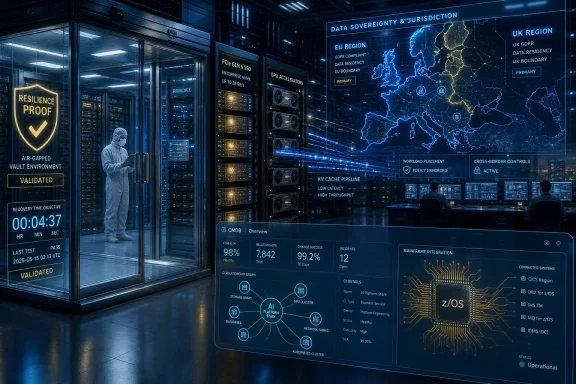 Storage Vendors Are Now Selling Proof, Not Just Capacity
The Blocks & Files storage news ticker published on 9 July 2026 reads like a catalog of enterprise anxiety. Commvault wants customers to measure how fast they can return to a clean state after an AI-assisted attack. FalconStor wants IBM Power shops to test recovery in a secure enclave. Rubrik is putting more than $500 million into the UK while attaching its cyber-resilience platform to the AWS European Sovereign Cloud. Precisely is pushing z/OS software inventory into ServiceNow because the supposedly modern CMDB still often has a mainframe-shaped blind spot.That is not a coincidence. Storage used to be evaluated around capacity, durability, latency, and cost per terabyte. Those still matter, but the purchasing conversation has shifted. Boards want to know whether the business can survive ransomware, regulators want to know where data is controlled, AI teams want to know whether infrastructure can feed accelerators without waste, and operations teams want inventories that include the old systems still running the money.
The most interesting thing about this set of announcements is that almost none of them is really “just storage.” Commvault’s Minutes to Recovery is a live cyber-resilience simulation. DDN’s work with Nebul is about large-scale AI inference performance in sovereign-hybrid cloud infrastructure. Samsung’s PM1763 is an SSD, but Samsung is pitching it for next-generation AI and HPC server environments. Rubrik’s UK expansion is partly a go-to-market move, partly a sovereignty move, and partly a bet that cyber resilience will remain a board-level budget line.
The through line is operational proof. Can you recover? Can you validate recovery? Can you discover the software running on your mainframe? Can you serve AI inference at scale? Can your sovereign-cloud posture survive procurement scrutiny? Vendors are learning that enterprise buyers no longer trust architecture diagrams alone. They want simulations, secure enclaves, support agreements, validated infrastructure claims, and named deployment models.
Commvault Turns Recovery Into a Two-Hour Combat Drill
Commvault’s announcement of Commvault Minutes to Recovery is the clearest example of the market’s pivot from theoretical readiness to measured performance. According to Commvault’s own launch material and the Blocks & Files report, Minutes to Recovery is a scenario-driven cyber-resilience simulation in which participants first act as attackers, using Frontier AI tools to run their own attacks, and then switch roles to defend against and recover from an incident under pressure. It is available globally as an onsite event, delivered in six languages, and completed in a single two-hour session.The important phrase is not “AI-driven cyberattacks,” even if that is the marketing hook. It is “Mean Time to Clean Recovery,” or MTCR. Commvault is trying to make MTCR the resilience equivalent of a board-readable metric: not how quickly an organization can restore something, but how quickly it can restore from a clean, trustworthy state after an attack has made ordinary assumptions dangerous.
That distinction matters because classic recovery metrics can flatter the organization. A recovery-time objective can sit comfortably in a planning document for years without being tested against compromised credentials, poisoned backups, isolated networks, executive panic, or forensic uncertainty. Commvault’s simulation format is designed to expose the gap between the plan and the actual recovery muscle.
There is a shrewd commercial angle here, of course. A vendor-led simulation naturally gives Commvault a way to frame the problem around the capabilities it wants customers to value. But the broader idea is sound: resilience that has not been exercised is not resilience; it is a hope with a spreadsheet attached. The more attackers use automation to compress the time between access, lateral movement, data theft, and extortion, the less credible it becomes for enterprises to treat recovery as a quarterly tabletop exercise.
The hacker-and-defender format is also a subtle admission that the security market’s old wall between “prevent the breach” and “recover from the breach” has collapsed. The same team that must understand how an attacker reaches critical data also needs to understand what a clean recovery path looks like after the attacker has touched identity, storage, backup consoles, and management planes. If participants can use Frontier AI tools in the offensive portion of the simulation, the defensive side has to assume a faster, noisier, and more adaptive incident than many organizations have rehearsed.
For Windows-heavy enterprises, the lesson is not that Commvault has invented a magic metric. It is that recovery should be measured against contaminated reality. Active Directory, endpoint management, backup credentials, service accounts, cloud consoles, and file shares all become part of the recovery problem once an attacker has moved from opportunistic malware to directed intrusion. MTCR is useful precisely because it forces IT and security teams to ask whether they can identify a clean recovery point, validate it, rebuild priority services, and do so under time pressure.
The risk is that MTCR becomes another acronym vendors staple to dashboards. The opportunity is that it becomes an uncomfortable rehearsal number: a measure that executives can understand and that administrators can improve through segmentation, immutable copies, recovery automation, identity hardening, and repeated testing.
Buyer action: Ask Commvault, or any resilience vendor making similar claims, to define exactly how “clean recovery” is measured, what evidence the exercise produces, which systems are included, and how the organization can repeat the test without turning it into a one-off workshop.
The Clean-Room Race Moves From Whiteboard to Infrastructure
FalconStor’s Cloud Clean Room announcement lands in the same conceptual neighborhood as Commvault’s simulation, but it approaches the problem from infrastructure rather than training. FalconStor Software announced FalconStor Cloud Clean Room as an on-demand infrastructure platform for IBM Power environments, giving organizations the ability to perform validated recovery testing inside a persistent secure enclave. Each test starts from a known-clean state and is designed to leave no carried-forward risk.That “known-clean” language is doing a lot of work. In a ransomware incident, the backup is not automatically the answer. The backup may be incomplete, too old, encrypted, misconfigured, or affected by the same compromise that damaged production. A clean-room model is meant to separate recovery validation from the very environment whose trustworthiness is in question.
FalconStor says the platform is built on its patent-pending Zero Trust Secure Enclave, or ZTSE, technology. It is designed as a standalone infrastructure layer that can be deployed across multiple use cases and integrated by third-party software vendors and service providers. FalconStor Habanero, the company’s existing managed offsite backup and archive vaulting solution for IBM i, IBM Power, and tape environments, is the first solution to be combined with the Cloud Clean Room.
The IBM Power focus is important. The broader security conversation often assumes x86 servers, cloud-native workloads, Windows endpoints, and SaaS control planes. But many enterprises still rely on IBM i, IBM Power, and tape-centered operational patterns for workloads that are old, critical, and poorly understood by newer security tooling. Those environments may not be fashionable, but they are often the systems where downtime is least tolerable.
FalconStor’s pitch also reflects a larger enterprise truth: recovery testing fails when it is too disruptive, too specialized, or too dependent on the same staff who are already overloaded maintaining production. By offering on-demand infrastructure and combining it with managed offsite backup and archive vaulting, FalconStor is trying to reduce the friction of validation. The most resilient architecture in the world is useless if the organization only dares to test it during an annual audit.
The practical consequence for administrators is that clean-room recovery is becoming a procurement category, not merely an architecture pattern. Buyers should ask hard questions. What does “known-clean” mean operationally? How are recovery points selected and validated? How is the enclave isolated from compromised identity systems? What evidence is produced after a test? Can the process be repeated without specialist heroics? How does it integrate with incident response, not just backup operations?
Commvault and FalconStor are not offering identical products, but they are responding to the same buyer fear. The board does not want to hear that backups exist. It wants to know whether the company can return to a trustworthy state after the attacker has tried to make trust itself expensive.
Buyer action: Require a demonstration of a full clean-room recovery workflow, including how the test starts, how isolation is maintained, how recovered data is validated, and what report is handed to security, audit, and executive teams afterward.
Rubrik Uses the UK to Turn Sovereignty Into a Cyber-Resilience Pitch
Rubrik’s announcement is larger in financial scope: more than $500 million, or £375 million, invested in the UK over the next five years, alongside a new London office serving as its EMEA headquarters. Rubrik also announced support for the AWS European Sovereign Cloud, with Rubrik Security Cloud available on that sovereign-cloud platform. The company said its UK business delivered a record first quarter and named Fortegra Financial Corporation, Harbour Energy, Manchester City Council, and the Scottish Government among new customers adopting its cyber-resilience platform.This is not just a real-estate story. It is Rubrik positioning itself around three overlapping enterprise pressures: cyber recovery, public-sector trust, and data sovereignty. The customer list matters because it spans financial services, energy, local government, and national government. Those sectors do not buy cyber-resilience platforms only because they like dashboards. They buy because the consequences of downtime, data loss, and regulatory failure are severe.
Rubrik says it now serves 2,000 customers across EMEA, nearly half of whom use three or more Rubrik products. That last clause is the commercial signal. Rubrik wants to move from backup and recovery into a broader cyber-resilience platform relationship, and multi-product adoption is the metric that shows whether customers are buying that story.
Support for the AWS European Sovereign Cloud adds another layer. Sovereign-cloud offerings are not only about geography; they are about legal exposure, operational control, procurement confidence, and the ability to tell regulators that sensitive workloads are being handled under a more constrained regime. For a cyber-resilience vendor, availability on a sovereign-cloud platform lets it participate in modernization conversations that might otherwise be limited by public-sector or regulated-industry requirements.
There is tension here. Rubrik is a US-headquartered company making a major UK and EMEA commitment while leaning into sovereign-cloud availability. That reflects the market’s compromise position. Many European and UK buyers want the scale and maturity of large cloud and security vendors, but they also want more local governance, local presence, and cloud models designed to answer sovereignty objections. Rubrik’s London EMEA headquarters is a corporate answer to that discomfort.
For WindowsForum readers managing Microsoft-heavy environments, the strategic takeaway is that data-protection purchasing is becoming inseparable from jurisdictional architecture. It is no longer enough to ask whether a product can protect Microsoft 365, SQL Server, Windows file services, or virtualized workloads. Enterprises increasingly need to know where metadata lives, how recovery copies are controlled, which cloud regions are involved, and whether the vendor’s operating model aligns with public-sector or regulated-industry constraints.
Rubrik’s UK investment does not prove it will win those deals. But it does show where the deals are moving. Cyber resilience is being sold not only as a technical feature but also as a regional commitment, a sovereignty posture, and a platform relationship.
Buyer action: Ask Rubrik, or any vendor making a sovereignty pitch, to map the exact control plane, metadata, support, recovery, and operational-access model for your deployment, not just the advertised cloud region or headline investment figure.
AI Infrastructure Is Forcing Storage Into the Accelerator Conversation
If Commvault, FalconStor, and Rubrik show the recovery side of the story, DDN, Nebul, and Samsung show the performance side. DDN has partnered with Europe’s Nebul to optimize large-scale AI inference performance through advanced KV Cache acceleration and high-performance data infrastructure for Nebul’s sovereign-hybrid cloud offerings. The collaboration uses DDN’s Infinia software and Nvidia GPU server gear, and DDN and Nebul are validating next-generation KV Cache acceleration capabilities designed to support Nvidia DSX-based AI factory deployments.That is a dense vendor paragraph, but the underlying point is simple: AI inference is no longer just a GPU problem. Large models generate heavy pressure on memory, networking, cache management, and storage. If the data path cannot keep accelerators fed efficiently, expensive GPU infrastructure can spend too much time waiting.
The mention of KV Cache acceleration is particularly telling. In transformer-based inference, key-value cache management is central to performance because the system must handle context and reuse intermediate state efficiently as models generate outputs. Storage vendors and data-infrastructure companies are now looking for ways to participate in that performance loop rather than sit outside it as a slower persistence layer.
The verified claim here should be kept narrow. DDN and Nebul are working around RoCE-based infrastructure validation, KV Cache acceleration, DDN Infinia, Nvidia GPU gear, and DSX-based AI factory support. That is enough to be meaningful without overstating the scope. It means the companies are trying to show that storage and data infrastructure can play a direct role in AI inference efficiency inside a sovereign-hybrid cloud context. It does not need to be inflated into a broader claim about future publications, vendor roadmaps, or unverified benchmarking programs.
RoCE validation matters because AI clusters are systems of bottlenecks. The storage software, network fabric, GPU servers, cache behavior, and workload shape all interact. A design that looks elegant in a diagram may behave differently once it is deployed as part of a real AI factory architecture. DDN and Nebul are effectively pointing to a more systems-level view of inference, where storage is judged by how it contributes to accelerator utilization and service delivery rather than by isolated storage metrics alone.
Samsung’s PM1763 announcement pushes the same argument at the device layer. Samsung has started mass production of its PCIe Gen 6-based PM1763 SSD in 3.84 TB, 7.68 TB, and 15.36 TB capacities. The drive is a 286-layer TLC SSD, with the source listing random read/write performance as 6.8 million and 950,000, sequential read speed of 28.4 GB/sec, and sequential write speed of 21.9 GB/sec. Samsung says that is more than twice the performance of its PCIe Gen 5-based PM1753 predecessor.
Samsung frames the PM1763 as an enterprise SSD for AI and HPC environments rather than a consumer enthusiast part. That distinction matters. PCIe Gen 6 storage is arriving first where throughput, power efficiency, thermals, and accelerator utilization can justify the cost and platform complexity. The relevant question for enterprise buyers is not whether the drive is “fast” in the abstract. It is whether the surrounding server, workload, cooling, and software stack can take advantage of that speed.
Samsung says PM1763 can transfer a 40-gigabyte large language model in approximately 1.4 seconds, helping reduce data latency between processors and accelerators. It also says the drive is optimized for next-generation, liquid-cooled AI and HPC server environments through direct-to-chip cooling technology, and claims 1.8x better power efficiency than PM1753.
The thermals are not incidental. AI servers are increasingly designed around dense accelerators, high-throughput networking, and liquid cooling because power and heat have become architectural constraints. A storage device that can move data faster but wrecks the thermal or power envelope is not a win. Samsung’s emphasis on direct-to-chip cooling and power efficiency shows that SSD design is being pulled into the same systems-level conversation as GPUs and networking.
For enterprise IT, the message is uncomfortable but useful: AI storage decisions cannot be made by the storage team alone. The relevant unit of analysis is the full AI pipeline. Model loading, inference context length, cache behavior, dataset movement, GPU utilization, network fabric, and facility cooling all shape whether a faster SSD or a new data platform actually improves business output.
Buyer action: For DDN-Nebul-style AI infrastructure, ask to see workload-specific validation that matches your inference pattern, network fabric, GPU platform, sovereignty requirements, and cache behavior. For Samsung PM1763-class devices, test the drive inside the target server and cooling design rather than relying only on headline SSD specifications.
The Day’s Announcements Split Into Three Enterprise Buying Motives
The announcements are easier to understand if they are grouped not by vendor category, but by the buyer anxiety they address. Some are about clean recovery. Some are about AI infrastructure efficiency. Some are about hybrid estate visibility and regional operating models.| Vendor or group | Move announced | Primary target | Proof point in the announcement | Why it matters |
|---|---|---|---|---|
| Commvault | Minutes to Recovery simulation | Security and IT teams | Two-hour onsite simulation producing MTCR | Turns recovery readiness into a tested metric |
| FalconStor | Cloud Clean Room | IBM Power environments | Validated recovery testing in a secure enclave | Gives legacy-critical estates a cleaner recovery model |
| Rubrik | UK investment and sovereign-cloud support | EMEA enterprises and public sector | More than $500 million over five years; London EMEA HQ | Connects cyber resilience with sovereignty and local presence |
| DDN and Nebul | AI inference optimization partnership | Sovereign-hybrid AI cloud | KV Cache acceleration, Infinia, Nvidia GPU server gear, RoCE validation | Moves storage into the AI factory performance path |
| Samsung | PM1763 PCIe Gen 6 SSD mass production | AI and HPC servers | 28.4 GB/sec sequential read and 21.9 GB/sec sequential write | Raises the device-level ceiling for accelerator-fed systems |
| Precisely | Ironstream z/OS Software Discovery for ServiceNow | Hybrid IT operations | Mainframe software inventory synchronized with ServiceNow CMDB | Makes mainframe assets visible in modern operations tooling |
| Databarracks | Acumen Business Services acquisition | UK continuity and resilience customers | 100+ clients added across financial services, healthcare, and manufacturing | Consolidates business continuity services into managed resilience |
| Scality and WEKA | Expanded France partnership | French enterprise storage buyers | Joint customer support agreement and in-country support | Localizes sales and tier-one support for a joint system |
That fragmentation is not a weakness. It is the shape of real enterprise computing. The same organization may be trying to run AI pilots, defend against ransomware, satisfy sovereignty requirements, modernize ServiceNow processes, and protect a mainframe estate that refuses to die because it still works. Vendors that pretend those problems are separate will miss how budgets are actually approved.
Mainframes Remain the Hybrid Estate’s Uncomfortable Blind Spot
Precisely’s Ironstream z/OS Software Discovery for ServiceNow announcement is less flashy than Samsung’s SSD or Rubrik’s investment, but for operations teams it may be just as consequential. Precisely announced Ironstream z/OS Software Discovery for ServiceNow software, now available in the ServiceNow Store. The product lets ServiceNow customers automatically discover mainframe software and bring it into the ServiceNow Configuration Management Database alongside the rest of the IT estate.This is the sort of announcement that sounds mundane until something breaks. Many enterprises run sophisticated IT service-management processes around distributed infrastructure while treating mainframe visibility as an exception, a manual feed, or a specialist-only domain. That creates a governance problem. If the CMDB does not accurately reflect what is running on z/OS, then incident response, change management, audit, software asset management, and service mapping all inherit a blind spot.
According to the source material, Ironstream z/OS Software Discovery runs directly on the mainframe to deliver a complete, continuously updated inventory of z/OS software and automatically synchronizes that data with the ServiceNow CMDB. Precisely frames the result as a reliable, audit-ready system of record for mainframe software, replacing manual processes and giving IT and operations teams a single source of truth.
The practical importance is not merely inventory. It is dependency awareness. When a Windows-based front end, a cloud integration layer, and a mainframe transaction system together deliver a business service, the outage path does not respect organizational silos. If ServiceNow sees only the cloud and distributed pieces, responders may misjudge impact, delay escalation, or approve changes without understanding mainframe dependencies.
For security teams, software discovery also intersects with vulnerability and compliance management. You cannot patch, compensate for, retire, or defend what you cannot see. That has been a familiar lesson in endpoint management for years, but mainframe estates are often excluded from the same operational discipline because they require specialist tooling and institutional knowledge.
Precisely’s move also illustrates a broader trend: modernization does not always mean replacing the old system. Sometimes modernization means making the old system visible to the tools that run the rest of the enterprise. That is less glamorous than rewriting applications, but it is often more realistic.
Buyer action: Ask Precisely how discovery data is collected on z/OS, how often it is synchronized with ServiceNow, how conflicts are handled, and whether the resulting CMDB records are detailed enough for audit, change, incident, and software asset management workflows.
Business Continuity Is Consolidating Because Customers Want a Managed Outcome
Databarracks’ acquisition of Acumen Business Services fits the same resilience narrative from a services angle. The UK continuity services firm acquired Acumen, the consultancy founded by Andy Osborne 20 years ago. It is Databarracks’ second acquisition of a standalone business continuity practice, following PlanB Consulting in 2024. Acumen brings more than 100 clients across financial services, healthcare, and manufacturing into Databarracks’ Business Resilience Managed Service.The pattern is straightforward: business continuity is moving from advisory documents toward managed resilience services. That does not mean planning disappears. It means customers increasingly want someone to help operationalize continuity across cyber incidents, outages, supplier failures, and regulatory expectations.
The Acumen client base is also telling. Financial services, healthcare, and manufacturing all have low tolerance for extended disruption, but many organizations in those sectors still operate a patchwork of backup tools, continuity plans, disaster-recovery contracts, tabletop exercises, and departmental workarounds. A managed resilience model promises to stitch those pieces together into something that can be governed and tested.
The acquisition also shows how cyber resilience is absorbing older continuity disciplines rather than replacing them. Before ransomware became a boardroom topic, business continuity teams were already asking how the organization would keep operating through site failures, supply-chain shocks, staff unavailability, and infrastructure outages. The cyber era has made those questions more urgent, but it has not made the old continuity skills obsolete.
Databarracks’ challenge will be integration. Buying a consultancy adds clients, expertise, and credibility, but managed resilience depends on repeatable delivery. Customers will want to know whether the acquired practice keeps its specialist knowledge while gaining better operational scale. They will also want to know how resilience services connect to technical recovery platforms, executive exercises, regulatory reporting, and day-to-day IT operations.
For IT leaders, the larger lesson is that resilience buying is no longer confined to storage arrays, backup licenses, or disaster-recovery sites. It increasingly includes advisory work, test orchestration, managed service delivery, audit support, and board communication. The vendor that helps prove continuity may become as important as the vendor that stores the copies.
Buyer action: Ask Databarracks or any continuity provider to show how advisory plans become recurring operational tests, how lessons are tracked, and how technical recovery evidence is connected to business-impact priorities.
Local Support Still Matters, Even in a Global Storage Market
Scality and WEKA’s expanded France partnership is a reminder that enterprise storage is not only won on architecture. It is also won through support geography, local relationships, and confidence in who answers the phone when something breaks.The two companies announced an expanded partnership in France, including a joint customer support agreement and in-country support. The point is not simply that Scality and WEKA want to sell more together. It is that buyers deploying complex storage and AI infrastructure often want local escalation paths, local language support, and a clear division of responsibility between vendors.
That matters because multi-vendor infrastructure can become messy at the exact moment customers need clarity. If a performance problem appears in a data-intensive environment, is the issue object storage, file storage, networking, compute, client behavior, software configuration, or workload design? A joint support agreement does not magically eliminate complexity, but it can reduce the finger-pointing risk that makes customers nervous about combined solutions.
France is also a useful example because local presence can carry particular weight in public sector, regulated industry, research, and large enterprise accounts. Procurement teams may care not only about performance and price, but also about where expertise resides, how support is delivered, and whether the vendor ecosystem has enough local depth to sustain the deployment after the sales team leaves.
For Scality and WEKA, the move supports a broader trend in which storage vendors partner around complementary architectures while trying to make the result feel like a coherent system. That is especially relevant as AI and analytics workloads blur the old boundaries between object storage, file storage, high-performance data platforms, and cloud-adjacent deployments.
For buyers, the practical issue is accountability. Partnerships are easy to announce and harder to operationalize. A joint support agreement is valuable only if the customer can see how tickets are routed, how escalations are handled, how severity is defined, and who owns resolution when both products are involved.
Buyer action: Ask for the joint support runbook before signing. Verify escalation paths, service-level commitments, named support contacts, local-language coverage, and how the vendors will reproduce and resolve cross-platform performance issues.
What Administrators Should Do With This News
For WindowsForum readers, the practical response to this announcement cluster is not to chase every product. It is to update the questions being asked in procurement, architecture review, and recovery planning. The market is moving from feature claims to proof claims, so buyers need to become more disciplined about demanding evidence.| Area | Question to ask now | Why it matters |
|---|---|---|
| Cyber recovery | Can we prove clean recovery under realistic attack assumptions? | Backups alone do not establish trust after compromise |
| Clean room | Can we validate recovery away from the compromised estate? | Recovery testing must not depend on the environment being trusted |
| Sovereignty | Where are data, metadata, support access, and control planes governed? | Region labels are not the same as operational sovereignty |
| AI infrastructure | Has the full inference pipeline been validated, not just the storage component? | GPU value is lost when data, cache, or network layers bottleneck |
| Mainframe visibility | Is z/OS software visible in the same system of record as distributed IT? | Hybrid operations fail when critical dependencies are invisible |
| Continuity services | Are continuity plans exercised and measured as an ongoing service? | Static plans decay quickly as systems and risks change |
| Local support | Who owns incidents across a joint solution in the customer’s country? | Multi-vendor architectures need clear operational accountability |
The administrators who will benefit most from this shift are not the ones who memorize every product name. They are the ones who translate announcements into controls, evidence, and runbooks. That is where the marketing language either becomes useful or collapses.
The Larger Signal: Storage Is Becoming a Trust Layer
The July 9 news wave is easy to misread as a set of unrelated product and channel updates. It is better understood as a map of where enterprise trust is being rebuilt.Commvault is trying to turn recovery into a measurable combat drill. FalconStor is turning clean-room recovery into infrastructure for IBM Power environments. Rubrik is tying cyber resilience to UK investment and sovereign-cloud availability. DDN and Nebul are pulling data infrastructure into the AI inference performance path. Samsung is pushing SSD design toward PCIe Gen 6 AI and HPC server requirements. Precisely is making mainframe software visible in ServiceNow. Databarracks is consolidating continuity expertise into managed resilience. Scality and WEKA are localizing joint support in France.
None of these moves alone defines the market. Together, they show storage and data infrastructure being pulled into four board-level questions: Can we recover? Can we comply? Can we understand what we run? Can we make AI infrastructure productive enough to justify its cost?
That is why “storage” is becoming an inadequate label. The sector is now part backup, part security, part sovereignty, part service management, part AI systems engineering, and part operational assurance. Capacity still matters. Performance still matters. Cost still matters. But they are increasingly judged inside a broader trust equation.
The forward-looking lesson is simple. The next storage buying cycle will reward vendors that can prove outcomes in the customer’s real operating context. Not just faster devices. Not just bigger platforms. Not just cleaner diagrams. Enterprises will want tested recovery, validated isolation, visible assets, local support, sovereign deployment options, and AI infrastructure that performs as a system.
For buyers, that is good news if they use the leverage. The right response to this wave of announcements is not cynicism. It is sharper procurement. Ask for proof. Ask for repeatability. Ask who owns the messy middle between products. Ask what happens during the third test, not just the first demo. In the AI and ransomware era, the storage layer is no longer just where data sits. It is where trust has to be demonstrated.
References
- Primary source: Blocks & Files
Published: 2026-07-09T19:00:22.024643
Loading…
www.blocksandfiles.com - Related coverage: ir.rubrik.com
Loading…
ir.rubrik.com - Related coverage: great.gov.uk
Loading…
www.great.gov.uk - Related coverage: pcgamer.com
Loading…
www.pcgamer.com - Related coverage: ddn.com
Loading…
www.ddn.com - Related coverage: precisely.com
Loading…
www.precisely.com