

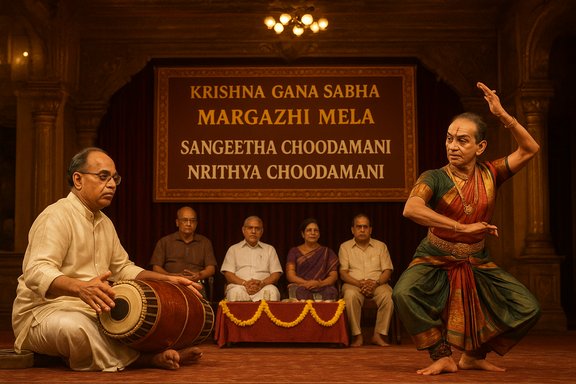
On the opening day of the 69th Margazhi Mela, the Krishna Gana Sabha placed a spotlight on two practitioners whose work bridges tradition and personal artistry: mridangam exponent K. V. Prasad was conferred the title Sangeetha Choodamani, and Bharatanatyam acharya G. Narendra received the Nrithya Choodamani distinction. The honours, presented during the Sabha’s inauguration programme on December 12, 2025, were celebrated as acknowledgements of long careers and distinctive artistic signatures — Prasad for his rhythmic clarity and balance, Narendra for the measured geometric grace and expressive abhinaya of his dance. Remarks made at the event praised both artistes’ technical command and stagecraft, while the ceremony itself underscored how established cultural institutions continue to define prestige in Chennai’s winter arts season.
At the same time, younger artists looking for models of innovation will watch whether the sabha’s future programming introduces a parallel logic of reward — one that explicitly honours experimentation, new choreography, and hybrid musical projects — alongside the traditional canon.
Source: The Hindu Mridangam exponent K.V. Prasad and bharatanatyam exponent G. Narendra honoured
 Background
The Margazhi Mela and Krishna Gana Sabha: a short primer
The Margazhi Mela is one of Chennai’s most stable seasonal cultural institutions, curated by the Krishna Gana Sabha. Running across late December and into early January, the Mela is a concentrated showcase of Carnatic music and Indian classical dance that attracts practitioners, connoisseurs, critics and students from across South India and beyond. Each year the Sabha confers two flagship awards at the Mela’s inauguration: Sangeetha Choodamani (for music) and Nrithya Choodamani (for dance). The awards traditionally carry a cash prize, a medallion and a citation, and are often used by the Sabha to honour living bearers of performance traditions whose work resonates with the Sabha’s aesthetic values.Institutional weight and cultural capital
For performers in Carnatic music and classical dance, recognition by a leading sabha is more than ceremonial. The Margazhi season remains the most visible calendar for serious careers in Chennai: festival slots, critical reviews, and institutional honours can shape invitations for the coming year, influence teaching demand, and determine archival attention. The Krishna Gana Sabha’s choices therefore play a real role in shaping which aesthetics and practices are elevated in the contemporary mainstream.The honours and the artists
K. V. Prasad — the mridangam voice of balance
K. V. Prasad is widely recognised in Carnatic circles for a deft, balanced accompaniment style. He has a long history of working with leading vocalists and instrumentalists, and his approach is often described as attentive to both musical detail and ensemble sound. Observers at the Margazhi Mela highlighted his capacity to deliver complex korvais with apparent spontaneity and a finely calibrated sonic balance that serves the larger musical conversation on stage.- Key attributes frequently noted in discussions of his work:
- Clarity of fingering and tonal projection.
- Structural command of korvai construction.
- A collaborative instinct for sound balance, ensuring the mridangam supports rather than overwhelms.
G. Narendra — geometric grace and expressive range
G. Narendra is a Bharatanatyam teacher, choreographer and performer with a background at vested institutions of training. Descriptions of his work at the inauguration emphasized geometric perfection, controlled choreography, and sensitive expressive abhinaya. Peers praised not only his technique but his ability to present choreography that is at once measured and emotionally legible.- Noted strengths in commentary around his award:
- Geometric precision in movement vocabulary.
- Expressive nuance in abhinaya that supports narrative clarity.
- A stage presence many described as charismatic without excess.
Contextual significance
Why these awards matter now
The Margazhi season remains the most consequential annual moment for South Indian classical arts. Awards announced at the inauguration function as early signals for programming trends and aesthetic priorities in the months and seasons that follow. By awarding a mridangam exponent and a Bharatanatyam acharya in the manner they did, the Sabha affirmed several implicit values:- A renewed respect for accompaniment and rhythmic craft, not just frontline virtuosity.
- A continuing preference for classical formalism combined with clear communicative intent in dance choreography.
- The institutional role of sabhas in curating and canonising taste across generations.
Public recognition vs. artistic ecosystems
Public honours like Sangeetha Choodamani and Nrithya Choodamani operate at the intersection of art and cultural infrastructure. They translate reputational capital into practical outcomes — increased visibility, potential for recording projects, and enhanced teaching demand. They also influence festival and sabha programming: winners become spokespersons for certain interpretative lineages or pedagogical emphases. That influence can be positive, sustaining excellence; it also carries the potential to ossify aesthetic preferences if not balanced with fresh curatorial vision.Critical reading of the ceremony and its language
The rhetoric of praise: what the laudations emphasized
Speakers at the inauguration highlighted technical mastery and artistic temperament. Two recurring motifs in remarks were:- For Prasad, commentators emphasized his role as a sonic equaliser — an accompanist who attends to balance and blend, able to “make sure everything is balanced and correct” both aesthetically and technically.
- For Narendra, praises centred on geometric precision and sensitive abhinaya, with some calling him a “rare artist” for the contemporary scene.
What the laudations did not foreground
The public remarks and the ceremonial framing did not extensively address several important dimensions:- Artistic risk-taking: there was little emphasis on experimental or cross-disciplinary work in the award rationale, suggesting a conservative bent in selection.
- Diversity and representation: beyond honouring the two named artistes, the framing didn’t address how underrepresented communities, younger artists, or alternative pedagogies are integrated into the Sabha’s honourscape.
- Audience engagement strategies: while technical excellence was foregrounded, there was less public discussion of how these recognitions translate into audience development or outreach beyond regular sabha audiences.
The broader cultural and institutional landscape
Sabhas, sponsors and the economics of prestige
A longstanding feature of Chennai’s cultural season is the partnership between sabhas and corporate patrons. At the inauguration, representatives from corporate partners and the sabha leadership were present and spoke to the long relationship between culture and banking or business support. The economic model that sustains large sabhas has several corollaries:- Sponsorships provide necessary financial stability, enabling prizes, artist fees and programming.
- Corporate patronage can shape event formats and visibility — sometimes pressuring institutions to prioritise certain headline acts or marketable names.
- Long-term partnerships can foster intergenerational continuity but also create dependencies that may constrain programming agility.
Tradition, lineages and training
Both awardees are products of established learning lineages and institutional training networks. That pedigree matters in Chennai’s ecosystem: lineage-based legitimacy continues to be a key credential for both performance and teaching opportunities. The awards therefore act to validate pedagogical lineages as much as individual artistry.- Benefit: lineage validation preserves technical standards and historical continuity.
- Risk: over-reliance on lineage definitions may limit recognition of new pedagogies or hybrid practices that sit outside classical transmission models.
Strengths highlighted by the awards
- Recognition of accompaniment: Awarding a mridangam exponent the Sangeetha Choodamani emphasises the centrality of percussion in concert architecture. This counters a front-line soloist bias and celebrates ensemble aesthetics.
- Emphasis on craft and clarity: Both honourees are celebrated for technical mastery — a healthy reinforcement of high performance standards.
- Institutional continuity: The Margazhi Mela’s persistence and ritualised honours sustain an artistic calendar that supports careers and provides a dependable public forum.
- Pedagogical signaling: Honouring artists with strong teaching roles underscores the importance of transmission and pedagogy for the future of the art forms.
Potential risks and areas for reflection
- Conservatism vs. innovation: When honours prioritise classical formalism without parallel celebration for risk-taking, institutions risk discouraging adventurous artists who could refresh the tradition.
- Gatekeeping and access: Awards that privilege entrenched lineages can inadvertently reinforce barriers to entry for talented artists from less traditional backgrounds or from regions outside Chennai.
- Commercialization pressures: Corporate sponsorship is necessary but can influence programming decisions; transparency around selection criteria and prize funding could mitigate perceptions of undue influence.
- Visibility for younger artists: The awards confer spotlight primarily on senior practitioners. Complementary recognition streams for emerging artists and experimental work could balance the ecosystem.
- Archival and digital strategy shortcomings: As performance culture moves increasingly online, sabhas must develop robust archival and digital access strategies so awards produce durable public records and reach broader audiences.
Recommendations for sabhas and stakeholders
- Strengthen transparency in award selection
- Publish selection criteria and panel composition annually.
- Create parallel awards for innovation and emerging artists
- Shortlists and residencies for younger performers would decentralise prestige.
- Expand outreach and touring
- Use award cycles to fund regional tours that bring laureates to smaller cities and towns.
- Invest in digital archives
- Record and release high-quality documentation of recipient performances and lectures for public access.
- Promote pedagogical diversity
- Support cross-institutional teaching residencies to encourage knowledge exchange beyond lineage boundaries.
- Foster community engagement
- Leverage award announcements to fund workshops and community classes led by laureates.
- Ensure sponsorship transparency
- Make the structure of sponsorships and their roles in funding clear to preserve institutional autonomy.
What these recognitions mean for audiences and younger musicians
For audiences, the recognition of K. V. Prasad and G. Narendra is an affirmation of the performance values that shape much of Chennai’s concert culture: ensemble balance, technical exactitude, and articulate storytelling in dance. For younger musicians and students, the awards serve as both inspiration and a reminder of what is culturally rewarded: disciplined practice, deep pedagogical foundations, and the ability to communicate craft to a public.At the same time, younger artists looking for models of innovation will watch whether the sabha’s future programming introduces a parallel logic of reward — one that explicitly honours experimentation, new choreography, and hybrid musical projects — alongside the traditional canon.
A closer look: balance, sound and abhinaya — technical notes
Mridangam accompaniment: more than rhythm
The mridangam’s role in a Carnatic ensemble is often described reductively as “keeping time.” The work of performers like K. V. Prasad complicates that notion. Modern accompanists are expected to deliver:- Dynamic balance: matching tonal quality to vocal or instrumental timbres so that the drum’s resonance complements the melodic line.
- Structural phrasing: crafting korvais and tani avartanams that reflect, mirror and augment the main artist’s interpretative choices.
- Interactive listening: anticipating and responding to improvisational moves in a way that sustains musical coherence.
Bharatanatyam: geometry and emotional register
Bharatanatyam’s vocabulary is built on precise body lines, rhythmic phrasing and an expressive repertoire of facial micro-expressions (abhinaya). The artistic praise for G. Narendra stressed:- Geometric precision: careful lines and measured spatial choreography that highlight classical grammar.
- Sensitive abhinaya: calibrated emotional expression that supports storytelling without theatrical excess.
Flagging unverifiable or limited claims
Some specific quotations and fine-grain descriptions used in public remarks at the inauguration were circulated in press briefings associated with the event. While event statements are consistent in praising technical mastery and stage presence for both artistes, independent confirmation of every direct quotation or paraphrase from every speech was not uniformly available across all secondary outlets at the time of writing. The broad factual claims — the awards, recipients, date of inauguration, and the general tenor of the laudations — are confirmed by multiple reputable accounts summarising the event; however, verbatim attribution for some remarks relied on contemporary press reporting from the inauguration.Looking forward: sustaining a living tradition
The Margazhi Mela’s ceremony and the honours it bestows are a ritualised moment of collective memory-making in Chennai’s classical arts ecosystem. They mark careers and signal institutional priorities. The recognition of K. V. Prasad and G. Narendra reminds practitioners and audiences that technical mastery, ensemble sensitivity and interpretive clarity remain central to what the sabha system rewards. Yet the future vitality of Carnatic music and Bharatanatyam will depend equally on the capacity of sabhas to broaden their field of honour and invest in outreach, archiving and innovation.- Maintain ritual excellence while expanding the circle of recognition.
- Use awards not only to celebrate past achievement, but to seed future creativity.
- Balance reverence for lineage with active support for new voices and pedagogies.
Conclusion
The Krishna Gana Sabha’s decision to honour K. V. Prasad with Sangeetha Choodamani and G. Narendra with Nrithya Choodamani at the Margazhi Mela’s inauguration is a deliberate recommitment to craft, balance and classical clarity. The choices reflect a sabha culture that prizes technical depth and pedagogical lineage, while reminding audiences of the ensemble sensibilities that make Carnatic concerts and Bharatanatyam performances resonate. At the institutional level, these recognitions are opportunities: to celebrate artistry, to reaffirm standards, and to reassess how honours can also foster innovation, inclusivity and wider public engagement. The challenge ahead for sabhas and patrons alike is to preserve the tradition’s heart while widening the aperture — so that recognition sustains both what is valued now and what will be vital tomorrow.Source: The Hindu Mridangam exponent K.V. Prasad and bharatanatyam exponent G. Narendra honoured
