

LinkedIn Speak may be absurd, but it is also a neat reminder that translation tools are no longer just for languages. Kagi Translate’s new preset shows how far modern AI-powered text transformation has come: it can take plain English and render it in a voice that feels like it was written by someone trying to land a keynote slot, a promotion, or both. The joke works because the output is painfully recognizable—all optimism, no friction, and just enough emoji to make your skin crawl.
For years, translation software has been judged on a fairly narrow set of criteria: accuracy, speed, language coverage, and whether it mangles idioms into something unintentionally funny. Tools like Google Translate, DeepL, and Microsoft’s own translation features established a baseline expectation that translation should preserve meaning while smoothing over awkward phrasing. Kagi Translate entered that market with a privacy-first pitch and a promise of context-aware output, which gave it room to experiment beyond simple language conversion.
That is what makes the LinkedIn Speak preset so interesting. It is not a translation in the classic sense, because it does not cross linguistic borders. Instead, it crosses register—the social and rhetorical style of a sentence. Rather than changing English to Spanish or Japanese, it changes ordinary statements into the polished, self-congratulatory cadence people associate with professional networking platforms.
Microsoft’s $26 billion acquisition of LinkedIn was a reminder that the service is more than a digital résumé warehouse. LinkedIn became a major layer in the professional internet, where personal branding, recruiting, sales outreach, and thought leadership all blur together. That context matters because the platform’s language has evolved into its own dialect, one that rewards confidence, abstraction, and positivity over directness.
Kagi’s joke lands because it turns that dialect into a feature. Instead of leaving users to manually imitate corporate speech, it offers a shortcut to the same output: high-energy phrasing, upbeat framing, and a relentless refusal to sound bored. The result is both funny and revealing, because it highlights how formulaic professional communication has become online.
What seems like a novelty feature also reflects a larger trend in AI tools. Generative systems are increasingly being used not just to translate content, but to rewrite intent—to adapt tone, audience, and even persona. That opens the door to productivity gains, but also to more synthetic communication that can obscure how a writer actually thinks.
This kind of phrasing is not random. It is an evolved survival language for platforms where every sentence is potentially being judged by recruiters, managers, clients, or future coworkers. The result is a style that treats uncertainty as weakness and turns modest achievements into strategic milestones.
That predictability is exactly why tools like Kagi Translate can automate it. Once the system understands the tone, it can reproduce the style with uncanny consistency. What was once a skill—learning how to sound appropriately ambitious—starts looking like a template.
That makes the style annoying but rational. Users are not necessarily trying to deceive anyone. They are often trying to sound engaged, promotable, and low-risk in a space where the audience includes people who influence careers.
The LinkedIn Speak preset is interesting because it sits somewhere between translation and rewriting. It is not simply substituting synonyms. It is changing the social texture of the text, making the original voice sound like a polished professional persona.
This is where AI-powered text tools start to feel less like dictionaries and more like collaborators. They can not only say what you meant in another language, but also say it in another emotional register. That is useful, but it also raises questions about authenticity.
In practical terms, this can be helpful for users who need to adapt the same content for different audiences. In more playful terms, it is a machine-built persona generator for anyone who wants to sound strategically aligned without doing the writing themselves.
The business model also matters because the feature reinforces Kagi’s broader brand identity. It wants to be the privacy-respecting, ad-free alternative to mainstream tools, but it also wants to be the clever one. LinkedIn Speak is memorable not because it is essential, but because it is distinctive.
What makes it especially effective is the way it removes friction. Normal human speech contains hesitation, skepticism, and occasional deadpan honesty. LinkedIn Speak strips that away and replaces it with a high-gloss confidence layer that makes everything sound mission-critical.
That’s why the joke lands as gloriously cursed. The translation is not random nonsense; it is socially legible nonsense. It sounds exactly like the kind of thing a human would write after spending too much time in the professional feedback loop.
A few reasons the style feels instantly recognizable:
That tension is what gives the translation its bite. The emoji does not change the message; it just helps package the message in a way that feels more socially acceptable. It is a tiny symbol of the entire platform’s performance economy.
That matters because many people do not need a perfect translation; they need a usable rewrite. If you are preparing a job post, an outreach message, or a company update, tone can matter almost as much as meaning.
The risk, however, is that the output becomes too uniform. If everyone uses the same rewrite layer, messaging starts to converge into the same polished corporate mush. That may improve consistency, but it can also flatten personality.
That duality is important. People use these tools both to be productive and to be funny, and sometimes the line between the two disappears. A person can polish a post and simultaneously make a joke about how polished it looks.
That strategy is smart because it acknowledges a basic truth: most users do not care about translation technology in the abstract. They care about whether the output is useful, the interface is pleasant, and the service feels trustworthy.
In that context, a playful feature like LinkedIn Speak becomes more than a meme. It reinforces the idea that Kagi can be both privacy-respecting and creatively flexible. That combination is rare enough to stand out.
That does not mean humor replaces utility. It means humor can amplify discovery. Users try the feature for the joke, then stay because the core product is actually solid.
Professional communication increasingly rewards clarity wrapped in optimism. The challenge is that this can slide into empty branding language if every sentence is optimized to sound impressive rather than informative.
The danger is that template thinking reduces the room for voice. When every message is polished through the same lens, audiences may stop trusting the sincerity of the message. Sounding professional can become a substitute for being substantive.
That does not mean everyone should start posting blunt hot takes. It means the market may eventually reward voices that feel human, not merely optimized. In a sea of polished updates, the person who sounds specific may be the one who is remembered.
This matters because style transformation is often more commercially useful than pure translation. Businesses care about getting messages into the right tone for the right audience, and consumers care about sounding like they belong in a particular setting.
If a manager assumes a recruit wrote a post themselves, but the text was heavily transformed by AI, the audience is responding to a mediated persona. That is not automatically bad, but it is worth noticing. The more invisible the rewrite, the more powerful—and potentially misleading—it becomes.
That is the real significance of the LinkedIn Speak joke. It is not just a parody of one platform’s culture. It is a preview of a future where style itself becomes a selectable feature.
What makes this category worth watching is not the novelty itself. It is the idea that users are increasingly asking software to help them sound like someone else depending on context. That shift could reshape not just translation, but how people think about drafting, editing, and presenting themselves online.
The real joke is not that a machine can speak LinkedIn. The joke is that so much of LinkedIn already speaks machine.
Source: Windows Central https://www.windowscentral.com/soft...edin-speak-and-its-as-cursed-as-youd-imagine/
 Background
For years, translation software has been judged on a fairly narrow set of criteria: accuracy, speed, language coverage, and whether it mangles idioms into something unintentionally funny. Tools like Google Translate, DeepL, and Microsoft’s own translation features established a baseline expectation that translation should preserve meaning while smoothing over awkward phrasing. Kagi Translate entered that market with a privacy-first pitch and a promise of context-aware output, which gave it room to experiment beyond simple language conversion.That is what makes the LinkedIn Speak preset so interesting. It is not a translation in the classic sense, because it does not cross linguistic borders. Instead, it crosses register—the social and rhetorical style of a sentence. Rather than changing English to Spanish or Japanese, it changes ordinary statements into the polished, self-congratulatory cadence people associate with professional networking platforms.
Microsoft’s $26 billion acquisition of LinkedIn was a reminder that the service is more than a digital résumé warehouse. LinkedIn became a major layer in the professional internet, where personal branding, recruiting, sales outreach, and thought leadership all blur together. That context matters because the platform’s language has evolved into its own dialect, one that rewards confidence, abstraction, and positivity over directness.
Kagi’s joke lands because it turns that dialect into a feature. Instead of leaving users to manually imitate corporate speech, it offers a shortcut to the same output: high-energy phrasing, upbeat framing, and a relentless refusal to sound bored. The result is both funny and revealing, because it highlights how formulaic professional communication has become online.
What seems like a novelty feature also reflects a larger trend in AI tools. Generative systems are increasingly being used not just to translate content, but to rewrite intent—to adapt tone, audience, and even persona. That opens the door to productivity gains, but also to more synthetic communication that can obscure how a writer actually thinks.
Why LinkedIn Speak Exists
LinkedIn Speak is not really about language; it is about incentives. On a platform built around professional reputation, users quickly learn that polished optimism tends to get more attention than blunt honesty. A post that says “I’m exhausted and this project was chaotic” is less likely to circulate than one that says “Excited to share lessons learned from a transformative cross-functional initiative.”This kind of phrasing is not random. It is an evolved survival language for platforms where every sentence is potentially being judged by recruiters, managers, clients, or future coworkers. The result is a style that treats uncertainty as weakness and turns modest achievements into strategic milestones.
The corporate tone is the product
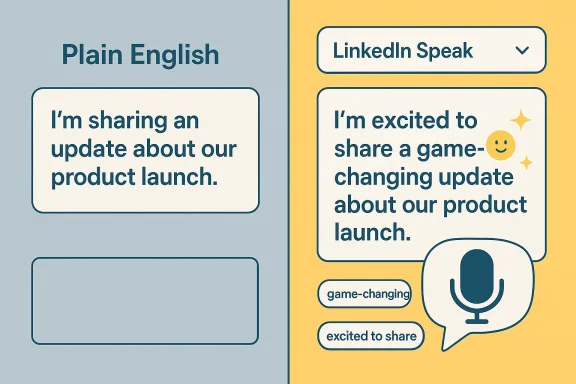
The funniest part of the Kagi experiment is that it exposes the production value behind corporate language. LinkedIn Speak often sounds impressive because it is built from familiar modular pieces: “excited to announce,” “thrilled to share,” “game-changing,” “thought leadership,” and “value-add.” Users can mix and match these elements the way a marketer assembles a campaign.That predictability is exactly why tools like Kagi Translate can automate it. Once the system understands the tone, it can reproduce the style with uncanny consistency. What was once a skill—learning how to sound appropriately ambitious—starts looking like a template.
- It emphasizes positivity over specificity.
- It turns individual effort into “team impact.”
- It reframes routine work as strategic leadership.
- It adds emojis and hashtags as social proof.
- It keeps the emotional temperature permanently elevated.
Why people still use it
There is also a practical reason LinkedIn Speak persists: it signals fluency in a professional environment. Many people do not enjoy writing this way, but they still do it because it helps them fit the norms of the platform. In that sense, the jargon is not merely vanity; it is a form of social alignment.That makes the style annoying but rational. Users are not necessarily trying to deceive anyone. They are often trying to sound engaged, promotable, and low-risk in a space where the audience includes people who influence careers.
What Kagi Translate Is Doing Differently
Kagi Translate is best known as a privacy-focused translation tool with broad language support and a clean interface. According to Kagi’s own documentation, it supports 248+ languages and offers text, website, document translation, proofreading, dictionary features, and browser integrations. It is designed to preserve meaning and tone, which makes it a natural platform for style-based experimentation.The LinkedIn Speak preset is interesting because it sits somewhere between translation and rewriting. It is not simply substituting synonyms. It is changing the social texture of the text, making the original voice sound like a polished professional persona.
From language conversion to tone conversion
Traditional translation attempts to keep the author’s intent intact while changing the words. Kagi’s LinkedIn Speak mode does something more interpretive: it keeps the message but alters the presentation. That is a subtle but meaningful distinction.This is where AI-powered text tools start to feel less like dictionaries and more like collaborators. They can not only say what you meant in another language, but also say it in another emotional register. That is useful, but it also raises questions about authenticity.
In practical terms, this can be helpful for users who need to adapt the same content for different audiences. In more playful terms, it is a machine-built persona generator for anyone who wants to sound strategically aligned without doing the writing themselves.
The free tier angle matters
Kagi says the Translate service is free for everyone, with paid members getting advanced features such as document translation and extended capabilities. That helps explain why features like LinkedIn Speak can spread quickly: they are easy to try, low-friction, and immediately entertaining. The humor is a form of distribution.The business model also matters because the feature reinforces Kagi’s broader brand identity. It wants to be the privacy-respecting, ad-free alternative to mainstream tools, but it also wants to be the clever one. LinkedIn Speak is memorable not because it is essential, but because it is distinctive.
Why the Joke Works So Well
The output Kagi produced in the example is funny because it captures the rhythms of online performative professionalism almost too well. It is enthusiastic, vague, and packed with phrases that feel designed to minimize dissent. It has the same synthetic positivity people associate with career posts, startup announcements, and “excited to share” updates.What makes it especially effective is the way it removes friction. Normal human speech contains hesitation, skepticism, and occasional deadpan honesty. LinkedIn Speak strips that away and replaces it with a high-gloss confidence layer that makes everything sound mission-critical.
The absurdity of endless optimism
There is something inherently comic about language that never admits anything is merely okay. In LinkedIn Speak, ordinary actions become outcomes, outcomes become learnings, and learnings become frameworks. A coffee chat becomes a “valuable alignment conversation,” and a finished task becomes a “major milestone.”That’s why the joke lands as gloriously cursed. The translation is not random nonsense; it is socially legible nonsense. It sounds exactly like the kind of thing a human would write after spending too much time in the professional feedback loop.
A few reasons the style feels instantly recognizable:
- It overuses abstract nouns.
- It inflates small wins into strategic wins.
- It replaces candid emotion with polished enthusiasm.
- It makes humblebragging sound like best practice.
- It treats networking as a moral good.
Emoji as emotional insulation
The emoji use is part of the joke too. In ordinary messaging, emojis can soften tone or add warmth. In LinkedIn Speak, they often act like decorative padding around a sales pitch. They make the text look friendlier without making it more honest.That tension is what gives the translation its bite. The emoji does not change the message; it just helps package the message in a way that feels more socially acceptable. It is a tiny symbol of the entire platform’s performance economy.
The Real Utility Behind the Comedy
It would be easy to dismiss LinkedIn Speak as a gag feature, but there is a real utility story underneath it. Users increasingly want tools that can adapt content for specific contexts, whether that means simplifying language, changing formality, or making a message sound more persuasive. Kagi Translate’s broader feature set already includes style and formality controls, which makes tone shifting a natural extension.That matters because many people do not need a perfect translation; they need a usable rewrite. If you are preparing a job post, an outreach message, or a company update, tone can matter almost as much as meaning.
Enterprise communication and the new rewriting layer
For enterprise users, this kind of feature could become a lightweight content-assist tool. Sales teams, recruiters, internal communications staff, and marketers all spend time tuning language to match audience expectations. A system that can quickly move a sentence into a more formal or more polished register could save time.The risk, however, is that the output becomes too uniform. If everyone uses the same rewrite layer, messaging starts to converge into the same polished corporate mush. That may improve consistency, but it can also flatten personality.
Consumer use is mostly about self-expression
For ordinary users, the appeal is different. The feature is funny because it lets people play with identity, parody workplace culture, and mock the very norms they are using. It is a performative parody machine as much as a translation tool.That duality is important. People use these tools both to be productive and to be funny, and sometimes the line between the two disappears. A person can polish a post and simultaneously make a joke about how polished it looks.
Kagi’s Position in the Translation Market
Kagi’s translation tools exist in a crowded space dominated by big, familiar names. Google Translate has massive reach and broad brand recognition, while DeepL has built a reputation around natural-sounding output and high-quality phrasing. Kagi’s differentiation is not just translation quality; it is the experience around translation, with privacy, ad-free use, and a more opinionated product design.That strategy is smart because it acknowledges a basic truth: most users do not care about translation technology in the abstract. They care about whether the output is useful, the interface is pleasant, and the service feels trustworthy.
Privacy as a differentiator
Kagi’s documentation emphasizes secure processing and the absence of personal data storage on its servers, while also noting that translation history is stored locally by default. That kind of positioning matters increasingly in a market where users are wary of how their text might be reused.In that context, a playful feature like LinkedIn Speak becomes more than a meme. It reinforces the idea that Kagi can be both privacy-respecting and creatively flexible. That combination is rare enough to stand out.
Humor as product strategy
There is also a marketing lesson here. Consumers remember products that surprise them. A translation tool that can suddenly turn your plain text into a hyper-corporate LinkedIn monologue is far more shareable than yet another “fast, accurate, and secure” pitch.That does not mean humor replaces utility. It means humor can amplify discovery. Users try the feature for the joke, then stay because the core product is actually solid.
How This Affects Professional Writing Norms
Tools like LinkedIn Speak are more than novelty filters; they also reveal how much professional writing already depends on formula. If AI can imitate the style convincingly, then the style itself was probably standardized long before the machine arrived. That is an uncomfortable but useful insight.Professional communication increasingly rewards clarity wrapped in optimism. The challenge is that this can slide into empty branding language if every sentence is optimized to sound impressive rather than informative.
The rise of template thinking
A lot of workplace writing now starts from templates, not from blank pages. Email intros, status updates, self-promotions, company announcements, and recruitment posts all use recognizable scaffolding. That makes them easy targets for automation.The danger is that template thinking reduces the room for voice. When every message is polished through the same lens, audiences may stop trusting the sincerity of the message. Sounding professional can become a substitute for being substantive.
Authenticity becomes a competitive advantage
This is where the irony gets interesting. If LinkedIn Speak becomes common, the people who stand out may be those who write with more directness and fewer buzzwords. The very existence of a corporate-speak translator could make authenticity feel more valuable.That does not mean everyone should start posting blunt hot takes. It means the market may eventually reward voices that feel human, not merely optimized. In a sea of polished updates, the person who sounds specific may be the one who is remembered.
The Broader AI Trend: Style as a Service
Kagi’s feature fits a larger wave of AI tools that increasingly focus on style manipulation rather than raw generation. Users can already ask systems to make text shorter, friendlier, more formal, more persuasive, or more SEO-friendly. LinkedIn Speak is just a particularly funny example of this pattern.This matters because style transformation is often more commercially useful than pure translation. Businesses care about getting messages into the right tone for the right audience, and consumers care about sounding like they belong in a particular setting.
The fine line between assistance and impersonation
When a tool rewrites text in your voice, it is assisting you. When it rewrites text into a very different social persona, it starts to edge into impersonation. That may sound dramatic, but it matters in professional contexts where tone is part of trust.If a manager assumes a recruit wrote a post themselves, but the text was heavily transformed by AI, the audience is responding to a mediated persona. That is not automatically bad, but it is worth noticing. The more invisible the rewrite, the more powerful—and potentially misleading—it becomes.
Why the future may be all about modes
The next generation of AI writing tools may not be judged primarily on how much they can generate. It may be judged on how many modes they can inhabit. Friendly, formal, concise, persuasive, brand-safe, academic, executive, conversational, and yes, gloriously corporate.That is the real significance of the LinkedIn Speak joke. It is not just a parody of one platform’s culture. It is a preview of a future where style itself becomes a selectable feature.
Strengths and Opportunities
Kagi Translate’s LinkedIn Speak mode is funny on the surface, but it also demonstrates how flexible modern language tools have become. The feature combines novelty, usefulness, and brand differentiation in a way that gives Kagi a memorable edge.- It showcases tone transformation rather than just language translation.
- It makes Kagi’s product feel distinctive in a crowded market.
- It gives users a low-stakes way to experiment with professional voice.
- It reinforces Kagi’s privacy-first positioning.
- It creates viral, shareable moments that can attract new users.
- It suggests a path toward more advanced style presets.
- It can be useful for professional rewriting and audience adaptation.
Risks and Concerns
For all its charm, a feature like LinkedIn Speak also highlights some real concerns about AI-assisted writing. Once tone rewriting becomes effortless, the line between authentic communication and polished performance gets even thinner.- It may encourage generic corporate language instead of clarity.
- It could make professional communication feel even more scripted.
- It may reduce the visible personality of the original writer.
- It can create confusion about how much text was machine-generated.
- It risks normalizing synthetic sincerity in workplace messaging.
- It may tempt users to optimize for impression rather than substance.
- It could become a crutch for people who should be writing more directly.
Looking Ahead
The most likely future for features like LinkedIn Speak is expansion. Today it is a joke mode; tomorrow it may be one of many style presets used for everything from hiring to marketing to internal communications. Kagi’s broader translation roadmap suggests the company is comfortable with experimentation, and that openness could make it a meaningful player in the next wave of AI writing tools.What makes this category worth watching is not the novelty itself. It is the idea that users are increasingly asking software to help them sound like someone else depending on context. That shift could reshape not just translation, but how people think about drafting, editing, and presenting themselves online.
- Watch for more style-specific presets beyond LinkedIn Speak.
- Look for deeper integration with browsers and document tools.
- Expect competitors to add more tone-based writing modes.
- Pay attention to whether users prefer honest voice or polished output.
- See whether professional platforms tolerate or encourage AI tone shaping.
The real joke is not that a machine can speak LinkedIn. The joke is that so much of LinkedIn already speaks machine.
Source: Windows Central https://www.windowscentral.com/soft...edin-speak-and-its-as-cursed-as-youd-imagine/
