
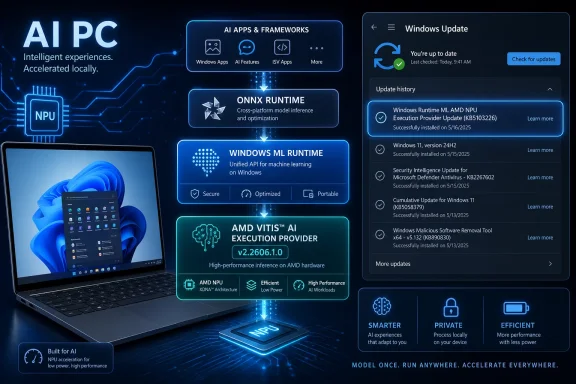
Microsoft is automatically distributing KB5103226, the AMD Vitis AI Execution Provider update version 2.2606.1.0, through Windows Update for Windows 11 version 24H2 and version 25H2 PCs that already have the latest cumulative update installed, where it appears in Update history as a Windows Runtime ML AMD NPU Execution Provider update. The patch is small in presentation but large in implication: Microsoft is treating AI acceleration less like an optional developer add-on and more like a living Windows component. That matters because the next generation of Windows performance will increasingly depend on vendor-specific inference plumbing that most users never see. KB5103226 is one more sign that the “AI PC” is becoming an update channel as much as a hardware category.
KB5103226 is not a flashy feature drop. It does not promise a redesigned Copilot interface, a new Recall setting, or a visible NPU benchmark in Settings. Instead, it updates the AMD Vitis AI Execution Provider, the layer that allows ONNX Runtime and Windows machine learning workloads to route supported inference tasks to AMD acceleration hardware.
That makes it easy to overlook. Windows users are trained to pay attention to cumulative updates, security patches, driver packages, and the occasional feature enablement switch. Execution providers live several layers below the familiar Windows experience, between application code and the silicon that actually runs machine learning operations.
But that hidden position is exactly why this update is worth watching. Microsoft’s Windows ML direction depends on a model in which hardware-specific acceleration can be acquired, updated, and selected dynamically, rather than bundled into every app or frozen at the driver version a PC shipped with. KB5103226 is a servicing artifact from that strategy.
The update applies to Windows 11 version 24H2 and Windows 11 version 25H2, provided the device has the latest cumulative update installed. It replaces KB5096134, which means this is not a one-off package but part of a continuing cadence for AMD’s Windows ML acceleration stack.
For the average user, that may sound abstract. For developers, OEMs, and admins, it is the shape of things to come: Windows Update is no longer just patching the operating system around AI workloads. It is increasingly patching the AI execution substrate itself.
AMD’s Vitis AI stack is AMD’s toolkit for hardware-accelerated inference. On Windows, the relevant piece here is the Vitis AI Execution Provider, which lets compatible workloads target AMD platforms including Ryzen AI processors, AMD adaptable SoCs, and Alveo data center acceleration cards. In the Windows 11 client context, the most visible audience is the Ryzen AI class of PCs.
This is not the same thing as a conventional display driver update. A GPU driver exposes graphics and compute capabilities broadly; an execution provider is more narrowly tied to how machine learning graphs are partitioned, optimized, and dispatched. It sits closer to the app framework and runtime than many users would expect.
That position gives Microsoft a useful lever. If Windows ML can acquire certified execution providers through Windows mechanisms, developers can write against ONNX Runtime and Windows ML APIs without packaging every vendor backend themselves. The app becomes less responsible for knowing every PC’s silicon layout, while Windows becomes more responsible for keeping the acceleration path current.
The tradeoff is obvious: the more Windows owns this path, the more Windows Update becomes part of the AI application compatibility story. KB5103226 is therefore not just an AMD component refresh. It is Microsoft asserting that AI acceleration belongs inside the normal maintenance rhythm of the OS.
Routine is valuable in infrastructure. The best possible version of an execution provider update is one that arrives automatically, improves compatibility or performance, and never forces the user to learn what graph partitioning means. In that sense, KB5103226 resembles the kind of plumbing update Windows has long delivered for certificates, servicing stacks, codecs, and hardware compatibility databases.
The difference is that AI acceleration is politically and commercially loaded in a way codecs are not. Microsoft, AMD, Intel, Qualcomm, and NVIDIA are all trying to make their hardware the preferred local inference target for the next wave of applications. The execution provider is where those ambitions meet the operating system.
That means a small KB article can carry a lot of platform strategy. Windows ML gives Microsoft a way to normalize hardware-specific AI acceleration without asking every app developer to build separate packages for every vendor. At the same time, it gives silicon vendors a route into Windows applications that is more standardized than bespoke SDK integration.
The result is a subtler kind of platform control. Microsoft is not merely adding AI features to Windows; it is building the distribution and selection machinery that determines which local AI hardware gets used, when it gets used, and how quickly that support improves after a PC ships.
For managed fleets, this reinforces a familiar reality: AI readiness will not be a single procurement decision. Buying NPU-equipped PCs is only the beginning. Keeping those machines useful for local inference will require Windows builds, cumulative updates, drivers, app frameworks, and execution providers to remain aligned.
That complicates validation. A business may standardize on a Ryzen AI laptop model and still see different behavior across rings if one group has the latest cumulative update and another does not. If an app relies on Windows ML’s dynamic provider acquisition, the presence or absence of a KB like this can become part of troubleshooting.
It also changes what “fully patched” means. Historically, administrators could think of quality updates and driver updates as separate tracks, with application runtimes handled by packaging teams. Windows ML blurs those boundaries. The OS update channel can now determine whether a vendor-specific AI backend is present and current.
This is manageable, but it requires discipline. IT teams that plan to support local AI workloads should inventory not only Windows version and driver level, but also the execution providers installed on supported devices. The Settings app’s Update history entry is a basic user-facing check, but enterprise tooling will need to catch up if these packages become common.
The challenge for AMD is not merely raw hardware capability. It is ecosystem friction. Developers do not want to maintain a separate inference path for every silicon vendor unless the payoff is overwhelming. A Windows-managed execution provider lowers that friction by making AMD acceleration accessible through common Windows ML and ONNX Runtime patterns.
That does not guarantee every model will accelerate beautifully. Developers still have to optimize models, understand supported operators, test behavior across hardware, and decide whether to prefer performance, efficiency, or predictability. Microsoft’s own Windows ML guidance makes clear that distributing execution providers is not the same as automatically optimizing every model.
Still, this is the right abstraction for the market Microsoft and AMD are trying to build. If local AI is supposed to move from novelty to normal application behavior, developers need a supported route that does not require turning every Windows app into a hardware detection science project. Execution providers are that route.
KB5103226 therefore helps AMD in a very specific way. It makes AMD’s AI backend part of Windows’ serviced inventory rather than a separate download that only motivated developers or OEM images will include. That is not glamorous, but it is how platforms become durable.
By limiting this update to 24H2 and 25H2, Microsoft is effectively reinforcing the dividing line between older Windows 11 systems and the newer Windows ML model. Plenty of Windows 11 PCs will continue to run applications and cloud-backed AI features perfectly well, but the cleaner path for hardware-optimized local inference is attached to newer OS releases.
This is not surprising. Hardware-specific AI acceleration needs OS support, modern drivers, runtime plumbing, and vendor cooperation. Microsoft is unlikely to backport the full experience indefinitely to older Windows branches, especially while the AI PC ecosystem is still moving quickly.
For users, the practical message is simple: if you want the newest local AI acceleration behavior, the Windows version matters. The NPU sticker on the laptop is not enough. The OS branch and update state are now part of the feature set.
For developers, the implication is sharper. Targeting Windows ML execution providers means designing for a world where capabilities can differ by Windows version, package state, and device class. Good applications will need graceful fallback paths, not assumptions that every Windows 11 PC exposes the same AI backend.
Even so, the entry matters. It gives support desks, power users, and developers a common phrase to search for when diagnosing whether the AMD NPU execution provider update is present. That is better than hiding the component entirely.
The naming also tells us how Microsoft wants users to understand the package. It is not framed as an AMD driver update, even though it is tied to AMD acceleration. It is framed as a Windows Runtime ML component update, with AMD NPU specificity attached.
That distinction is important. Microsoft is positioning Windows ML as the system layer, with vendor execution providers fitting into that layer. The PC vendor and silicon vendor still matter, but the update’s home is Windows Update.
If this model succeeds, users may eventually see these entries the way they see .NET runtime updates or hardware extension packages: occasionally visible, rarely understood, usually left alone. That is probably the desired outcome. AI acceleration should not require users to become runtime librarians.
That is where the Windows AI servicing model still needs maturation. If execution providers are going to affect application behavior, performance, compatibility, and power consumption, enterprises will eventually want more than a version number and a package name. They will want change notes that explain whether an update fixes model failures, expands operator coverage, improves stability, or changes device selection behavior.
Developers will want the same thing. A model that ran on CPU yesterday and begins selecting an NPU tomorrow may be a win, but it is also a behavior change. If performance improves but numerical output changes slightly, or if a workload shifts from GPU to NPU under an efficiency policy, support teams need to know what changed.
This is not a reason to reject automatic updates. Static AI stacks are worse. Local inference is too new, hardware support is too uneven, and model behavior is too varied for vendors to freeze execution providers for years at a time.
But it is a reason to demand better transparency as the stack becomes more consequential. Microsoft has learned this lesson before with drivers: automatic servicing is powerful, but opaque changes can frustrate the very professionals tasked with keeping Windows fleets stable. AI execution providers will need a similar balance between freshness and explainability.
But the model changes the developer contract. If execution providers can update independently through Windows Update, then the hardware acceleration environment is not static. It may improve over time, but it may also differ between two machines that otherwise appear similar.
Microsoft’s guidance around provider selection reflects this reality. Apps can explicitly select execution providers for predictability, or use device policies that express goals such as maximum performance, preference for an NPU, or maximum efficiency. That is a sensible abstraction, but it still requires developers to write resilient code.
The best Windows AI apps will treat acceleration as opportunistic rather than guaranteed. They will detect available providers, handle fallback cleanly, test across device classes, and avoid assuming that an NPU path is always present or always best. They will also need telemetry good enough to explain which backend actually ran a given workload.
KB5103226 is therefore a reminder that AI PCs are not a single target. They are a matrix of OS builds, cumulative updates, runtime packages, execution providers, drivers, firmware, and silicon capabilities. Windows ML can simplify that matrix, but it cannot make it disappear.
A PC’s AI capability at launch may not be its AI capability six months later. Execution provider updates can improve compatibility, unlock better paths for supported workloads, or align the runtime with newer Windows ML APIs. Conversely, a poorly maintained system can leave capable silicon underutilized.
That makes AI PC purchasing more complicated. Buyers should care not only about the NPU but about the vendor’s update record, Microsoft’s Windows version requirements, and whether the software they actually use targets local inference in a meaningful way. Hardware without a maintained software path is just a benchmark waiting for a workload.
For AMD systems, Vitis AI is part of that maintained path. KB5103226 suggests Microsoft and AMD are continuing to update the Windows-facing component rather than leaving it as a static OEM image artifact. That is encouraging, particularly for early AI PC buyers who do not want their machines to become obsolete in software before the hardware ages.
Still, the broader industry must resist overselling what these updates mean. An execution provider update does not magically make every AI app faster. It improves the substrate on which properly built and compatible workloads can run. The distance between “NPU present” and “user-visible speedup” remains filled with application engineering.
Microsoft’s approach has an advantage here. A Windows-certified execution provider distributed through Windows Update can be governed by Microsoft’s servicing, certification, and rollback mechanisms more consistently than random app-bundled binaries. Centralized distribution can reduce fragmentation and make patching faster when defects are found.
The downside is concentration. If many applications depend on the Windows-provided AMD execution provider, a regression can have wider blast radius than a single app’s bundled runtime. That is why staged rollout, update rings, and clear diagnostics matter.
For home users, the sensible response is not to block the update. If the device is eligible, the update should arrive automatically, and keeping Windows’ AI components current is generally the path of least trouble. For managed environments, the response is to treat these components as part of the platform baseline and validate them like other hardware-adjacent updates.
The security story will become more important as local AI handles more sensitive data. One of the selling points of NPUs is that they can process workloads on-device rather than shipping everything to the cloud. That benefit depends on trust in the local runtime stack. Execution providers are now part of that trust chain.
The Windows platform is changing in layers. At the top are consumer-visible AI features. Beneath them are developer APIs and app frameworks. Beneath those are runtimes such as ONNX Runtime and Windows ML. Beneath those are execution providers that know how to talk to AMD, Intel, Qualcomm, NVIDIA, and other hardware paths.
KB5103226 lives in one of the lower layers. The lower layers are where platform shifts often become real. Users may argue about whether they want a given AI feature, but developers and OEMs need the machinery that makes local inference dependable before those features can mature.
This is why the update deserves more attention than its support-page brevity suggests. Microsoft is building an evergreen AI substrate for Windows, and each vendor execution provider update is a brick in that foundation. Some bricks will be mundane. The wall still matters.
KB5103226 will not settle the AI PC debate, and it will not make every AMD-powered Windows machine feel transformed overnight. But it does show where Microsoft thinks the center of gravity belongs: not in one-off demos, not in vendor SDK silos, and not in applications carrying every backend themselves, but in a serviced Windows layer that can keep pace with silicon. If that bet works, future AI features on Windows will feel less like hardware tricks and more like ordinary platform capabilities; if it fails, users will be left with expensive NPUs waiting for software that never quite arrives.
 Microsoft Moves AI Acceleration Into the Servicing Machine
KB5103226 is not a flashy feature drop. It does not promise a redesigned Copilot interface, a new Recall setting, or a visible NPU benchmark in Settings. Instead, it updates the AMD Vitis AI Execution Provider, the layer that allows ONNX Runtime and Windows machine learning workloads to route supported inference tasks to AMD acceleration hardware.That makes it easy to overlook. Windows users are trained to pay attention to cumulative updates, security patches, driver packages, and the occasional feature enablement switch. Execution providers live several layers below the familiar Windows experience, between application code and the silicon that actually runs machine learning operations.
But that hidden position is exactly why this update is worth watching. Microsoft’s Windows ML direction depends on a model in which hardware-specific acceleration can be acquired, updated, and selected dynamically, rather than bundled into every app or frozen at the driver version a PC shipped with. KB5103226 is a servicing artifact from that strategy.
The update applies to Windows 11 version 24H2 and Windows 11 version 25H2, provided the device has the latest cumulative update installed. It replaces KB5096134, which means this is not a one-off package but part of a continuing cadence for AMD’s Windows ML acceleration stack.
For the average user, that may sound abstract. For developers, OEMs, and admins, it is the shape of things to come: Windows Update is no longer just patching the operating system around AI workloads. It is increasingly patching the AI execution substrate itself.
The Execution Provider Is the Part of AI PCs Users Were Never Supposed to Think About
The term execution provider is developer vocabulary, but the concept is straightforward. ONNX Runtime can run machine learning models across different kinds of hardware, and an execution provider is the adapter that knows how to use a particular backend efficiently. Without that adapter, a model may fall back to more generic CPU or GPU execution, leaving specialized silicon underused.AMD’s Vitis AI stack is AMD’s toolkit for hardware-accelerated inference. On Windows, the relevant piece here is the Vitis AI Execution Provider, which lets compatible workloads target AMD platforms including Ryzen AI processors, AMD adaptable SoCs, and Alveo data center acceleration cards. In the Windows 11 client context, the most visible audience is the Ryzen AI class of PCs.
This is not the same thing as a conventional display driver update. A GPU driver exposes graphics and compute capabilities broadly; an execution provider is more narrowly tied to how machine learning graphs are partitioned, optimized, and dispatched. It sits closer to the app framework and runtime than many users would expect.
That position gives Microsoft a useful lever. If Windows ML can acquire certified execution providers through Windows mechanisms, developers can write against ONNX Runtime and Windows ML APIs without packaging every vendor backend themselves. The app becomes less responsible for knowing every PC’s silicon layout, while Windows becomes more responsible for keeping the acceleration path current.
The tradeoff is obvious: the more Windows owns this path, the more Windows Update becomes part of the AI application compatibility story. KB5103226 is therefore not just an AMD component refresh. It is Microsoft asserting that AI acceleration belongs inside the normal maintenance rhythm of the OS.
KB5103226 Is Quiet Because Microsoft Wants This to Become Boring
There is a reason the support article is brief. It says what the component is, names the supported Windows versions, states the prerequisite, and tells users where to verify installation. That sparseness is not accidental; Microsoft wants these packages to feel routine.Routine is valuable in infrastructure. The best possible version of an execution provider update is one that arrives automatically, improves compatibility or performance, and never forces the user to learn what graph partitioning means. In that sense, KB5103226 resembles the kind of plumbing update Windows has long delivered for certificates, servicing stacks, codecs, and hardware compatibility databases.
The difference is that AI acceleration is politically and commercially loaded in a way codecs are not. Microsoft, AMD, Intel, Qualcomm, and NVIDIA are all trying to make their hardware the preferred local inference target for the next wave of applications. The execution provider is where those ambitions meet the operating system.
That means a small KB article can carry a lot of platform strategy. Windows ML gives Microsoft a way to normalize hardware-specific AI acceleration without asking every app developer to build separate packages for every vendor. At the same time, it gives silicon vendors a route into Windows applications that is more standardized than bespoke SDK integration.
The result is a subtler kind of platform control. Microsoft is not merely adding AI features to Windows; it is building the distribution and selection machinery that determines which local AI hardware gets used, when it gets used, and how quickly that support improves after a PC ships.
The Prerequisite Tells Admins This Is Part of the New Windows Baseline
KB5103226 requires the latest cumulative update for Windows 11 version 24H2 or 25H2. That prerequisite is easy to read as boilerplate, but it matters for enterprise environments. Microsoft is tying the AI component update to the current servicing state of the operating system, not treating it as a detached optional runtime.For managed fleets, this reinforces a familiar reality: AI readiness will not be a single procurement decision. Buying NPU-equipped PCs is only the beginning. Keeping those machines useful for local inference will require Windows builds, cumulative updates, drivers, app frameworks, and execution providers to remain aligned.
That complicates validation. A business may standardize on a Ryzen AI laptop model and still see different behavior across rings if one group has the latest cumulative update and another does not. If an app relies on Windows ML’s dynamic provider acquisition, the presence or absence of a KB like this can become part of troubleshooting.
It also changes what “fully patched” means. Historically, administrators could think of quality updates and driver updates as separate tracks, with application runtimes handled by packaging teams. Windows ML blurs those boundaries. The OS update channel can now determine whether a vendor-specific AI backend is present and current.
This is manageable, but it requires discipline. IT teams that plan to support local AI workloads should inventory not only Windows version and driver level, but also the execution providers installed on supported devices. The Settings app’s Update history entry is a basic user-facing check, but enterprise tooling will need to catch up if these packages become common.
AMD Gets a Cleaner Path Into Windows AI Workloads
For AMD, KB5103226 is part of a broader effort to make Ryzen AI hardware useful beyond demos and vendor showcase apps. NPUs are only valuable when software can find them, target them, and rely on them. The execution provider is a practical answer to that problem.The challenge for AMD is not merely raw hardware capability. It is ecosystem friction. Developers do not want to maintain a separate inference path for every silicon vendor unless the payoff is overwhelming. A Windows-managed execution provider lowers that friction by making AMD acceleration accessible through common Windows ML and ONNX Runtime patterns.
That does not guarantee every model will accelerate beautifully. Developers still have to optimize models, understand supported operators, test behavior across hardware, and decide whether to prefer performance, efficiency, or predictability. Microsoft’s own Windows ML guidance makes clear that distributing execution providers is not the same as automatically optimizing every model.
Still, this is the right abstraction for the market Microsoft and AMD are trying to build. If local AI is supposed to move from novelty to normal application behavior, developers need a supported route that does not require turning every Windows app into a hardware detection science project. Execution providers are that route.
KB5103226 therefore helps AMD in a very specific way. It makes AMD’s AI backend part of Windows’ serviced inventory rather than a separate download that only motivated developers or OEM images will include. That is not glamorous, but it is how platforms become durable.
Windows 11 24H2 and 25H2 Are Becoming the AI Compatibility Line
The update’s supported versions are also revealing. Windows 11 version 24H2 was already the major platform baseline for Copilot+ PC-era capabilities and newer Windows AI infrastructure. Version 25H2 continues that line rather than resetting it.By limiting this update to 24H2 and 25H2, Microsoft is effectively reinforcing the dividing line between older Windows 11 systems and the newer Windows ML model. Plenty of Windows 11 PCs will continue to run applications and cloud-backed AI features perfectly well, but the cleaner path for hardware-optimized local inference is attached to newer OS releases.
This is not surprising. Hardware-specific AI acceleration needs OS support, modern drivers, runtime plumbing, and vendor cooperation. Microsoft is unlikely to backport the full experience indefinitely to older Windows branches, especially while the AI PC ecosystem is still moving quickly.
For users, the practical message is simple: if you want the newest local AI acceleration behavior, the Windows version matters. The NPU sticker on the laptop is not enough. The OS branch and update state are now part of the feature set.
For developers, the implication is sharper. Targeting Windows ML execution providers means designing for a world where capabilities can differ by Windows version, package state, and device class. Good applications will need graceful fallback paths, not assumptions that every Windows 11 PC exposes the same AI backend.
The Update History Entry Is Small, but It Gives Users a Handle
Microsoft says users can verify KB5103226 by going to Settings, then Windows Update, then Update history. After installation, the listed entry should read “Windows Runtime ML AMD NPU Execution Provider Update (KB5103226).” That phrasing is more user-facing than the component’s internal role, but it is still not exactly consumer-friendly.Even so, the entry matters. It gives support desks, power users, and developers a common phrase to search for when diagnosing whether the AMD NPU execution provider update is present. That is better than hiding the component entirely.
The naming also tells us how Microsoft wants users to understand the package. It is not framed as an AMD driver update, even though it is tied to AMD acceleration. It is framed as a Windows Runtime ML component update, with AMD NPU specificity attached.
That distinction is important. Microsoft is positioning Windows ML as the system layer, with vendor execution providers fitting into that layer. The PC vendor and silicon vendor still matter, but the update’s home is Windows Update.
If this model succeeds, users may eventually see these entries the way they see .NET runtime updates or hardware extension packages: occasionally visible, rarely understood, usually left alone. That is probably the desired outcome. AI acceleration should not require users to become runtime librarians.
The Risk Is Not the Patch; It Is the Pace of the Stack
There is no indication from the KB article that KB5103226 is a security update or an emergency fix. It is described as an update with improvements to the AMD Vitis AI Execution Provider AI component. The absence of detail is typical for these component updates, but it also leaves administrators with limited information about what changed.That is where the Windows AI servicing model still needs maturation. If execution providers are going to affect application behavior, performance, compatibility, and power consumption, enterprises will eventually want more than a version number and a package name. They will want change notes that explain whether an update fixes model failures, expands operator coverage, improves stability, or changes device selection behavior.
Developers will want the same thing. A model that ran on CPU yesterday and begins selecting an NPU tomorrow may be a win, but it is also a behavior change. If performance improves but numerical output changes slightly, or if a workload shifts from GPU to NPU under an efficiency policy, support teams need to know what changed.
This is not a reason to reject automatic updates. Static AI stacks are worse. Local inference is too new, hardware support is too uneven, and model behavior is too varied for vendors to freeze execution providers for years at a time.
But it is a reason to demand better transparency as the stack becomes more consequential. Microsoft has learned this lesson before with drivers: automatic servicing is powerful, but opaque changes can frustrate the very professionals tasked with keeping Windows fleets stable. AI execution providers will need a similar balance between freshness and explainability.
Developers Are Being Asked to Trust a Moving Target
Windows ML’s promise is attractive: use familiar ONNX Runtime patterns, let Windows provide access to certified execution providers, and allow apps to benefit from hardware acceleration without bundling every vendor-specific backend. That is the right direction for Windows as a broad hardware ecosystem.But the model changes the developer contract. If execution providers can update independently through Windows Update, then the hardware acceleration environment is not static. It may improve over time, but it may also differ between two machines that otherwise appear similar.
Microsoft’s guidance around provider selection reflects this reality. Apps can explicitly select execution providers for predictability, or use device policies that express goals such as maximum performance, preference for an NPU, or maximum efficiency. That is a sensible abstraction, but it still requires developers to write resilient code.
The best Windows AI apps will treat acceleration as opportunistic rather than guaranteed. They will detect available providers, handle fallback cleanly, test across device classes, and avoid assuming that an NPU path is always present or always best. They will also need telemetry good enough to explain which backend actually ran a given workload.
KB5103226 is therefore a reminder that AI PCs are not a single target. They are a matrix of OS builds, cumulative updates, runtime packages, execution providers, drivers, firmware, and silicon capabilities. Windows ML can simplify that matrix, but it cannot make it disappear.
The AI PC Is Becoming a Serviced Relationship, Not a Spec Sheet
The industry has marketed AI PCs as hardware: TOPS ratings, NPUs, Copilot+ labels, and processor branding. Those things matter, but they are only the static half of the story. The dynamic half is servicing.A PC’s AI capability at launch may not be its AI capability six months later. Execution provider updates can improve compatibility, unlock better paths for supported workloads, or align the runtime with newer Windows ML APIs. Conversely, a poorly maintained system can leave capable silicon underutilized.
That makes AI PC purchasing more complicated. Buyers should care not only about the NPU but about the vendor’s update record, Microsoft’s Windows version requirements, and whether the software they actually use targets local inference in a meaningful way. Hardware without a maintained software path is just a benchmark waiting for a workload.
For AMD systems, Vitis AI is part of that maintained path. KB5103226 suggests Microsoft and AMD are continuing to update the Windows-facing component rather than leaving it as a static OEM image artifact. That is encouraging, particularly for early AI PC buyers who do not want their machines to become obsolete in software before the hardware ages.
Still, the broader industry must resist overselling what these updates mean. An execution provider update does not magically make every AI app faster. It improves the substrate on which properly built and compatible workloads can run. The distance between “NPU present” and “user-visible speedup” remains filled with application engineering.
Security-Minded Users Should Watch the Supply Chain, Not Panic About the Component
Any automatically delivered component that influences application execution deserves scrutiny. That does not mean KB5103226 is suspicious; it means the Windows AI stack is becoming another supply-chain surface. Execution providers are code, and code that sits between applications and hardware must be updated, signed, validated, and monitored.Microsoft’s approach has an advantage here. A Windows-certified execution provider distributed through Windows Update can be governed by Microsoft’s servicing, certification, and rollback mechanisms more consistently than random app-bundled binaries. Centralized distribution can reduce fragmentation and make patching faster when defects are found.
The downside is concentration. If many applications depend on the Windows-provided AMD execution provider, a regression can have wider blast radius than a single app’s bundled runtime. That is why staged rollout, update rings, and clear diagnostics matter.
For home users, the sensible response is not to block the update. If the device is eligible, the update should arrive automatically, and keeping Windows’ AI components current is generally the path of least trouble. For managed environments, the response is to treat these components as part of the platform baseline and validate them like other hardware-adjacent updates.
The security story will become more important as local AI handles more sensitive data. One of the selling points of NPUs is that they can process workloads on-device rather than shipping everything to the cloud. That benefit depends on trust in the local runtime stack. Execution providers are now part of that trust chain.
The Visible Change Is Tiny; the Platform Shift Is Not
For most WindowsForum readers, KB5103226 will not produce a dramatic before-and-after moment. There may be no notification beyond Update history, no new app icon, and no obvious benchmark unless you are running workloads that use the AMD Vitis AI path. That does not make the update unimportant.The Windows platform is changing in layers. At the top are consumer-visible AI features. Beneath them are developer APIs and app frameworks. Beneath those are runtimes such as ONNX Runtime and Windows ML. Beneath those are execution providers that know how to talk to AMD, Intel, Qualcomm, NVIDIA, and other hardware paths.
KB5103226 lives in one of the lower layers. The lower layers are where platform shifts often become real. Users may argue about whether they want a given AI feature, but developers and OEMs need the machinery that makes local inference dependable before those features can mature.
This is why the update deserves more attention than its support-page brevity suggests. Microsoft is building an evergreen AI substrate for Windows, and each vendor execution provider update is a brick in that foundation. Some bricks will be mundane. The wall still matters.
The AMD NPU Update Is a Test Case for Windows’ AI Maintenance Era
The concrete facts around KB5103226 are narrow, which is precisely why the broader pattern stands out.- KB5103226 updates the AMD Vitis AI Execution Provider to version 2.2606.1.0 for eligible Windows 11 version 24H2 and 25H2 systems.
- The update is delivered automatically through Windows Update rather than as a manual developer download.
- Devices must already have the latest cumulative update for their supported Windows version before the package applies.
- The update replaces KB5096134, showing that AMD’s Windows ML execution provider is on a continuing servicing track.
- Users can confirm installation in Settings under Windows Update history, where it is listed as a Windows Runtime ML AMD NPU Execution Provider update.
- The practical effect is most relevant to apps and workloads that use ONNX Runtime or Windows ML in ways that can target AMD’s AI acceleration path.
KB5103226 will not settle the AI PC debate, and it will not make every AMD-powered Windows machine feel transformed overnight. But it does show where Microsoft thinks the center of gravity belongs: not in one-off demos, not in vendor SDK silos, and not in applications carrying every backend themselves, but in a serviced Windows layer that can keep pace with silicon. If that bet works, future AI features on Windows will feel less like hardware tricks and more like ordinary platform capabilities; if it fails, users will be left with expensive NPUs waiting for software that never quite arrives.
References
- Primary source: Microsoft Support
Published: Tue, 23 Jun 2026 17:02:24 Z
Loading…
support.microsoft.com