

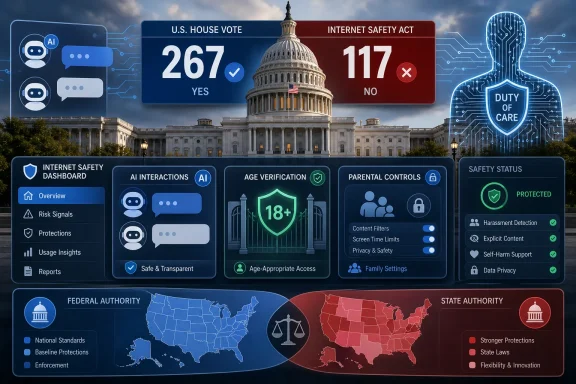
The U.S. House of Representatives voted 267-117 on June 29, 2026, to pass the Kids Internet and Digital Safety Act, a bipartisan online child-safety package that now heads to the Senate amid disputes over platform liability, state authority, AI chatbot safeguards, and age-verification rules. The vote is real, the margin is large, and the political symbolism is obvious. But the harder truth is that Congress has not suddenly solved online child safety; it has moved the fight from whether Washington should act to what kind of internet Washington is willing to regulate.
The distinction matters because this is not simply “KOSA passes the House,” even if that shorthand is already spreading. The House package borrows from years of Kids Online Safety Act debate, folds in chatbot and privacy provisions, and tries to reconcile child-protection politics with the tech industry’s demand for a predictable national rulebook. That makes the bill important not because it is destined to become law unchanged, but because it shows where the next phase of platform regulation is headed: toward design duties, age signals, AI disclosures, and a renewed argument over whether states or Washington should set the rules.
For more than a decade, Congress has been very good at yelling at technology companies and very bad at writing laws that survive contact with lobbyists, constitutional concerns, and the messy architecture of the modern web. Hearings have come and gone. CEOs have been scolded under bright lights. Lawmakers have discovered, rediscovered, and mispronounced the mechanics of algorithmic feeds.
The House vote breaks that pattern, at least procedurally. A 267-117 tally is not a narrow messaging vote designed only for campaign mailers. It is a broad enough margin to signal that online child safety has become one of the few technology issues where Republicans and Democrats can still find overlapping political incentives.
That does not mean they agree on the internet they want. Conservatives often frame the problem around parental control, pornography access, grooming, and perceived platform bias. Democrats more often emphasize addictive design, mental-health risks, data exploitation, and corporate accountability. Parents who have lost children after online harms have supplied the emotional pressure behind both camps.
The result is a bill that tries to be many things at once: a children’s privacy update, a platform-design bill, an AI chatbot warning label, and a federal-state compromise. That breadth is the source of its political strength. It is also why the Senate may treat the House product less as a finished bill than as an opening bid.
The Senate passed a kids’ online safety package in 2024 by an overwhelming 91-3 vote, but that earlier momentum did not translate into a signed law. The House has now moved its own package in 2026, and key Senate voices have already criticized it as weaker than the Senate approach. In other words, passage in one chamber is not the same as a clear path to the president’s desk.
The dispute centers partly on the familiar phrase duty of care. In platform regulation, that phrase carries enormous weight because it asks whether companies must merely provide tools and disclosures, or whether they must actively design products to avoid foreseeable harms to minors. Safety advocates generally prefer a stronger duty. Platforms and civil-liberties groups, for different reasons, worry that broad duties can become either litigation magnets or speech-policing mandates.
The House bill appears designed to thread that needle. It advertises stricter child-safety rules while attempting to avoid the most sweeping interpretations of platform responsibility. That compromise may be why it passed the House. It may also be why Senate supporters of a tougher KOSA are not ready to celebrate.
That is a notable shift in the online safety debate. Earlier rounds of children’s internet regulation focused on data collection, advertising, pornography access, and social media feeds. The chatbot provisions acknowledge a newer risk: software that does not merely recommend content to a teenager, but talks back in a synthetic approximation of intimacy, authority, or friendship.
This is where WindowsForum readers should pay attention beyond the culture-war framing. AI assistants are no longer fringe toys. Microsoft has put Copilot across Windows, Edge, Microsoft 365, Bing, and developer workflows. Google, Meta, OpenAI, Anthropic, Character.AI-style companion apps, and countless smaller vendors are all pushing conversational interfaces into ordinary consumer life.
A disclosure that “I am an AI, not a person” may sound modest, even obvious. But if enacted, it would mark a federal recognition that the humanlike presentation of AI is not just a UX choice. For minors, Congress is treating it as a safety variable.
The harder question is whether disclosure is enough. A chatbot can tell a user it is not human and still simulate emotional availability, offer bad advice, intensify a vulnerable user’s fixation, or steer a conversation in ways its operator did not anticipate. The bill’s disclosure mandate is therefore best understood as a floor, not a solution. It may make deception harder to defend, but it will not make synthetic companionship safe by itself.
The technical and privacy consequences are significant. Age verification is easy to demand in a hearing and hard to implement without creating new risks. A platform can ask for a government ID, rely on third-party verification, estimate age from behavior or biometrics, use credit-card signals, or require device-level parental controls. Every path has trade-offs.
For users, the obvious concern is privacy. A system built to keep children out of adult content can become a system that maps adults’ lawful browsing habits to identity documents. A third-party verification market can reduce direct exposure to platforms, but it also creates new intermediaries holding sensitive signals. A privacy-preserving token model may be better, but it requires adoption, standards, and trust.
For administrators and endpoint managers, the issue is even broader. If federal law begins to normalize age-aware access, operating systems, browsers, app stores, identity providers, and family-management tools become more important policy enforcement points. Microsoft Family Safety, Apple Screen Time, Google Family Link, school-managed Chromebooks, and mobile device management platforms could all become part of a larger compliance ecosystem, even if the statute formally regulates online services rather than operating systems.
That is why age verification is not just about adult websites. It is about whether the web remains primarily session-based and pseudonymous, or whether more services begin requiring identity-adjacent assertions before they show content, enable messaging, or personalize feeds.
That creates an obvious collision. A federal child-safety bill can either set a national floor, allowing states to go further, or it can preempt state laws and create a single national ceiling. Supporters of state experimentation argue that states have been forced to act because Congress spent years doing nothing. Platforms argue that inconsistent state requirements can fragment online services and create compliance chaos.
The House compromise tries to present itself as preserving room for stronger state action. Critics are not convinced. They worry that the details could make it harder to bring certain lawsuits or enforce state-level duties against platform design features.
This is not an academic dispute. If California, Texas, Florida, New York, and Utah all build different online child-safety regimes, large platforms will either implement the strictest common denominator nationwide or build geographically segmented compliance systems. Smaller platforms may simply block features, restrict minors broadly, or exit certain markets. A federal law that truly harmonizes obligations would be valuable. A federal law that quietly weakens stronger state protections would be a very different bargain.
That shift is why platform companies care so much about the precise wording of these bills. If the law only requires parental dashboards, reporting channels, and public policies, companies can build compliance pages and move on. If the law reaches recommender systems, default settings, engagement loops, and product architecture, the compliance burden becomes operational rather than cosmetic.
The House package gestures toward that deeper layer. It is concerned with content delivery, parental oversight, privacy, chatbot behavior, and minors’ interactions with platform features. Whether it truly forces design changes will depend on the final statutory language, agency rulemaking, and litigation.
The likely near-term result is not a cleaner internet. It is more documentation, more product review, more risk scoring, and more lawyer-driven design meetings. That may sound cynical, but it is also how regulation becomes real. Seatbelts, privacy notices, accessibility requirements, breach reporting, and financial compliance all began as a mix of engineering, paperwork, and institutional fear.
For users, the visible changes may be uneven. Some services may add age prompts, parental controls, warning labels, or chatbot disclaimers. Others may disable features for younger users. Still others may decide that verifying youth status is too risky and instead require stronger identity signals from everyone.
Civil-liberties groups have long warned that broad online safety duties may encourage over-removal. If a company faces liability for exposing minors to vaguely defined harmful material, the safe corporate response may be to restrict discussions of mental health, sexuality, eating disorders, substance use, political extremism, or other sensitive topics. Some of that content may be dangerous in certain contexts. Some may be educational, supportive, or lifesaving.
This is where the design-versus-content distinction becomes legally important. A law focused on privacy, default settings, deceptive design, age-appropriate controls, and transparency has a better chance of surviving scrutiny than a law that effectively tells platforms which lawful ideas minors may see. But the boundary is not clean. Recommendation systems are both design and speech distribution.
Age verification also raises speech concerns. If adults must identify themselves to access lawful content, courts may ask whether the burden is too high. If minors are blocked from broad categories of material, courts may ask whether the law is narrowly tailored. Recent litigation around state laws shows that this terrain remains unstable.
The House vote does not settle that constitutional fight. It ensures that the fight will continue under greater political pressure, with child safety on one side and speech, privacy, and anonymity on the other.
Microsoft sits in several of those lanes at once. Windows is not a social network, but Windows is a gateway to browsers, apps, games, search, AI assistants, identity accounts, and family controls. Xbox is a youth-facing community. Edge and Bing touch content discovery. Copilot makes the AI disclosure issue immediate. Microsoft 365 and school deployments connect the company to minors through education and family environments.
If federal law requires clear AI disclosures to minors, Microsoft is unlikely to struggle with the basic label. The company already brands Copilot as an assistant and has incentives to present AI interactions transparently. The harder compliance problem is contextual: knowing when the user is a minor, when the interaction falls within covered use, and when crisis-related safeguards must trigger.
That puts identity and account management back in the spotlight. A signed-in Microsoft account with family settings can carry age-related signals. A local Windows account, shared household PC, school-managed device, or browser session may not. If law and product design increasingly depend on knowing whether a user is under 18, the operating environment becomes part of the policy problem.
For enterprise IT, the impact is indirect but real. Corporate administrators may not be managing children’s accounts, but they will inherit vendor changes made for compliance. Browser policies, AI assistant defaults, content filtering, identity federation, audit logs, and data-retention settings can all shift when platform vendors redesign products for regulated markets.
That does not mean Congress should do nothing. “Regulation helps incumbents” is a useful warning, not a veto. But if lawmakers write obligations that are vague, expensive, or dependent on enterprise-scale trust-and-safety operations, they may harden the dominance of the very companies they criticize.
The best version of a federal child-safety law would distinguish between high-risk, high-scale platforms and smaller services with limited reach. It would set clear duties, provide safe harbors for good-faith compliance, and avoid forcing every website operator to become an identity-verification shop. The worst version would produce a brittle compliance regime where only giants can afford to participate.
WindowsForum itself is a useful mental model. Community sites are not TikTok, but they still host user-generated content, accounts, private messages, moderation decisions, and occasionally minors. A law written with trillion-dollar platforms in mind can still splash onto smaller communities if definitions are broad enough.
That is why the Senate debate matters. The final bill must decide whether it is regulating surveillance advertising giants, algorithmic social networks, AI companion services, adult content providers, or nearly every interactive service on the web. Those are not the same target.
There is value in that approach. Many parents genuinely do not know what their children’s apps are doing. Default settings can be hostile to family oversight. Platforms often make it easier to sign up than to understand what data is collected, what strangers can send, or how recommendation systems behave.
But parental controls have limits. Not every child has an engaged, technically capable, or safe parent. Not every risk is visible from a dashboard. A teen in crisis may not be protected by a setting buried three menus deep. A predator, scammer, or manipulative chatbot does not become harmless because a parent received a weekly email.
There is also a class divide in “parental empowerment” rhetoric. Families with time, devices, literacy, stable housing, and technical confidence are better positioned to use controls. Families under stress may get more prompts, more warnings, and more blame without receiving meaningful protection.
The better policy question is not whether parents should have tools. They should. The question is whether those tools are being used as a substitute for platform accountability. If the final law lets companies shift responsibility to parents while preserving the engagement systems that create risk, Congress will have mistaken interface design for reform.
Senators who backed earlier KOSA language are likely to push for stronger duties. House negotiators will defend their compromise as more passable and more legally durable. The White House, industry groups, child-safety advocates, state officials, civil-liberties organizations, and parent groups will all try to shape the final text.
The calendar matters. Congress can pass major technology legislation quickly when leadership wants it, but online safety has a long record of near-misses. The closer a bill gets to becoming real, the more every affected group studies the verbs, definitions, exceptions, and preemption clauses.
If the Senate substantially rewrites the House package, the chambers will need reconciliation. If leadership attaches the measure to a larger vehicle, online child safety could become part of a bigger negotiation over AI rules, defense policy, appropriations, or year-end legislation. That kind of bundling can get bills enacted. It can also bury controversial compromises in must-pass text.
The most likely outcome is not a clean victory lap. It is a messy negotiation in which everyone claims to support children, while fighting over liability, speech, privacy, state power, and money.
The distinction matters because this is not simply “KOSA passes the House,” even if that shorthand is already spreading. The House package borrows from years of Kids Online Safety Act debate, folds in chatbot and privacy provisions, and tries to reconcile child-protection politics with the tech industry’s demand for a predictable national rulebook. That makes the bill important not because it is destined to become law unchanged, but because it shows where the next phase of platform regulation is headed: toward design duties, age signals, AI disclosures, and a renewed argument over whether states or Washington should set the rules.
 Congress Finally Finds a Tech Fight It Can Vote On
For more than a decade, Congress has been very good at yelling at technology companies and very bad at writing laws that survive contact with lobbyists, constitutional concerns, and the messy architecture of the modern web. Hearings have come and gone. CEOs have been scolded under bright lights. Lawmakers have discovered, rediscovered, and mispronounced the mechanics of algorithmic feeds.The House vote breaks that pattern, at least procedurally. A 267-117 tally is not a narrow messaging vote designed only for campaign mailers. It is a broad enough margin to signal that online child safety has become one of the few technology issues where Republicans and Democrats can still find overlapping political incentives.
That does not mean they agree on the internet they want. Conservatives often frame the problem around parental control, pornography access, grooming, and perceived platform bias. Democrats more often emphasize addictive design, mental-health risks, data exploitation, and corporate accountability. Parents who have lost children after online harms have supplied the emotional pressure behind both camps.
The result is a bill that tries to be many things at once: a children’s privacy update, a platform-design bill, an AI chatbot warning label, and a federal-state compromise. That breadth is the source of its political strength. It is also why the Senate may treat the House product less as a finished bill than as an opening bid.
The House Did Not Pass the Senate’s Dream Bill
The most important correction is also the simplest: the House passed the Kids Internet and Digital Safety Act, not the Senate’s preferred version of the Kids Online Safety Act as previously advanced. That may sound like legislative hair-splitting, but in tech policy the difference between two drafts can determine whether a law creates a genuine duty, a compliance checklist, or a liability shield.The Senate passed a kids’ online safety package in 2024 by an overwhelming 91-3 vote, but that earlier momentum did not translate into a signed law. The House has now moved its own package in 2026, and key Senate voices have already criticized it as weaker than the Senate approach. In other words, passage in one chamber is not the same as a clear path to the president’s desk.
The dispute centers partly on the familiar phrase duty of care. In platform regulation, that phrase carries enormous weight because it asks whether companies must merely provide tools and disclosures, or whether they must actively design products to avoid foreseeable harms to minors. Safety advocates generally prefer a stronger duty. Platforms and civil-liberties groups, for different reasons, worry that broad duties can become either litigation magnets or speech-policing mandates.
The House bill appears designed to thread that needle. It advertises stricter child-safety rules while attempting to avoid the most sweeping interpretations of platform responsibility. That compromise may be why it passed the House. It may also be why Senate supporters of a tougher KOSA are not ready to celebrate.
The Chatbot Disclosure Rule Is the Bill’s Most 2026 Idea
The most obviously modern part of the package is its treatment of AI chatbots. The bill would require chatbots to disclose that they are not human, with special concern for interactions involving minors. It also includes safety-oriented provisions around crisis situations, including prompts related to suicide or self-harm.That is a notable shift in the online safety debate. Earlier rounds of children’s internet regulation focused on data collection, advertising, pornography access, and social media feeds. The chatbot provisions acknowledge a newer risk: software that does not merely recommend content to a teenager, but talks back in a synthetic approximation of intimacy, authority, or friendship.
This is where WindowsForum readers should pay attention beyond the culture-war framing. AI assistants are no longer fringe toys. Microsoft has put Copilot across Windows, Edge, Microsoft 365, Bing, and developer workflows. Google, Meta, OpenAI, Anthropic, Character.AI-style companion apps, and countless smaller vendors are all pushing conversational interfaces into ordinary consumer life.
A disclosure that “I am an AI, not a person” may sound modest, even obvious. But if enacted, it would mark a federal recognition that the humanlike presentation of AI is not just a UX choice. For minors, Congress is treating it as a safety variable.
The harder question is whether disclosure is enough. A chatbot can tell a user it is not human and still simulate emotional availability, offer bad advice, intensify a vulnerable user’s fixation, or steer a conversation in ways its operator did not anticipate. The bill’s disclosure mandate is therefore best understood as a floor, not a solution. It may make deception harder to defend, but it will not make synthetic companionship safe by itself.
Age Verification Moves From Adult Sites to the Wider Stack
The bill’s age-verification provisions are another sign that lawmakers are moving away from the old internet assumption that users are simply anonymous adults unless proven otherwise. For certain categories of content, especially pornography, the House package would push platforms toward stronger checks before granting access. That aligns with a wave of state laws already forcing adult sites and platforms to confront age gates.The technical and privacy consequences are significant. Age verification is easy to demand in a hearing and hard to implement without creating new risks. A platform can ask for a government ID, rely on third-party verification, estimate age from behavior or biometrics, use credit-card signals, or require device-level parental controls. Every path has trade-offs.
For users, the obvious concern is privacy. A system built to keep children out of adult content can become a system that maps adults’ lawful browsing habits to identity documents. A third-party verification market can reduce direct exposure to platforms, but it also creates new intermediaries holding sensitive signals. A privacy-preserving token model may be better, but it requires adoption, standards, and trust.
For administrators and endpoint managers, the issue is even broader. If federal law begins to normalize age-aware access, operating systems, browsers, app stores, identity providers, and family-management tools become more important policy enforcement points. Microsoft Family Safety, Apple Screen Time, Google Family Link, school-managed Chromebooks, and mobile device management platforms could all become part of a larger compliance ecosystem, even if the statute formally regulates online services rather than operating systems.
That is why age verification is not just about adult websites. It is about whether the web remains primarily session-based and pseudonymous, or whether more services begin requiring identity-adjacent assertions before they show content, enable messaging, or personalize feeds.
State Power Is the Fight Hiding Inside the Child-Safety Pitch
The House bill’s treatment of state authority may be the most consequential part of the package, even if it is less emotionally charged than chatbot harms or teen mental health. The United States already has a fast-growing patchwork of state online-safety, privacy, social media, and age-verification laws. Some states want stricter rules than Washington. The tech industry wants fewer conflicting obligations.That creates an obvious collision. A federal child-safety bill can either set a national floor, allowing states to go further, or it can preempt state laws and create a single national ceiling. Supporters of state experimentation argue that states have been forced to act because Congress spent years doing nothing. Platforms argue that inconsistent state requirements can fragment online services and create compliance chaos.
The House compromise tries to present itself as preserving room for stronger state action. Critics are not convinced. They worry that the details could make it harder to bring certain lawsuits or enforce state-level duties against platform design features.
This is not an academic dispute. If California, Texas, Florida, New York, and Utah all build different online child-safety regimes, large platforms will either implement the strictest common denominator nationwide or build geographically segmented compliance systems. Smaller platforms may simply block features, restrict minors broadly, or exit certain markets. A federal law that truly harmonizes obligations would be valuable. A federal law that quietly weakens stronger state protections would be a very different bargain.
Platform Design Is Finally on Trial
The old model of internet regulation treated harmful content as the central problem. The new model increasingly treats harmful design as the target. Infinite scroll, autoplay, algorithmic amplification, ephemeral messaging, exploitative notifications, targeted advertising, and persuasive AI agents are no longer just product features. They are becoming potential evidence.That shift is why platform companies care so much about the precise wording of these bills. If the law only requires parental dashboards, reporting channels, and public policies, companies can build compliance pages and move on. If the law reaches recommender systems, default settings, engagement loops, and product architecture, the compliance burden becomes operational rather than cosmetic.
The House package gestures toward that deeper layer. It is concerned with content delivery, parental oversight, privacy, chatbot behavior, and minors’ interactions with platform features. Whether it truly forces design changes will depend on the final statutory language, agency rulemaking, and litigation.
The likely near-term result is not a cleaner internet. It is more documentation, more product review, more risk scoring, and more lawyer-driven design meetings. That may sound cynical, but it is also how regulation becomes real. Seatbelts, privacy notices, accessibility requirements, breach reporting, and financial compliance all began as a mix of engineering, paperwork, and institutional fear.
For users, the visible changes may be uneven. Some services may add age prompts, parental controls, warning labels, or chatbot disclaimers. Others may disable features for younger users. Still others may decide that verifying youth status is too risky and instead require stronger identity signals from everyone.
The Free-Speech Objection Has Not Gone Away
Any serious child-safety bill involving online platforms immediately runs into the First Amendment. The problem is not that children have no safety interests. The problem is that laws aimed at harmful content can easily become laws that pressure platforms to suppress lawful speech.Civil-liberties groups have long warned that broad online safety duties may encourage over-removal. If a company faces liability for exposing minors to vaguely defined harmful material, the safe corporate response may be to restrict discussions of mental health, sexuality, eating disorders, substance use, political extremism, or other sensitive topics. Some of that content may be dangerous in certain contexts. Some may be educational, supportive, or lifesaving.
This is where the design-versus-content distinction becomes legally important. A law focused on privacy, default settings, deceptive design, age-appropriate controls, and transparency has a better chance of surviving scrutiny than a law that effectively tells platforms which lawful ideas minors may see. But the boundary is not clean. Recommendation systems are both design and speech distribution.
Age verification also raises speech concerns. If adults must identify themselves to access lawful content, courts may ask whether the burden is too high. If minors are blocked from broad categories of material, courts may ask whether the law is narrowly tailored. Recent litigation around state laws shows that this terrain remains unstable.
The House vote does not settle that constitutional fight. It ensures that the fight will continue under greater political pressure, with child safety on one side and speech, privacy, and anonymity on the other.
Microsoft and the Windows Ecosystem Will Not Be Spectators
It is tempting to read this legislation as a Meta, TikTok, Snap, YouTube, Discord, and adult-site problem. That is too narrow. Any major company providing online services to minors, AI chat interfaces, app distribution, identity infrastructure, cloud tools, gaming communities, or advertising systems has reason to watch the bill closely.Microsoft sits in several of those lanes at once. Windows is not a social network, but Windows is a gateway to browsers, apps, games, search, AI assistants, identity accounts, and family controls. Xbox is a youth-facing community. Edge and Bing touch content discovery. Copilot makes the AI disclosure issue immediate. Microsoft 365 and school deployments connect the company to minors through education and family environments.
If federal law requires clear AI disclosures to minors, Microsoft is unlikely to struggle with the basic label. The company already brands Copilot as an assistant and has incentives to present AI interactions transparently. The harder compliance problem is contextual: knowing when the user is a minor, when the interaction falls within covered use, and when crisis-related safeguards must trigger.
That puts identity and account management back in the spotlight. A signed-in Microsoft account with family settings can carry age-related signals. A local Windows account, shared household PC, school-managed device, or browser session may not. If law and product design increasingly depend on knowing whether a user is under 18, the operating environment becomes part of the policy problem.
For enterprise IT, the impact is indirect but real. Corporate administrators may not be managing children’s accounts, but they will inherit vendor changes made for compliance. Browser policies, AI assistant defaults, content filtering, identity federation, audit logs, and data-retention settings can all shift when platform vendors redesign products for regulated markets.
Compliance Will Reward the Giants It Claims to Discipline
One uncomfortable truth about sweeping internet regulation is that the biggest platforms are often best equipped to survive it. Meta, Google, Microsoft, Apple, Amazon, and ByteDance can hire compliance teams, build age-assurance systems, create transparency reports, run safety reviews, and absorb litigation. A small forum, indie app, game server, education startup, or open-source community may not.That does not mean Congress should do nothing. “Regulation helps incumbents” is a useful warning, not a veto. But if lawmakers write obligations that are vague, expensive, or dependent on enterprise-scale trust-and-safety operations, they may harden the dominance of the very companies they criticize.
The best version of a federal child-safety law would distinguish between high-risk, high-scale platforms and smaller services with limited reach. It would set clear duties, provide safe harbors for good-faith compliance, and avoid forcing every website operator to become an identity-verification shop. The worst version would produce a brittle compliance regime where only giants can afford to participate.
WindowsForum itself is a useful mental model. Community sites are not TikTok, but they still host user-generated content, accounts, private messages, moderation decisions, and occasionally minors. A law written with trillion-dollar platforms in mind can still splash onto smaller communities if definitions are broad enough.
That is why the Senate debate matters. The final bill must decide whether it is regulating surveillance advertising giants, algorithmic social networks, AI companion services, adult content providers, or nearly every interactive service on the web. Those are not the same target.
Parents Want Control, But Control Is Not the Same as Safety
Parental-control tools are politically attractive because they promise empowerment without requiring the government to make every judgment directly. Give parents dashboards, labels, settings, reports, and consent flows, and the state can say it has strengthened families rather than censored the web.There is value in that approach. Many parents genuinely do not know what their children’s apps are doing. Default settings can be hostile to family oversight. Platforms often make it easier to sign up than to understand what data is collected, what strangers can send, or how recommendation systems behave.
But parental controls have limits. Not every child has an engaged, technically capable, or safe parent. Not every risk is visible from a dashboard. A teen in crisis may not be protected by a setting buried three menus deep. A predator, scammer, or manipulative chatbot does not become harmless because a parent received a weekly email.
There is also a class divide in “parental empowerment” rhetoric. Families with time, devices, literacy, stable housing, and technical confidence are better positioned to use controls. Families under stress may get more prompts, more warnings, and more blame without receiving meaningful protection.
The better policy question is not whether parents should have tools. They should. The question is whether those tools are being used as a substitute for platform accountability. If the final law lets companies shift responsibility to parents while preserving the engagement systems that create risk, Congress will have mistaken interface design for reform.
The Senate Now Holds the Real Bill
The House vote creates momentum, but the Senate will decide whether this becomes law, stalls again, or mutates into a broader bargain involving AI preemption and other technology priorities. That is the phase where the public branding of “protecting kids online” becomes less useful than the legislative machinery underneath.Senators who backed earlier KOSA language are likely to push for stronger duties. House negotiators will defend their compromise as more passable and more legally durable. The White House, industry groups, child-safety advocates, state officials, civil-liberties organizations, and parent groups will all try to shape the final text.
The calendar matters. Congress can pass major technology legislation quickly when leadership wants it, but online safety has a long record of near-misses. The closer a bill gets to becoming real, the more every affected group studies the verbs, definitions, exceptions, and preemption clauses.
If the Senate substantially rewrites the House package, the chambers will need reconciliation. If leadership attaches the measure to a larger vehicle, online child safety could become part of a bigger negotiation over AI rules, defense policy, appropriations, or year-end legislation. That kind of bundling can get bills enacted. It can also bury controversial compromises in must-pass text.
The most likely outcome is not a clean victory lap. It is a messy negotiation in which everyone claims to support children, while fighting over liability, speech, privacy, state power, and money.
The Vote Reveals the Internet Washington Is Trying to Build
The concrete lesson from the House vote is that online child safety has moved from hearing-room outrage to statutory design, but the final architecture remains unsettled.- The House passed the Kids Internet and Digital Safety Act on June 29, 2026, by a 267-117 vote, sending the package to the Senate rather than making it law.
- The bill is related to the broader Kids Online Safety Act debate, but it is not identical to the stronger Senate-backed approach that previously drew overwhelming support.
- AI chatbot disclosure is now a federal legislative priority, especially where minors may mistake synthetic systems for human companions or trusted advisers.
- Age verification is expanding from a pornography-access issue into a broader infrastructure debate about identity, privacy, browsers, app stores, and platform compliance.
- The biggest unresolved fight is whether federal law will preserve stronger state rules or quietly narrow the paths states and families can use to hold platforms accountable.
- Windows users and IT administrators may feel the effects through browsers, AI assistants, family accounts, school devices, gaming services, identity systems, and vendor default settings.
References
- Primary source: Türkiye Today
Published: 2026-06-30T08:50:20.117227
US House votes to hold platforms accountable for online child safety - Türkiye Today
US House passes Kids Online Safety Act 267 to 117, sending bill to Senate for reviewwww.turkiyetoday.com - Related coverage: axios.com
House vote sets up Senate clash over kids' online safety
The House passed the KIDS Act, but key senators say the legislation has little chance of advancing in its current form.www.axios.com
- Related coverage: aa.com.tr
US House passes bipartisan online child safety bill
Kids Online Safety Act advances on 267-117 vote as Senate divisions cloud prospects | Anadoluwww.aa.com.tr - Related coverage: pallone.house.gov
Pallone Celebrates House Passage of Bipartisan KIDS Act to Protect Kids Online
WASHINGTON – After months of negotiation, Congressman Frank Pallone, Jr. (D-NJ) celebrated House passage of bipartisan legislation he co-authored to protect kids and teens online and rein in Big Tech. Pallone negotiated the bipartisan agreement on the Kids Internet and Digital Safety (KIDS) Act...pallone.house.gov
- Related coverage: investing.com
US House passes youth online safety legislation By Reuters
US House passes youth online safety legislationwww.investing.com - Related coverage: commerce.senate.gov
Cantwell, Blumenthal, Parents Raise the Alarm About Weak KIDS Act Heading to House Vote Next Week - U.S. Senate Committee on Commerce, Science, & Transportation
U.S. Senator Maria Cantwell (D-Wash.) Ranking Member of the Senate Commerce, Science and Transportation Committee and Senator Richard Blumenthal (D-Conn.), author of the Senate Kids Online Safety Act (KOSA) were joined today by families who have suffered devastating losses due to their... www.commerce.senate.gov
- Related coverage: mlex.com
US House passes KIDS Act, teeing up Senate vote | MLex | Specialist news and analysis on legal risk and regulation
The US House passed the Kids Internet and Digital Safety Act by a 267-117 vote Monday.www.mlex.com - Related coverage: foushee.house.gov
Reps. Foushee, Moore Introduce Bipartisan Bill Protecting Children from AI Companion Chatbots | U.S. Congresswoman Valerie Foushee
The Official U.S. Congressional website of Congresswoman Valerie Fousheefoushee.house.gov - Related coverage: republicans-energycommerce.house.gov
E&C Leaders Celebrate House Passage of KIDS Act
The Committee on Energy and Commerce is the oldest standing legislative committee in the U.S. House of Representatives and is vested with the broadest jurisdiction of any congressional authorizing committee.republicans-energycommerce.house.gov - Related coverage: trahan.house.gov
- Related coverage: houchin.house.gov
Houchin Bills to Protect Children from AI Dangers Pass Energy & Commerce Committee
WASHINGTON, D.C. — Yesterday, the House Energy and Commerce Committee passed H.R. 7757, the Kids Internet and Digital Safety (KIDS) Act, a sweeping legislative package to protect children online. Included in the legislation are two bills authored by Congresswoman Erin Houchin (IN-09): the AI...houchin.house.gov
- Related coverage: clerk.house.gov
Office of the Clerk, U.S. House of Representatives
VOTE QUESTION: On Motion to Suspend the Rules and Pass, as Amended, DESCRIPTION: KIDS Act, VOTE TYPE: 2/3 Yea-And-Nay, STATUS: Passedclerk.house.gov - Related coverage: rollcall.com
Kids bill faces uncertainty after House passage – Roll Call
Online safety legislation focused on children and teens that has come under fire from key senators passed the House Monday, setting the stage for continued wrangling as Congress seeks to address concerns raised by parent and free speech groups. The bipartisan legislation, which Energy and...rollcall.com
- Related coverage: ground.news
House passes kids online safety package despite watchdog pushback
The House passed a sprawling package of kids online safety bills Monday night, marking the first time a version of the landmark Kids Online Safety Act (KOSA) made it out of the lower chamber.%22 d=%22M44,140.1h42.8V272H54.9c0-0.1,0-103.8,0-103.8H44V140.1z M44,1c28.4,0,42.6,16.2,42.6,42.2v66.1H54.9V43.8 c0-7.2-3.1-11.7-10.6-11.7c-7,0-10.6,4.2-10.6,11.7c0,0,0,228.1,0,228.2H0.2c0-0.5,0-228.8,0-228.8C0.1,16.8,14.8,1,44,1L44,1z%22/><style>path { fill: %23262626 } @media (prefers-color-scheme: dark) { path { fill: %23EEEFE9 } }</style></svg>) ground.news
ground.news
- Related coverage: docs.house.gov
